Exploring Ethical Concerns: AI, Robotics, and the Future of Work

Verified

Added on  2021/06/18

|7
|1612
|70
Essay
AI Summary
This essay analyzes the ethical implications of increasing automation and the deployment of robotics in the workplace, focusing on the case study of AI and robots potentially taking over human jobs. It discusses ICT ethical issues such as professional ethics, privacy, security, cyber-crime, intellectual property, internet regulation, social inclusion, community identity, and pervasive computing. Classical ethical theories like Utilitarianism, Deontology, Virtue Theory, and Contract Theory are applied to evaluate the psychological and social impacts on employees and customers. The essay concludes that the complexity of human-computer interaction and the threat to job security can negatively affect the financial condition of enterprises and the moral principles of employees.

Document Page
Topic In Ethics
tabler-icon-diamond-filled.svg

Paraphrase This Document

Need a fresh take? Get an instant paraphrase of this document with our AI Paraphraser
Document Page
Contents
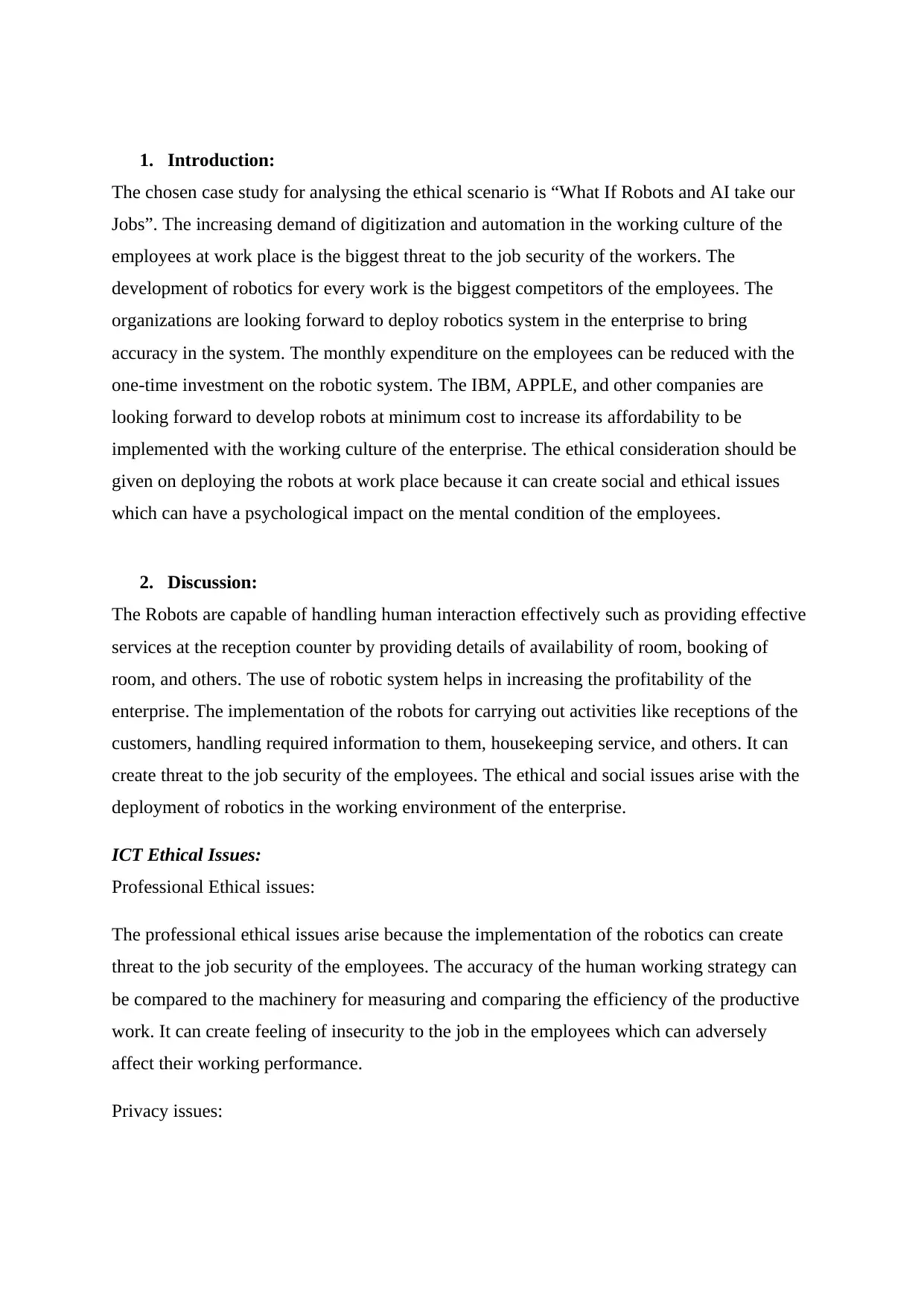
1. Introduction:..................................................................................................................................2
2. Discussion:....................................................................................................................................2
ICT Ethical Issues:............................................................................................................................2
Classical ethical Theories..................................................................................................................4
3. Conclusion.....................................................................................................................................5
4. References.....................................................................................................................................5
Document Page
1. Introduction:
The chosen case study for analysing the ethical scenario is “What If Robots and AI take our
Jobs”. The increasing demand of digitization and automation in the working culture of the
employees at work place is the biggest threat to the job security of the workers. The
development of robotics for every work is the biggest competitors of the employees. The
organizations are looking forward to deploy robotics system in the enterprise to bring
accuracy in the system. The monthly expenditure on the employees can be reduced with the
one-time investment on the robotic system. The IBM, APPLE, and other companies are
looking forward to develop robots at minimum cost to increase its affordability to be
implemented with the working culture of the enterprise. The ethical consideration should be
given on deploying the robots at work place because it can create social and ethical issues
which can have a psychological impact on the mental condition of the employees.
2. Discussion:
The Robots are capable of handling human interaction effectively such as providing effective
services at the reception counter by providing details of availability of room, booking of
room, and others. The use of robotic system helps in increasing the profitability of the
enterprise. The implementation of the robots for carrying out activities like receptions of the
customers, handling required information to them, housekeeping service, and others. It can
create threat to the job security of the employees. The ethical and social issues arise with the
deployment of robotics in the working environment of the enterprise.
ICT Ethical Issues:
Professional Ethical issues:
The professional ethical issues arise because the implementation of the robotics can create
threat to the job security of the employees. The accuracy of the human working strategy can
be compared to the machinery for measuring and comparing the efficiency of the productive
work. It can create feeling of insecurity to the job in the employees which can adversely
affect their working performance.
Privacy issues:
Document Page
The deployment of the robotics can create the threat to the privacy disclosure of the
information working plan. It is the unethical activity for disclosing the business plan of the
enterprise to the third party due to the leakage of information from the robotic system.
Security issues:
The inclusion of the robotic system in the working culture of the environment raises the
issues of using high parameters of security procedures because inefficiency of the security in
the robotics can result into the leakages of the company databases to the third party (Berler,
and Poullet, 2015). The confidential information of the organization and the customers can b
leaked to the third party which can adversely affect the working of the enterprise.
Cyber-crime issues:
The manipulation and the modification of the information stored in the database can disrupt
harmed the image and reputation of the company. The inaccuracy in the information can
create a problematic situation for the robotic system to handle the situation because the robots
are not able to analyse the inaccuracy of the information (Lang, Macfadyen, Slade, Prinsloo,
and Sclater, 2013). The robots are not able to judge the correctness of the information.
Intellectual property issues
The loss of the intellectual property can occurs due by developing copyrights of the
organization information without the permission of the project owner. It can adversely affect
the reputation and the good will of the enterprise (Leonard, 2018). The hacker can retrieve
the information from the robotic system by getting unauthorised access of the information to
the confidential information of the company database.
Internet Regulation issues:
The changes in the regulatory framework of the internet can affect the working of the robots
to give accurate result to provide quality of service to the customers.
Social Inclusion issues
It is difficult to manage human computer interaction at the work place. The customers and the
employees are not feeling comfortable to retrieve the information from the robots. It can
create social issues. The ineffective bonding can be the result of human computer interaction
which can adversely affect the growth of the company (Hussain, 2011).
tabler-icon-diamond-filled.svg

Paraphrase This Document

Need a fresh take? Get an instant paraphrase of this document with our AI Paraphraser
Document Page
Community and identity issues
The unauthorised accessing of the customer account can create the problem of identity issues
because the robots are not effective in analysing the correct person and can provides the
authentication to the wrong person (Christian, 2017).
Pervasive and convergent computing issues
The connection between the cyber world and the physical world is the problematic scenario
for managing human computer interaction. It is difficult to manage communication between
different departments of the organization.
Classical ethical Theories
Utilitarian Theory
The implementation of the robots can affect the sentiments and emotional attitude towards
the bonding of employees and customers with the organization. The utilization of robotics
bring accuracy in the working environment of the enterprise but adversely affect the bonding
with the customers and employees (PressReader, 2017).
Deontology Theory
The working employees can commit suicide, suffered from mental illness, change in attitude
and behaviour, and others due to the threat of job loss with the implementation of robots in
the business curriculum. The feeling of threat arises with the matching accuracy of the
machinery in the employees. The employees face difficulty in handling tasks and
communication with the employed robots at work place. The threat to the job security can
affect the moral principles of the employees. They can choose the path of generating wrong
income for their livelihood (Singh, 2015). The employees can changes the path of following
their moral principles due to the negative impact of automation with the use of robotics.
Virtue Theory
The virtue theory focuses on the psychological behaviour of the employees with the
deployment of the robotics in the working culture of the environment. The feeling of
insecurity and imperfection in the working employees takes place which can affect the
productivity and capabilities of the employees (Gillman, 2013). The use of robotics can
create a psychological impact on the customers and the employees. The customers are also
Document Page
not able to communicate effectively with the robots at work place which can decline the
economic status of the company.
Contract Theory
The bonding between the customers and employees with the organization culture can
negatively affect with the involvement of robotics at the work place. The profitability of the
organization can decline due to the poor communication between the human computer
interactions. The social ethical issues arise with managing communication with the robots.
The different dialects of the language are the major concern for maintaining effective
relationship between the computer and the human (Giorgini, Mecca. Gibson, Medeiros,
Mumford, Connelly, and Devenport, 2015). The valuable framework of communication with
the customers can negatively affected by the implementation of the robots.
3. Conclusion
It can be concluded that the ethical issues arises with the deployment and implementation of
the robots at work place because the complexity in managing human computer interaction
can affect the operational working plan of the organization which have a direct impact on the
declination in the financial and economic condition of the enterprise. The threat to the job
security can affect the moral principles of the employees. They can choose the path of
generating wrong income for their livelihood.
4. References
Berler, J., and Poullet, Y. (2015). What Governance and regulations for the internet? Ethical
Issues. 1st ed. Retrieved from https://link.springer.com/chapter/10.1007/0-387-
31168-8_11
Christians, C. (2017). Ethical theories in communication research. 1st ed. Retrieved from
https://www.tandfonline.com/doi/abs/10.1080/1461670052000328168?
journalCode=rjos20
Gilman, S. (2013). Ethics code and code of conduct as tools for promoting an ethical and
professional public service. 1st ed. Retrieved from
https://www.oecd.org/mena/governance/35521418.pdf
Document Page
Giorgini, V, Mecca. J., Gibson, C., Medeiros, K., Mumford, M., Connelly, S, and Devenport,
L. (2015). Researchers perception in ethical guidelines and codes of conduct. 1st ed.
Retrieved from https://www.ncbi.nlm.nih.gov/pmc/articles/PMC4313573/
Hussain, T. (2011). Are ethical and moral values are important for personality development.
1st ed. Retrieved from http://www.indiastudychannel.com/forum/75702-Are-ethical-
moral-values-important-for.aspx
Lang, C., Macfadyen, L., Slade, S., Prinsloo, P., and Sclater, N. (2013). The complexities of
developing a personal code of ethics for learning analytics practitioners. 1st ed.
Retrieved from http://oro.open.ac.uk/53751/7/Slade.pdf
Leonard, K. (2018). Workplace values and ethics. 1st ed. Retrieved from
http://smallbusiness.chron.com/workplace-values-ethics-4887.html
Press Reader. (2017). What if robots and AI takes our jobs. 1st ed. Retrieved from
http://www.pressreader.com/canada/waterloo-region-record/20170422/28175844917
2066
Singh, C. (2015). Importance of morals and ethics and values speech in our lives. 1st ed.
Retrieved from https://www.speakingtree.in/blog/importance-of-moral-ethics-values-
in-our-lives
chevron_up_icon
1 out of 7
circle_padding
hide_on_mobile
zoom_out_icon
[object Object]