Costing Methods: Comparative Analysis of Traditional and ABC Costing

Verified

Added on  2023/05/27

|10
|1966
|67
Report
AI Summary
This report provides a comprehensive comparison of traditional and Activity-Based Costing (ABC) methods. It begins by outlining the disadvantages of traditional costing, highlighting its limitations in providing non-financial information, its reliance on single overhead pools, and its inability to adapt to modern manufacturing environments. The report then contrasts traditional and ABC costing through a detailed example, illustrating how ABC allocates costs based on activities and cost drivers, leading to more accurate cost assignments. The analysis further explores the reasons for the shift from traditional to ABC costing, emphasizing the shortcomings of traditional methods in representing cost information and the influence of Cooper and Kaplan's work. The report concludes by examining the inability of traditional costing to account for product diversity, volume diversity, and product complexity, underscoring the need for the more refined and adaptable ABC approach in contemporary business environments.

Document Page
Running Head: COSTING 0
COSTING
tabler-icon-diamond-filled.svg

Paraphrase This Document

Need a fresh take? Get an instant paraphrase of this document with our AI Paraphraser
Document Page
COSTING 1
Table of Contents
Introduction................................................................................................................................2
Question 1..................................................................................................................................2
Question 2..................................................................................................................................3
Question 3..................................................................................................................................5
Question 4..................................................................................................................................6
Conclusion..................................................................................................................................6
References..................................................................................................................................8
Document Page
COSTING 2
Introduction
Traditional costing was the methods used by the organisations years ago and the move
towards the ABC costing was a much needed approach for the firms especially in case of the
manufacturing firms. This report discusses the issues faced by the traditional product costing
and why there was a need to change and modify the structure. The changes have also been
neutral as there is still some room for improvement. Further a detailed analysis has also been
carried out with the example to fetch the difference between the traditional costing and the
ABC costing (Vaysman and Mishra, 2011).
Question 1
Disadvantages of the Traditional product costing
There are many studies that can demonstrate the disadvantages of the traditional product
Costing system. Primarily the needs of the managers are not me today with the adoption of
the Traditional based costing method due to the following reasons.
The traditional costing system fails to provide the non-financial information regarding the
Small and the medium enterprises. The information that is provided in association with the
quality and the customer service is of trivial nature. Moreover the traditional based costing
system makes use of single overhead pool and is not directly attributable to the cost of the
product or as labour (Cheung, 2016). The expenses would for the category such as supply and
the maintenance, salary of the managers and depreciation on fixed assets. The only purpose
the traditional based costing serves is the identification of the indirect costs but the same are
not classified eventually. The traditional manufacturing is covers the routine process but
when the environment with the high technical aspects is encountered the traditional costing
system fails and the work of the labours decreased eventually. Therefore the costing of the
Document Page
COSTING 3
products that is based on the traditional method certainly imposes the tariff on the factory
overheads which is high. This increases the complexity of the transactions which
immediately distorts the system of costing. The accuracy under the system of the traditional
costing is lacks due to the presence of the detailed calculations and work and arbitrarily costs
are assigned instead of the allocation of the costs to a particular product. This method also
failed to assist the companies in justifying the manufacturing cycle time improvements.
Question 2
Twenty years ago, the cost structure of most of the companies was traditional system of
costing whereas in the later years the companies evolved and followed the ABC system of
costing. To find out the difference between the two methods the example has been created in
order to understand the difference between the two (Balakrishnan, Labro and Soderstrom,
2014).
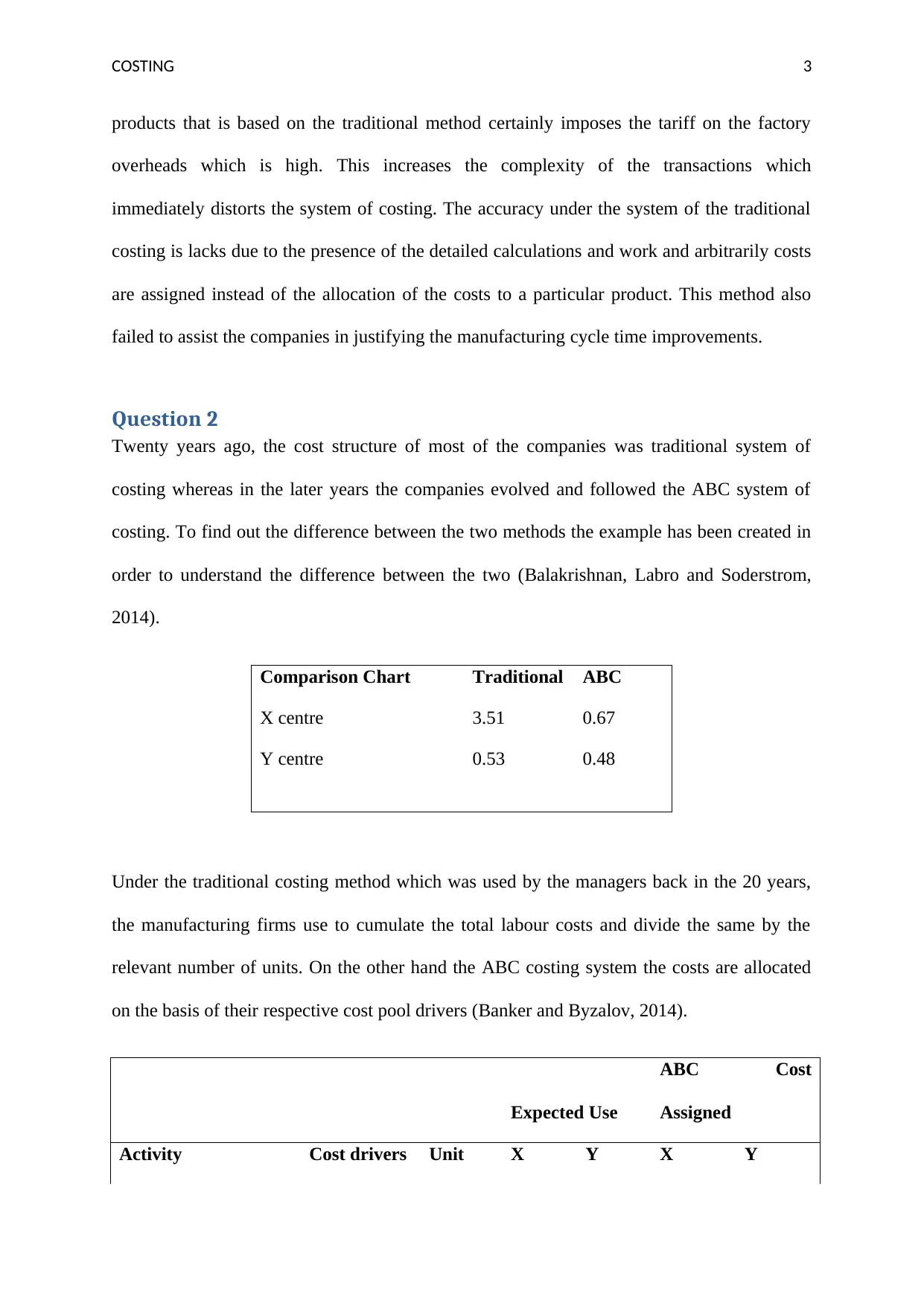
Comparison Chart Traditional ABC
X centre 3.51 0.67
Y centre 0.53 0.48
Under the traditional costing method which was used by the managers back in the 20 years,
the manufacturing firms use to cumulate the total labour costs and divide the same by the
relevant number of units. On the other hand the ABC costing system the costs are allocated
on the basis of their respective cost pool drivers (Banker and Byzalov, 2014).
Expected Use
ABC Cost
Assigned
Activity Cost drivers Unit X Y X Y
tabler-icon-diamond-filled.svg

Paraphrase This Document

Need a fresh take? Get an instant paraphrase of this document with our AI Paraphraser
Document Page
COSTING 4
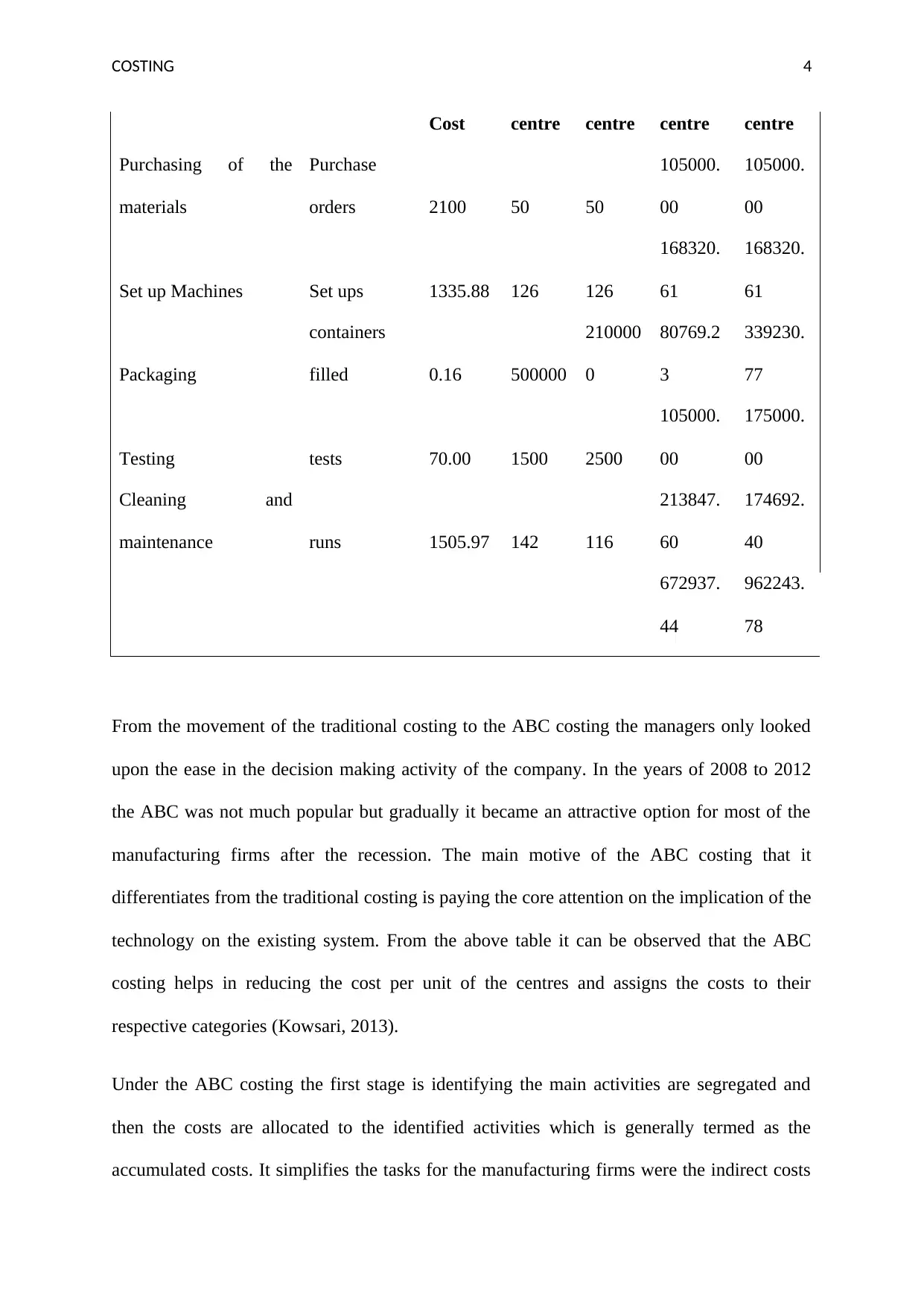
Cost centre centre centre centre
Purchasing of the
materials
Purchase
orders 2100 50 50
105000.
00
105000.
00
Set up Machines Set ups 1335.88 126 126
168320.
61
168320.
61
Packaging
containers
filled 0.16 500000
210000
0
80769.2
3
339230.
77
Testing tests 70.00 1500 2500
105000.
00
175000.
00
Cleaning and
maintenance runs 1505.97 142 116
213847.
60
174692.
40
672937.
44
962243.
78
From the movement of the traditional costing to the ABC costing the managers only looked
upon the ease in the decision making activity of the company. In the years of 2008 to 2012
the ABC was not much popular but gradually it became an attractive option for most of the
manufacturing firms after the recession. The main motive of the ABC costing that it
differentiates from the traditional costing is paying the core attention on the implication of the
technology on the existing system. From the above table it can be observed that the ABC
costing helps in reducing the cost per unit of the centres and assigns the costs to their
respective categories (Kowsari, 2013).
Under the ABC costing the first stage is identifying the main activities are segregated and
then the costs are allocated to the identified activities which is generally termed as the
accumulated costs. It simplifies the tasks for the manufacturing firms were the indirect costs
Document Page
COSTING 5
are enormous and also the large companies are the construction of variety of the costs. This
helps in calculating the complex transactions and removing the undervalued activities that are
not creating value for the customers. ABC costing helped the managers in getting the
knowledge of the original parameters that resulted in creation of the indirect factors and
invest the money on more potential activities from the sick activities (Hossain, 2015).
Question 3
The causes of the change in the cost structure were the certain limitations on part of the
traditional costing. These limitations were escalating with such a pace that the managers of
the company felt to change the system and save the costs to the company. Furthermore, the
lack of ability to represent the information of the costs differently was not found under the
traditional method of the costing. The costs domains were difficult to be segregated as the
common cost centres were utilised. Due to this reasons many manufacturing firms were
facing lot of difficulties and problems and therefore the managers decided to opt for the ABC
costing. Cooper and Kaplan along with Johnson in the year 1980 have an important role in
the determining the shortcomings of the traditional system. In response to the needs of the
production sector that faced the dissatisfaction reacted to the approach of the ABC Costing
(Soekardan, 2015).
Activity based Costing is the measure of the real activities happening on the daily basis
which the traditional basis of costing failed to compel with. Since the world evolved in terms
of the technology the methods have also been evolving. The change in the structure was
necessary as there was lack of transparency; it was not suitable for the purpose of banking
and failed to anticipate the necessary resources. Altogether it made the process slow and time
consuming and therefore once the technology invaded the requirement of the ABC costing
was necessary for the managers (Percevic, 2013).
Document Page
COSTING 6
Question 4
The traditional product costing cannot account for cost of the products diversity, volume
diversity and product complexity because traditional product costing fails to allocate the
resources differently. The failure arises when the traditional based costing presumes that the
cost is attached to the product and this holds true only for the few costs. When the managers
required the segmentation reporting the traditional based costing does not meet all the
criteria’s and hence the traditional product costing required some reformation in the systems
(Liu, Rhee and McLaren, 2018).
The operational performance was not increasing overall and the interdependencies were not
found easily. This system though is cost effective but yet with the changes in technology was
not fitting best with the requirements of the company. Moreover, it was not just the needs of
the companies the overall market pricing was again the greater issue. When compared to the
ABC costing the volume diversity was the issue that the labours were not aware and as soon
as the mechanical of the technical work accelerated the ABC approach was found to be the
better option in terms of the accessibility and the accuracy. The capacity constraint was the
hurdle the traditional based costing method was suffering (Haddadi, 2015).
There are some products that are complex in nature and the measurement or the allocation of
costs under the traditional based costing systems was difficult to figure out. The dilemma
arises when there was the huge variation in the costs and the company was making loss on
per unit of the products (Armstrong, Blouin, Jagolinzer and Larcker, 2015).
Conclusion
From the above analysis it can be concluded that the traditional based costing system was not
fitting well with the current needs of the organisations and keeping in mind the limitations
and the drawbacks on the product diversity, volume diversity and the complexity of the
tabler-icon-diamond-filled.svg

Paraphrase This Document

Need a fresh take? Get an instant paraphrase of this document with our AI Paraphraser
Document Page
COSTING 7
transactions which the traditional costing failed to upgrade is the reason there was a need to
change the system. The new system not only provides the value to the customers but also
provides an insight of the costs and the redeployment of the costs to their relevant areas.
Document Page
COSTING 8
References
Armstrong, C.S., Blouin, J.L., Jagolinzer, A.D. and Larcker, D.F., (2015) Corporate
governance, incentives, and tax avoidance. Journal of Accounting and Economics, 60(1),
pp.1-17.
Balakrishnan, R., Labro, E. and Soderstrom, N.S., (2014) Cost structure and sticky
costs. Journal of management accounting research, 26(2), pp.91-116.
Banker, R.D. and Byzalov, D., (2014) Asymmetric cost behavior. Journal of Management
Accounting Research, 26(2), pp.43-79.
Cheung, S.N., (2016) Economic organization and transaction costs. The New Palgrave
Dictionary of Economics, pp.1-5.
Haddadi, H. (2015) Comparative Study of Traditional and Activity-Based Costing in Forging
Companies of Iran Tractor. International Journal of Management Sciences and Business
Research.4(3). pp. 155-163.
Hossain, A. (2015) Activity-Based Costing (ABC) An Effective Tool for Better
Management. Journal of Finance and Accounting. 6(4). pp. 66-71.
Kowsari, F. (2013) Changing in Costing Models from Traditional to Performance Focused
Activity Based Costing (PFABC). Journal of Natural and Social Sciences. 2(3). pp. 2497-
2504.
Liu, L.Y.J., Rhee, Y. and McLaren, J., (2018) Development of Activity-Based Costing and
Time-Driven Activity-Based Costing: a Survey of Literature. In BAFA Annual Conference
2018. Newcastle University.
Document Page
COSTING 9
Percevic, H. (2013) Movement From Traditional to Modern Cost Accounting Methods in
Manufacturing Companies. Journal of finance. 4(6). pp. 155-163.
Soekardan, D. (2015) An Analysis Of Activity Based Costing: Between Benefit And Cost
For Its Implementation. INTERNATIONAL JOURNAL OF SCIENTIFIC & TECHNOLOGY
RESEARCH VOLUME. 5(6). pp. 334-342.
Vaysman, I. and Mishra, B. (2011). Cost System choice and Incentives. Journal of accounting
research. 39(3). pp. 619-641.
chevron_up_icon
1 out of 10
circle_padding
hide_on_mobile
zoom_out_icon
[object Object]