Traffic Padding Report: Data Confidentiality and Network Security

Verified

Added on  2022/09/12

|5
|653
|14
Report
AI Summary
This report delves into the concept of traffic padding, a crucial technique in network security aimed at protecting data confidentiality and preventing cyber attacks. It explains how traffic padding works by introducing spurious data to obscure the actual data, making it difficult for hackers to identify and access sensitive information. The report highlights the importance of traffic padding in various applications, emphasizing its role in securing communication channels and protecting against data breaches. It also discusses the different methods used in traffic padding, such as adding extra data to the beginning, end, or middle of the data, and altering non-sense phases with obscure messages. Furthermore, the report mentions the use of signature files with base rhythm to separate extra data, and the role of ciphertext output when the normal text is unavailable. Overall, this report concludes that traffic padding is a valuable procedure for enhancing network security and protecting data from unauthorized access.
Document Page
Running head: TRAFFIC PADDING
TRAFFIC PADDING
Name of the Student
Name of the University
Author Note
tabler-icon-diamond-filled.svg

Paraphrase This Document

Need a fresh take? Get an instant paraphrase of this document with our AI Paraphraser
Document Page
1TRAFFIC PADDING
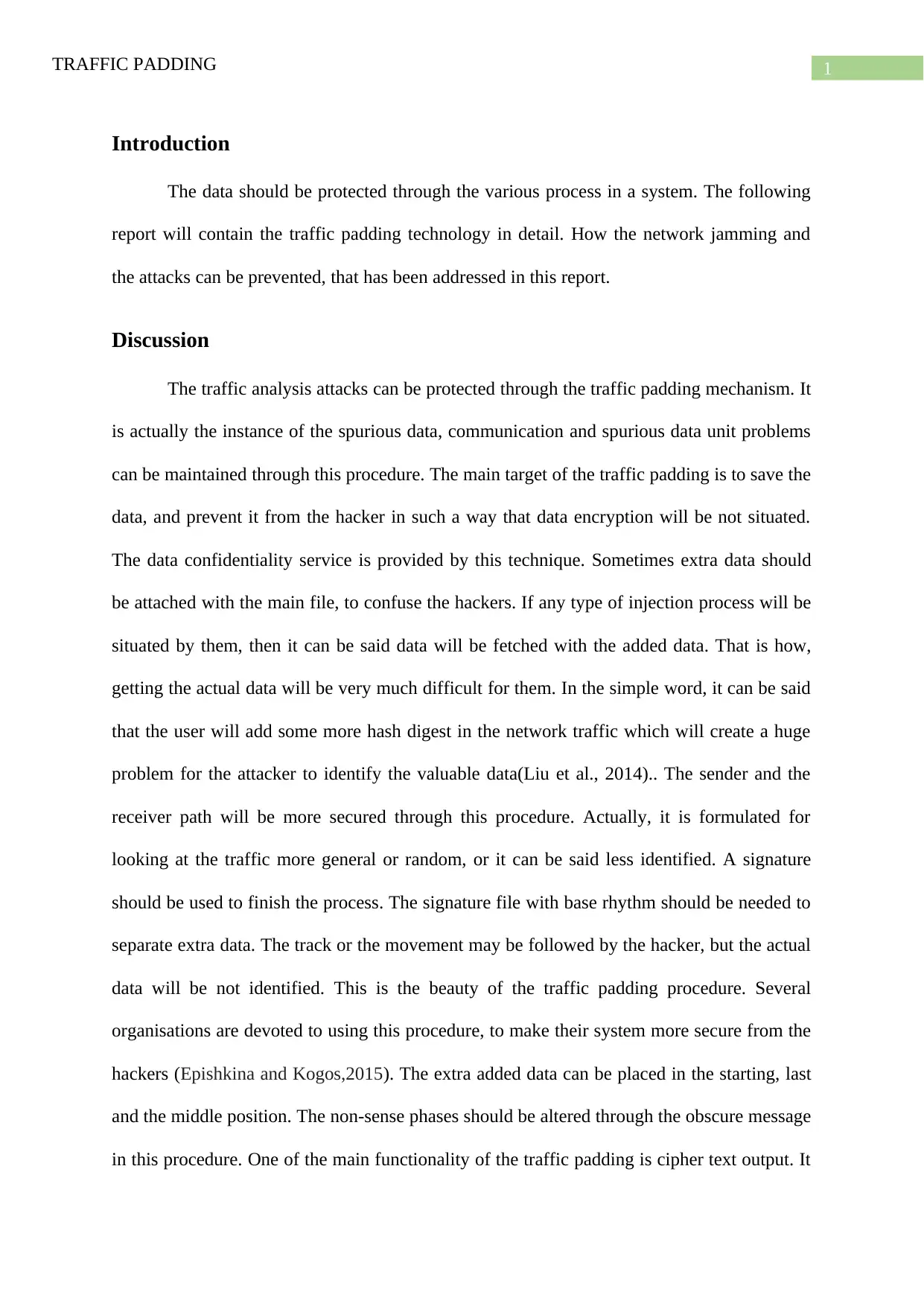
Introduction
The data should be protected through the various process in a system. The following
report will contain the traffic padding technology in detail. How the network jamming and
the attacks can be prevented, that has been addressed in this report.
Discussion
The traffic analysis attacks can be protected through the traffic padding mechanism. It
is actually the instance of the spurious data, communication and spurious data unit problems
can be maintained through this procedure. The main target of the traffic padding is to save the
data, and prevent it from the hacker in such a way that data encryption will be not situated.
The data confidentiality service is provided by this technique. Sometimes extra data should
be attached with the main file, to confuse the hackers. If any type of injection process will be
situated by them, then it can be said data will be fetched with the added data. That is how,
getting the actual data will be very much difficult for them. In the simple word, it can be said
that the user will add some more hash digest in the network traffic which will create a huge
problem for the attacker to identify the valuable data(Liu et al., 2014).. The sender and the
receiver path will be more secured through this procedure. Actually, it is formulated for
looking at the traffic more general or random, or it can be said less identified. A signature
should be used to finish the process. The signature file with base rhythm should be needed to
separate extra data. The track or the movement may be followed by the hacker, but the actual
data will be not identified. This is the beauty of the traffic padding procedure. Several
organisations are devoted to using this procedure, to make their system more secure from the
hackers (Epishkina and Kogos,2015). The extra added data can be placed in the starting, last
and the middle position. The non-sense phases should be altered through the obscure message
in this procedure. One of the main functionality of the traffic padding is cipher text output. It
Document Page
2TRAFFIC PADDING
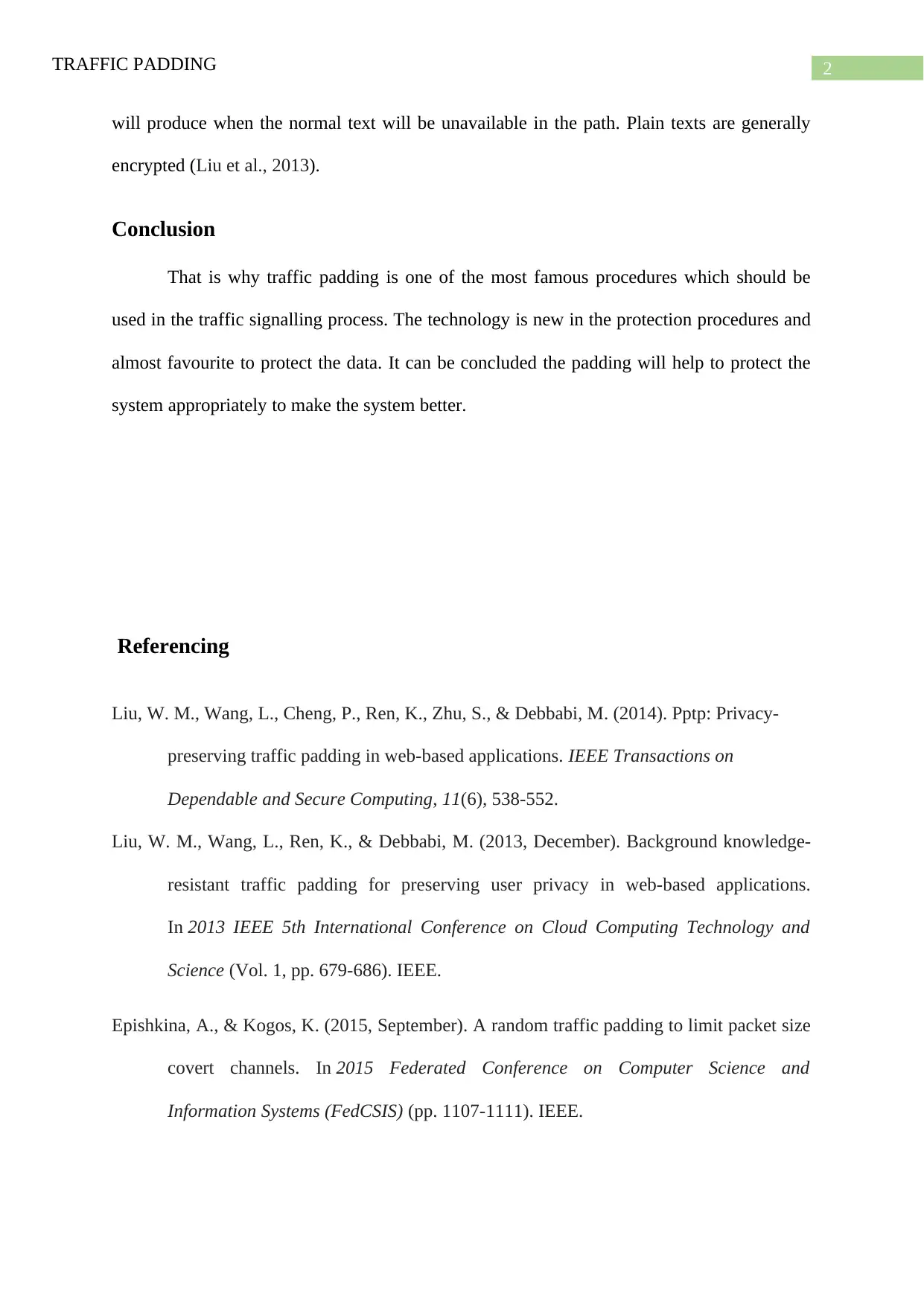
will produce when the normal text will be unavailable in the path. Plain texts are generally
encrypted (Liu et al., 2013).
Conclusion
That is why traffic padding is one of the most famous procedures which should be
used in the traffic signalling process. The technology is new in the protection procedures and
almost favourite to protect the data. It can be concluded the padding will help to protect the
system appropriately to make the system better.
Referencing
Liu, W. M., Wang, L., Cheng, P., Ren, K., Zhu, S., & Debbabi, M. (2014). Pptp: Privacy-
preserving traffic padding in web-based applications. IEEE Transactions on
Dependable and Secure Computing, 11(6), 538-552.
Liu, W. M., Wang, L., Ren, K., & Debbabi, M. (2013, December). Background knowledge-
resistant traffic padding for preserving user privacy in web-based applications.
In 2013 IEEE 5th International Conference on Cloud Computing Technology and
Science (Vol. 1, pp. 679-686). IEEE.
Epishkina, A., & Kogos, K. (2015, September). A random traffic padding to limit packet size
covert channels. In 2015 Federated Conference on Computer Science and
Information Systems (FedCSIS) (pp. 1107-1111). IEEE.
Document Page
3TRAFFIC PADDING
tabler-icon-diamond-filled.svg

Paraphrase This Document

Need a fresh take? Get an instant paraphrase of this document with our AI Paraphraser
Document Page
4TRAFFIC PADDING
chevron_up_icon
1 out of 5
circle_padding
hide_on_mobile
zoom_out_icon
[object Object]