HRM Strategies: Enhancing Customer Service through Training Programs
VerifiedAdded on 2023/06/04
|6
|1530
|395
Report
AI Summary
This report evaluates the benefits of training and development within Human Resource Management (HRM) in the context of customer service. It differentiates between training and development, highlighting that training is a structured program focused on specific job skills, while development is a self-driven activity aimed at overall employee growth. The report analyzes the advantages and disadvantages of training and development programs, noting that while they improve employee performance and service quality, they can also be costly and time-consuming. Furthermore, it discusses the role of employees in building a positive brand image through excellent customer service, emphasizing that employee performance directly impacts customer feedback and overall brand perception. The report concludes that organizations must prioritize training and development to enhance service quality, build a strong brand image, and achieve sustained growth, using performance indicators to regularly evaluate their progress.

Human Resource Management
Paraphrase This Document
Need a fresh take? Get an instant paraphrase of this document with our AI Paraphraser

HUMAN RESOURCE MANAGEMENT
1
Consumer Service is a process of taking care of the customer demands and needs by
delivering the high quality of services. It is the responsibility of the organisation to deliver the
high quality of services to customer so that the customer needs are satisfy (Cook, 2017).
Customer services are provided to the customer during and after the customer requirements.
Customer services are provided by the employee of an organisation, it is essential to provide
the training and development to employees to deliver the high quality of services. The main
purpose of this report is to evaluate the training and development benefits for the organisation
in the context of customer service (Kumar, and Reinartz, 2018). In the first phase of the
report, difference between the training and development will be discussed. In the next phase,
advantage and disadvantage of customer service will be analysed. The last phase of paper,
role of employees in building the brand image will be discussed.
It has been seen that training and development is used as a function of human resource
management with similar objective. But both the words are different from each other.
Training is a program which is organised by the organisation to train the employee but
development is a self-assistant activity. Training program is organised to provide the training
to employees to develop their skills and knowledge for a specific job profile but development
activity is all about the taking care of overall growth of employees such as talents and skills.
The main difference between training and development is that training is provided by the
trainer but the overall growth of employee is depending on the employee itself (Elstak, Bhatt,
Van Riel, Pratt, and Berens, 2015). The training is a short term process because the
employees are train for specific job profile but the development is long term process because
it is an overall growth of the employees. Training is organised to enhance the productivity of
employee and development activity helps to develop the personality for the future. Training is
the job-oriented activity and development is the career-oriented activity. It has been seen that
the main objective of training is to develop or enhance the performance of an employee but
1
Consumer Service is a process of taking care of the customer demands and needs by
delivering the high quality of services. It is the responsibility of the organisation to deliver the
high quality of services to customer so that the customer needs are satisfy (Cook, 2017).
Customer services are provided to the customer during and after the customer requirements.
Customer services are provided by the employee of an organisation, it is essential to provide
the training and development to employees to deliver the high quality of services. The main
purpose of this report is to evaluate the training and development benefits for the organisation
in the context of customer service (Kumar, and Reinartz, 2018). In the first phase of the
report, difference between the training and development will be discussed. In the next phase,
advantage and disadvantage of customer service will be analysed. The last phase of paper,
role of employees in building the brand image will be discussed.
It has been seen that training and development is used as a function of human resource
management with similar objective. But both the words are different from each other.
Training is a program which is organised by the organisation to train the employee but
development is a self-assistant activity. Training program is organised to provide the training
to employees to develop their skills and knowledge for a specific job profile but development
activity is all about the taking care of overall growth of employees such as talents and skills.
The main difference between training and development is that training is provided by the
trainer but the overall growth of employee is depending on the employee itself (Elstak, Bhatt,
Van Riel, Pratt, and Berens, 2015). The training is a short term process because the
employees are train for specific job profile but the development is long term process because
it is an overall growth of the employees. Training is organised to enhance the productivity of
employee and development activity helps to develop the personality for the future. Training is
the job-oriented activity and development is the career-oriented activity. It has been seen that
the main objective of training is to develop or enhance the performance of an employee but

HUMAN RESOURCE MANAGEMENT
2
the main objective of development activity is to develop the personality of employee to
handle the future challenges. By organising the training program, the performance of
employee is enhanced but from the development activity the general knowledge of the
employees is improved. Training and development are different from each other but it is use
in a similar objective that is development of performance of employees which is beneficial
for the organisation.
Training and development is a process which helps the organisation in delivering the high
quality of customer services to the customer. Training and development is a process which
motivate the employees towards the work. By providing the training to the employees; the
performance of employees will improved which is beneficial for the organisation. Training
program is beneficial for the employees as well because they can easily understand their work
and responsibility towards the organisation. To improve the performance; it is necessary for
the employee to understand the tools and techniques which is used in their work. Training
and development process helps the employees in adopting the new technology and
innovation. It is necessary for the organisation to provide the time to time training to the
employees so they can adopt the new techniques which is used in the organisation for better
services (Konings, and Vanormelingen, 2015) Adoption of new technology improves the
quality of services of the organisation for the consumers. Training and development process
helps to improve the services by providing the training of uses the tools and techniques of
their work (Hollenbeck, and Jamieson, 2015).
Training and development process has many benefits but it also has disadvantage which
affects the performance of the organisation. Training and development is the process which
contain the high cost. There are many organisations who appoint the trainers to train the
employees as per the job profile but these trainers charge the high fees from the organisation.
2
the main objective of development activity is to develop the personality of employee to
handle the future challenges. By organising the training program, the performance of
employee is enhanced but from the development activity the general knowledge of the
employees is improved. Training and development are different from each other but it is use
in a similar objective that is development of performance of employees which is beneficial
for the organisation.
Training and development is a process which helps the organisation in delivering the high
quality of customer services to the customer. Training and development is a process which
motivate the employees towards the work. By providing the training to the employees; the
performance of employees will improved which is beneficial for the organisation. Training
program is beneficial for the employees as well because they can easily understand their work
and responsibility towards the organisation. To improve the performance; it is necessary for
the employee to understand the tools and techniques which is used in their work. Training
and development process helps the employees in adopting the new technology and
innovation. It is necessary for the organisation to provide the time to time training to the
employees so they can adopt the new techniques which is used in the organisation for better
services (Konings, and Vanormelingen, 2015) Adoption of new technology improves the
quality of services of the organisation for the consumers. Training and development process
helps to improve the services by providing the training of uses the tools and techniques of
their work (Hollenbeck, and Jamieson, 2015).
Training and development process has many benefits but it also has disadvantage which
affects the performance of the organisation. Training and development is the process which
contain the high cost. There are many organisations who appoint the trainers to train the
employees as per the job profile but these trainers charge the high fees from the organisation.
⊘ This is a preview!⊘
Do you want full access?
Subscribe today to unlock all pages.

Trusted by 1+ million students worldwide

HUMAN RESOURCE MANAGEMENT
3
At the time of training of machinery, the duplicate machine is required which also consume
high cost. Trainer and machines are necessary to provide the training that is why training and
development is a cost consuming process. The disadvantage of this process is it consumes
time. Training and development process helps the employee to understand the work but if the
trainer explain the things in rush then it becomes the problem for the organisation (Sikora,
and Ferris, 2014).
Employees contribute in building the brand image of the organisation. The performance of
the employees helps in delivering the best quality of services to customer. Quality of services
received by the customer gives the positive feedback which builds the strong brand image in
the market. Each and every employee encourages the other employees towards the work. If
an employee has good performance then the organisation appreciates the employee by
providing them by rewards and awards. It encourages the other employees to perform well so
that the organisation brand image is build up. It is necessary to measure the performance of
employee by evaluating the growth of the organisation. Performance Indicator is use to
evaluate the performance of the organisation. Different organisation has their different pattern
to evaluate the performance (Collings, Wood, and Szamosi, 2018).
For example- Manufacturing industries measure their performance by evaluating the
efficiency of per unit. But in the Service industry the performance is measure by evaluating
the growth of the organisation such as annual sale, growth in size, and many others. It
includes those items which reflect the achievement of organisation (Shields, et al., 2015).
From the above analysis, it has been concluded that the organisation has the responsibility to
deliver the quality of customer services. Quality of services provide by the organisation to
train the employees by training and development process. Training and development are the
different word but it is used for the similar objective. Training and development is the
3
At the time of training of machinery, the duplicate machine is required which also consume
high cost. Trainer and machines are necessary to provide the training that is why training and
development is a cost consuming process. The disadvantage of this process is it consumes
time. Training and development process helps the employee to understand the work but if the
trainer explain the things in rush then it becomes the problem for the organisation (Sikora,
and Ferris, 2014).
Employees contribute in building the brand image of the organisation. The performance of
the employees helps in delivering the best quality of services to customer. Quality of services
received by the customer gives the positive feedback which builds the strong brand image in
the market. Each and every employee encourages the other employees towards the work. If
an employee has good performance then the organisation appreciates the employee by
providing them by rewards and awards. It encourages the other employees to perform well so
that the organisation brand image is build up. It is necessary to measure the performance of
employee by evaluating the growth of the organisation. Performance Indicator is use to
evaluate the performance of the organisation. Different organisation has their different pattern
to evaluate the performance (Collings, Wood, and Szamosi, 2018).
For example- Manufacturing industries measure their performance by evaluating the
efficiency of per unit. But in the Service industry the performance is measure by evaluating
the growth of the organisation such as annual sale, growth in size, and many others. It
includes those items which reflect the achievement of organisation (Shields, et al., 2015).
From the above analysis, it has been concluded that the organisation has the responsibility to
deliver the quality of customer services. Quality of services provide by the organisation to
train the employees by training and development process. Training and development are the
different word but it is used for the similar objective. Training and development is the
Paraphrase This Document
Need a fresh take? Get an instant paraphrase of this document with our AI Paraphraser

HUMAN RESOURCE MANAGEMENT
4
beneficial for the organisation because it improves the performance of employees but the
organisation also has the disadvantage. It is cost and time consuming process which affects
the productivity of the organisation. Performance of employees helps the organisation in
building the brand image in the market. Delivery of high quality of services enhances the
brand image of the market. The organisation can evaluate the performance with the help of
performance indicator. It is necessary for the organisation to evaluate their performance on
the regular basis. The organisation will achieve the high growth by satisfying the consumer
demand by delivering the quality of services.
4
beneficial for the organisation because it improves the performance of employees but the
organisation also has the disadvantage. It is cost and time consuming process which affects
the productivity of the organisation. Performance of employees helps the organisation in
building the brand image in the market. Delivery of high quality of services enhances the
brand image of the market. The organisation can evaluate the performance with the help of
performance indicator. It is necessary for the organisation to evaluate their performance on
the regular basis. The organisation will achieve the high growth by satisfying the consumer
demand by delivering the quality of services.

HUMAN RESOURCE MANAGEMENT
5
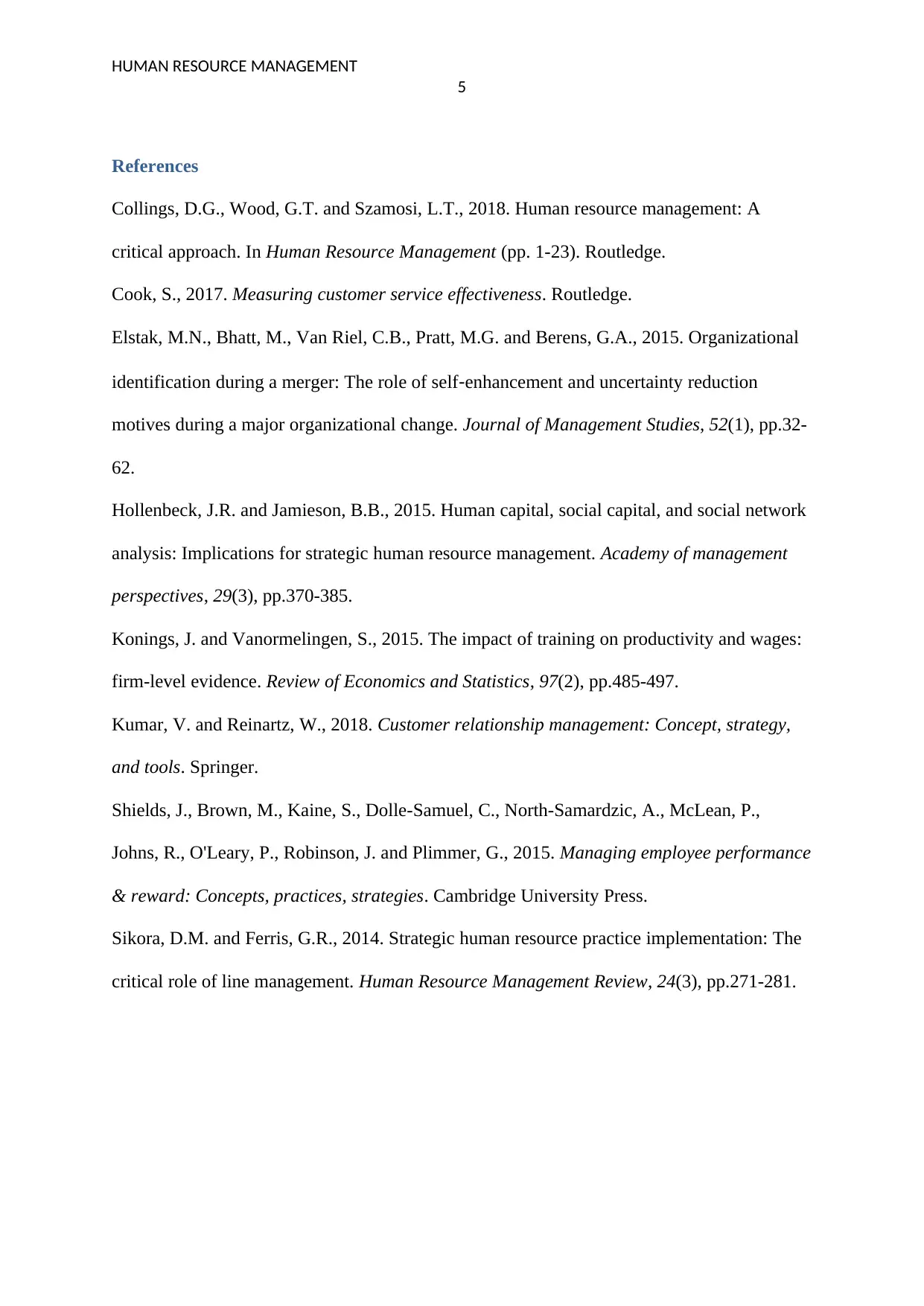
References
Collings, D.G., Wood, G.T. and Szamosi, L.T., 2018. Human resource management: A
critical approach. In Human Resource Management (pp. 1-23). Routledge.
Cook, S., 2017. Measuring customer service effectiveness. Routledge.
Elstak, M.N., Bhatt, M., Van Riel, C.B., Pratt, M.G. and Berens, G.A., 2015. Organizational
identification during a merger: The role of self‐enhancement and uncertainty reduction
motives during a major organizational change. Journal of Management Studies, 52(1), pp.32-
62.
Hollenbeck, J.R. and Jamieson, B.B., 2015. Human capital, social capital, and social network
analysis: Implications for strategic human resource management. Academy of management
perspectives, 29(3), pp.370-385.
Konings, J. and Vanormelingen, S., 2015. The impact of training on productivity and wages:
firm-level evidence. Review of Economics and Statistics, 97(2), pp.485-497.
Kumar, V. and Reinartz, W., 2018. Customer relationship management: Concept, strategy,
and tools. Springer.
Shields, J., Brown, M., Kaine, S., Dolle-Samuel, C., North-Samardzic, A., McLean, P.,
Johns, R., O'Leary, P., Robinson, J. and Plimmer, G., 2015. Managing employee performance
& reward: Concepts, practices, strategies. Cambridge University Press.
Sikora, D.M. and Ferris, G.R., 2014. Strategic human resource practice implementation: The
critical role of line management. Human Resource Management Review, 24(3), pp.271-281.
5
References
Collings, D.G., Wood, G.T. and Szamosi, L.T., 2018. Human resource management: A
critical approach. In Human Resource Management (pp. 1-23). Routledge.
Cook, S., 2017. Measuring customer service effectiveness. Routledge.
Elstak, M.N., Bhatt, M., Van Riel, C.B., Pratt, M.G. and Berens, G.A., 2015. Organizational
identification during a merger: The role of self‐enhancement and uncertainty reduction
motives during a major organizational change. Journal of Management Studies, 52(1), pp.32-
62.
Hollenbeck, J.R. and Jamieson, B.B., 2015. Human capital, social capital, and social network
analysis: Implications for strategic human resource management. Academy of management
perspectives, 29(3), pp.370-385.
Konings, J. and Vanormelingen, S., 2015. The impact of training on productivity and wages:
firm-level evidence. Review of Economics and Statistics, 97(2), pp.485-497.
Kumar, V. and Reinartz, W., 2018. Customer relationship management: Concept, strategy,
and tools. Springer.
Shields, J., Brown, M., Kaine, S., Dolle-Samuel, C., North-Samardzic, A., McLean, P.,
Johns, R., O'Leary, P., Robinson, J. and Plimmer, G., 2015. Managing employee performance
& reward: Concepts, practices, strategies. Cambridge University Press.
Sikora, D.M. and Ferris, G.R., 2014. Strategic human resource practice implementation: The
critical role of line management. Human Resource Management Review, 24(3), pp.271-281.
⊘ This is a preview!⊘
Do you want full access?
Subscribe today to unlock all pages.

Trusted by 1+ million students worldwide
1 out of 6
Related Documents
Your All-in-One AI-Powered Toolkit for Academic Success.
+13062052269
info@desklib.com
Available 24*7 on WhatsApp / Email
Unlock your academic potential
Copyright © 2020–2026 A2Z Services. All Rights Reserved. Developed and managed by ZUCOL.