Translation of Knowledge to Practice: Nursing Report Analysis
VerifiedAdded on 2020/11/23
|6
|1695
|328
Report
AI Summary
This report delves into the critical aspects of medication management within the nursing profession, emphasizing the importance of professional development and reflective practice. It identifies challenges such as medication list oversight, communication gaps between practitioners and patients, and ethical and legal considerations. The report proposes strategies like transcription of prescriptions, electronic prescribing, and careful medicine supply to enhance practice development. It highlights the significance of patient-centered care, collaboration, and inter-professional teamwork. Furthermore, the report explores governance and regulatory frameworks, focusing on accountability and practice standards for graduate nurses, as defined by the Nursing and Midwifery Board of Australia. The conclusion underscores the role of effective medication management in reducing readmissions and the need for continuous improvement in nursing practice.
Translation Of Knowledge To
Practice(Nursing)
Practice(Nursing)
Paraphrase This Document
Need a fresh take? Get an instant paraphrase of this document with our AI Paraphraser

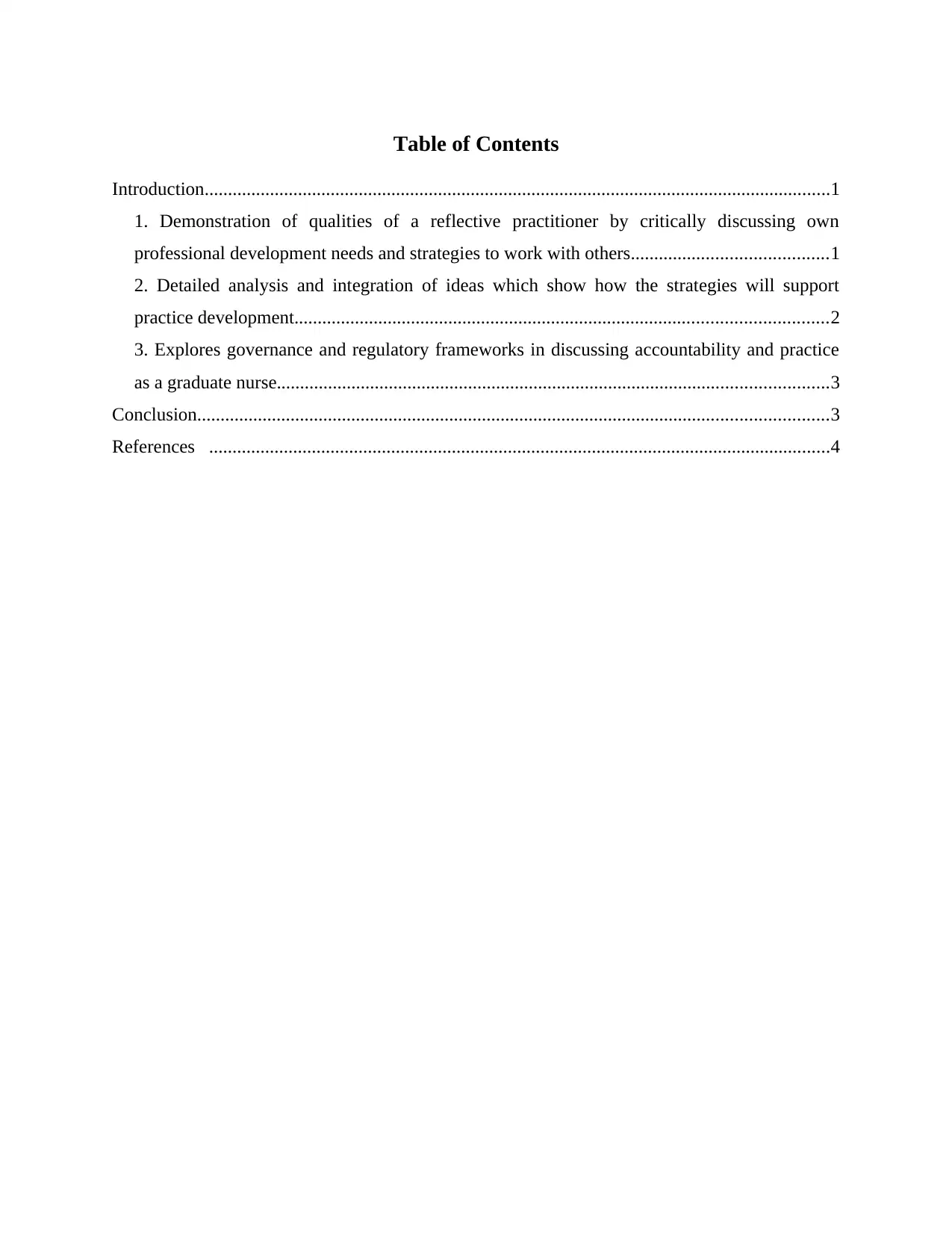
Table of Contents
Introduction......................................................................................................................................1
1. Demonstration of qualities of a reflective practitioner by critically discussing own
professional development needs and strategies to work with others..........................................1
2. Detailed analysis and integration of ideas which show how the strategies will support
practice development..................................................................................................................2
3. Explores governance and regulatory frameworks in discussing accountability and practice
as a graduate nurse......................................................................................................................3
Conclusion.......................................................................................................................................3
References .....................................................................................................................................4
Introduction......................................................................................................................................1
1. Demonstration of qualities of a reflective practitioner by critically discussing own
professional development needs and strategies to work with others..........................................1
2. Detailed analysis and integration of ideas which show how the strategies will support
practice development..................................................................................................................2
3. Explores governance and regulatory frameworks in discussing accountability and practice
as a graduate nurse......................................................................................................................3
Conclusion.......................................................................................................................................3
References .....................................................................................................................................4

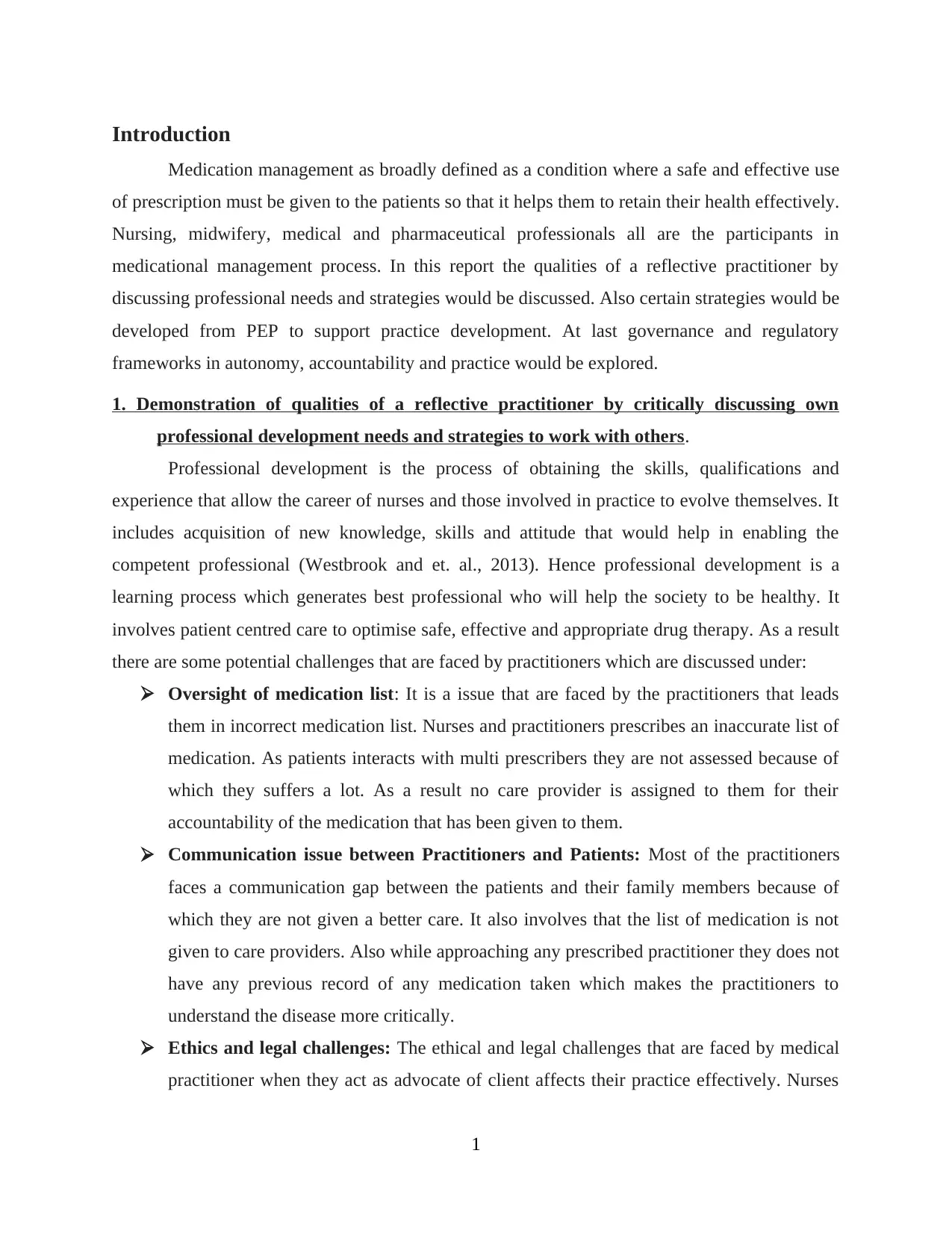
Introduction
Medication management as broadly defined as a condition where a safe and effective use
of prescription must be given to the patients so that it helps them to retain their health effectively.
Nursing, midwifery, medical and pharmaceutical professionals all are the participants in
medicational management process. In this report the qualities of a reflective practitioner by
discussing professional needs and strategies would be discussed. Also certain strategies would be
developed from PEP to support practice development. At last governance and regulatory
frameworks in autonomy, accountability and practice would be explored.
1. Demonstration of qualities of a reflective practitioner by critically discussing own
professional development needs and strategies to work with others.
Professional development is the process of obtaining the skills, qualifications and
experience that allow the career of nurses and those involved in practice to evolve themselves. It
includes acquisition of new knowledge, skills and attitude that would help in enabling the
competent professional (Westbrook and et. al., 2013). Hence professional development is a
learning process which generates best professional who will help the society to be healthy. It
involves patient centred care to optimise safe, effective and appropriate drug therapy. As a result
there are some potential challenges that are faced by practitioners which are discussed under:
Oversight of medication list: It is a issue that are faced by the practitioners that leads
them in incorrect medication list. Nurses and practitioners prescribes an inaccurate list of
medication. As patients interacts with multi prescribers they are not assessed because of
which they suffers a lot. As a result no care provider is assigned to them for their
accountability of the medication that has been given to them.
Communication issue between Practitioners and Patients: Most of the practitioners
faces a communication gap between the patients and their family members because of
which they are not given a better care. It also involves that the list of medication is not
given to care providers. Also while approaching any prescribed practitioner they does not
have any previous record of any medication taken which makes the practitioners to
understand the disease more critically.
Ethics and legal challenges: The ethical and legal challenges that are faced by medical
practitioner when they act as advocate of client affects their practice effectively. Nurses
1
Medication management as broadly defined as a condition where a safe and effective use
of prescription must be given to the patients so that it helps them to retain their health effectively.
Nursing, midwifery, medical and pharmaceutical professionals all are the participants in
medicational management process. In this report the qualities of a reflective practitioner by
discussing professional needs and strategies would be discussed. Also certain strategies would be
developed from PEP to support practice development. At last governance and regulatory
frameworks in autonomy, accountability and practice would be explored.
1. Demonstration of qualities of a reflective practitioner by critically discussing own
professional development needs and strategies to work with others.
Professional development is the process of obtaining the skills, qualifications and
experience that allow the career of nurses and those involved in practice to evolve themselves. It
includes acquisition of new knowledge, skills and attitude that would help in enabling the
competent professional (Westbrook and et. al., 2013). Hence professional development is a
learning process which generates best professional who will help the society to be healthy. It
involves patient centred care to optimise safe, effective and appropriate drug therapy. As a result
there are some potential challenges that are faced by practitioners which are discussed under:
Oversight of medication list: It is a issue that are faced by the practitioners that leads
them in incorrect medication list. Nurses and practitioners prescribes an inaccurate list of
medication. As patients interacts with multi prescribers they are not assessed because of
which they suffers a lot. As a result no care provider is assigned to them for their
accountability of the medication that has been given to them.
Communication issue between Practitioners and Patients: Most of the practitioners
faces a communication gap between the patients and their family members because of
which they are not given a better care. It also involves that the list of medication is not
given to care providers. Also while approaching any prescribed practitioner they does not
have any previous record of any medication taken which makes the practitioners to
understand the disease more critically.
Ethics and legal challenges: The ethical and legal challenges that are faced by medical
practitioner when they act as advocate of client affects their practice effectively. Nurses
1
⊘ This is a preview!⊘
Do you want full access?
Subscribe today to unlock all pages.

Trusted by 1+ million students worldwide

need to focus on ethical practices as there are some of the act that includes a ethical
nurse practice act and clients right. A nurse duty is to inform and support a person in such
a way that patients make decision which is best possible for himself.
Patient or Family engagement challenges: A nurse has to manage the engagement of
family so as to make patient recover more quickly (Spinewine, and et. al.,2013). They
also face the problem of understanding the patients ability to take medications not
assessed. Some times as patients is not able to understand a new prescription they
continues to take old medication which is the main issue that is faced by nurses.
As a result for maintaining the professional development and to provide best practice to
the patients a professional development strategy should be implemented so as to meet the
identified needs which includes:
Transcription of prescription: Best practice of a nurse staff indicates the responsibility
of documenting the prescription. A nurse who transcribe the prescription is accountable
for the decision of transcribe and the accuracy of transcription.
Electronic prescribing: The electronic prescription writing is considered as one of the
best tool that helps in prescribing medicine to patients (Skomra, Qualcomm Inc, 2013).
Nurses should take care that a electronic prescription must be dated and should be signed
by the practitioners or nurses.
Supply of medicines: A nurse should carefully check that the medicines supplied to the
patients are same as prescribed by the practitioners and should also help the patients in
taking them.
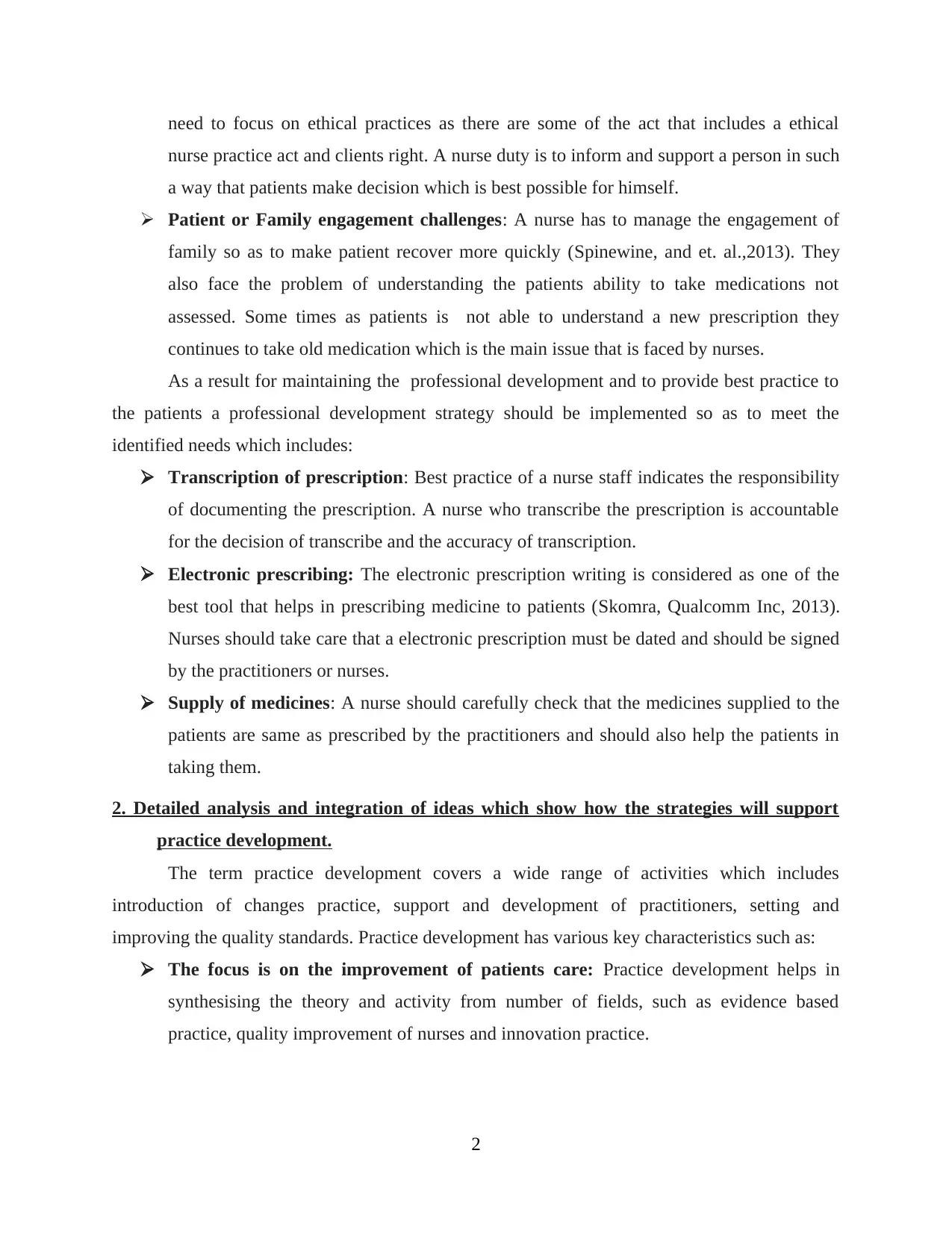
2. Detailed analysis and integration of ideas which show how the strategies will support
practice development.
The term practice development covers a wide range of activities which includes
introduction of changes practice, support and development of practitioners, setting and
improving the quality standards. Practice development has various key characteristics such as:
The focus is on the improvement of patients care: Practice development helps in
synthesising the theory and activity from number of fields, such as evidence based
practice, quality improvement of nurses and innovation practice.
2
nurse practice act and clients right. A nurse duty is to inform and support a person in such
a way that patients make decision which is best possible for himself.
Patient or Family engagement challenges: A nurse has to manage the engagement of
family so as to make patient recover more quickly (Spinewine, and et. al.,2013). They
also face the problem of understanding the patients ability to take medications not
assessed. Some times as patients is not able to understand a new prescription they
continues to take old medication which is the main issue that is faced by nurses.
As a result for maintaining the professional development and to provide best practice to
the patients a professional development strategy should be implemented so as to meet the
identified needs which includes:
Transcription of prescription: Best practice of a nurse staff indicates the responsibility
of documenting the prescription. A nurse who transcribe the prescription is accountable
for the decision of transcribe and the accuracy of transcription.
Electronic prescribing: The electronic prescription writing is considered as one of the
best tool that helps in prescribing medicine to patients (Skomra, Qualcomm Inc, 2013).
Nurses should take care that a electronic prescription must be dated and should be signed
by the practitioners or nurses.
Supply of medicines: A nurse should carefully check that the medicines supplied to the
patients are same as prescribed by the practitioners and should also help the patients in
taking them.
2. Detailed analysis and integration of ideas which show how the strategies will support
practice development.
The term practice development covers a wide range of activities which includes
introduction of changes practice, support and development of practitioners, setting and
improving the quality standards. Practice development has various key characteristics such as:
The focus is on the improvement of patients care: Practice development helps in
synthesising the theory and activity from number of fields, such as evidence based
practice, quality improvement of nurses and innovation practice.
2
Paraphrase This Document
Need a fresh take? Get an instant paraphrase of this document with our AI Paraphraser

This is pinned to develop and active engagement of practitioners: As it focuses on
patients needs this can only be succeeded when if they become engaged. This is a
fundamental criteria for practice development in nurses.
It is collaborative and inter professional: it is seen that patients needs does not cease at
the boundaries and between the departments, professionals and organisations. Practice
development focuses on these issues and importance of teamwork. This approach helps
nurses to maximise the creative potential of different skills and perspectives.
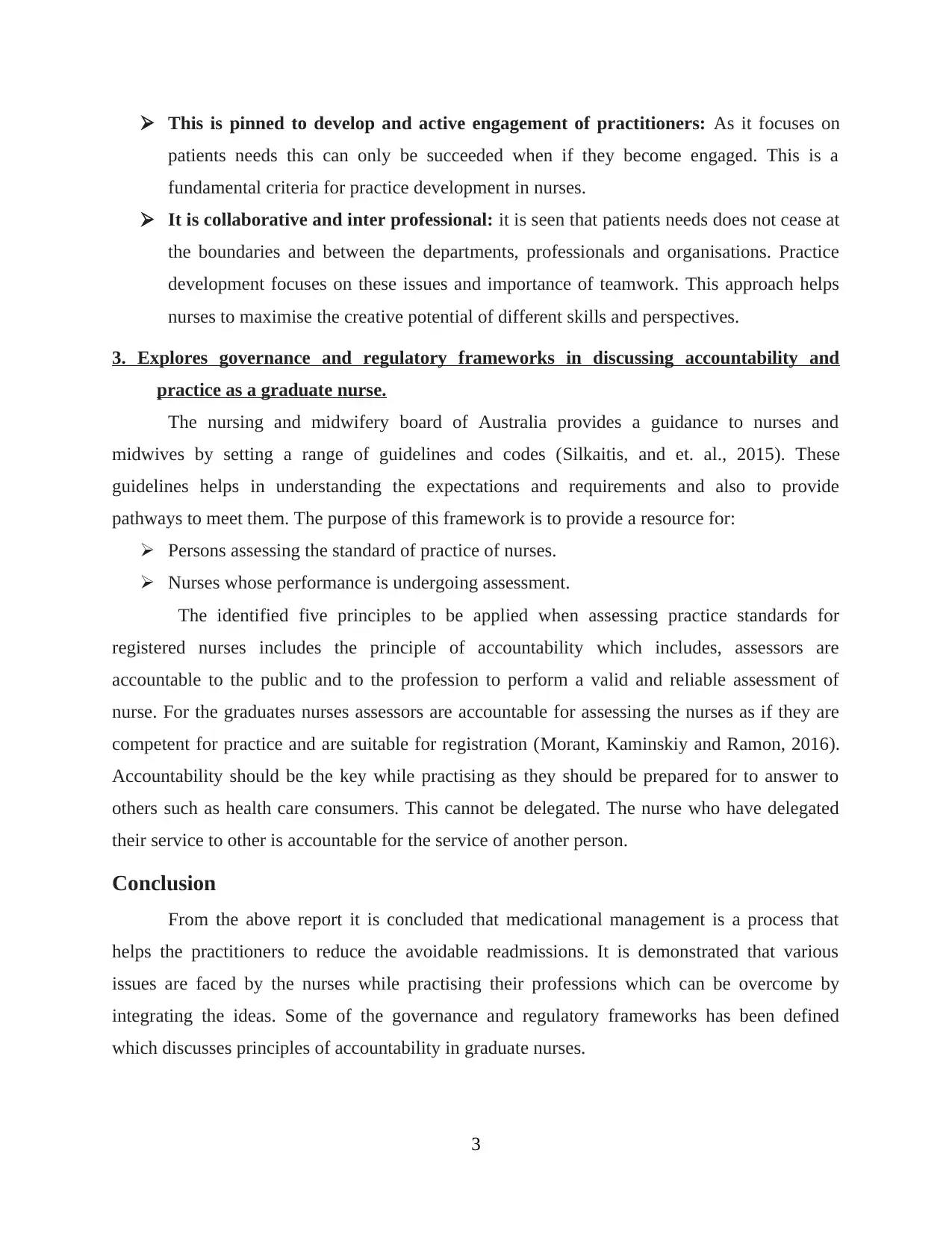
3. Explores governance and regulatory frameworks in discussing accountability and
practice as a graduate nurse.
The nursing and midwifery board of Australia provides a guidance to nurses and
midwives by setting a range of guidelines and codes (Silkaitis, and et. al., 2015). These
guidelines helps in understanding the expectations and requirements and also to provide
pathways to meet them. The purpose of this framework is to provide a resource for:
Persons assessing the standard of practice of nurses.
Nurses whose performance is undergoing assessment.
The identified five principles to be applied when assessing practice standards for
registered nurses includes the principle of accountability which includes, assessors are
accountable to the public and to the profession to perform a valid and reliable assessment of
nurse. For the graduates nurses assessors are accountable for assessing the nurses as if they are
competent for practice and are suitable for registration (Morant, Kaminskiy and Ramon, 2016).
Accountability should be the key while practising as they should be prepared for to answer to
others such as health care consumers. This cannot be delegated. The nurse who have delegated
their service to other is accountable for the service of another person.
Conclusion
From the above report it is concluded that medicational management is a process that
helps the practitioners to reduce the avoidable readmissions. It is demonstrated that various
issues are faced by the nurses while practising their professions which can be overcome by
integrating the ideas. Some of the governance and regulatory frameworks has been defined
which discusses principles of accountability in graduate nurses.
3
patients needs this can only be succeeded when if they become engaged. This is a
fundamental criteria for practice development in nurses.
It is collaborative and inter professional: it is seen that patients needs does not cease at
the boundaries and between the departments, professionals and organisations. Practice
development focuses on these issues and importance of teamwork. This approach helps
nurses to maximise the creative potential of different skills and perspectives.
3. Explores governance and regulatory frameworks in discussing accountability and
practice as a graduate nurse.
The nursing and midwifery board of Australia provides a guidance to nurses and
midwives by setting a range of guidelines and codes (Silkaitis, and et. al., 2015). These
guidelines helps in understanding the expectations and requirements and also to provide
pathways to meet them. The purpose of this framework is to provide a resource for:
Persons assessing the standard of practice of nurses.
Nurses whose performance is undergoing assessment.
The identified five principles to be applied when assessing practice standards for
registered nurses includes the principle of accountability which includes, assessors are
accountable to the public and to the profession to perform a valid and reliable assessment of
nurse. For the graduates nurses assessors are accountable for assessing the nurses as if they are
competent for practice and are suitable for registration (Morant, Kaminskiy and Ramon, 2016).
Accountability should be the key while practising as they should be prepared for to answer to
others such as health care consumers. This cannot be delegated. The nurse who have delegated
their service to other is accountable for the service of another person.
Conclusion
From the above report it is concluded that medicational management is a process that
helps the practitioners to reduce the avoidable readmissions. It is demonstrated that various
issues are faced by the nurses while practising their professions which can be overcome by
integrating the ideas. Some of the governance and regulatory frameworks has been defined
which discusses principles of accountability in graduate nurses.
3

References
Books and Authors
Coffman, D.J., Vanderveen, T.W., Lee, B.A. and Schlotterbeck, D.L., CareFusion 303 Inc, 2017.
Distributed remote asset and medication management drug delivery system. U.S. Patent
9,600,633.
Ferguson, A., 2012. Automated medication management system and method for use. U.S. Patent
8,212,677.
Henriques, M.A., Costa, M.A. and Cabrita, J., 2012. Adherence and medication management by
the elderly. Journal of clinical nursing. 21(21-22). pp.3096-3105.
Johnson, K.B., Lehmann, C.U. and Council on Clinical Information Technology, 2013.
Electronic prescribing in pediatrics: toward safer and more effective medication
management. Pediatrics, pp.peds-2013.
Maidment, I.D., Fox, C., Boustani, M. and Katona, C., 2012. Medication management—the
missing link in dementia interventions. International journal of geriatric psychiatry.
27(5). pp.439-442.
Manning, K.J., Clarke, C., Lorry, A., Weintraub, D., Wilkinson, J.R., Duda, J.E. and Moberg,
P.J., 2012. Medication management and neuropsychological performance in Parkinson's
disease. The Clinical Neuropsychologist. 26(1). pp.45-58.
Martinez, J.D., Wilkinson, J.P., Steinhauer, T.C. and Frazier, K., CareFusion 303 Inc, 2012.
Identification system and method for medication management. U.S. Patent 8,219,413.
Morant, N., Kaminskiy, E. and Ramon, S., 2016. Shared decision making for psychiatric
medication management: beyond the micro‐social. Health Expectations. 19(5). pp.1002-
1014.
Silkaitis, R.P., Holland, G.N., Keely, P.B. and Pelletier, J., Hospira Inc, 2015. Medication
management system. U.S. Patent 9,123,077.
Skomra, S.A., Qualcomm Inc, 2013. Mobile wireless medication management system. U.S.
Patent 8,538,775.
Spinewine, A., Claeys, C., Foulon, V. and Chevalier, P., 2013. Approaches for improving
continuity of care in medication management: a systematic review. International
journal for quality in health care. 25(4). pp.403-417.
Westbrook, J.I., Li, L., Georgiou, A., Paoloni, R. and Cullen, J., 2013. Impact of an electronic
medication management system on hospital doctors' and nurses' work: a controlled pre–
post, time and motion study. Journal of the American Medical Informatics Association.
20(6). pp.1150-1158.
4
Books and Authors
Coffman, D.J., Vanderveen, T.W., Lee, B.A. and Schlotterbeck, D.L., CareFusion 303 Inc, 2017.
Distributed remote asset and medication management drug delivery system. U.S. Patent
9,600,633.
Ferguson, A., 2012. Automated medication management system and method for use. U.S. Patent
8,212,677.
Henriques, M.A., Costa, M.A. and Cabrita, J., 2012. Adherence and medication management by
the elderly. Journal of clinical nursing. 21(21-22). pp.3096-3105.
Johnson, K.B., Lehmann, C.U. and Council on Clinical Information Technology, 2013.
Electronic prescribing in pediatrics: toward safer and more effective medication
management. Pediatrics, pp.peds-2013.
Maidment, I.D., Fox, C., Boustani, M. and Katona, C., 2012. Medication management—the
missing link in dementia interventions. International journal of geriatric psychiatry.
27(5). pp.439-442.
Manning, K.J., Clarke, C., Lorry, A., Weintraub, D., Wilkinson, J.R., Duda, J.E. and Moberg,
P.J., 2012. Medication management and neuropsychological performance in Parkinson's
disease. The Clinical Neuropsychologist. 26(1). pp.45-58.
Martinez, J.D., Wilkinson, J.P., Steinhauer, T.C. and Frazier, K., CareFusion 303 Inc, 2012.
Identification system and method for medication management. U.S. Patent 8,219,413.
Morant, N., Kaminskiy, E. and Ramon, S., 2016. Shared decision making for psychiatric
medication management: beyond the micro‐social. Health Expectations. 19(5). pp.1002-
1014.
Silkaitis, R.P., Holland, G.N., Keely, P.B. and Pelletier, J., Hospira Inc, 2015. Medication
management system. U.S. Patent 9,123,077.
Skomra, S.A., Qualcomm Inc, 2013. Mobile wireless medication management system. U.S.
Patent 8,538,775.
Spinewine, A., Claeys, C., Foulon, V. and Chevalier, P., 2013. Approaches for improving
continuity of care in medication management: a systematic review. International
journal for quality in health care. 25(4). pp.403-417.
Westbrook, J.I., Li, L., Georgiou, A., Paoloni, R. and Cullen, J., 2013. Impact of an electronic
medication management system on hospital doctors' and nurses' work: a controlled pre–
post, time and motion study. Journal of the American Medical Informatics Association.
20(6). pp.1150-1158.
4
⊘ This is a preview!⊘
Do you want full access?
Subscribe today to unlock all pages.

Trusted by 1+ million students worldwide
1 out of 6
Related Documents
Your All-in-One AI-Powered Toolkit for Academic Success.
+13062052269
info@desklib.com
Available 24*7 on WhatsApp / Email
Unlock your academic potential
Copyright © 2020–2025 A2Z Services. All Rights Reserved. Developed and managed by ZUCOL.