Transparency in Oil Industry: EITI Analysis
VerifiedAdded on 2019/09/16
|22
|4888
|307
Report
AI Summary
This report examines the role of the Extractive Industries Transparency Initiative (EITI) in promoting transparency within the oil industry, focusing on case studies of Azerbaijan and Liberia. It explores the concept of the 'resource curse' and how EITI aims to mitigate its negative impacts by fostering accountability and open management of extractive resources. The report analyzes the implementation of EITI in both countries, highlighting its influence on governance, economic development, and civil society engagement. It also discusses the challenges and limitations of EITI, while emphasizing its potential to improve transparency and accountability in the oil and gas sector.
Running Head: Transparency in Oil Industry
Environmental Economics
Transparency in the oil industry
Environmental Economics
Transparency in the oil industry

Paraphrase This Document
Need a fresh take? Get an instant paraphrase of this document with our AI Paraphraser
Transparency in Oil Industry 1
Table of Contents
Introduction....................................................................................................................................................1
Extractive Industry Transparency Initiative and the Resource Curse............................................................2
EITI in Azerbaijan.........................................................................................................................................5
EITI in Liberia.............................................................................................................................................11
Conclusion...................................................................................................................................................15
References....................................................................................................................................................17
Table of Contents
Introduction....................................................................................................................................................1
Extractive Industry Transparency Initiative and the Resource Curse............................................................2
EITI in Azerbaijan.........................................................................................................................................5
EITI in Liberia.............................................................................................................................................11
Conclusion...................................................................................................................................................15
References....................................................................................................................................................17
Transparency in Oil Industry 2
Introduction
There has been a great recognition from the last decade of the significance of transparency. It is
required for the economic growth and the social development, especially for oil-producing
organizations. The continuous enhancement in the prices of the international oil over the last two
years, bring large benefits for different oil manufacturing countries. This also demands a greater
range of accountability and transparency from the broad range of stakeholders (Van Alstine,
2014). In this paper, we will study about the transparency level in the oil industry by studying the
role of extractive industry transparency initiative. This will help us in measuring the impact of
EITI on the transparency of oil industry in different countries. The Extractive industry
transparency initiative is work as a standard for bringing transparency in oil industries of
different countries. More than 50 countries work under the standards formulated by the EITI for
managing their oil industries. It provides international support in both consumer countries and
oil-producing countries (Obeng-Odoom, 2014). Its purpose is to enhance the level of voluntary
cooperation between civil society, private oil organizations, and governments to increase
transparency in the mining and oil sectors. In this paper, we analyze the level of transparency in
Azerbaijan and Liberia oil sector. It represents that while various efforts have already been taken
to strengthen the level of transparency, sustained and continued action is required to identify the
remaining gaps in these areas. Transparency is an essential task for the success of an
organization. Transparency is required to enhance accountability and to improve the use of oil
revenue or also strengthen the fiscal policies to meet the different development priorities of the
countries. Bringing transparency proves helpful in development and poverty reduction in a
country. Thus, it can be said that transparency is considered an important function in a particular
industry. Economic development and growth of a country mainly depend on the transparency
Introduction
There has been a great recognition from the last decade of the significance of transparency. It is
required for the economic growth and the social development, especially for oil-producing
organizations. The continuous enhancement in the prices of the international oil over the last two
years, bring large benefits for different oil manufacturing countries. This also demands a greater
range of accountability and transparency from the broad range of stakeholders (Van Alstine,
2014). In this paper, we will study about the transparency level in the oil industry by studying the
role of extractive industry transparency initiative. This will help us in measuring the impact of
EITI on the transparency of oil industry in different countries. The Extractive industry
transparency initiative is work as a standard for bringing transparency in oil industries of
different countries. More than 50 countries work under the standards formulated by the EITI for
managing their oil industries. It provides international support in both consumer countries and
oil-producing countries (Obeng-Odoom, 2014). Its purpose is to enhance the level of voluntary
cooperation between civil society, private oil organizations, and governments to increase
transparency in the mining and oil sectors. In this paper, we analyze the level of transparency in
Azerbaijan and Liberia oil sector. It represents that while various efforts have already been taken
to strengthen the level of transparency, sustained and continued action is required to identify the
remaining gaps in these areas. Transparency is an essential task for the success of an
organization. Transparency is required to enhance accountability and to improve the use of oil
revenue or also strengthen the fiscal policies to meet the different development priorities of the
countries. Bringing transparency proves helpful in development and poverty reduction in a
country. Thus, it can be said that transparency is considered an important function in a particular
industry. Economic development and growth of a country mainly depend on the transparency
⊘ This is a preview!⊘
Do you want full access?
Subscribe today to unlock all pages.

Trusted by 1+ million students worldwide
Transparency in Oil Industry 3
level of its existing companies. In the same manner, EITI also plays an important role in bringing
success and growth in the oil industry. The prevalence of corruption and poor transparency in
public management is not limited to oil-producing countries, but oil-rich economies appear to be
in this respect particularly vulnerable (Mahdavi, 2014). Efforts are made to enhance the
transparency level in the oil industry can, therefore, be instrumental in changing the complete
perceptions about governance in the different countries. Therefore, it is the responsibility of the
government of the countries to pay more attention towards the exhaustible nature of oil.
Extractive Industry Transparency Initiative and the Resource Curse
Extractive industry transparency initiative is considered as a global standard to promote the
accountable and open management of extractive resources. It mainly focuses on addressing the
main issues in the mining, oil and gas sectors (Azerbaijan Validation, 2016). On the other hand,
resource curse is considered as a paradoxical situation in which countries with non-renewable
resources experience large growth or even economic contraction. It can be said that resource
curse in a country occurs when they focus their energies on a single industry such as mining and
ignores the other available major sectors. The EITI is considered as a multi-stakeholder initiative
which involves different state-owned and multinational extractive organizations, home
governments, international financial institutions, civil society groups and investors, host
governments, and industry or business associations, which have formulated different means or
ways of revenue transparency (VALIDATION REPORT, 2015). It mainly concentrates on the
prudent utilization of natural resources wealth and concludes that the management of such
wealth should be exercised in the national development interests. It can be said that the EITI
mainly operates on the principle of independent, full, active and free measurement of the ways
that extractive organizations interact with government and influence society and communities.
level of its existing companies. In the same manner, EITI also plays an important role in bringing
success and growth in the oil industry. The prevalence of corruption and poor transparency in
public management is not limited to oil-producing countries, but oil-rich economies appear to be
in this respect particularly vulnerable (Mahdavi, 2014). Efforts are made to enhance the
transparency level in the oil industry can, therefore, be instrumental in changing the complete
perceptions about governance in the different countries. Therefore, it is the responsibility of the
government of the countries to pay more attention towards the exhaustible nature of oil.
Extractive Industry Transparency Initiative and the Resource Curse
Extractive industry transparency initiative is considered as a global standard to promote the
accountable and open management of extractive resources. It mainly focuses on addressing the
main issues in the mining, oil and gas sectors (Azerbaijan Validation, 2016). On the other hand,
resource curse is considered as a paradoxical situation in which countries with non-renewable
resources experience large growth or even economic contraction. It can be said that resource
curse in a country occurs when they focus their energies on a single industry such as mining and
ignores the other available major sectors. The EITI is considered as a multi-stakeholder initiative
which involves different state-owned and multinational extractive organizations, home
governments, international financial institutions, civil society groups and investors, host
governments, and industry or business associations, which have formulated different means or
ways of revenue transparency (VALIDATION REPORT, 2015). It mainly concentrates on the
prudent utilization of natural resources wealth and concludes that the management of such
wealth should be exercised in the national development interests. It can be said that the EITI
mainly operates on the principle of independent, full, active and free measurement of the ways
that extractive organizations interact with government and influence society and communities.
Paraphrase This Document
Need a fresh take? Get an instant paraphrase of this document with our AI Paraphraser
Transparency in Oil Industry 4
During 2015, the 49 countries were reported to be in the process of implementing the EITI
(https://eiti.org/implementing_country/35#extractive-industries-contribution). Among these
countries, 33 are considered EITI compliant. Rest countries were known as the candidates of the
EITI. Due to the resource curse, a particular nation becomes completely dependent on the gross
domestic product or prices of different commodities. Mainly corruption in a particular country
occurs when the framework of income distribution and resource rights are not established in the
society. This will bring unfair practices and regulations in a particular industry.
The main proposal of the EITI is to publish revenue data to hold governments accountable. This
will motivate it to establish good practices to regulate the environment of different oil industries
in a significant manner (AZERBAIJAN EXTRACTIVE INDUSTRIES TRANSPARENCY
INITIATIVE 2014). EITI adopt efficient standards which state that wealth from a country's
natural resources should provide benefits to every citizen. Due to this reason, all standards are
developed by the EITI with more efficiency because it requires high standards of accountability
and transparency. Generally, the idea of EITI was initiated during 2002, but it was officially
established in 2003. It was established during the high-level meeting of different representatives,
industries, society groups and governments in the United Kingdom. This meeting was mainly
occurring on the formulation of different principles of EITI which will guide an oil and gas
industry in performing their day to day functions. It is mainly considered non-profit
organizations.
There are different drivers for compliance which helpful in bringing transparency in the oil and
gas industry. One of them is the regular publications of all necessary material of gas, oil and
mining payments by different organizations to governments and all types of revenue are received
by the governments from these organizations. It is the responsibility of the EITI to disseminate
During 2015, the 49 countries were reported to be in the process of implementing the EITI
(https://eiti.org/implementing_country/35#extractive-industries-contribution). Among these
countries, 33 are considered EITI compliant. Rest countries were known as the candidates of the
EITI. Due to the resource curse, a particular nation becomes completely dependent on the gross
domestic product or prices of different commodities. Mainly corruption in a particular country
occurs when the framework of income distribution and resource rights are not established in the
society. This will bring unfair practices and regulations in a particular industry.
The main proposal of the EITI is to publish revenue data to hold governments accountable. This
will motivate it to establish good practices to regulate the environment of different oil industries
in a significant manner (AZERBAIJAN EXTRACTIVE INDUSTRIES TRANSPARENCY
INITIATIVE 2014). EITI adopt efficient standards which state that wealth from a country's
natural resources should provide benefits to every citizen. Due to this reason, all standards are
developed by the EITI with more efficiency because it requires high standards of accountability
and transparency. Generally, the idea of EITI was initiated during 2002, but it was officially
established in 2003. It was established during the high-level meeting of different representatives,
industries, society groups and governments in the United Kingdom. This meeting was mainly
occurring on the formulation of different principles of EITI which will guide an oil and gas
industry in performing their day to day functions. It is mainly considered non-profit
organizations.
There are different drivers for compliance which helpful in bringing transparency in the oil and
gas industry. One of them is the regular publications of all necessary material of gas, oil and
mining payments by different organizations to governments and all types of revenue are received
by the governments from these organizations. It is the responsibility of the EITI to disseminate
Transparency in Oil Industry 5
that publication to a large number of potential audience and public. Second, when the wide
publications and such reporting is insufficient, revenues and payments are made to be a credible
or independent audit of reputable international standards. Another one is the international
recognition which enables EITI to bring such standards which prove its efficiency
(VALIDATION REPORT, 2015). There are different countries which want to be the part of the
EITI. Due to the international recognition, it needs to focus more on the efficiency of its
standards because they play an important role in the success of oil and gas industry of a
particular country. The fourth driver for compliance is investment attraction. Its efficiency
enables it to be the investment attraction of different countries. Most of the countries want to
invest in it so that they can take its membership, but only some countries are able to do so. Due
to high investment attraction capability, it is considered the very popular standard for success of
oil and growth industry. This success enhances the GDP of a particular country. Another
important driver is business environment improvement. Standards of the EITI brings
transparency in different functional activities of a particular country which ultimately leads
improvement in the business environment of different oil and gas organizations. Improvement in
the business environment brings various growth opportunity to get success in future
(https://eiti.org/sites/default/files/documents/2014_azerbaijan_eiti_report.pdf ).
There are approximate 51 implementing countries which try to become the member of the EITI.
It operates in fulfilment of its various objectives. The prime objective of the EITI is to grow the
demand-side of the social accountability by offering the public insight into revenues. All these
revenues are mainly generated from the exploitation of different mineral resources of different
countries. Another objective of the organization is to build a platform for the public debate by
focusing on the spending efficiency of extractive sector revenues. This can also be done by
that publication to a large number of potential audience and public. Second, when the wide
publications and such reporting is insufficient, revenues and payments are made to be a credible
or independent audit of reputable international standards. Another one is the international
recognition which enables EITI to bring such standards which prove its efficiency
(VALIDATION REPORT, 2015). There are different countries which want to be the part of the
EITI. Due to the international recognition, it needs to focus more on the efficiency of its
standards because they play an important role in the success of oil and gas industry of a
particular country. The fourth driver for compliance is investment attraction. Its efficiency
enables it to be the investment attraction of different countries. Most of the countries want to
invest in it so that they can take its membership, but only some countries are able to do so. Due
to high investment attraction capability, it is considered the very popular standard for success of
oil and growth industry. This success enhances the GDP of a particular country. Another
important driver is business environment improvement. Standards of the EITI brings
transparency in different functional activities of a particular country which ultimately leads
improvement in the business environment of different oil and gas organizations. Improvement in
the business environment brings various growth opportunity to get success in future
(https://eiti.org/sites/default/files/documents/2014_azerbaijan_eiti_report.pdf ).
There are approximate 51 implementing countries which try to become the member of the EITI.
It operates in fulfilment of its various objectives. The prime objective of the EITI is to grow the
demand-side of the social accountability by offering the public insight into revenues. All these
revenues are mainly generated from the exploitation of different mineral resources of different
countries. Another objective of the organization is to build a platform for the public debate by
focusing on the spending efficiency of extractive sector revenues. This can also be done by
⊘ This is a preview!⊘
Do you want full access?
Subscribe today to unlock all pages.
Trusted by 1+ million students worldwide
Transparency in Oil Industry 6
measuring weaknesses and gap in resource revenue management. To maintain the efficiency of
the platform EITI provide various recommendations to stop any type of revenue leakage
(Sovacool, 2015). It also focusing on enhancing the efficiency in communication level of
GHEITI and also ensure that all information on mineral expenditure and revenue are provided on
a timely basis and in comprehensible and accessible format. All these objectives enforce it to
come up with latest and efficient standards with which it can accomplish its overall objectives
and ensuring long-term growth of different oil industries. It is continuously progressing day by
day and enforcing oil industry to gain long-term success in their countries. It established
different types of associations in different countries such as international development
association, an organization for economic cooperation and development, and international bank
for reconstruction and development. All these acts work as a positive sign in growth and
development of different countries (García‐Rodríguez, 2013). EITI proves helpful in uncovering
the financial irregularities and also provide a roadmap for different reforms of the mining, gas,
and oil industry sector. It also establishes the different stages for wider sector reforms like
institutional reforms and financial management reforms. The active participation of the civil
society organization also considered as important criteria and a condition for the success of the
standards enforced by the EITI to bring transparency in different functions of the oil and gas
industry sector. Thus, it can be said that resource curse and extractive industry transparency
initiative play an important role in bringing transparency in oil and gas industry of different
countries.
EITI in Azerbaijan
Azerbaijan is considered as the oldest oil producing nation of the world with natural gas reserves
of 1300 billion cubic meters or crude oil reserves of 7 billion barrels (Papyrakis, 2016). The
measuring weaknesses and gap in resource revenue management. To maintain the efficiency of
the platform EITI provide various recommendations to stop any type of revenue leakage
(Sovacool, 2015). It also focusing on enhancing the efficiency in communication level of
GHEITI and also ensure that all information on mineral expenditure and revenue are provided on
a timely basis and in comprehensible and accessible format. All these objectives enforce it to
come up with latest and efficient standards with which it can accomplish its overall objectives
and ensuring long-term growth of different oil industries. It is continuously progressing day by
day and enforcing oil industry to gain long-term success in their countries. It established
different types of associations in different countries such as international development
association, an organization for economic cooperation and development, and international bank
for reconstruction and development. All these acts work as a positive sign in growth and
development of different countries (García‐Rodríguez, 2013). EITI proves helpful in uncovering
the financial irregularities and also provide a roadmap for different reforms of the mining, gas,
and oil industry sector. It also establishes the different stages for wider sector reforms like
institutional reforms and financial management reforms. The active participation of the civil
society organization also considered as important criteria and a condition for the success of the
standards enforced by the EITI to bring transparency in different functions of the oil and gas
industry sector. Thus, it can be said that resource curse and extractive industry transparency
initiative play an important role in bringing transparency in oil and gas industry of different
countries.
EITI in Azerbaijan
Azerbaijan is considered as the oldest oil producing nation of the world with natural gas reserves
of 1300 billion cubic meters or crude oil reserves of 7 billion barrels (Papyrakis, 2016). The
Paraphrase This Document
Need a fresh take? Get an instant paraphrase of this document with our AI Paraphraser
Transparency in Oil Industry 7
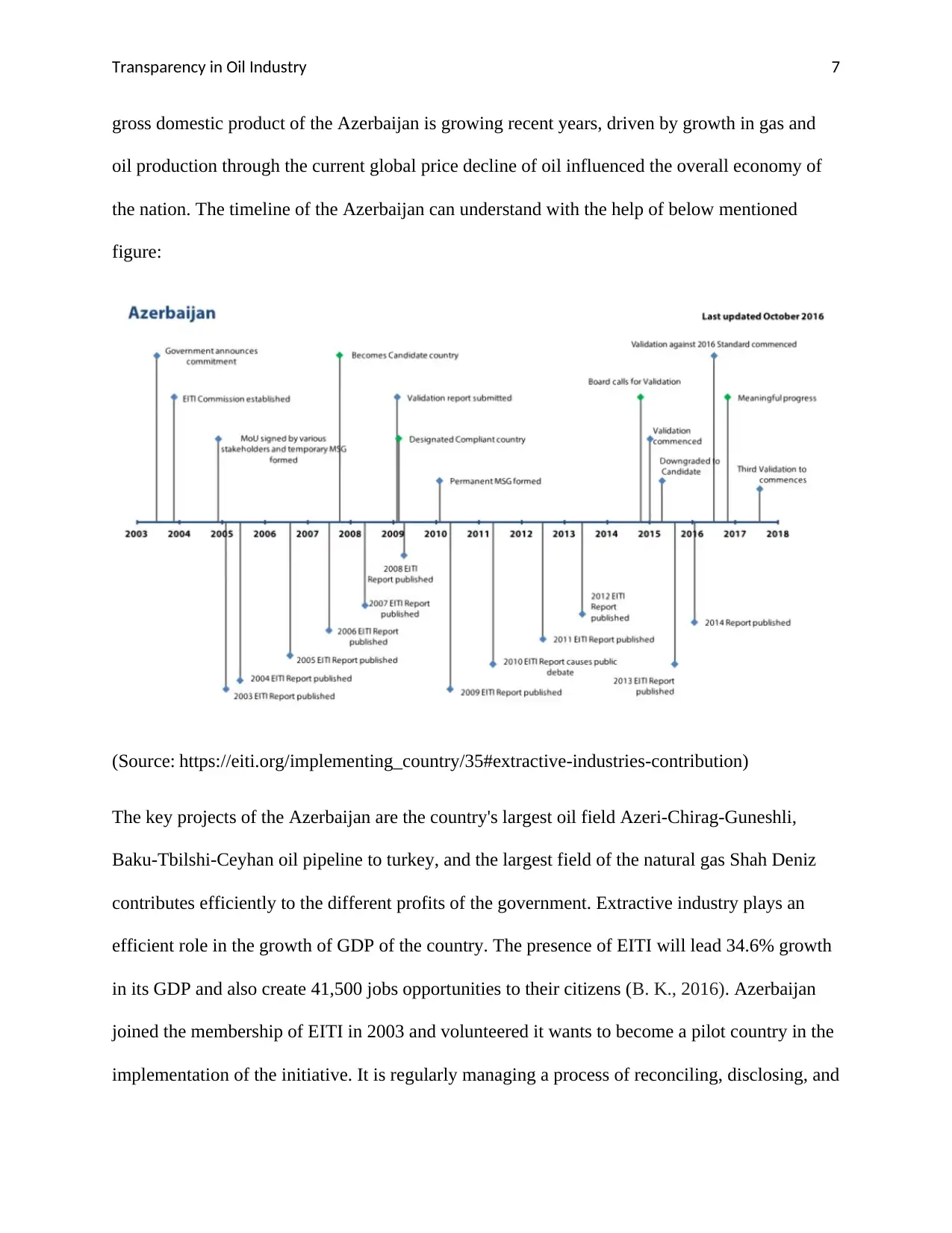
gross domestic product of the Azerbaijan is growing recent years, driven by growth in gas and
oil production through the current global price decline of oil influenced the overall economy of
the nation. The timeline of the Azerbaijan can understand with the help of below mentioned
figure:
(Source: https://eiti.org/implementing_country/35#extractive-industries-contribution)
The key projects of the Azerbaijan are the country's largest oil field Azeri-Chirag-Guneshli,
Baku-Tbilshi-Ceyhan oil pipeline to turkey, and the largest field of the natural gas Shah Deniz
contributes efficiently to the different profits of the government. Extractive industry plays an
efficient role in the growth of GDP of the country. The presence of EITI will lead 34.6% growth
in its GDP and also create 41,500 jobs opportunities to their citizens (B. K., 2016). Azerbaijan
joined the membership of EITI in 2003 and volunteered it wants to become a pilot country in the
implementation of the initiative. It is regularly managing a process of reconciling, disclosing, and
gross domestic product of the Azerbaijan is growing recent years, driven by growth in gas and
oil production through the current global price decline of oil influenced the overall economy of
the nation. The timeline of the Azerbaijan can understand with the help of below mentioned
figure:
(Source: https://eiti.org/implementing_country/35#extractive-industries-contribution)
The key projects of the Azerbaijan are the country's largest oil field Azeri-Chirag-Guneshli,
Baku-Tbilshi-Ceyhan oil pipeline to turkey, and the largest field of the natural gas Shah Deniz
contributes efficiently to the different profits of the government. Extractive industry plays an
efficient role in the growth of GDP of the country. The presence of EITI will lead 34.6% growth
in its GDP and also create 41,500 jobs opportunities to their citizens (B. K., 2016). Azerbaijan
joined the membership of EITI in 2003 and volunteered it wants to become a pilot country in the
implementation of the initiative. It is regularly managing a process of reconciling, disclosing, and
Transparency in Oil Industry 8
publishing payments of extractive sector organizations to the government and government
receipts from those organizations. The first EITI report of the Azerbaijan was published during
2005. In 2014, the EITI reported mainly focusing on implementation of the different initiative so
that report can be published as per the determined standards of EITI. Reconciliation is a process
led by the EITI initiatives. It brings recommendable growth in the economy of the country. After
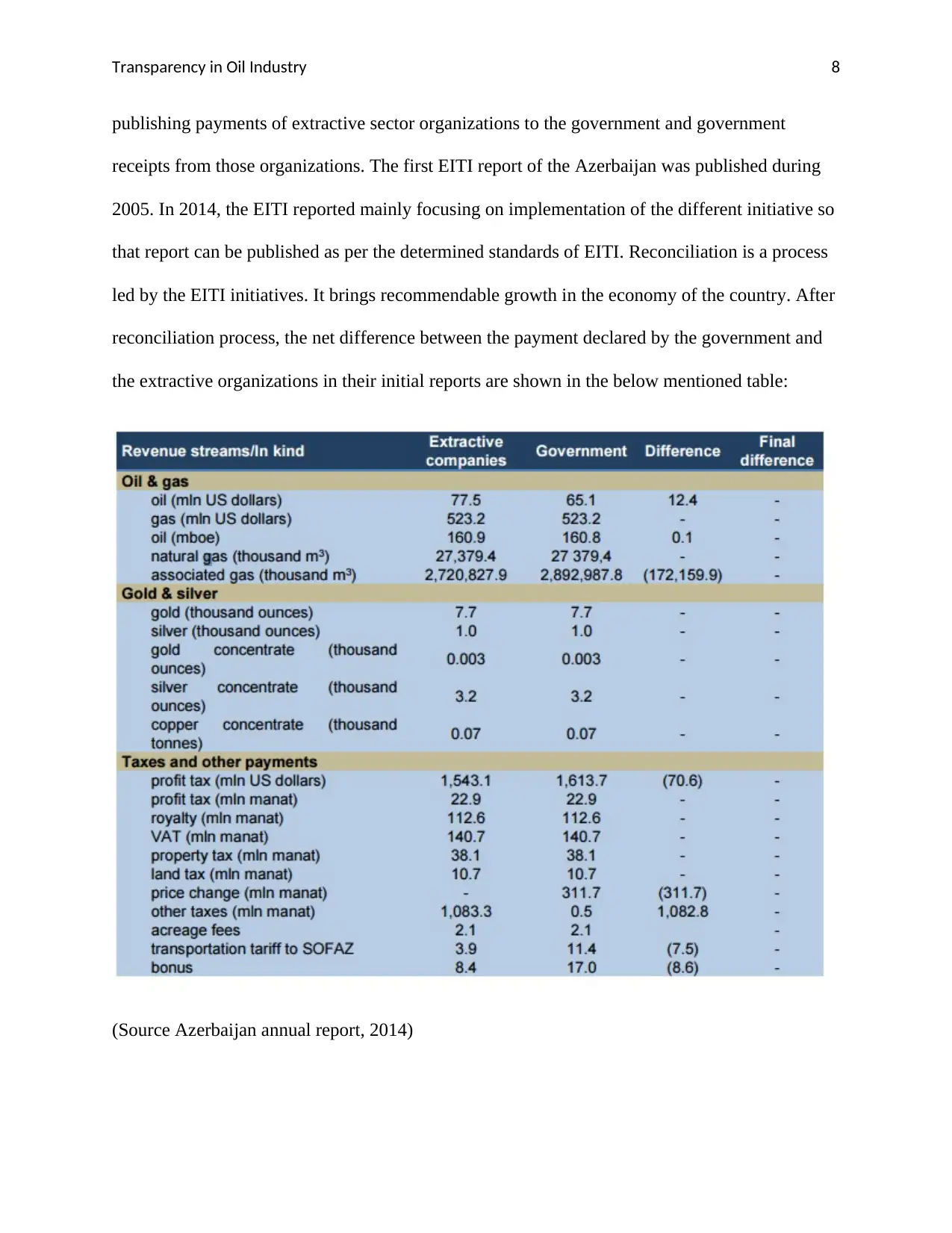
reconciliation process, the net difference between the payment declared by the government and
the extractive organizations in their initial reports are shown in the below mentioned table:
(Source Azerbaijan annual report, 2014)
publishing payments of extractive sector organizations to the government and government
receipts from those organizations. The first EITI report of the Azerbaijan was published during
2005. In 2014, the EITI reported mainly focusing on implementation of the different initiative so
that report can be published as per the determined standards of EITI. Reconciliation is a process
led by the EITI initiatives. It brings recommendable growth in the economy of the country. After
reconciliation process, the net difference between the payment declared by the government and
the extractive organizations in their initial reports are shown in the below mentioned table:
(Source Azerbaijan annual report, 2014)
⊘ This is a preview!⊘
Do you want full access?
Subscribe today to unlock all pages.
Trusted by 1+ million students worldwide
Transparency in Oil Industry 9
From the above-mentioned table, the significant difference between the oil and gas industries can
understand in an effective manner. Furthermore, it also contributed largely towards the
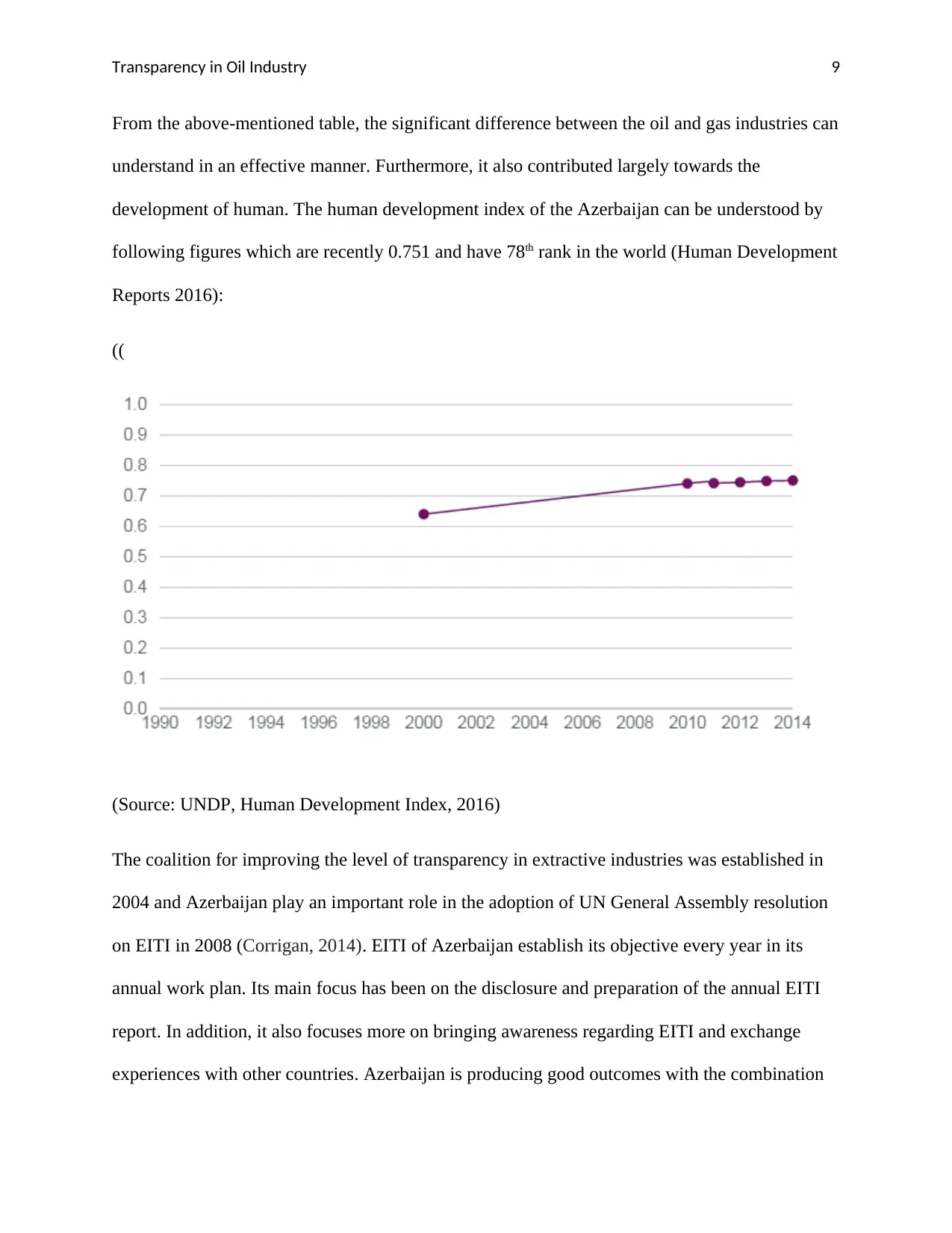
development of human. The human development index of the Azerbaijan can be understood by
following figures which are recently 0.751 and have 78th rank in the world (Human Development
Reports 2016):
((
(Source: UNDP, Human Development Index, 2016)
The coalition for improving the level of transparency in extractive industries was established in
2004 and Azerbaijan play an important role in the adoption of UN General Assembly resolution
on EITI in 2008 (Corrigan, 2014). EITI of Azerbaijan establish its objective every year in its
annual work plan. Its main focus has been on the disclosure and preparation of the annual EITI
report. In addition, it also focuses more on bringing awareness regarding EITI and exchange
experiences with other countries. Azerbaijan is producing good outcomes with the combination
From the above-mentioned table, the significant difference between the oil and gas industries can
understand in an effective manner. Furthermore, it also contributed largely towards the
development of human. The human development index of the Azerbaijan can be understood by
following figures which are recently 0.751 and have 78th rank in the world (Human Development
Reports 2016):
((
(Source: UNDP, Human Development Index, 2016)
The coalition for improving the level of transparency in extractive industries was established in
2004 and Azerbaijan play an important role in the adoption of UN General Assembly resolution
on EITI in 2008 (Corrigan, 2014). EITI of Azerbaijan establish its objective every year in its
annual work plan. Its main focus has been on the disclosure and preparation of the annual EITI
report. In addition, it also focuses more on bringing awareness regarding EITI and exchange
experiences with other countries. Azerbaijan is producing good outcomes with the combination
Paraphrase This Document
Need a fresh take? Get an instant paraphrase of this document with our AI Paraphraser
Transparency in Oil Industry 10
of the EITI initiatives. It is producing various positive outcomes for its success. Its success can
easily measure with its economic data which are shown in the below mentioned table (Sovacool,
2016):
Estimated reserve of approximate 7 billion barrels
18 PSAs: 5 offshore, 12 onshore
Estimated production of approximated 870,000 bpd
Largest field of oil: Azeri-Chirag-Guneshli (650,000 bpd)
GDP during 2013 43.4%
Revenue from export was approximate 92%
65.8% of the budget during 2013
Recent worth of the SOFAZ $37 billion
Oil resources in the Azerbaijan have been developed after the 1800s. After that time period, the
country represents recommendable changes in its development. During 1985 to 1991, the GDP
of the country also shrank by 17% which will bring huge changes in the oil and gas industry of
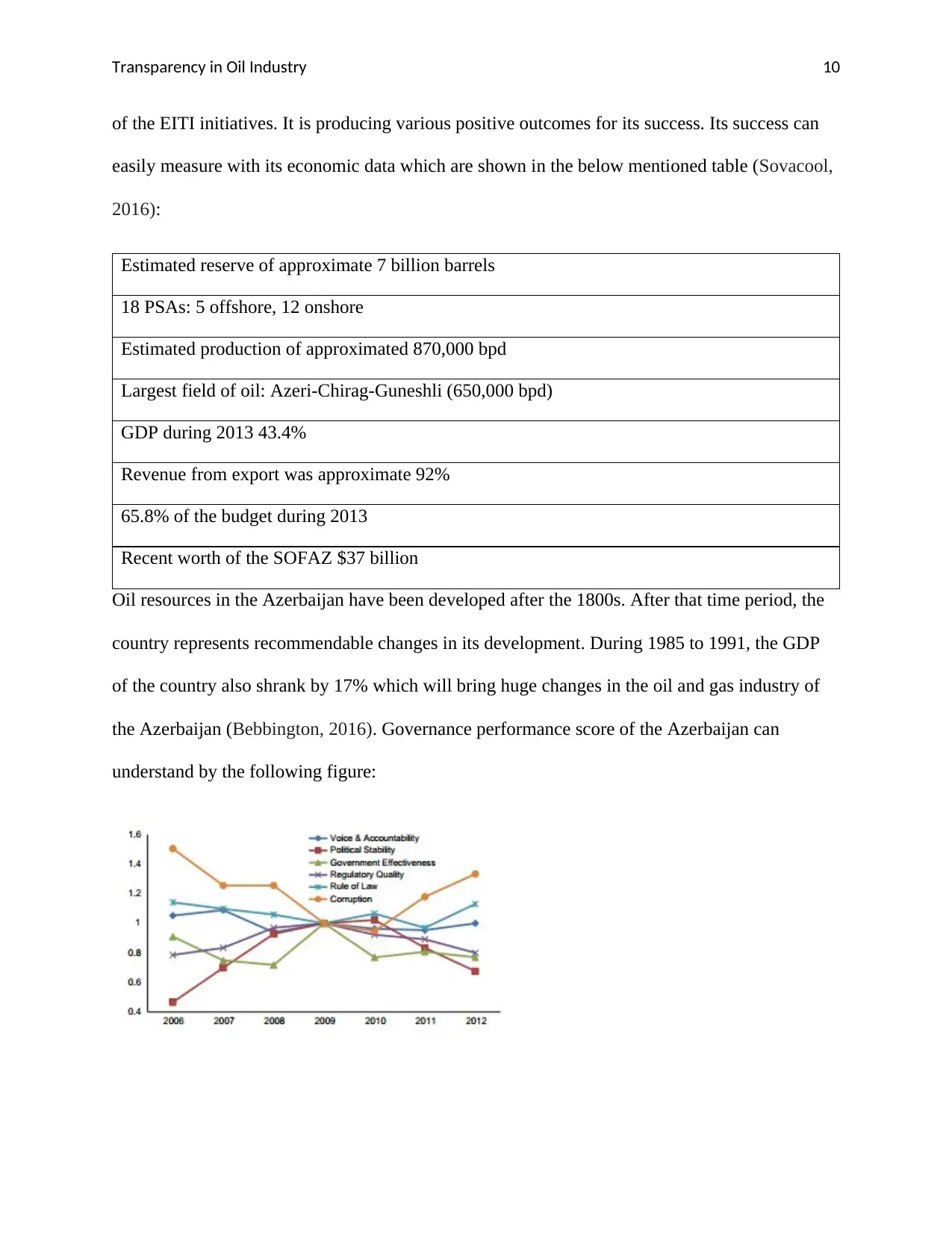
the Azerbaijan (Bebbington, 2016). Governance performance score of the Azerbaijan can
understand by the following figure:
of the EITI initiatives. It is producing various positive outcomes for its success. Its success can
easily measure with its economic data which are shown in the below mentioned table (Sovacool,
2016):
Estimated reserve of approximate 7 billion barrels
18 PSAs: 5 offshore, 12 onshore
Estimated production of approximated 870,000 bpd
Largest field of oil: Azeri-Chirag-Guneshli (650,000 bpd)
GDP during 2013 43.4%
Revenue from export was approximate 92%
65.8% of the budget during 2013
Recent worth of the SOFAZ $37 billion
Oil resources in the Azerbaijan have been developed after the 1800s. After that time period, the
country represents recommendable changes in its development. During 1985 to 1991, the GDP
of the country also shrank by 17% which will bring huge changes in the oil and gas industry of
the Azerbaijan (Bebbington, 2016). Governance performance score of the Azerbaijan can
understand by the following figure:
Transparency in Oil Industry 11
(Source: https://eiti.org/sites/default/files/documents/Sovacool%20%26%20Andrews
%20%5B2015%5D%20-%20Does%20transparency%20matter%20-%20%20Evaluating%20the
%20governance%20impacts%20of%20the%20Extractive%20Industries%20Transparency
%20Initiative%20(EITI)%20in%20Azerbaijan%20and%20Liberia.pdf)
The presence of EITI influences the development and governance of the country in a significant
manner. Availability of EITI helps the government of the country in collecting the necessary
information required for publication of payments from IOCs (Hawker, 2014). This will bring
positive outcomes for its success. It also enables the country in developing more government
accountability. This will reduce the transparency level of the expenditures which will
significantly influence its performance. It is necessary for a country to monitor its political
accountability which helpful in reducing the significant influence of different unforeseen factors.
On the other hand, social engagement of the country also created with the help of EITI.
Generally, it is said that presence of socio-political mischief works as a hurdle in building the
social engagement by implementing EITI (Hystad, 2014). It portrayed as an attempt to represent
the status quo and win the win the regime of an external respectability. On the home page of the
EITI, its president gives a statement that says "transparency will become one the important
ground for their success. All this brings efficiency in the management of different future
revenues of gas and oil and permits every citizen of the country to feel it in her or his daily life.
All this seems unclear because the country will not be able to reap the combined social, political
and economic beliefs regarding transparency. According to the independent evaluation of the
World Bank, it rates the EITI in Azerbaijan as highly effective in terms of profit transparency
measures. All these brings various growth opportunities for the oil and gas industry of the
country which ultimately enhance the GDP growth rate of the country.
(Source: https://eiti.org/sites/default/files/documents/Sovacool%20%26%20Andrews
%20%5B2015%5D%20-%20Does%20transparency%20matter%20-%20%20Evaluating%20the
%20governance%20impacts%20of%20the%20Extractive%20Industries%20Transparency
%20Initiative%20(EITI)%20in%20Azerbaijan%20and%20Liberia.pdf)
The presence of EITI influences the development and governance of the country in a significant
manner. Availability of EITI helps the government of the country in collecting the necessary
information required for publication of payments from IOCs (Hawker, 2014). This will bring
positive outcomes for its success. It also enables the country in developing more government
accountability. This will reduce the transparency level of the expenditures which will
significantly influence its performance. It is necessary for a country to monitor its political
accountability which helpful in reducing the significant influence of different unforeseen factors.
On the other hand, social engagement of the country also created with the help of EITI.
Generally, it is said that presence of socio-political mischief works as a hurdle in building the
social engagement by implementing EITI (Hystad, 2014). It portrayed as an attempt to represent
the status quo and win the win the regime of an external respectability. On the home page of the
EITI, its president gives a statement that says "transparency will become one the important
ground for their success. All this brings efficiency in the management of different future
revenues of gas and oil and permits every citizen of the country to feel it in her or his daily life.
All this seems unclear because the country will not be able to reap the combined social, political
and economic beliefs regarding transparency. According to the independent evaluation of the
World Bank, it rates the EITI in Azerbaijan as highly effective in terms of profit transparency
measures. All these brings various growth opportunities for the oil and gas industry of the
country which ultimately enhance the GDP growth rate of the country.
⊘ This is a preview!⊘
Do you want full access?
Subscribe today to unlock all pages.
Trusted by 1+ million students worldwide

1 out of 22


Related Documents


Your All-in-One AI-Powered Toolkit for Academic Success.
+13062052269
info@desklib.com
Available 24*7 on WhatsApp / Email
![[object Object]](/_next/static/media/star-bottom.7253800d.svg)
Unlock your academic potential
Copyright © 2020–2026 A2Z Services. All Rights Reserved. Developed and managed by ZUCOL.