University Report: Underground Coal Mining and Subsidence in Australia
VerifiedAdded on 2023/06/03
|20
|5006
|468
Report
AI Summary
This report provides a detailed analysis of underground coal mining practices in Australia, with a specific focus on the phenomenon of surface subsidence. It begins with an overview of the two primary mining methods used in Australia: underground and open-cut mining, highlighting their applications and economic considerations. The report then delves into the specifics of underground coal mining, particularly longwall mining, detailing its historical context and operational mechanics. It defines mine subsidence, explaining its causes and mechanisms, especially in the context of longwall mining. The report addresses the question of how longwall mining leads to surface subsidence, explaining the process of tunnel creation, pillar weakening, and subsequent ground collapse. It explores the methods used to predict surface subsidence, including empirical, analytical, and numerical approaches, and discusses the instruments and techniques used for monitoring ground movements. The report also discusses the potential environmental and societal impacts of mining subsidence and how these impacts are regulated in Australia.
Mining 1
UNDERGROUND COAL MINING
by (student name)
The Name of the Class (Course)
Professor or Tutor
University name
The City and State where it is located
The Date of submission
UNDERGROUND COAL MINING
by (student name)
The Name of the Class (Course)
Professor or Tutor
University name
The City and State where it is located
The Date of submission

Paraphrase This Document
Need a fresh take? Get an instant paraphrase of this document with our AI Paraphraser
Mining 2
Summery
This assignment describes the underground coal mining in Australia. The subsidence due to
underground coal mining have also been discussed.
The following questions have been discussed in details:
I. Definition of subsidence induced by underground coal mining
II. How longwall mining leads to surface subsidence
III. How to design a mining layout to minimize subsidence
IV. Potential impacts of mining subsidence and how they are regulated in Australia
Introduction
The two main mining method used in Australia to mine coal are underground mining and
open cut methods. Open mining method are applied in areas where mining is shallow. This
means the coal reserves can be accessed easily. The cost used in extracting should be
compensated by the coal mined, this is based on the feasible economic practice. The open mining
method uses blast or drilling to mine coal. Trucks and shovels may also be used (Caterpillar
2013)
Most of the underground mining in Australia are practiced in the low areas of NSW and
Queensland. Other areas also contain coal; however, underground method may not be used. the
main reason may be the quality of coal in these areas, which might be low. Other areas with coal
mining in Australia are collie, found in western Australia (Fernandez, Gonzalez ,Nicieza,,
Summery
This assignment describes the underground coal mining in Australia. The subsidence due to
underground coal mining have also been discussed.
The following questions have been discussed in details:
I. Definition of subsidence induced by underground coal mining
II. How longwall mining leads to surface subsidence
III. How to design a mining layout to minimize subsidence
IV. Potential impacts of mining subsidence and how they are regulated in Australia
Introduction
The two main mining method used in Australia to mine coal are underground mining and
open cut methods. Open mining method are applied in areas where mining is shallow. This
means the coal reserves can be accessed easily. The cost used in extracting should be
compensated by the coal mined, this is based on the feasible economic practice. The open mining
method uses blast or drilling to mine coal. Trucks and shovels may also be used (Caterpillar
2013)
Most of the underground mining in Australia are practiced in the low areas of NSW and
Queensland. Other areas also contain coal; however, underground method may not be used. the
main reason may be the quality of coal in these areas, which might be low. Other areas with coal
mining in Australia are collie, found in western Australia (Fernandez, Gonzalez ,Nicieza,,
Mining 3
Menendez, Diaz and Alvarez 2005) .The extent of damage of features found on the earth surface
has drastically increased with increasing need for coal. These damages are also increasing due to
population increase in mining areas.
In underground mining. Miners create tunnels, ways and routes which are used to access
the coal, some other coal pillars are left standing to provide support for the roof. The pillars left
may not support the roof for long, with time, the ground surface may collapse and debris move to
fill the empty underground spaces.
Mine subsidence has been defined by different scholars. One of the statutory definitions
is that based on the Illinois, stated as:
"Mine Subsidence “refers to ground movement, which maybe vertical, lateral or horizontal from
human made underground mining of coal’’. (Shahriar, Amoushahi and Arabzadeh 2009)
The mine subsidence define here does not include activities that do not pertain mine extraction
such as landslides or earthquakes.
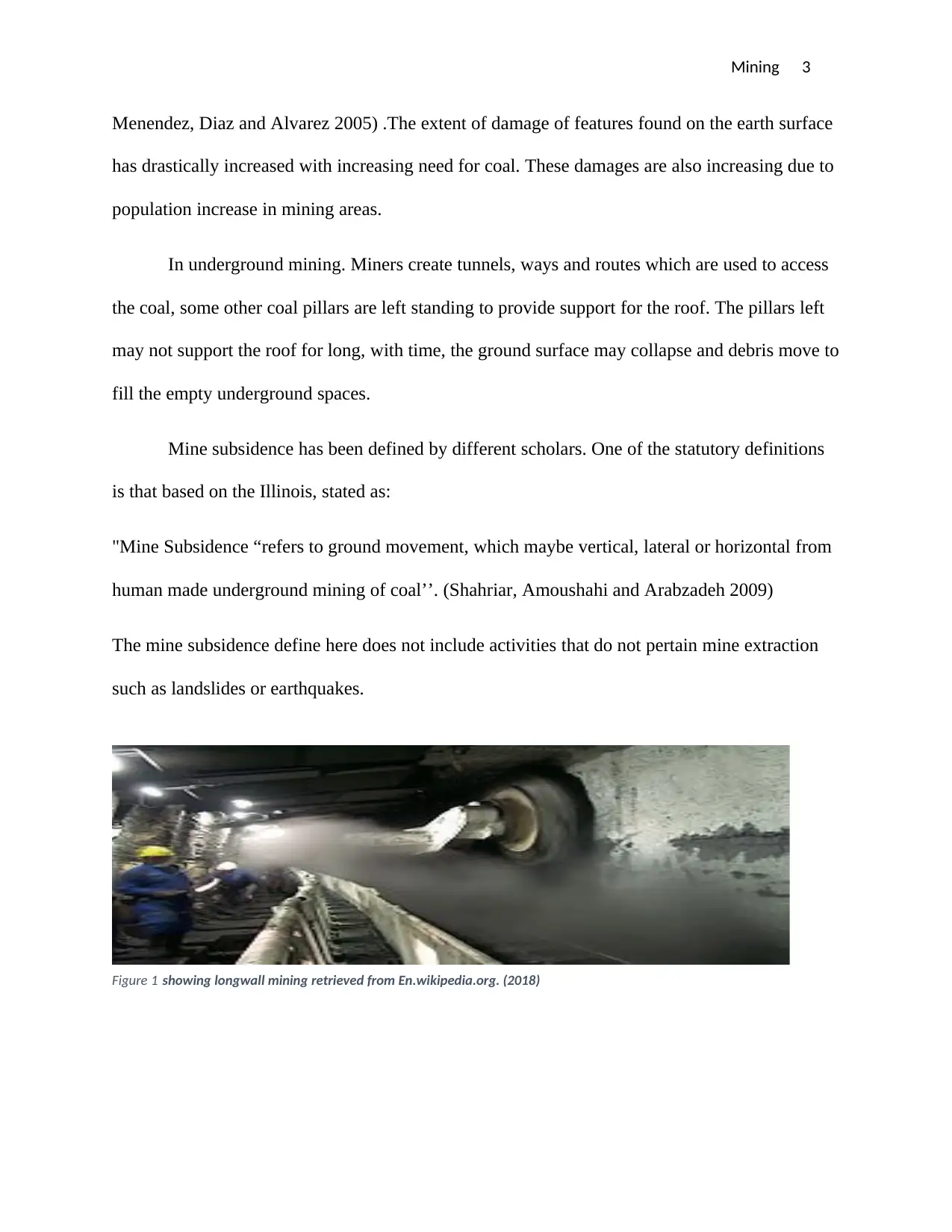
Figure 1 showing longwall mining retrieved from En.wikipedia.org. (2018)
Menendez, Diaz and Alvarez 2005) .The extent of damage of features found on the earth surface
has drastically increased with increasing need for coal. These damages are also increasing due to
population increase in mining areas.
In underground mining. Miners create tunnels, ways and routes which are used to access
the coal, some other coal pillars are left standing to provide support for the roof. The pillars left
may not support the roof for long, with time, the ground surface may collapse and debris move to
fill the empty underground spaces.
Mine subsidence has been defined by different scholars. One of the statutory definitions
is that based on the Illinois, stated as:
"Mine Subsidence “refers to ground movement, which maybe vertical, lateral or horizontal from
human made underground mining of coal’’. (Shahriar, Amoushahi and Arabzadeh 2009)
The mine subsidence define here does not include activities that do not pertain mine extraction
such as landslides or earthquakes.
Figure 1 showing longwall mining retrieved from En.wikipedia.org. (2018)
⊘ This is a preview!⊘
Do you want full access?
Subscribe today to unlock all pages.

Trusted by 1+ million students worldwide
Mining 4
One of the commonly used method of underground mining in extracting coal is longwall
mining. In this method, a large and long wall of the mineral is extracted in one-piece slice, with
dimensions ranging from 600 centimeters to 1000centimimeters. The whole block which is being
extracted has general dimensions of 3000-4000 meters, and width of between 260- 410 meters.
The longwall mining method was first introduced in the England during the 17th century.
Those extracting coal used to cut the coal on the width while taking out the loose coal mines,
they used wood and frames to support the roof from falling. The name shropfire was used to
refer to this longwall method of mining. Despite the improvements due to modern technology,
longwall mining idea still stands to be same as before. The main aim in every coal mining is to
extract the coal mines, and to leave a safe space for the miners. This means the roof should be
stable and not prone to any collapse (Asadi,, Shahriar, and Goshtasbi 2004)
The first underground coal mining started with use of tunnels and adits which were first
accessed from the top surface of the coal seams. These tunnels were risky, the practice was later
abolished. This was due to pollution in the tunnels caused by the methane gases burned to light
the tunnels. Open flames too lead to difficulties in working inside the underground tunnels.
The increasing demand for coal lead to modernization of underground mining, during
industrial revolution, shafts were used to access the deep coal reserves. The development in coal
mining technology rose far much, and by the late 19th century, most of the coal mined were from
the underground mining techniques. The coal wide spread mining was much felt between 1970
and 1980, its capacity increased by a higher percentage, majorly in those countries with vast coal
reserves, they include Australia, India, South Africa and United States of America. The coal
mining was renewed back in 1990, which lead to introduction of more coal mining areas in
Australia (an example is the Queensland in Australia) and by digging dip in the existing surface
One of the commonly used method of underground mining in extracting coal is longwall
mining. In this method, a large and long wall of the mineral is extracted in one-piece slice, with
dimensions ranging from 600 centimeters to 1000centimimeters. The whole block which is being
extracted has general dimensions of 3000-4000 meters, and width of between 260- 410 meters.
The longwall mining method was first introduced in the England during the 17th century.
Those extracting coal used to cut the coal on the width while taking out the loose coal mines,
they used wood and frames to support the roof from falling. The name shropfire was used to
refer to this longwall method of mining. Despite the improvements due to modern technology,
longwall mining idea still stands to be same as before. The main aim in every coal mining is to
extract the coal mines, and to leave a safe space for the miners. This means the roof should be
stable and not prone to any collapse (Asadi,, Shahriar, and Goshtasbi 2004)
The first underground coal mining started with use of tunnels and adits which were first
accessed from the top surface of the coal seams. These tunnels were risky, the practice was later
abolished. This was due to pollution in the tunnels caused by the methane gases burned to light
the tunnels. Open flames too lead to difficulties in working inside the underground tunnels.
The increasing demand for coal lead to modernization of underground mining, during
industrial revolution, shafts were used to access the deep coal reserves. The development in coal
mining technology rose far much, and by the late 19th century, most of the coal mined were from
the underground mining techniques. The coal wide spread mining was much felt between 1970
and 1980, its capacity increased by a higher percentage, majorly in those countries with vast coal
reserves, they include Australia, India, South Africa and United States of America. The coal
mining was renewed back in 1990, which lead to introduction of more coal mining areas in
Australia (an example is the Queensland in Australia) and by digging dip in the existing surface
Paraphrase This Document
Need a fresh take? Get an instant paraphrase of this document with our AI Paraphraser
Mining 5
mining areas (Aerial Topographic Laser Survey Systems 2012) The total coal mined rose to a
total of forty five percent in the mid nineteen nineties. this proportion varied depending on the
country, Australia had a total of thirty percent, with china leading with higher percentage.
Underground coal mining is applied only in areas with economic significance. Lignite coal and
brown coal is mined using open cut methods (Anderson, Patterson, and Nicholson 2007)
The underground coal mine majorly is divided into two significant areas, this are: coal
production part; the coal is carried to the foot of the collecting shaft; the coal could be
transported to the surface by using a conveyor belt of hoisting it up. The first area, production,
represents a major part in the underground coal mining, it also analyses the future responses
needed in accessing the underground coal mines.
The underground coal mining methods comprises of two significant methods, through
this mining methods, different variations and distinct ways have been realized, this has led to
solving problems that arise based on the condition for different environments. Room-and-pillar
mining uses tunnels or passages, which are road like on a common grid, the mining technique
sets up strong pillars to protect the roof from falling or collapsing hence preventing subsidence.
Longwall mining leads to total extraction of coal in the mines, this causes voids which later
causes subsidence (Atkinson 2008)
Q1. Definition of subsidence induced by underground coal mining
subsidence due to underground coal mining refers movement of the ground surface
material caused by readjustments of the existing weight materials when an underground coal
mine collapse (Peng 1992). The top surface layer is less affected, the problem is subsidence
could
mining areas (Aerial Topographic Laser Survey Systems 2012) The total coal mined rose to a
total of forty five percent in the mid nineteen nineties. this proportion varied depending on the
country, Australia had a total of thirty percent, with china leading with higher percentage.
Underground coal mining is applied only in areas with economic significance. Lignite coal and
brown coal is mined using open cut methods (Anderson, Patterson, and Nicholson 2007)
The underground coal mine majorly is divided into two significant areas, this are: coal
production part; the coal is carried to the foot of the collecting shaft; the coal could be
transported to the surface by using a conveyor belt of hoisting it up. The first area, production,
represents a major part in the underground coal mining, it also analyses the future responses
needed in accessing the underground coal mines.
The underground coal mining methods comprises of two significant methods, through
this mining methods, different variations and distinct ways have been realized, this has led to
solving problems that arise based on the condition for different environments. Room-and-pillar
mining uses tunnels or passages, which are road like on a common grid, the mining technique
sets up strong pillars to protect the roof from falling or collapsing hence preventing subsidence.
Longwall mining leads to total extraction of coal in the mines, this causes voids which later
causes subsidence (Atkinson 2008)
Q1. Definition of subsidence induced by underground coal mining
subsidence due to underground coal mining refers movement of the ground surface
material caused by readjustments of the existing weight materials when an underground coal
mine collapse (Peng 1992). The top surface layer is less affected, the problem is subsidence
could
Mining 6
affect the water resources by blocking the aquifers or water mixing with coal, this would result to
acidification. This underground coal mines not only induce acid to water but also causes
subsidence. Subsidence results when the pillars which used to support the roof of underground
coal mines weakens and hence collapsing, the voids will have to be filed up, hence causing
subsidence.
Q2. How longwall mining leads to surface subsidence
During longwall mining, a roadway or tunnel may be rigged into a coal seam, the digging
leads to a space in between the tunnels. The force exerted to the mines before tunneling will be
supported by the remaining coal on the tunnel sides. This number of roadways or tunnels keeps
increasing as miners explore more coal, in this process, small pillars of coal are left behind.
These pillars have to bear the overall increasing weight of the overhead roofs of tunnels. For this
case, few pillars left will have to contain the extra load which is as result of more coal mined.
The more load and forces exerted to remaining coal pillars exerts compression to the coal
seams around within the area of extraction. Finally, the pillars left becomes weak and may not be
able to support the tunnel roof. The adjacent roof strata sink and divides through bedding surface
making it collapse into the tunnel space (Sonmez, Gokceoglu, Nefeslioglu, and Kayabasi 2006).
Therefore, the subsidence of surface materials is caused by the collapse of roof strata that sinks
into the void left during the extraction. The whole mass debris along the collapsing strata fills the
void, immediate materials will follow. This movement extents to the top surface of the mine.
The results of longwall mining could be shallow surfaces on top of the mines surfaces.
These surfaces could be rectangular in shape, uniform or irregular shapes, the shallow surfaces
affect the water resources by blocking the aquifers or water mixing with coal, this would result to
acidification. This underground coal mines not only induce acid to water but also causes
subsidence. Subsidence results when the pillars which used to support the roof of underground
coal mines weakens and hence collapsing, the voids will have to be filed up, hence causing
subsidence.
Q2. How longwall mining leads to surface subsidence
During longwall mining, a roadway or tunnel may be rigged into a coal seam, the digging
leads to a space in between the tunnels. The force exerted to the mines before tunneling will be
supported by the remaining coal on the tunnel sides. This number of roadways or tunnels keeps
increasing as miners explore more coal, in this process, small pillars of coal are left behind.
These pillars have to bear the overall increasing weight of the overhead roofs of tunnels. For this
case, few pillars left will have to contain the extra load which is as result of more coal mined.
The more load and forces exerted to remaining coal pillars exerts compression to the coal
seams around within the area of extraction. Finally, the pillars left becomes weak and may not be
able to support the tunnel roof. The adjacent roof strata sink and divides through bedding surface
making it collapse into the tunnel space (Sonmez, Gokceoglu, Nefeslioglu, and Kayabasi 2006).
Therefore, the subsidence of surface materials is caused by the collapse of roof strata that sinks
into the void left during the extraction. The whole mass debris along the collapsing strata fills the
void, immediate materials will follow. This movement extents to the top surface of the mine.
The results of longwall mining could be shallow surfaces on top of the mines surfaces.
These surfaces could be rectangular in shape, uniform or irregular shapes, the shallow surfaces
⊘ This is a preview!⊘
Do you want full access?
Subscribe today to unlock all pages.
Trusted by 1+ million students worldwide
Mining 7
could at times be characterized by cracks, soil buckles and stumping. These effects would affect
the environment. The amount of subsidence due to longwall mining is approximated to be 60
percent in the area B this represents two to three meters of the vertical movement, which differs
from seams that are shallow (Slideshare.net 2018).
The vertical subsidence does not cause surface movement that may lead to damages.
Instead, the dangerous movements could be those that are as result of tilting, this causes
damages, as it causes lowering of top surface.
Other examples of surface mining methods which induces spaces in the underground
mines which could later collapse (this include extraction through the pillar method, long wall
mining and all other metalliferous mining techniques that uses carving") will lead to surface
subsidence. The magnitude of subsidence caused by underground mining can be relatively
predicted, its extent and manifestation can also be identified, exceptions includes areas where the
pillars are old, or mining is near the surface. The subsidence caused by underground mining
always occurs within the area of the workings. This indicates the subsidence will be localized
between a specific area, including the margin found outside the area. The vertical subsidence
does not cause surface movement that may lead to damages. Instead, the dangerous movements
could be those that are as result of tilting, this causes damages, as it causes lowering of top
surface. (Donnelly, De La Cruz, Asmar, Zapata, and Perez 2001)
The subsidence caused by underground mining could largely be minimized by practicing
good mining techniques and planning. This could be achieved by integrating the managing,
planning and repairing teams.
could at times be characterized by cracks, soil buckles and stumping. These effects would affect
the environment. The amount of subsidence due to longwall mining is approximated to be 60
percent in the area B this represents two to three meters of the vertical movement, which differs
from seams that are shallow (Slideshare.net 2018).
The vertical subsidence does not cause surface movement that may lead to damages.
Instead, the dangerous movements could be those that are as result of tilting, this causes
damages, as it causes lowering of top surface.
Other examples of surface mining methods which induces spaces in the underground
mines which could later collapse (this include extraction through the pillar method, long wall
mining and all other metalliferous mining techniques that uses carving") will lead to surface
subsidence. The magnitude of subsidence caused by underground mining can be relatively
predicted, its extent and manifestation can also be identified, exceptions includes areas where the
pillars are old, or mining is near the surface. The subsidence caused by underground mining
always occurs within the area of the workings. This indicates the subsidence will be localized
between a specific area, including the margin found outside the area. The vertical subsidence
does not cause surface movement that may lead to damages. Instead, the dangerous movements
could be those that are as result of tilting, this causes damages, as it causes lowering of top
surface. (Donnelly, De La Cruz, Asmar, Zapata, and Perez 2001)
The subsidence caused by underground mining could largely be minimized by practicing
good mining techniques and planning. This could be achieved by integrating the managing,
planning and repairing teams.
Paraphrase This Document
Need a fresh take? Get an instant paraphrase of this document with our AI Paraphraser
Mining 8
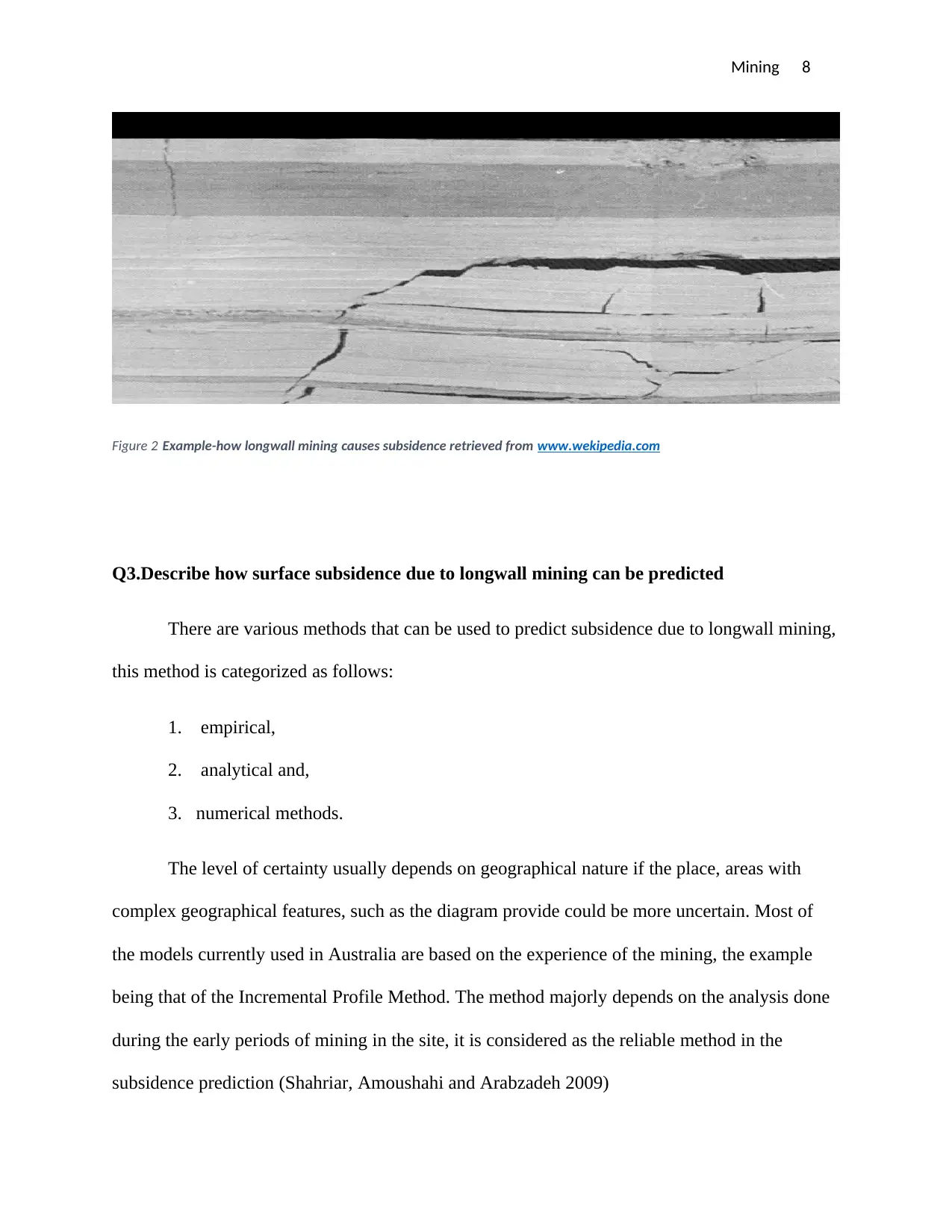
Figure 2 Example-how longwall mining causes subsidence retrieved from www.wekipedia.com
Q3.Describe how surface subsidence due to longwall mining can be predicted
There are various methods that can be used to predict subsidence due to longwall mining,
this method is categorized as follows:
1. empirical,
2. analytical and,
3. numerical methods.
The level of certainty usually depends on geographical nature if the place, areas with
complex geographical features, such as the diagram provide could be more uncertain. Most of
the models currently used in Australia are based on the experience of the mining, the example
being that of the Incremental Profile Method. The method majorly depends on the analysis done
during the early periods of mining in the site, it is considered as the reliable method in the
subsidence prediction (Shahriar, Amoushahi and Arabzadeh 2009)
Figure 2 Example-how longwall mining causes subsidence retrieved from www.wekipedia.com
Q3.Describe how surface subsidence due to longwall mining can be predicted
There are various methods that can be used to predict subsidence due to longwall mining,
this method is categorized as follows:
1. empirical,
2. analytical and,
3. numerical methods.
The level of certainty usually depends on geographical nature if the place, areas with
complex geographical features, such as the diagram provide could be more uncertain. Most of
the models currently used in Australia are based on the experience of the mining, the example
being that of the Incremental Profile Method. The method majorly depends on the analysis done
during the early periods of mining in the site, it is considered as the reliable method in the
subsidence prediction (Shahriar, Amoushahi and Arabzadeh 2009)
Mining 9
To use incremental profile method, the site needs to be subsequently developed and the
parameters needed to model the site have to be used. This will help in generating the prediction
profile and the resultant impacts. The overseeing of any occurrence of subsidence is needed to
help in accessing both manmade and natural facilities located on the surface or below the
expected subsidence area. for efficient prediction, the general knowledge of the subsidence
material should be established. The behavior of rocks and masses in the roadways should be
studied. The behavior of rocks and debris differs depending on the site which mining is done,
depth is a major factor that will also help in prediction, the shape of tunnels, the total amount of
minerals mined, the natural layout of the surface and the geological structure also determines the
prediction (Aerial Topographic Laser Survey Systems 2012)
Scientist have devised suitable instruments used to monitor the subsidence that could be
induced by coal mining. The technology monitors the ground movements and establishes the
level of subsidence. These techniques include airborne and satellite-based remote control and
sensing methods and underground monitoring using instruments such as extensometers, ground
surveys, piezometers, inclinometers and stress meters in vertical boreholes (Anderson, Patterson,
and Nicholson 2007)
The most common techniques used in Australia is the GPS. The GPS is a ground
monitoring method used to monitor the earth surface behavior. However, remote controlled
sensing methods such as Light Detection and Ranging (LiDAR) are taking the current market in
subsidence detection, this is because they are accurate, cost effective and this makes the viable.
The techniques used to predict subsidence due to underground coal mining falls under three
categories (Shahriar, Amoushahi and Arabzadeh 2009):
To use incremental profile method, the site needs to be subsequently developed and the
parameters needed to model the site have to be used. This will help in generating the prediction
profile and the resultant impacts. The overseeing of any occurrence of subsidence is needed to
help in accessing both manmade and natural facilities located on the surface or below the
expected subsidence area. for efficient prediction, the general knowledge of the subsidence
material should be established. The behavior of rocks and masses in the roadways should be
studied. The behavior of rocks and debris differs depending on the site which mining is done,
depth is a major factor that will also help in prediction, the shape of tunnels, the total amount of
minerals mined, the natural layout of the surface and the geological structure also determines the
prediction (Aerial Topographic Laser Survey Systems 2012)
Scientist have devised suitable instruments used to monitor the subsidence that could be
induced by coal mining. The technology monitors the ground movements and establishes the
level of subsidence. These techniques include airborne and satellite-based remote control and
sensing methods and underground monitoring using instruments such as extensometers, ground
surveys, piezometers, inclinometers and stress meters in vertical boreholes (Anderson, Patterson,
and Nicholson 2007)
The most common techniques used in Australia is the GPS. The GPS is a ground
monitoring method used to monitor the earth surface behavior. However, remote controlled
sensing methods such as Light Detection and Ranging (LiDAR) are taking the current market in
subsidence detection, this is because they are accurate, cost effective and this makes the viable.
The techniques used to predict subsidence due to underground coal mining falls under three
categories (Shahriar, Amoushahi and Arabzadeh 2009):
⊘ This is a preview!⊘
Do you want full access?
Subscribe today to unlock all pages.
Trusted by 1+ million students worldwide
Mining 10
empirical, this is done by analyzing the material strength using back analysis, the data is
obtained based on field performance of the pillars.
analytical and numerical methods, the behavior of the rocks is calculated. This is
achieved by using the mathematical applications. The solutions may be obtained from
mathematical principles. This will help in knowing the behavior of rocks when mining is
done
hybrid or combination methods, the method involves using both the two methods stated
above, that is.
The above methods are well established and would give accurate information. Accuracy may
be within 100mm, which will depend on the state of the mining area, either complex or simple.
Accuracy for all the techniques should be considered. The input parameters used will depend on
the site, these parameters will output the level of expected subsidence. Care should be considered
in analyzing new sites, this is because there is no specific data that can be used to predict the
subsidence. Extraction of panels needs to be done, and instruments calibrated. The data of the
site should also be validated. Reliable perfections will be done later and validating the first
parameters. (Shahriar., Amoushahi and Arabzadeh 2009)
Based on experience, the magnitude of subsidence varies so much. The size of coals
seams extracted and subsidence resulted may be irrational. The NSW predicts that subsidence
may be sixty five percent compared to the underground coal mines performed. (Shahriar.,
Amoushahi and Arabzadeh, 2009)
As for my case, I would prefer using analytical methods to predict subsidence due to
longwall mining. To perform the prediction, the behavior of the rocks is calculated. This
empirical, this is done by analyzing the material strength using back analysis, the data is
obtained based on field performance of the pillars.
analytical and numerical methods, the behavior of the rocks is calculated. This is
achieved by using the mathematical applications. The solutions may be obtained from
mathematical principles. This will help in knowing the behavior of rocks when mining is
done
hybrid or combination methods, the method involves using both the two methods stated
above, that is.
The above methods are well established and would give accurate information. Accuracy may
be within 100mm, which will depend on the state of the mining area, either complex or simple.
Accuracy for all the techniques should be considered. The input parameters used will depend on
the site, these parameters will output the level of expected subsidence. Care should be considered
in analyzing new sites, this is because there is no specific data that can be used to predict the
subsidence. Extraction of panels needs to be done, and instruments calibrated. The data of the
site should also be validated. Reliable perfections will be done later and validating the first
parameters. (Shahriar., Amoushahi and Arabzadeh 2009)
Based on experience, the magnitude of subsidence varies so much. The size of coals
seams extracted and subsidence resulted may be irrational. The NSW predicts that subsidence
may be sixty five percent compared to the underground coal mines performed. (Shahriar.,
Amoushahi and Arabzadeh, 2009)
As for my case, I would prefer using analytical methods to predict subsidence due to
longwall mining. To perform the prediction, the behavior of the rocks is calculated. This
Paraphrase This Document
Need a fresh take? Get an instant paraphrase of this document with our AI Paraphraser
Mining 11
is achieved by using the mathematical applications. The solutions may be obtained from
mathematical principles. This will help in knowing the behavior of rocks when mining is
done and hence predicting the subsidence that may occur in the process of longwall
mining.
Q4. How to design a mining layout to minimize subsidence
To design a mining layout, various considerations must be adhered to. Analysis must be
done to identify or predict any subsidence that could occur.
Considerations to make in designing a mining layout
well supported roadways or tunnels
cost effective design
low subsidence impacts.
The brackets to be modeled must be stable
Events which are associated with are geological structures must be modeled.
To achieve a good design, it is important to explain why the underground mines
collapse, this will help us know exactly what we have to overcome.
The reasons were as listed below;
1. The support structure may not be symmetrical, that is, the coal left to support the
tunnels may be weak or not symmetrical
2. The history of rocks or mining in the region
3. Places in which dykes and fault lines exist or intersect
4. Frequent earthquakes in areas of mines
is achieved by using the mathematical applications. The solutions may be obtained from
mathematical principles. This will help in knowing the behavior of rocks when mining is
done and hence predicting the subsidence that may occur in the process of longwall
mining.
Q4. How to design a mining layout to minimize subsidence
To design a mining layout, various considerations must be adhered to. Analysis must be
done to identify or predict any subsidence that could occur.
Considerations to make in designing a mining layout
well supported roadways or tunnels
cost effective design
low subsidence impacts.
The brackets to be modeled must be stable
Events which are associated with are geological structures must be modeled.
To achieve a good design, it is important to explain why the underground mines
collapse, this will help us know exactly what we have to overcome.
The reasons were as listed below;
1. The support structure may not be symmetrical, that is, the coal left to support the
tunnels may be weak or not symmetrical
2. The history of rocks or mining in the region
3. Places in which dykes and fault lines exist or intersect
4. Frequent earthquakes in areas of mines
Mining 12
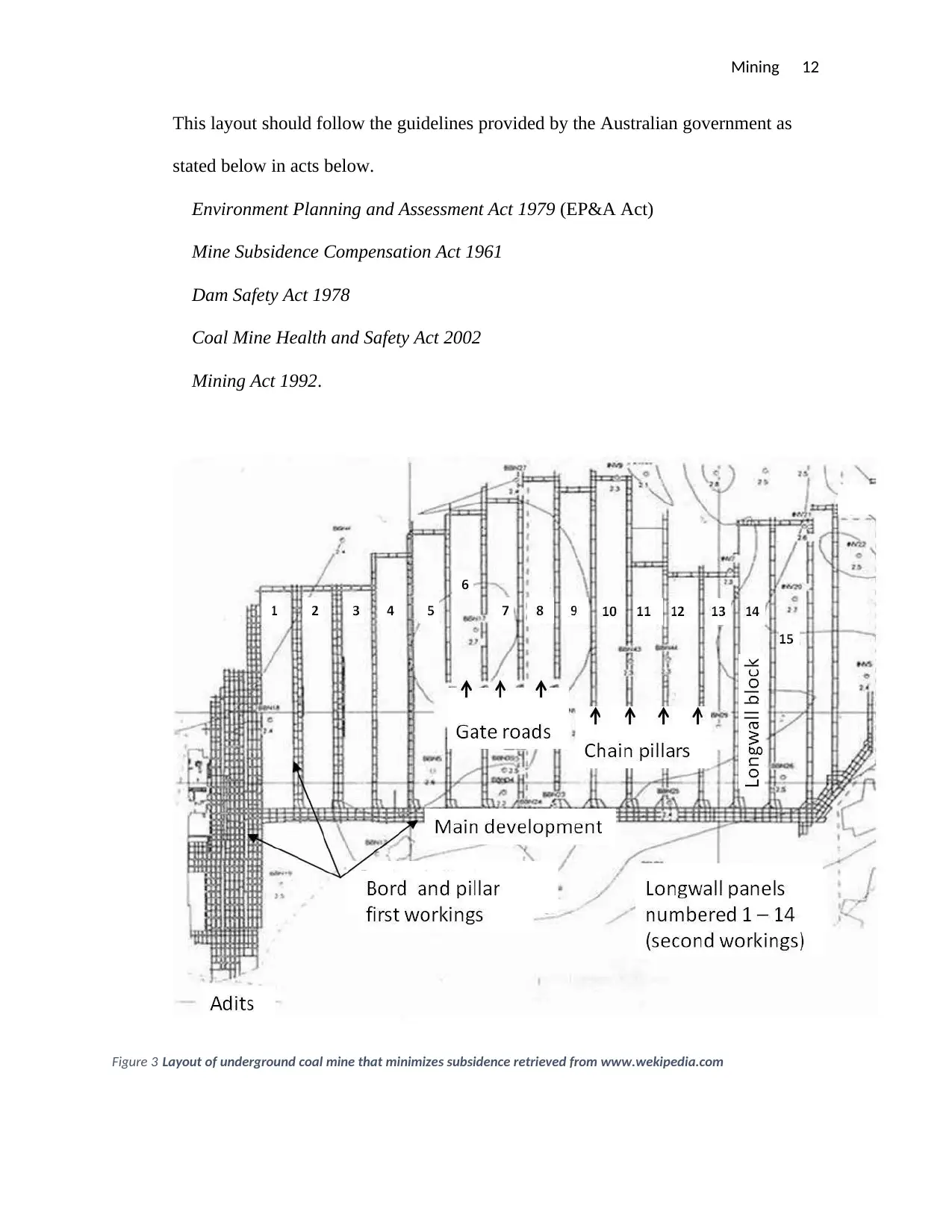
This layout should follow the guidelines provided by the Australian government as
stated below in acts below.
Environment Planning and Assessment Act 1979 (EP&A Act)
Mine Subsidence Compensation Act 1961
Dam Safety Act 1978
Coal Mine Health and Safety Act 2002
Mining Act 1992.
Figure 3 Layout of underground coal mine that minimizes subsidence retrieved from www.wekipedia.com
This layout should follow the guidelines provided by the Australian government as
stated below in acts below.
Environment Planning and Assessment Act 1979 (EP&A Act)
Mine Subsidence Compensation Act 1961
Dam Safety Act 1978
Coal Mine Health and Safety Act 2002
Mining Act 1992.
Figure 3 Layout of underground coal mine that minimizes subsidence retrieved from www.wekipedia.com
⊘ This is a preview!⊘
Do you want full access?
Subscribe today to unlock all pages.
Trusted by 1+ million students worldwide

1 out of 20


Related Documents


Your All-in-One AI-Powered Toolkit for Academic Success.
+13062052269
info@desklib.com
Available 24*7 on WhatsApp / Email
![[object Object]](/_next/static/media/star-bottom.7253800d.svg)
Unlock your academic potential
Copyright © 2020–2025 A2Z Services. All Rights Reserved. Developed and managed by ZUCOL.