Research Project: Legislation's Influence on Health and Social Care
VerifiedAdded on 2020/07/22
|18
|4200
|93
Report
AI Summary
This report presents a comprehensive research project focused on the influence of legislation within the health and social care sector, specifically examining its impact on service users and operational practices. The project begins with an investigation into the research area, defining aims, objectives, and ethical considerations. A literature review explores relevant legislations, such as the Health and Safety Act 1974 and the Equality Act 2010, and their effects on service user rights and organizational operations. The methodology section compares qualitative and quantitative research approaches, detailing primary and secondary data collection methods, as well as tools for data analysis, including thematic analysis. The importance of data validity and reliability is also addressed. The project outlines support sources, timelines, and research methods, including research questions and justification for the chosen methods. Data recording, collation, and analysis are described, leading to conclusions, reflections, and recommendations. The report also discusses the potential uses for the research findings. Overall, the report highlights the importance of legislation in protecting service users and ensuring effective health and social care practices.
Undertake a research project within
services for health and social care or
children and young people
services for health and social care or
children and young people

Paraphrase This Document
Need a fresh take? Get an instant paraphrase of this document with our AI Paraphraser
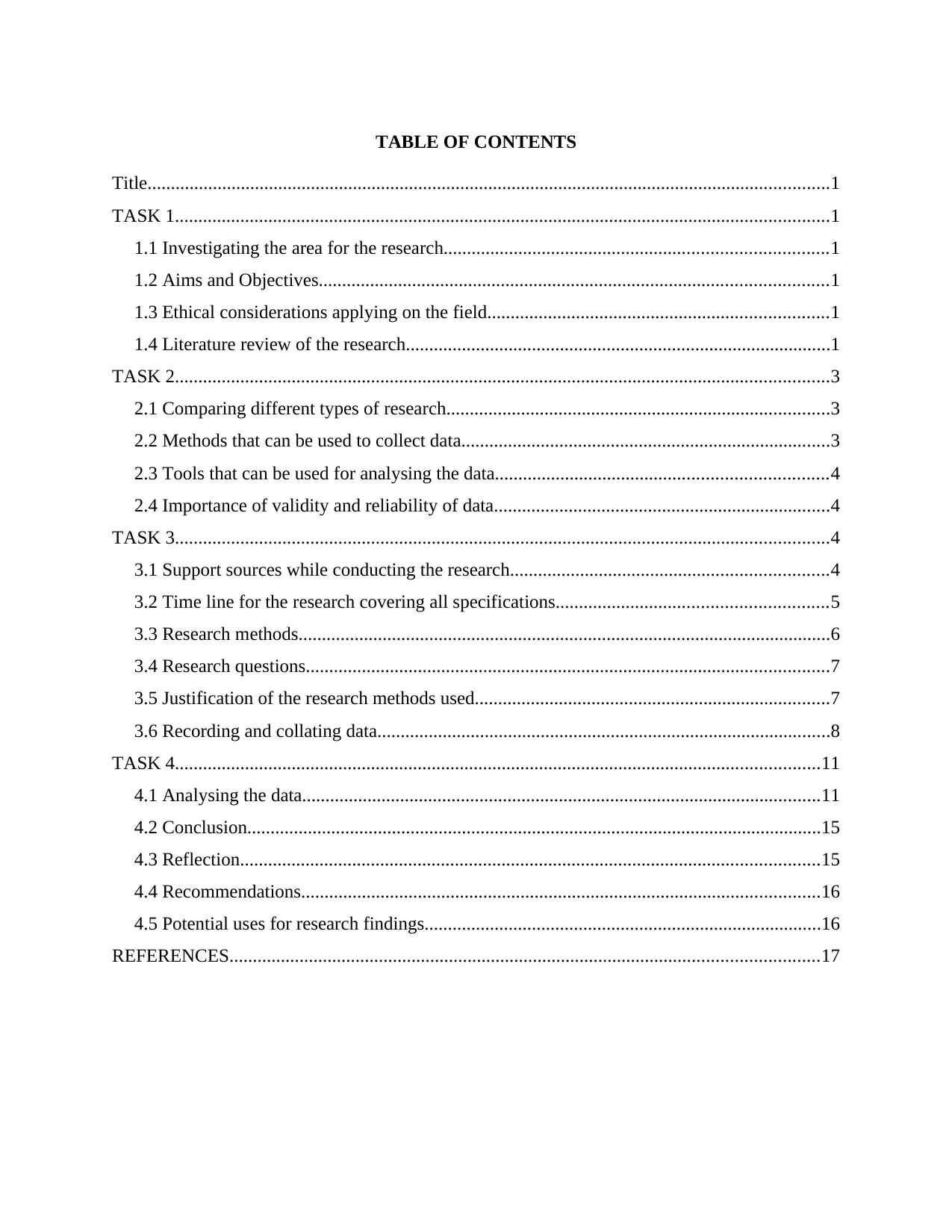
TABLE OF CONTENTS
Title..................................................................................................................................................1
TASK 1............................................................................................................................................1
1.1 Investigating the area for the research..................................................................................1
1.2 Aims and Objectives.............................................................................................................1
1.3 Ethical considerations applying on the field.........................................................................1
1.4 Literature review of the research...........................................................................................1
TASK 2............................................................................................................................................3
2.1 Comparing different types of research..................................................................................3
2.2 Methods that can be used to collect data...............................................................................3
2.3 Tools that can be used for analysing the data.......................................................................4
2.4 Importance of validity and reliability of data........................................................................4
TASK 3............................................................................................................................................4
3.1 Support sources while conducting the research....................................................................4
3.2 Time line for the research covering all specifications..........................................................5
3.3 Research methods..................................................................................................................6
3.4 Research questions................................................................................................................7
3.5 Justification of the research methods used............................................................................7
3.6 Recording and collating data.................................................................................................8
TASK 4..........................................................................................................................................11
4.1 Analysing the data...............................................................................................................11
4.2 Conclusion...........................................................................................................................15
4.3 Reflection............................................................................................................................15
4.4 Recommendations...............................................................................................................16
4.5 Potential uses for research findings.....................................................................................16
REFERENCES..............................................................................................................................17
Title..................................................................................................................................................1
TASK 1............................................................................................................................................1
1.1 Investigating the area for the research..................................................................................1
1.2 Aims and Objectives.............................................................................................................1
1.3 Ethical considerations applying on the field.........................................................................1
1.4 Literature review of the research...........................................................................................1
TASK 2............................................................................................................................................3
2.1 Comparing different types of research..................................................................................3
2.2 Methods that can be used to collect data...............................................................................3
2.3 Tools that can be used for analysing the data.......................................................................4
2.4 Importance of validity and reliability of data........................................................................4
TASK 3............................................................................................................................................4
3.1 Support sources while conducting the research....................................................................4
3.2 Time line for the research covering all specifications..........................................................5
3.3 Research methods..................................................................................................................6
3.4 Research questions................................................................................................................7
3.5 Justification of the research methods used............................................................................7
3.6 Recording and collating data.................................................................................................8
TASK 4..........................................................................................................................................11
4.1 Analysing the data...............................................................................................................11
4.2 Conclusion...........................................................................................................................15
4.3 Reflection............................................................................................................................15
4.4 Recommendations...............................................................................................................16
4.5 Potential uses for research findings.....................................................................................16
REFERENCES..............................................................................................................................17
Title
To understand different legislations that can have a positive influence on the service users
and operations in the nursing care.
TASK 1
1.1 Investigating the area for the research
The area of the research project is wide enough as it is to identify various types of
legislations associated with the health and social sector that can have some positive influence on
the operations and service users that are acting in the health and social sector (Jack and Groves,
2015). So, it can be considered as an effective topic that can actually involve ways to provide the
people an efficient and appropriate set of services.
1.2 Aims and Objectives
The aim and objectives of the following research are given as under :
Aim
To discuss the legislations that have an efficient influence on the service users and other
operations in the health and social care.
Objectives
To analyse different legislations of the health and social sector on different factors.
To analyse the impact of legislations on increasing the rights of service users.
To recommend ways of analysing the impact of different legislations on service users
and operations in the health and social care.
1.3 Ethical considerations applying on the field
Ethics are considered as the standards that can be used at the time of the conduct which
helps in making efficient differences between what is right and what is wrong. So, ethical
considerations that can be applied to the area involves the fact that if in case, in some health and
social care, any employee etc. is facing some sort of discrimination etc., then at that time ethical
considerations can help in promoting the use of some legislations that can prove effective enough
for resolving the issue. So, this is the role of ethical considerations in the health and social care.
1.4 Literature review of the research
On the basis of the basic aim of the research, some objectives have been defined, on the
basis of which a review can be performed. So, the review is discussed as under :
1
To understand different legislations that can have a positive influence on the service users
and operations in the nursing care.
TASK 1
1.1 Investigating the area for the research
The area of the research project is wide enough as it is to identify various types of
legislations associated with the health and social sector that can have some positive influence on
the operations and service users that are acting in the health and social sector (Jack and Groves,
2015). So, it can be considered as an effective topic that can actually involve ways to provide the
people an efficient and appropriate set of services.
1.2 Aims and Objectives
The aim and objectives of the following research are given as under :
Aim
To discuss the legislations that have an efficient influence on the service users and other
operations in the health and social care.
Objectives
To analyse different legislations of the health and social sector on different factors.
To analyse the impact of legislations on increasing the rights of service users.
To recommend ways of analysing the impact of different legislations on service users
and operations in the health and social care.
1.3 Ethical considerations applying on the field
Ethics are considered as the standards that can be used at the time of the conduct which
helps in making efficient differences between what is right and what is wrong. So, ethical
considerations that can be applied to the area involves the fact that if in case, in some health and
social care, any employee etc. is facing some sort of discrimination etc., then at that time ethical
considerations can help in promoting the use of some legislations that can prove effective enough
for resolving the issue. So, this is the role of ethical considerations in the health and social care.
1.4 Literature review of the research
On the basis of the basic aim of the research, some objectives have been defined, on the
basis of which a review can be performed. So, the review is discussed as under :
1
⊘ This is a preview!⊘
Do you want full access?
Subscribe today to unlock all pages.

Trusted by 1+ million students worldwide
Different legislations of the health and social sector
Although there are various laws and policies associated with the health and social care
that have a positive impact on the service users and so on the operations of the care homes, but
some very well known examples can be considered as the health and safety act 1974, Equality
Act 2010 etc. The health and safety act considers the fact that as the employees are working in
the nursing home, if any accident or incident happens, then it is the responsibility of the health
and social care to provide immediate services and treatments to the person. Whether it is about
admitting in the hospital or about providing support and care, it is completely the responsibility
of the nursing care home at that time (Folland, Goodman and Stano, 2016). So, an efficiency in
cooperating with the person is necessary as according to the regulations of the Act. Also, there is
an Equality act 2010 which considers the fact that there should be no sort of discrimination in the
health and social sector because when a person is admitted, the changed environment throws
some impact on their mental stability. So, to avoid any such complication, the law can be applied
in all the health and social care organisations. Whether it is related to age, caste, colour etc., it is
not at all allowed in a health care. Also, the ones found guilty in this act may have to pay huge
penalties and also may lead to the imprisonment. So, every organisation under health and social
care should ensure the implementation of these laws so that the whole processing can be done in
an effective and appropriate manner.
Impact of legislations on increasing the rights of service users
These legislations can be considered as a factor by which the employees and other
members working in such organisations can feel safe enough. It is important for the health and
social sector to keep it maintained to avoid any sort of complicated or complex situations
because when a person is admitted in such an environment that is different from the external one,
it somehow affects their mental stability to an extent (Jack and Groves, 2015). Therefore, it can
be considered that it is a factor that the people in such care homes even can feel secure that
nothing bad will happen to them, whether it is about the discrimination or mis behaving with
anyone. It is because there are proper rules and legislations that have been developed by the
government for protecting the rights of the individuals. As an individual, it is the right of
everyone to live as the way they want. So, they do not deserve any sort of mis behave or
discrimination, whether on any basis such as colour, race etc. Thus, these policies and
2
Although there are various laws and policies associated with the health and social care
that have a positive impact on the service users and so on the operations of the care homes, but
some very well known examples can be considered as the health and safety act 1974, Equality
Act 2010 etc. The health and safety act considers the fact that as the employees are working in
the nursing home, if any accident or incident happens, then it is the responsibility of the health
and social care to provide immediate services and treatments to the person. Whether it is about
admitting in the hospital or about providing support and care, it is completely the responsibility
of the nursing care home at that time (Folland, Goodman and Stano, 2016). So, an efficiency in
cooperating with the person is necessary as according to the regulations of the Act. Also, there is
an Equality act 2010 which considers the fact that there should be no sort of discrimination in the
health and social sector because when a person is admitted, the changed environment throws
some impact on their mental stability. So, to avoid any such complication, the law can be applied
in all the health and social care organisations. Whether it is related to age, caste, colour etc., it is
not at all allowed in a health care. Also, the ones found guilty in this act may have to pay huge
penalties and also may lead to the imprisonment. So, every organisation under health and social
care should ensure the implementation of these laws so that the whole processing can be done in
an effective and appropriate manner.
Impact of legislations on increasing the rights of service users
These legislations can be considered as a factor by which the employees and other
members working in such organisations can feel safe enough. It is important for the health and
social sector to keep it maintained to avoid any sort of complicated or complex situations
because when a person is admitted in such an environment that is different from the external one,
it somehow affects their mental stability to an extent (Jack and Groves, 2015). Therefore, it can
be considered that it is a factor that the people in such care homes even can feel secure that
nothing bad will happen to them, whether it is about the discrimination or mis behaving with
anyone. It is because there are proper rules and legislations that have been developed by the
government for protecting the rights of the individuals. As an individual, it is the right of
everyone to live as the way they want. So, they do not deserve any sort of mis behave or
discrimination, whether on any basis such as colour, race etc. Thus, these policies and
2
Paraphrase This Document
Need a fresh take? Get an instant paraphrase of this document with our AI Paraphraser
legislations help in protecting the rights of the people so that they can also live a happier and
healthier life.
TASK 2
2.1 Comparing different types of research
There are two types of research and both of them are discussed as under :
Qualitative research
Qualitative research is considered as a method that is associated with various academic
disciplines and there is a sort of relation with the theoretical area. A very well known and
common example of this can be considered as the thematic analysis in which there is the
presence of the qualitative area without any mathematical or statistical area or expression.
Quantitative research
Quantitative research is considered as a method that makes involvement of the statistical
techniques for achieving the objectives (Ell, 2018). So, it can be classified that this analysis
makes involvement of statistical, mathematical and also some computational techniques. The
focus here is on the statistical data rather than the theoretical one.
2.2 Methods that can be used to collect data
There are two methods that can be used to gather the information and data for an
effective processing of the research and these are discussed as under :
Primary method
Primary collection of data is considered as the method in which the data is being gathered
at the first time and after it gets collected, the same can be used for the research. There are
various different sources of collecting the primary data and some common examples of it can be
considered as the focused groups, interviews, surveys etc. in this research, the researcher will
make use of the primary data because it will help in analysing better about the impact of different
legislations on the services and service suers in the health and social care.
Secondary method
Secondary collection of data is considered as the way in which the data and information
has been already collected by some other external body and the same information can be used by
the researcher for making it more efficient and appropriate. Various sources of this method of
collecting the information involves online, books, journals etc. In this research, the researcher
3
healthier life.
TASK 2
2.1 Comparing different types of research
There are two types of research and both of them are discussed as under :
Qualitative research
Qualitative research is considered as a method that is associated with various academic
disciplines and there is a sort of relation with the theoretical area. A very well known and
common example of this can be considered as the thematic analysis in which there is the
presence of the qualitative area without any mathematical or statistical area or expression.
Quantitative research
Quantitative research is considered as a method that makes involvement of the statistical
techniques for achieving the objectives (Ell, 2018). So, it can be classified that this analysis
makes involvement of statistical, mathematical and also some computational techniques. The
focus here is on the statistical data rather than the theoretical one.
2.2 Methods that can be used to collect data
There are two methods that can be used to gather the information and data for an
effective processing of the research and these are discussed as under :
Primary method
Primary collection of data is considered as the method in which the data is being gathered
at the first time and after it gets collected, the same can be used for the research. There are
various different sources of collecting the primary data and some common examples of it can be
considered as the focused groups, interviews, surveys etc. in this research, the researcher will
make use of the primary data because it will help in analysing better about the impact of different
legislations on the services and service suers in the health and social care.
Secondary method
Secondary collection of data is considered as the way in which the data and information
has been already collected by some other external body and the same information can be used by
the researcher for making it more efficient and appropriate. Various sources of this method of
collecting the information involves online, books, journals etc. In this research, the researcher
3
will make use of the primary data instead of the secondary one because the primary data can
seem suitable for this research to achieve the objectives.
2.3 Tools that can be used for analysing the data
The tools that can be used for analysing the information and data are discussed as under :
Thematic analysis
Thematic analysis is considered as the analysis which considers the qualitative evaluation
of all the information and data that is being used for the research. It involves the theoretical
framework because it can seem suitable and relevant enough for achieving the objectives and
targets of the research.
Statistical analysis
Statistical analysis means the involvement of mathematical or statistical data and also, it
can mean the involvement of SPSS techniques for collecting all the required information and
data. But in this research, the researcher will make use of the thematic analysis because it can
help in getting appropriate results that can prove effective for the research as well.
2.4 Importance of validity and reliability of data
Validity and reliability, both are considered as important aspects that can help in
analysing the effectiveness and quality of the research. Reliability is classified as the total rate in
which consistent results can be obtained using the help of an assessment tool. On the other hand,
validity helps in providing the details of the sound ability of the complete research is. It means
the degree to check whether every factor has been specified or not properly. So, validity and
reliability are classified as those factors that helps in checking the effectiveness, standard and
quality of the data so that it can act efficient enough for achieving the objectives and targets of
the research.
TASK 3
3.1 Support sources while conducting the research
There are various sources that must be required at the time of conducting the research and
some well known examples are discussed as under :
Cost
It is obvious enough that when the researcher will investigate for different amount of data
and information for making the research effective, there must be requiring some resources as
4
seem suitable for this research to achieve the objectives.
2.3 Tools that can be used for analysing the data
The tools that can be used for analysing the information and data are discussed as under :
Thematic analysis
Thematic analysis is considered as the analysis which considers the qualitative evaluation
of all the information and data that is being used for the research. It involves the theoretical
framework because it can seem suitable and relevant enough for achieving the objectives and
targets of the research.
Statistical analysis
Statistical analysis means the involvement of mathematical or statistical data and also, it
can mean the involvement of SPSS techniques for collecting all the required information and
data. But in this research, the researcher will make use of the thematic analysis because it can
help in getting appropriate results that can prove effective for the research as well.
2.4 Importance of validity and reliability of data
Validity and reliability, both are considered as important aspects that can help in
analysing the effectiveness and quality of the research. Reliability is classified as the total rate in
which consistent results can be obtained using the help of an assessment tool. On the other hand,
validity helps in providing the details of the sound ability of the complete research is. It means
the degree to check whether every factor has been specified or not properly. So, validity and
reliability are classified as those factors that helps in checking the effectiveness, standard and
quality of the data so that it can act efficient enough for achieving the objectives and targets of
the research.
TASK 3
3.1 Support sources while conducting the research
There are various sources that must be required at the time of conducting the research and
some well known examples are discussed as under :
Cost
It is obvious enough that when the researcher will investigate for different amount of data
and information for making the research effective, there must be requiring some resources as
4
⊘ This is a preview!⊘
Do you want full access?
Subscribe today to unlock all pages.
Trusted by 1+ million students worldwide
well (Jack and Groves, 2015). A very well known and common example of this can be
considered as the cost factor because it is efficient enough that an appropriate amount of cost will
be required for collecting all the required data for the research.
Time
Along with the cost, an efficient amount of time will be required as well. In some cases,
the researcher wants to expand the time of the research in order to make it more appropriate but
there is a risk factor in that as at this time, some factors can act barriers if the time is expanded.
So, it is better for the researcher to complete the report in a given deadline only so that no factor
can act as a challenge or barrier afterwards.
3.2 Time line for the research covering all specifications
Basis Week
1
Week 2 Week 3 Week 4 Week 5 Week 6 Week 7 Week 8
Identificati
on area of
the
research
Developing
the aim
Developing
the
objectives.
Range of
methods
and tools
for
collecting
and
analysing
5
considered as the cost factor because it is efficient enough that an appropriate amount of cost will
be required for collecting all the required data for the research.
Time
Along with the cost, an efficient amount of time will be required as well. In some cases,
the researcher wants to expand the time of the research in order to make it more appropriate but
there is a risk factor in that as at this time, some factors can act barriers if the time is expanded.
So, it is better for the researcher to complete the report in a given deadline only so that no factor
can act as a challenge or barrier afterwards.
3.2 Time line for the research covering all specifications
Basis Week
1
Week 2 Week 3 Week 4 Week 5 Week 6 Week 7 Week 8
Identificati
on area of
the
research
Developing
the aim
Developing
the
objectives.
Range of
methods
and tools
for
collecting
and
analysing
5
Paraphrase This Document
Need a fresh take? Get an instant paraphrase of this document with our AI Paraphraser
the data
Implementa
tion of
Research
methodolog
y
Gathering
the
primary
data
Analysis
and
interpretati
on of data
Conclusion
3.3 Research methods
Research is considered as an effective way of collecting all the facts and features that can
help in making the whole research more effective and appropriate. There are various aspects of
the research methodology and some of them are discussed as following :
Research approach
Research approach is considered as a proper method that can be involved by the
researcher to make the research more effective and appropriate. There are two ways on the basis
of which research approach can be classified such as inductive and deductive. The deductive
approach is considered as the one that deals with aimed objectives whereas the inductive
approach is associated with the emerging of new theories. In this research, the researcher will
make use of the deductive approach because in analysing the impact of legislations on the
services and service users does not need the development of new theory as in case of inductive
approach. Thus, the researcher will make use of the deductive one.
6
Implementa
tion of
Research
methodolog
y
Gathering
the
primary
data
Analysis
and
interpretati
on of data
Conclusion
3.3 Research methods
Research is considered as an effective way of collecting all the facts and features that can
help in making the whole research more effective and appropriate. There are various aspects of
the research methodology and some of them are discussed as following :
Research approach
Research approach is considered as a proper method that can be involved by the
researcher to make the research more effective and appropriate. There are two ways on the basis
of which research approach can be classified such as inductive and deductive. The deductive
approach is considered as the one that deals with aimed objectives whereas the inductive
approach is associated with the emerging of new theories. In this research, the researcher will
make use of the deductive approach because in analysing the impact of legislations on the
services and service users does not need the development of new theory as in case of inductive
approach. Thus, the researcher will make use of the deductive one.
6
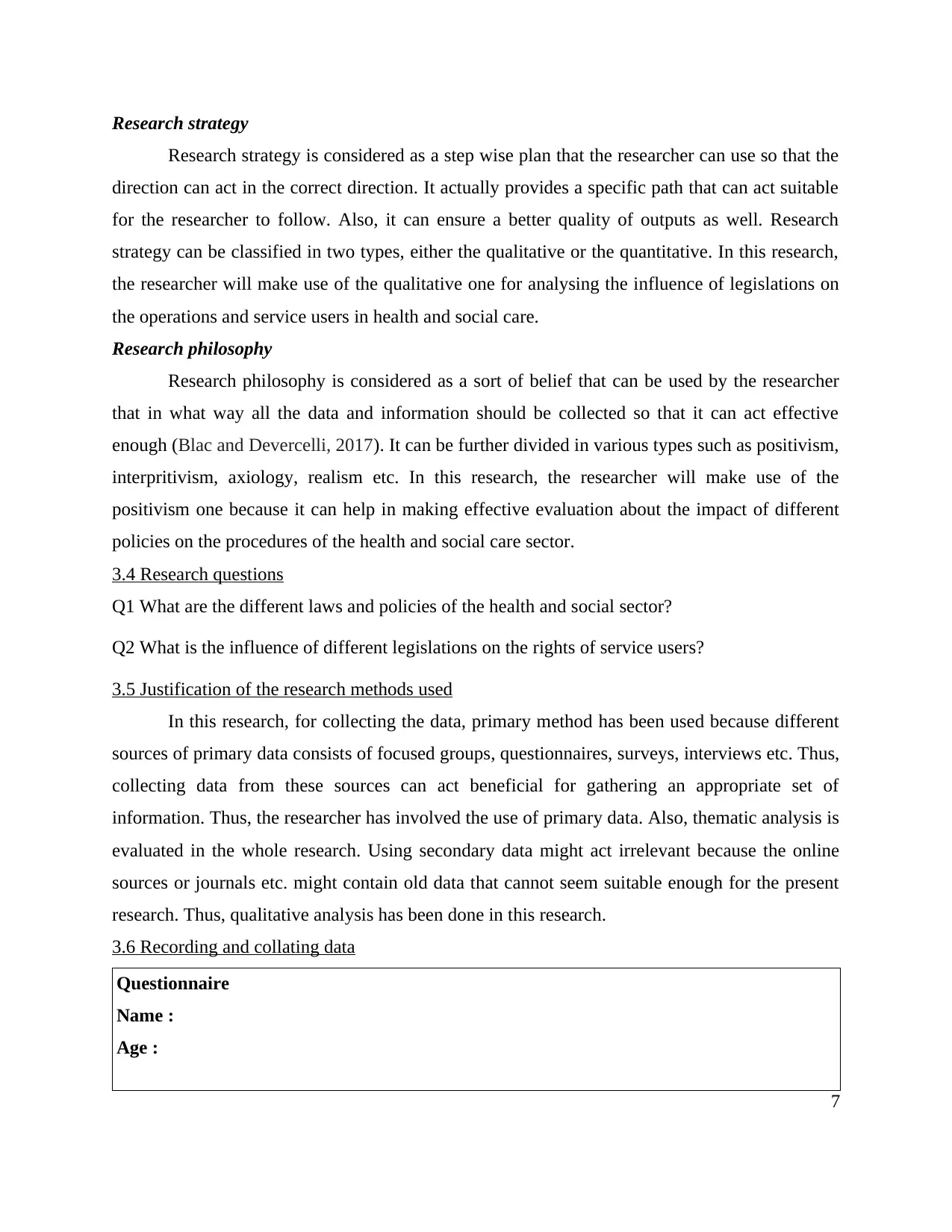
Research strategy
Research strategy is considered as a step wise plan that the researcher can use so that the
direction can act in the correct direction. It actually provides a specific path that can act suitable
for the researcher to follow. Also, it can ensure a better quality of outputs as well. Research
strategy can be classified in two types, either the qualitative or the quantitative. In this research,
the researcher will make use of the qualitative one for analysing the influence of legislations on
the operations and service users in health and social care.
Research philosophy
Research philosophy is considered as a sort of belief that can be used by the researcher
that in what way all the data and information should be collected so that it can act effective
enough (Blac and Devercelli, 2017). It can be further divided in various types such as positivism,
interpritivism, axiology, realism etc. In this research, the researcher will make use of the
positivism one because it can help in making effective evaluation about the impact of different
policies on the procedures of the health and social care sector.
3.4 Research questions
Q1 What are the different laws and policies of the health and social sector?
Q2 What is the influence of different legislations on the rights of service users?
3.5 Justification of the research methods used
In this research, for collecting the data, primary method has been used because different
sources of primary data consists of focused groups, questionnaires, surveys, interviews etc. Thus,
collecting data from these sources can act beneficial for gathering an appropriate set of
information. Thus, the researcher has involved the use of primary data. Also, thematic analysis is
evaluated in the whole research. Using secondary data might act irrelevant because the online
sources or journals etc. might contain old data that cannot seem suitable enough for the present
research. Thus, qualitative analysis has been done in this research.
3.6 Recording and collating data
Questionnaire
Name :
Age :
7
Research strategy is considered as a step wise plan that the researcher can use so that the
direction can act in the correct direction. It actually provides a specific path that can act suitable
for the researcher to follow. Also, it can ensure a better quality of outputs as well. Research
strategy can be classified in two types, either the qualitative or the quantitative. In this research,
the researcher will make use of the qualitative one for analysing the influence of legislations on
the operations and service users in health and social care.
Research philosophy
Research philosophy is considered as a sort of belief that can be used by the researcher
that in what way all the data and information should be collected so that it can act effective
enough (Blac and Devercelli, 2017). It can be further divided in various types such as positivism,
interpritivism, axiology, realism etc. In this research, the researcher will make use of the
positivism one because it can help in making effective evaluation about the impact of different
policies on the procedures of the health and social care sector.
3.4 Research questions
Q1 What are the different laws and policies of the health and social sector?
Q2 What is the influence of different legislations on the rights of service users?
3.5 Justification of the research methods used
In this research, for collecting the data, primary method has been used because different
sources of primary data consists of focused groups, questionnaires, surveys, interviews etc. Thus,
collecting data from these sources can act beneficial for gathering an appropriate set of
information. Thus, the researcher has involved the use of primary data. Also, thematic analysis is
evaluated in the whole research. Using secondary data might act irrelevant because the online
sources or journals etc. might contain old data that cannot seem suitable enough for the present
research. Thus, qualitative analysis has been done in this research.
3.6 Recording and collating data
Questionnaire
Name :
Age :
7
⊘ This is a preview!⊘
Do you want full access?
Subscribe today to unlock all pages.
Trusted by 1+ million students worldwide
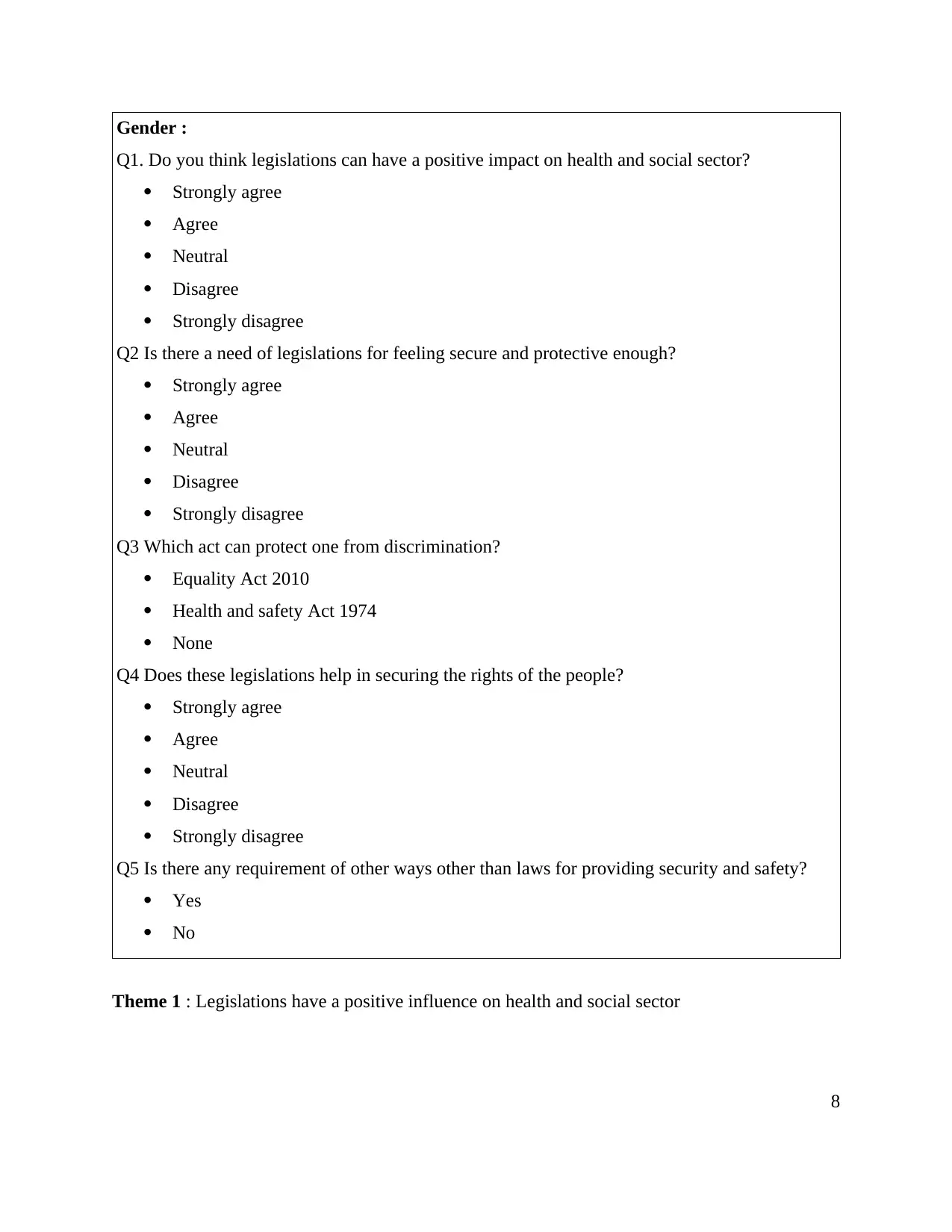
Gender :
Q1. Do you think legislations can have a positive impact on health and social sector?
Strongly agree
Agree
Neutral
Disagree
Strongly disagree
Q2 Is there a need of legislations for feeling secure and protective enough?
Strongly agree
Agree
Neutral
Disagree
Strongly disagree
Q3 Which act can protect one from discrimination?
Equality Act 2010
Health and safety Act 1974
None
Q4 Does these legislations help in securing the rights of the people?
Strongly agree
Agree
Neutral
Disagree
Strongly disagree
Q5 Is there any requirement of other ways other than laws for providing security and safety?
Yes
No
Theme 1 : Legislations have a positive influence on health and social sector
8
Q1. Do you think legislations can have a positive impact on health and social sector?
Strongly agree
Agree
Neutral
Disagree
Strongly disagree
Q2 Is there a need of legislations for feeling secure and protective enough?
Strongly agree
Agree
Neutral
Disagree
Strongly disagree
Q3 Which act can protect one from discrimination?
Equality Act 2010
Health and safety Act 1974
None
Q4 Does these legislations help in securing the rights of the people?
Strongly agree
Agree
Neutral
Disagree
Strongly disagree
Q5 Is there any requirement of other ways other than laws for providing security and safety?
Yes
No
Theme 1 : Legislations have a positive influence on health and social sector
8
Paraphrase This Document
Need a fresh take? Get an instant paraphrase of this document with our AI Paraphraser
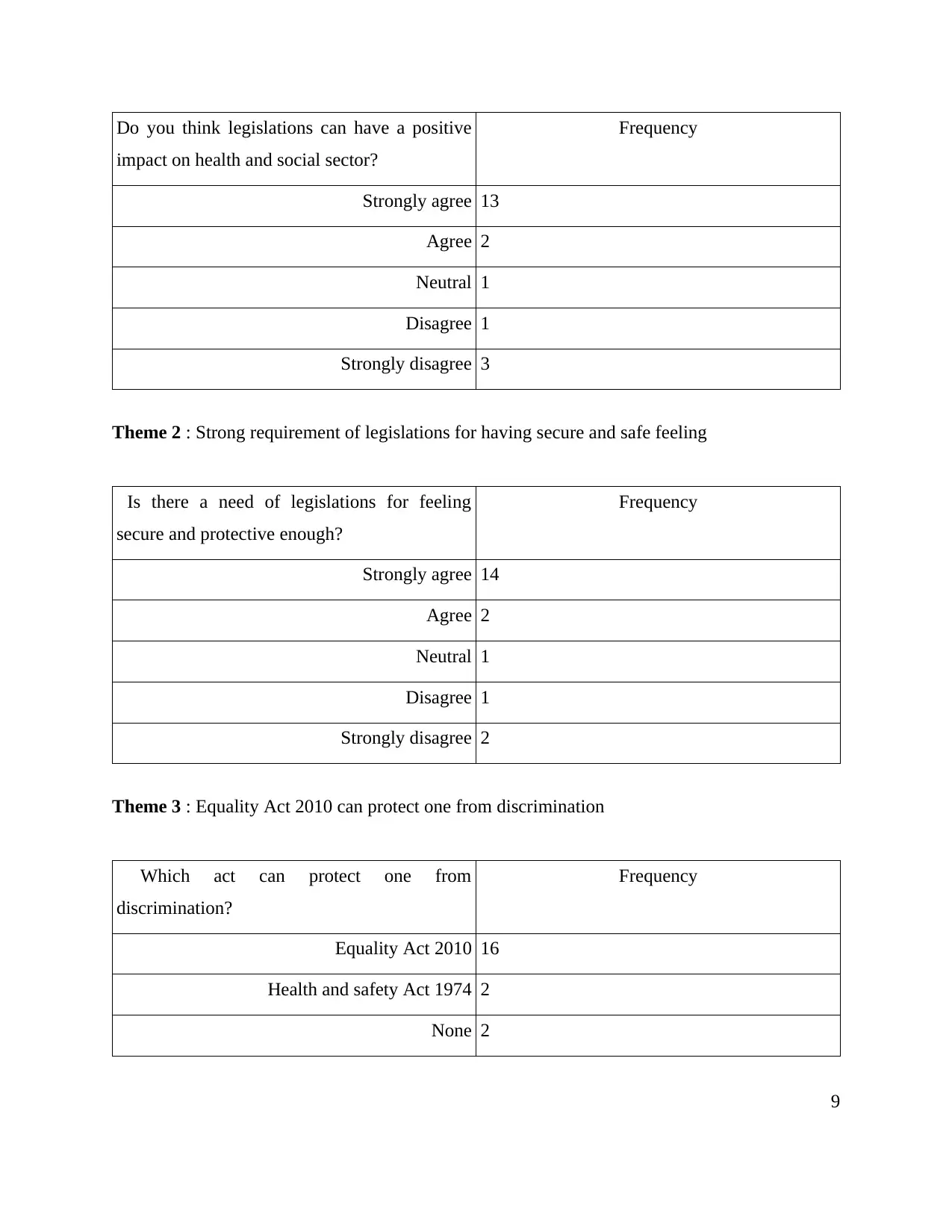
Do you think legislations can have a positive
impact on health and social sector?
Frequency
Strongly agree 13
Agree 2
Neutral 1
Disagree 1
Strongly disagree 3
Theme 2 : Strong requirement of legislations for having secure and safe feeling
Is there a need of legislations for feeling
secure and protective enough?
Frequency
Strongly agree 14
Agree 2
Neutral 1
Disagree 1
Strongly disagree 2
Theme 3 : Equality Act 2010 can protect one from discrimination
Which act can protect one from
discrimination?
Frequency
Equality Act 2010 16
Health and safety Act 1974 2
None 2
9
impact on health and social sector?
Frequency
Strongly agree 13
Agree 2
Neutral 1
Disagree 1
Strongly disagree 3
Theme 2 : Strong requirement of legislations for having secure and safe feeling
Is there a need of legislations for feeling
secure and protective enough?
Frequency
Strongly agree 14
Agree 2
Neutral 1
Disagree 1
Strongly disagree 2
Theme 3 : Equality Act 2010 can protect one from discrimination
Which act can protect one from
discrimination?
Frequency
Equality Act 2010 16
Health and safety Act 1974 2
None 2
9
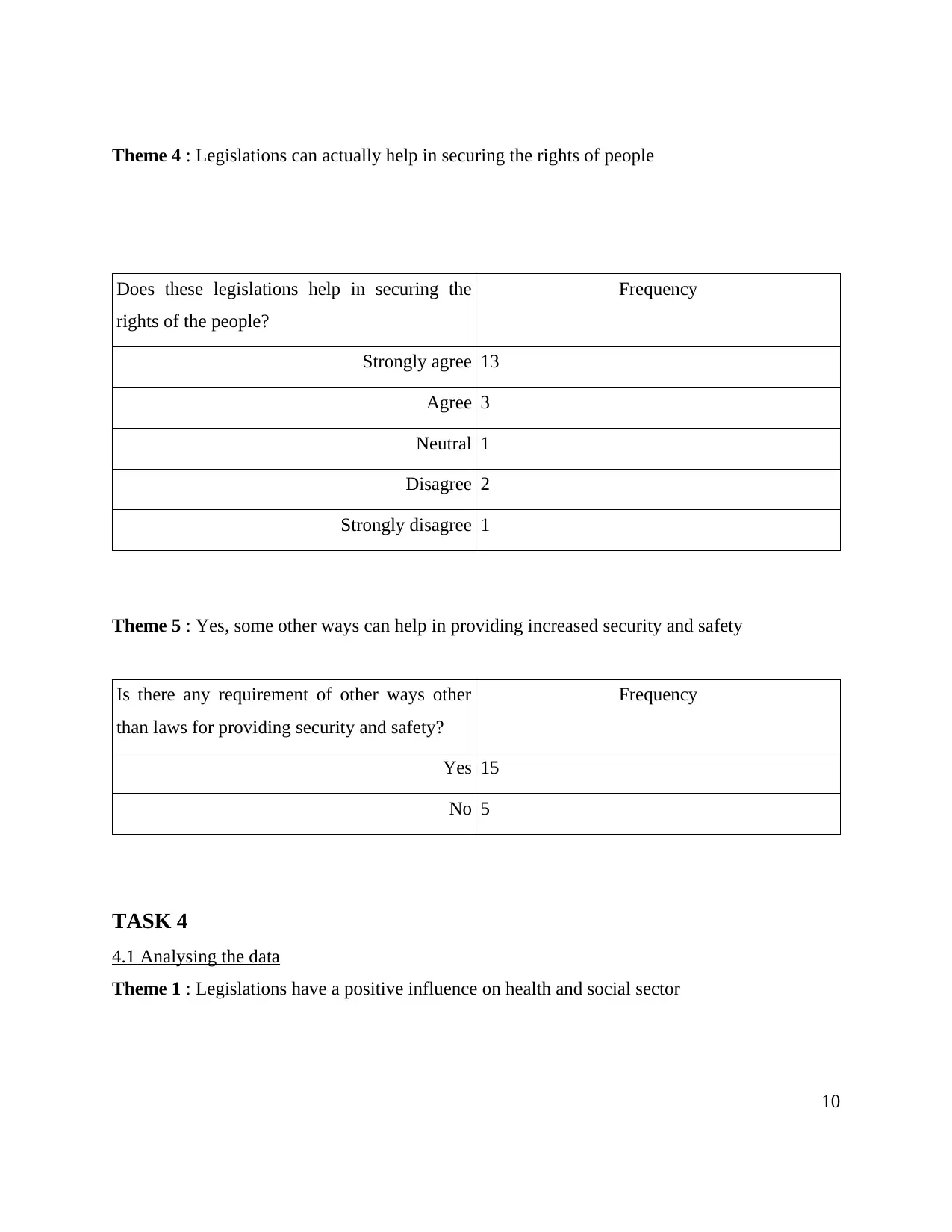
Theme 4 : Legislations can actually help in securing the rights of people
Does these legislations help in securing the
rights of the people?
Frequency
Strongly agree 13
Agree 3
Neutral 1
Disagree 2
Strongly disagree 1
Theme 5 : Yes, some other ways can help in providing increased security and safety
Is there any requirement of other ways other
than laws for providing security and safety?
Frequency
Yes 15
No 5
TASK 4
4.1 Analysing the data
Theme 1 : Legislations have a positive influence on health and social sector
10
Does these legislations help in securing the
rights of the people?
Frequency
Strongly agree 13
Agree 3
Neutral 1
Disagree 2
Strongly disagree 1
Theme 5 : Yes, some other ways can help in providing increased security and safety
Is there any requirement of other ways other
than laws for providing security and safety?
Frequency
Yes 15
No 5
TASK 4
4.1 Analysing the data
Theme 1 : Legislations have a positive influence on health and social sector
10
⊘ This is a preview!⊘
Do you want full access?
Subscribe today to unlock all pages.
Trusted by 1+ million students worldwide

1 out of 18


Related Documents


Your All-in-One AI-Powered Toolkit for Academic Success.
+13062052269
info@desklib.com
Available 24*7 on WhatsApp / Email
![[object Object]](/_next/static/media/star-bottom.7253800d.svg)
Unlock your academic potential
Copyright © 2020–2026 A2Z Services. All Rights Reserved. Developed and managed by ZUCOL.