Business Ethics & Sustainability: A Case Study of Facebook's Data Leak
VerifiedAdded on 2023/06/03
|15
|4039
|199
Case Study
AI Summary
This case study analyzes Facebook's unethical data leak involving Cambridge Analytica, impacting over 310,000 Australian users, and explores the implications for business ethics and sustainability. It discusses how Facebook's actions deviated from ethical business management practices, including virtue ethics, utilitarian ethics, and deontological ethics. The report highlights the company's failure to uphold corporate social responsibilities and ethical sustainability in the digital world. Key stakeholders, including Facebook, Cambridge Analytica, affected users, and governments, faced significant repercussions. Recommendations emphasize the need for stricter data protection measures and greater corporate accountability. The case underscores the importance of integrating ethical considerations into business strategies to ensure sustainable and responsible growth, while prioritizing the welfare of society and protecting user data.
Business ethics and sustainability
October 19
2018
Bid data leak of
Facebook users in
Australia
October 19
2018
Bid data leak of
Facebook users in
Australia

Paraphrase This Document
Need a fresh take? Get an instant paraphrase of this document with our AI Paraphraser
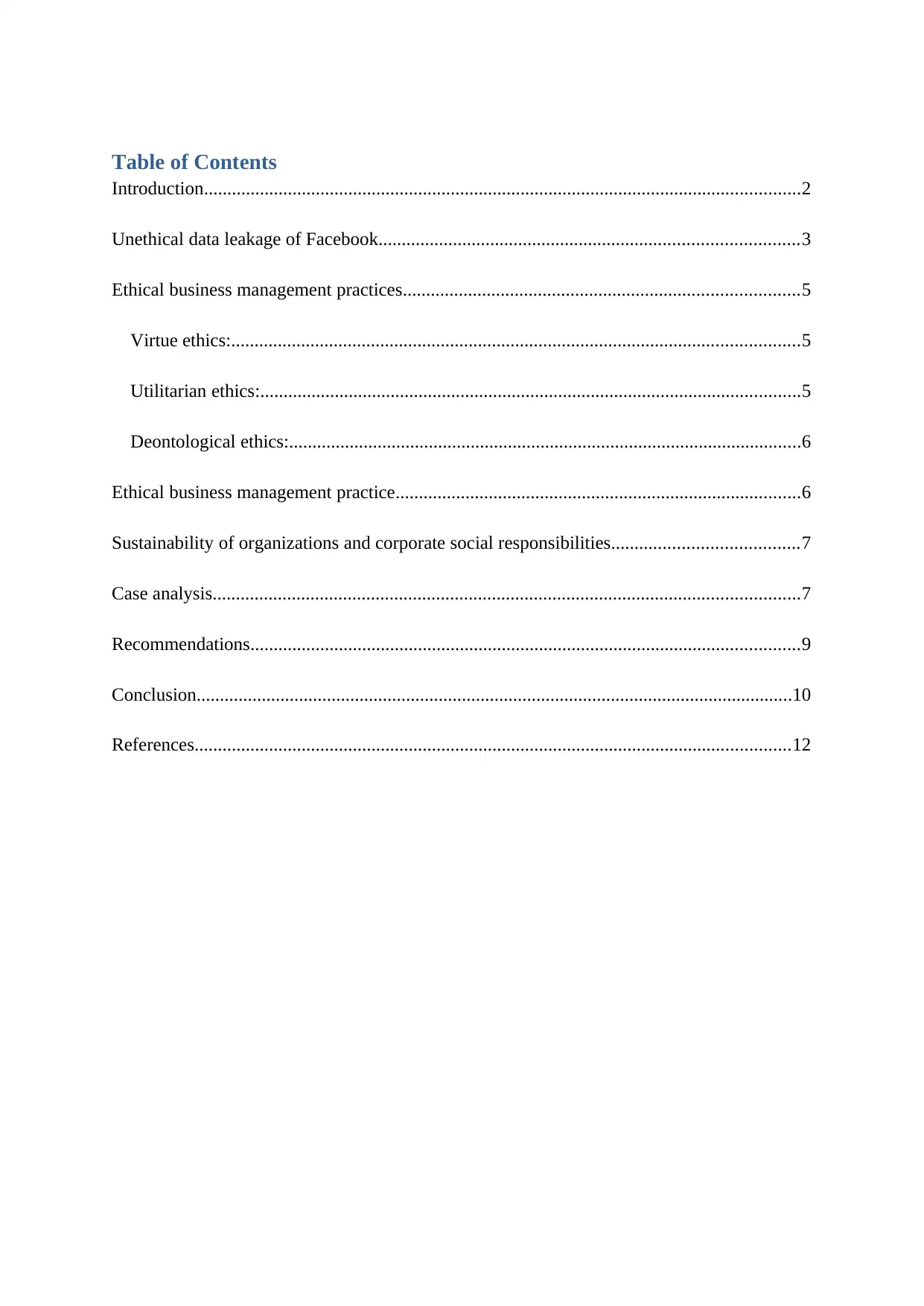
Table of Contents
Introduction................................................................................................................................2
Unethical data leakage of Facebook..........................................................................................3
Ethical business management practices.....................................................................................5
Virtue ethics:..........................................................................................................................5
Utilitarian ethics:....................................................................................................................5
Deontological ethics:..............................................................................................................6
Ethical business management practice.......................................................................................6
Sustainability of organizations and corporate social responsibilities........................................7
Case analysis..............................................................................................................................7
Recommendations......................................................................................................................9
Conclusion................................................................................................................................10
References................................................................................................................................12
Introduction................................................................................................................................2
Unethical data leakage of Facebook..........................................................................................3
Ethical business management practices.....................................................................................5
Virtue ethics:..........................................................................................................................5
Utilitarian ethics:....................................................................................................................5
Deontological ethics:..............................................................................................................6
Ethical business management practice.......................................................................................6
Sustainability of organizations and corporate social responsibilities........................................7
Case analysis..............................................................................................................................7
Recommendations......................................................................................................................9
Conclusion................................................................................................................................10
References................................................................................................................................12
Introduction
Today, in the era of cut throat competition a relentless and never-ending contest has begun to
cross the ethical boundaries in doing business. In corporation, the implementation of well-
structured and formulated ethical policy for doing business has several benefits. Business
ethics also include the truthfulness of management with its employees as well as customers.
Today, in the globalising world meeting the needs of present generation without affecting the
future generation’s ability to meet their needs is characterised as the sustainable development.
Since the beginning of this discussion about sustainable development in an ethical manner
until the present day, number of terms related to the sustainable development of ethical
business has grown high (Chakrabarty, & Bass, 2015). Although the idea of sustainable
development has become very common in the work of scholars, it is noticed that there is no
clear definition of sustainable development following the business ethics. Today, with the
increasing competition among organization to increase their own business has somewhere left
the behind the meaning of business ethics. In the immensely competing world organizations
are using unethical business practices to make their business growing (Chell, Spence, Perrini,
& Harris, 2016).
Somewhere, in between business growth, and ethical business, organizations are dominantly
looking for the growth instead of practicing business ethics. Business ethics in the literature
are defined as corporate social responsibility. In this report, a brief discussion about business
ethic and sustainability growth has been made to understand the social responsibilities of
organization in order to make an ethical and sustainable growth for the future generation.
This report discusses the case of unethical Data Leakage, of Facebook back in March 2018.
In the analytical part, this report discusses the case in accordance to the ethical sustainability
of digital world to showcase its responsibility towards the welfare of society.
Today, in the era of cut throat competition a relentless and never-ending contest has begun to
cross the ethical boundaries in doing business. In corporation, the implementation of well-
structured and formulated ethical policy for doing business has several benefits. Business
ethics also include the truthfulness of management with its employees as well as customers.
Today, in the globalising world meeting the needs of present generation without affecting the
future generation’s ability to meet their needs is characterised as the sustainable development.
Since the beginning of this discussion about sustainable development in an ethical manner
until the present day, number of terms related to the sustainable development of ethical
business has grown high (Chakrabarty, & Bass, 2015). Although the idea of sustainable
development has become very common in the work of scholars, it is noticed that there is no
clear definition of sustainable development following the business ethics. Today, with the
increasing competition among organization to increase their own business has somewhere left
the behind the meaning of business ethics. In the immensely competing world organizations
are using unethical business practices to make their business growing (Chell, Spence, Perrini,
& Harris, 2016).
Somewhere, in between business growth, and ethical business, organizations are dominantly
looking for the growth instead of practicing business ethics. Business ethics in the literature
are defined as corporate social responsibility. In this report, a brief discussion about business
ethic and sustainability growth has been made to understand the social responsibilities of
organization in order to make an ethical and sustainable growth for the future generation.
This report discusses the case of unethical Data Leakage, of Facebook back in March 2018.
In the analytical part, this report discusses the case in accordance to the ethical sustainability
of digital world to showcase its responsibility towards the welfare of society.
⊘ This is a preview!⊘
Do you want full access?
Subscribe today to unlock all pages.

Trusted by 1+ million students worldwide
Unethical data leakage of Facebook
Facebook is a social networking site where people connect with each-other around the world.
This platform requires all the personal information data of its users to create their account. In
this manner, Facebook has an access to millions of people’s personal information (Hern, &
Pegg, 2018). Since a very long time, Facebook is facing data security challenges from
different governments based on reports given by private agencies (Bartholomeusz, 2018). In
the past company has faced several problems questioning about the security of users’
personal information data. Also, company has faced the data leakage in the past.
This report will discuss the case of data breach from Facebook site that was reported in the
news article of The Sydney morning Herald, on 5th April 2018. Rachel Clun has reported the
article with a heading saying, “Facebook says 310,000 Australian users may have been
affected by Cambridge Analytica scandal. In reports, it has been reported that the social
media company revealed that the personal information data of more than 310,000 Australian
Facebook users have been shared their personal information data with Cambridge Analytica.
According to the report, company says that they have potentially shared the data of about 87
million users with the research company, but they don’t know about the exact data or the
exact number of people affected by the data that was given to the research company. report
claims that this is the first official confirmation from the company side about the possible
scope of data leak. Reports have estimated 50 million people gets affected with the data
breach, whereas Facebook estimated up to 311,127 Australians were affected in the big data
breach. Official of the company says that “with the use possible most expensive methodology
this is the best estimated number of unique accounts that directly installed the
“thisisyourdigitallife” application as well as those who have shared their personal information
data with their friends. In the counter argument, Cambridge Analytica said that the company
has licenced the data on only 30 million people instead of 87 million claimed by Facebook
Facebook is a social networking site where people connect with each-other around the world.
This platform requires all the personal information data of its users to create their account. In
this manner, Facebook has an access to millions of people’s personal information (Hern, &
Pegg, 2018). Since a very long time, Facebook is facing data security challenges from
different governments based on reports given by private agencies (Bartholomeusz, 2018). In
the past company has faced several problems questioning about the security of users’
personal information data. Also, company has faced the data leakage in the past.
This report will discuss the case of data breach from Facebook site that was reported in the
news article of The Sydney morning Herald, on 5th April 2018. Rachel Clun has reported the
article with a heading saying, “Facebook says 310,000 Australian users may have been
affected by Cambridge Analytica scandal. In reports, it has been reported that the social
media company revealed that the personal information data of more than 310,000 Australian
Facebook users have been shared their personal information data with Cambridge Analytica.
According to the report, company says that they have potentially shared the data of about 87
million users with the research company, but they don’t know about the exact data or the
exact number of people affected by the data that was given to the research company. report
claims that this is the first official confirmation from the company side about the possible
scope of data leak. Reports have estimated 50 million people gets affected with the data
breach, whereas Facebook estimated up to 311,127 Australians were affected in the big data
breach. Official of the company says that “with the use possible most expensive methodology
this is the best estimated number of unique accounts that directly installed the
“thisisyourdigitallife” application as well as those who have shared their personal information
data with their friends. In the counter argument, Cambridge Analytica said that the company
has licenced the data on only 30 million people instead of 87 million claimed by Facebook
Paraphrase This Document
Need a fresh take? Get an instant paraphrase of this document with our AI Paraphraser
(Meade, 2018). Also on official twitter account, Cambridge Analytica said that the company
immediately deleted that raw data from its file service also started the process of searching
and removing any of the derivative from its system.
In the counter answer to Cambridge Analytica, Facebook said that the company will inform
people at the top of their news feed page starting from April 9th. Different interviews and
reports state that the company authorities are accepting the data leak as their fault and accept
that it was their mistake that they didn’t take a broad view off their responsibilities for the
deal and they made a mistake. This case is completely fall into the practices of unethical
businesses showing their irresponsible behaviour towards the social aspects.
In this case, main stakeholders are identified as the companies involved, Facebook and
Cambridge Analytica, along with the people affected with the major leak. Also, the
governments of other countries are affected with this news resulted in making a negative
image for Facebook. Analysis about the impact of this case states that Facebook is going to
face a lot of challenges related to its security terms in Australia along with other countries
due to their concern for the same case with their people. Cambridge Analytica will also have
to suffer a lot from its shareholder related to this unethical deal with the company. Current
analysis of the case also reports that people affected with this unethical business practice have
lost their personal information data that is available to digital world without their knowledge.
This may cause a serious harm to their personal life or some other companies can use this
data in an unethical manner to make their business. During all this, Facebook may lose its
market in different nations or operating parts around the world. This analysis based on the
public reports makes it clear that every stakeholder involved in this unethical practice has a
significant impact on themselves along with affecting the reputation of company as well. In
this case single stakeholder cannot be defined as guilty for the breach of unethical practices
as there are different ethical definitions are available in the research. In this case all the issues
immediately deleted that raw data from its file service also started the process of searching
and removing any of the derivative from its system.
In the counter answer to Cambridge Analytica, Facebook said that the company will inform
people at the top of their news feed page starting from April 9th. Different interviews and
reports state that the company authorities are accepting the data leak as their fault and accept
that it was their mistake that they didn’t take a broad view off their responsibilities for the
deal and they made a mistake. This case is completely fall into the practices of unethical
businesses showing their irresponsible behaviour towards the social aspects.
In this case, main stakeholders are identified as the companies involved, Facebook and
Cambridge Analytica, along with the people affected with the major leak. Also, the
governments of other countries are affected with this news resulted in making a negative
image for Facebook. Analysis about the impact of this case states that Facebook is going to
face a lot of challenges related to its security terms in Australia along with other countries
due to their concern for the same case with their people. Cambridge Analytica will also have
to suffer a lot from its shareholder related to this unethical deal with the company. Current
analysis of the case also reports that people affected with this unethical business practice have
lost their personal information data that is available to digital world without their knowledge.
This may cause a serious harm to their personal life or some other companies can use this
data in an unethical manner to make their business. During all this, Facebook may lose its
market in different nations or operating parts around the world. This analysis based on the
public reports makes it clear that every stakeholder involved in this unethical practice has a
significant impact on themselves along with affecting the reputation of company as well. In
this case single stakeholder cannot be defined as guilty for the breach of unethical practices
as there are different ethical definitions are available in the research. In this case all the issues
mentioned in different reports of public domain data are global level issues as they are
concerned at global level for Australia as well as other Nations too. To understand the case
in depth literature material provided by the scholars will help a lot. In this order to understand
the case more logically a literature analysis of the case is done in the next part of report.
Ethical business management practices
In the simplest form ethics are described as a system of moral principles which affect people
in making decisions for their individual’s personal life as well as their business purposes.
Ethos, the origin word of Ethics has the meaning like custom, character, or habit (Jondle,
Ardichvili, & Mitchell, 2014). This single word, ethics covers the below mentioned
dilemmas:
How to live good life and grow business sustainably
Individual person as well as organization’s rights and responsibilities
Difference between what is right and what is wrong for different aspects
In the research work, ethics are classified into three categories as virtual ethics, utilitarian
ethics, and deontological ethics.
Virtue ethics:
These are normative ethical theories that emphasize the virtue of individual’s mind or
character. People practicing virtue ethics discuss the nature and other information related to
their own virtue.
Utilitarian ethics:
Utilitarian ethics are defined in the theory of utilitarianism that advocates the actions of an
individual or an organization’s overall happiness or satisfaction and rejects the ideas or
actions that may cause any harm or unhappiness. In this theory when a utilitarian’s goal is too
concerned at global level for Australia as well as other Nations too. To understand the case
in depth literature material provided by the scholars will help a lot. In this order to understand
the case more logically a literature analysis of the case is done in the next part of report.
Ethical business management practices
In the simplest form ethics are described as a system of moral principles which affect people
in making decisions for their individual’s personal life as well as their business purposes.
Ethos, the origin word of Ethics has the meaning like custom, character, or habit (Jondle,
Ardichvili, & Mitchell, 2014). This single word, ethics covers the below mentioned
dilemmas:
How to live good life and grow business sustainably
Individual person as well as organization’s rights and responsibilities
Difference between what is right and what is wrong for different aspects
In the research work, ethics are classified into three categories as virtual ethics, utilitarian
ethics, and deontological ethics.
Virtue ethics:
These are normative ethical theories that emphasize the virtue of individual’s mind or
character. People practicing virtue ethics discuss the nature and other information related to
their own virtue.
Utilitarian ethics:
Utilitarian ethics are defined in the theory of utilitarianism that advocates the actions of an
individual or an organization’s overall happiness or satisfaction and rejects the ideas or
actions that may cause any harm or unhappiness. In this theory when a utilitarian’s goal is too
⊘ This is a preview!⊘
Do you want full access?
Subscribe today to unlock all pages.
Trusted by 1+ million students worldwide
directed towards the happiness or welfare of society, economy reflects in their political
decisions or aims to the betterment of maximum number of people. This level is defined as
Maxim of Utilitarianism (Mandal, Ponnambath, & Parija, 2016).
Deontological ethics:
This is the theory based on a “nonconsequentialist” view of people and making moral
decision for the society. The term deontology if originated from the Greek word for duty. In
the literature also the theory is defined based on the focus of individual or organization’s duty
towards the people associated with them in their personal life or with their business purpose.
Ethical business management practice
In the current era of emerging technology and globalization, people are shifting their business
focus towards more profit instead of realising their ethical responsibilities towards others
(Rhodes, 2016). There was always an optimistic connection known between business success
and business approach. In the literature also it is accepted that it is not easy for management
to evaluate an ethical situation they encounters in their business as ethics are very complex
concept to apply in business practices (Wang, & Calvano, 2015). For management it is
critical to agree on some off the policies made by the leaders, else the whole management
needs to be redesigned because a leader not following the ethical policy or management
might affect the organization as well as its business significantly. In such situations, toughest
task is making employees realise the business values and formulate them into their usual
practices.
In the emerging competitive business market differentiating between lawful justice and fair
justice is very difficult to make decision on some unethical practices that organizations
practice for their personal benefits. To maintain this balance in between organizations’
decisions or aims to the betterment of maximum number of people. This level is defined as
Maxim of Utilitarianism (Mandal, Ponnambath, & Parija, 2016).
Deontological ethics:
This is the theory based on a “nonconsequentialist” view of people and making moral
decision for the society. The term deontology if originated from the Greek word for duty. In
the literature also the theory is defined based on the focus of individual or organization’s duty
towards the people associated with them in their personal life or with their business purpose.
Ethical business management practice
In the current era of emerging technology and globalization, people are shifting their business
focus towards more profit instead of realising their ethical responsibilities towards others
(Rhodes, 2016). There was always an optimistic connection known between business success
and business approach. In the literature also it is accepted that it is not easy for management
to evaluate an ethical situation they encounters in their business as ethics are very complex
concept to apply in business practices (Wang, & Calvano, 2015). For management it is
critical to agree on some off the policies made by the leaders, else the whole management
needs to be redesigned because a leader not following the ethical policy or management
might affect the organization as well as its business significantly. In such situations, toughest
task is making employees realise the business values and formulate them into their usual
practices.
In the emerging competitive business market differentiating between lawful justice and fair
justice is very difficult to make decision on some unethical practices that organizations
practice for their personal benefits. To maintain this balance in between organizations’
Paraphrase This Document
Need a fresh take? Get an instant paraphrase of this document with our AI Paraphraser
business and their responsibilities towards the society some corporate social responsibilities
that have to be followed into their business practices to make their business sustainable.
Sustainability is the responsible factor for such unethical practices (Yang, Vitell, & Bush,
2017). Companies are looking for their future sustainability and this desire making them to
cross the boundaries of their ethical responsibilities. To make employees’ role clear in such
practice no written code now or then is available.
Sustainability of organizations and corporate social responsibilities
In the emerging world, sustainability has become the most widely used concept by
organizations, academic institutions, and governments. This concept of sustainability was
first explained by Elkington, which is based not only on environmental aspect but also the
social and economic aspects as well. This concept makes it clear that the sustainability must
be based on social and economic aspects as well (Brandenburg, Govindan, Sarkis, & Seuring,
2014). Although the concept is been used widely, organizations are using the concept of
sustainability in relation to their sustainable development. This sustainable development of
their business is focused on their business development instead of their ethical practices
(Tian, & Peterson, 2016). Along with the concept of sustainability and sustainable
development corporate social responsibilities are introduced to the organization to make their
business more ethical. Following these responsibility counts them into the category of ethical
business practices and ethical sustainable development (Quarshie, Salmi, & Leuschner,
2016).
Case analysis
The above case mentioned in the report is a complete breach of ethical business practices and
is considered as unethical business practice from both the ends. Business ethics suggested
that have to be followed into their business practices to make their business sustainable.
Sustainability is the responsible factor for such unethical practices (Yang, Vitell, & Bush,
2017). Companies are looking for their future sustainability and this desire making them to
cross the boundaries of their ethical responsibilities. To make employees’ role clear in such
practice no written code now or then is available.
Sustainability of organizations and corporate social responsibilities
In the emerging world, sustainability has become the most widely used concept by
organizations, academic institutions, and governments. This concept of sustainability was
first explained by Elkington, which is based not only on environmental aspect but also the
social and economic aspects as well. This concept makes it clear that the sustainability must
be based on social and economic aspects as well (Brandenburg, Govindan, Sarkis, & Seuring,
2014). Although the concept is been used widely, organizations are using the concept of
sustainability in relation to their sustainable development. This sustainable development of
their business is focused on their business development instead of their ethical practices
(Tian, & Peterson, 2016). Along with the concept of sustainability and sustainable
development corporate social responsibilities are introduced to the organization to make their
business more ethical. Following these responsibility counts them into the category of ethical
business practices and ethical sustainable development (Quarshie, Salmi, & Leuschner,
2016).
Case analysis
The above case mentioned in the report is a complete breach of ethical business practices and
is considered as unethical business practice from both the ends. Business ethics suggested
that the organizations are the central locus of ethics as ethics can be used by organizations
significantly to develop a society or organization for the future generation. Here, in this case,
everything is against the ethical business (Badshah, 2018). Only ethical practice followed is
of economic aspect. Both the companies used their business for their economic benefits
instead of recognising their responsibilities towards the society (Meredith, 2018). Facebook
shows its irresponsibility by making a deal that was even not clearly understood by the
company and Cambridge Analytica took an advantage of this irresponsibility of Facebook to
use its source for such a huge data. This scandal has increased the importance of collecting,
maintaining, and leveraging first party data exponentially. In a news article published online
at news.com.au, it is reported that Cambridge Analytica used a controversial tool for their use
in political campaign and used this data while working for Donald Trump (Chang, 2018).
This shows a completely unethical use of peoples’ personal information data for an
individual’s personal benefits. Reports suggest that Cambridge Analytica used this data in the
election campaign of Donald Trump. In the response of this scandal CEO of Facebook, Mark
Zuckerberg stated that the company had taken the most important actions to prevent such
incidents but they made mistake, therefore there is much more to do and company is working
on such actions. The allegations made on Cambridge Analytica seem logical as the data
harvested in this scandal may have been used in the presidential election campaign of Trump.
This scandal made Facebook to realise impact of misusing their customers’ data. This
realization made the company authorities to modify their company policies related to the
providing staff members to political offices at the time of elections (BBC-NEWS, 2018a).
The data lose scandal made it to the company authorities to take a decision about not sending
their staff members at different political offices at the time of elections. In the similar context,
company has removed more than 800 pages or accounts allegedly created on the social
platform to seek profit from politically themed spam content (BBC-NEWS, (2018b).
significantly to develop a society or organization for the future generation. Here, in this case,
everything is against the ethical business (Badshah, 2018). Only ethical practice followed is
of economic aspect. Both the companies used their business for their economic benefits
instead of recognising their responsibilities towards the society (Meredith, 2018). Facebook
shows its irresponsibility by making a deal that was even not clearly understood by the
company and Cambridge Analytica took an advantage of this irresponsibility of Facebook to
use its source for such a huge data. This scandal has increased the importance of collecting,
maintaining, and leveraging first party data exponentially. In a news article published online
at news.com.au, it is reported that Cambridge Analytica used a controversial tool for their use
in political campaign and used this data while working for Donald Trump (Chang, 2018).
This shows a completely unethical use of peoples’ personal information data for an
individual’s personal benefits. Reports suggest that Cambridge Analytica used this data in the
election campaign of Donald Trump. In the response of this scandal CEO of Facebook, Mark
Zuckerberg stated that the company had taken the most important actions to prevent such
incidents but they made mistake, therefore there is much more to do and company is working
on such actions. The allegations made on Cambridge Analytica seem logical as the data
harvested in this scandal may have been used in the presidential election campaign of Trump.
This scandal made Facebook to realise impact of misusing their customers’ data. This
realization made the company authorities to modify their company policies related to the
providing staff members to political offices at the time of elections (BBC-NEWS, 2018a).
The data lose scandal made it to the company authorities to take a decision about not sending
their staff members at different political offices at the time of elections. In the similar context,
company has removed more than 800 pages or accounts allegedly created on the social
platform to seek profit from politically themed spam content (BBC-NEWS, (2018b).
⊘ This is a preview!⊘
Do you want full access?
Subscribe today to unlock all pages.
Trusted by 1+ million students worldwide
Recommendations
Business ethics represents the corporate social responsibilities of an organization. Social
media businesses like Facebook have more responsibilities in ethical way towards the society
in comparison to other businesses, as they direct the society towards a direction for future.
Facebook is a giant social medial platform that plays a significant role in directing people in a
constructive as well as destructive direction. Responsibilities of an organization increases
with the increase in its size (Park, Lee, & Kim, 2014). Being the most popular social media
site it has the most powerful impact on people and can introduce changes similar to that of
the Cambridge Analystica did in presidential campaign of Trump. Seeing such
responsibilities of an organization it is most prior responsibility of Facebook to ensure ethical
use of the company platform provided to the world. Although company has taken some
dramatic decisions after this incident, some changes in its business policies with corporate
firms have to be revised and restructured to ensure the security of personal data shared at the
platform. In this way, company already decided to not to send its staff in political campaigns
as well as removed several accounts and pages allegedly using politically themed spam
content for their individual profit (Holtzhausen, 2015).
In order to secure the privacy, company can improve its privacy policies as well as may apply
some quality content filters to share any information on the platform. Also, company can
introduce an authentication check for any data uploading over the networking site. Such data
authentication filter will help the organization to follow its corporate social responsibilities.
Along with such changes in the policies for Facebook, corporate social responsibilities should
be realised by Cambridge Analytica as well. In order to implement these responsibilities,
Cambridge Analytica should understand its impact over the social as well as political change
that the company can introduce to the world. This incident has shown the capabilities of the
company but it should use these capabilities in the welfare of society with some positive
Business ethics represents the corporate social responsibilities of an organization. Social
media businesses like Facebook have more responsibilities in ethical way towards the society
in comparison to other businesses, as they direct the society towards a direction for future.
Facebook is a giant social medial platform that plays a significant role in directing people in a
constructive as well as destructive direction. Responsibilities of an organization increases
with the increase in its size (Park, Lee, & Kim, 2014). Being the most popular social media
site it has the most powerful impact on people and can introduce changes similar to that of
the Cambridge Analystica did in presidential campaign of Trump. Seeing such
responsibilities of an organization it is most prior responsibility of Facebook to ensure ethical
use of the company platform provided to the world. Although company has taken some
dramatic decisions after this incident, some changes in its business policies with corporate
firms have to be revised and restructured to ensure the security of personal data shared at the
platform. In this way, company already decided to not to send its staff in political campaigns
as well as removed several accounts and pages allegedly using politically themed spam
content for their individual profit (Holtzhausen, 2015).
In order to secure the privacy, company can improve its privacy policies as well as may apply
some quality content filters to share any information on the platform. Also, company can
introduce an authentication check for any data uploading over the networking site. Such data
authentication filter will help the organization to follow its corporate social responsibilities.
Along with such changes in the policies for Facebook, corporate social responsibilities should
be realised by Cambridge Analytica as well. In order to implement these responsibilities,
Cambridge Analytica should understand its impact over the social as well as political change
that the company can introduce to the world. This incident has shown the capabilities of the
company but it should use these capabilities in the welfare of society with some positive
Paraphrase This Document
Need a fresh take? Get an instant paraphrase of this document with our AI Paraphraser
changes that can lead to a better world (André, & Pache, 2016). Making business should be
an agenda of company but it must do an ethical business. To follow business ethics
Cambridge Analytica should revise its business policies as well as its business nature.
Restructuring of business policies can be done by deciding its limitations to work for political
parties or to restrict its unethical use for some individual’s personal or group benefits.
Conclusion
In the above report business environment in the context of its ethical behaviour for the
society and wold is discussed. This report concludes that the emerging global world has
introduces bigger responsibilities for organizations operating in international business market.
For organizations, there are some social responsibilities defined under the ethical business
practices to ensure the betterment of society and world in a positive manner. Corporate world
directs the world society into a direction to lead for the future, therefore, it should understand
its responsibilities and follow the same for ethical business practices. This report suggests
different ethics introduced in the global context that lead any scenario to a particular direction
and drag the business as well in that particular direction. The case discussed of big data
leakage of Facebook users in Australia has made it clear that what the possible consequences
of an unethical business practice are. This repost shows the dark side of unethical business
practices that may lead the world society to a wrong direction. Also, this report suggests that
there are different definitions of ethical business practices in different context. These
definitions may justify an unethical business practice in another context but the overall
impact on the society needs to be evaluated to justify any business practice. Report supports
ethical business practices with better sustainability. It concludes that organizations practicing
ethical business are more sustainable in comparison to those practicing unethical business.
The case of Facebook data leakage, irresponsibility of both the organization reflected the
an agenda of company but it must do an ethical business. To follow business ethics
Cambridge Analytica should revise its business policies as well as its business nature.
Restructuring of business policies can be done by deciding its limitations to work for political
parties or to restrict its unethical use for some individual’s personal or group benefits.
Conclusion
In the above report business environment in the context of its ethical behaviour for the
society and wold is discussed. This report concludes that the emerging global world has
introduces bigger responsibilities for organizations operating in international business market.
For organizations, there are some social responsibilities defined under the ethical business
practices to ensure the betterment of society and world in a positive manner. Corporate world
directs the world society into a direction to lead for the future, therefore, it should understand
its responsibilities and follow the same for ethical business practices. This report suggests
different ethics introduced in the global context that lead any scenario to a particular direction
and drag the business as well in that particular direction. The case discussed of big data
leakage of Facebook users in Australia has made it clear that what the possible consequences
of an unethical business practice are. This repost shows the dark side of unethical business
practices that may lead the world society to a wrong direction. Also, this report suggests that
there are different definitions of ethical business practices in different context. These
definitions may justify an unethical business practice in another context but the overall
impact on the society needs to be evaluated to justify any business practice. Report supports
ethical business practices with better sustainability. It concludes that organizations practicing
ethical business are more sustainable in comparison to those practicing unethical business.
The case of Facebook data leakage, irresponsibility of both the organization reflected the
consequences of what they did. Therefore, organizations need to understand their social
responsibilities towards the society they are working in or making for the future.
responsibilities towards the society they are working in or making for the future.
⊘ This is a preview!⊘
Do you want full access?
Subscribe today to unlock all pages.
Trusted by 1+ million students worldwide

1 out of 15


Related Documents


Your All-in-One AI-Powered Toolkit for Academic Success.
+13062052269
info@desklib.com
Available 24*7 on WhatsApp / Email
![[object Object]](/_next/static/media/star-bottom.7253800d.svg)
Unlock your academic potential
Copyright © 2020–2025 A2Z Services. All Rights Reserved. Developed and managed by ZUCOL.