Business Law: Contract Acceptance, UCC, and Liability Analysis
VerifiedAdded on 2022/08/13
|4
|812
|24
Homework Assignment
AI Summary
This assignment analyzes a business law case involving a dispute between Sally and a supplier. The core issue revolves around contract acceptance, consideration, and potential liability. Sally sent a pre-printed form with an offer, but the supplier responded with a different amount. The analysis delves into the application of the Uniform Commercial Code (UCC), the mirror image rule, and the last shot rule to determine if a valid contract was formed and if Sally can be held liable for breach. The analysis concludes that a contract exists under the UCC and the supplier can potentially sue Sally for breach of contract based on the terms of the supplier's form. The assignment utilizes legal principles and case precedents to support the conclusions.
Running head: BUSINESS LAW
BUSINESS LAW
Name of the Student
Name of the University
Author Note
BUSINESS LAW
Name of the Student
Name of the University
Author Note
Paraphrase This Document
Need a fresh take? Get an instant paraphrase of this document with our AI Paraphraser

1BUSINESS LAW
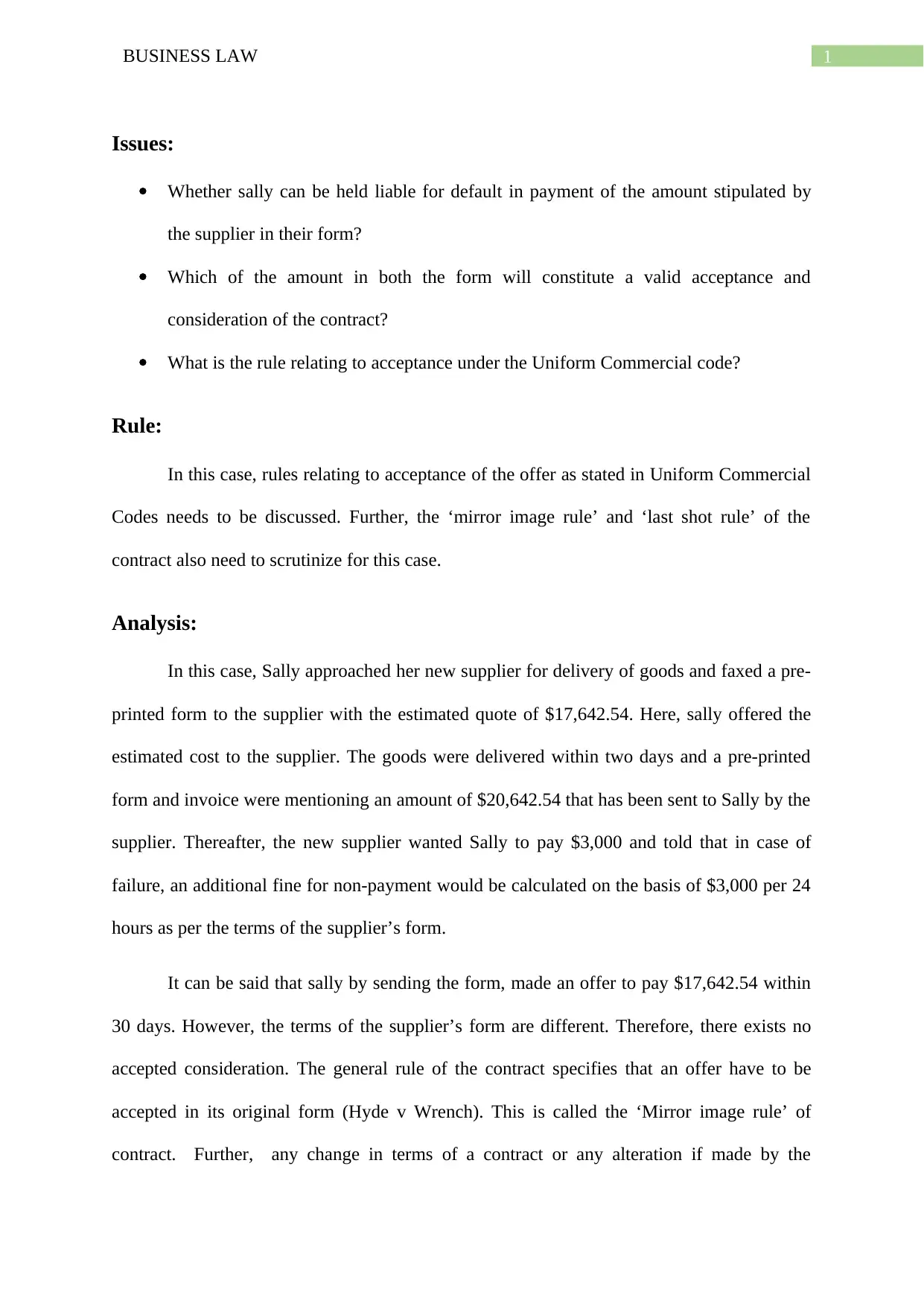
Issues:
Whether sally can be held liable for default in payment of the amount stipulated by
the supplier in their form?
Which of the amount in both the form will constitute a valid acceptance and
consideration of the contract?
What is the rule relating to acceptance under the Uniform Commercial code?
Rule:
In this case, rules relating to acceptance of the offer as stated in Uniform Commercial
Codes needs to be discussed. Further, the ‘mirror image rule’ and ‘last shot rule’ of the
contract also need to scrutinize for this case.
Analysis:
In this case, Sally approached her new supplier for delivery of goods and faxed a pre-
printed form to the supplier with the estimated quote of $17,642.54. Here, sally offered the
estimated cost to the supplier. The goods were delivered within two days and a pre-printed
form and invoice were mentioning an amount of $20,642.54 that has been sent to Sally by the
supplier. Thereafter, the new supplier wanted Sally to pay $3,000 and told that in case of
failure, an additional fine for non-payment would be calculated on the basis of $3,000 per 24
hours as per the terms of the supplier’s form.
It can be said that sally by sending the form, made an offer to pay $17,642.54 within
30 days. However, the terms of the supplier’s form are different. Therefore, there exists no
accepted consideration. The general rule of the contract specifies that an offer have to be
accepted in its original form (Hyde v Wrench). This is called the ‘Mirror image rule’ of
contract. Further, any change in terms of a contract or any alteration if made by the
Issues:
Whether sally can be held liable for default in payment of the amount stipulated by
the supplier in their form?
Which of the amount in both the form will constitute a valid acceptance and
consideration of the contract?
What is the rule relating to acceptance under the Uniform Commercial code?
Rule:
In this case, rules relating to acceptance of the offer as stated in Uniform Commercial
Codes needs to be discussed. Further, the ‘mirror image rule’ and ‘last shot rule’ of the
contract also need to scrutinize for this case.
Analysis:
In this case, Sally approached her new supplier for delivery of goods and faxed a pre-
printed form to the supplier with the estimated quote of $17,642.54. Here, sally offered the
estimated cost to the supplier. The goods were delivered within two days and a pre-printed
form and invoice were mentioning an amount of $20,642.54 that has been sent to Sally by the
supplier. Thereafter, the new supplier wanted Sally to pay $3,000 and told that in case of
failure, an additional fine for non-payment would be calculated on the basis of $3,000 per 24
hours as per the terms of the supplier’s form.
It can be said that sally by sending the form, made an offer to pay $17,642.54 within
30 days. However, the terms of the supplier’s form are different. Therefore, there exists no
accepted consideration. The general rule of the contract specifies that an offer have to be
accepted in its original form (Hyde v Wrench). This is called the ‘Mirror image rule’ of
contract. Further, any change in terms of a contract or any alteration if made by the

2BUSINESS LAW
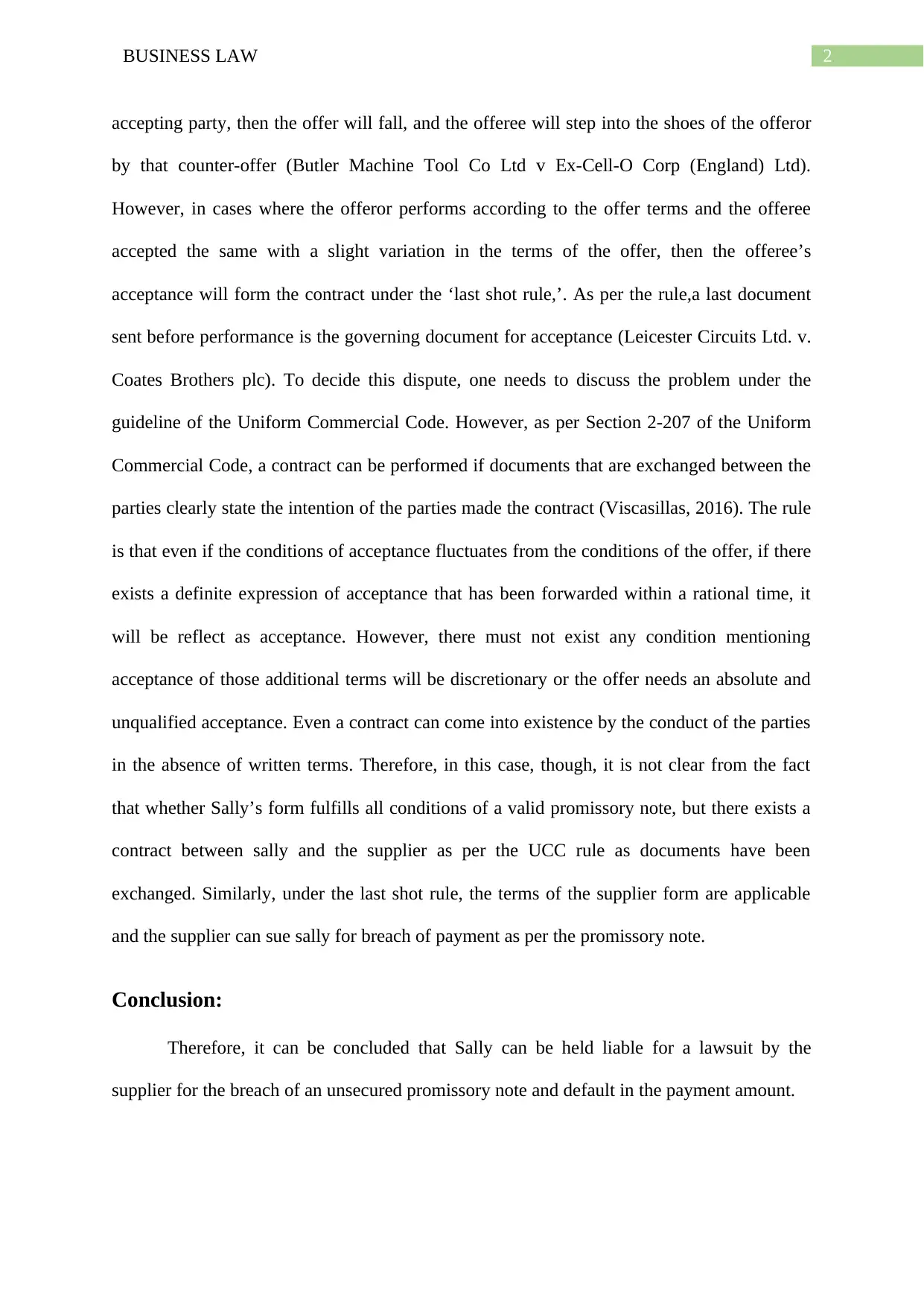
accepting party, then the offer will fall, and the offeree will step into the shoes of the offeror
by that counter-offer (Butler Machine Tool Co Ltd v Ex-Cell-O Corp (England) Ltd).
However, in cases where the offeror performs according to the offer terms and the offeree
accepted the same with a slight variation in the terms of the offer, then the offeree’s
acceptance will form the contract under the ‘last shot rule,’. As per the rule,a last document
sent before performance is the governing document for acceptance (Leicester Circuits Ltd. v.
Coates Brothers plc). To decide this dispute, one needs to discuss the problem under the
guideline of the Uniform Commercial Code. However, as per Section 2-207 of the Uniform
Commercial Code, a contract can be performed if documents that are exchanged between the
parties clearly state the intention of the parties made the contract (Viscasillas, 2016). The rule
is that even if the conditions of acceptance fluctuates from the conditions of the offer, if there
exists a definite expression of acceptance that has been forwarded within a rational time, it
will be reflect as acceptance. However, there must not exist any condition mentioning
acceptance of those additional terms will be discretionary or the offer needs an absolute and
unqualified acceptance. Even a contract can come into existence by the conduct of the parties
in the absence of written terms. Therefore, in this case, though, it is not clear from the fact
that whether Sally’s form fulfills all conditions of a valid promissory note, but there exists a
contract between sally and the supplier as per the UCC rule as documents have been
exchanged. Similarly, under the last shot rule, the terms of the supplier form are applicable
and the supplier can sue sally for breach of payment as per the promissory note.
Conclusion:
Therefore, it can be concluded that Sally can be held liable for a lawsuit by the
supplier for the breach of an unsecured promissory note and default in the payment amount.
accepting party, then the offer will fall, and the offeree will step into the shoes of the offeror
by that counter-offer (Butler Machine Tool Co Ltd v Ex-Cell-O Corp (England) Ltd).
However, in cases where the offeror performs according to the offer terms and the offeree
accepted the same with a slight variation in the terms of the offer, then the offeree’s
acceptance will form the contract under the ‘last shot rule,’. As per the rule,a last document
sent before performance is the governing document for acceptance (Leicester Circuits Ltd. v.
Coates Brothers plc). To decide this dispute, one needs to discuss the problem under the
guideline of the Uniform Commercial Code. However, as per Section 2-207 of the Uniform
Commercial Code, a contract can be performed if documents that are exchanged between the
parties clearly state the intention of the parties made the contract (Viscasillas, 2016). The rule
is that even if the conditions of acceptance fluctuates from the conditions of the offer, if there
exists a definite expression of acceptance that has been forwarded within a rational time, it
will be reflect as acceptance. However, there must not exist any condition mentioning
acceptance of those additional terms will be discretionary or the offer needs an absolute and
unqualified acceptance. Even a contract can come into existence by the conduct of the parties
in the absence of written terms. Therefore, in this case, though, it is not clear from the fact
that whether Sally’s form fulfills all conditions of a valid promissory note, but there exists a
contract between sally and the supplier as per the UCC rule as documents have been
exchanged. Similarly, under the last shot rule, the terms of the supplier form are applicable
and the supplier can sue sally for breach of payment as per the promissory note.
Conclusion:
Therefore, it can be concluded that Sally can be held liable for a lawsuit by the
supplier for the breach of an unsecured promissory note and default in the payment amount.
⊘ This is a preview!⊘
Do you want full access?
Subscribe today to unlock all pages.

Trusted by 1+ million students worldwide

3BUSINESS LAW
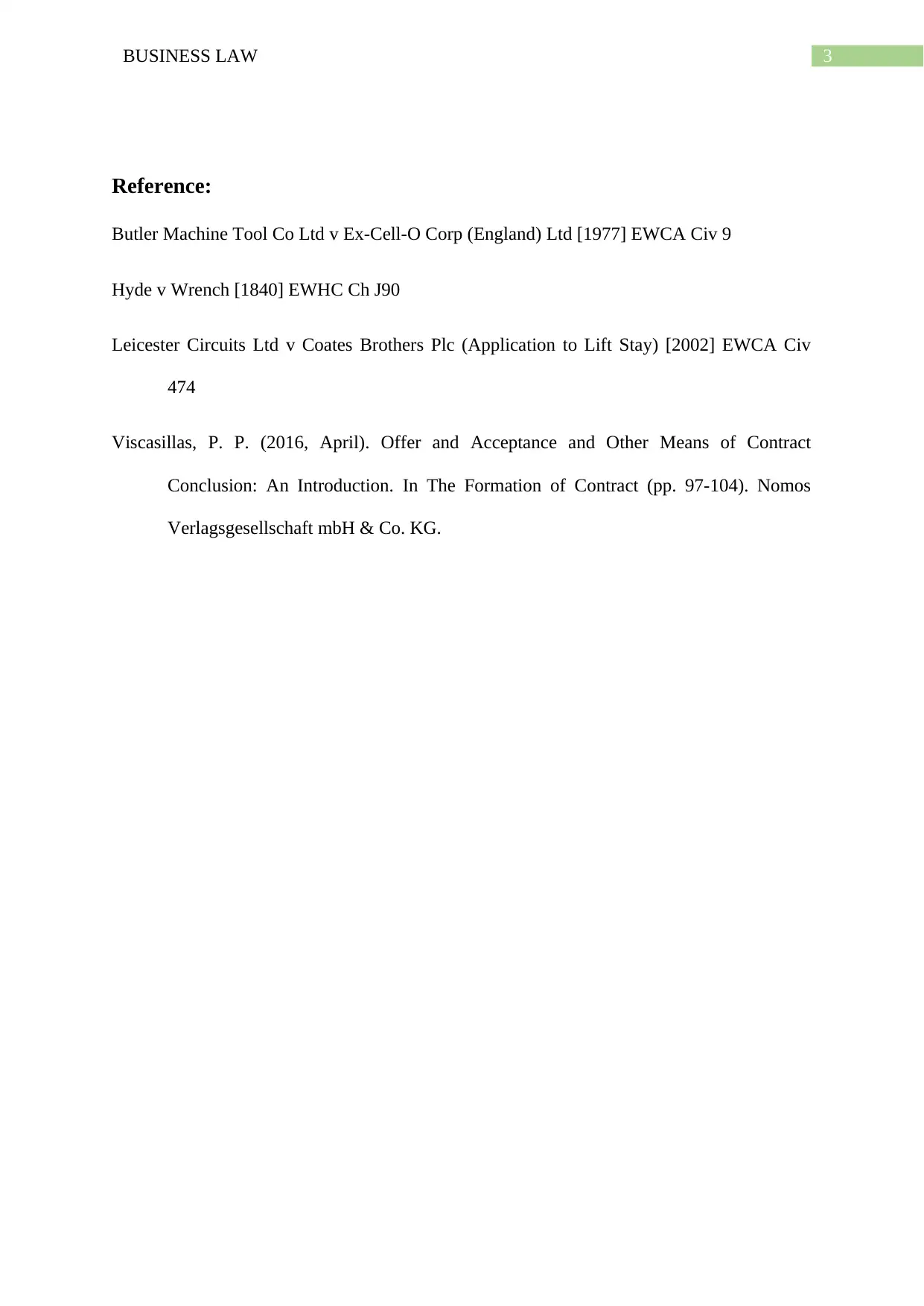
Reference:
Butler Machine Tool Co Ltd v Ex-Cell-O Corp (England) Ltd [1977] EWCA Civ 9
Hyde v Wrench [1840] EWHC Ch J90
Leicester Circuits Ltd v Coates Brothers Plc (Application to Lift Stay) [2002] EWCA Civ
474
Viscasillas, P. P. (2016, April). Offer and Acceptance and Other Means of Contract
Conclusion: An Introduction. In The Formation of Contract (pp. 97-104). Nomos
Verlagsgesellschaft mbH & Co. KG.
Reference:
Butler Machine Tool Co Ltd v Ex-Cell-O Corp (England) Ltd [1977] EWCA Civ 9
Hyde v Wrench [1840] EWHC Ch J90
Leicester Circuits Ltd v Coates Brothers Plc (Application to Lift Stay) [2002] EWCA Civ
474
Viscasillas, P. P. (2016, April). Offer and Acceptance and Other Means of Contract
Conclusion: An Introduction. In The Formation of Contract (pp. 97-104). Nomos
Verlagsgesellschaft mbH & Co. KG.
1 out of 4
Related Documents
Your All-in-One AI-Powered Toolkit for Academic Success.
+13062052269
info@desklib.com
Available 24*7 on WhatsApp / Email
Unlock your academic potential
Copyright © 2020–2026 A2Z Services. All Rights Reserved. Developed and managed by ZUCOL.