History Assignment: Unit 1 DBQ Document Analysis - Sub-Saharan Africa
VerifiedAdded on 2022/09/16
|5
|1695
|64
Homework Assignment
AI Summary
This assignment analyzes various primary source documents to evaluate the achievements of kingdoms and empires in Sub-Saharan Africa between c. 1200 and c. 1450. The analysis includes sourcing, theme, and context analysis of documents such as an Egyptian official's account of Mansa Musa, descriptions of Timbuktu, and accounts of travels to the Kingdom of Mali. The assignment also examines the significance of cultural artifacts like the Benin bronze heads and the coiled snake staff. Furthermore, the assignment includes context and thesis paragraphs, which provide background information on the Song Dynasty and the effects of intellectual innovation in Dar al-Islam and the Americas, as well as the effects of agriculture on social organization in Europe. The document explores the political, economic, and cultural aspects of the regions, offering insights into their development and interactions. The assignment aims to demonstrate an understanding of historical context, sourcing, and analysis of primary source materials.
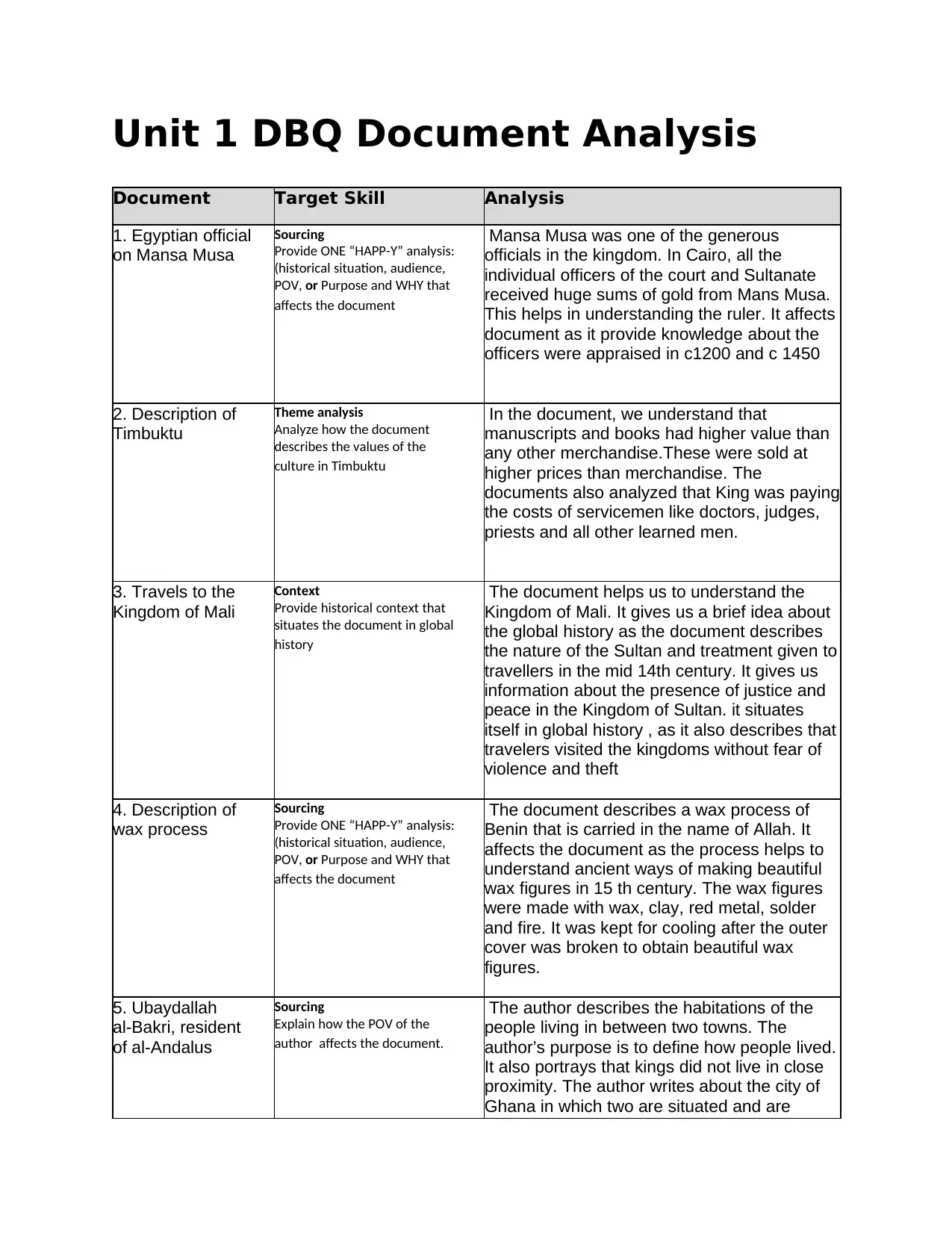
Unit 1 DBQ Document Analysis
Document Target Skill Analysis
1. Egyptian official
on Mansa Musa
Sourcing
Provide ONE “HAPP-Y” analysis:
(historical situation, audience,
POV, or Purpose and WHY that
affects the document
Mansa Musa was one of the generous
officials in the kingdom. In Cairo, all the
individual officers of the court and Sultanate
received huge sums of gold from Mans Musa.
This helps in understanding the ruler. It affects
document as it provide knowledge about the
officers were appraised in c1200 and c 1450
2. Description of
Timbuktu
Theme analysis
Analyze how the document
describes the values of the
culture in Timbuktu
In the document, we understand that
manuscripts and books had higher value than
any other merchandise.These were sold at
higher prices than merchandise. The
documents also analyzed that King was paying
the costs of servicemen like doctors, judges,
priests and all other learned men.
3. Travels to the
Kingdom of Mali
Context
Provide historical context that
situates the document in global
history
The document helps us to understand the
Kingdom of Mali. It gives us a brief idea about
the global history as the document describes
the nature of the Sultan and treatment given to
travellers in the mid 14th century. It gives us
information about the presence of justice and
peace in the Kingdom of Sultan. it situates
itself in global history , as it also describes that
travelers visited the kingdoms without fear of
violence and theft
4. Description of
wax process
Sourcing
Provide ONE “HAPP-Y” analysis:
(historical situation, audience,
POV, or Purpose and WHY that
affects the document
The document describes a wax process of
Benin that is carried in the name of Allah. It
affects the document as the process helps to
understand ancient ways of making beautiful
wax figures in 15 th century. The wax figures
were made with wax, clay, red metal, solder
and fire. It was kept for cooling after the outer
cover was broken to obtain beautiful wax
figures.
5. Ubaydallah
al-Bakri, resident
of al-Andalus
Sourcing
Explain how the POV of the
author affects the document.
The author describes the habitations of the
people living in between two towns. The
author’s purpose is to define how people lived.
It also portrays that kings did not live in close
proximity. The author writes about the city of
Ghana in which two are situated and are
Document Target Skill Analysis
1. Egyptian official
on Mansa Musa
Sourcing
Provide ONE “HAPP-Y” analysis:
(historical situation, audience,
POV, or Purpose and WHY that
affects the document
Mansa Musa was one of the generous
officials in the kingdom. In Cairo, all the
individual officers of the court and Sultanate
received huge sums of gold from Mans Musa.
This helps in understanding the ruler. It affects
document as it provide knowledge about the
officers were appraised in c1200 and c 1450
2. Description of
Timbuktu
Theme analysis
Analyze how the document
describes the values of the
culture in Timbuktu
In the document, we understand that
manuscripts and books had higher value than
any other merchandise.These were sold at
higher prices than merchandise. The
documents also analyzed that King was paying
the costs of servicemen like doctors, judges,
priests and all other learned men.
3. Travels to the
Kingdom of Mali
Context
Provide historical context that
situates the document in global
history
The document helps us to understand the
Kingdom of Mali. It gives us a brief idea about
the global history as the document describes
the nature of the Sultan and treatment given to
travellers in the mid 14th century. It gives us
information about the presence of justice and
peace in the Kingdom of Sultan. it situates
itself in global history , as it also describes that
travelers visited the kingdoms without fear of
violence and theft
4. Description of
wax process
Sourcing
Provide ONE “HAPP-Y” analysis:
(historical situation, audience,
POV, or Purpose and WHY that
affects the document
The document describes a wax process of
Benin that is carried in the name of Allah. It
affects the document as the process helps to
understand ancient ways of making beautiful
wax figures in 15 th century. The wax figures
were made with wax, clay, red metal, solder
and fire. It was kept for cooling after the outer
cover was broken to obtain beautiful wax
figures.
5. Ubaydallah
al-Bakri, resident
of al-Andalus
Sourcing
Explain how the POV of the
author affects the document.
The author describes the habitations of the
people living in between two towns. The
author’s purpose is to define how people lived.
It also portrays that kings did not live in close
proximity. The author writes about the city of
Ghana in which two are situated and are
Paraphrase This Document
Need a fresh take? Get an instant paraphrase of this document with our AI Paraphraser

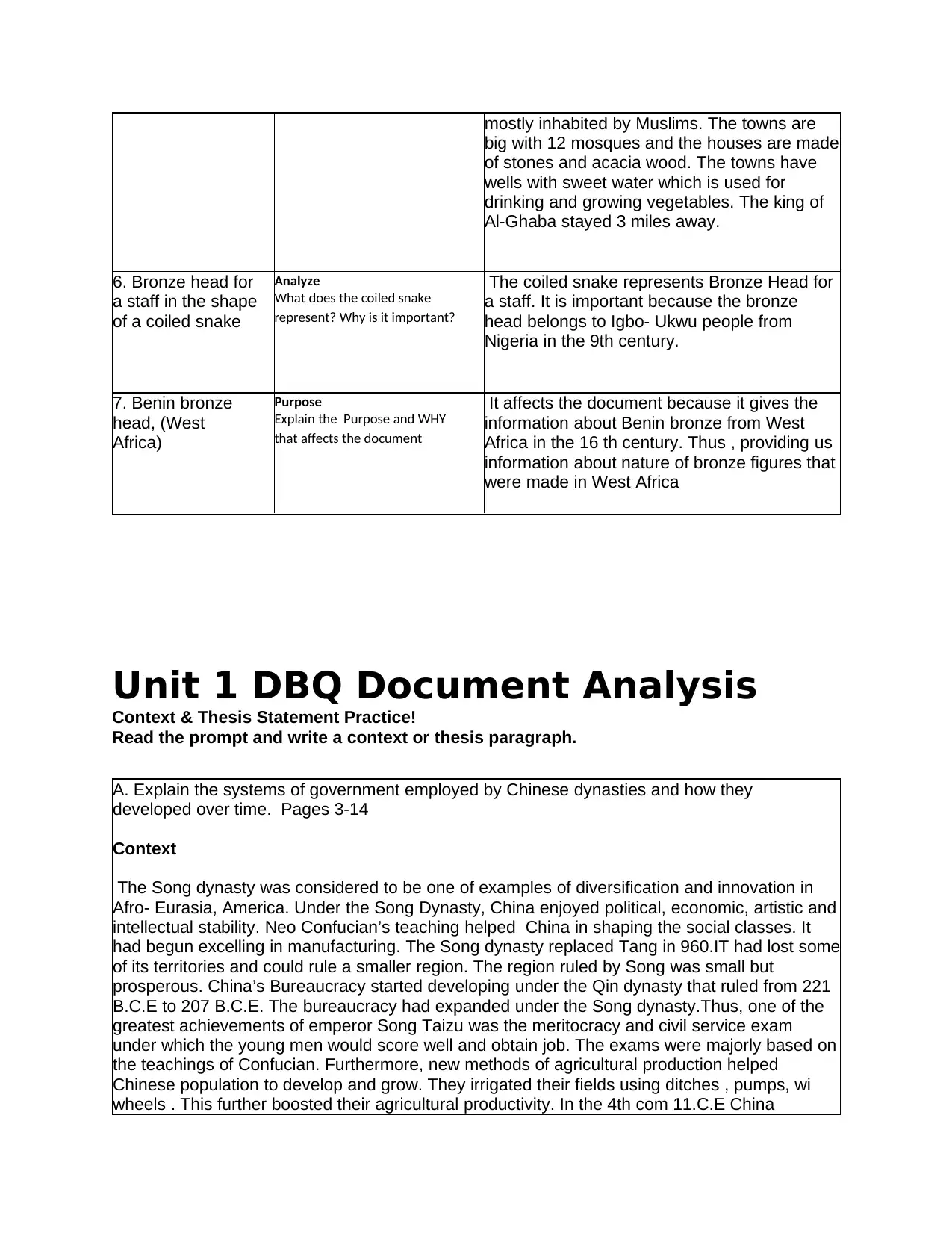
mostly inhabited by Muslims. The towns are
big with 12 mosques and the houses are made
of stones and acacia wood. The towns have
wells with sweet water which is used for
drinking and growing vegetables. The king of
Al-Ghaba stayed 3 miles away.
6. Bronze head for
a staff in the shape
of a coiled snake
Analyze
What does the coiled snake
represent? Why is it important?
The coiled snake represents Bronze Head for
a staff. It is important because the bronze
head belongs to Igbo- Ukwu people from
Nigeria in the 9th century.
7. Benin bronze
head, (West
Africa)
Purpose
Explain the Purpose and WHY
that affects the document
It affects the document because it gives the
information about Benin bronze from West
Africa in the 16 th century. Thus , providing us
information about nature of bronze figures that
were made in West Africa
Unit 1 DBQ Document Analysis
Context & Thesis Statement Practice!
Read the prompt and write a context or thesis paragraph.
A. Explain the systems of government employed by Chinese dynasties and how they
developed over time. Pages 3-14
Context
The Song dynasty was considered to be one of examples of diversification and innovation in
Afro- Eurasia, America. Under the Song Dynasty, China enjoyed political, economic, artistic and
intellectual stability. Neo Confucian’s teaching helped China in shaping the social classes. It
had begun excelling in manufacturing. The Song dynasty replaced Tang in 960.IT had lost some
of its territories and could rule a smaller region. The region ruled by Song was small but
prosperous. China’s Bureaucracy started developing under the Qin dynasty that ruled from 221
B.C.E to 207 B.C.E. The bureaucracy had expanded under the Song dynasty.Thus, one of the
greatest achievements of emperor Song Taizu was the meritocracy and civil service exam
under which the young men would score well and obtain job. The exams were majorly based on
the teachings of Confucian. Furthermore, new methods of agricultural production helped
Chinese population to develop and grow. They irrigated their fields using ditches , pumps, wi
wheels . This further boosted their agricultural productivity. In the 4th com 11.C.E China
big with 12 mosques and the houses are made
of stones and acacia wood. The towns have
wells with sweet water which is used for
drinking and growing vegetables. The king of
Al-Ghaba stayed 3 miles away.
6. Bronze head for
a staff in the shape
of a coiled snake
Analyze
What does the coiled snake
represent? Why is it important?
The coiled snake represents Bronze Head for
a staff. It is important because the bronze
head belongs to Igbo- Ukwu people from
Nigeria in the 9th century.
7. Benin bronze
head, (West
Africa)
Purpose
Explain the Purpose and WHY
that affects the document
It affects the document because it gives the
information about Benin bronze from West
Africa in the 16 th century. Thus , providing us
information about nature of bronze figures that
were made in West Africa
Unit 1 DBQ Document Analysis
Context & Thesis Statement Practice!
Read the prompt and write a context or thesis paragraph.
A. Explain the systems of government employed by Chinese dynasties and how they
developed over time. Pages 3-14
Context
The Song dynasty was considered to be one of examples of diversification and innovation in
Afro- Eurasia, America. Under the Song Dynasty, China enjoyed political, economic, artistic and
intellectual stability. Neo Confucian’s teaching helped China in shaping the social classes. It
had begun excelling in manufacturing. The Song dynasty replaced Tang in 960.IT had lost some
of its territories and could rule a smaller region. The region ruled by Song was small but
prosperous. China’s Bureaucracy started developing under the Qin dynasty that ruled from 221
B.C.E to 207 B.C.E. The bureaucracy had expanded under the Song dynasty.Thus, one of the
greatest achievements of emperor Song Taizu was the meritocracy and civil service exam
under which the young men would score well and obtain job. The exams were majorly based on
the teachings of Confucian. Furthermore, new methods of agricultural production helped
Chinese population to develop and grow. They irrigated their fields using ditches , pumps, wi
wheels . This further boosted their agricultural productivity. In the 4th com 11.C.E China

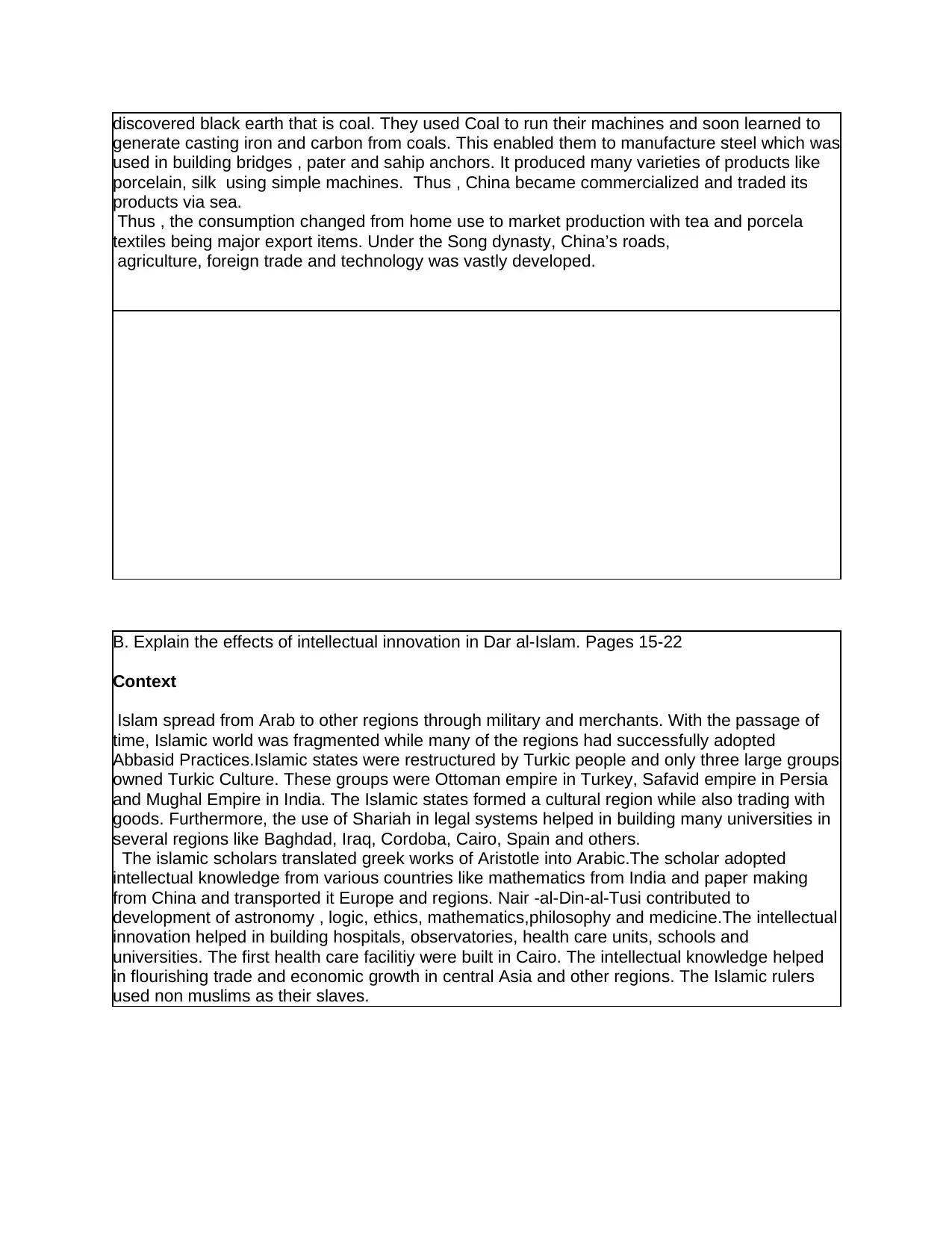
discovered black earth that is coal. They used Coal to run their machines and soon learned to
generate casting iron and carbon from coals. This enabled them to manufacture steel which was
used in building bridges , pater and sahip anchors. It produced many varieties of products like
porcelain, silk using simple machines. Thus , China became commercialized and traded its
products via sea.
Thus , the consumption changed from home use to market production with tea and porcela
textiles being major export items. Under the Song dynasty, China’s roads,
agriculture, foreign trade and technology was vastly developed.
B. Explain the effects of intellectual innovation in Dar al-Islam. Pages 15-22
Context
Islam spread from Arab to other regions through military and merchants. With the passage of
time, Islamic world was fragmented while many of the regions had successfully adopted
Abbasid Practices.Islamic states were restructured by Turkic people and only three large groups
owned Turkic Culture. These groups were Ottoman empire in Turkey, Safavid empire in Persia
and Mughal Empire in India. The Islamic states formed a cultural region while also trading with
goods. Furthermore, the use of Shariah in legal systems helped in building many universities in
several regions like Baghdad, Iraq, Cordoba, Cairo, Spain and others.
The islamic scholars translated greek works of Aristotle into Arabic.The scholar adopted
intellectual knowledge from various countries like mathematics from India and paper making
from China and transported it Europe and regions. Nair -al-Din-al-Tusi contributed to
development of astronomy , logic, ethics, mathematics,philosophy and medicine.The intellectual
innovation helped in building hospitals, observatories, health care units, schools and
universities. The first health care facilitiy were built in Cairo. The intellectual knowledge helped
in flourishing trade and economic growth in central Asia and other regions. The Islamic rulers
used non muslims as their slaves.
generate casting iron and carbon from coals. This enabled them to manufacture steel which was
used in building bridges , pater and sahip anchors. It produced many varieties of products like
porcelain, silk using simple machines. Thus , China became commercialized and traded its
products via sea.
Thus , the consumption changed from home use to market production with tea and porcela
textiles being major export items. Under the Song dynasty, China’s roads,
agriculture, foreign trade and technology was vastly developed.
B. Explain the effects of intellectual innovation in Dar al-Islam. Pages 15-22
Context
Islam spread from Arab to other regions through military and merchants. With the passage of
time, Islamic world was fragmented while many of the regions had successfully adopted
Abbasid Practices.Islamic states were restructured by Turkic people and only three large groups
owned Turkic Culture. These groups were Ottoman empire in Turkey, Safavid empire in Persia
and Mughal Empire in India. The Islamic states formed a cultural region while also trading with
goods. Furthermore, the use of Shariah in legal systems helped in building many universities in
several regions like Baghdad, Iraq, Cordoba, Cairo, Spain and others.
The islamic scholars translated greek works of Aristotle into Arabic.The scholar adopted
intellectual knowledge from various countries like mathematics from India and paper making
from China and transported it Europe and regions. Nair -al-Din-al-Tusi contributed to
development of astronomy , logic, ethics, mathematics,philosophy and medicine.The intellectual
innovation helped in building hospitals, observatories, health care units, schools and
universities. The first health care facilitiy were built in Cairo. The intellectual knowledge helped
in flourishing trade and economic growth in central Asia and other regions. The Islamic rulers
used non muslims as their slaves.
⊘ This is a preview!⊘
Do you want full access?
Subscribe today to unlock all pages.

Trusted by 1+ million students worldwide

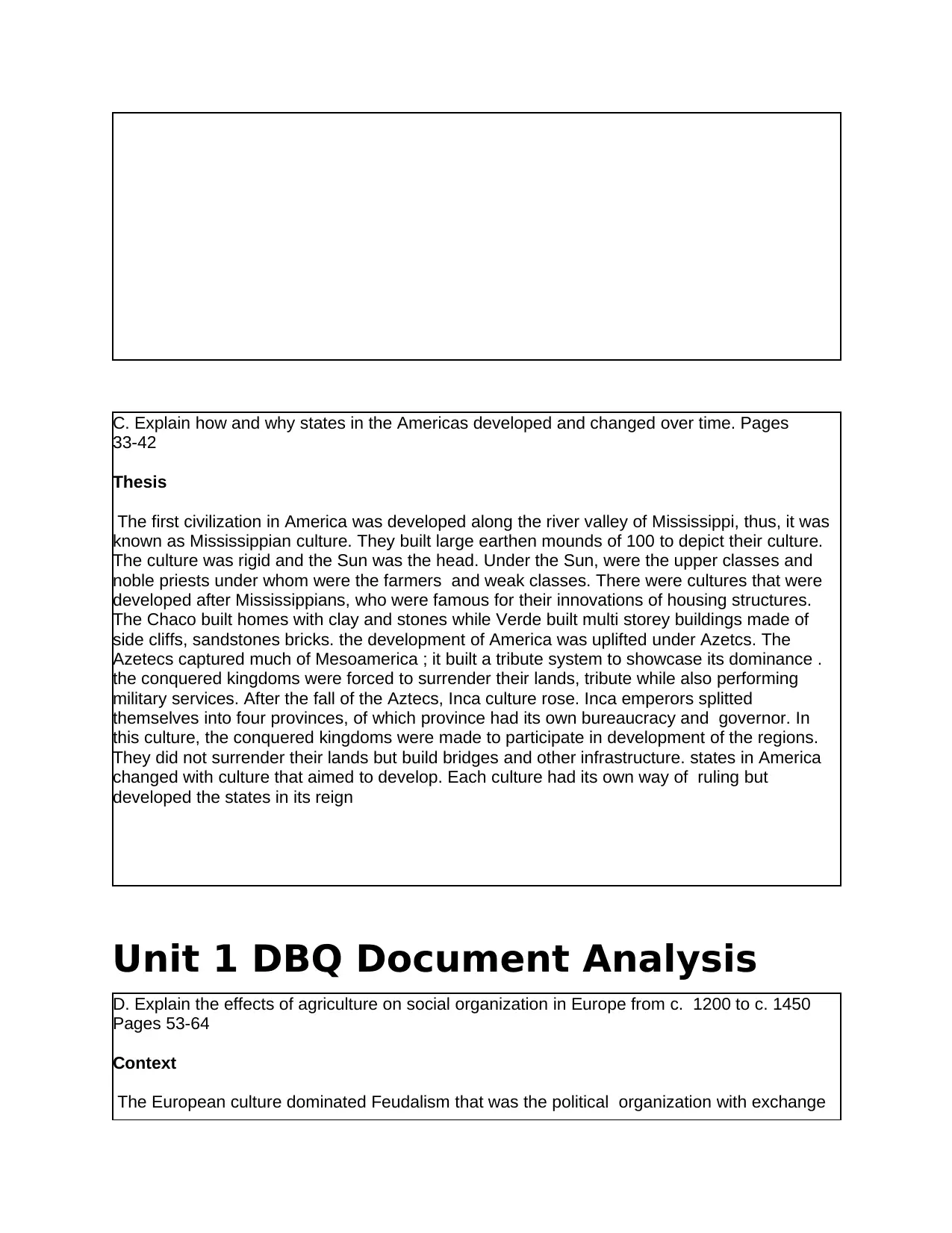
C. Explain how and why states in the Americas developed and changed over time. Pages
33-42
Thesis
The first civilization in America was developed along the river valley of Mississippi, thus, it was
known as Mississippian culture. They built large earthen mounds of 100 to depict their culture.
The culture was rigid and the Sun was the head. Under the Sun, were the upper classes and
noble priests under whom were the farmers and weak classes. There were cultures that were
developed after Mississippians, who were famous for their innovations of housing structures.
The Chaco built homes with clay and stones while Verde built multi storey buildings made of
side cliffs, sandstones bricks. the development of America was uplifted under Azetcs. The
Azetecs captured much of Mesoamerica ; it built a tribute system to showcase its dominance .
the conquered kingdoms were forced to surrender their lands, tribute while also performing
military services. After the fall of the Aztecs, Inca culture rose. Inca emperors splitted
themselves into four provinces, of which province had its own bureaucracy and governor. In
this culture, the conquered kingdoms were made to participate in development of the regions.
They did not surrender their lands but build bridges and other infrastructure. states in America
changed with culture that aimed to develop. Each culture had its own way of ruling but
developed the states in its reign
Unit 1 DBQ Document Analysis
D. Explain the effects of agriculture on social organization in Europe from c. 1200 to c. 1450
Pages 53-64
Context
The European culture dominated Feudalism that was the political organization with exchange
33-42
Thesis
The first civilization in America was developed along the river valley of Mississippi, thus, it was
known as Mississippian culture. They built large earthen mounds of 100 to depict their culture.
The culture was rigid and the Sun was the head. Under the Sun, were the upper classes and
noble priests under whom were the farmers and weak classes. There were cultures that were
developed after Mississippians, who were famous for their innovations of housing structures.
The Chaco built homes with clay and stones while Verde built multi storey buildings made of
side cliffs, sandstones bricks. the development of America was uplifted under Azetcs. The
Azetecs captured much of Mesoamerica ; it built a tribute system to showcase its dominance .
the conquered kingdoms were forced to surrender their lands, tribute while also performing
military services. After the fall of the Aztecs, Inca culture rose. Inca emperors splitted
themselves into four provinces, of which province had its own bureaucracy and governor. In
this culture, the conquered kingdoms were made to participate in development of the regions.
They did not surrender their lands but build bridges and other infrastructure. states in America
changed with culture that aimed to develop. Each culture had its own way of ruling but
developed the states in its reign
Unit 1 DBQ Document Analysis
D. Explain the effects of agriculture on social organization in Europe from c. 1200 to c. 1450
Pages 53-64
Context
The European culture dominated Feudalism that was the political organization with exchange
Paraphrase This Document
Need a fresh take? Get an instant paraphrase of this document with our AI Paraphraser

of land as loyalty . Europe was being ruled majorly by the Muslim. thus , economic and political
stability was brought when the muslim rulers were ruled out in four crusades and Christian
regained its power. Agriculture production started and excess helped towns and cities to grow.
region to flourish The three -field system and agricultural advancements helped in population
growth. The development was fragmented after plague struck many regions of Eurasia. Since
the muslim population was still prevalent, some of them converted to jew while others faced
discrimination in the country.
stability was brought when the muslim rulers were ruled out in four crusades and Christian
regained its power. Agriculture production started and excess helped towns and cities to grow.
region to flourish The three -field system and agricultural advancements helped in population
growth. The development was fragmented after plague struck many regions of Eurasia. Since
the muslim population was still prevalent, some of them converted to jew while others faced
discrimination in the country.
1 out of 5
Your All-in-One AI-Powered Toolkit for Academic Success.
+13062052269
info@desklib.com
Available 24*7 on WhatsApp / Email
Unlock your academic potential
Copyright © 2020–2025 A2Z Services. All Rights Reserved. Developed and managed by ZUCOL.