Unilever's Management and Operational Strategies: A Detailed Report
VerifiedAdded on 2022/12/28
|15
|4051
|96
Report
AI Summary
This report provides a comprehensive analysis of Unilever's management and operations. It begins by examining the roles of managers and leaders, differentiating between their responsibilities and exploring how leadership and management styles vary in different organizational situations. The report then delves into various leadership theories and models, including situational, system, and contingency leadership, evaluating their strengths and weaknesses. The second part focuses on Unilever's key operations, detailing functions like product design, manufacturing, supply chain management, and inventory management. It explores the roles and responsibilities of managers in these areas, operational approaches, and the impact of external factors on decision-making. The report concludes with a discussion on improving operational efficiency within Unilever, providing valuable insights into the company's strategic management and operational practices.
Unit 4 - Management and
Operations
Operations

Paraphrase This Document
Need a fresh take? Get an instant paraphrase of this document with our AI Paraphraser
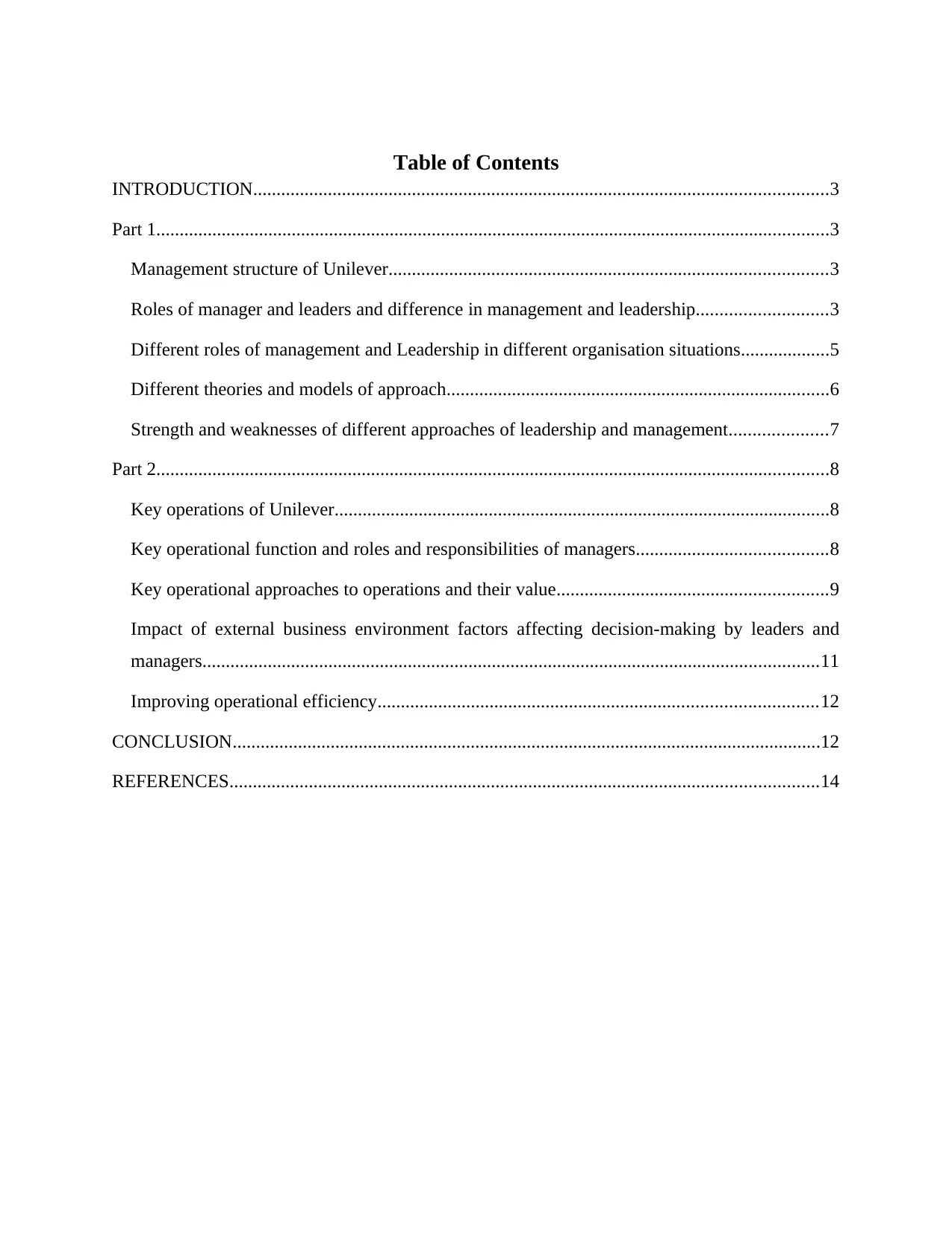
Table of Contents
INTRODUCTION...........................................................................................................................3
Part 1................................................................................................................................................3
Management structure of Unilever..............................................................................................3
Roles of manager and leaders and difference in management and leadership............................3
Different roles of management and Leadership in different organisation situations...................5
Different theories and models of approach..................................................................................6
Strength and weaknesses of different approaches of leadership and management.....................7
Part 2................................................................................................................................................8
Key operations of Unilever..........................................................................................................8
Key operational function and roles and responsibilities of managers.........................................8
Key operational approaches to operations and their value..........................................................9
Impact of external business environment factors affecting decision-making by leaders and
managers....................................................................................................................................11
Improving operational efficiency..............................................................................................12
CONCLUSION..............................................................................................................................12
REFERENCES..............................................................................................................................14
INTRODUCTION...........................................................................................................................3
Part 1................................................................................................................................................3
Management structure of Unilever..............................................................................................3
Roles of manager and leaders and difference in management and leadership............................3
Different roles of management and Leadership in different organisation situations...................5
Different theories and models of approach..................................................................................6
Strength and weaknesses of different approaches of leadership and management.....................7
Part 2................................................................................................................................................8
Key operations of Unilever..........................................................................................................8
Key operational function and roles and responsibilities of managers.........................................8
Key operational approaches to operations and their value..........................................................9
Impact of external business environment factors affecting decision-making by leaders and
managers....................................................................................................................................11
Improving operational efficiency..............................................................................................12
CONCLUSION..............................................................................................................................12
REFERENCES..............................................................................................................................14
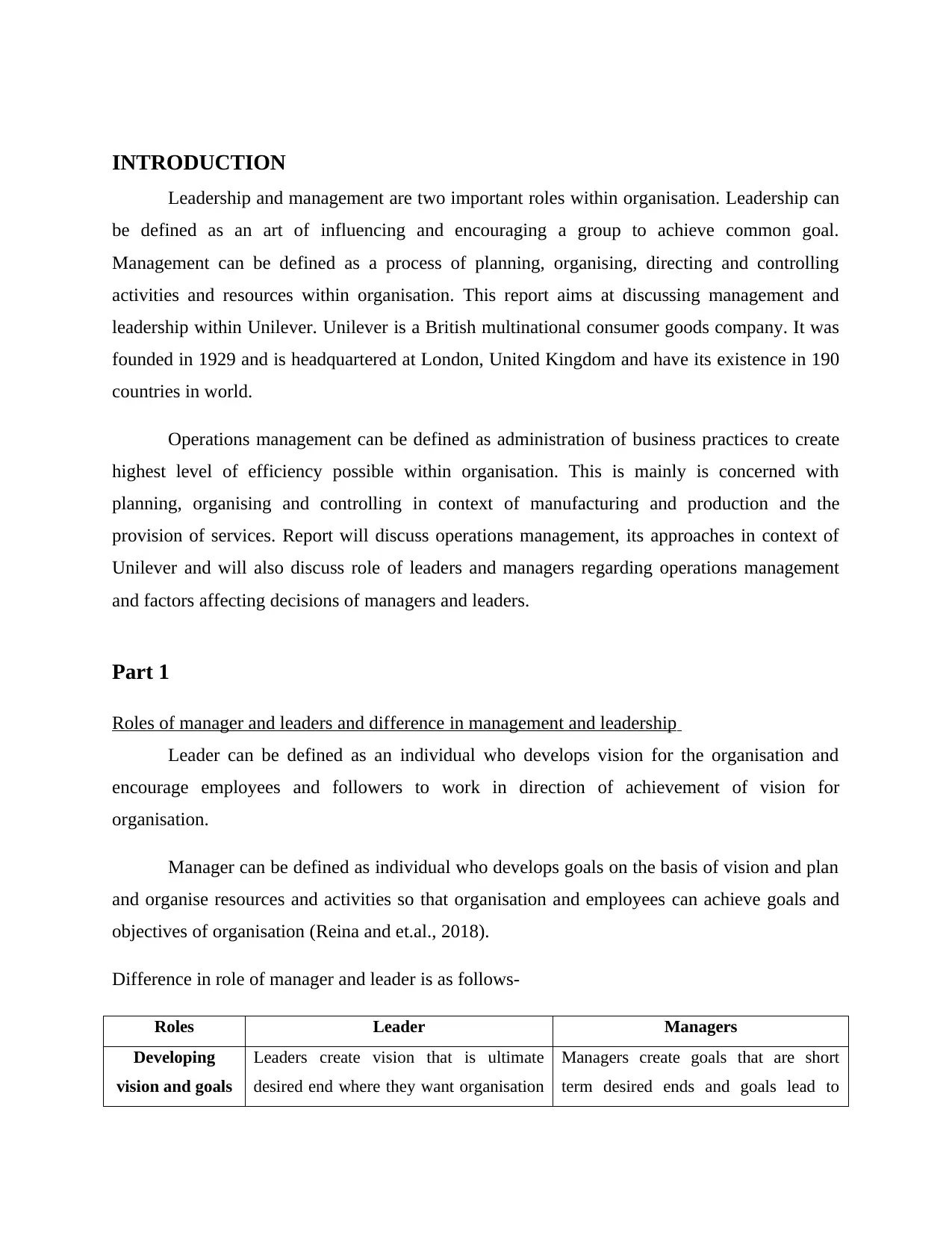
INTRODUCTION
Leadership and management are two important roles within organisation. Leadership can
be defined as an art of influencing and encouraging a group to achieve common goal.
Management can be defined as a process of planning, organising, directing and controlling
activities and resources within organisation. This report aims at discussing management and
leadership within Unilever. Unilever is a British multinational consumer goods company. It was
founded in 1929 and is headquartered at London, United Kingdom and have its existence in 190
countries in world.
Operations management can be defined as administration of business practices to create
highest level of efficiency possible within organisation. This is mainly is concerned with
planning, organising and controlling in context of manufacturing and production and the
provision of services. Report will discuss operations management, its approaches in context of
Unilever and will also discuss role of leaders and managers regarding operations management
and factors affecting decisions of managers and leaders.
Part 1
Roles of manager and leaders and difference in management and leadership
Leader can be defined as an individual who develops vision for the organisation and
encourage employees and followers to work in direction of achievement of vision for
organisation.
Manager can be defined as individual who develops goals on the basis of vision and plan
and organise resources and activities so that organisation and employees can achieve goals and
objectives of organisation (Reina and et.al., 2018).
Difference in role of manager and leader is as follows-
Roles Leader Managers
Developing
vision and goals
Leaders create vision that is ultimate
desired end where they want organisation
Managers create goals that are short
term desired ends and goals lead to
Leadership and management are two important roles within organisation. Leadership can
be defined as an art of influencing and encouraging a group to achieve common goal.
Management can be defined as a process of planning, organising, directing and controlling
activities and resources within organisation. This report aims at discussing management and
leadership within Unilever. Unilever is a British multinational consumer goods company. It was
founded in 1929 and is headquartered at London, United Kingdom and have its existence in 190
countries in world.
Operations management can be defined as administration of business practices to create
highest level of efficiency possible within organisation. This is mainly is concerned with
planning, organising and controlling in context of manufacturing and production and the
provision of services. Report will discuss operations management, its approaches in context of
Unilever and will also discuss role of leaders and managers regarding operations management
and factors affecting decisions of managers and leaders.
Part 1
Roles of manager and leaders and difference in management and leadership
Leader can be defined as an individual who develops vision for the organisation and
encourage employees and followers to work in direction of achievement of vision for
organisation.
Manager can be defined as individual who develops goals on the basis of vision and plan
and organise resources and activities so that organisation and employees can achieve goals and
objectives of organisation (Reina and et.al., 2018).
Difference in role of manager and leader is as follows-
Roles Leader Managers
Developing
vision and goals
Leaders create vision that is ultimate
desired end where they want organisation
Managers create goals that are short
term desired ends and goals lead to
⊘ This is a preview!⊘
Do you want full access?
Subscribe today to unlock all pages.

Trusted by 1+ million students worldwide
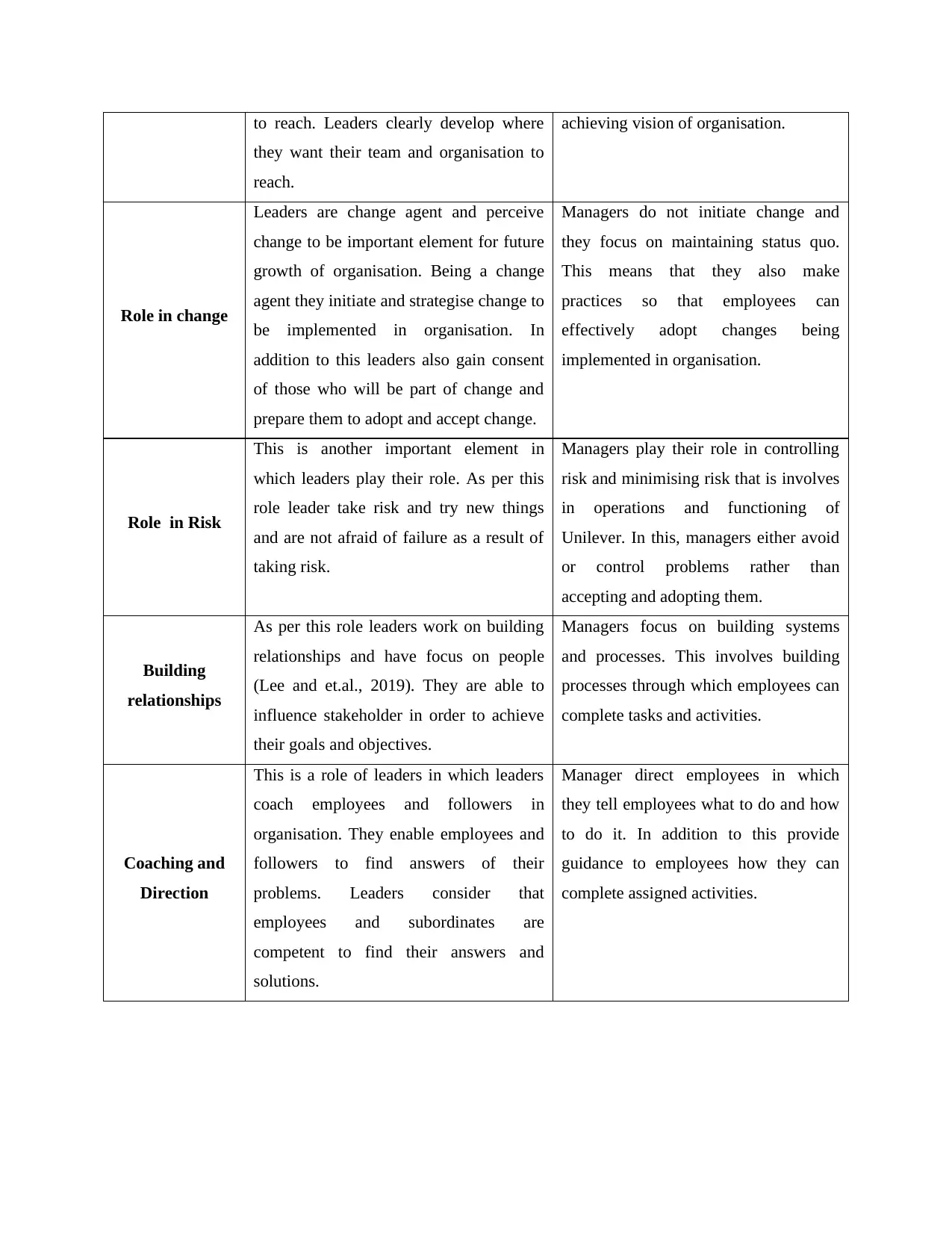
to reach. Leaders clearly develop where
they want their team and organisation to
reach.
achieving vision of organisation.
Role in change
Leaders are change agent and perceive
change to be important element for future
growth of organisation. Being a change
agent they initiate and strategise change to
be implemented in organisation. In
addition to this leaders also gain consent
of those who will be part of change and
prepare them to adopt and accept change.
Managers do not initiate change and
they focus on maintaining status quo.
This means that they also make
practices so that employees can
effectively adopt changes being
implemented in organisation.
Role in Risk
This is another important element in
which leaders play their role. As per this
role leader take risk and try new things
and are not afraid of failure as a result of
taking risk.
Managers play their role in controlling
risk and minimising risk that is involves
in operations and functioning of
Unilever. In this, managers either avoid
or control problems rather than
accepting and adopting them.
Building
relationships
As per this role leaders work on building
relationships and have focus on people
(Lee and et.al., 2019). They are able to
influence stakeholder in order to achieve
their goals and objectives.
Managers focus on building systems
and processes. This involves building
processes through which employees can
complete tasks and activities.
Coaching and
Direction
This is a role of leaders in which leaders
coach employees and followers in
organisation. They enable employees and
followers to find answers of their
problems. Leaders consider that
employees and subordinates are
competent to find their answers and
solutions.
Manager direct employees in which
they tell employees what to do and how
to do it. In addition to this provide
guidance to employees how they can
complete assigned activities.
they want their team and organisation to
reach.
achieving vision of organisation.
Role in change
Leaders are change agent and perceive
change to be important element for future
growth of organisation. Being a change
agent they initiate and strategise change to
be implemented in organisation. In
addition to this leaders also gain consent
of those who will be part of change and
prepare them to adopt and accept change.
Managers do not initiate change and
they focus on maintaining status quo.
This means that they also make
practices so that employees can
effectively adopt changes being
implemented in organisation.
Role in Risk
This is another important element in
which leaders play their role. As per this
role leader take risk and try new things
and are not afraid of failure as a result of
taking risk.
Managers play their role in controlling
risk and minimising risk that is involves
in operations and functioning of
Unilever. In this, managers either avoid
or control problems rather than
accepting and adopting them.
Building
relationships
As per this role leaders work on building
relationships and have focus on people
(Lee and et.al., 2019). They are able to
influence stakeholder in order to achieve
their goals and objectives.
Managers focus on building systems
and processes. This involves building
processes through which employees can
complete tasks and activities.
Coaching and
Direction
This is a role of leaders in which leaders
coach employees and followers in
organisation. They enable employees and
followers to find answers of their
problems. Leaders consider that
employees and subordinates are
competent to find their answers and
solutions.
Manager direct employees in which
they tell employees what to do and how
to do it. In addition to this provide
guidance to employees how they can
complete assigned activities.
Paraphrase This Document
Need a fresh take? Get an instant paraphrase of this document with our AI Paraphraser
Different roles of management and Leadership in different organisation situations
There are different situations in an organisation that require contribution and support of
both leader as well as manager. Organisational situations and role of management and leadership
are as follows-
Implementing Change
This is a very important situation in which change is implemented in Unilever. In this
change is developed and implemented in organisation to achieve specific goals and objectives of
the organisation. In order to successfully implement change in Unilever effective change
management plays very important role. In addition to this change management involves
effectively planning change and organising different elements accordingly. Unfreezing, freezing
and refreezing are important phases of change management. Roles of leader and manager during
change implementation are-
Role of Leader- Leader plays very important role in change implementation within Unilever
(Arif and et.al., 2017). Leader plays important role in setting direction for change
implementation within organisation. Leader also plays important role in establishing
relationships in which they communicate vision for the organisational change and prepare
organisation and employees within Unilever to adopt and accept changes in organisation. In
addition to this leaders also play role model so that employees can inspiration from leader and
work accordingly.
Role of Manager- Role of manager in change includes planning change and its implementation.
Managers also organise resources required for change and in addition to this organising activities
for resources in Unilever is also role of manager. In addition to this another important role that
managers play in change implementation within Unilever is providing regular assistance to
employees when they are working in new practices of organisation. In addition to this listening
to problems of employees and providing adequate solution is also role of employees.
Launch of new product
This is another situation within Unilever that requires support and contribution of leaders
and managers of Unilever (Cheng and Yang, 2019). Launch of new product is a situation in
There are different situations in an organisation that require contribution and support of
both leader as well as manager. Organisational situations and role of management and leadership
are as follows-
Implementing Change
This is a very important situation in which change is implemented in Unilever. In this
change is developed and implemented in organisation to achieve specific goals and objectives of
the organisation. In order to successfully implement change in Unilever effective change
management plays very important role. In addition to this change management involves
effectively planning change and organising different elements accordingly. Unfreezing, freezing
and refreezing are important phases of change management. Roles of leader and manager during
change implementation are-
Role of Leader- Leader plays very important role in change implementation within Unilever
(Arif and et.al., 2017). Leader plays important role in setting direction for change
implementation within organisation. Leader also plays important role in establishing
relationships in which they communicate vision for the organisational change and prepare
organisation and employees within Unilever to adopt and accept changes in organisation. In
addition to this leaders also play role model so that employees can inspiration from leader and
work accordingly.
Role of Manager- Role of manager in change includes planning change and its implementation.
Managers also organise resources required for change and in addition to this organising activities
for resources in Unilever is also role of manager. In addition to this another important role that
managers play in change implementation within Unilever is providing regular assistance to
employees when they are working in new practices of organisation. In addition to this listening
to problems of employees and providing adequate solution is also role of employees.
Launch of new product
This is another situation within Unilever that requires support and contribution of leaders
and managers of Unilever (Cheng and Yang, 2019). Launch of new product is a situation in
which organisation introduces its new product in its target market. This is an important situation
and role of leader and manager is as follows-
Role of Leader- Leader plays very important role in linking organisational vision with new
product launch and its activities. Leaders also play important role in reflecting organisational
values through launch of new product of Unilever.
Role of Manager- Manager also play important role in new product development. This is done
by organising different activities linked with launch of new product. In addition to this planning
event and organisation of activities is also included in role of manager within Unilever while
launch of new product.
Different theories and models of approach
Situational leadership
Situational leadership Theory and approach outlines different styles of leadership that a leader
can adopt on the basis of different situations within Unilever. As per this theory success of
leadership is highly based on ability of leader to adapt different styles on the basis of situation
within organisation (Thompson and Glasø, 2018). Situations consist of maturity level of
employees that is based on their commitment towards goal achievement and get capability for
goal achievement. Some styles of situational leaders are telling employees what to do and how to
do it. Selling, in this style of leadership leaders’ offer different options to employees and
employees can select one of the option to complete the task. Participating style of leadership
includes motivating and encouraging employees and allowing them to make decisions and
complete task and offering less direction. Delegating style of leadership in situational leadership
is concerned with delegating task employees in which all decisions are taken by employees.
System leadership
System leadership approach is concerned with creating conditions within Unilever where people
at every level in organisational hierarchy are able to provide their best contribution in realising
organisational goals and objectives. This approach of leadership is based on principles of human
behaviour and different models of effective leadership. System leadership also involve
organisational strategy and system designs as an important element to enable everyone to
perform productively (David and Drysdale, 2018). System leadership provide tools to leader in
and role of leader and manager is as follows-
Role of Leader- Leader plays very important role in linking organisational vision with new
product launch and its activities. Leaders also play important role in reflecting organisational
values through launch of new product of Unilever.
Role of Manager- Manager also play important role in new product development. This is done
by organising different activities linked with launch of new product. In addition to this planning
event and organisation of activities is also included in role of manager within Unilever while
launch of new product.
Different theories and models of approach
Situational leadership
Situational leadership Theory and approach outlines different styles of leadership that a leader
can adopt on the basis of different situations within Unilever. As per this theory success of
leadership is highly based on ability of leader to adapt different styles on the basis of situation
within organisation (Thompson and Glasø, 2018). Situations consist of maturity level of
employees that is based on their commitment towards goal achievement and get capability for
goal achievement. Some styles of situational leaders are telling employees what to do and how to
do it. Selling, in this style of leadership leaders’ offer different options to employees and
employees can select one of the option to complete the task. Participating style of leadership
includes motivating and encouraging employees and allowing them to make decisions and
complete task and offering less direction. Delegating style of leadership in situational leadership
is concerned with delegating task employees in which all decisions are taken by employees.
System leadership
System leadership approach is concerned with creating conditions within Unilever where people
at every level in organisational hierarchy are able to provide their best contribution in realising
organisational goals and objectives. This approach of leadership is based on principles of human
behaviour and different models of effective leadership. System leadership also involve
organisational strategy and system designs as an important element to enable everyone to
perform productively (David and Drysdale, 2018). System leadership provide tools to leader in
⊘ This is a preview!⊘
Do you want full access?
Subscribe today to unlock all pages.
Trusted by 1+ million students worldwide
organisation so that they can predict behaviour of employees within Unilever. Leaders when are
able to predict behaviour of employees and members within Unilever they become capable of
making effective decisions to drive performance and innovation within Unilever. System
leadership enables organisation to get benefit of knowledge and intelligence of people working
within Unilever at all level.
Contingency leadership
This is another approach of leadership in Unilever. This approach of leadership considers that
effectiveness and success of leadership is contingent upon situation in which they are leading
organisation or leading teams with an organisation. As per this theory leader cannot work
effectively in every kind of situation and when they leadership style is adequately aligned with
situation they are able to performed effectively and their leadership becomes successful (Vidal
and et.al., 2017). Factors on the basis of which leadership style is contingent includes
relationship of leader and member within Unilever, task structure and leaders position power. On
the basis of these elements success of leadership style can be identified and in addition to this
least preferred co-worker scale can also be used to identify success of leadership style in
particular situation.
Strength and weaknesses of different approaches of leadership and management
Strength and Weaknesses of situational leadership
Strength
Leaders can effectively work in different organisational situations and employees can
also work under right kind of leadership within Unilever
This leadership style is effective for every employee in Unilever regardless of the time
they have been employed in organisation (Thompson and Glasø, 2018)
Weaknesses
In order to adapt to different styles leaders require being experienced
Inadequate knowledge of situation can affect effectiveness of leadership
Strength and Weaknesses of Contingency leadership
able to predict behaviour of employees and members within Unilever they become capable of
making effective decisions to drive performance and innovation within Unilever. System
leadership enables organisation to get benefit of knowledge and intelligence of people working
within Unilever at all level.
Contingency leadership
This is another approach of leadership in Unilever. This approach of leadership considers that
effectiveness and success of leadership is contingent upon situation in which they are leading
organisation or leading teams with an organisation. As per this theory leader cannot work
effectively in every kind of situation and when they leadership style is adequately aligned with
situation they are able to performed effectively and their leadership becomes successful (Vidal
and et.al., 2017). Factors on the basis of which leadership style is contingent includes
relationship of leader and member within Unilever, task structure and leaders position power. On
the basis of these elements success of leadership style can be identified and in addition to this
least preferred co-worker scale can also be used to identify success of leadership style in
particular situation.
Strength and weaknesses of different approaches of leadership and management
Strength and Weaknesses of situational leadership
Strength
Leaders can effectively work in different organisational situations and employees can
also work under right kind of leadership within Unilever
This leadership style is effective for every employee in Unilever regardless of the time
they have been employed in organisation (Thompson and Glasø, 2018)
Weaknesses
In order to adapt to different styles leaders require being experienced
Inadequate knowledge of situation can affect effectiveness of leadership
Strength and Weaknesses of Contingency leadership
Paraphrase This Document
Need a fresh take? Get an instant paraphrase of this document with our AI Paraphraser
Strength
Leaders can effectively perform their leadership duties and responsibilities when they are
working on situation that are effective as per their situation
Weaknesses
Leadership can be failure and ineffective when situation is not suitable
This is an complicated approach of leadership (Vidal and et.al., 2017).
On the basis of above discussion it can be concluded that leadership and management both
are very important for successful functioning of Unilever. Different leadership approaches
discussed outlines that every leadership style has their own advantages and disadvantages for
organisation.
On the basis of above analysis it is recommended that Unilever while selecting people for
leadership positions should consider that recruit and develop leaders with situational
leadership style where they are required to deal with different type of people on the basis
of maturity.
On the other hand will leadership positions deal with same kind of people in terms of
commitment and competency contingency leadership can be Highly Effective in such
situation
Part 2
Key operations of Unilever
Unilever is a consumer goods company and provide different types of products to
customers including food and drinks and eating products of different types. Operational
management functions of Unilever include designing goods and services and manufacturing
goods and services (Anitah, 2019). In addition to this functions also involve supply chain
management and maintenance of production facility of organisation.
Key operational function and roles and responsibilities of managers
Design goods and services- This involves developing design for goods and services of Unilever.
This is first and foremost activity in operations of Unilever.
Leaders can effectively perform their leadership duties and responsibilities when they are
working on situation that are effective as per their situation
Weaknesses
Leadership can be failure and ineffective when situation is not suitable
This is an complicated approach of leadership (Vidal and et.al., 2017).
On the basis of above discussion it can be concluded that leadership and management both
are very important for successful functioning of Unilever. Different leadership approaches
discussed outlines that every leadership style has their own advantages and disadvantages for
organisation.
On the basis of above analysis it is recommended that Unilever while selecting people for
leadership positions should consider that recruit and develop leaders with situational
leadership style where they are required to deal with different type of people on the basis
of maturity.
On the other hand will leadership positions deal with same kind of people in terms of
commitment and competency contingency leadership can be Highly Effective in such
situation
Part 2
Key operations of Unilever
Unilever is a consumer goods company and provide different types of products to
customers including food and drinks and eating products of different types. Operational
management functions of Unilever include designing goods and services and manufacturing
goods and services (Anitah, 2019). In addition to this functions also involve supply chain
management and maintenance of production facility of organisation.
Key operational function and roles and responsibilities of managers
Design goods and services- This involves developing design for goods and services of Unilever.
This is first and foremost activity in operations of Unilever.
Manufacturing goods and services- This is concerned with operation in which input is
converted into final products to be sold to customers.
Process and capacity design- This is concerned with designing process and capacity where
input is converted into output.
Supply chain management- This is concerned with managing supply chain in organisation. In
this input is acquired within organisation and output is supplied to customers and consumers.
Inventory Management- This involves managing inventory to be used in manufacturing
activities and inventory that is ready to be delivered to consumers (Sinulingga, 2019).
Maintenance- This activity of operations involve maintenance of production capacity.
Role of Leader- Role of leader in these operations functions is to ensure that these are suitable
and right on the basis of organisational direction of organisational vision. Leaders also develop
relationships with different parties and stakeholders to ensure that operational functions can be
effectively completed. Leader also plays important role in motivating and encouraging
individuals to perform effectively their role in operations functions.
Role of Manager- Role of manager in this includes planning and implementing plans for
operational functions and activities. In addition this organising and coordinating operational
functions and ensuring their direction towards organisational goals is also responsibility of
manager within Unilever. In addition to this maintaining quality of products and standards of
practices is also a role of leader in Unilever.
Key operational approaches to operations and their value
Just-In-Time (JIT)
This is an operational management approach that suggests that material for
manufacturing should be aligned directly with schedules of production within Unilever (Li and
et.al., 2017). This means that supplier of inputs and material supplies them when they are
required before starting manufacturing operations. This requires that supply is coordinated with
production activities within Unilever. In order to implement this approach for operations within
converted into final products to be sold to customers.
Process and capacity design- This is concerned with designing process and capacity where
input is converted into output.
Supply chain management- This is concerned with managing supply chain in organisation. In
this input is acquired within organisation and output is supplied to customers and consumers.
Inventory Management- This involves managing inventory to be used in manufacturing
activities and inventory that is ready to be delivered to consumers (Sinulingga, 2019).
Maintenance- This activity of operations involve maintenance of production capacity.
Role of Leader- Role of leader in these operations functions is to ensure that these are suitable
and right on the basis of organisational direction of organisational vision. Leaders also develop
relationships with different parties and stakeholders to ensure that operational functions can be
effectively completed. Leader also plays important role in motivating and encouraging
individuals to perform effectively their role in operations functions.
Role of Manager- Role of manager in this includes planning and implementing plans for
operational functions and activities. In addition this organising and coordinating operational
functions and ensuring their direction towards organisational goals is also responsibility of
manager within Unilever. In addition to this maintaining quality of products and standards of
practices is also a role of leader in Unilever.
Key operational approaches to operations and their value
Just-In-Time (JIT)
This is an operational management approach that suggests that material for
manufacturing should be aligned directly with schedules of production within Unilever (Li and
et.al., 2017). This means that supplier of inputs and material supplies them when they are
required before starting manufacturing operations. This requires that supply is coordinated with
production activities within Unilever. In order to implement this approach for operations within
⊘ This is a preview!⊘
Do you want full access?
Subscribe today to unlock all pages.
Trusted by 1+ million students worldwide
Unilever it is important that organisations maintain effective relationship with suppliers and also
maintain coordination so that they can supply required material and input on right time.
This approach of operations management helps in reducing cost associated with
maintenance of inventory. In addition to this it also is helpful in ensuring optimum utilisation of
production facility.
Lean production
Lean production is another important approach of operations management. This approach
of operations management outlines that Unilever should create more effective processes of
manufacturing by eliminating wasteful practices and improve efficiency of facility and
processes. This approach considered that waste that occurred from operations activity does not
have any value for customers and customers do not like to pay for waste (Wagner, Herrmann and
Thiede, 2017). In order to create highest possible value for customers it is important that
Unilever works on reducing waste to least so that they can increase output that has value for
customer. Effective application of this approach is based on organisations capability to design
and develop manufacturing processes that provides highest possible productivity by reducing
waste to lowest level possible. Unilever can develop such practices by research and development
and innovation capabilities of organisation.
Application of this approach of operations management Unilever can help them in
increasing customer satisfaction and reduce cost of manufacturing.
Total quality management
This is another approach of operations management that Unilever can consider for its
operational activities. Total quality management approach is highly beneficial and effective for
long-term success of Unilever through customer satisfaction. Total quality management
approach considered that all members of Unilever should participate in improving overall
practices of Unilever along with product and services and culture of Unilever (van Kemenade
and Hardjono, 2019). Total quality management approach is customer focused and requires
involvement of total employees and is process centred approach. In addition to this total quality
management also includes integrated systems in which decisions are based on facts and leaders
maintain coordination so that they can supply required material and input on right time.
This approach of operations management helps in reducing cost associated with
maintenance of inventory. In addition to this it also is helpful in ensuring optimum utilisation of
production facility.
Lean production
Lean production is another important approach of operations management. This approach
of operations management outlines that Unilever should create more effective processes of
manufacturing by eliminating wasteful practices and improve efficiency of facility and
processes. This approach considered that waste that occurred from operations activity does not
have any value for customers and customers do not like to pay for waste (Wagner, Herrmann and
Thiede, 2017). In order to create highest possible value for customers it is important that
Unilever works on reducing waste to least so that they can increase output that has value for
customer. Effective application of this approach is based on organisations capability to design
and develop manufacturing processes that provides highest possible productivity by reducing
waste to lowest level possible. Unilever can develop such practices by research and development
and innovation capabilities of organisation.
Application of this approach of operations management Unilever can help them in
increasing customer satisfaction and reduce cost of manufacturing.
Total quality management
This is another approach of operations management that Unilever can consider for its
operational activities. Total quality management approach is highly beneficial and effective for
long-term success of Unilever through customer satisfaction. Total quality management
approach considered that all members of Unilever should participate in improving overall
practices of Unilever along with product and services and culture of Unilever (van Kemenade
and Hardjono, 2019). Total quality management approach is customer focused and requires
involvement of total employees and is process centred approach. In addition to this total quality
management also includes integrated systems in which decisions are based on facts and leaders
Paraphrase This Document
Need a fresh take? Get an instant paraphrase of this document with our AI Paraphraser
and managers have a strong emphasis on continuous improvement of elements affecting
effectiveness of operations within Unilever.
With this approach Unilever can enhance its sustainability and value that its product
provides to customers.
Value of these approaches for Unilever
Profitability- Effective application of different approaches of operations management helps in
increasing profitability of Unilever. Profitability of Unilever increases by reducing cost and
increasing productivity.
Quality of Output- These approaches also help in enhancing quality of output that gets
developed during operations activities of Unilever (Ivanov, Tsipoulanidis and Schönberger,
2017). Approaches like total quality management and lean production are examples of how
Unilever can increase quality of output approaches of operations management.
Effective and efficient utilisation of resources- Approaches of operations management are also
helpful in ensuring effective and efficient utilisation of organisational resources. Resources
included in this are material and input, human resources and financial resources.
Impact of external business environment factors affecting decision-making by leaders and
managers
Decision making of leaders and managers gets affected by several internal and external
factors of environment and which Unilever operates. Some of external environmental factors
affecting decision making of leaders and managers are as follows-
Competition within industry- Unilever operate in a highly competitive industry and
competition for Unilever gets intensified by the fact that it provides different types of products
and has existence in different industries. Competition of Unilever has a significant impact and
influence on decision making of leaders and managers within Unilever (Calabrese and et.al.,
2018). Leaders and managers required to consider the factors through which Unilever can
maintain from position in competition of industry.
Globalisation- Unilever is an organisation that operates in 190 countries in the world and
globalisation is one of the most important factors to affect in decision making of leaders and
effectiveness of operations within Unilever.
With this approach Unilever can enhance its sustainability and value that its product
provides to customers.
Value of these approaches for Unilever
Profitability- Effective application of different approaches of operations management helps in
increasing profitability of Unilever. Profitability of Unilever increases by reducing cost and
increasing productivity.
Quality of Output- These approaches also help in enhancing quality of output that gets
developed during operations activities of Unilever (Ivanov, Tsipoulanidis and Schönberger,
2017). Approaches like total quality management and lean production are examples of how
Unilever can increase quality of output approaches of operations management.
Effective and efficient utilisation of resources- Approaches of operations management are also
helpful in ensuring effective and efficient utilisation of organisational resources. Resources
included in this are material and input, human resources and financial resources.
Impact of external business environment factors affecting decision-making by leaders and
managers
Decision making of leaders and managers gets affected by several internal and external
factors of environment and which Unilever operates. Some of external environmental factors
affecting decision making of leaders and managers are as follows-
Competition within industry- Unilever operate in a highly competitive industry and
competition for Unilever gets intensified by the fact that it provides different types of products
and has existence in different industries. Competition of Unilever has a significant impact and
influence on decision making of leaders and managers within Unilever (Calabrese and et.al.,
2018). Leaders and managers required to consider the factors through which Unilever can
maintain from position in competition of industry.
Globalisation- Unilever is an organisation that operates in 190 countries in the world and
globalisation is one of the most important factors to affect in decision making of leaders and
managers of Unilever. It is very important that the decision enables organisation to become
successful on global standards. Decisions of leaders and managers regarding operations
management get significantly affected by globalisation.
Customers- Decisions of leaders and managers get significantly affected by customers
(Johnston, Adeniran-Ogundipe and Lautenbach, 2017). This is because success of organisation
and its operations activities depends on whether they have been accepted by customers or not. It
is very important that leaders and managers take decisions that their product is acceptable to
customers and outperform expectations of customers regarding products of Unilever.
Improving operational efficiency
Focus on quality- This is an important way through which operational efficiency of Unilever
can be improved. It is important that leaders and managers have strong emphasis on quality
which enables them to identify and develop different ways through which they can develop
practices and processes to increase quality of products and practices of manufacturing.
Technological utilisation- This is another approach through which quality of product and
processes can be enhanced. Technology can provide several types of assistance in operations
management including measuring quality and increasing quality by reducing waste (Mohapatra
and Mohanty, 2017). Application of effective Research and development practices can help in
developing Technology through which operations efficiency can be increased.
Continuous Improvement- This is a way through which efficiency of operations can be
improved to successfully meet business objectives. System leadership approach can have
significant impact on effectively applying continuous improvement practices in organisation to
enhance efficiency of Unilever. Continuous improvement takes place when everyone within
organisation considers it as their responsibility to share their opinion and ideas through which
efficiency of operations can be achieved within organisation.
Innovation- This is another approach in which through innovation Unilever can enhance
efficiency of its operations. Innovation includes developing practice and processes to increase
productivity and decrease cost of production and enhance efficiency of operations (Jawabri,
Rehman and Alarmouti, 2019). Participative and transformational leadership approach can help
successful on global standards. Decisions of leaders and managers regarding operations
management get significantly affected by globalisation.
Customers- Decisions of leaders and managers get significantly affected by customers
(Johnston, Adeniran-Ogundipe and Lautenbach, 2017). This is because success of organisation
and its operations activities depends on whether they have been accepted by customers or not. It
is very important that leaders and managers take decisions that their product is acceptable to
customers and outperform expectations of customers regarding products of Unilever.
Improving operational efficiency
Focus on quality- This is an important way through which operational efficiency of Unilever
can be improved. It is important that leaders and managers have strong emphasis on quality
which enables them to identify and develop different ways through which they can develop
practices and processes to increase quality of products and practices of manufacturing.
Technological utilisation- This is another approach through which quality of product and
processes can be enhanced. Technology can provide several types of assistance in operations
management including measuring quality and increasing quality by reducing waste (Mohapatra
and Mohanty, 2017). Application of effective Research and development practices can help in
developing Technology through which operations efficiency can be increased.
Continuous Improvement- This is a way through which efficiency of operations can be
improved to successfully meet business objectives. System leadership approach can have
significant impact on effectively applying continuous improvement practices in organisation to
enhance efficiency of Unilever. Continuous improvement takes place when everyone within
organisation considers it as their responsibility to share their opinion and ideas through which
efficiency of operations can be achieved within organisation.
Innovation- This is another approach in which through innovation Unilever can enhance
efficiency of its operations. Innovation includes developing practice and processes to increase
productivity and decrease cost of production and enhance efficiency of operations (Jawabri,
Rehman and Alarmouti, 2019). Participative and transformational leadership approach can help
⊘ This is a preview!⊘
Do you want full access?
Subscribe today to unlock all pages.
Trusted by 1+ million students worldwide

1 out of 15


Related Documents


Your All-in-One AI-Powered Toolkit for Academic Success.
+13062052269
info@desklib.com
Available 24*7 on WhatsApp / Email
![[object Object]](/_next/static/media/star-bottom.7253800d.svg)
Unlock your academic potential
Copyright © 2020–2026 A2Z Services. All Rights Reserved. Developed and managed by ZUCOL.