Contract and Negligence: Contractual and Tortious Liability Report
VerifiedAdded on 2019/12/28
|13
|4578
|152
Report
AI Summary
This report delves into the intricacies of contract and negligence law. It begins by defining contracts and outlining their essential elements, such as offer and acceptance, intention to create legal relations, capacity, consideration, and free consent. The report then explores various contract types, including face-to-face, written, oral, and distant contracts, highlighting their characteristics and relevance. Furthermore, it analyzes different terms and conditions within contracts, differentiating between express, implied, and exclusion clauses. The report then presents a case study involving a customer, Marry, who purchases a faulty television, examining the applicability of contract elements and terms. It assesses the validity of exclusion clauses under the Unfair Contract Terms Act 1977 and explores the distinctions between contractual liability and liability in tort, specifically focusing on negligence. The report also explains vicarious liability and applies the elements of the tort of negligence to the given scenario. The report concludes by summarizing the key findings and implications of contract and negligence principles.
Aspect of Contract and
Negligence
Negligence

Paraphrase This Document
Need a fresh take? Get an instant paraphrase of this document with our AI Paraphraser
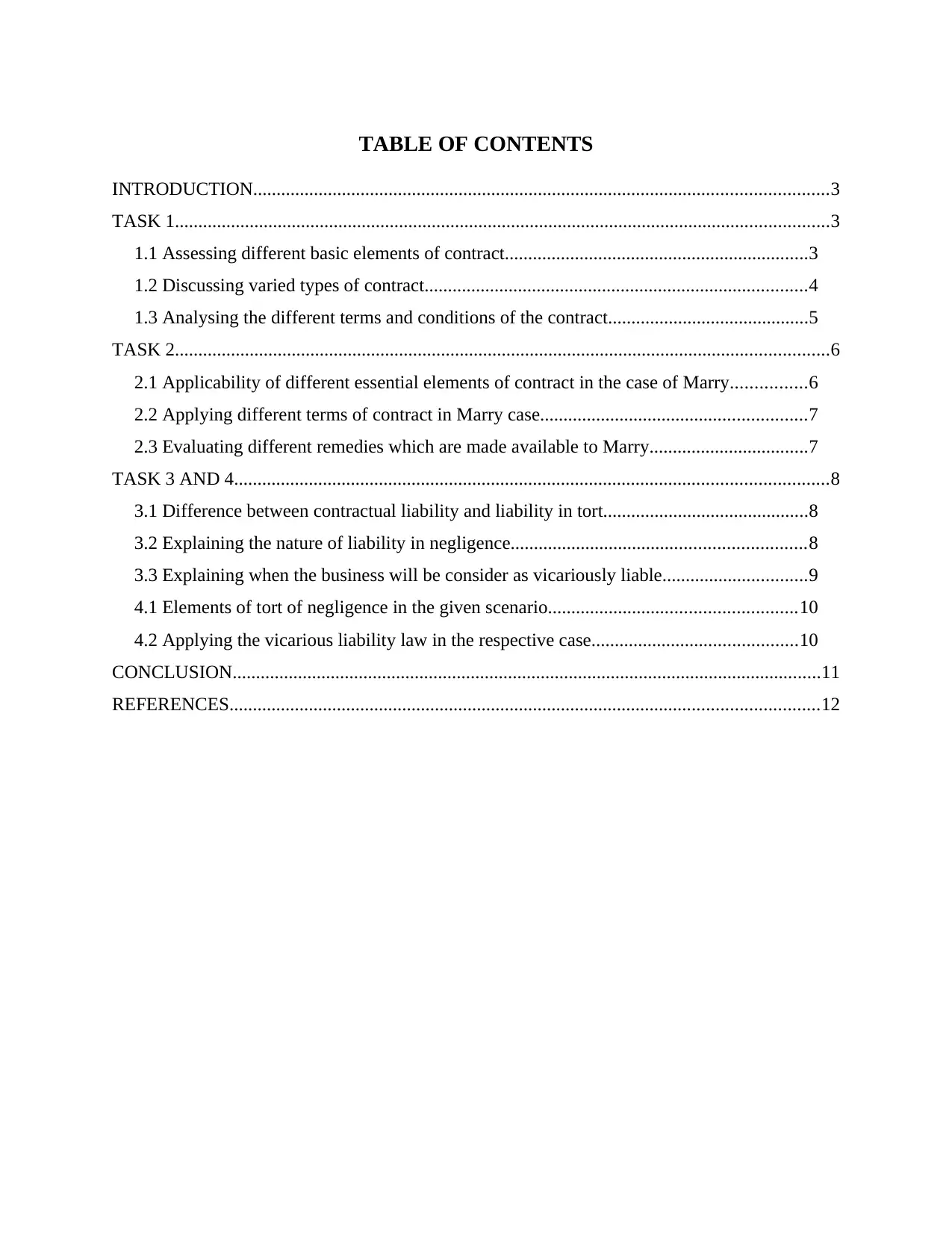
TABLE OF CONTENTS
INTRODUCTION...........................................................................................................................3
TASK 1............................................................................................................................................3
1.1 Assessing different basic elements of contract.................................................................3
1.2 Discussing varied types of contract..................................................................................4
1.3 Analysing the different terms and conditions of the contract...........................................5
TASK 2............................................................................................................................................6
2.1 Applicability of different essential elements of contract in the case of Marry................6
2.2 Applying different terms of contract in Marry case.........................................................7
2.3 Evaluating different remedies which are made available to Marry..................................7
TASK 3 AND 4...............................................................................................................................8
3.1 Difference between contractual liability and liability in tort............................................8
3.2 Explaining the nature of liability in negligence...............................................................8
3.3 Explaining when the business will be consider as vicariously liable...............................9
4.1 Elements of tort of negligence in the given scenario.....................................................10
4.2 Applying the vicarious liability law in the respective case............................................10
CONCLUSION..............................................................................................................................11
REFERENCES..............................................................................................................................12
INTRODUCTION...........................................................................................................................3
TASK 1............................................................................................................................................3
1.1 Assessing different basic elements of contract.................................................................3
1.2 Discussing varied types of contract..................................................................................4
1.3 Analysing the different terms and conditions of the contract...........................................5
TASK 2............................................................................................................................................6
2.1 Applicability of different essential elements of contract in the case of Marry................6
2.2 Applying different terms of contract in Marry case.........................................................7
2.3 Evaluating different remedies which are made available to Marry..................................7
TASK 3 AND 4...............................................................................................................................8
3.1 Difference between contractual liability and liability in tort............................................8
3.2 Explaining the nature of liability in negligence...............................................................8
3.3 Explaining when the business will be consider as vicariously liable...............................9
4.1 Elements of tort of negligence in the given scenario.....................................................10
4.2 Applying the vicarious liability law in the respective case............................................10
CONCLUSION..............................................................................................................................11
REFERENCES..............................................................................................................................12
INTRODUCTION
Contract is the written agreement in which both parties make the promise to perform
certain things (Meaning of contract, 2016). In addition to this, it can also be said that it is the
document which create obligations to perform something upon the parties. It is important for the
parties to form contract who have taken decision of entering into legal relationship with any
person. This is because, with the help of given document only any of the members of contract
can create obligation upon other people, in the circumstance when respective members of parties
denies acting as per the terms and conditions of contract. The present report is based upon
different type of case scenario. In this context, the report will give description regarding different
aspects which are associated with the term contract.
TASK 1
Following report is prepared with an aim to improve the knowledge of employees who
are not legally qualified. The report will cover the following points.
1.1 Assessing different basic elements of contract
It is required by the parties that they should form valid contract. This is because, if it is
not formed at that time it becomes very difficult for the parties with regard to get all the benefits
which are associated with the valid contract. In accordance with the given context, number of
elements are assessed which makes the contract valid. The detailed explanation of them are
depicted in below: Offer and acceptance: It is being consider as the first element of contract which needs to
be fulfilled by the parties. In this regard, the contract formed will be consider as valid
when one party gives offer or invitation to other for entering into contractual relationship
with it (Bowyer, 2000). Herein, the offer which person has made need to be accepted by
other. Hence, if party denies accepting the contract at that time no legal relationship will
be formed between the individuals (Pharmaceutical Society of Great Britain v Boots
[1953]). However, invitation to treat is completely different term than offer. In the
invitation to treat, party gives open offer which can be accepted by any person. Parties must have an intention to enter into the contractual relationship: The given
element of valid contract state that the parties should have an intention with regard to
enter into the legal relationship. Thus, if parties do not have intention to get entry into
Contract is the written agreement in which both parties make the promise to perform
certain things (Meaning of contract, 2016). In addition to this, it can also be said that it is the
document which create obligations to perform something upon the parties. It is important for the
parties to form contract who have taken decision of entering into legal relationship with any
person. This is because, with the help of given document only any of the members of contract
can create obligation upon other people, in the circumstance when respective members of parties
denies acting as per the terms and conditions of contract. The present report is based upon
different type of case scenario. In this context, the report will give description regarding different
aspects which are associated with the term contract.
TASK 1
Following report is prepared with an aim to improve the knowledge of employees who
are not legally qualified. The report will cover the following points.
1.1 Assessing different basic elements of contract
It is required by the parties that they should form valid contract. This is because, if it is
not formed at that time it becomes very difficult for the parties with regard to get all the benefits
which are associated with the valid contract. In accordance with the given context, number of
elements are assessed which makes the contract valid. The detailed explanation of them are
depicted in below: Offer and acceptance: It is being consider as the first element of contract which needs to
be fulfilled by the parties. In this regard, the contract formed will be consider as valid
when one party gives offer or invitation to other for entering into contractual relationship
with it (Bowyer, 2000). Herein, the offer which person has made need to be accepted by
other. Hence, if party denies accepting the contract at that time no legal relationship will
be formed between the individuals (Pharmaceutical Society of Great Britain v Boots
[1953]). However, invitation to treat is completely different term than offer. In the
invitation to treat, party gives open offer which can be accepted by any person. Parties must have an intention to enter into the contractual relationship: The given
element of valid contract state that the parties should have an intention with regard to
enter into the legal relationship. Thus, if parties do not have intention to get entry into
⊘ This is a preview!⊘
Do you want full access?
Subscribe today to unlock all pages.

Trusted by 1+ million students worldwide
contractual relationship at that time there is a no contract will be formed between the
parties.
Capacity of the members of party: This element of legal contract depict that the parties
must be capable in entering into the legal relationship. However, the competency of the
partitives will be judged on the basis of following aspect:
1. Must be minor
2. The people should not be disqualified from the eyes of law
3. Must not be insane or of unsound mind (Godden and et.al., 2013). Consideration: It is being consider as another most important element of contract which
depict that the contract must contract some consideration. Here, consideration means
something in return which both parties gives to each other through performance. The
consideration for the contract can be in both monetary and non-monetary form.
Free consent: This means that an individual should not use any forceful act in order to get
the consent from other party members with regard to enter into legal relationship with
them (Oya, 2012). This is because, if this will happen then in the given circumstance also
the contract which is formed will not be consider as valid. Overall, it can be said that by
considering all these points valid contract can be formed by the parties.
1.2 Discussing varied types of contract
The contract is of several types and the detailed explanation of them are enumerated in
below: Face to face contract: In this contract, members of parties meet at that specific place and
make the decision about the terms and conditions which they will follow during the
tenure of given contract. It is an effective form of contract because it enables the party
with regard to make the quick decision that whether they are accepting the offer being
made by other member of party or not. Written contract: It is commonly used type of contract wherein all the terms and
conditions of contract is being written by the parties in some paper or document. This
document plays very important role in the circumstance when any member of party
denies in acting as per the terms and conditions of the contract (Zoll, 2012). In addition to
this, it can also be said that written contract is the proof or evidence which both parties
have about their legal relationship.
parties.
Capacity of the members of party: This element of legal contract depict that the parties
must be capable in entering into the legal relationship. However, the competency of the
partitives will be judged on the basis of following aspect:
1. Must be minor
2. The people should not be disqualified from the eyes of law
3. Must not be insane or of unsound mind (Godden and et.al., 2013). Consideration: It is being consider as another most important element of contract which
depict that the contract must contract some consideration. Here, consideration means
something in return which both parties gives to each other through performance. The
consideration for the contract can be in both monetary and non-monetary form.
Free consent: This means that an individual should not use any forceful act in order to get
the consent from other party members with regard to enter into legal relationship with
them (Oya, 2012). This is because, if this will happen then in the given circumstance also
the contract which is formed will not be consider as valid. Overall, it can be said that by
considering all these points valid contract can be formed by the parties.
1.2 Discussing varied types of contract
The contract is of several types and the detailed explanation of them are enumerated in
below: Face to face contract: In this contract, members of parties meet at that specific place and
make the decision about the terms and conditions which they will follow during the
tenure of given contract. It is an effective form of contract because it enables the party
with regard to make the quick decision that whether they are accepting the offer being
made by other member of party or not. Written contract: It is commonly used type of contract wherein all the terms and
conditions of contract is being written by the parties in some paper or document. This
document plays very important role in the circumstance when any member of party
denies in acting as per the terms and conditions of the contract (Zoll, 2012). In addition to
this, it can also be said that written contract is the proof or evidence which both parties
have about their legal relationship.
Paraphrase This Document
Need a fresh take? Get an instant paraphrase of this document with our AI Paraphraser
Oral contract: It is the type of contract in which terms and conditions are specified by the
parties through spoken communication (Oral contract, 2016). It is being regard as one of
the most ineffective form of contract, this is because here parties does have any proof of
their legal relationship. However, the given contract applies all the provisions of dispute
remedy. But, the benefits which are associated with this remedy is given to other
individual after considering the situational approach.
Distant contract: This contract is completely opposite to the face to face contract. It is
due to the fact that, here in the given contract parties does not have any physical contact
with each other. Hence, with an aim to make the decision about all the terms and
conditions of the contract parties tend to take help from the means such as email and
telephone etc. In addition to this, such type of contract applies all the postal related rules
and regulations (Hunt, Kessler and Mawer, 2012). Overall, it can be depicted that by
forming any of the type of contract, members of parties can enter into legal relationship
with other.
1.3 Analysing the different terms and conditions of the contract
Terms and conditions are being regarded as one of the most essential part of contract. It is
due to the fact that, this lays the base of parties legal relationship. Herein, as per the English law
terms are the guidelines or guiding principles which parties have to follow or abide. However, if
party do not abide with the same at that time, court of law have the full authority in terms of
taking any legal action upon them. The terms are of following types:
Express terms: It is being consider as one of the provision in contract which is
communicated by parties either in spoken and written words. The express terms are of
three types that are condition, warranties and innominate terms. Conditions are the most
important terms of contract and these are directly related with the contract objectives
(Poussard v Spiers (1876) 1 QBD 410). The parties have obligations to fulfil all the
specified terms. But, if they will not fulfil the same at that time significant legal action
will be taken upon them. In addition to this, warranty is other form of express terms
which one party gives to other in return of purchasing the goods and services
(McKendrick, 2012). Here, if the person who have given warranty will not act as per the
specified condition, then the affected arty has the full authority to take legal action upon
parties through spoken communication (Oral contract, 2016). It is being regard as one of
the most ineffective form of contract, this is because here parties does have any proof of
their legal relationship. However, the given contract applies all the provisions of dispute
remedy. But, the benefits which are associated with this remedy is given to other
individual after considering the situational approach.
Distant contract: This contract is completely opposite to the face to face contract. It is
due to the fact that, here in the given contract parties does not have any physical contact
with each other. Hence, with an aim to make the decision about all the terms and
conditions of the contract parties tend to take help from the means such as email and
telephone etc. In addition to this, such type of contract applies all the postal related rules
and regulations (Hunt, Kessler and Mawer, 2012). Overall, it can be depicted that by
forming any of the type of contract, members of parties can enter into legal relationship
with other.
1.3 Analysing the different terms and conditions of the contract
Terms and conditions are being regarded as one of the most essential part of contract. It is
due to the fact that, this lays the base of parties legal relationship. Herein, as per the English law
terms are the guidelines or guiding principles which parties have to follow or abide. However, if
party do not abide with the same at that time, court of law have the full authority in terms of
taking any legal action upon them. The terms are of following types:
Express terms: It is being consider as one of the provision in contract which is
communicated by parties either in spoken and written words. The express terms are of
three types that are condition, warranties and innominate terms. Conditions are the most
important terms of contract and these are directly related with the contract objectives
(Poussard v Spiers (1876) 1 QBD 410). The parties have obligations to fulfil all the
specified terms. But, if they will not fulfil the same at that time significant legal action
will be taken upon them. In addition to this, warranty is other form of express terms
which one party gives to other in return of purchasing the goods and services
(McKendrick, 2012). Here, if the person who have given warranty will not act as per the
specified condition, then the affected arty has the full authority to take legal action upon
it in an effective way. However, innominate terms are those terms which can neither be
consider as condition nor warranty. Implied terms: These are the terms which get inserted into contract from the movement
parties make the decision of entering into the legal relationship. These terms are decided
by the court of law and mainly works upon the aim of protecting the interest of both
parties in an effectual manner.
Exclusion clause: The respective clause protect the interest of that party who tend to be
reside in default position as per the eyes of law (Appelbaum, 2014).
TASK 2
2.1 Applicability of different essential elements of contract in the case of Marry
Case description
In the given case, Marry has entered into some departmental store which is called by the
name of “Sales are Us”. She had entered into store for the purpose to purchase the television. In
this regard, she has taken round of store and hence liked one television set and thereby has made
the payment of same for purchasing purpose. In this context, she had signed the deed without
reading the terms and conditions which are written upon it. However, in evening when she had
turned on television at that time the set got exploded and thus because of it Marry got injured.
Identifying the major elements of the contract
The respective case evident the application of different essential elements of contract. It
consists of offer, consideration, acceptance and having intention to get entry into legal
relationship. Here, in the given case Sales are Us had given offer to Marry. This is being given
by it by putting agreement of deed in front of her. However, on receiving the deed Marry has
signed her signature in the agreement (Edwards, Edwards and Wells, 2008). This depict that the
Marry has accepted the terms and conditions of the contract. Furthermore, the given thing also
indicate that she had accepted the offer of departmental store. This also comes under her legal
intention. In addition to this, another essential element which is being seen in the given case is
related with consideration. Here, for departmental store consideration were money which they
had received on delivering television to Marry. In the similar way, for Marry consideration were
television set. The case depict the applicability of all essential elements of contract. Thus, it can
be said that there is a contractual relationship is being established between the parties.
consider as condition nor warranty. Implied terms: These are the terms which get inserted into contract from the movement
parties make the decision of entering into the legal relationship. These terms are decided
by the court of law and mainly works upon the aim of protecting the interest of both
parties in an effectual manner.
Exclusion clause: The respective clause protect the interest of that party who tend to be
reside in default position as per the eyes of law (Appelbaum, 2014).
TASK 2
2.1 Applicability of different essential elements of contract in the case of Marry
Case description
In the given case, Marry has entered into some departmental store which is called by the
name of “Sales are Us”. She had entered into store for the purpose to purchase the television. In
this regard, she has taken round of store and hence liked one television set and thereby has made
the payment of same for purchasing purpose. In this context, she had signed the deed without
reading the terms and conditions which are written upon it. However, in evening when she had
turned on television at that time the set got exploded and thus because of it Marry got injured.
Identifying the major elements of the contract
The respective case evident the application of different essential elements of contract. It
consists of offer, consideration, acceptance and having intention to get entry into legal
relationship. Here, in the given case Sales are Us had given offer to Marry. This is being given
by it by putting agreement of deed in front of her. However, on receiving the deed Marry has
signed her signature in the agreement (Edwards, Edwards and Wells, 2008). This depict that the
Marry has accepted the terms and conditions of the contract. Furthermore, the given thing also
indicate that she had accepted the offer of departmental store. This also comes under her legal
intention. In addition to this, another essential element which is being seen in the given case is
related with consideration. Here, for departmental store consideration were money which they
had received on delivering television to Marry. In the similar way, for Marry consideration were
television set. The case depict the applicability of all essential elements of contract. Thus, it can
be said that there is a contractual relationship is being established between the parties.
⊘ This is a preview!⊘
Do you want full access?
Subscribe today to unlock all pages.
Trusted by 1+ million students worldwide
2.2 Applying different terms of contract in Marry case
There are varied terms of contract are applied in the Marry case. Herein, the given case
depict the applications of two different type of clause which are clause 9 and 11. The clause
number 9 entail that firm will not be held liable for the faulty product. Hence, if buyer will not
satisfy with the product and has demanded replacement or repairing of the same at that time all
cost of these will be bear by them only (Goldman, 2013). Furthermore, clause number 11 entail
that Sales are Us will not be held liable for the injury which is caused to customers on supply of
faulty product. The application of these clauses is saving the store from the liability of paying the
damage which is caused to customer of company due to faulty product.
In this regard, as per the Unfair Contract Terms Act 1977, exclusion clause will be
consider as valid. But, the clause number 11 will not be consider as valid in the given case. This
is because of the application of different sales of goods act provisions. Here, the given act entail
that it is the responsibility of seller that it should supply high quality of goods and services to its
buyers. Hence, if seller will not perform it at that time he/she will be consider as liable for any
kind of injury which is caused to its customers due to ineffective good (Johnson, 2013).
In accordance with the given context, it can be said that the respective departmental store
cannot protect itself with the use of exclusion clause. Hence, the store will have to pay the
damage to Marry.
2.3 Evaluating different remedies which are made available to Marry
The decision has been taken regarding the remedies which are available to Marry after
reviewing the respective case. In this regard, it is examined that Marry got injured in evening
because of explosion of her purchased television. This incident was happened in the same day
when she had purchased the television from the store. Due to this, her arms had burned. Due to
this, she could not be able to work for more than three weeks. Hence, because of recklessness of
departmental store she had suffered huge financial loss (Goldstein, 2013).
However, on recovering from the injury Marry has visited store and has confronted
following demands in front of them:
She has demanded the replacement of faulty television.
She has also demanded the financial compensation from the store.
However, with the use of exclusion clause departmental store is saving itself from the
liability which it has towards the customers. On analysing the give case, it can be said that the
There are varied terms of contract are applied in the Marry case. Herein, the given case
depict the applications of two different type of clause which are clause 9 and 11. The clause
number 9 entail that firm will not be held liable for the faulty product. Hence, if buyer will not
satisfy with the product and has demanded replacement or repairing of the same at that time all
cost of these will be bear by them only (Goldman, 2013). Furthermore, clause number 11 entail
that Sales are Us will not be held liable for the injury which is caused to customers on supply of
faulty product. The application of these clauses is saving the store from the liability of paying the
damage which is caused to customer of company due to faulty product.
In this regard, as per the Unfair Contract Terms Act 1977, exclusion clause will be
consider as valid. But, the clause number 11 will not be consider as valid in the given case. This
is because of the application of different sales of goods act provisions. Here, the given act entail
that it is the responsibility of seller that it should supply high quality of goods and services to its
buyers. Hence, if seller will not perform it at that time he/she will be consider as liable for any
kind of injury which is caused to its customers due to ineffective good (Johnson, 2013).
In accordance with the given context, it can be said that the respective departmental store
cannot protect itself with the use of exclusion clause. Hence, the store will have to pay the
damage to Marry.
2.3 Evaluating different remedies which are made available to Marry
The decision has been taken regarding the remedies which are available to Marry after
reviewing the respective case. In this regard, it is examined that Marry got injured in evening
because of explosion of her purchased television. This incident was happened in the same day
when she had purchased the television from the store. Due to this, her arms had burned. Due to
this, she could not be able to work for more than three weeks. Hence, because of recklessness of
departmental store she had suffered huge financial loss (Goldstein, 2013).
However, on recovering from the injury Marry has visited store and has confronted
following demands in front of them:
She has demanded the replacement of faulty television.
She has also demanded the financial compensation from the store.
However, with the use of exclusion clause departmental store is saving itself from the
liability which it has towards the customers. On analysing the give case, it can be said that the
Paraphrase This Document
Need a fresh take? Get an instant paraphrase of this document with our AI Paraphraser
exclusion clause which departmental store is using will not be consider as valid in the given case.
It is due to the application of different Sales of good act provision. Hence, Marry has full
authority with regard to claim the compensation for the injury which is caused to it due to
carelessness of departmental store (Chambel and Fortuna, 2015).
TASK 3 AND 4
3.1 Difference between contractual liability and liability in tort
There is a significant difference is being assessed between contractual liability and
liability in tort. The detailed explanation of the same is depicted in below:
Basis Liability in tort Contractual liability
Parties relationship In the liability of tort, court of
law determines the relationship
which tend to be existed
between the members of party.
But, in the given form of
contract parties gets enter into
relationship through mutual
consent and agreement.
Main reason for the
occurrence of given form of
liabilities
The liability of tort occur when
any member of party does not
fulfil their obliged roles and
responsibilities in an effective
manner. Thus, because of it
injury is being caused to the
person who is innocent
(Murfin, 2012).
However, the given liability
occur when parties does not
act as per the terms and
conditions of the contract. In
other words, this liability occur
when any member of party
does not give satisfied
performance.
Condition relating to the
damage
Here, parties does not
formulate any deed. Thus, here
the decision regarding the
damage is taken by the court
of law.
The party who is in default has
to pay damage to the affected
party as per the contractual
agreement (Oya, 2012).
3.2 Explaining the nature of liability in negligence
Negligence is the act in which one person does not give reasonable care to the other
person and because of it injury is being caused to the other party. In accordance with the given
It is due to the application of different Sales of good act provision. Hence, Marry has full
authority with regard to claim the compensation for the injury which is caused to it due to
carelessness of departmental store (Chambel and Fortuna, 2015).
TASK 3 AND 4
3.1 Difference between contractual liability and liability in tort
There is a significant difference is being assessed between contractual liability and
liability in tort. The detailed explanation of the same is depicted in below:
Basis Liability in tort Contractual liability
Parties relationship In the liability of tort, court of
law determines the relationship
which tend to be existed
between the members of party.
But, in the given form of
contract parties gets enter into
relationship through mutual
consent and agreement.
Main reason for the
occurrence of given form of
liabilities
The liability of tort occur when
any member of party does not
fulfil their obliged roles and
responsibilities in an effective
manner. Thus, because of it
injury is being caused to the
person who is innocent
(Murfin, 2012).
However, the given liability
occur when parties does not
act as per the terms and
conditions of the contract. In
other words, this liability occur
when any member of party
does not give satisfied
performance.
Condition relating to the
damage
Here, parties does not
formulate any deed. Thus, here
the decision regarding the
damage is taken by the court
of law.
The party who is in default has
to pay damage to the affected
party as per the contractual
agreement (Oya, 2012).
3.2 Explaining the nature of liability in negligence
Negligence is the act in which one person does not give reasonable care to the other
person and because of it injury is being caused to the other party. In accordance with the given
context, following principles of negligence are identified which are if satisfied at that time
claimant party has full authority with regard to claim the damage from the other individual in an
effectual way. The detailed explanation regarding the different principles of negligence are
depicted in below: Duty of care: The first principle is of duty of care. The given principle entail that it is the
responsibility of defendants that it should ensure the utmost care of the people who works
within organization or gets services from the firm. For example, in Donoghue V
Stevenson case, Stevenson who is the owner of beer company has the duty that he should
give high quality of beer to its buyers (Pittman, Hesje and Lamoureux, 2013). Breach of duty: The given principle made applicable when defendant fails in fulfilling its
general roles and responsibilities in an effective manner. For instance, in the
aforementioned care Stevenson has breached its duty to deliver high quality services to
the buyers. Hence, it is because of his careless attitude only injury is being caused to
Donoghue after drinking ineffective drink.
Causation: This principle dictate that injury must be caused to claimant due to negligent
action of defendant. In the given case also, it is because of Stevenson negligence only
injury is being caused to the Donoghue (Porat, 2012).
3.3 Explaining when the business will be consider as vicariously liable
Vicarious liability is the type of condition in which someone is held liable for the action
or omission which is being performed by some other person. For example, with regard to the
workplace context employer will be held liable for any kind of ineffective act which is being
done by the employees during the tenure of employment. However, the business will be held
vicariously liable when below give conditions are satisfied:
There must be employer and employee related relationship should be existed between
individual. The worker should perform negligent act during the course of employment.
Flip flop case study
In the respective case, Paul has purchased ticket from the local cinema which is called by
the name of film flops. Before starting of film, Paul has taken the decision to purchase some
popcorn. However, during the process of purchasing the popcorn, one of the employee of cited
firm has accidentally poured hot coffee in Paul hand and because of it he got injured very badly.
claimant party has full authority with regard to claim the damage from the other individual in an
effectual way. The detailed explanation regarding the different principles of negligence are
depicted in below: Duty of care: The first principle is of duty of care. The given principle entail that it is the
responsibility of defendants that it should ensure the utmost care of the people who works
within organization or gets services from the firm. For example, in Donoghue V
Stevenson case, Stevenson who is the owner of beer company has the duty that he should
give high quality of beer to its buyers (Pittman, Hesje and Lamoureux, 2013). Breach of duty: The given principle made applicable when defendant fails in fulfilling its
general roles and responsibilities in an effective manner. For instance, in the
aforementioned care Stevenson has breached its duty to deliver high quality services to
the buyers. Hence, it is because of his careless attitude only injury is being caused to
Donoghue after drinking ineffective drink.
Causation: This principle dictate that injury must be caused to claimant due to negligent
action of defendant. In the given case also, it is because of Stevenson negligence only
injury is being caused to the Donoghue (Porat, 2012).
3.3 Explaining when the business will be consider as vicariously liable
Vicarious liability is the type of condition in which someone is held liable for the action
or omission which is being performed by some other person. For example, with regard to the
workplace context employer will be held liable for any kind of ineffective act which is being
done by the employees during the tenure of employment. However, the business will be held
vicariously liable when below give conditions are satisfied:
There must be employer and employee related relationship should be existed between
individual. The worker should perform negligent act during the course of employment.
Flip flop case study
In the respective case, Paul has purchased ticket from the local cinema which is called by
the name of film flops. Before starting of film, Paul has taken the decision to purchase some
popcorn. However, during the process of purchasing the popcorn, one of the employee of cited
firm has accidentally poured hot coffee in Paul hand and because of it he got injured very badly.
⊘ This is a preview!⊘
Do you want full access?
Subscribe today to unlock all pages.
Trusted by 1+ million students worldwide
After this incident, Paul has called the manager and on examining the given incident it was
assessed by the manager that his employee was in the influence of some toxic element.
Hence, after reviewing the given case it can be said that Film Flop will be consider as
vicariously liable for the act which is being done by its employee. It is due to the fact that it is the
responsibility of employer that they should examine their employees that whether they are under
the influence of some toxic element or not (Homer, 2016). Furthermore, it is their responsibility
of employer only that they ensure the safety and security of their customers. These all things are
not being followed by the employer of Film Flop. Thus, it is correct to said that Paul has full
authority with regard to claim the damage for the injury which is caused to him because of
careless behaviour of Film Flop worker.
4.1 Elements of tort of negligence in the given scenario
All three elements of tort of negligence are being applied to the given case: Duty of care: The employer of Flip Flop tend to be reside in the duty of care position.
Hence, in accordance with the given context he has the responsibility to give high quality
services to the buyers. Furthermore, he also has the duty to ensure security of its buyers. Breach of duty: But, Flip Flop worker has breached the respective duty. Hence, due to
this Paul got injured and now he is claiming damages from the firm.
Causation: Here, Flip Flop has performed negligent action and because of it injury is
being caused to Paul (Fordham, 2013).
This indicates that the respective case satisfies all the principles of tort of negligence.
Hence, in this context Paul has full authority to claim the damage from the cinema hall which is
caused to it.
4.2 Applying the vicarious liability law in the respective case
Different principles are assessed which can save the person who is in default from the
payment of damages. The detailed explanation of the same is depicted in below: Contributory negligence: This principle state that both claimant and defendant must be
equally involved in the act of negligence. Volenti non fit injuria: Defendant can save itself from the payment of damage if it will
prove that claimant got injured because of its own negligent action.
assessed by the manager that his employee was in the influence of some toxic element.
Hence, after reviewing the given case it can be said that Film Flop will be consider as
vicariously liable for the act which is being done by its employee. It is due to the fact that it is the
responsibility of employer that they should examine their employees that whether they are under
the influence of some toxic element or not (Homer, 2016). Furthermore, it is their responsibility
of employer only that they ensure the safety and security of their customers. These all things are
not being followed by the employer of Film Flop. Thus, it is correct to said that Paul has full
authority with regard to claim the damage for the injury which is caused to him because of
careless behaviour of Film Flop worker.
4.1 Elements of tort of negligence in the given scenario
All three elements of tort of negligence are being applied to the given case: Duty of care: The employer of Flip Flop tend to be reside in the duty of care position.
Hence, in accordance with the given context he has the responsibility to give high quality
services to the buyers. Furthermore, he also has the duty to ensure security of its buyers. Breach of duty: But, Flip Flop worker has breached the respective duty. Hence, due to
this Paul got injured and now he is claiming damages from the firm.
Causation: Here, Flip Flop has performed negligent action and because of it injury is
being caused to Paul (Fordham, 2013).
This indicates that the respective case satisfies all the principles of tort of negligence.
Hence, in this context Paul has full authority to claim the damage from the cinema hall which is
caused to it.
4.2 Applying the vicarious liability law in the respective case
Different principles are assessed which can save the person who is in default from the
payment of damages. The detailed explanation of the same is depicted in below: Contributory negligence: This principle state that both claimant and defendant must be
equally involved in the act of negligence. Volenti non fit injuria: Defendant can save itself from the payment of damage if it will
prove that claimant got injured because of its own negligent action.
Paraphrase This Document
Need a fresh take? Get an instant paraphrase of this document with our AI Paraphraser
Ex turpi causa: The action which is being carried out by defendant will not be consider as
immoral or ineffective (Ex turpi causa, 2016). Then, in this situation the given principle
will be applied (Murfin, 2012).
In the Film Flop case, Ex turpi causa principle can be applied. It is due to the fact that, the
employee was under the influence of some toxic element at the time when given action was
happened. Thus, employer does not have any control upon the situation.
CONCLUSION
From the above report, it can be stated that the parties should comply with all the
essential elements of valid contract. This is because, it is through this way only legal and ethical
relationship can be formed between the members of parties. Furthermore, it is also required by
the employers that they should make efforts in terms of maintaining the safety and security of
their workers as well as customers. This is because, if they will not perform that at that time
different legal action will be taken upon them.
immoral or ineffective (Ex turpi causa, 2016). Then, in this situation the given principle
will be applied (Murfin, 2012).
In the Film Flop case, Ex turpi causa principle can be applied. It is due to the fact that, the
employee was under the influence of some toxic element at the time when given action was
happened. Thus, employer does not have any control upon the situation.
CONCLUSION
From the above report, it can be stated that the parties should comply with all the
essential elements of valid contract. This is because, it is through this way only legal and ethical
relationship can be formed between the members of parties. Furthermore, it is also required by
the employers that they should make efforts in terms of maintaining the safety and security of
their workers as well as customers. This is because, if they will not perform that at that time
different legal action will be taken upon them.
REFERENCES
Books and Journals
Appelbaum, P. S., 2014. Law & Psychiatry: Policing Expert Testimony: The Role of
Professional Organizations.
Bowyer, M. L., 2000. Insurance contract law and regulation and competition in the UK insurance
industry: The missing link. Journal of Financial Regulation and Compliance. 8(2).
pp.140–150.
Chambel, M. J. and Fortuna, R., 2015. Wage reduction of Portuguese civil servants and their
attitudes: the psychological contract perspective. The International Journal of Human
Resource Management, (ahead-of-print). pp.1-19.
Edwards, S. J., Edwards, L. L. and Wells, K. P., 2008. Tort Law for Legal Assistants. Cengage
Learning publication.
Fordham, M., 2013. Legislation and Case Notes: Contributory Negligence and the Disabled
Claimant. Singapore Journal of Legal Studies. pp.192.
Godden, L. and et.al., 2013. Law, governance and risk: Deconstructing the public-private divide
in climate change adaptation. UNSWLJ. 36. pp.224.
Goldman, A., 2013. Business law: Principles and Practices. Cengage.
Goldstein, A. D., 2013. Public Meaning Rule: Reconciling Meaning, Intent, and Contract
Interpretation, The. Santa Clara L. Rev. 53. pp.73.
Homer, P., 2016. Indivisible Injury Negligence and Nuisance Cases–Proving Causation Among
Multiple-Source Polluters: A State-by-State Survey of the Law for New England, and a
Proposal for a New Causation Framework.University of New Hampshire Law Review.
3(1). pp.6.
Hunt, R. J., Kessler, L. L. and Mawer, W. T., 2012. Dischargeable or Not Dischargeable: Does
an Intentional Breach of Contract Fall within Willful and Malicious under Section 523 (a)
(6) of the Bankruptcy Code?. Southern Law Journal. 22(2). pp.215.
Johnson, M., 2013. The body in the mind: The bodily basis of meaning, imagination, and reason.
University of Chicago Press.
McKendrick, E., 2012. Contract Law: Text, Cases, and Materials. Oxford University Press.
Murfin, J., 2012. The Supply‐Side Determinants of Loan Contract Strictness.The Journal of
Finance. 67(5). pp.1565-1601.
Oya, C., 2012. Contract Farming in Sub‐Saharan Africa: A Survey of Approaches, Debates and
Issues. Journal of Agrarian Change. 12(1). pp.1-33.
Books and Journals
Appelbaum, P. S., 2014. Law & Psychiatry: Policing Expert Testimony: The Role of
Professional Organizations.
Bowyer, M. L., 2000. Insurance contract law and regulation and competition in the UK insurance
industry: The missing link. Journal of Financial Regulation and Compliance. 8(2).
pp.140–150.
Chambel, M. J. and Fortuna, R., 2015. Wage reduction of Portuguese civil servants and their
attitudes: the psychological contract perspective. The International Journal of Human
Resource Management, (ahead-of-print). pp.1-19.
Edwards, S. J., Edwards, L. L. and Wells, K. P., 2008. Tort Law for Legal Assistants. Cengage
Learning publication.
Fordham, M., 2013. Legislation and Case Notes: Contributory Negligence and the Disabled
Claimant. Singapore Journal of Legal Studies. pp.192.
Godden, L. and et.al., 2013. Law, governance and risk: Deconstructing the public-private divide
in climate change adaptation. UNSWLJ. 36. pp.224.
Goldman, A., 2013. Business law: Principles and Practices. Cengage.
Goldstein, A. D., 2013. Public Meaning Rule: Reconciling Meaning, Intent, and Contract
Interpretation, The. Santa Clara L. Rev. 53. pp.73.
Homer, P., 2016. Indivisible Injury Negligence and Nuisance Cases–Proving Causation Among
Multiple-Source Polluters: A State-by-State Survey of the Law for New England, and a
Proposal for a New Causation Framework.University of New Hampshire Law Review.
3(1). pp.6.
Hunt, R. J., Kessler, L. L. and Mawer, W. T., 2012. Dischargeable or Not Dischargeable: Does
an Intentional Breach of Contract Fall within Willful and Malicious under Section 523 (a)
(6) of the Bankruptcy Code?. Southern Law Journal. 22(2). pp.215.
Johnson, M., 2013. The body in the mind: The bodily basis of meaning, imagination, and reason.
University of Chicago Press.
McKendrick, E., 2012. Contract Law: Text, Cases, and Materials. Oxford University Press.
Murfin, J., 2012. The Supply‐Side Determinants of Loan Contract Strictness.The Journal of
Finance. 67(5). pp.1565-1601.
Oya, C., 2012. Contract Farming in Sub‐Saharan Africa: A Survey of Approaches, Debates and
Issues. Journal of Agrarian Change. 12(1). pp.1-33.
⊘ This is a preview!⊘
Do you want full access?
Subscribe today to unlock all pages.
Trusted by 1+ million students worldwide

1 out of 13


Related Documents


Your All-in-One AI-Powered Toolkit for Academic Success.
+13062052269
info@desklib.com
Available 24*7 on WhatsApp / Email
![[object Object]](/_next/static/media/star-bottom.7253800d.svg)
Unlock your academic potential
Copyright © 2020–2026 A2Z Services. All Rights Reserved. Developed and managed by ZUCOL.