Dissertation Assessment Record: Level 6
VerifiedAdded on 2019/09/19
|6
|1879
|327
Dissertation
AI Summary
This document is a Dissertation Assessment Record for Level 6 students at University College Birmingham. It includes a marking scheme with grade descriptors for various performance levels, ranging from 80+ to below 40. The document outlines the criteria for assessing the dissertation, including structure, aim/objectives, literature review, methodology, analysis, and conclusions. It also provides a section for overall comments and indicates whether the dissertation is a resit or may be used for publication. The marking scheme is detailed, with specific areas for evaluation and space for the marker to provide feedback.
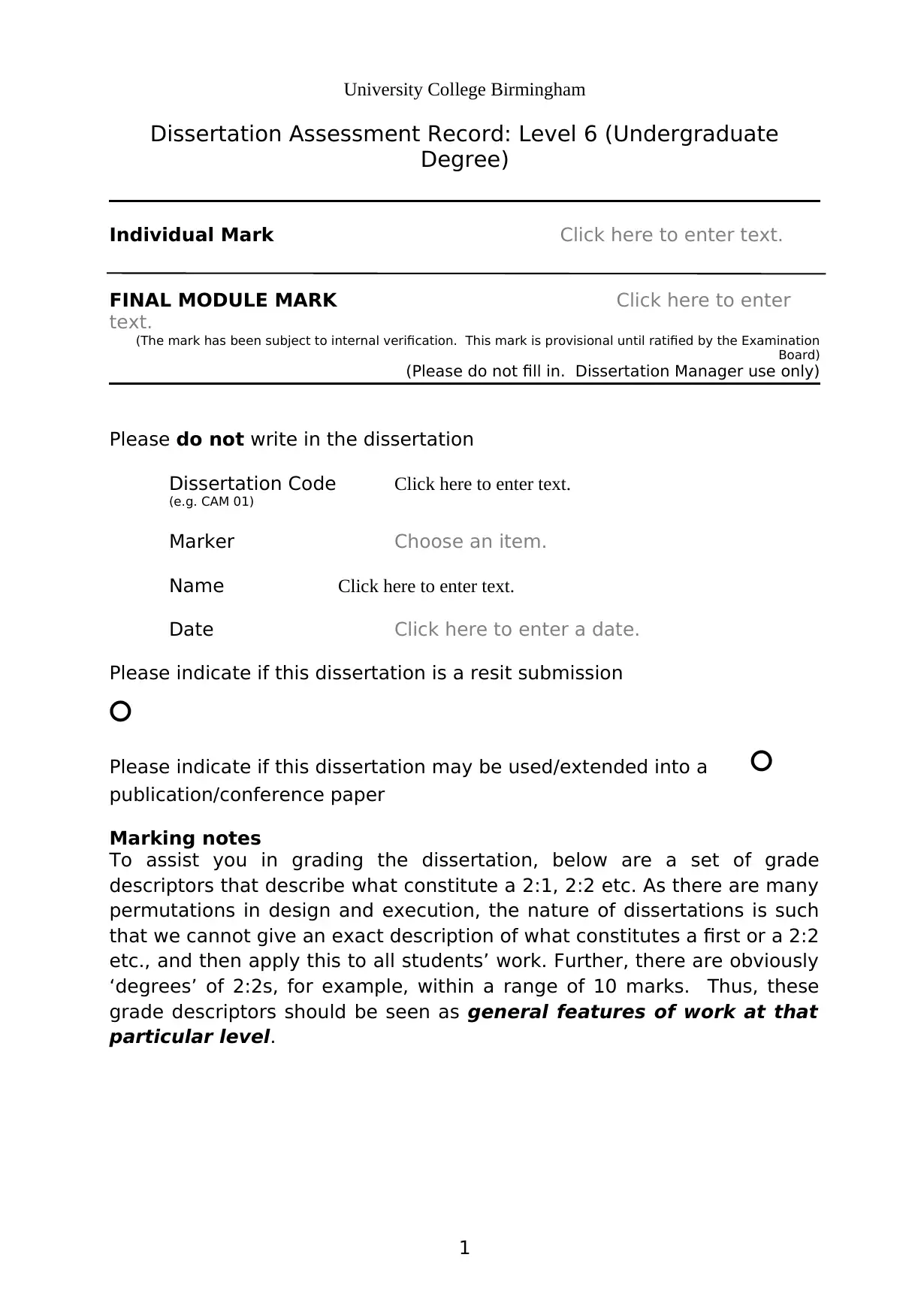
University College Birmingham
Dissertation Assessment Record: Level 6 (Undergraduate
Degree)
Individual Mark Click here to enter text.
FINAL MODULE MARK Click here to enter
text.
(The mark has been subject to internal verification. This mark is provisional until ratified by the Examination
Board)
(Please do not fill in. Dissertation Manager use only)
Please do not write in the dissertation
Dissertation Code Click here to enter text.
(e.g. CAM 01)
Marker Choose an item.
Name Click here to enter text.
Date Click here to enter a date.
Please indicate if this dissertation is a resit submission
○
Please indicate if this dissertation may be used/extended into a ○
publication/conference paper
Marking notes
To assist you in grading the dissertation, below are a set of grade
descriptors that describe what constitute a 2:1, 2:2 etc. As there are many
permutations in design and execution, the nature of dissertations is such
that we cannot give an exact description of what constitutes a first or a 2:2
etc., and then apply this to all students’ work. Further, there are obviously
‘degrees’ of 2:2s, for example, within a range of 10 marks. Thus, these
grade descriptors should be seen as general features of work at that
particular level.
1
Dissertation Assessment Record: Level 6 (Undergraduate
Degree)
Individual Mark Click here to enter text.
FINAL MODULE MARK Click here to enter
text.
(The mark has been subject to internal verification. This mark is provisional until ratified by the Examination
Board)
(Please do not fill in. Dissertation Manager use only)
Please do not write in the dissertation
Dissertation Code Click here to enter text.
(e.g. CAM 01)
Marker Choose an item.
Name Click here to enter text.
Date Click here to enter a date.
Please indicate if this dissertation is a resit submission
○
Please indicate if this dissertation may be used/extended into a ○
publication/conference paper
Marking notes
To assist you in grading the dissertation, below are a set of grade
descriptors that describe what constitute a 2:1, 2:2 etc. As there are many
permutations in design and execution, the nature of dissertations is such
that we cannot give an exact description of what constitutes a first or a 2:2
etc., and then apply this to all students’ work. Further, there are obviously
‘degrees’ of 2:2s, for example, within a range of 10 marks. Thus, these
grade descriptors should be seen as general features of work at that
particular level.
1

Paraphrase This Document
Need a fresh take? Get an instant paraphrase of this document with our AI Paraphraser
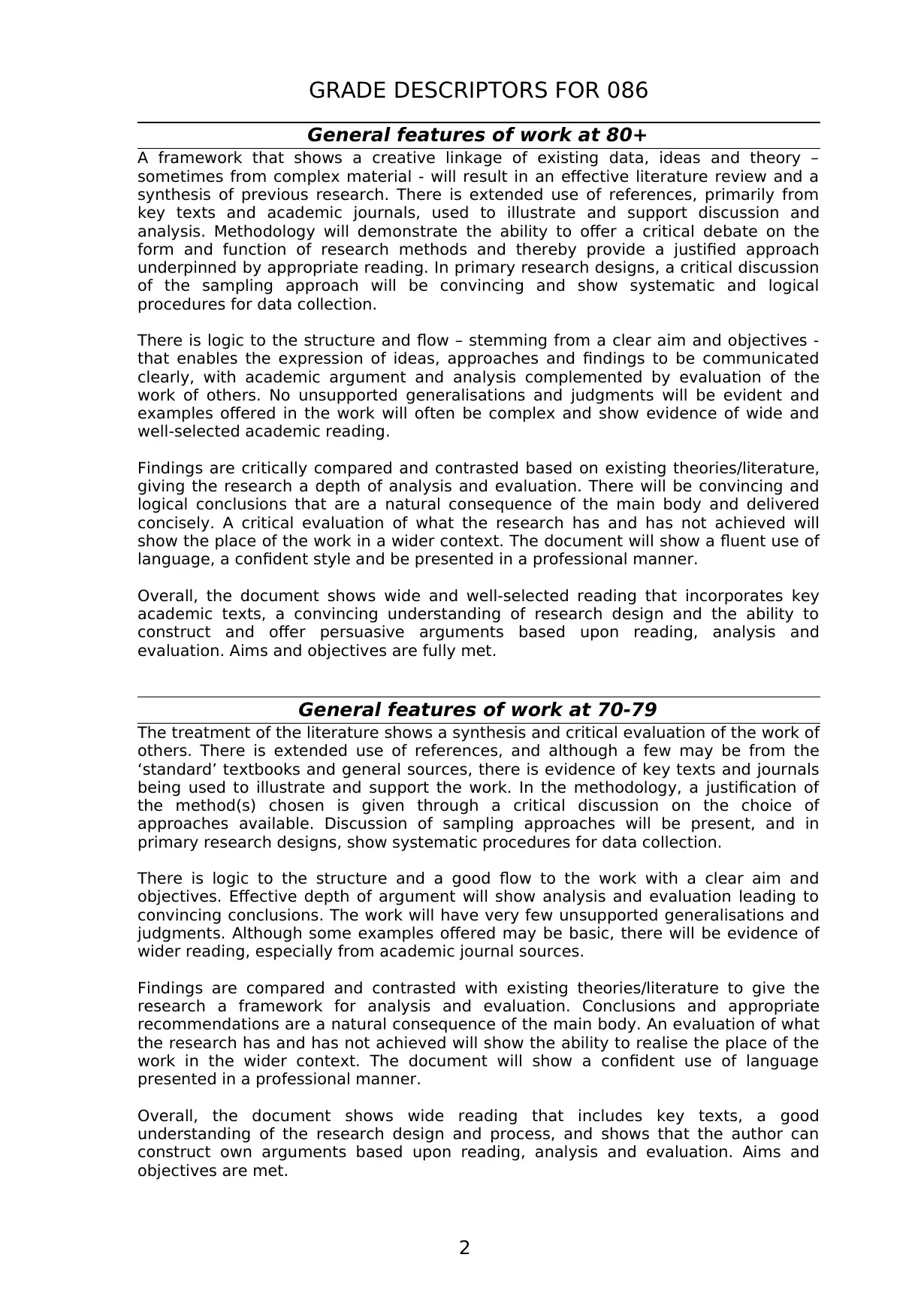
GRADE DESCRIPTORS FOR 086
General features of work at 80+
A framework that shows a creative linkage of existing data, ideas and theory –
sometimes from complex material - will result in an effective literature review and a
synthesis of previous research. There is extended use of references, primarily from
key texts and academic journals, used to illustrate and support discussion and
analysis. Methodology will demonstrate the ability to offer a critical debate on the
form and function of research methods and thereby provide a justified approach
underpinned by appropriate reading. In primary research designs, a critical discussion
of the sampling approach will be convincing and show systematic and logical
procedures for data collection.
There is logic to the structure and flow – stemming from a clear aim and objectives -
that enables the expression of ideas, approaches and findings to be communicated
clearly, with academic argument and analysis complemented by evaluation of the
work of others. No unsupported generalisations and judgments will be evident and
examples offered in the work will often be complex and show evidence of wide and
well-selected academic reading.
Findings are critically compared and contrasted based on existing theories/literature,
giving the research a depth of analysis and evaluation. There will be convincing and
logical conclusions that are a natural consequence of the main body and delivered
concisely. A critical evaluation of what the research has and has not achieved will
show the place of the work in a wider context. The document will show a fluent use of
language, a confident style and be presented in a professional manner.
Overall, the document shows wide and well-selected reading that incorporates key
academic texts, a convincing understanding of research design and the ability to
construct and offer persuasive arguments based upon reading, analysis and
evaluation. Aims and objectives are fully met.
General features of work at 70-79
The treatment of the literature shows a synthesis and critical evaluation of the work of
others. There is extended use of references, and although a few may be from the
‘standard’ textbooks and general sources, there is evidence of key texts and journals
being used to illustrate and support the work. In the methodology, a justification of
the method(s) chosen is given through a critical discussion on the choice of
approaches available. Discussion of sampling approaches will be present, and in
primary research designs, show systematic procedures for data collection.
There is logic to the structure and a good flow to the work with a clear aim and
objectives. Effective depth of argument will show analysis and evaluation leading to
convincing conclusions. The work will have very few unsupported generalisations and
judgments. Although some examples offered may be basic, there will be evidence of
wider reading, especially from academic journal sources.
Findings are compared and contrasted with existing theories/literature to give the
research a framework for analysis and evaluation. Conclusions and appropriate
recommendations are a natural consequence of the main body. An evaluation of what
the research has and has not achieved will show the ability to realise the place of the
work in the wider context. The document will show a confident use of language
presented in a professional manner.
Overall, the document shows wide reading that includes key texts, a good
understanding of the research design and process, and shows that the author can
construct own arguments based upon reading, analysis and evaluation. Aims and
objectives are met.
2
General features of work at 80+
A framework that shows a creative linkage of existing data, ideas and theory –
sometimes from complex material - will result in an effective literature review and a
synthesis of previous research. There is extended use of references, primarily from
key texts and academic journals, used to illustrate and support discussion and
analysis. Methodology will demonstrate the ability to offer a critical debate on the
form and function of research methods and thereby provide a justified approach
underpinned by appropriate reading. In primary research designs, a critical discussion
of the sampling approach will be convincing and show systematic and logical
procedures for data collection.
There is logic to the structure and flow – stemming from a clear aim and objectives -
that enables the expression of ideas, approaches and findings to be communicated
clearly, with academic argument and analysis complemented by evaluation of the
work of others. No unsupported generalisations and judgments will be evident and
examples offered in the work will often be complex and show evidence of wide and
well-selected academic reading.
Findings are critically compared and contrasted based on existing theories/literature,
giving the research a depth of analysis and evaluation. There will be convincing and
logical conclusions that are a natural consequence of the main body and delivered
concisely. A critical evaluation of what the research has and has not achieved will
show the place of the work in a wider context. The document will show a fluent use of
language, a confident style and be presented in a professional manner.
Overall, the document shows wide and well-selected reading that incorporates key
academic texts, a convincing understanding of research design and the ability to
construct and offer persuasive arguments based upon reading, analysis and
evaluation. Aims and objectives are fully met.
General features of work at 70-79
The treatment of the literature shows a synthesis and critical evaluation of the work of
others. There is extended use of references, and although a few may be from the
‘standard’ textbooks and general sources, there is evidence of key texts and journals
being used to illustrate and support the work. In the methodology, a justification of
the method(s) chosen is given through a critical discussion on the choice of
approaches available. Discussion of sampling approaches will be present, and in
primary research designs, show systematic procedures for data collection.
There is logic to the structure and a good flow to the work with a clear aim and
objectives. Effective depth of argument will show analysis and evaluation leading to
convincing conclusions. The work will have very few unsupported generalisations and
judgments. Although some examples offered may be basic, there will be evidence of
wider reading, especially from academic journal sources.
Findings are compared and contrasted with existing theories/literature to give the
research a framework for analysis and evaluation. Conclusions and appropriate
recommendations are a natural consequence of the main body. An evaluation of what
the research has and has not achieved will show the ability to realise the place of the
work in the wider context. The document will show a confident use of language
presented in a professional manner.
Overall, the document shows wide reading that includes key texts, a good
understanding of the research design and process, and shows that the author can
construct own arguments based upon reading, analysis and evaluation. Aims and
objectives are met.
2
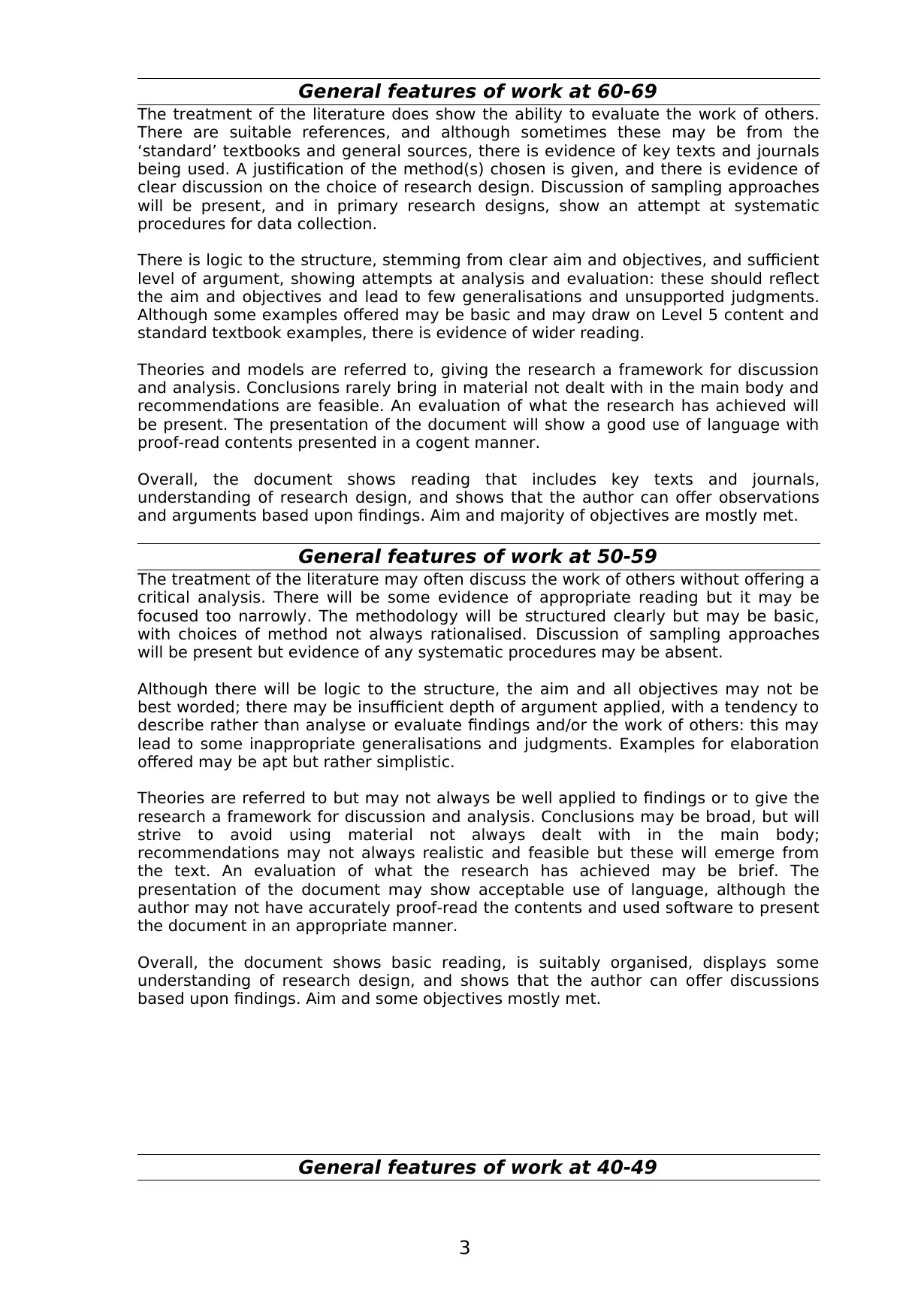
General features of work at 60-69
The treatment of the literature does show the ability to evaluate the work of others.
There are suitable references, and although sometimes these may be from the
‘standard’ textbooks and general sources, there is evidence of key texts and journals
being used. A justification of the method(s) chosen is given, and there is evidence of
clear discussion on the choice of research design. Discussion of sampling approaches
will be present, and in primary research designs, show an attempt at systematic
procedures for data collection.
There is logic to the structure, stemming from clear aim and objectives, and sufficient
level of argument, showing attempts at analysis and evaluation: these should reflect
the aim and objectives and lead to few generalisations and unsupported judgments.
Although some examples offered may be basic and may draw on Level 5 content and
standard textbook examples, there is evidence of wider reading.
Theories and models are referred to, giving the research a framework for discussion
and analysis. Conclusions rarely bring in material not dealt with in the main body and
recommendations are feasible. An evaluation of what the research has achieved will
be present. The presentation of the document will show a good use of language with
proof-read contents presented in a cogent manner.
Overall, the document shows reading that includes key texts and journals,
understanding of research design, and shows that the author can offer observations
and arguments based upon findings. Aim and majority of objectives are mostly met.
General features of work at 50-59
The treatment of the literature may often discuss the work of others without offering a
critical analysis. There will be some evidence of appropriate reading but it may be
focused too narrowly. The methodology will be structured clearly but may be basic,
with choices of method not always rationalised. Discussion of sampling approaches
will be present but evidence of any systematic procedures may be absent.
Although there will be logic to the structure, the aim and all objectives may not be
best worded; there may be insufficient depth of argument applied, with a tendency to
describe rather than analyse or evaluate findings and/or the work of others: this may
lead to some inappropriate generalisations and judgments. Examples for elaboration
offered may be apt but rather simplistic.
Theories are referred to but may not always be well applied to findings or to give the
research a framework for discussion and analysis. Conclusions may be broad, but will
strive to avoid using material not always dealt with in the main body;
recommendations may not always realistic and feasible but these will emerge from
the text. An evaluation of what the research has achieved may be brief. The
presentation of the document may show acceptable use of language, although the
author may not have accurately proof-read the contents and used software to present
the document in an appropriate manner.
Overall, the document shows basic reading, is suitably organised, displays some
understanding of research design, and shows that the author can offer discussions
based upon findings. Aim and some objectives mostly met.
General features of work at 40-49
3
The treatment of the literature does show the ability to evaluate the work of others.
There are suitable references, and although sometimes these may be from the
‘standard’ textbooks and general sources, there is evidence of key texts and journals
being used. A justification of the method(s) chosen is given, and there is evidence of
clear discussion on the choice of research design. Discussion of sampling approaches
will be present, and in primary research designs, show an attempt at systematic
procedures for data collection.
There is logic to the structure, stemming from clear aim and objectives, and sufficient
level of argument, showing attempts at analysis and evaluation: these should reflect
the aim and objectives and lead to few generalisations and unsupported judgments.
Although some examples offered may be basic and may draw on Level 5 content and
standard textbook examples, there is evidence of wider reading.
Theories and models are referred to, giving the research a framework for discussion
and analysis. Conclusions rarely bring in material not dealt with in the main body and
recommendations are feasible. An evaluation of what the research has achieved will
be present. The presentation of the document will show a good use of language with
proof-read contents presented in a cogent manner.
Overall, the document shows reading that includes key texts and journals,
understanding of research design, and shows that the author can offer observations
and arguments based upon findings. Aim and majority of objectives are mostly met.
General features of work at 50-59
The treatment of the literature may often discuss the work of others without offering a
critical analysis. There will be some evidence of appropriate reading but it may be
focused too narrowly. The methodology will be structured clearly but may be basic,
with choices of method not always rationalised. Discussion of sampling approaches
will be present but evidence of any systematic procedures may be absent.
Although there will be logic to the structure, the aim and all objectives may not be
best worded; there may be insufficient depth of argument applied, with a tendency to
describe rather than analyse or evaluate findings and/or the work of others: this may
lead to some inappropriate generalisations and judgments. Examples for elaboration
offered may be apt but rather simplistic.
Theories are referred to but may not always be well applied to findings or to give the
research a framework for discussion and analysis. Conclusions may be broad, but will
strive to avoid using material not always dealt with in the main body;
recommendations may not always realistic and feasible but these will emerge from
the text. An evaluation of what the research has achieved may be brief. The
presentation of the document may show acceptable use of language, although the
author may not have accurately proof-read the contents and used software to present
the document in an appropriate manner.
Overall, the document shows basic reading, is suitably organised, displays some
understanding of research design, and shows that the author can offer discussions
based upon findings. Aim and some objectives mostly met.
General features of work at 40-49
3
⊘ This is a preview!⊘
Do you want full access?
Subscribe today to unlock all pages.

Trusted by 1+ million students worldwide
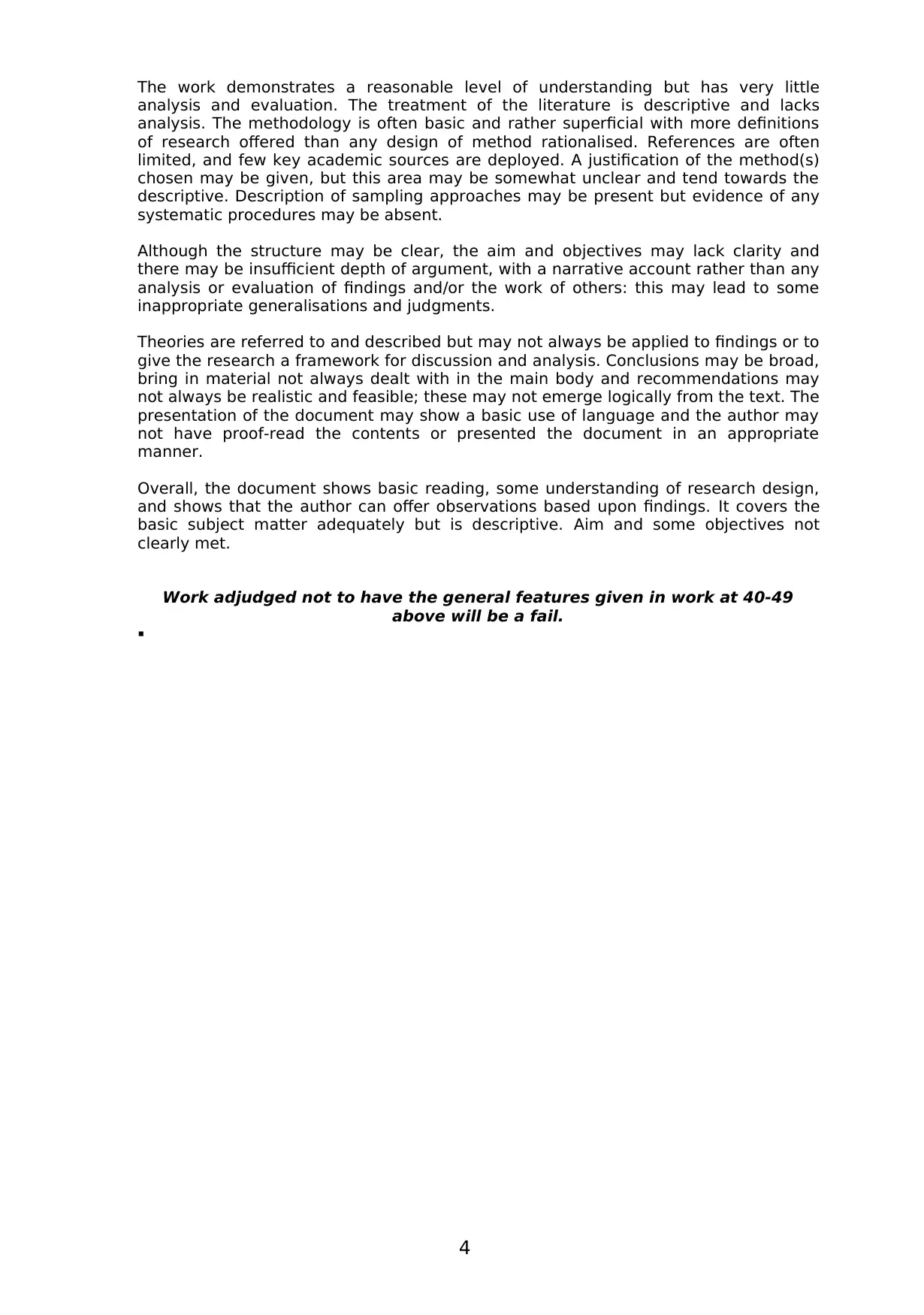
The work demonstrates a reasonable level of understanding but has very little
analysis and evaluation. The treatment of the literature is descriptive and lacks
analysis. The methodology is often basic and rather superficial with more definitions
of research offered than any design of method rationalised. References are often
limited, and few key academic sources are deployed. A justification of the method(s)
chosen may be given, but this area may be somewhat unclear and tend towards the
descriptive. Description of sampling approaches may be present but evidence of any
systematic procedures may be absent.
Although the structure may be clear, the aim and objectives may lack clarity and
there may be insufficient depth of argument, with a narrative account rather than any
analysis or evaluation of findings and/or the work of others: this may lead to some
inappropriate generalisations and judgments.
Theories are referred to and described but may not always be applied to findings or to
give the research a framework for discussion and analysis. Conclusions may be broad,
bring in material not always dealt with in the main body and recommendations may
not always be realistic and feasible; these may not emerge logically from the text. The
presentation of the document may show a basic use of language and the author may
not have proof-read the contents or presented the document in an appropriate
manner.
Overall, the document shows basic reading, some understanding of research design,
and shows that the author can offer observations based upon findings. It covers the
basic subject matter adequately but is descriptive. Aim and some objectives not
clearly met.
Work adjudged not to have the general features given in work at 40-49
above will be a fail.
4
analysis and evaluation. The treatment of the literature is descriptive and lacks
analysis. The methodology is often basic and rather superficial with more definitions
of research offered than any design of method rationalised. References are often
limited, and few key academic sources are deployed. A justification of the method(s)
chosen may be given, but this area may be somewhat unclear and tend towards the
descriptive. Description of sampling approaches may be present but evidence of any
systematic procedures may be absent.
Although the structure may be clear, the aim and objectives may lack clarity and
there may be insufficient depth of argument, with a narrative account rather than any
analysis or evaluation of findings and/or the work of others: this may lead to some
inappropriate generalisations and judgments.
Theories are referred to and described but may not always be applied to findings or to
give the research a framework for discussion and analysis. Conclusions may be broad,
bring in material not always dealt with in the main body and recommendations may
not always be realistic and feasible; these may not emerge logically from the text. The
presentation of the document may show a basic use of language and the author may
not have proof-read the contents or presented the document in an appropriate
manner.
Overall, the document shows basic reading, some understanding of research design,
and shows that the author can offer observations based upon findings. It covers the
basic subject matter adequately but is descriptive. Aim and some objectives not
clearly met.
Work adjudged not to have the general features given in work at 40-49
above will be a fail.
4
Paraphrase This Document
Need a fresh take? Get an instant paraphrase of this document with our AI Paraphraser
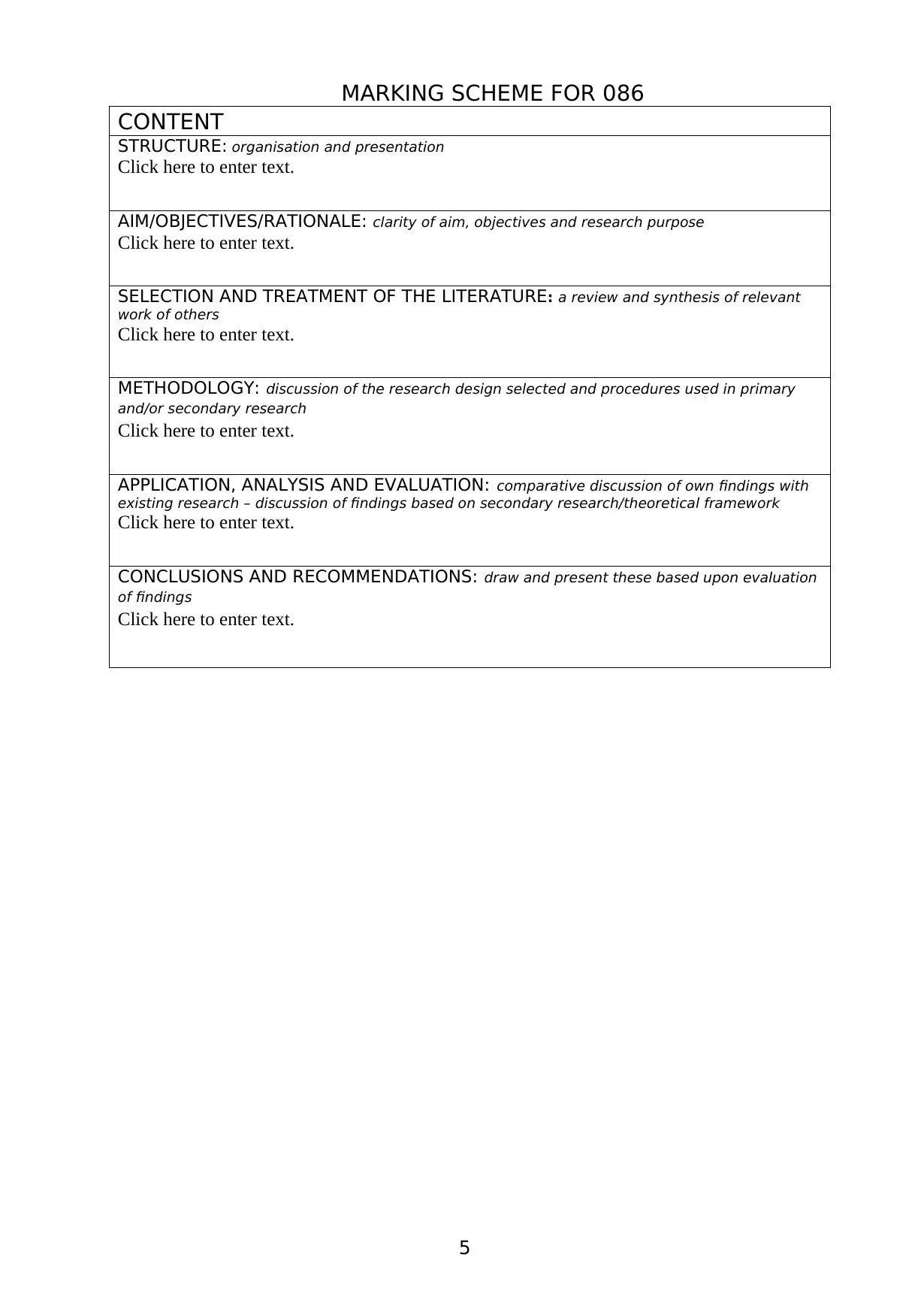
MARKING SCHEME FOR 086
CONTENT
STRUCTURE: organisation and presentation
Click here to enter text.
AIM/OBJECTIVES/RATIONALE: clarity of aim, objectives and research purpose
Click here to enter text.
SELECTION AND TREATMENT OF THE LITERATURE: a review and synthesis of relevant
work of others
Click here to enter text.
METHODOLOGY: discussion of the research design selected and procedures used in primary
and/or secondary research
Click here to enter text.
APPLICATION, ANALYSIS AND EVALUATION: comparative discussion of own findings with
existing research – discussion of findings based on secondary research/theoretical framework
Click here to enter text.
CONCLUSIONS AND RECOMMENDATIONS: draw and present these based upon evaluation
of findings
Click here to enter text.
5
CONTENT
STRUCTURE: organisation and presentation
Click here to enter text.
AIM/OBJECTIVES/RATIONALE: clarity of aim, objectives and research purpose
Click here to enter text.
SELECTION AND TREATMENT OF THE LITERATURE: a review and synthesis of relevant
work of others
Click here to enter text.
METHODOLOGY: discussion of the research design selected and procedures used in primary
and/or secondary research
Click here to enter text.
APPLICATION, ANALYSIS AND EVALUATION: comparative discussion of own findings with
existing research – discussion of findings based on secondary research/theoretical framework
Click here to enter text.
CONCLUSIONS AND RECOMMENDATIONS: draw and present these based upon evaluation
of findings
Click here to enter text.
5

OVERALL COMMENTS:
Click here to enter text.
6
Click here to enter text.
6
⊘ This is a preview!⊘
Do you want full access?
Subscribe today to unlock all pages.
Trusted by 1+ million students worldwide

1 out of 6


Related Documents


![Analyzing ICT Ethical Issues Using Ethical Theories - [Course Name]](/_next/image/?url=https%3A%2F%2Fdesklib.com%2Fmedia%2Fimages%2Fe29ab4a5fdcc4564af0c176e1c8c64ca.jpg&w=256&q=75)

Your All-in-One AI-Powered Toolkit for Academic Success.
+13062052269
info@desklib.com
Available 24*7 on WhatsApp / Email
![[object Object]](/_next/static/media/star-bottom.7253800d.svg)
Unlock your academic potential
Copyright © 2020–2026 A2Z Services. All Rights Reserved. Developed and managed by ZUCOL.