Statistics Assignment: Correlation and Nonparametric Tests

Verified

Added on  2022/09/17

|4
|522
|27
Homework Assignment
AI Summary
This assignment delves into the concepts of correlation and nonparametric tests in statistics. The first part discusses the limitations of correlation, emphasizing that it does not imply causation, and outlines the necessary conditions for applying the Pearson Correlation Coefficient, such as data following a normal distribution and the absence of outliers. The second part explores scenarios where nonparametric tests are more appropriate than parametric tests, particularly when dealing with skewed data, small sample sizes, or ordinal data. The assignment provides a comprehensive understanding of these statistical methods and their appropriate applications. The assignment is contributed to Desklib, a platform providing AI-based study tools for students.
Document Page
Running head: USING AND INTERPRETING STATISTICS 1
Using and Interpreting Statistics
Name
Institution
Date
tabler-icon-diamond-filled.svg

Paraphrase This Document

Need a fresh take? Get an instant paraphrase of this document with our AI Paraphraser
Document Page
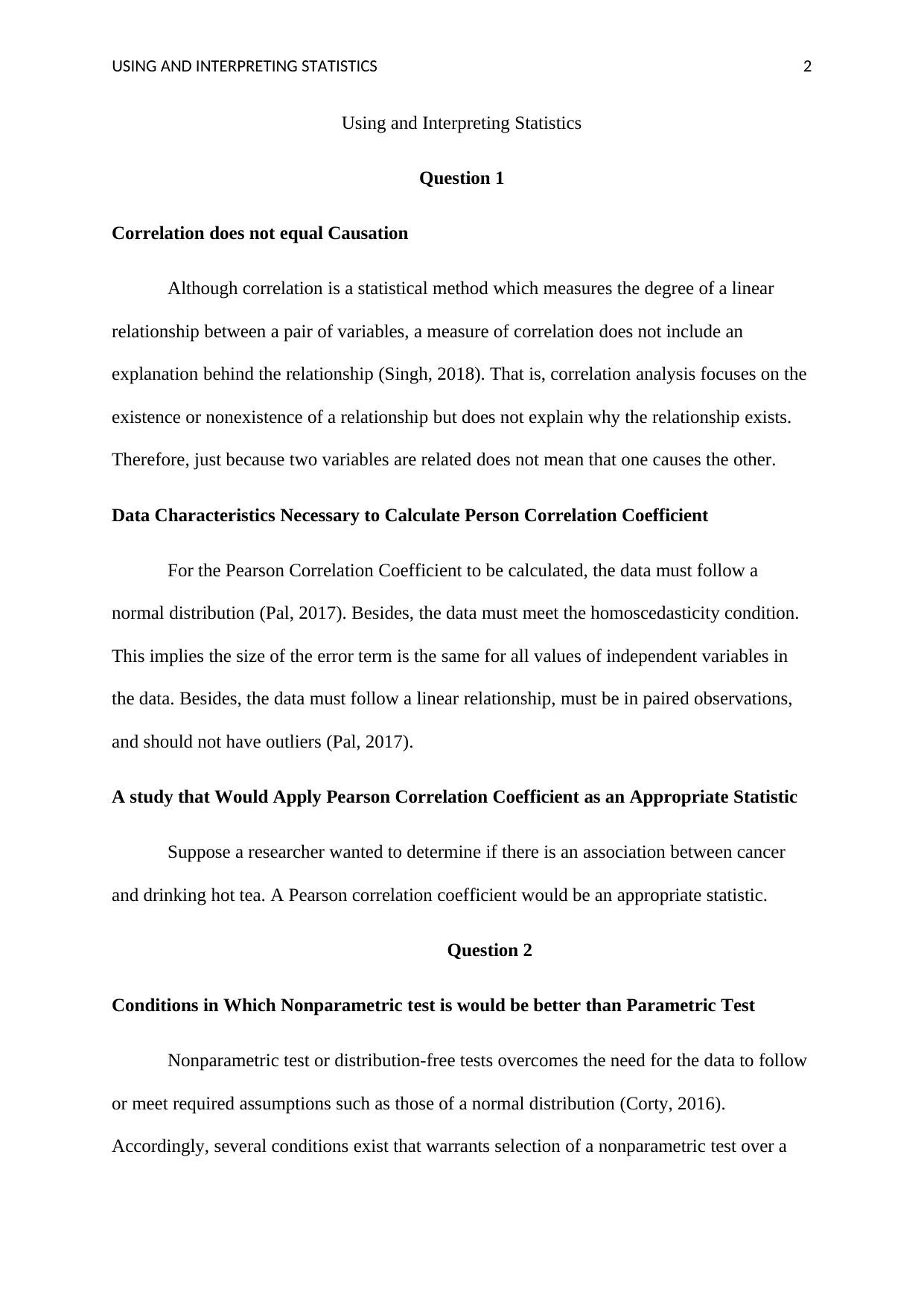
USING AND INTERPRETING STATISTICS 2
Using and Interpreting Statistics
Question 1
Correlation does not equal Causation
Although correlation is a statistical method which measures the degree of a linear
relationship between a pair of variables, a measure of correlation does not include an
explanation behind the relationship (Singh, 2018). That is, correlation analysis focuses on the
existence or nonexistence of a relationship but does not explain why the relationship exists.
Therefore, just because two variables are related does not mean that one causes the other.
Data Characteristics Necessary to Calculate Person Correlation Coefficient
For the Pearson Correlation Coefficient to be calculated, the data must follow a
normal distribution (Pal, 2017). Besides, the data must meet the homoscedasticity condition.
This implies the size of the error term is the same for all values of independent variables in
the data. Besides, the data must follow a linear relationship, must be in paired observations,
and should not have outliers (Pal, 2017).
A study that Would Apply Pearson Correlation Coefficient as an Appropriate Statistic
Suppose a researcher wanted to determine if there is an association between cancer
and drinking hot tea. A Pearson correlation coefficient would be an appropriate statistic.
Question 2
Conditions in Which Nonparametric test is would be better than Parametric Test
Nonparametric test or distribution-free tests overcomes the need for the data to follow
or meet required assumptions such as those of a normal distribution (Corty, 2016).
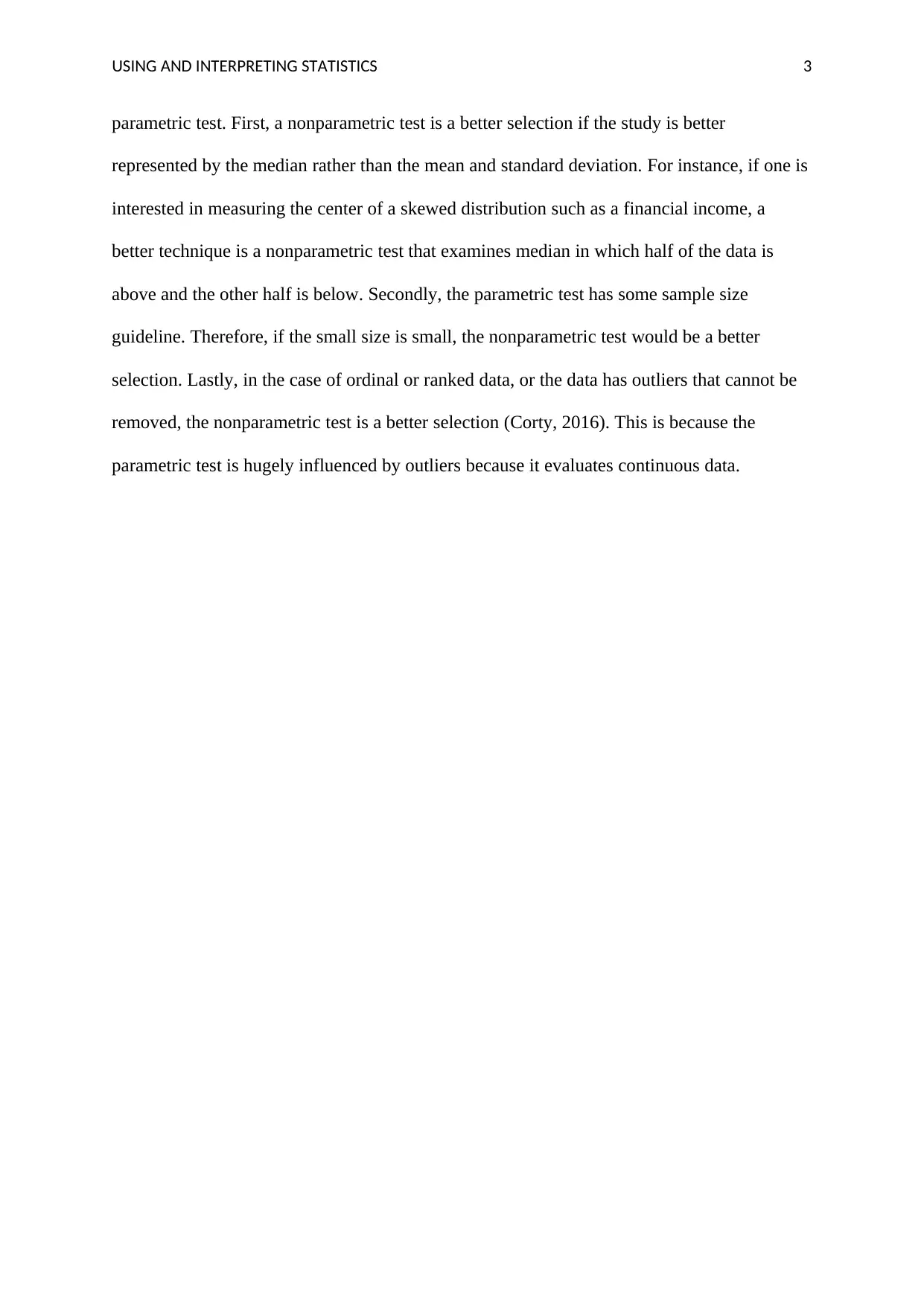
Accordingly, several conditions exist that warrants selection of a nonparametric test over a
Document Page
USING AND INTERPRETING STATISTICS 3
parametric test. First, a nonparametric test is a better selection if the study is better
represented by the median rather than the mean and standard deviation. For instance, if one is
interested in measuring the center of a skewed distribution such as a financial income, a
better technique is a nonparametric test that examines median in which half of the data is
above and the other half is below. Secondly, the parametric test has some sample size
guideline. Therefore, if the small size is small, the nonparametric test would be a better
selection. Lastly, in the case of ordinal or ranked data, or the data has outliers that cannot be
removed, the nonparametric test is a better selection (Corty, 2016). This is because the
parametric test is hugely influenced by outliers because it evaluates continuous data.
Document Page
USING AND INTERPRETING STATISTICS 4
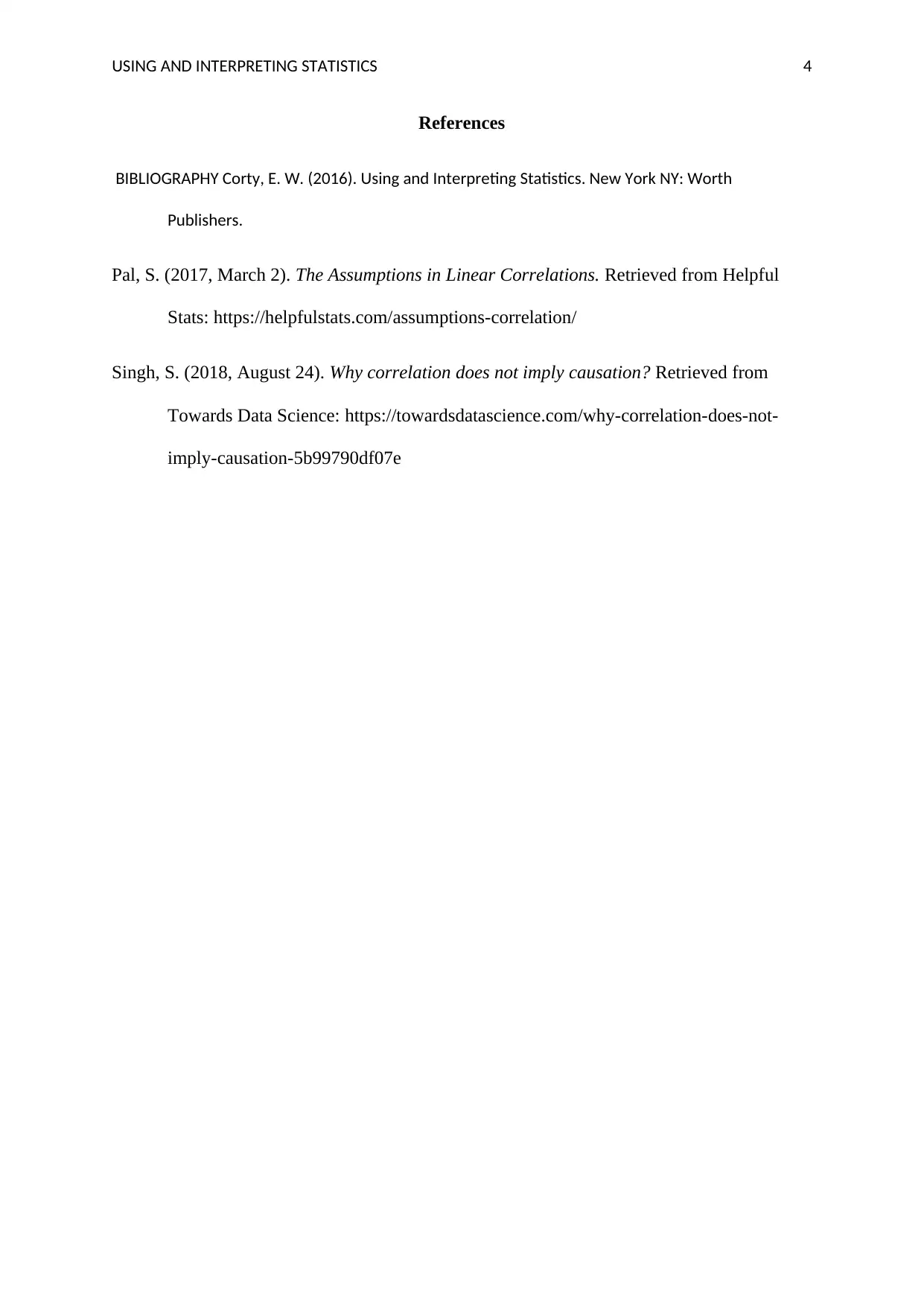
References
BIBLIOGRAPHY Corty, E. W. (2016). Using and Interpreting Statistics. New York NY: Worth
Publishers.
Pal, S. (2017, March 2). The Assumptions in Linear Correlations. Retrieved from Helpful
Stats: https://helpfulstats.com/assumptions-correlation/
Singh, S. (2018, August 24). Why correlation does not imply causation? Retrieved from
Towards Data Science: https://towardsdatascience.com/why-correlation-does-not-
imply-causation-5b99790df07e
chevron_up_icon
1 out of 4
circle_padding
hide_on_mobile
zoom_out_icon
[object Object]