BAP22 - Managerial Accounting: Value Chain Analysis in Rio Tinto
VerifiedAdded on 2023/06/04
|7
|1979
|426
Report
AI Summary
This report provides a comprehensive analysis of the value chain process within Rio Tinto, an Australian manufacturing company, focusing on its application in the steel manufacturing sector. It begins by explaining Porter's concept of the value chain as a tool for cost analysis and operational efficiency, dividing processes into primary and support activities. The report details how value chain analysis is used for cost estimation by identifying value-creating activities and eliminating wasteful ones. It further explores the information used in various value chain segments, including activity identification, cost evaluation, benchmarking, cost driver identification, and opportunities for cost reduction. The analysis then focuses on Rio Tinto, illustrating how the company uses the value chain process in its steel manufacturing operations, highlighting both primary activities (inbound logistics, operations, outbound logistics, marketing and sales, and after-sales service) and support activities (material, technology, human resource, service, finance, and project management). The report concludes that value chain analysis is essential for reducing costs and enhancing value within the supply chain process, particularly for manufacturing companies like Rio Tinto. Desklib provides access to similar solved assignments and study resources for students.
Part 2: Managerial Accounting
1
1
Paraphrase This Document
Need a fresh take? Get an instant paraphrase of this document with our AI Paraphraser

Introduction
Value chain refers to process that is integrated with supply chain process to helps the
management accountant to save the costs incurred while performing these activities. Value chain
process divides the whole process into multiples activities and they are further divided into
primary activities and support activities. The objective of value chain is to minimize the cost and
maximize the operational efficiency through identification of wasteful activities and remove
them through introducing the activities that adds value to the product.
This report will briefly explain the concept of value chain provided by Porter and how it
can be used to estimate the costs. All the segment or parts of value chain are explained together
with application of its elements in Rio Tinto, a manufacturing company in Australia.
1. Value Chain Meaning
The value chain can be regarded as the basic tool that is used for cost analysis by
developing a value-chain of all the activities that are involved in creation of a particular product
or service. This approach is widely used in accounting to identify the value creating activities
and eliminating the unnecessary activities for attaining operational efficiency. This type of
costing considers all the activities involved in a product creation right from acquisition of
resources till its final delivery. It is regarded to be an effective management accounting tool that
is largely been used by the accounting managers to assess the cost behavior from its value
activities (Yang and Shang, 2007). It helps in developing an analysis regarding the internal and
external activities of a firm and assessing their contribution in enhancing the value of a product
or service created. As such, the wasteful activities can be identified accurately that helps in
reducing the costs and maximizing the operational efficiency.
The use of value chain enables a company to improve its strategic position as follows:
It leads to improvement in the product quality through developing an adequate
understanding of the customer requirements
It provides an effective way for examining the competitive cost position of a firm and
improving its strategic position thereby enabling it to attain competitive position
It helps in reduction of time for creating a product or service by elimination of the
unnecessary activities
It leads to reduction in the cost by placing focus on the significant areas requiring
minimization of cost and thereby leading to re-establishment of the value chain (Cadez,
and Guilding, 2007).
2. Use of Value Chain for Cost Estimation
Value chain is regarded as the combination of activities that leads in development of
valuable product or service for a firm. The identification of different activities involved helps in
2
Value chain refers to process that is integrated with supply chain process to helps the
management accountant to save the costs incurred while performing these activities. Value chain
process divides the whole process into multiples activities and they are further divided into
primary activities and support activities. The objective of value chain is to minimize the cost and
maximize the operational efficiency through identification of wasteful activities and remove
them through introducing the activities that adds value to the product.
This report will briefly explain the concept of value chain provided by Porter and how it
can be used to estimate the costs. All the segment or parts of value chain are explained together
with application of its elements in Rio Tinto, a manufacturing company in Australia.
1. Value Chain Meaning
The value chain can be regarded as the basic tool that is used for cost analysis by
developing a value-chain of all the activities that are involved in creation of a particular product
or service. This approach is widely used in accounting to identify the value creating activities
and eliminating the unnecessary activities for attaining operational efficiency. This type of
costing considers all the activities involved in a product creation right from acquisition of
resources till its final delivery. It is regarded to be an effective management accounting tool that
is largely been used by the accounting managers to assess the cost behavior from its value
activities (Yang and Shang, 2007). It helps in developing an analysis regarding the internal and
external activities of a firm and assessing their contribution in enhancing the value of a product
or service created. As such, the wasteful activities can be identified accurately that helps in
reducing the costs and maximizing the operational efficiency.
The use of value chain enables a company to improve its strategic position as follows:
It leads to improvement in the product quality through developing an adequate
understanding of the customer requirements
It provides an effective way for examining the competitive cost position of a firm and
improving its strategic position thereby enabling it to attain competitive position
It helps in reduction of time for creating a product or service by elimination of the
unnecessary activities
It leads to reduction in the cost by placing focus on the significant areas requiring
minimization of cost and thereby leading to re-establishment of the value chain (Cadez,
and Guilding, 2007).
2. Use of Value Chain for Cost Estimation
Value chain is regarded as the combination of activities that leads in development of
valuable product or service for a firm. The identification of different activities involved helps in
2

estimating the cost that are present on the value chain. The identification of the primary and
support activities related with the creation of products helps an accounting manager to develop
different strategies for reducing the cost associated with each activity (Hutaibat, 2011). The
strategies that are developed should lead in keeping the value of the product created to be
constant and only aims at reducing the cost. The identification of the cost drivers associated with
each activity helps in estimation of the costs which can be operational, executional or structural.
The accounting managers by developing the strategies to eliminate the factors that results in
enhancing the value chain activities can significantly attain cost efficiency (Peter, 2011).
3. Information used in costs depicted in various segments of value chain for managers
The various segments that lead in developing a value chain for gaining information about
the costs can be described in detail as follows:
Identification of the value chain activities and segregating them into distinct activities
This stage of the value chain consists of identifying the different types of value chain
activities that need to be carried out in the process of designing, manufacturing and distribution.
The activities should be identified distinctly if it represents a significant proportion of the overall
cost.
Evaluating the importance of different activities in the overall cost of the product
The development of an optimum chain of valuable activities for product development
requires significant cost analysis to be carried out for identification of the cost associated with
carrying out each activity. This is followed by determination of the effectiveness of the company
in investing in various activities of the value chain (Kirli, 2011).
Comparison of the costs as the activity
The identification of the useful and wasteful activities depends on benchmarking the unit
costs required for carrying out each activity in comparison to those of the competitors.
Identification of the cost drivers
The identification of the costs to be incurred in carrying out each activity of the value
chain depends on structural, executional and operational cost drivers. The structural cost driver
determine the cost incurred in activities such as involved within the use of technology and other
supply chain costs. The executional cost driver depends on cost involves in designing, quality
check and adopting the use of continuous improvement programs. The operational cost driver
includes the cost that are dependent on the factors such as number of products, number of orders
of customers and various number of parts.
Identification of Opportunities for reducing costs
3
support activities related with the creation of products helps an accounting manager to develop
different strategies for reducing the cost associated with each activity (Hutaibat, 2011). The
strategies that are developed should lead in keeping the value of the product created to be
constant and only aims at reducing the cost. The identification of the cost drivers associated with
each activity helps in estimation of the costs which can be operational, executional or structural.
The accounting managers by developing the strategies to eliminate the factors that results in
enhancing the value chain activities can significantly attain cost efficiency (Peter, 2011).
3. Information used in costs depicted in various segments of value chain for managers
The various segments that lead in developing a value chain for gaining information about
the costs can be described in detail as follows:
Identification of the value chain activities and segregating them into distinct activities
This stage of the value chain consists of identifying the different types of value chain
activities that need to be carried out in the process of designing, manufacturing and distribution.
The activities should be identified distinctly if it represents a significant proportion of the overall
cost.
Evaluating the importance of different activities in the overall cost of the product
The development of an optimum chain of valuable activities for product development
requires significant cost analysis to be carried out for identification of the cost associated with
carrying out each activity. This is followed by determination of the effectiveness of the company
in investing in various activities of the value chain (Kirli, 2011).
Comparison of the costs as the activity
The identification of the useful and wasteful activities depends on benchmarking the unit
costs required for carrying out each activity in comparison to those of the competitors.
Identification of the cost drivers
The identification of the costs to be incurred in carrying out each activity of the value
chain depends on structural, executional and operational cost drivers. The structural cost driver
determine the cost incurred in activities such as involved within the use of technology and other
supply chain costs. The executional cost driver depends on cost involves in designing, quality
check and adopting the use of continuous improvement programs. The operational cost driver
includes the cost that are dependent on the factors such as number of products, number of orders
of customers and various number of parts.
Identification of Opportunities for reducing costs
3
⊘ This is a preview!⊘
Do you want full access?
Subscribe today to unlock all pages.

Trusted by 1+ million students worldwide

The identification of the cost drivers is followed by development of effective business
strategies that helps a firm in attaining the cost advantage by having a control on the various
drivers of the cost. A firm should aim to reduce the costs associated with each value chain
activity and enhancing the value of product or service created (Mei, Han and Chen, 2009).
4.Purpose of Value Chain in Rio Tinto
Rio Tinto is one the major producer of iron ore in Australia and it falls in the list of ASX
top 100 companies. It uses iron ore in manufacturing of steel that requires integrated value chain
process. Value chain process is required within the manufacturing of steel because process of
steel manufacturing is very rigorous and requires proper handling and standardized value chain
integrated in the supply chain process. There is huge cost involved in the process of steel
manufacturing that creates huge responsibility on the cost manager to control the overall cost of
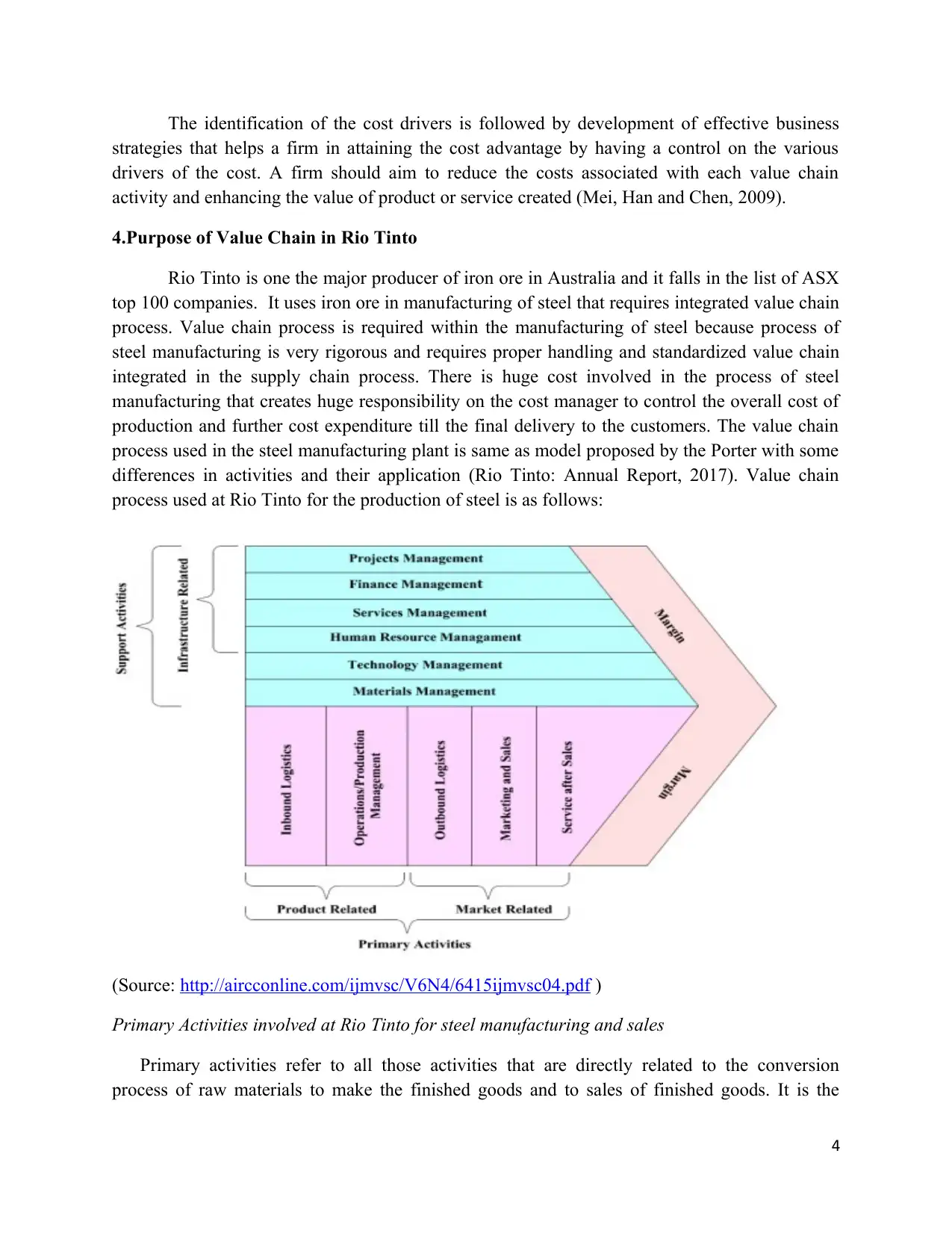
production and further cost expenditure till the final delivery to the customers. The value chain
process used in the steel manufacturing plant is same as model proposed by the Porter with some
differences in activities and their application (Rio Tinto: Annual Report, 2017). Value chain
process used at Rio Tinto for the production of steel is as follows:
(Source: http://aircconline.com/ijmvsc/V6N4/6415ijmvsc04.pdf )
Primary Activities involved at Rio Tinto for steel manufacturing and sales
Primary activities refer to all those activities that are directly related to the conversion
process of raw materials to make the finished goods and to sales of finished goods. It is the
4
strategies that helps a firm in attaining the cost advantage by having a control on the various
drivers of the cost. A firm should aim to reduce the costs associated with each value chain
activity and enhancing the value of product or service created (Mei, Han and Chen, 2009).
4.Purpose of Value Chain in Rio Tinto
Rio Tinto is one the major producer of iron ore in Australia and it falls in the list of ASX
top 100 companies. It uses iron ore in manufacturing of steel that requires integrated value chain
process. Value chain process is required within the manufacturing of steel because process of
steel manufacturing is very rigorous and requires proper handling and standardized value chain
integrated in the supply chain process. There is huge cost involved in the process of steel
manufacturing that creates huge responsibility on the cost manager to control the overall cost of
production and further cost expenditure till the final delivery to the customers. The value chain
process used in the steel manufacturing plant is same as model proposed by the Porter with some
differences in activities and their application (Rio Tinto: Annual Report, 2017). Value chain
process used at Rio Tinto for the production of steel is as follows:
(Source: http://aircconline.com/ijmvsc/V6N4/6415ijmvsc04.pdf )
Primary Activities involved at Rio Tinto for steel manufacturing and sales
Primary activities refer to all those activities that are directly related to the conversion
process of raw materials to make the finished goods and to sales of finished goods. It is the
4
Paraphrase This Document
Need a fresh take? Get an instant paraphrase of this document with our AI Paraphraser

reason why primary activity is grouped into two main activities one is product related and market
related. Product related activities add values to the product and market related activities add
values to the product and services transferred to the customer. There are five primary activities
that are performed by Rio as their value chain process:
Inbound Logistics: In order to start the production of steel there is requirement of raw
material and under this activity all such process is performed. It includes handling of raw
material and its storage including transfers within the various departments.
Operations /Production Management: This process is quite complex as it requires raw
material handling, processing it and make the proper storage of it. Rio Tinto has defined
set of steps under this process that needs to be performed to complete this process. Value
chain process provides Rio Tinto with ease of operations otherwise this process will be
most difficult process.
Outbound logistics: This process includes planning, distribution, warehousing and any
other activity requires making the goods available to the customers at the right place. As
Rio Tinto has bigger supply chain process it is easy to handle this activity and derive
most of the value from this activity.
Marketing and Sales: This activity helps Rio Tinto to add value to the process of
marketing such as price management, domestic sales and other activities that add values
to the sales process.
Service after sales: This process helps to add value to the product such as quality
aspects, delivery aspects, pre/post sales, warranty services etc (Rio Tinto: Our Value
Chain, 2016).
Auxiliary or support activities performed in process of steel manufacturing by Rio Tinto
Supports services includes process such as material management, technology
management, human resource management, services management, finance management and
project management. All these activities helps to add value to the product and also make sure
that no such activities are performed that does not add value to the product. All the process
performed under the support activities are not directly involved in the conversion process but
helps to support the primary activities. Without the use of support activities primary activities are
useless or they will not provide the optimum value to the whole supply chain process (Rao,
2015).
Conclusion
The overall analysis shows that value chain analysis helps to reduce the cost incurred
during the process of supply chain and also identifies the activities that do not add value to the
product. So it can be said that value chain is the essential part of the supply chain process and it
must be includes by the manufacturing companies.
5
related. Product related activities add values to the product and market related activities add
values to the product and services transferred to the customer. There are five primary activities
that are performed by Rio as their value chain process:
Inbound Logistics: In order to start the production of steel there is requirement of raw
material and under this activity all such process is performed. It includes handling of raw
material and its storage including transfers within the various departments.
Operations /Production Management: This process is quite complex as it requires raw
material handling, processing it and make the proper storage of it. Rio Tinto has defined
set of steps under this process that needs to be performed to complete this process. Value
chain process provides Rio Tinto with ease of operations otherwise this process will be
most difficult process.
Outbound logistics: This process includes planning, distribution, warehousing and any
other activity requires making the goods available to the customers at the right place. As
Rio Tinto has bigger supply chain process it is easy to handle this activity and derive
most of the value from this activity.
Marketing and Sales: This activity helps Rio Tinto to add value to the process of
marketing such as price management, domestic sales and other activities that add values
to the sales process.
Service after sales: This process helps to add value to the product such as quality
aspects, delivery aspects, pre/post sales, warranty services etc (Rio Tinto: Our Value
Chain, 2016).
Auxiliary or support activities performed in process of steel manufacturing by Rio Tinto
Supports services includes process such as material management, technology
management, human resource management, services management, finance management and
project management. All these activities helps to add value to the product and also make sure
that no such activities are performed that does not add value to the product. All the process
performed under the support activities are not directly involved in the conversion process but
helps to support the primary activities. Without the use of support activities primary activities are
useless or they will not provide the optimum value to the whole supply chain process (Rao,
2015).
Conclusion
The overall analysis shows that value chain analysis helps to reduce the cost incurred
during the process of supply chain and also identifies the activities that do not add value to the
product. So it can be said that value chain is the essential part of the supply chain process and it
must be includes by the manufacturing companies.
5

References
Cadez, S. and Guilding, C. 2007. Benchmarking the incidence of strategic management
accounting in Slovenia. Journal of Accounting and Organizational Change 3 (2), pp. 126-146.
Hutaibat, K. 2011. Value Chain for Strategic Management Accounting in Higher Education.
International Journal of Business and Management 6(11), pp.206-218.
Kirli, M. 2011. The Implementation Of Strategic Management Accounting Based On Value
Chain Analysis: Value Chain Accounting. International Journal Of Social Sciences And
Humanity Studies 3(1), pp. 307-321.
Mei, X., Han, Z. and Chen, H. 2009. Study on the Cost Management Based on the Cooperative
Value Chain. International Journal of Business and Management 4 (6), pp. 17-22.
Peter H. 2011. Managing Value Chain Strategy. Journal of Management and Marketing
Research, 9, pp.1-11.
Rao, N. 2015. Value Chain Model For Steel Manufacturing Sector: A Case Study. International
Journal of Managing Value and Supply Chains (IJMVSC) 6 (4), pp. 45-53.
Rio Tinto: Annual Report. 2017. [Online]. Available at:
https://www.riotinto.com/documents/RT_2017_Annual_Report.pdf [Accessed on: 30 October
2018].
Rio Tinto: Our Value Chain. 2016. 2016 Sustainable development report. [Online]. Available at:
http://www.riotinto.com/documents/RT_SD2016_our_value_chain.pdf [Accessed on: 30
October 2018].
Yang J. and Shang W. 2007. Finance Management Based on Value Chain Management.
International Journal of Business and Management 2(5), pp.101-103.
6
Cadez, S. and Guilding, C. 2007. Benchmarking the incidence of strategic management
accounting in Slovenia. Journal of Accounting and Organizational Change 3 (2), pp. 126-146.
Hutaibat, K. 2011. Value Chain for Strategic Management Accounting in Higher Education.
International Journal of Business and Management 6(11), pp.206-218.
Kirli, M. 2011. The Implementation Of Strategic Management Accounting Based On Value
Chain Analysis: Value Chain Accounting. International Journal Of Social Sciences And
Humanity Studies 3(1), pp. 307-321.
Mei, X., Han, Z. and Chen, H. 2009. Study on the Cost Management Based on the Cooperative
Value Chain. International Journal of Business and Management 4 (6), pp. 17-22.
Peter H. 2011. Managing Value Chain Strategy. Journal of Management and Marketing
Research, 9, pp.1-11.
Rao, N. 2015. Value Chain Model For Steel Manufacturing Sector: A Case Study. International
Journal of Managing Value and Supply Chains (IJMVSC) 6 (4), pp. 45-53.
Rio Tinto: Annual Report. 2017. [Online]. Available at:
https://www.riotinto.com/documents/RT_2017_Annual_Report.pdf [Accessed on: 30 October
2018].
Rio Tinto: Our Value Chain. 2016. 2016 Sustainable development report. [Online]. Available at:
http://www.riotinto.com/documents/RT_SD2016_our_value_chain.pdf [Accessed on: 30
October 2018].
Yang J. and Shang W. 2007. Finance Management Based on Value Chain Management.
International Journal of Business and Management 2(5), pp.101-103.
6
⊘ This is a preview!⊘
Do you want full access?
Subscribe today to unlock all pages.

Trusted by 1+ million students worldwide

7
1 out of 7
Related Documents
Your All-in-One AI-Powered Toolkit for Academic Success.
+13062052269
info@desklib.com
Available 24*7 on WhatsApp / Email
Unlock your academic potential
Copyright © 2020–2026 A2Z Services. All Rights Reserved. Developed and managed by ZUCOL.