Accounting and Value Management: Investment Strategies and Analysis

Verified

Added on  2023/06/15

|8
|1774
|295
Essay
AI Summary
This essay delves into the principles of accounting and value management, focusing on strategies to maximize shareholder value. It emphasizes the importance of value-based management as an approach to ensure consistent performance in maximizing shareholder value. The analysis highlights the significance of return on invested capital (ROIC) as a key metric for evaluating investment performance and comparing profitability. Effective managers are shown to prioritize long-term investments, concentrated portfolios, and strategic resource allocation to achieve sustained value creation. The essay further discusses how managers can make informed investment decisions by comparing anticipated ROIC with the cost of capital, reinvesting in profitable projects, and returning free cash flow to stockholders when appropriate. It also addresses the challenges of using earnings per share as a metric and the importance of accurately measuring capital investment. The ultimate goal is to optimize returns on invested capital by aligning investment portfolios with stated time horizons and risk objectives, emphasizing real assets, and ensuring commitment to long-term investment horizons.
Document Page
Running head: ACCOUNTING AND VALUE MANAGEMENT
Accounting and Value Management
Name of the Student
Name of the University
Authors Note
Course ID
tabler-icon-diamond-filled.svg

Paraphrase This Document

Need a fresh take? Get an instant paraphrase of this document with our AI Paraphraser
Document Page
1ACCOUNTING AND VALUE MANAGEMENT
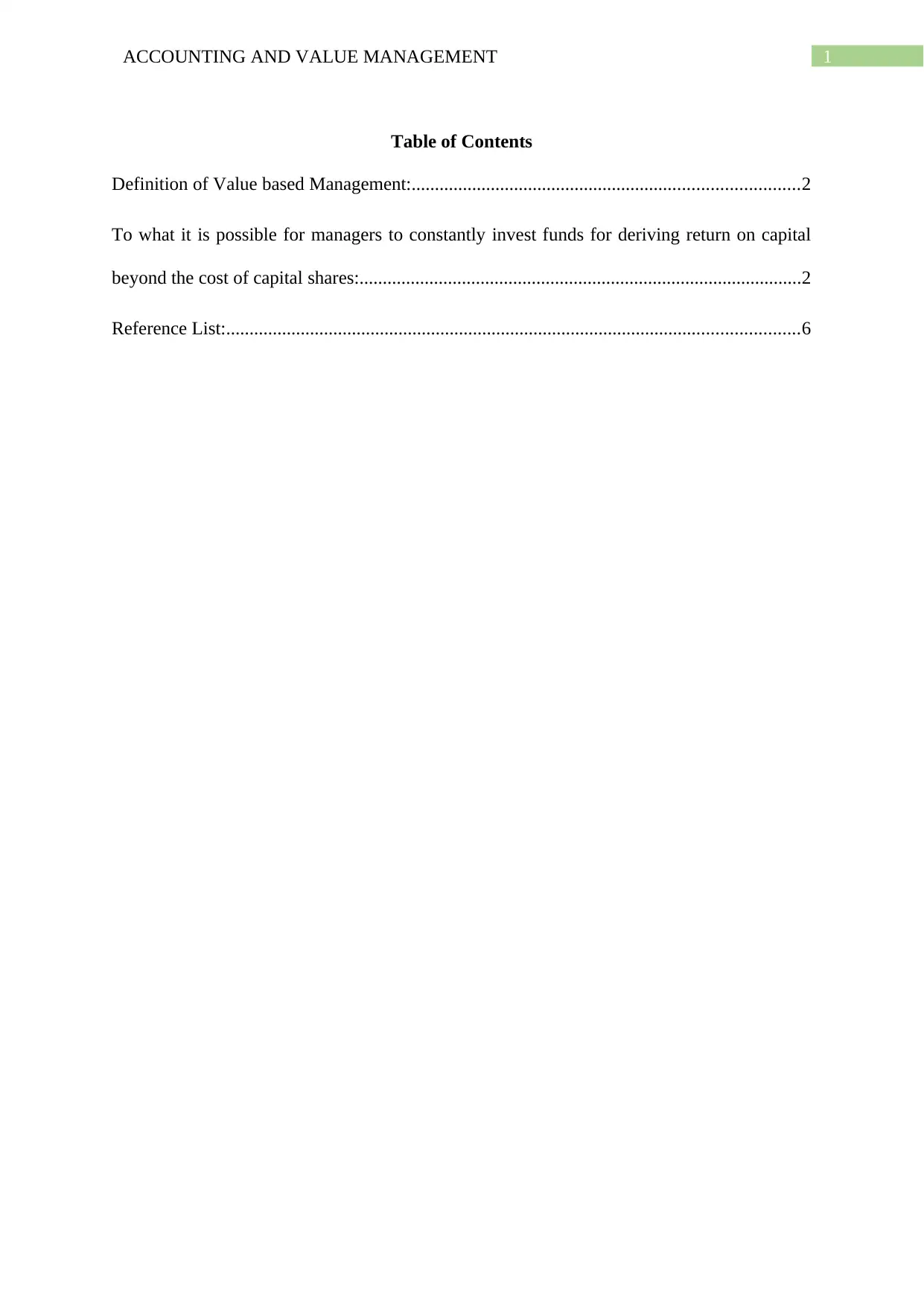
Table of Contents
Definition of Value based Management:...................................................................................2
To what it is possible for managers to constantly invest funds for deriving return on capital
beyond the cost of capital shares:...............................................................................................2
Reference List:...........................................................................................................................6
Document Page
2ACCOUNTING AND VALUE MANAGEMENT
Definition of Value based Management:
Value based management are regarded as the approach that makes sure that the
companies are performing consistently to maximize the value of shareholder. The value
based management is regarded as the philosophy of management and approach which enables
and backs the maximum value creation for the firm (Balance 2014). Value based
management incorporates the procedure of creation, management and measurement of value.
The procedure of value creation needs an understanding of the appeal of market and industry
where an individual competes with one’s competitive position that is in relation to the other
market players. Once the understanding is created and is associated with the significant value
chain drivers of cash flow, cost-effectiveness and competitive strategy can be formed or
altered to increase the forthcoming returns.
To what it is possible for managers to constantly invest funds for deriving return on
capital beyond the cost of capital shares:
Return on invested capital is regarded as one of the most reliable source of
understanding the performance metric for determining the superiority of investment (Lan,
Moneta and Wermers 2016). Importantly for managers in determining the higher return on
capital beyond the cost of shares the return on invested capital is a vital to measure for
comparing the level of comparative profitability for the businesses.
Managers that work reliably with the long term method yield higher return on
invested capital (Kahn and Lemmon 2014). To continuously produce return on the capital
beyond the cost of share the managers look to invest in long term investment idea and
concentrated portfolios with higher amount of active shares to engage in the organizations
long term strategic and apportionment of resources. This enables producing long term value
creation along with the fund depositors. It is the ability of the managers to derive the cash
Document Page
3ACCOUNTING AND VALUE MANAGEMENT
flow at the lower risk and assign the cash flow on rational basis that helps in driving value for
shareholder over the time.
For the managers capitalizing on the value of investment needs an understanding of
the proper return on capital to stockholders (Mao and Zhu 2015). The managers better
understand that when their anticipated return on invested capital from investment or
acquisition is greater than the cost of capital they would use those investment or acquisition
that would yield a higher worth of return. If the marginal cost of capital is higher than the
return on invested capital, returns can be derived with the help of reinvestment or acquisition
and then financing in those profit yielding projects that would provide higher return (Davis
and Lleo 2015). In such kind of circumstances, the shareholders will be in the position of
deriving higher return on capital through reinvesting the fund in the business.
Managers may discover some of the plans that value investment but not essentially
adequate to make use of the free cash flow. For these businesses, it is logical to make
investment in some of the projects whereas at the same time returning back a number of free
cash flow to stockholders (Cremers et al. 2016). Netting the stockholder return makes the use
of the free cash flow in an orderly manner to apply the philosophy of investment. Importantly
the managers measure the capital investment project based on the impact on the earnings per
share. Even when everything goes according to the plan it can be confusing. This is because
the accrual accounting postpones the identification of the actual expenditure.
In determining the higher return on invested capital from the cost of share managers
are given with the choice of selecting among the market value and book value. Managers
often choose to proceed with the market value (Walden 2015). Managers uses the cost of
capital by using the market value weights for debt and equity. The computation of accounting
tabler-icon-diamond-filled.svg

Paraphrase This Document

Need a fresh take? Get an instant paraphrase of this document with our AI Paraphraser
Document Page
4ACCOUNTING AND VALUE MANAGEMENT
return is conceivably the only place in investment for managers where they return back to
book value.
In generating the higher return on capital from the cost of shares the managers try to
compute the return on invested capital in the current asset they assume that the book value of
the debt and equity efficiently measures the capital investment (Zaher 2017). The managers
mark up the value of the current assets to determine their power of earning. Alternatively,
even though there are no growth assets making the use of the market value of the current
investment helps in generating improved result for the managers which is equivalent to the
cost of capital. The primary reason where the manager derives higher return on investment
the managers uses the operating income in deriving the cost of capital (Chandra 2017). The
return on capital determines the return on capital invested for an asset the managers places
their focus on return on equity as the noteworthy component of investment. This is because it
is associated with the earnings that are left over for the equity financiers following the debt
service cost have been factored in the equity-invested asset.
The return on equity for an invested fund represent that an organization is therefore
providing composite return on all the assets and cash operating. Based on the extent that the
cash is different both in respect of the return and risk the operating assets, the return on equity
for a firm having significant amount of cash balance would be depressed by the lower and
less risky return derived by cash earnings. One of the most sensible course of action that is
undertaken by the manager is not to take into the account the earnings and book value as
stated but to adjust those returns in order to obtain better measure of the returns derived by an
investor on its investment (Levy 2015). The purpose of the manager is not to project the last
year return with total precision but arriving with the measure of return which can be helpful
in determining the future performance.
Document Page
5ACCOUNTING AND VALUE MANAGEMENT
The manager to optimize the return on invested from the cost of capital the manager is
required to make sure that the portfolio is originally invested in line with the stated time
horizon and objective of risk (Yuniningsih, Widodo and Wajdi 2017). This would require the
manager to allocate more amount of capital to the real asset such as infrastructure and real
estate. It might represent that greater amount of weight is placed on the strategies within the
given class of asset and on long term value creation of the asset.
Finally, the asset is required to assure that their internal investment and the external
fund managers remain committed to the long term investment horizon. Mutual structures for
compensation should be made to reward the managers for their long term investment. Several
investors have placed their focus on encouraging the long-term return beyond the cost of
shares because careful analysis would enable the managers in deriving longer return for their
investment (Harris et al. 2016). It is often found that managers are recommended to make an
investment only when the return on possible venture is higher than the organizations
weighted average cost of capital. Even though the investors do not get dividends, the
shareholders are anticipated to derive the return on investment based on the rise of the stock
price. Managers are under the obligation of maximizing their return to the shareholders by
allocating the capital adequately. When the managers have the opportunities of making an
investment they would earn a higher return on invested capital than the marginal cost of the
capital required to fund the investment.
Document Page
6ACCOUNTING AND VALUE MANAGEMENT
Reference List:
Balance, P.A., 2014. Investment management. City.
Chandra, P., 2017. Investment analysis and portfolio management. McGraw-Hill Education.
Cremers, M., Ferreira, M.A., Matos, P. and Starks, L., 2016. Indexing and active fund
management: International evidence. Journal of Financial Economics, 120(3), pp.539-560.
HA Davis, M. and Lleo, S., 2015. Risk-Sensitive Investment Management.
Harris, E.P., Northcott, D., Elmassri, M.M. and Huikku, J., 2016. Theorising strategic
investment decision-making using strong structuration theory. Accounting, Auditing &
Accountability Journal, 29(7), pp.1177-1203.
Kahn, R.N. and Lemmon, M., 2014. The Asset Manager’s Dilemma: How Strategic Beta Is
Disrupting the Investment Management Industry. Working paper, BlackRock.
Lan, C., Moneta, F. and Wermers, R., 2016. Holding Horizon: A New Measure of Active
Investment Management.
Levy, H., 2015. Stochastic dominance: Investment decision making under uncertainty.
Springer.
Mao, S. and Zhu, T., 2015. The Technique and Management of Investment Control in Metro
Engineering. In Information Technology and Mechatronics Engineering Conference,
China(pp. 207-211).
Walden, M.L., 2015. Active versus passive investment management of state pension plans:
Implications for personal finance. Journal of Financial Counseling and Planning, 26(2),
pp.160-171.
tabler-icon-diamond-filled.svg

Paraphrase This Document

Need a fresh take? Get an instant paraphrase of this document with our AI Paraphraser
Document Page
7ACCOUNTING AND VALUE MANAGEMENT
Yuniningsih, Y., Widodo, S. and Wajdi, M.B.N., 2017. An analysis of Decision Making in
the Stock Investment. Economic: Journal of Economic and Islamic Law, 8(2), pp.122-128.
Zaher, T., 2017. The Value of Active Investment Strategies(No. 2017-WP-02). Indiana State
University, Scott College of Business, Networks Financial Institute.
chevron_up_icon
1 out of 8
circle_padding
hide_on_mobile
zoom_out_icon
[object Object]