Literature Review: Analysis of Water Distribution Pipe Failure Models

Verified

Added on  2023/06/10

|7
|766
|387
Literature Review
AI Summary
This paper presents a literature review of a 2015 research review on statistical failure models for water distribution pipes, authored by Andreas Scheidegger, Joao P. Leitão, and Lisa Scholten. The review focuses on analyzing failure models to develop a statistical model for pipe failure, with the aim of improving pipe rehabilitation and asset management strategies. The paper summarizes existing research, emphasizing the importance of understanding water distribution infrastructure deterioration in urban areas. It reviews various statistical failure models, categorizing them and considering pipe-based deterioration models to derive system-wide failure rates. The review highlights four key effects on pipe failure: initial installation problems, stress from repairs, weakening of pipes after repairs, and gradual deterioration over time. It also reports on the spatial dependency of failure rates within water distribution systems. The conclusion emphasizes the advantages of pipe failure models in informing management decisions and highlights the importance of selecting the most appropriate model based on data characteristics, likelihood functions, and alignment with operational experience.
Document Page
Running head: LITERATURE REVIEW
Literature Review
Name of the Student
Name of the University
Author Note
tabler-icon-diamond-filled.svg

Paraphrase This Document

Need a fresh take? Get an instant paraphrase of this document with our AI Paraphraser
Document Page
1LITERATURE REVIEW
Executive Summary
This paper serves as a review of a 2015 research review of Statistical failure models for
water distribution pipes by Andreas Scheidegger, Joao P. Leitão, and Lisa Scholten. The paper
reviews failure models to derive statistically a pipe failure model such that pipe rehabilitation
along with asset management can be efficiently done. The author of this review has reviewed
plenty of previous research. This paper summarizes the review made by the author.
Document Page
2LITERATURE REVIEW
Table of Contents
Introduction......................................................................................................................................3
Problem Statement.......................................................................................................................3
Background..................................................................................................................................3
Objectives....................................................................................................................................3
Methodology....................................................................................................................................3
Result...............................................................................................................................................4
Conclusion.......................................................................................................................................5
Document Page
3LITERATURE REVIEW
Introduction
Problem Statement
This paper reviews these failure models to provide scientists a pipe failure model using
statistical means so that pipe rehabilitation as well as asset management decisions can be taken.
The author has reviewed many previous works and none had provided a solution or the
information needed for the selection of the efficient model.
Background
The condition of the water distribution infrastructures in urban areas is very important as
the continuity of water distribution is taken care of by these systems. Thorough research has been
undertaken in countries like Australia, US, Canada and in Europe and these studies stressed on
the need to find ways to gauge the deterioration of and failure in the water distribution systems in
urban areas.
Objectives
The objective of this paper was to review existing works, compare, and analyze the
statistical failure models in a systematic way for the water distribution pipes from a unified
perspective.
Methodology
The paper reviews other works and provides a three dimensional categorization which is
not found in most of the other reviews and concentrates on statistical models. The pipe-based
deterioration models are considered in the review as it helps to derive a system wide rate of
failure. These models can be clubbed with any management strategies and the assessment made
tabler-icon-diamond-filled.svg

Paraphrase This Document

Need a fresh take? Get an instant paraphrase of this document with our AI Paraphraser
Document Page
4LITERATURE REVIEW
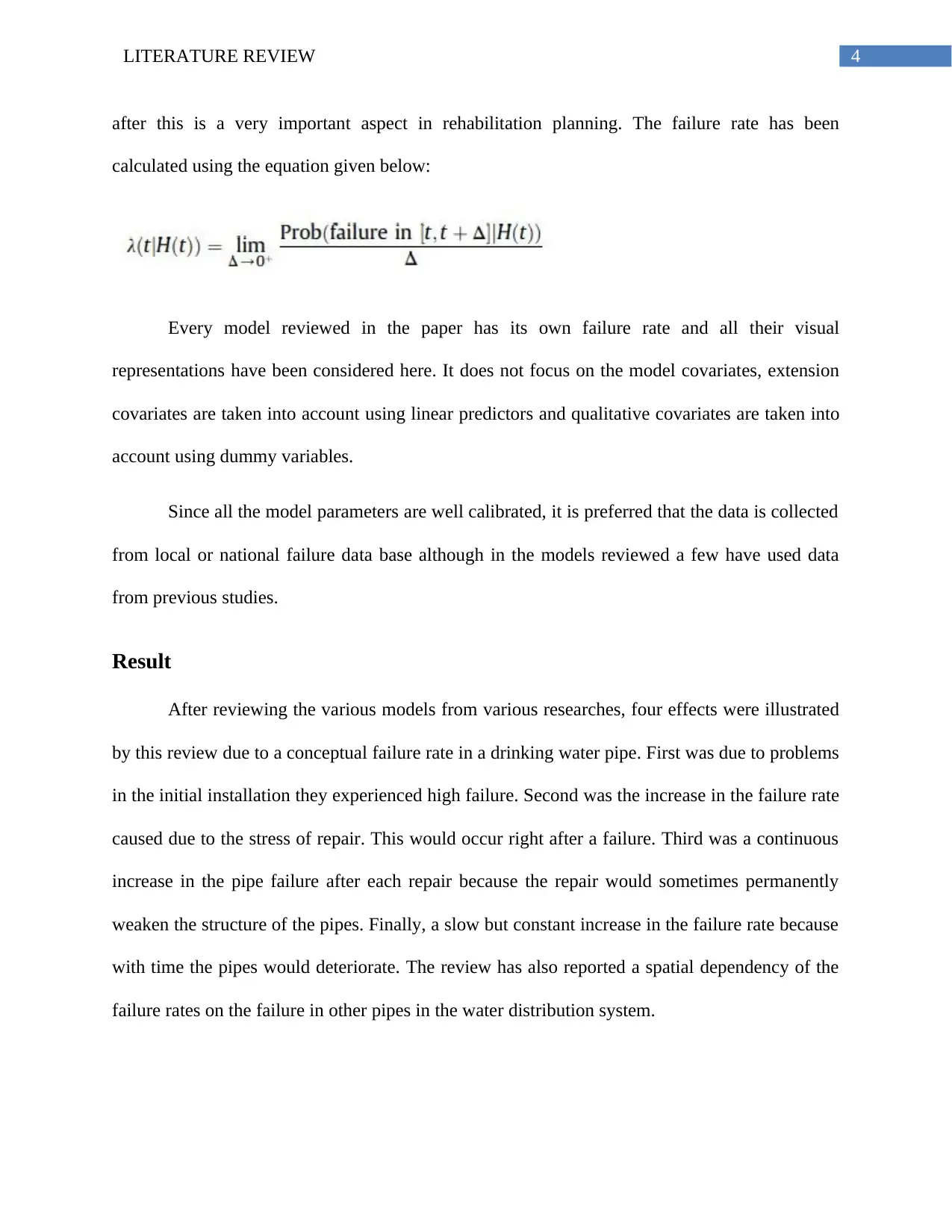
after this is a very important aspect in rehabilitation planning. The failure rate has been
calculated using the equation given below:
Every model reviewed in the paper has its own failure rate and all their visual
representations have been considered here. It does not focus on the model covariates, extension
covariates are taken into account using linear predictors and qualitative covariates are taken into
account using dummy variables.
Since all the model parameters are well calibrated, it is preferred that the data is collected
from local or national failure data base although in the models reviewed a few have used data
from previous studies.
Result
After reviewing the various models from various researches, four effects were illustrated
by this review due to a conceptual failure rate in a drinking water pipe. First was due to problems
in the initial installation they experienced high failure. Second was the increase in the failure rate
caused due to the stress of repair. This would occur right after a failure. Third was a continuous
increase in the pipe failure after each repair because the repair would sometimes permanently
weaken the structure of the pipes. Finally, a slow but constant increase in the failure rate because
with time the pipes would deteriorate. The review has also reported a spatial dependency of the
failure rates on the failure in other pipes in the water distribution system.
Document Page
5LITERATURE REVIEW
Conclusion
To sum up, the pipe failure models have a huge advantage in comparison to the lifespan
of the pipe because the failure behavior can be independently modelled for management
decisions. Water utilities in urban areas are characterized with left truncation along with survival
selection but they cannot be taken into account by all models as models are selected and
developed based on their data characteristics and the different calibrations require different
formulation of the likelihood function. The selection of the most adequate model should be done
taking into account the likelihood functions, whether the predictions match with the central
questions and whether the assumptions are in agreement with the operator’s experience.
Document Page
6LITERATURE REVIEW
References
Scheidegger, A., Leitão, J.P. and Scholten, L., 2015. Statistical failure models for water distribution pipes–
A review from a unified perspective. Water research, 83, pp.237-247.
chevron_up_icon
1 out of 7
circle_padding
hide_on_mobile
zoom_out_icon
[object Object]