Water Supply Code Assignment: NR 809 and Wisconsin Regulations

Verified

Added on  2019/09/18

|3
|1012
|210
Homework Assignment
AI Summary
This homework assignment delves into the Wisconsin Administrative Code, specifically NR 809, to explore regulations pertaining to drinking water. The assignment poses a series of questions covering various aspects of water supply management, including the classification of public water systems, the consideration of cost in best available treatment technologies, and the definition of an entry point. It also addresses the classification of water systems based on usage and source, such as non-transient non-community systems and groundwater under the direct influence of surface water. Furthermore, the assignment examines monitoring requirements, including who can increase or decrease them, and the enforceability of Maximum Contaminant Level Goals (MCLGs). It covers scenarios where bottled water may be used, the MCL for nitrate, and the monitoring frequency for non-community transient systems. The assignment also includes questions on laboratory certifications for water sample analysis, changes in sanitary survey evaluations, and the procedures for addressing total coliform-positive samples. Lastly, it investigates the frequency of sanitary surveys for non-community systems and the required distances of wells from potential contaminant sources.
Document Page
Water Supply WI Administrative Code Assignment
The purpose of this assignment is to give you some exposure to Wisconsin Administrative Code
requirements for environmental protection specific to Drinking Water. This is not an in depth analysis
(that would take an entire class by itself), but something to help you feel comfortable with Code so you
could use the Wisconsin Administrative Code, or a different state’s equivalent, in the future. Use your
text book and the Wisconsin Administrative Code to answer the following questions. For each answer
include the citation or citations within the Wisconsin Administrative Code where you found your answer.
Submit your answers to the dropbox by the due date.
NR 809
1.What are the two types of public water supplies?
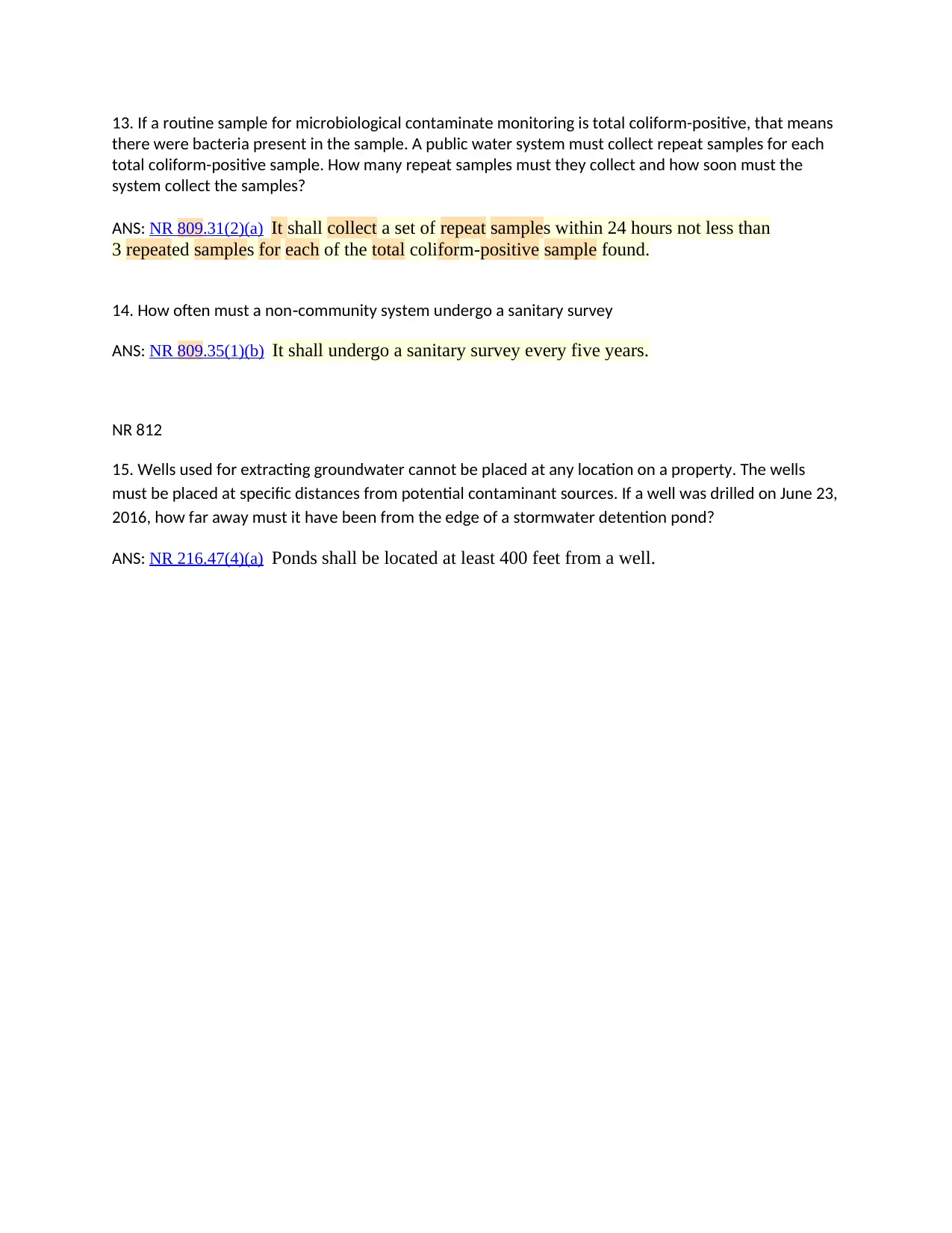
ANS: NR 809.04(67) A public water system can call as either a “community water system" or a “non-
community water system."
2. Does a best available technology for treatment take cost into consideration?
ANS: NR 809.90(1)(a)1. Yes, it takes cost into consideration.
3. What is an entry point?
ANS: NR 809.04(29) “Entry point" means a location in the public water system after treatment or
chemical addition, if any, but prior to the distribution system. A sample collected in the distribution
system may be considered an entry point sample if the department has determined it is more
representative of the water sources.
4. A daycare center is open 10 months of the year with teachers and 54 children registered to attend. If
the daycare center has its own water supply, would it be considered a non transient non community
water system? If not, what type of system is it?
ANS: NR 809.04(58) Yes, it would be considered as a non-transient non-community water system.
5. Would a Brita on Tap Faucet be considered a POE (point of entry) or POU (point of use) treatment
device?
ANS: NR 809.04(64) and NR 809.04(65)
It would be “Point-of-use treatment device."
6. Is a system that uses groundwater under the direct influence of surface water a groundwater or
surface water system?
tabler-icon-diamond-filled.svg

Paraphrase This Document

Need a fresh take? Get an instant paraphrase of this document with our AI Paraphraser
Document Page
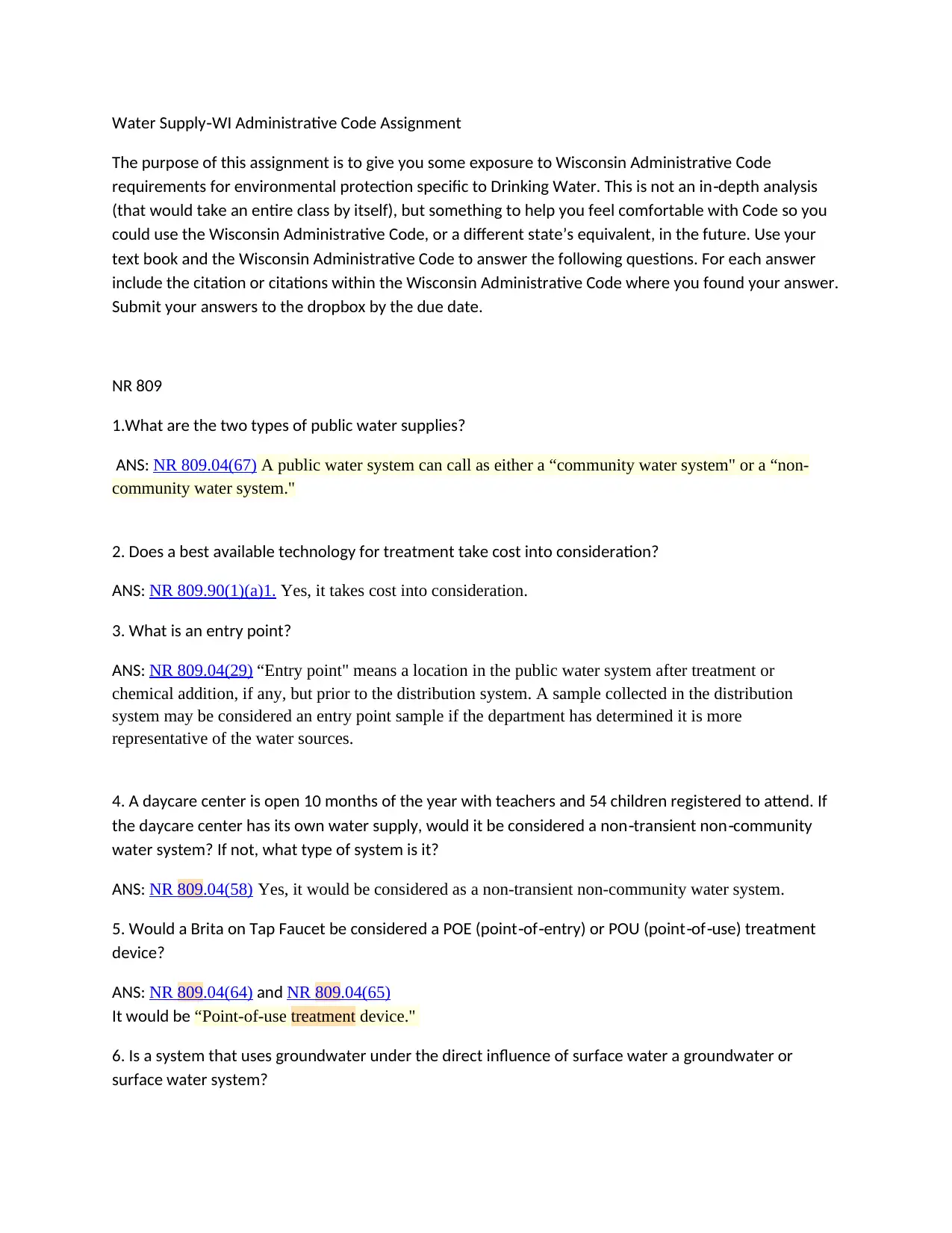
ANS: NR 809.31(1)(c)3. Non-community water system with respect to NR 809.04 (40)
7. Water suppliers must conduct monitoring. Who may increase monitoring requirements? Who may
decrease monitoring requirements if such a decrease will not adversely affect the protection of public
health?
ANS: NR 809.06 The Department of Natural Resources
8. Under NR 809.07 (2) there is a table of MCLGs that are less than the MCL. Are those levels
enforceable?
ANS: NR 809.09 Yes, these levels are enforceable.
9. When may bottled water be used for a public water supply?
ANS: NR 809.10 Bottled water may be used temporarily for a public water supply to avoid unreasonable
risk to health.
10. What is the MCL for nitrate? For a non community transient system that uses groundwater, what
will the monitoring frequency be for nitrate if the system’s last sample had a result of 6.2 mg/l?
ANS: NR 809.11(2) Maximum contaminant level is of 10.0 mg/l for nitrate .
NR 809.31(2m)(e) Non-transient non-community water systems shall repeat the
monitoring frequency for groundwater systems quarterly for minimum one year.
NR 809.91(1)(b)
11. Analysis of drinking water samples for inorganic and synthetic organic contaminants only conducted
by laboratories that have which types of certifications or approval?
ANS: NR 149.13(4)
NR 149.13(4)(c) Analyte groups are organized into classes. Laboratories analyzing aqueous and solid
matrices may be certified or registered for analyte groups belonging to the analytical classes contained
in Table 3 of this subchapter.
12. If a system had a sanitary survey conducted May 3, 2016, what “new” evaluation with regards to
microbiological contaminant monitoring would have been conducted during that sanitary survey that
would not have been conducted during the system’s sanitary survey that was conducted in 2011?
ANS: NR 809.31(1)(ar)2.After April, 1,2016, the department requires a special monitoring with
regards to sanitary surveys. Thus, the water supplier of the seasonal system shall collect
compliance samples during these time periods.
Document Page
13. If a routine sample for microbiological contaminate monitoring is total coliform-positive, that means
there were bacteria present in the sample. A public water system must collect repeat samples for each
total coliform-positive sample. How many repeat samples must they collect and how soon must the
system collect the samples?
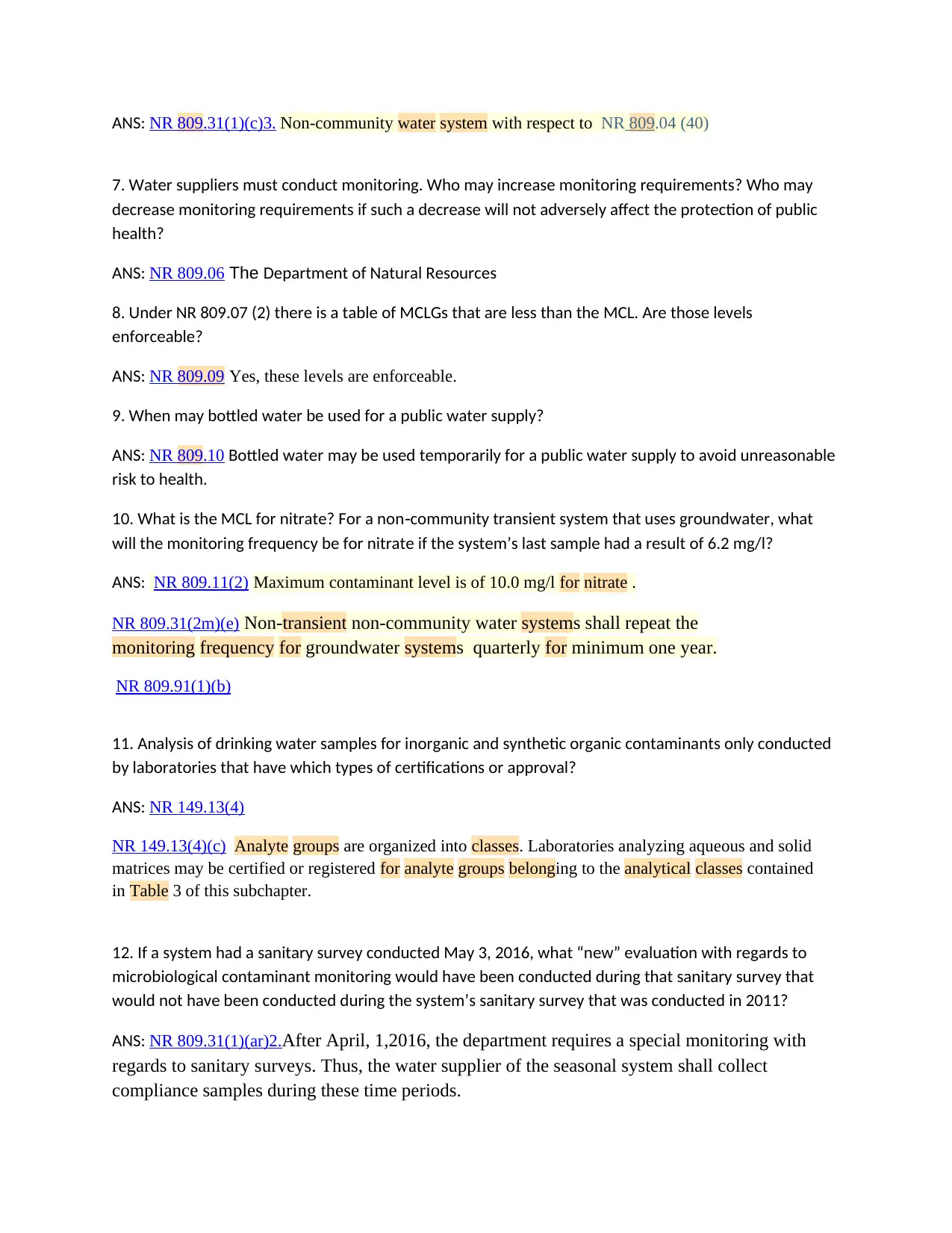
ANS: NR 809.31(2)(a) It shall collect a set of repeat samples within 24 hours not less than
3 repeated samples for each of the total coliform-positive sample found.
14. How often must a non community system undergo a sanitary survey
ANS: NR 809.35(1)(b) It shall undergo a sanitary survey every five years.
NR 812
15. Wells used for extracting groundwater cannot be placed at any location on a property. The wells
must be placed at specific distances from potential contaminant sources. If a well was drilled on June 23,
2016, how far away must it have been from the edge of a stormwater detention pond?
ANS: NR 216.47(4)(a) Ponds shall be located at least 400 feet from a well.
chevron_up_icon
1 out of 3
circle_padding
hide_on_mobile
zoom_out_icon
[object Object]