Analyzing Water Consumption: The Everyday Water Project Case Study
VerifiedAdded on 2023/06/11
|10
|3535
|175
Case Study
AI Summary
This case study presents the Everyday Water project as an example of cultural research on domestic water usage and its application to natural resource policy and practice. The project moves away from considering water as a discrete resource, instead understanding its consumption in terms of shifting cultural traditions, service use, and the intersection of daily practices with socio-technical systems. The findings indicate that people are willing to take DIY measures to save water within current systems and can imagine alternatives with improved knowledge, leadership, and incentives to shift to a different water culture, highlighting the importance of understanding cultural meanings and social practices in developing effective natural resource management strategies for sustainable urban lifestyles.
RUNNING HEAD: Rethinking culture and society
Rethinking culture and society
Rethinking culture and society

Paraphrase This Document
Need a fresh take? Get an instant paraphrase of this document with our AI Paraphraser
Rethinking culture and society 1
Keyword: Water
Presently, most of the areas of Australia are suffering from water related problems in the form of
failed aquifers and river system, long-term drought and unsustainable rates of urban water
consumption (Bekele, Page, Vanderzalm, Kaksonen & Gonzalez, 2018). Therefore, a culture
change is required to guide Australians regarding the use of water (Turner, Fiske & Hodge,
2016). For reducing the water demand, some practical initiatives and policies are aimed for the
development of cultural innovations. It also necessary to understand the domestic patterns of
water-use by keeping in mind the convergence of technology, social practice and cultural
meaning so that manner of changing these conventions can be identified by way of mobilizing
the resourcefulness, creativity and sense of connection of people to larger lifeworld (Pena-
Guzman, Melgarejo, Prats, Torres & Martinez, 2017).
For gaining proper understanding regarding resource consumption, it is important to gain
knowledge about this complex world and cultural domain so that effective natural resource
management strategies can be developed which will play a significant role in the adoption of
more sustainable urban lifestyles (Hellberg, 2017). This paper uses Everyday Water project in
the form of a case study of latest cultural research on domestic water usage along with its
application to policies and practice of natural resource. Everyday Water project is different as it
does not consider water as discrete utility or resource but understands its use due to changing
cultural traditions, use of services and intersection of day to day expectations and practices with
socio-technical system. The approach adopted place emphasis on the importance of cultural
meanings (for example, nature, water and gardens) and particular social practices, as both
function by interacting with socio-technical systems and technologies and are embedded in the
everyday life. The aim of this paper is to develop this approach by discussing recent research
project on interactions, values and practices regarding water in Western Sydney (Crow- Miller,
Chang, Stoker & Wentz, 2016).
Experts such as engineers, resource economists, biologists, etc. dominate the public discourses
on conservation in places such as Australia. This approach is preoccupied with the prediction of
demand and supply of future resources which are calculated in accordance with regional,
national or global needs. For such analyses, humans appear as individuals, who are targeted by
advertising campaigns and market research so that they are encouraged to adopt ‘green’
Keyword: Water
Presently, most of the areas of Australia are suffering from water related problems in the form of
failed aquifers and river system, long-term drought and unsustainable rates of urban water
consumption (Bekele, Page, Vanderzalm, Kaksonen & Gonzalez, 2018). Therefore, a culture
change is required to guide Australians regarding the use of water (Turner, Fiske & Hodge,
2016). For reducing the water demand, some practical initiatives and policies are aimed for the
development of cultural innovations. It also necessary to understand the domestic patterns of
water-use by keeping in mind the convergence of technology, social practice and cultural
meaning so that manner of changing these conventions can be identified by way of mobilizing
the resourcefulness, creativity and sense of connection of people to larger lifeworld (Pena-
Guzman, Melgarejo, Prats, Torres & Martinez, 2017).
For gaining proper understanding regarding resource consumption, it is important to gain
knowledge about this complex world and cultural domain so that effective natural resource
management strategies can be developed which will play a significant role in the adoption of
more sustainable urban lifestyles (Hellberg, 2017). This paper uses Everyday Water project in
the form of a case study of latest cultural research on domestic water usage along with its
application to policies and practice of natural resource. Everyday Water project is different as it
does not consider water as discrete utility or resource but understands its use due to changing
cultural traditions, use of services and intersection of day to day expectations and practices with
socio-technical system. The approach adopted place emphasis on the importance of cultural
meanings (for example, nature, water and gardens) and particular social practices, as both
function by interacting with socio-technical systems and technologies and are embedded in the
everyday life. The aim of this paper is to develop this approach by discussing recent research
project on interactions, values and practices regarding water in Western Sydney (Crow- Miller,
Chang, Stoker & Wentz, 2016).
Experts such as engineers, resource economists, biologists, etc. dominate the public discourses
on conservation in places such as Australia. This approach is preoccupied with the prediction of
demand and supply of future resources which are calculated in accordance with regional,
national or global needs. For such analyses, humans appear as individuals, who are targeted by
advertising campaigns and market research so that they are encouraged to adopt ‘green’
Rethinking culture and society 2
consumer choices, or as a whole population, the total consumers of socially anonymous
resources. These models of humans have been operative in the strategies for the management of
domestic water demand presently positioned in Sydney. The citizens who can be regulated by the
law framed by government are targeted through mandatory water restriction while consumer
rebates are used to target an individual water user for using water-saving technologies. The
emphasis is on holding individuals responsible for excess consumption and for taking steps for
reducing it (Tapsuwan, Burton, Mankad, Tucker & Greenhill, 2014).
This resource and environment centered approach can be analyzed in several ways. Highly
complex, diverse, multiple and ambivalent features of human engagement with natural energy
resources and nature are ignored by such environmental instrumentalism (Huckle & Martin,
2014). The restrictions and penalties that are currently imposed along with the various sanctioned
‘green’ retrofits are in the form of demand management tools that are based on ‘one-size-fits-all’
model. Managing demand here means blaming users and demanding the required change from
them. Restrictions are imposed by demand management that suppress ad ignore rather than
supporting diversity in capacities, values and meaningful water practices while not being capable
of addressing cultural, social and industrial dynamics driving the demand up for energy and
water (Allon & Sofoulis, 2006). The research provided that everyday consumption of water is
tangled with the users in the form of habitual enjoyment of technologies, services and
experiences made possible by water. The approach adopted underscores the significance of
investigating the daily life dimensions and inspecting the unobtrusive practices of consumption.
Habits and expectations of cleanliness are hardly made explicit except in ads for deodorizers and
cleaners and in case of childhood training while domestic water fittings are inconspicuous
features of daily life that an attitude about it is not developed (Browne, 2015).
The socio-technical and socio- culture approach represents the users as the knots in the networks.
Users are bundles of habits, conventions and expectations that have been shaped together by
interacting with present water technologies and water along with diverse effects of
infrastructures and large-scale systems for sewerage, water supply and drainage, and linked
corporate, social and government arrangements. The effects caused by the large scale systems
are ignored by the overriding discourses on water conservation at the time of determining
expectations regarding water use habits and its supply (Kenway & Lam, 2016). The limitations
consumer choices, or as a whole population, the total consumers of socially anonymous
resources. These models of humans have been operative in the strategies for the management of
domestic water demand presently positioned in Sydney. The citizens who can be regulated by the
law framed by government are targeted through mandatory water restriction while consumer
rebates are used to target an individual water user for using water-saving technologies. The
emphasis is on holding individuals responsible for excess consumption and for taking steps for
reducing it (Tapsuwan, Burton, Mankad, Tucker & Greenhill, 2014).
This resource and environment centered approach can be analyzed in several ways. Highly
complex, diverse, multiple and ambivalent features of human engagement with natural energy
resources and nature are ignored by such environmental instrumentalism (Huckle & Martin,
2014). The restrictions and penalties that are currently imposed along with the various sanctioned
‘green’ retrofits are in the form of demand management tools that are based on ‘one-size-fits-all’
model. Managing demand here means blaming users and demanding the required change from
them. Restrictions are imposed by demand management that suppress ad ignore rather than
supporting diversity in capacities, values and meaningful water practices while not being capable
of addressing cultural, social and industrial dynamics driving the demand up for energy and
water (Allon & Sofoulis, 2006). The research provided that everyday consumption of water is
tangled with the users in the form of habitual enjoyment of technologies, services and
experiences made possible by water. The approach adopted underscores the significance of
investigating the daily life dimensions and inspecting the unobtrusive practices of consumption.
Habits and expectations of cleanliness are hardly made explicit except in ads for deodorizers and
cleaners and in case of childhood training while domestic water fittings are inconspicuous
features of daily life that an attitude about it is not developed (Browne, 2015).
The socio-technical and socio- culture approach represents the users as the knots in the networks.
Users are bundles of habits, conventions and expectations that have been shaped together by
interacting with present water technologies and water along with diverse effects of
infrastructures and large-scale systems for sewerage, water supply and drainage, and linked
corporate, social and government arrangements. The effects caused by the large scale systems
are ignored by the overriding discourses on water conservation at the time of determining
expectations regarding water use habits and its supply (Kenway & Lam, 2016). The limitations
⊘ This is a preview!⊘
Do you want full access?
Subscribe today to unlock all pages.

Trusted by 1+ million students worldwide
Rethinking culture and society 3
on the capacities and powers of the users are overlooked by them that are baked into domestic
water fillings and urban water infrastructures and therefore constantly fails in recognizing the
hurdles in saving water presented by standard fittings, infrastructure and water utilities. The
current institutional and technological infrastructures for water delivery can be classified as ‘Big
Water’ in urban Australia. With the help of clicking sentinel, Big Water is established in the
houses in the water meter which is a device that hooks the individuals into dependency on large
scale systems deputized with obligation for water supply (Fam & Mellick Lopes, 2015). The
collective conventions of Big Water related to the use of water and responsibility distribution
related to it are baked in to domestic objects such as sewer systems, drains, taps and automatic
washing machines which form part of the standard water fittings. These are the user friendly
interfaces that are designed for the purpose of providing ease in water usage. However, such
devices are saver-unfriendly as their design is for delivering and disposing of water of drinking
quality after using it for one time (Sofoulis, 2005).
This analysis provides that the evolvement of water bodies is for the purpose of delivering
residents with a counter-rational imagination of a periodically invariant and endless flow of
water. However, the civic goals related to sanitized and clean population are attained by this and
it also arrogates every responsibility for wastes and supply and also sets infrastructures with the
help of which these powers are cemented into the housing design and urban landscape. In case of
water crisis, Big Water puts the blame on individual users and does not admit its own
responsibility. Big Water expects the users to compensate for the unsustainability and
wastefulness of the system on which approximately 94% of the households in Sydney are
dependent. Everyday Water project research provides that a number of people are willing to take
responsibility involving ad hoc and inconvenient efforts for saving and reusing water by making
the use of domestic technologies so that gardens can be kept alive (Meyer & Kersten, 2016).
The Everyday Water project was developed in partnership by researchers from University of
Western Sydney's Centre for Cultural Research and Integrated Catchment and Environmental
Management group and developers from Western Sydney’s new housing settlement. The
objectives of the project were as follows:
Standardizing the current practices and attitudes of the community around water in
Western Sydney
on the capacities and powers of the users are overlooked by them that are baked into domestic
water fillings and urban water infrastructures and therefore constantly fails in recognizing the
hurdles in saving water presented by standard fittings, infrastructure and water utilities. The
current institutional and technological infrastructures for water delivery can be classified as ‘Big
Water’ in urban Australia. With the help of clicking sentinel, Big Water is established in the
houses in the water meter which is a device that hooks the individuals into dependency on large
scale systems deputized with obligation for water supply (Fam & Mellick Lopes, 2015). The
collective conventions of Big Water related to the use of water and responsibility distribution
related to it are baked in to domestic objects such as sewer systems, drains, taps and automatic
washing machines which form part of the standard water fittings. These are the user friendly
interfaces that are designed for the purpose of providing ease in water usage. However, such
devices are saver-unfriendly as their design is for delivering and disposing of water of drinking
quality after using it for one time (Sofoulis, 2005).
This analysis provides that the evolvement of water bodies is for the purpose of delivering
residents with a counter-rational imagination of a periodically invariant and endless flow of
water. However, the civic goals related to sanitized and clean population are attained by this and
it also arrogates every responsibility for wastes and supply and also sets infrastructures with the
help of which these powers are cemented into the housing design and urban landscape. In case of
water crisis, Big Water puts the blame on individual users and does not admit its own
responsibility. Big Water expects the users to compensate for the unsustainability and
wastefulness of the system on which approximately 94% of the households in Sydney are
dependent. Everyday Water project research provides that a number of people are willing to take
responsibility involving ad hoc and inconvenient efforts for saving and reusing water by making
the use of domestic technologies so that gardens can be kept alive (Meyer & Kersten, 2016).
The Everyday Water project was developed in partnership by researchers from University of
Western Sydney's Centre for Cultural Research and Integrated Catchment and Environmental
Management group and developers from Western Sydney’s new housing settlement. The
objectives of the project were as follows:
Standardizing the current practices and attitudes of the community around water in
Western Sydney
Paraphrase This Document
Need a fresh take? Get an instant paraphrase of this document with our AI Paraphraser
Rethinking culture and society 4
Determining the hurdles in the adoption of further techniques and technologies related to
water-conservation
Recommending ideas for intervention strategies and community education.
Participants for the research were recruited from the limit of 15 km radium of the projected
development by articles in newspapers and letterbox drops. After interviewing 33 respondents,
25 agreed to proceed to the next stage by maintain a Water Diary for 1-4 week period. A kit was
provided to the diarists with pen, exercise book, instructions, camera, etc. for stimulating
reflection and ideas. A short questionnaire on the ideas and habits about recycling of water
constituted the third stage of the project. Unexpected findings resulted through this sample than
56% of the general sample was recycling water than the first sample of 48%. Both the samples
consisted of the households with modest household incomes (Wu, Keremane & McKay,
2016).The actor-network theory and socio-technical interests provided that there is a vital role of
water sites and water in the social life of households. The research found that the kitchen sink
was the place of interaction with other household members and water. All the social interactions
concerning water took place at the kitchen sink. 25% of the domestic water is consumed by the
laundry for cleaning the clothes. The question arises regarding the form of practices and
technologies that can be facilitated in the new housing designs (Fam, Lahiri- Dutt & Sofoulis,
2015).
Half of the interviewees made attempts for recycling the water from kitchen, laundry, bath and
shower by making the use of do it yourself methods that involves hoses and buckets. The key use
of recycled water is to keep the drought affected gardens alive. Some participants have also
stored the rainwater for birds while some others carried water from the bathtub to the garden.
Those who attempted recycling of water had some prior experience of surviving at the place
where the water was supplied, whether overseas or in rural Australia. The findings suggest the
link between the different parts of the world and Australia. These are the connections which have
been established as a result of childhood memories, family networks and travel experiences
which play an important part in the urban water cultures (Sofoulis, 2015).
The inaction on water recycling has been justified by the State government by citing market
research that people are uncomfortable in drinking recycled sewage. However, the recycles water
is accepted by people for other purposes. Adequate recycling technologies are wanted by 80% of
Determining the hurdles in the adoption of further techniques and technologies related to
water-conservation
Recommending ideas for intervention strategies and community education.
Participants for the research were recruited from the limit of 15 km radium of the projected
development by articles in newspapers and letterbox drops. After interviewing 33 respondents,
25 agreed to proceed to the next stage by maintain a Water Diary for 1-4 week period. A kit was
provided to the diarists with pen, exercise book, instructions, camera, etc. for stimulating
reflection and ideas. A short questionnaire on the ideas and habits about recycling of water
constituted the third stage of the project. Unexpected findings resulted through this sample than
56% of the general sample was recycling water than the first sample of 48%. Both the samples
consisted of the households with modest household incomes (Wu, Keremane & McKay,
2016).The actor-network theory and socio-technical interests provided that there is a vital role of
water sites and water in the social life of households. The research found that the kitchen sink
was the place of interaction with other household members and water. All the social interactions
concerning water took place at the kitchen sink. 25% of the domestic water is consumed by the
laundry for cleaning the clothes. The question arises regarding the form of practices and
technologies that can be facilitated in the new housing designs (Fam, Lahiri- Dutt & Sofoulis,
2015).
Half of the interviewees made attempts for recycling the water from kitchen, laundry, bath and
shower by making the use of do it yourself methods that involves hoses and buckets. The key use
of recycled water is to keep the drought affected gardens alive. Some participants have also
stored the rainwater for birds while some others carried water from the bathtub to the garden.
Those who attempted recycling of water had some prior experience of surviving at the place
where the water was supplied, whether overseas or in rural Australia. The findings suggest the
link between the different parts of the world and Australia. These are the connections which have
been established as a result of childhood memories, family networks and travel experiences
which play an important part in the urban water cultures (Sofoulis, 2015).
The inaction on water recycling has been justified by the State government by citing market
research that people are uncomfortable in drinking recycled sewage. However, the recycles water
is accepted by people for other purposes. Adequate recycling technologies are wanted by 80% of
Rethinking culture and society 5
questionnaire sample such as pumps and treatment tanks. Participants are also interested in
reticulated recycled water and urban stormwater schemes of the government (Radcliffe, 2015).
Some believed that incentives and rebates will help Western Sydney in saving more water. On
the other hand, barriers to change comprised lack of information regarding the availability of
required technology, uncertainty regarding regulations on greywater and rainwater tanks,
dependence on landlords, etc. The water authorities are unwilling to let go their control over
sewerage and water supply and on the other hand, users perceiving domestic water technologies
are expecting technical and financial assistance for acquiring water-saving innovations. The cost
of new technology adoption can be reduced by subsidies, financial schemes and microcredit
arrangements. Therefore, it can be concluded that people in Western Sydney are willing to adopt
do it yourself recycling measures for their gardens. Home based solutions are being considered
by the householders more willingly than water authorities and political leaders for reusing and
saving water (Chubaka, Ross & Edwards, 2017).
Attitudes towards recycled water have significantly changed as a result of the longing to keep the
gardens blooming even under the situation of water restrictions and drought. The strong
attachment of people towards their gardens can be evaluated against the fluctuating domestic
water use patterns over the past 20 years, when gardens and homes have established as a place of
recreation, leisure and identity display. The research made under the Everyday Water project
confirmed the extent and depth of spiritual and cultural investments in water in context of
gardens. A relationship to water has been expressed by a number of participants which was
attached with identity, memory and attitudes. However, some belief that the people have not
changed and this behavior is only the result of duress as their gardens were drying up (Gomez-
Reyes, 2016). The research also confirmed that there is also a positive correlation between the
water used outside home and the emotional feelings and attitudes towards garden. This implies
that the desire to preserve the gardens is the biggest motivator for people to collect or recycle
water. The research also highlighted that water restrictions have some negative effect such as
causing reduction in the gardening activities could damage the connectedness with a bigger
lifeworld which could inspire further struggles of individuals at conservation (Bichai, Grindle &
Murthy, 2018).
questionnaire sample such as pumps and treatment tanks. Participants are also interested in
reticulated recycled water and urban stormwater schemes of the government (Radcliffe, 2015).
Some believed that incentives and rebates will help Western Sydney in saving more water. On
the other hand, barriers to change comprised lack of information regarding the availability of
required technology, uncertainty regarding regulations on greywater and rainwater tanks,
dependence on landlords, etc. The water authorities are unwilling to let go their control over
sewerage and water supply and on the other hand, users perceiving domestic water technologies
are expecting technical and financial assistance for acquiring water-saving innovations. The cost
of new technology adoption can be reduced by subsidies, financial schemes and microcredit
arrangements. Therefore, it can be concluded that people in Western Sydney are willing to adopt
do it yourself recycling measures for their gardens. Home based solutions are being considered
by the householders more willingly than water authorities and political leaders for reusing and
saving water (Chubaka, Ross & Edwards, 2017).
Attitudes towards recycled water have significantly changed as a result of the longing to keep the
gardens blooming even under the situation of water restrictions and drought. The strong
attachment of people towards their gardens can be evaluated against the fluctuating domestic
water use patterns over the past 20 years, when gardens and homes have established as a place of
recreation, leisure and identity display. The research made under the Everyday Water project
confirmed the extent and depth of spiritual and cultural investments in water in context of
gardens. A relationship to water has been expressed by a number of participants which was
attached with identity, memory and attitudes. However, some belief that the people have not
changed and this behavior is only the result of duress as their gardens were drying up (Gomez-
Reyes, 2016). The research also confirmed that there is also a positive correlation between the
water used outside home and the emotional feelings and attitudes towards garden. This implies
that the desire to preserve the gardens is the biggest motivator for people to collect or recycle
water. The research also highlighted that water restrictions have some negative effect such as
causing reduction in the gardening activities could damage the connectedness with a bigger
lifeworld which could inspire further struggles of individuals at conservation (Bichai, Grindle &
Murthy, 2018).
⊘ This is a preview!⊘
Do you want full access?
Subscribe today to unlock all pages.
Trusted by 1+ million students worldwide
Rethinking culture and society 6
Water is not only an important constituent of tangible activities but is also linked with a number
of intangible beliefs, values and indefinable concepts such as cleanliness, comfort and pleasure.
The demand for resources is automatically driven up as they can provide experiences and
services. Water offers cleanliness, comfort and convenience to the individuals. The significance
of water in terms of its consumption in everyday life can only be understood after appreciating
the habitual, affective, experiential and sensory qualities of water experiences. The main theme
of Everyday Water Research was the experiences of physical sensation, pleasure and comfort
linked with water. Water and the linked socio- technical services and systems are associated with
the standards maintained of bodily comfort and cleanliness and with the body as a basis of
pleasure, sensuality and fun. The entire home revolves around the water usage which provides
that water does not only comprise 70% of our bodies but also equal to 70% of our lives. Cleaning
and scrubbing form the necessary obsessions in which much of the water is used and very small
quantity of water is used for the purpose of drinking (Watson, 2017).
As discussed throughout this paper, water plays a major role in the life of every individual. For
the purpose of developing a multidimensional understanding regarding the interconnections and
complex relationships involving humans, non-human and water in gardens and domestic homes
and to make the application of this involvedness within housing policy, design and practice, an
attempt was made in the form of the Everyday Water project. However, it cannot be
appropriately commented upon that ho the results of the project will influence a particular
housing development but still a better understanding of the values and cultural meanings
affecting domestic water consumption is required for the purpose of achieving the cultural shifts
needed for sustainable water future. ‘Culture’ is a combination of practices, values and
interactions that involve both non-human and human forms, technologies and socio- technical
systems. The nature surrounding the humans including water also comprises a part of culture.
The activities in which is used by people are particular combination of practices and ideas that
take place by interacting with systems and technologies thereby providing ‘built-in ‘ hurdles to
water saving. Therefore, this paper helps in concluding that reshaping of practice is dependent
upon the combination of multiple issues and strategies. The cultural and social values the
requirement of change underscoring the significance of lawn or daily shower as a contemporary
sign of identity seem to simply work against and at last override. However, if the cultural and
Water is not only an important constituent of tangible activities but is also linked with a number
of intangible beliefs, values and indefinable concepts such as cleanliness, comfort and pleasure.
The demand for resources is automatically driven up as they can provide experiences and
services. Water offers cleanliness, comfort and convenience to the individuals. The significance
of water in terms of its consumption in everyday life can only be understood after appreciating
the habitual, affective, experiential and sensory qualities of water experiences. The main theme
of Everyday Water Research was the experiences of physical sensation, pleasure and comfort
linked with water. Water and the linked socio- technical services and systems are associated with
the standards maintained of bodily comfort and cleanliness and with the body as a basis of
pleasure, sensuality and fun. The entire home revolves around the water usage which provides
that water does not only comprise 70% of our bodies but also equal to 70% of our lives. Cleaning
and scrubbing form the necessary obsessions in which much of the water is used and very small
quantity of water is used for the purpose of drinking (Watson, 2017).
As discussed throughout this paper, water plays a major role in the life of every individual. For
the purpose of developing a multidimensional understanding regarding the interconnections and
complex relationships involving humans, non-human and water in gardens and domestic homes
and to make the application of this involvedness within housing policy, design and practice, an
attempt was made in the form of the Everyday Water project. However, it cannot be
appropriately commented upon that ho the results of the project will influence a particular
housing development but still a better understanding of the values and cultural meanings
affecting domestic water consumption is required for the purpose of achieving the cultural shifts
needed for sustainable water future. ‘Culture’ is a combination of practices, values and
interactions that involve both non-human and human forms, technologies and socio- technical
systems. The nature surrounding the humans including water also comprises a part of culture.
The activities in which is used by people are particular combination of practices and ideas that
take place by interacting with systems and technologies thereby providing ‘built-in ‘ hurdles to
water saving. Therefore, this paper helps in concluding that reshaping of practice is dependent
upon the combination of multiple issues and strategies. The cultural and social values the
requirement of change underscoring the significance of lawn or daily shower as a contemporary
sign of identity seem to simply work against and at last override. However, if the cultural and
Paraphrase This Document
Need a fresh take? Get an instant paraphrase of this document with our AI Paraphraser
Rethinking culture and society 7
social construction of identities and norms were instead re-imagined, revised or recast
differently, there would be a better probability for consumptions patterns to change.
social construction of identities and norms were instead re-imagined, revised or recast
differently, there would be a better probability for consumptions patterns to change.
Rethinking culture and society 8
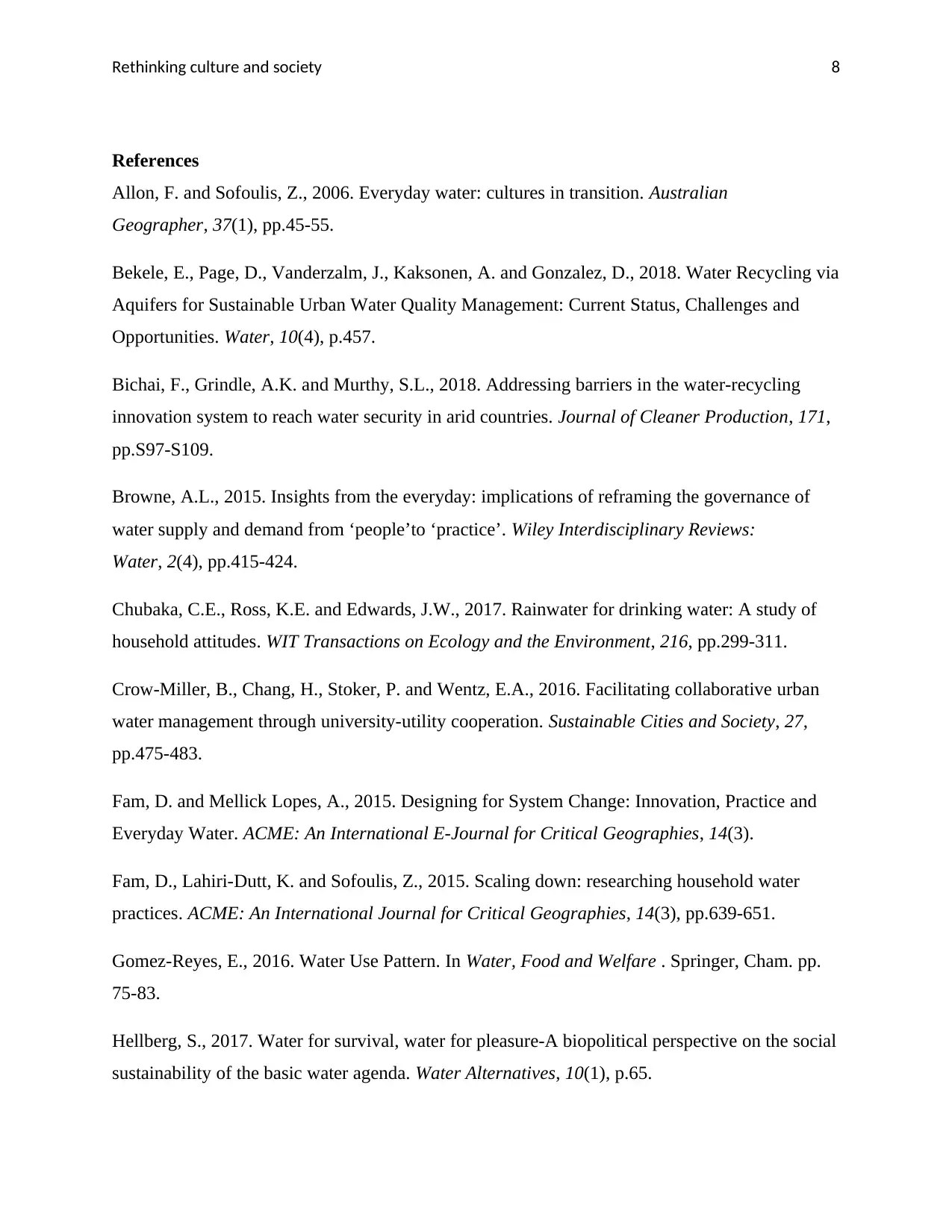
References
Allon, F. and Sofoulis, Z., 2006. Everyday water: cultures in transition. Australian
Geographer, 37(1), pp.45-55.
Bekele, E., Page, D., Vanderzalm, J., Kaksonen, A. and Gonzalez, D., 2018. Water Recycling via
Aquifers for Sustainable Urban Water Quality Management: Current Status, Challenges and
Opportunities. Water, 10(4), p.457.
Bichai, F., Grindle, A.K. and Murthy, S.L., 2018. Addressing barriers in the water-recycling
innovation system to reach water security in arid countries. Journal of Cleaner Production, 171,
pp.S97-S109.
Browne, A.L., 2015. Insights from the everyday: implications of reframing the governance of
water supply and demand from ‘people’to ‘practice’. Wiley Interdisciplinary Reviews:
Water, 2(4), pp.415-424.
Chubaka, C.E., Ross, K.E. and Edwards, J.W., 2017. Rainwater for drinking water: A study of
household attitudes. WIT Transactions on Ecology and the Environment, 216, pp.299-311.
Crow-Miller, B., Chang, H., Stoker, P. and Wentz, E.A., 2016. Facilitating collaborative urban
water management through university-utility cooperation. Sustainable Cities and Society, 27,
pp.475-483.
Fam, D. and Mellick Lopes, A., 2015. Designing for System Change: Innovation, Practice and
Everyday Water. ACME: An International E-Journal for Critical Geographies, 14(3).
Fam, D., Lahiri-Dutt, K. and Sofoulis, Z., 2015. Scaling down: researching household water
practices. ACME: An International Journal for Critical Geographies, 14(3), pp.639-651.
Gomez-Reyes, E., 2016. Water Use Pattern. In Water, Food and Welfare . Springer, Cham. pp.
75-83.
Hellberg, S., 2017. Water for survival, water for pleasure-A biopolitical perspective on the social
sustainability of the basic water agenda. Water Alternatives, 10(1), p.65.
References
Allon, F. and Sofoulis, Z., 2006. Everyday water: cultures in transition. Australian
Geographer, 37(1), pp.45-55.
Bekele, E., Page, D., Vanderzalm, J., Kaksonen, A. and Gonzalez, D., 2018. Water Recycling via
Aquifers for Sustainable Urban Water Quality Management: Current Status, Challenges and
Opportunities. Water, 10(4), p.457.
Bichai, F., Grindle, A.K. and Murthy, S.L., 2018. Addressing barriers in the water-recycling
innovation system to reach water security in arid countries. Journal of Cleaner Production, 171,
pp.S97-S109.
Browne, A.L., 2015. Insights from the everyday: implications of reframing the governance of
water supply and demand from ‘people’to ‘practice’. Wiley Interdisciplinary Reviews:
Water, 2(4), pp.415-424.
Chubaka, C.E., Ross, K.E. and Edwards, J.W., 2017. Rainwater for drinking water: A study of
household attitudes. WIT Transactions on Ecology and the Environment, 216, pp.299-311.
Crow-Miller, B., Chang, H., Stoker, P. and Wentz, E.A., 2016. Facilitating collaborative urban
water management through university-utility cooperation. Sustainable Cities and Society, 27,
pp.475-483.
Fam, D. and Mellick Lopes, A., 2015. Designing for System Change: Innovation, Practice and
Everyday Water. ACME: An International E-Journal for Critical Geographies, 14(3).
Fam, D., Lahiri-Dutt, K. and Sofoulis, Z., 2015. Scaling down: researching household water
practices. ACME: An International Journal for Critical Geographies, 14(3), pp.639-651.
Gomez-Reyes, E., 2016. Water Use Pattern. In Water, Food and Welfare . Springer, Cham. pp.
75-83.
Hellberg, S., 2017. Water for survival, water for pleasure-A biopolitical perspective on the social
sustainability of the basic water agenda. Water Alternatives, 10(1), p.65.
⊘ This is a preview!⊘
Do you want full access?
Subscribe today to unlock all pages.
Trusted by 1+ million students worldwide
Rethinking culture and society 9
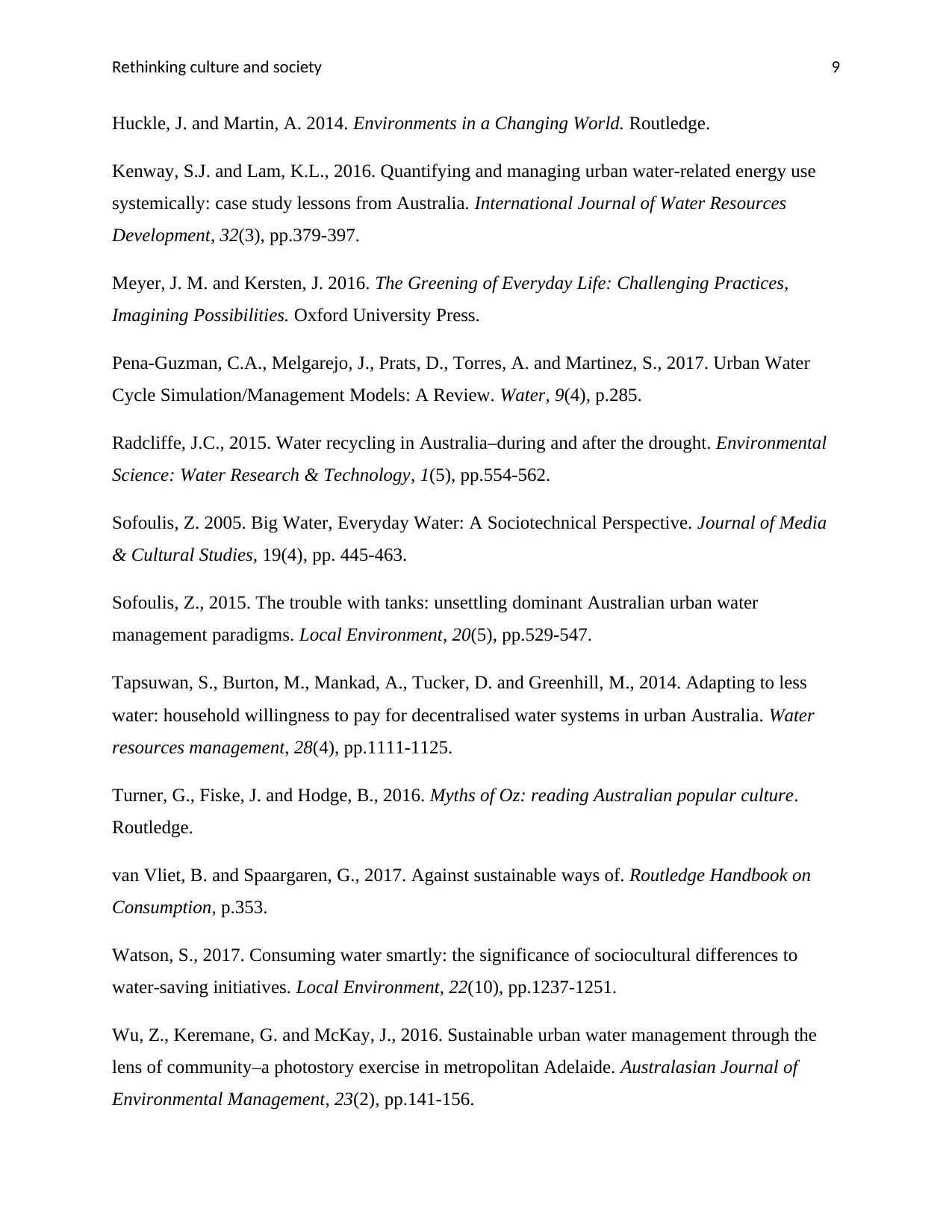
Huckle, J. and Martin, A. 2014. Environments in a Changing World. Routledge.
Kenway, S.J. and Lam, K.L., 2016. Quantifying and managing urban water-related energy use
systemically: case study lessons from Australia. International Journal of Water Resources
Development, 32(3), pp.379-397.
Meyer, J. M. and Kersten, J. 2016. The Greening of Everyday Life: Challenging Practices,
Imagining Possibilities. Oxford University Press.
Pena-Guzman, C.A., Melgarejo, J., Prats, D., Torres, A. and Martinez, S., 2017. Urban Water
Cycle Simulation/Management Models: A Review. Water, 9(4), p.285.
Radcliffe, J.C., 2015. Water recycling in Australia–during and after the drought. Environmental
Science: Water Research & Technology, 1(5), pp.554-562.
Sofoulis, Z. 2005. Big Water, Everyday Water: A Sociotechnical Perspective. Journal of Media
& Cultural Studies, 19(4), pp. 445-463.
Sofoulis, Z., 2015. The trouble with tanks: unsettling dominant Australian urban water
management paradigms. Local Environment, 20(5), pp.529-547.
Tapsuwan, S., Burton, M., Mankad, A., Tucker, D. and Greenhill, M., 2014. Adapting to less
water: household willingness to pay for decentralised water systems in urban Australia. Water
resources management, 28(4), pp.1111-1125.
Turner, G., Fiske, J. and Hodge, B., 2016. Myths of Oz: reading Australian popular culture.
Routledge.
van Vliet, B. and Spaargaren, G., 2017. Against sustainable ways of. Routledge Handbook on
Consumption, p.353.
Watson, S., 2017. Consuming water smartly: the significance of sociocultural differences to
water-saving initiatives. Local Environment, 22(10), pp.1237-1251.
Wu, Z., Keremane, G. and McKay, J., 2016. Sustainable urban water management through the
lens of community–a photostory exercise in metropolitan Adelaide. Australasian Journal of
Environmental Management, 23(2), pp.141-156.
Huckle, J. and Martin, A. 2014. Environments in a Changing World. Routledge.
Kenway, S.J. and Lam, K.L., 2016. Quantifying and managing urban water-related energy use
systemically: case study lessons from Australia. International Journal of Water Resources
Development, 32(3), pp.379-397.
Meyer, J. M. and Kersten, J. 2016. The Greening of Everyday Life: Challenging Practices,
Imagining Possibilities. Oxford University Press.
Pena-Guzman, C.A., Melgarejo, J., Prats, D., Torres, A. and Martinez, S., 2017. Urban Water
Cycle Simulation/Management Models: A Review. Water, 9(4), p.285.
Radcliffe, J.C., 2015. Water recycling in Australia–during and after the drought. Environmental
Science: Water Research & Technology, 1(5), pp.554-562.
Sofoulis, Z. 2005. Big Water, Everyday Water: A Sociotechnical Perspective. Journal of Media
& Cultural Studies, 19(4), pp. 445-463.
Sofoulis, Z., 2015. The trouble with tanks: unsettling dominant Australian urban water
management paradigms. Local Environment, 20(5), pp.529-547.
Tapsuwan, S., Burton, M., Mankad, A., Tucker, D. and Greenhill, M., 2014. Adapting to less
water: household willingness to pay for decentralised water systems in urban Australia. Water
resources management, 28(4), pp.1111-1125.
Turner, G., Fiske, J. and Hodge, B., 2016. Myths of Oz: reading Australian popular culture.
Routledge.
van Vliet, B. and Spaargaren, G., 2017. Against sustainable ways of. Routledge Handbook on
Consumption, p.353.
Watson, S., 2017. Consuming water smartly: the significance of sociocultural differences to
water-saving initiatives. Local Environment, 22(10), pp.1237-1251.
Wu, Z., Keremane, G. and McKay, J., 2016. Sustainable urban water management through the
lens of community–a photostory exercise in metropolitan Adelaide. Australasian Journal of
Environmental Management, 23(2), pp.141-156.

1 out of 10


Related Documents


Your All-in-One AI-Powered Toolkit for Academic Success.
+13062052269
info@desklib.com
Available 24*7 on WhatsApp / Email
![[object Object]](/_next/static/media/star-bottom.7253800d.svg)
Unlock your academic potential
Copyright © 2020–2026 A2Z Services. All Rights Reserved. Developed and managed by ZUCOL.