A Comprehensive Analysis of Web Content Watermarking Techniques
VerifiedAdded on 2024/05/29
|4
|1776
|218
Report
AI Summary
This research report delves into the topic of watermarking web content, addressing the growing need for security and copyright protection in the digital age. It discusses how easily web content can be copied and reused, leading to the introduction of digital watermarking to ensure authenticity, integrity, and confidentiality. The report highlights the importance of information security in reducing copyright risks and protecting against forgery, plagiarism, and tampering. It covers various challenges in data hiding, such as robustness, capacity, and perceptibility, and explores techniques like steganography, cryptography, and digital watermarking. The proposed methodology involves screening web content, extracting rules, generating watermarks, encrypting them using AES, and embedding them into webpages. Experiments are conducted to evaluate the effectiveness of the watermarking process, and the report concludes by emphasizing the significance of digital watermarking in reducing the redistribution and replication of web content.

Introduction
The topic for the research is “Watermarking of Web Content” (Mir, 2013). Security and the
information are two important disciplined concepts and by growing in the technology of internet,
the biggest challenge which is faced is to manage the security aspects over the internet. As the
content on the data can be copied and reused easily and it rise in the digital copyrights (Huang,
2004). So the concept of Digital Watermarking is introduced which can helping achieving the
CIA core properties of security that are authenticity, integrity, and confidentiality (Lee, 2008).
Information Security is the first important concept as with the growth in the technology and trend
in the world data is mostly publishing electronically on the internet (Wolfgang, 1999). It helps in
reducing the copyright risk and strengthened the information more against the forgery,
redistribution, plagiarism, tampering, and the illicit copying (Atallah, 2002). As per the surveys,
every small and big organization in the world is using this web content on the daily basis. For the
data hiding purpose there are various issues like robustness which means survival of data,
capacity, and perceptibility which means unacceptable visual data (Voloshynovskiy, 2000).
Information Hiding is very needed to concept to which limits the amount of the redistribution
and replication of the uneven number of copies (Brassil, 1999). The one of the most important
and diverse reason of this is the cyberspace inhabitants and culture (Biryukov, 2009). Being
availability of the data for free rather than exchanging the data people only take the relevant
information. This leads to the predicaments range related to the security of the copies intellectual
copyright which is the prior issue and is to be solved and addressed prominently (Hartung,
1999).
Relating to this there are also various security threats (Mulwad, 2011). As the watermarking is
the application which is required and used to protect authentication, authorization, ownership and
conversion of various files. There are two attacks which can occur in the system, passive and
active attacks. In passive, the information is breached and monitoring is done by the attacker and
no participation is involved in the system (Craver, 1998). But in the active attacks, the attacker
actively participate in the system and can change the data as per his need and they are detected in
system by the client (Robert, 2009).
The disciplines techniques for information security used some standard methods like
steganography, cryptography, and digital watermarking (Topkara, 2005). Cryptography is the
technique of encrypting and decrypting of data to make it secure by using some coding or
algorithm. Steganography is a secret coding technique which covered the original data into some
other format and it is undetectable (Merel, 2007).
The methodology behind this research is to prevent the web content from getting replicated and
distributed again on the network of internet. In the methodology which has been proposed is
implemented and successfully experimented. The textual content of the various different
webpages are taken from all different resources and taking their use as a system dynamic pages
or the static pages. In this methodology the words of high range of frequency is taken to test and
The topic for the research is “Watermarking of Web Content” (Mir, 2013). Security and the
information are two important disciplined concepts and by growing in the technology of internet,
the biggest challenge which is faced is to manage the security aspects over the internet. As the
content on the data can be copied and reused easily and it rise in the digital copyrights (Huang,
2004). So the concept of Digital Watermarking is introduced which can helping achieving the
CIA core properties of security that are authenticity, integrity, and confidentiality (Lee, 2008).
Information Security is the first important concept as with the growth in the technology and trend
in the world data is mostly publishing electronically on the internet (Wolfgang, 1999). It helps in
reducing the copyright risk and strengthened the information more against the forgery,
redistribution, plagiarism, tampering, and the illicit copying (Atallah, 2002). As per the surveys,
every small and big organization in the world is using this web content on the daily basis. For the
data hiding purpose there are various issues like robustness which means survival of data,
capacity, and perceptibility which means unacceptable visual data (Voloshynovskiy, 2000).
Information Hiding is very needed to concept to which limits the amount of the redistribution
and replication of the uneven number of copies (Brassil, 1999). The one of the most important
and diverse reason of this is the cyberspace inhabitants and culture (Biryukov, 2009). Being
availability of the data for free rather than exchanging the data people only take the relevant
information. This leads to the predicaments range related to the security of the copies intellectual
copyright which is the prior issue and is to be solved and addressed prominently (Hartung,
1999).
Relating to this there are also various security threats (Mulwad, 2011). As the watermarking is
the application which is required and used to protect authentication, authorization, ownership and
conversion of various files. There are two attacks which can occur in the system, passive and
active attacks. In passive, the information is breached and monitoring is done by the attacker and
no participation is involved in the system (Craver, 1998). But in the active attacks, the attacker
actively participate in the system and can change the data as per his need and they are detected in
system by the client (Robert, 2009).
The disciplines techniques for information security used some standard methods like
steganography, cryptography, and digital watermarking (Topkara, 2005). Cryptography is the
technique of encrypting and decrypting of data to make it secure by using some coding or
algorithm. Steganography is a secret coding technique which covered the original data into some
other format and it is undetectable (Merel, 2007).
The methodology behind this research is to prevent the web content from getting replicated and
distributed again on the network of internet. In the methodology which has been proposed is
implemented and successfully experimented. The textual content of the various different
webpages are taken from all different resources and taking their use as a system dynamic pages
or the static pages. In this methodology the words of high range of frequency is taken to test and
Paraphrase This Document
Need a fresh take? Get an instant paraphrase of this document with our AI Paraphraser

to generate the watermarks. The AES (Advanced Encryption Standard) technique is used to
encrypt the watermarks before getting embedded on the page.
In the details of the system, firstly the screening of the web content is done. After that rules are
extracted which are based on some features. After applying the rules watermarks are generated
and then the encryption of those watermarks are done. After the encryption of the watermarks
they are embedded into the webpages. Once uploaded on the network of the internet, the content
will be registered by the CA and the communication is made secured.
At last experiments are performed and the results of those experiments are noted. The
experiments are done on various websites, and their watermarks are noted and their digital
encrypted watermarks.
The research topic is of watermarking of web content in which there is the encryption of the web
data is done. The data hiding and security about the data is being discussed and the techniques of
doing that is given. Also, what are the security threats associated with the system are all
discussed in the above paragraphs. The thesis statement in the above research is system details.
In the statement the complete process description is given that how the analysis of web content is
done to the end of the registration process and to provide full security and the watermarking
process done on that. The importance of this research is that it allow various organization of web
content to reduce the redistribution and replication of copies by the process of digital
watermarking. The aspects of problem which are there in other researchers were of CIA security
protocols. Also, the ownership protocol is also defined. In the further research on the topic the
outline gap is that, there is more advanced knowledge can be gained about the watermark
technique and more methodology are to be discussed in details for making the web content more
confidential and secured. The main statement which provide the aim of this research is
“watermarking of the web content”. The research outcome is discussed in the above paragraph
where discussion is made about the experiments performed.
The reason behind choosing this first sentence to be the topic because by increasing growth of
web content on the digital network, the best fast growing technique is of the watermark process.
The logical flows in this research has some basic idea and a systematic manner. Firstly, small
introduction is given about the topic. Then after that, hiding and security of information is
discussed. In addition to this, various security threats, discipline techniques and the methodology
is discussed. At last, details of system flow and the outcomes is given. The references is taken
from various generals, articles and related research paper is taken from different websites and
google scholar. In the complete paper each paragraph is justified for single topic and the
explanation of each of them is given. The references are cited here for gaining more and more
information about the research topic and can help in the deep learning.
encrypt the watermarks before getting embedded on the page.
In the details of the system, firstly the screening of the web content is done. After that rules are
extracted which are based on some features. After applying the rules watermarks are generated
and then the encryption of those watermarks are done. After the encryption of the watermarks
they are embedded into the webpages. Once uploaded on the network of the internet, the content
will be registered by the CA and the communication is made secured.
At last experiments are performed and the results of those experiments are noted. The
experiments are done on various websites, and their watermarks are noted and their digital
encrypted watermarks.
The research topic is of watermarking of web content in which there is the encryption of the web
data is done. The data hiding and security about the data is being discussed and the techniques of
doing that is given. Also, what are the security threats associated with the system are all
discussed in the above paragraphs. The thesis statement in the above research is system details.
In the statement the complete process description is given that how the analysis of web content is
done to the end of the registration process and to provide full security and the watermarking
process done on that. The importance of this research is that it allow various organization of web
content to reduce the redistribution and replication of copies by the process of digital
watermarking. The aspects of problem which are there in other researchers were of CIA security
protocols. Also, the ownership protocol is also defined. In the further research on the topic the
outline gap is that, there is more advanced knowledge can be gained about the watermark
technique and more methodology are to be discussed in details for making the web content more
confidential and secured. The main statement which provide the aim of this research is
“watermarking of the web content”. The research outcome is discussed in the above paragraph
where discussion is made about the experiments performed.
The reason behind choosing this first sentence to be the topic because by increasing growth of
web content on the digital network, the best fast growing technique is of the watermark process.
The logical flows in this research has some basic idea and a systematic manner. Firstly, small
introduction is given about the topic. Then after that, hiding and security of information is
discussed. In addition to this, various security threats, discipline techniques and the methodology
is discussed. At last, details of system flow and the outcomes is given. The references is taken
from various generals, articles and related research paper is taken from different websites and
google scholar. In the complete paper each paragraph is justified for single topic and the
explanation of each of them is given. The references are cited here for gaining more and more
information about the research topic and can help in the deep learning.

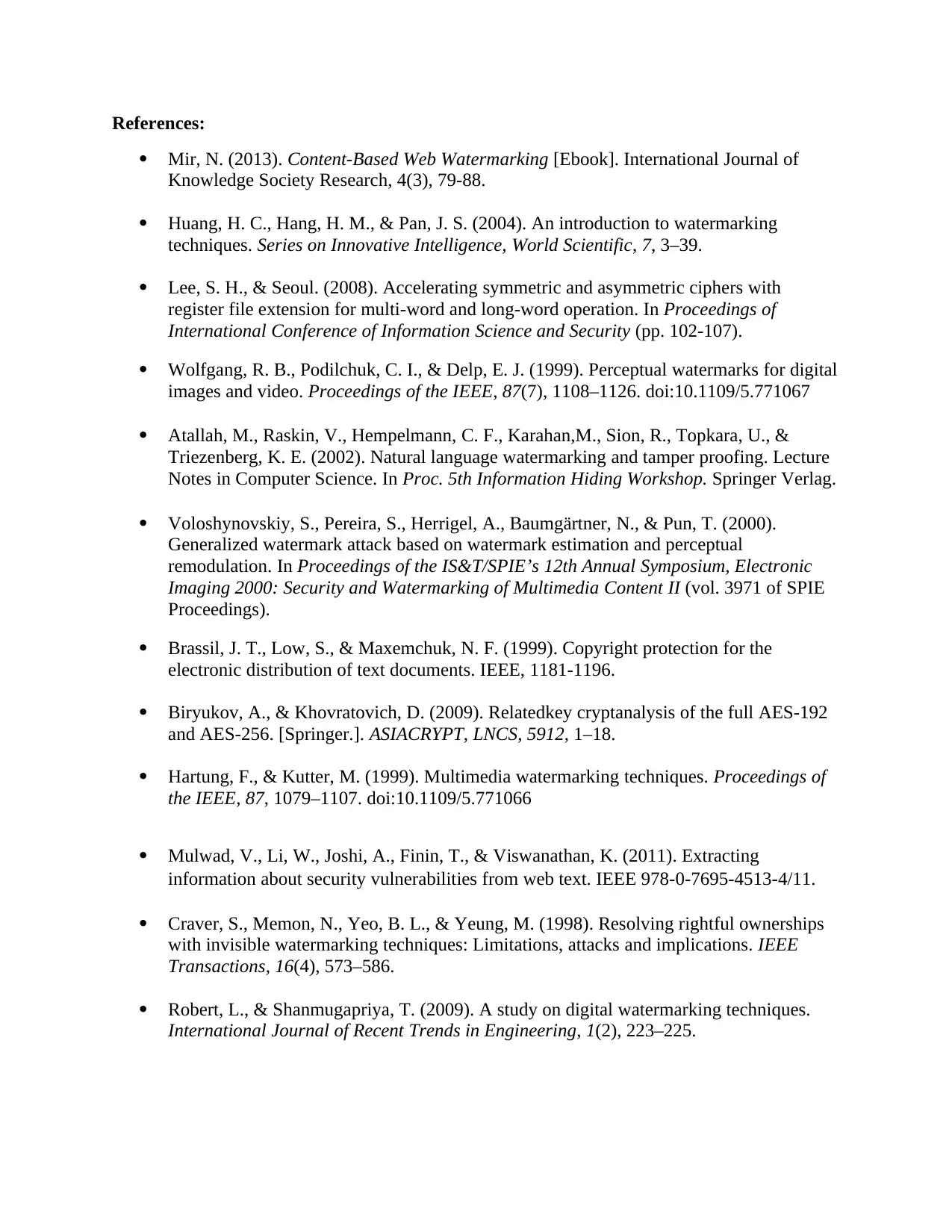
References:
Mir, N. (2013). Content-Based Web Watermarking [Ebook]. International Journal of
Knowledge Society Research, 4(3), 79-88.
Huang, H. C., Hang, H. M., & Pan, J. S. (2004). An introduction to watermarking
techniques. Series on Innovative Intelligence, World Scientific, 7, 3–39.
Lee, S. H., & Seoul. (2008). Accelerating symmetric and asymmetric ciphers with
register file extension for multi-word and long-word operation. In Proceedings of
International Conference of Information Science and Security (pp. 102-107).
Wolfgang, R. B., Podilchuk, C. I., & Delp, E. J. (1999). Perceptual watermarks for digital
images and video. Proceedings of the IEEE, 87(7), 1108–1126. doi:10.1109/5.771067
Atallah, M., Raskin, V., Hempelmann, C. F., Karahan,M., Sion, R., Topkara, U., &
Triezenberg, K. E. (2002). Natural language watermarking and tamper proofing. Lecture
Notes in Computer Science. In Proc. 5th Information Hiding Workshop. Springer Verlag.
Voloshynovskiy, S., Pereira, S., Herrigel, A., Baumgärtner, N., & Pun, T. (2000).
Generalized watermark attack based on watermark estimation and perceptual
remodulation. In Proceedings of the IS&T/SPIE’s 12th Annual Symposium, Electronic
Imaging 2000: Security and Watermarking of Multimedia Content II (vol. 3971 of SPIE
Proceedings).
Brassil, J. T., Low, S., & Maxemchuk, N. F. (1999). Copyright protection for the
electronic distribution of text documents. IEEE, 1181-1196.
Biryukov, A., & Khovratovich, D. (2009). Relatedkey cryptanalysis of the full AES-192
and AES-256. [Springer.]. ASIACRYPT, LNCS, 5912, 1–18.
Hartung, F., & Kutter, M. (1999). Multimedia watermarking techniques. Proceedings of
the IEEE, 87, 1079–1107. doi:10.1109/5.771066
Mulwad, V., Li, W., Joshi, A., Finin, T., & Viswanathan, K. (2011). Extracting
information about security vulnerabilities from web text. IEEE 978-0-7695-4513-4/11.
Craver, S., Memon, N., Yeo, B. L., & Yeung, M. (1998). Resolving rightful ownerships
with invisible watermarking techniques: Limitations, attacks and implications. IEEE
Transactions, 16(4), 573–586.
Robert, L., & Shanmugapriya, T. (2009). A study on digital watermarking techniques.
International Journal of Recent Trends in Engineering, 1(2), 223–225.
Mir, N. (2013). Content-Based Web Watermarking [Ebook]. International Journal of
Knowledge Society Research, 4(3), 79-88.
Huang, H. C., Hang, H. M., & Pan, J. S. (2004). An introduction to watermarking
techniques. Series on Innovative Intelligence, World Scientific, 7, 3–39.
Lee, S. H., & Seoul. (2008). Accelerating symmetric and asymmetric ciphers with
register file extension for multi-word and long-word operation. In Proceedings of
International Conference of Information Science and Security (pp. 102-107).
Wolfgang, R. B., Podilchuk, C. I., & Delp, E. J. (1999). Perceptual watermarks for digital
images and video. Proceedings of the IEEE, 87(7), 1108–1126. doi:10.1109/5.771067
Atallah, M., Raskin, V., Hempelmann, C. F., Karahan,M., Sion, R., Topkara, U., &
Triezenberg, K. E. (2002). Natural language watermarking and tamper proofing. Lecture
Notes in Computer Science. In Proc. 5th Information Hiding Workshop. Springer Verlag.
Voloshynovskiy, S., Pereira, S., Herrigel, A., Baumgärtner, N., & Pun, T. (2000).
Generalized watermark attack based on watermark estimation and perceptual
remodulation. In Proceedings of the IS&T/SPIE’s 12th Annual Symposium, Electronic
Imaging 2000: Security and Watermarking of Multimedia Content II (vol. 3971 of SPIE
Proceedings).
Brassil, J. T., Low, S., & Maxemchuk, N. F. (1999). Copyright protection for the
electronic distribution of text documents. IEEE, 1181-1196.
Biryukov, A., & Khovratovich, D. (2009). Relatedkey cryptanalysis of the full AES-192
and AES-256. [Springer.]. ASIACRYPT, LNCS, 5912, 1–18.
Hartung, F., & Kutter, M. (1999). Multimedia watermarking techniques. Proceedings of
the IEEE, 87, 1079–1107. doi:10.1109/5.771066
Mulwad, V., Li, W., Joshi, A., Finin, T., & Viswanathan, K. (2011). Extracting
information about security vulnerabilities from web text. IEEE 978-0-7695-4513-4/11.
Craver, S., Memon, N., Yeo, B. L., & Yeung, M. (1998). Resolving rightful ownerships
with invisible watermarking techniques: Limitations, attacks and implications. IEEE
Transactions, 16(4), 573–586.
Robert, L., & Shanmugapriya, T. (2009). A study on digital watermarking techniques.
International Journal of Recent Trends in Engineering, 1(2), 223–225.
⊘ This is a preview!⊘
Do you want full access?
Subscribe today to unlock all pages.

Trusted by 1+ million students worldwide

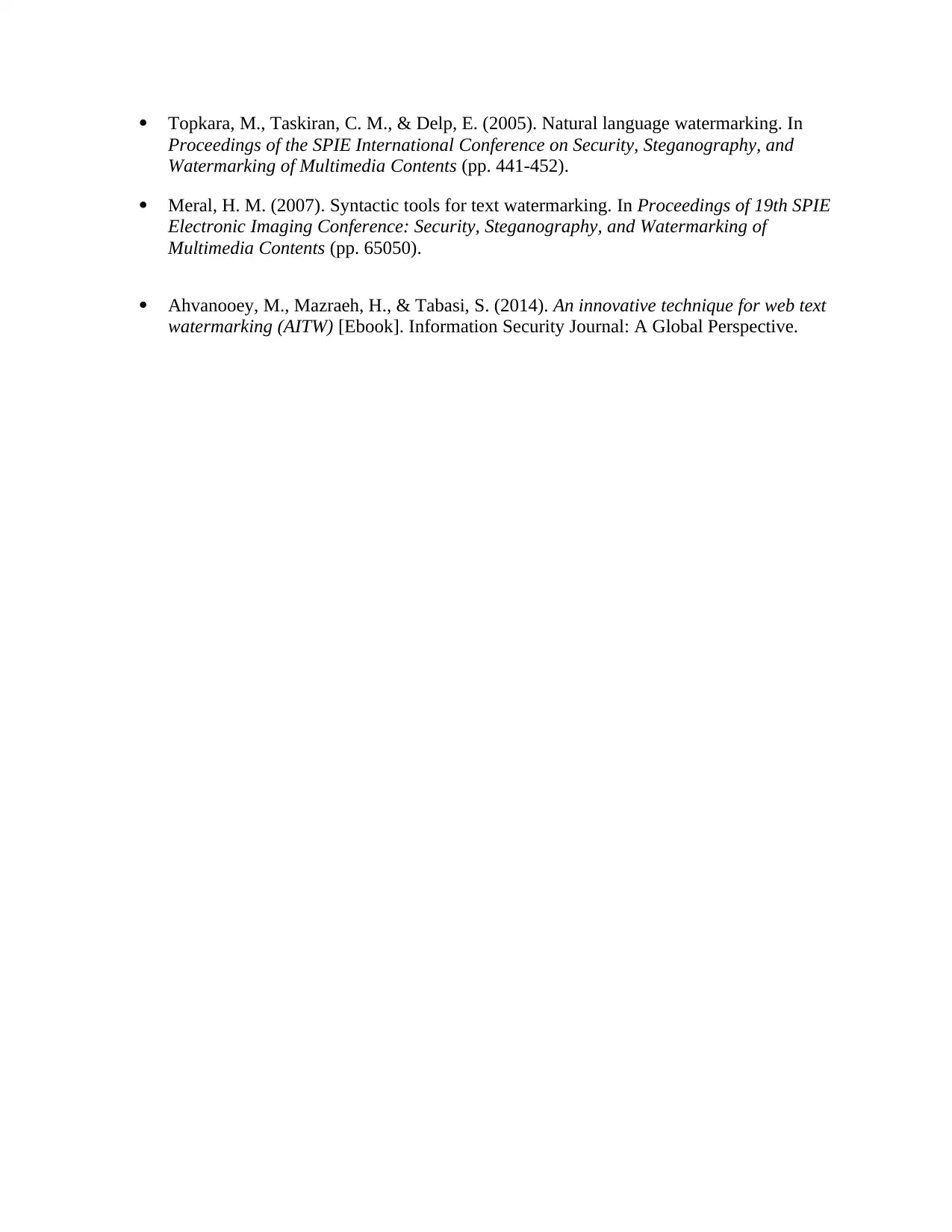
Topkara, M., Taskiran, C. M., & Delp, E. (2005). Natural language watermarking. In
Proceedings of the SPIE International Conference on Security, Steganography, and
Watermarking of Multimedia Contents (pp. 441-452).
Meral, H. M. (2007). Syntactic tools for text watermarking. In Proceedings of 19th SPIE
Electronic Imaging Conference: Security, Steganography, and Watermarking of
Multimedia Contents (pp. 65050).
Ahvanooey, M., Mazraeh, H., & Tabasi, S. (2014). An innovative technique for web text
watermarking (AITW) [Ebook]. Information Security Journal: A Global Perspective.
Proceedings of the SPIE International Conference on Security, Steganography, and
Watermarking of Multimedia Contents (pp. 441-452).
Meral, H. M. (2007). Syntactic tools for text watermarking. In Proceedings of 19th SPIE
Electronic Imaging Conference: Security, Steganography, and Watermarking of
Multimedia Contents (pp. 65050).
Ahvanooey, M., Mazraeh, H., & Tabasi, S. (2014). An innovative technique for web text
watermarking (AITW) [Ebook]. Information Security Journal: A Global Perspective.
1 out of 4
Related Documents
Your All-in-One AI-Powered Toolkit for Academic Success.
+13062052269
info@desklib.com
Available 24*7 on WhatsApp / Email
Unlock your academic potential
Copyright © 2020–2026 A2Z Services. All Rights Reserved. Developed and managed by ZUCOL.