Wave Propagation Analysis: Computational Framework Comparison
VerifiedAdded on 2020/04/29
|9
|2093
|244
Report
AI Summary
This report delves into the significance of numerical analysis within geotechnical engineering, emphasizing the study of soil and rock mechanics to assess subsurface conditions and material properties. The report focuses on wave propagation analysis, specifically examining the application of coupled finite–infinite element methods in analyzing two-phase saturated porous media. It details the computational framework, including its strengths and limitations, and compares various numerical methods used in geotechnical engineering. The study includes a comparative analysis of the model with existing literature, highlighting the advantages and disadvantages of different approaches, such as the finite element method and infinite element formulation. The report also covers governing equations, infinite element formulation, and verification methods, providing a comprehensive overview of wave propagation analysis techniques and their effectiveness in simulating soil behavior and material decay functions. The report concludes with a discussion of the most efficient methods for civil engineers, emphasizing the importance of testing and proof-testing different approaches to achieve accurate results.
Running Head: Different methods to calculate Wave propagation Analysis
Different methods to calculate Wave propagation Analysis
Author
Instructor
Institution affiliation
Different methods to calculate Wave propagation Analysis
Author
Instructor
Institution affiliation

Paraphrase This Document
Need a fresh take? Get an instant paraphrase of this document with our AI Paraphraser
Different methods to calculate Wave propagation Analysis
Executive Summary
This report shows the importance of Numerical analysis in Geotechnical Engineering. Geotechnical
engineering is the process whereby rock mechanics and soil mechanics use to investigate subsurface
conditions and materials so that they can come up with appropriate physical, chemical or mechanical
composition of these materials. The mechanics also use it Geotechnical Engineering to check the stability
of slopes made naturally and those made by man.
The report will also describe the computational framework/numerical model proposed and its main
strength and limitations, the report will compare different numerical methods developed to study the same
Geotechnical Engineering. At the end, there will be a comparison of the model done with other works in
literature.
Executive Summary
This report shows the importance of Numerical analysis in Geotechnical Engineering. Geotechnical
engineering is the process whereby rock mechanics and soil mechanics use to investigate subsurface
conditions and materials so that they can come up with appropriate physical, chemical or mechanical
composition of these materials. The mechanics also use it Geotechnical Engineering to check the stability
of slopes made naturally and those made by man.
The report will also describe the computational framework/numerical model proposed and its main
strength and limitations, the report will compare different numerical methods developed to study the same
Geotechnical Engineering. At the end, there will be a comparison of the model done with other works in
literature.
Different methods to calculate Wave propagation Analysis
Table of Contents
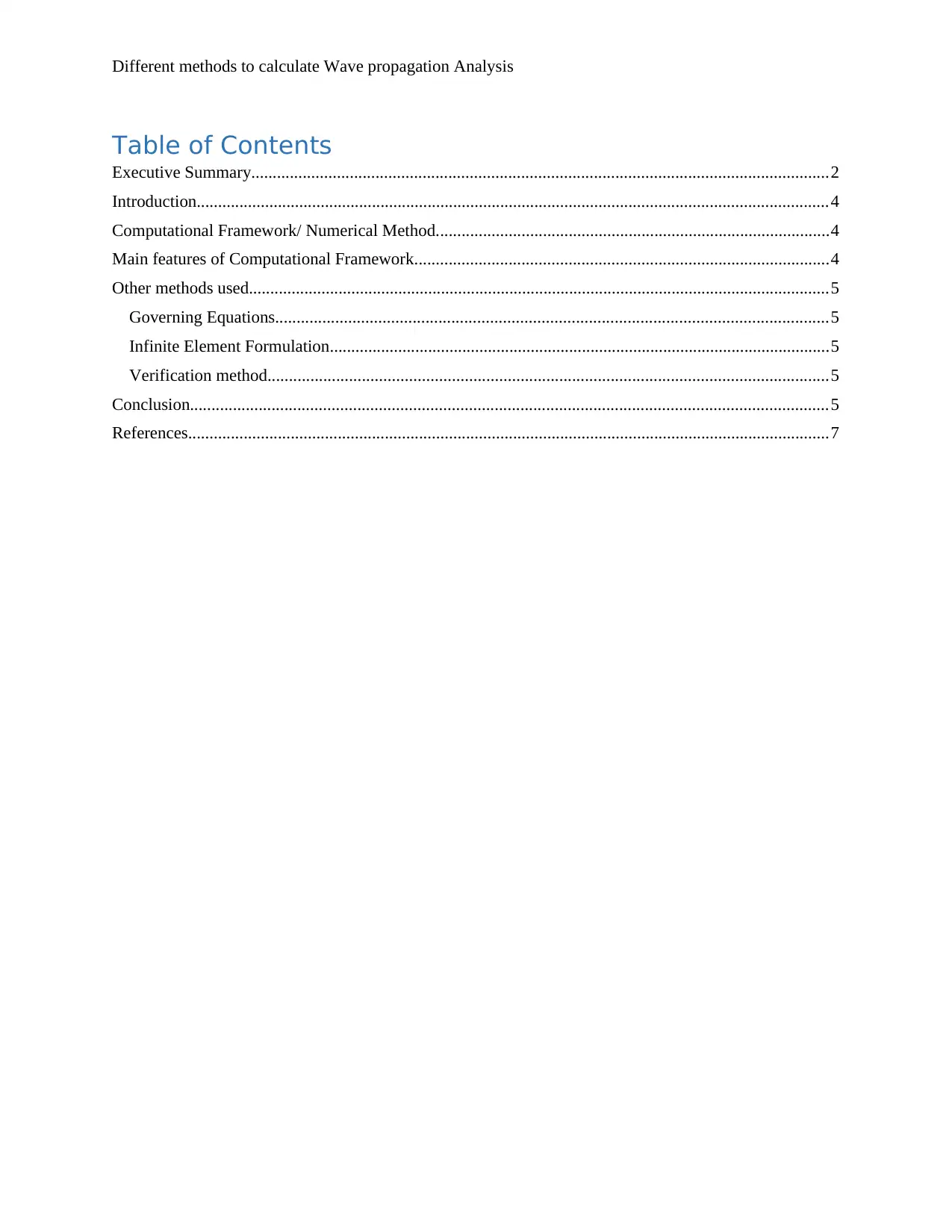
Executive Summary.......................................................................................................................................2
Introduction....................................................................................................................................................4
Computational Framework/ Numerical Method............................................................................................4
Main features of Computational Framework.................................................................................................4
Other methods used........................................................................................................................................5
Governing Equations.................................................................................................................................5
Infinite Element Formulation.....................................................................................................................5
Verification method...................................................................................................................................5
Conclusion.....................................................................................................................................................5
References......................................................................................................................................................7
Table of Contents
Executive Summary.......................................................................................................................................2
Introduction....................................................................................................................................................4
Computational Framework/ Numerical Method............................................................................................4
Main features of Computational Framework.................................................................................................4
Other methods used........................................................................................................................................5
Governing Equations.................................................................................................................................5
Infinite Element Formulation.....................................................................................................................5
Verification method...................................................................................................................................5
Conclusion.....................................................................................................................................................5
References......................................................................................................................................................7
⊘ This is a preview!⊘
Do you want full access?
Subscribe today to unlock all pages.

Trusted by 1+ million students worldwide
Different methods to calculate Wave propagation Analysis
Introduction
According to (Braja, 2016)there is a need for Civil Engineers to properly understand different theories
and analysis that are used to evaluate soils and foundation designs. The extensive Geotechnical
Engineering is a wide study that helps mechanics in their day to day study of soil and rocks, learning their
features and soil composition. In this report, we are looking at a study of wave propagation analysis of
two-phase saturated porous media using coupled finite–infinite element method. An extensive study of
soil and its behaviors, the decay function of sub-surface materials is shown based on the analytical
solution. A properly managed study of the phenomenon of wave propagation in water bearing media must
have effective and results. There are many methods used to deal with unbounded domains. However both
methods are good and give estimated results. The finite and infinite domain. Computationally,
Differential Equations governs wave propagation, saturated slightly in porous media.
Computational Framework/ Numerical Method.
Computational framework is the basis of observing chemical processes reactions. In the research method
of wave propagation analysis of two phase saturated porous media using finite-infinite element method,
computational framework/numerical model is the finite method proposed for analyzing the remote
domains. This method is usually used in engineering and mathematical physics to come up with solutions
of numeric. The finite method is used to truncate boundaries that are at a large distance remotely from one
zone then fixed or free boundary conditions are imposed. This approach have its own limitations
whereby, if the waves reflect back near the field, wrong results may be incurred. This approach has its
own limitations in case the systems used are taken legal action. The finite method may lead to high costs
resolving from computational, large storage needed and time frame penalties. These are the major
limitations of the numerical method.
Main features of Computational Framework.
One of the features of the truncating approach is imposing a special boundary condition whereby the
infinite domain is truncated at an arbitrary location, for example absorption of energy. This method
however is not satisfactory because they are mostly artificial.
Another feature of the Framework is using a finite element that are coupled together and boundary
element method. This is whereby there is a division of the whole system to the closest field, that in
cooperates symmetrical boundaries and non- homogeneous and those fields that extent to limitlessness.
The third feature in the finite method, is using the cloning method that was proposed by known Dasguta.
Which was later made better by wolf and Song. The advantage of this method is that it is the only finite
approach that is standalone. However its main weakness is whereby, some conditions of similarity of
geometry and property of material can be satisfied.
Another great feature for computational framework is the use of finite element and the infinite approach.
This is used to measure the infinity in different ways whereby the finite elements measure near area and
in-finite one used to measure areas that are far.
Introduction
According to (Braja, 2016)there is a need for Civil Engineers to properly understand different theories
and analysis that are used to evaluate soils and foundation designs. The extensive Geotechnical
Engineering is a wide study that helps mechanics in their day to day study of soil and rocks, learning their
features and soil composition. In this report, we are looking at a study of wave propagation analysis of
two-phase saturated porous media using coupled finite–infinite element method. An extensive study of
soil and its behaviors, the decay function of sub-surface materials is shown based on the analytical
solution. A properly managed study of the phenomenon of wave propagation in water bearing media must
have effective and results. There are many methods used to deal with unbounded domains. However both
methods are good and give estimated results. The finite and infinite domain. Computationally,
Differential Equations governs wave propagation, saturated slightly in porous media.
Computational Framework/ Numerical Method.
Computational framework is the basis of observing chemical processes reactions. In the research method
of wave propagation analysis of two phase saturated porous media using finite-infinite element method,
computational framework/numerical model is the finite method proposed for analyzing the remote
domains. This method is usually used in engineering and mathematical physics to come up with solutions
of numeric. The finite method is used to truncate boundaries that are at a large distance remotely from one
zone then fixed or free boundary conditions are imposed. This approach have its own limitations
whereby, if the waves reflect back near the field, wrong results may be incurred. This approach has its
own limitations in case the systems used are taken legal action. The finite method may lead to high costs
resolving from computational, large storage needed and time frame penalties. These are the major
limitations of the numerical method.
Main features of Computational Framework.
One of the features of the truncating approach is imposing a special boundary condition whereby the
infinite domain is truncated at an arbitrary location, for example absorption of energy. This method
however is not satisfactory because they are mostly artificial.
Another feature of the Framework is using a finite element that are coupled together and boundary
element method. This is whereby there is a division of the whole system to the closest field, that in
cooperates symmetrical boundaries and non- homogeneous and those fields that extent to limitlessness.
The third feature in the finite method, is using the cloning method that was proposed by known Dasguta.
Which was later made better by wolf and Song. The advantage of this method is that it is the only finite
approach that is standalone. However its main weakness is whereby, some conditions of similarity of
geometry and property of material can be satisfied.
Another great feature for computational framework is the use of finite element and the infinite approach.
This is used to measure the infinity in different ways whereby the finite elements measure near area and
in-finite one used to measure areas that are far.
Paraphrase This Document
Need a fresh take? Get an instant paraphrase of this document with our AI Paraphraser
Different methods to calculate Wave propagation Analysis
Other methods used
Governing Equations
Governing equations is whereby, mass is conserved and energy too is conserved in fluid. In wave
propagation analysis, the porous media can be compressed with viscid fluids.
Infinite Element Formulation
This is where shape decays with distance and zero is reaches infinity. The shape functionality does not
matter a lot here. This methods consists of two main steps whereby, there is need of analytical
identification solution of the problem and derivation of the shape from it. This method in cooperates
several solutions.
I.D analytical approach is one of the solutions of the infinite element foundation whereby element
functions shapes are derived from it. Shape functions is another type of infinite element solution whereby
the shape functions are the key elements. Property functions is another approach whereby all directions
are shown.
Finite Element Formulation.
This is where, the research is done using Galerkin approach. The Finite Element Method (FEM) is a
numerical technique that is used to get estimated solutions of partial differential equations. FEM, was
originated from the need of solving complex elasticity and structural analysis problems in Civil
Engineering. It aids in giving strength and stiffness to structures that are being simulated. Moreover
assists in cost elimination and weight minimization to structures that are being built. This method
subdivides large tasks into smaller parts that are simple to tackle which are called finite elements.
(Joonsang, 2012)
Infinite Element Formulation
Infinite element Formulation (IFEM), is usually calculated using integer m, known as the infinite element
order. For one to get the smallest error possible between estimated and exact solution, then the order of
integer m, should be highest. These elements, the infinite elements are used in acoustic models to
represent the radiation of field on finite elements that are unbounded. They have many advantages over
some of the boundary treatment of such tasks. While carrying out this example, providing stability to
such structures some of the factors to be taken into consideration entails avoidance of very big,
dominant massing, large elongated or slab-like plates, being very innovative and creative with
appropriate choice of materials especially key in the, inaccurate methods of computation of
stresses and strains from the effects of shrinkage, this is to mean only shapeless materials are
used.rimming the infinite domain at an arbitrary location then imposing great boundary locations. This is
where shape decays with distance to zero as reaches it infinity. The shape functionality does not matter a
lot here. This methods consists of two main steps whereby, there is need of analytical identification
solution of the problem and derivation of the shape from it. This method in cooperates several solutions.
(Joonsang, 2012)
Other methods used
Governing Equations
Governing equations is whereby, mass is conserved and energy too is conserved in fluid. In wave
propagation analysis, the porous media can be compressed with viscid fluids.
Infinite Element Formulation
This is where shape decays with distance and zero is reaches infinity. The shape functionality does not
matter a lot here. This methods consists of two main steps whereby, there is need of analytical
identification solution of the problem and derivation of the shape from it. This method in cooperates
several solutions.
I.D analytical approach is one of the solutions of the infinite element foundation whereby element
functions shapes are derived from it. Shape functions is another type of infinite element solution whereby
the shape functions are the key elements. Property functions is another approach whereby all directions
are shown.
Finite Element Formulation.
This is where, the research is done using Galerkin approach. The Finite Element Method (FEM) is a
numerical technique that is used to get estimated solutions of partial differential equations. FEM, was
originated from the need of solving complex elasticity and structural analysis problems in Civil
Engineering. It aids in giving strength and stiffness to structures that are being simulated. Moreover
assists in cost elimination and weight minimization to structures that are being built. This method
subdivides large tasks into smaller parts that are simple to tackle which are called finite elements.
(Joonsang, 2012)
Infinite Element Formulation
Infinite element Formulation (IFEM), is usually calculated using integer m, known as the infinite element
order. For one to get the smallest error possible between estimated and exact solution, then the order of
integer m, should be highest. These elements, the infinite elements are used in acoustic models to
represent the radiation of field on finite elements that are unbounded. They have many advantages over
some of the boundary treatment of such tasks. While carrying out this example, providing stability to
such structures some of the factors to be taken into consideration entails avoidance of very big,
dominant massing, large elongated or slab-like plates, being very innovative and creative with
appropriate choice of materials especially key in the, inaccurate methods of computation of
stresses and strains from the effects of shrinkage, this is to mean only shapeless materials are
used.rimming the infinite domain at an arbitrary location then imposing great boundary locations. This is
where shape decays with distance to zero as reaches it infinity. The shape functionality does not matter a
lot here. This methods consists of two main steps whereby, there is need of analytical identification
solution of the problem and derivation of the shape from it. This method in cooperates several solutions.
(Joonsang, 2012)
Different methods to calculate Wave propagation Analysis
Verification method
Verification method commonly have four parts, which are intense inspection, demonstration of the
results, testing and analyzing the findings. In inspection, the common methods used are usually the five
senses which are tasting, touching, seeing, smelling or olfactory. This is used to identify the accuracy and
efficiency of the infinite method during wave propagation analysis. Two experiment are carried out and
then they are compared to verify the similarities. Example, a problem with 1D problem that consists
saturated porous media subjected to a uniform harmonic loading with circular frequency. A schematic
representation of the problem and the finite–infinite element the near field is discretized using eight-node
isoperimetric finite elements and the far field is modelled using a single infinite element.
Comparison of Finite Element method and other Methods
Theoretically finite element method has more advantages compared to other methods on porous
media. The most known advantage is stability. Finite element method is more stable compared to
the other methods and easy to establish. It is good to know prior so that one will not use it
unknowingly.
Convergence is another advantage of finite method because variation forms usually are
consistent with governing equations. The approximation of finite method usually follows from
best approximate results.
The finite method is easily adaptable thus making adaptivity the third advantage of finite method
over the others. This is where you have to rely on indication and not estimation. The other
method show where error might be and not the exact place.
Computationally, finite method also has some advantages as listed below,
i. Hybridization this is where the mixed formulation method is used, where you use second
order term as systems of two first order terms.
ii. Inhomogeneity this is when one used higher order quadrature rule in finite method
naturally.
iii. Complex geometrics, this is where infinite method is used to solve problems
theoretically given that one has a good mesh generator, without changing a code.
iv. Boundary conditions, this is whereby finite element method is used to resort conditions
that are considered weak.
With the above comparisons, of finite elements over the other methods, the advantages make the
method seem to be the most efficient method to use in the testing’s.
Verification method
Verification method commonly have four parts, which are intense inspection, demonstration of the
results, testing and analyzing the findings. In inspection, the common methods used are usually the five
senses which are tasting, touching, seeing, smelling or olfactory. This is used to identify the accuracy and
efficiency of the infinite method during wave propagation analysis. Two experiment are carried out and
then they are compared to verify the similarities. Example, a problem with 1D problem that consists
saturated porous media subjected to a uniform harmonic loading with circular frequency. A schematic
representation of the problem and the finite–infinite element the near field is discretized using eight-node
isoperimetric finite elements and the far field is modelled using a single infinite element.
Comparison of Finite Element method and other Methods
Theoretically finite element method has more advantages compared to other methods on porous
media. The most known advantage is stability. Finite element method is more stable compared to
the other methods and easy to establish. It is good to know prior so that one will not use it
unknowingly.
Convergence is another advantage of finite method because variation forms usually are
consistent with governing equations. The approximation of finite method usually follows from
best approximate results.
The finite method is easily adaptable thus making adaptivity the third advantage of finite method
over the others. This is where you have to rely on indication and not estimation. The other
method show where error might be and not the exact place.
Computationally, finite method also has some advantages as listed below,
i. Hybridization this is where the mixed formulation method is used, where you use second
order term as systems of two first order terms.
ii. Inhomogeneity this is when one used higher order quadrature rule in finite method
naturally.
iii. Complex geometrics, this is where infinite method is used to solve problems
theoretically given that one has a good mesh generator, without changing a code.
iv. Boundary conditions, this is whereby finite element method is used to resort conditions
that are considered weak.
With the above comparisons, of finite elements over the other methods, the advantages make the
method seem to be the most efficient method to use in the testing’s.
⊘ This is a preview!⊘
Do you want full access?
Subscribe today to unlock all pages.
Trusted by 1+ million students worldwide
Different methods to calculate Wave propagation Analysis
Conclusion
In conclusion, wave propagation problems have been fully analyzed and it is seen that that have saturated
the soils in great way. This includes domains that are unbounded. Geotechnical Engineering should be
incorporated more and many approaches used to come up with an accurate answer or method. Application
of the infinite element is discussed into length to show efficiency of the proposed element. The Finite
method may seem to be the best, but keeping in mind the other methods too are all well perceived. The
main aim is to come up with a better method that will give accurate results irrespective of the shape of the
soils or surfaces. To conclude, when the two methods are in cooperated or used together, they tend to
bring out accurate results, until when infinite elements are introduced and then the numerical results
seems to disappear. For Civil Engineers to come up with the best method, they need to test and proof test
the method and finally use the one that does not strain, or limit them in any way possible.
Conclusion
In conclusion, wave propagation problems have been fully analyzed and it is seen that that have saturated
the soils in great way. This includes domains that are unbounded. Geotechnical Engineering should be
incorporated more and many approaches used to come up with an accurate answer or method. Application
of the infinite element is discussed into length to show efficiency of the proposed element. The Finite
method may seem to be the best, but keeping in mind the other methods too are all well perceived. The
main aim is to come up with a better method that will give accurate results irrespective of the shape of the
soils or surfaces. To conclude, when the two methods are in cooperated or used together, they tend to
bring out accurate results, until when infinite elements are introduced and then the numerical results
seems to disappear. For Civil Engineers to come up with the best method, they need to test and proof test
the method and finally use the one that does not strain, or limit them in any way possible.
Paraphrase This Document
Need a fresh take? Get an instant paraphrase of this document with our AI Paraphraser
Different methods to calculate Wave propagation Analysis
References
Athanasios, P., & Thomas, B. (2010). Soil Engineering. Berlin: Heidelberg.
Braja, M. (2016). Principles of Foundation Engineering. Australia: Cengage Learning.
Celebi, E., Goktepe, F., & Karahan, N. (2012). Non-linear finite element analysis for ptrediction of
seismic response of buildings considering soil-structure interaction. Copemicus GmbH.
Delwyn, G., & Murray, D. (2012). Unsaturated soils mechanics in engineering. Hoboken, N.J: Wiley.
Hao, L. (2008). Diffraction of SH-waves by surface or sub-surface topographies with application to soil-
structure interaction on shallow foundations. Los Angeles: California.
Jien, H., & Andrew, J. (2011). Geo-Frontiers 2011: advances in geotechnical Engineering. Reston: VA
Joonsang, P. (2012). Wave motion in finite and infinite media using the thin layer method.
Karl, T., & Ralph, B. (2013). Soil Mechanics in Engineering practice. England: Read Books Ltd.
Lutz, L. (2007). Wave propagation in infinite Domains: with applications to structure interaction.
Dordrecht: Springer.
Reddy, R. (2010). Soil Engineering. New Delhi: GeneTech Books.
Rodney, L. (2013). Soil and Water conservation engineering. St. Joseph: Mich.
Sunjay, K. (2017). Fundamentals of Fibre-Reinforced Soil Engineering. Singapore: Springer Singapore.
References
Athanasios, P., & Thomas, B. (2010). Soil Engineering. Berlin: Heidelberg.
Braja, M. (2016). Principles of Foundation Engineering. Australia: Cengage Learning.
Celebi, E., Goktepe, F., & Karahan, N. (2012). Non-linear finite element analysis for ptrediction of
seismic response of buildings considering soil-structure interaction. Copemicus GmbH.
Delwyn, G., & Murray, D. (2012). Unsaturated soils mechanics in engineering. Hoboken, N.J: Wiley.
Hao, L. (2008). Diffraction of SH-waves by surface or sub-surface topographies with application to soil-
structure interaction on shallow foundations. Los Angeles: California.
Jien, H., & Andrew, J. (2011). Geo-Frontiers 2011: advances in geotechnical Engineering. Reston: VA
Joonsang, P. (2012). Wave motion in finite and infinite media using the thin layer method.
Karl, T., & Ralph, B. (2013). Soil Mechanics in Engineering practice. England: Read Books Ltd.
Lutz, L. (2007). Wave propagation in infinite Domains: with applications to structure interaction.
Dordrecht: Springer.
Reddy, R. (2010). Soil Engineering. New Delhi: GeneTech Books.
Rodney, L. (2013). Soil and Water conservation engineering. St. Joseph: Mich.
Sunjay, K. (2017). Fundamentals of Fibre-Reinforced Soil Engineering. Singapore: Springer Singapore.

Different methods to calculate Wave propagation Analysis
⊘ This is a preview!⊘
Do you want full access?
Subscribe today to unlock all pages.
Trusted by 1+ million students worldwide

1 out of 9


Your All-in-One AI-Powered Toolkit for Academic Success.
+13062052269
info@desklib.com
Available 24*7 on WhatsApp / Email
![[object Object]](/_next/static/media/star-bottom.7253800d.svg)
Unlock your academic potential
Copyright © 2020–2026 A2Z Services. All Rights Reserved. Developed and managed by ZUCOL.