A Review of Wavelet Transform Applications in Signal Processing
VerifiedAdded on 2023/06/16
|5
|2137
|449
Report
AI Summary
This report provides a concise overview of the application of Wavelet Transform (WT) in signal processing, a technique widely used for over two decades in both signal and image processing. It highlights WT's utility in image compression, image de-noising, noise removal from signals, signal classification, and feature extraction. The report begins by introducing the evolution from Fourier Transform (FT) to Short Time Fourier Transform (STFT) and finally to WT, emphasizing WT's advantage of using a variable windowing function for time-frequency domain analysis of transient signals. Different types of WT, including Continuous Wavelet Transform (CWT), Discrete Wavelet Transform (DWT), Stationary Wavelet Transform (SWT), and Wavelet Packet Transform (WPT), are discussed along with their mathematical representations. The report also explores WT's application in signal de-noising, detailing the key parameters such as mother wavelet selection, decomposition level, and thresholding techniques. Furthermore, it examines feature extraction and classification methods using WT, referencing various studies that employ techniques like cross wavelet transform, Principal Component Analysis (PCA), Linear Discriminant Analysis, and Back Propagation Neural Networks (BPNN) for classifying different types of signals.
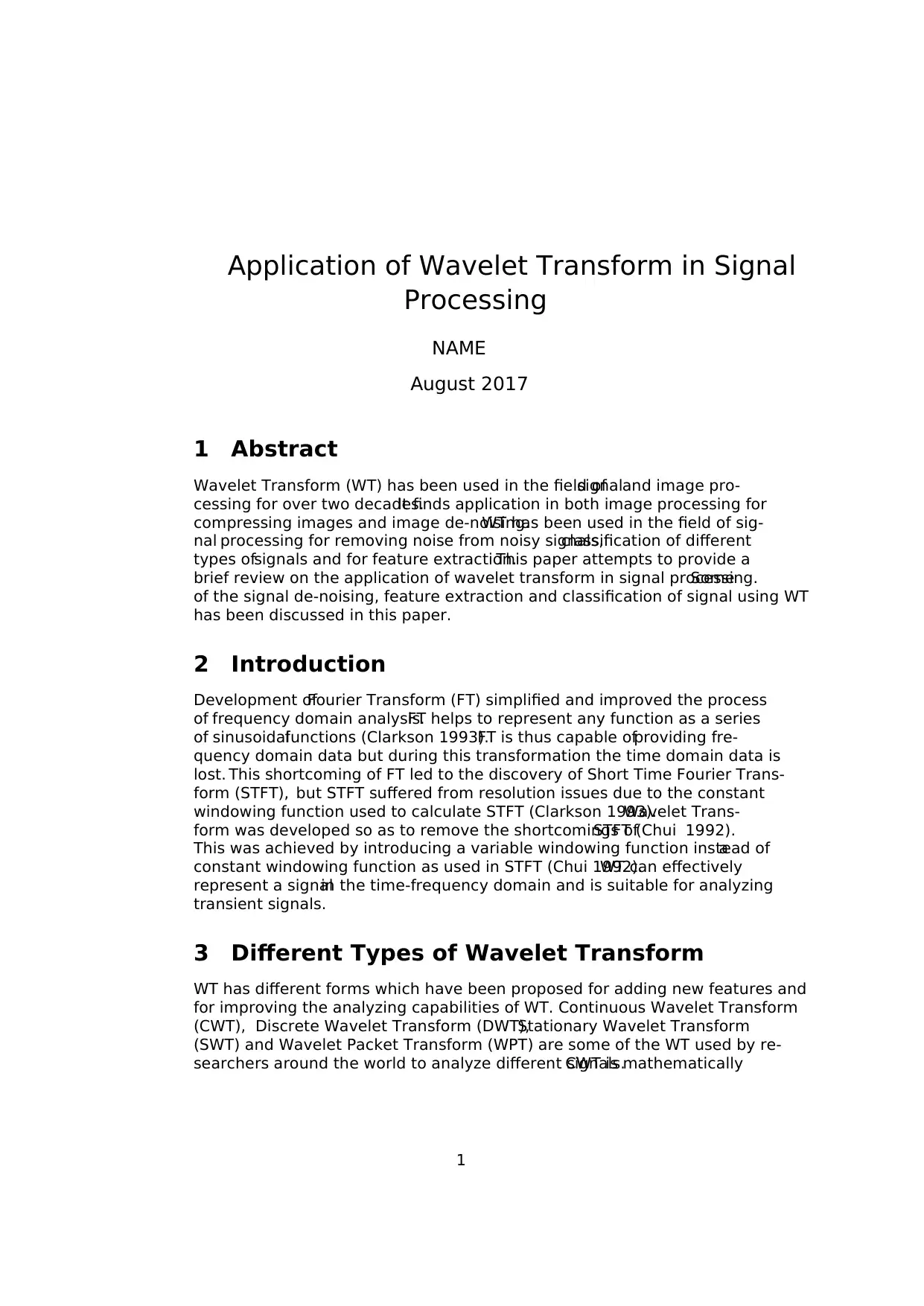
Application of Wavelet Transform in Signal
Processing
NAME
August 2017
1 Abstract
Wavelet Transform (WT) has been used in the field ofsignaland image pro-
cessing for over two decades.It finds application in both image processing for
compressing images and image de-noising.WT has been used in the field of sig-
nal processing for removing noise from noisy signals,classification of different
types ofsignals and for feature extraction.This paper attempts to provide a
brief review on the application of wavelet transform in signal processing.Some
of the signal de-noising, feature extraction and classification of signal using WT
has been discussed in this paper.
2 Introduction
Development ofFourier Transform (FT) simplified and improved the process
of frequency domain analysis.FT helps to represent any function as a series
of sinusoidalfunctions (Clarkson 1993).FT is thus capable ofproviding fre-
quency domain data but during this transformation the time domain data is
lost. This shortcoming of FT led to the discovery of Short Time Fourier Trans-
form (STFT), but STFT suffered from resolution issues due to the constant
windowing function used to calculate STFT (Clarkson 1993).Wavelet Trans-
form was developed so as to remove the shortcomings ofSTFT (Chui 1992).
This was achieved by introducing a variable windowing function instead ofa
constant windowing function as used in STFT (Chui 1992).WT can effectively
represent a signalin the time-frequency domain and is suitable for analyzing
transient signals.
3 Different Types of Wavelet Transform
WT has different forms which have been proposed for adding new features and
for improving the analyzing capabilities of WT. Continuous Wavelet Transform
(CWT), Discrete Wavelet Transform (DWT),Stationary Wavelet Transform
(SWT) and Wavelet Packet Transform (WPT) are some of the WT used by re-
searchers around the world to analyze different signals.CWT is mathematically
1
Processing
NAME
August 2017
1 Abstract
Wavelet Transform (WT) has been used in the field ofsignaland image pro-
cessing for over two decades.It finds application in both image processing for
compressing images and image de-noising.WT has been used in the field of sig-
nal processing for removing noise from noisy signals,classification of different
types ofsignals and for feature extraction.This paper attempts to provide a
brief review on the application of wavelet transform in signal processing.Some
of the signal de-noising, feature extraction and classification of signal using WT
has been discussed in this paper.
2 Introduction
Development ofFourier Transform (FT) simplified and improved the process
of frequency domain analysis.FT helps to represent any function as a series
of sinusoidalfunctions (Clarkson 1993).FT is thus capable ofproviding fre-
quency domain data but during this transformation the time domain data is
lost. This shortcoming of FT led to the discovery of Short Time Fourier Trans-
form (STFT), but STFT suffered from resolution issues due to the constant
windowing function used to calculate STFT (Clarkson 1993).Wavelet Trans-
form was developed so as to remove the shortcomings ofSTFT (Chui 1992).
This was achieved by introducing a variable windowing function instead ofa
constant windowing function as used in STFT (Chui 1992).WT can effectively
represent a signalin the time-frequency domain and is suitable for analyzing
transient signals.
3 Different Types of Wavelet Transform
WT has different forms which have been proposed for adding new features and
for improving the analyzing capabilities of WT. Continuous Wavelet Transform
(CWT), Discrete Wavelet Transform (DWT),Stationary Wavelet Transform
(SWT) and Wavelet Packet Transform (WPT) are some of the WT used by re-
searchers around the world to analyze different signals.CWT is mathematically
1

Paraphrase This Document
Need a fresh take? Get an instant paraphrase of this document with our AI Paraphraser
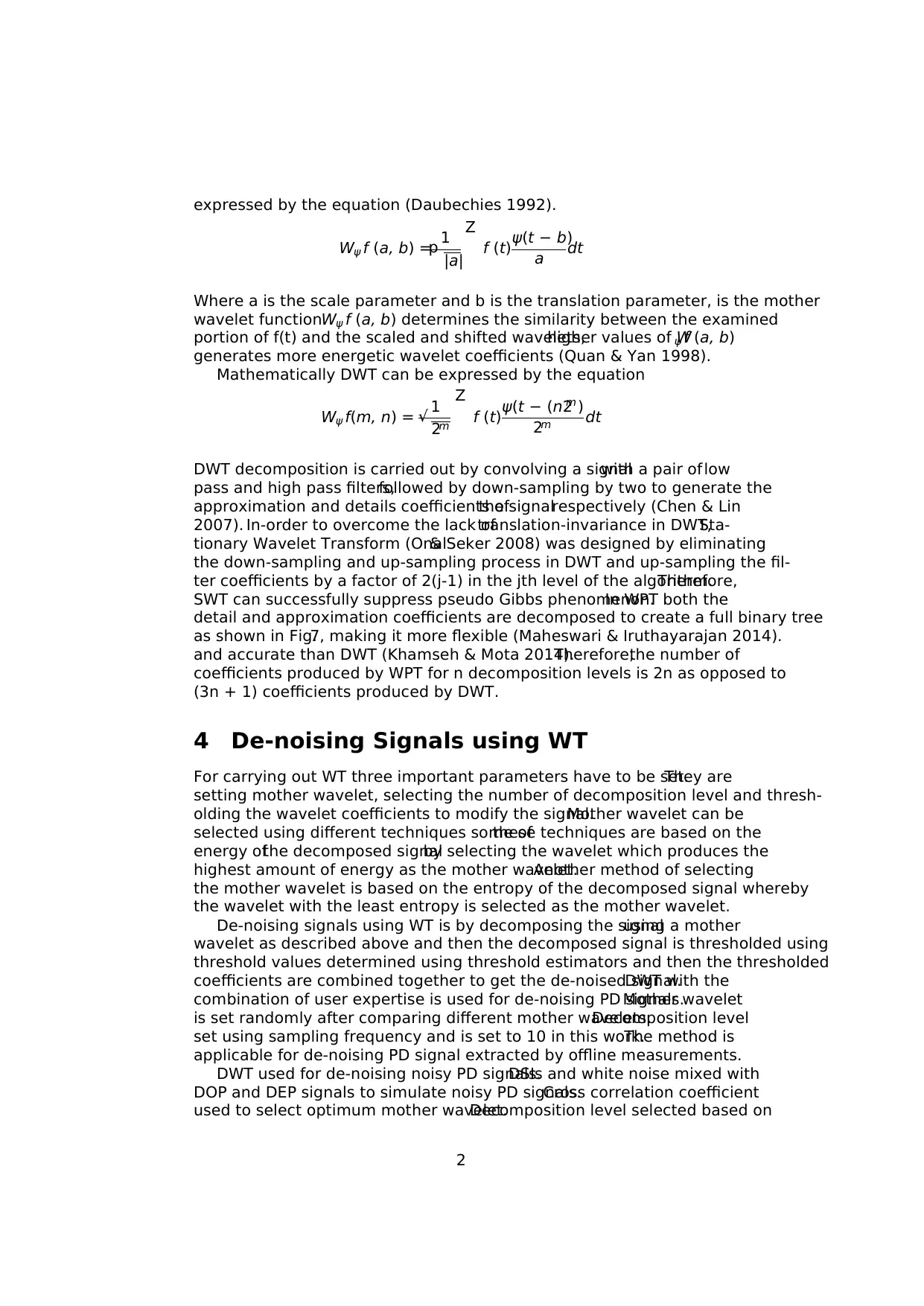
expressed by the equation (Daubechies 1992).
Wψ f (a, b) = 1
p |a|
Z
f (t)ψ(t − b)
a dt
Where a is the scale parameter and b is the translation parameter, is the mother
wavelet function.Wψ f (a, b) determines the similarity between the examined
portion of f(t) and the scaled and shifted wavelets,higher values of Wψ f (a, b)
generates more energetic wavelet coefficients (Quan & Yan 1998).
Mathematically DWT can be expressed by the equation
Wψ f(m, n) = 1
√ 2m
Z
f (t)ψ(t − (n2m )
2m dt
DWT decomposition is carried out by convolving a signalwith a pair of low
pass and high pass filters,followed by down-sampling by two to generate the
approximation and details coefficients ofthe signalrespectively (Chen & Lin
2007). In-order to overcome the lack oftranslation-invariance in DWT,Sta-
tionary Wavelet Transform (Onal& Seker 2008) was designed by eliminating
the down-sampling and up-sampling process in DWT and up-sampling the fil-
ter coefficients by a factor of 2(j-1) in the jth level of the algorithm.Therefore,
SWT can successfully suppress pseudo Gibbs phenomenon.In WPT both the
detail and approximation coefficients are decomposed to create a full binary tree
as shown in Fig.7, making it more flexible (Maheswari & Iruthayarajan 2014).
and accurate than DWT (Khamseh & Mota 2014).Therefore,the number of
coefficients produced by WPT for n decomposition levels is 2n as opposed to
(3n + 1) coefficients produced by DWT.
4 De-noising Signals using WT
For carrying out WT three important parameters have to be set.They are
setting mother wavelet, selecting the number of decomposition level and thresh-
olding the wavelet coefficients to modify the signal.Mother wavelet can be
selected using different techniques some ofthese techniques are based on the
energy ofthe decomposed signalby selecting the wavelet which produces the
highest amount of energy as the mother wavelet.Another method of selecting
the mother wavelet is based on the entropy of the decomposed signal whereby
the wavelet with the least entropy is selected as the mother wavelet.
De-noising signals using WT is by decomposing the signalusing a mother
wavelet as described above and then the decomposed signal is thresholded using
threshold values determined using threshold estimators and then the thresholded
coefficients are combined together to get the de-noised signal.DWT with the
combination of user expertise is used for de-noising PD signals.Mother wavelet
is set randomly after comparing different mother wavelets.Decomposition level
set using sampling frequency and is set to 10 in this work.The method is
applicable for de-noising PD signal extracted by offline measurements.
DWT used for de-noising noisy PD signals.DSIs and white noise mixed with
DOP and DEP signals to simulate noisy PD signals.Cross correlation coefficient
used to select optimum mother wavelet.Decomposition level selected based on
2
Wψ f (a, b) = 1
p |a|
Z
f (t)ψ(t − b)
a dt
Where a is the scale parameter and b is the translation parameter, is the mother
wavelet function.Wψ f (a, b) determines the similarity between the examined
portion of f(t) and the scaled and shifted wavelets,higher values of Wψ f (a, b)
generates more energetic wavelet coefficients (Quan & Yan 1998).
Mathematically DWT can be expressed by the equation
Wψ f(m, n) = 1
√ 2m
Z
f (t)ψ(t − (n2m )
2m dt
DWT decomposition is carried out by convolving a signalwith a pair of low
pass and high pass filters,followed by down-sampling by two to generate the
approximation and details coefficients ofthe signalrespectively (Chen & Lin
2007). In-order to overcome the lack oftranslation-invariance in DWT,Sta-
tionary Wavelet Transform (Onal& Seker 2008) was designed by eliminating
the down-sampling and up-sampling process in DWT and up-sampling the fil-
ter coefficients by a factor of 2(j-1) in the jth level of the algorithm.Therefore,
SWT can successfully suppress pseudo Gibbs phenomenon.In WPT both the
detail and approximation coefficients are decomposed to create a full binary tree
as shown in Fig.7, making it more flexible (Maheswari & Iruthayarajan 2014).
and accurate than DWT (Khamseh & Mota 2014).Therefore,the number of
coefficients produced by WPT for n decomposition levels is 2n as opposed to
(3n + 1) coefficients produced by DWT.
4 De-noising Signals using WT
For carrying out WT three important parameters have to be set.They are
setting mother wavelet, selecting the number of decomposition level and thresh-
olding the wavelet coefficients to modify the signal.Mother wavelet can be
selected using different techniques some ofthese techniques are based on the
energy ofthe decomposed signalby selecting the wavelet which produces the
highest amount of energy as the mother wavelet.Another method of selecting
the mother wavelet is based on the entropy of the decomposed signal whereby
the wavelet with the least entropy is selected as the mother wavelet.
De-noising signals using WT is by decomposing the signalusing a mother
wavelet as described above and then the decomposed signal is thresholded using
threshold values determined using threshold estimators and then the thresholded
coefficients are combined together to get the de-noised signal.DWT with the
combination of user expertise is used for de-noising PD signals.Mother wavelet
is set randomly after comparing different mother wavelets.Decomposition level
set using sampling frequency and is set to 10 in this work.The method is
applicable for de-noising PD signal extracted by offline measurements.
DWT used for de-noising noisy PD signals.DSIs and white noise mixed with
DOP and DEP signals to simulate noisy PD signals.Cross correlation coefficient
used to select optimum mother wavelet.Decomposition level selected based on
2
sampling frequency ofthe signal,with an increase ofsampling frequency the
decomposition level should be increased.Automatic level dependent threshold
estimator for threshold setting is developed and used along with hard thresh-
olding function.A technique for locating PD origin site is proposed by making
use ofthe PD’s localmaxima line followed by continuous wavelet transform
analysis.
Both CWT and DWT could be used to de-noise PD signals measured us-
ing Acoustic emission method.DWT was carried out using ‘sym8’as mother
wavelet.PD could be recovered using higher leveldetails coefficients and the
lower level details coefficients could be discarded.The method makes use of PD
signals generated using different methods in Laboratory.Here wavelet analy-
sis is used for identifying the frequencies where PD occurs.A new WT based
technique to detect PD signalby passing the signalthrough Kaiser’s window,
and decomposing the signalinto different resolutions.The maximum coeffi-
cients localized at each resolution is used to extract and measure the PD signal.
Decomposition level selected using trial and error method.No thresholding or
reconstruction is required.PD is extracted using details coefficients of a single
decomposition level.The extracted PD data-size is very small compared to the
originalsignal. The proposed method was checked using both simulated and
laboratory data.
A new WT technique based on genetic adaptive threshold estimation is pro-
posed.The method is used to separate white noise from PD signals.‘db8’is
selected as the mother wavelet.Decomposition levels of both 4 and 6 are used to
decompose simulated PD signals.A new thresholding function with continuous
derivatives is introduced in this paper.An adaptive threshold selection scheme
is introduced in the work for de-noising ultra-high frequency PD signals.Fast
Fourier Transform and MultiResolution Analysis were carried out to detect
different discharge patterns and judge their intensities.Without de-noising PD
signals features were extracted using a windowing technique by focusing on a
narrow data window where PD exists.Noise is concentrated on separate win-
dows.The proposed technique can distinguish those windows that contain PD
and those windows that contain noise.The method locates PD pulses in specific
data windows even when measured in the presence of excessive noise thus this
method reduces the computational complexity for further computation.
5 Feature Extraction and Classification
Dey & Munshi (2010)applied crosswavelettransform using Mortelas the
mother wavelet to extract PD features and classified the signals using a rough
set theory based classifier.Hao & Michel (2011) used wavelet decomposition to
calculate energy, then applied Principal Component Analysis (PCA) to reduce
data and then implemented DBSCAN algorithm for clustering PD and noise
into different groups.Li & Grzybowski(2012) used WPT to decompose PD
signals to 5 levels for feature extraction through energy calculations and then
applied Linear Discriminant Analysis for reduction of redundant data and for
classification of PD signals.
Dongsong & Kunpeng (2013) developed a method ofdomain feature ex-
traction based on WPT with singular value decomposition by decomposing the
envelope signal to 4 levels with WPT using ‘db4’ as the mother wavelet which
3
decomposition level should be increased.Automatic level dependent threshold
estimator for threshold setting is developed and used along with hard thresh-
olding function.A technique for locating PD origin site is proposed by making
use ofthe PD’s localmaxima line followed by continuous wavelet transform
analysis.
Both CWT and DWT could be used to de-noise PD signals measured us-
ing Acoustic emission method.DWT was carried out using ‘sym8’as mother
wavelet.PD could be recovered using higher leveldetails coefficients and the
lower level details coefficients could be discarded.The method makes use of PD
signals generated using different methods in Laboratory.Here wavelet analy-
sis is used for identifying the frequencies where PD occurs.A new WT based
technique to detect PD signalby passing the signalthrough Kaiser’s window,
and decomposing the signalinto different resolutions.The maximum coeffi-
cients localized at each resolution is used to extract and measure the PD signal.
Decomposition level selected using trial and error method.No thresholding or
reconstruction is required.PD is extracted using details coefficients of a single
decomposition level.The extracted PD data-size is very small compared to the
originalsignal. The proposed method was checked using both simulated and
laboratory data.
A new WT technique based on genetic adaptive threshold estimation is pro-
posed.The method is used to separate white noise from PD signals.‘db8’is
selected as the mother wavelet.Decomposition levels of both 4 and 6 are used to
decompose simulated PD signals.A new thresholding function with continuous
derivatives is introduced in this paper.An adaptive threshold selection scheme
is introduced in the work for de-noising ultra-high frequency PD signals.Fast
Fourier Transform and MultiResolution Analysis were carried out to detect
different discharge patterns and judge their intensities.Without de-noising PD
signals features were extracted using a windowing technique by focusing on a
narrow data window where PD exists.Noise is concentrated on separate win-
dows.The proposed technique can distinguish those windows that contain PD
and those windows that contain noise.The method locates PD pulses in specific
data windows even when measured in the presence of excessive noise thus this
method reduces the computational complexity for further computation.
5 Feature Extraction and Classification
Dey & Munshi (2010)applied crosswavelettransform using Mortelas the
mother wavelet to extract PD features and classified the signals using a rough
set theory based classifier.Hao & Michel (2011) used wavelet decomposition to
calculate energy, then applied Principal Component Analysis (PCA) to reduce
data and then implemented DBSCAN algorithm for clustering PD and noise
into different groups.Li & Grzybowski(2012) used WPT to decompose PD
signals to 5 levels for feature extraction through energy calculations and then
applied Linear Discriminant Analysis for reduction of redundant data and for
classification of PD signals.
Dongsong & Kunpeng (2013) developed a method ofdomain feature ex-
traction based on WPT with singular value decomposition by decomposing the
envelope signal to 4 levels with WPT using ‘db4’ as the mother wavelet which
3
⊘ This is a preview!⊘
Do you want full access?
Subscribe today to unlock all pages.

Trusted by 1+ million students worldwide
was selected by Shannon entropy based wavelet selection scheme,then the co-
efficient matrix obtained was built in the scale, after which feature vectors were
extracted by means of Singular Value Decomposition (SVD) and Back Propa-
gation Neural Network (BPNN) was used for pattern recognition.
Nasir & Bashir (2015) adopted WT technique for extracting unique features
from the signal and Particle Swarm Optimization (PSO) technique for selecting
the optimalfeatures required for classifying acoustic PD signals.They used a
radial basis function neural network for classifying corona discharge in air, sur-
face discharge in air and internal discharge in oil.Harbaji & El-Hag (2015)used
a KNN based classifier along with PCA feature extraction technique to classify
multi-class PD sources.
References
Chen, L-J., L. W.-M. T. T.-P. & Lin, Y.-H. (2007), ‘Study of partial discharge
measurement in power equipment using acoustic technique and wavelet trans-
form’, IEEE Transaction on Power Delivery 22(3), pp.1575–1580.
Chui, C. (1992), An Introduction to Wavelets, Academic Press Professional Inc.,
London.
Clarkson,P. (1993),Optimaland Adaptive SignalProcessing,CRC Press Inc.,
Boca Raton.
Daubechies,I. (1992), Ten Lecturesof Wavelets,Springer-Verlag,New
Brunswick.
Dey,D., C. B. C.-S. & Munshi, S. (2010),‘Cross wavelet transform as a new
paradigm for feature extraction from noisy partialdischarge pulses’,IEEE
Transaction on Dielectrics and ElectricalInsulation 17(1), 157–166.
Dongsong, L. & Kunpeng, C. (2013), ‘Envelope signal of partial discharge pat-
tern recognition based on wavelet packet transform.’, Advanced Materials Re-
search 823, 536–540.
Hao, L., L. L. H.-J. S. D.-C. A. W. C. & Michel, M. (2011),‘Discrimina-
tion of multiple pd sources using wavelet decomposition and principalcom-
ponent analysis’,IEEE Transaction on Dielectrics and ElectricalInsulation
18(5), 1702–1711.
Harbaji, M., S. K. & El-Hag, A. (2015),‘Classification ofcommon pd types
in oil-paper insulation system using acoustic signals’,IEEE Transaction on
Dielectrics and ElectricalInsulation 22(3), 1674–1683.
Khamseh,H.B., R. V. V.-F. & Mota, H. (2014),Mining undecimated wavelet
transform maxima lines:An effective way to denoise partial discharge signals.,
in ‘Electrical Insulation Conference’, IEEE, Philadelphia, pp. 260–266.
URL: http://ieeexplore.ieee.org/document/6869388/
Li, J., J. T. H.-R. & Grzybowski, S. (2012), ‘Recognition of ultra high frequency
partial discharge signals using multi-scale features’,IEEE Transaction on
Dielectrics and ElectricalInsulation 19(4), 1412–1420.
4
efficient matrix obtained was built in the scale, after which feature vectors were
extracted by means of Singular Value Decomposition (SVD) and Back Propa-
gation Neural Network (BPNN) was used for pattern recognition.
Nasir & Bashir (2015) adopted WT technique for extracting unique features
from the signal and Particle Swarm Optimization (PSO) technique for selecting
the optimalfeatures required for classifying acoustic PD signals.They used a
radial basis function neural network for classifying corona discharge in air, sur-
face discharge in air and internal discharge in oil.Harbaji & El-Hag (2015)used
a KNN based classifier along with PCA feature extraction technique to classify
multi-class PD sources.
References
Chen, L-J., L. W.-M. T. T.-P. & Lin, Y.-H. (2007), ‘Study of partial discharge
measurement in power equipment using acoustic technique and wavelet trans-
form’, IEEE Transaction on Power Delivery 22(3), pp.1575–1580.
Chui, C. (1992), An Introduction to Wavelets, Academic Press Professional Inc.,
London.
Clarkson,P. (1993),Optimaland Adaptive SignalProcessing,CRC Press Inc.,
Boca Raton.
Daubechies,I. (1992), Ten Lecturesof Wavelets,Springer-Verlag,New
Brunswick.
Dey,D., C. B. C.-S. & Munshi, S. (2010),‘Cross wavelet transform as a new
paradigm for feature extraction from noisy partialdischarge pulses’,IEEE
Transaction on Dielectrics and ElectricalInsulation 17(1), 157–166.
Dongsong, L. & Kunpeng, C. (2013), ‘Envelope signal of partial discharge pat-
tern recognition based on wavelet packet transform.’, Advanced Materials Re-
search 823, 536–540.
Hao, L., L. L. H.-J. S. D.-C. A. W. C. & Michel, M. (2011),‘Discrimina-
tion of multiple pd sources using wavelet decomposition and principalcom-
ponent analysis’,IEEE Transaction on Dielectrics and ElectricalInsulation
18(5), 1702–1711.
Harbaji, M., S. K. & El-Hag, A. (2015),‘Classification ofcommon pd types
in oil-paper insulation system using acoustic signals’,IEEE Transaction on
Dielectrics and ElectricalInsulation 22(3), 1674–1683.
Khamseh,H.B., R. V. V.-F. & Mota, H. (2014),Mining undecimated wavelet
transform maxima lines:An effective way to denoise partial discharge signals.,
in ‘Electrical Insulation Conference’, IEEE, Philadelphia, pp. 260–266.
URL: http://ieeexplore.ieee.org/document/6869388/
Li, J., J. T. H.-R. & Grzybowski, S. (2012), ‘Recognition of ultra high frequency
partial discharge signals using multi-scale features’,IEEE Transaction on
Dielectrics and ElectricalInsulation 19(4), 1412–1420.
4
Paraphrase This Document
Need a fresh take? Get an instant paraphrase of this document with our AI Paraphraser
Maheswari,R.V., S. P. V.-B. & Iruthayarajan,M. (2014),‘Partial discharge
signal denoising using adaptive translation wavelet transform-online measure-
ment’, Journalof ElectricalEngineering & Technology 9(2), 695–706.
Nasir, A., A. M. P.-M. & Bashir, N. (2015),‘A review on hybrid wavelet re-
grouping particle swarm optimization neural networks for characterization of
partial discharge acoustic signals’, Renewable and Sustainable Energy Reviews
45, 20–35.
Onal, E., K. O. & Seker, S. (2008),‘Multi-resolution waveletanalysisfor
chopped impulse voltage measurements and feature extraction’, IEEE Trans-
action on Dielectrics and ElectricalInsulation 15(3), 893–900.
Quan, Y., G. N. Z.-G. & Yan, Z. (1998), ‘Wavelet transform applying in partial
discharge measurement’,Conference Record of the 1998 IEEE International
Symposium on ElectricalInsulation 2, 428–431.
5
signal denoising using adaptive translation wavelet transform-online measure-
ment’, Journalof ElectricalEngineering & Technology 9(2), 695–706.
Nasir, A., A. M. P.-M. & Bashir, N. (2015),‘A review on hybrid wavelet re-
grouping particle swarm optimization neural networks for characterization of
partial discharge acoustic signals’, Renewable and Sustainable Energy Reviews
45, 20–35.
Onal, E., K. O. & Seker, S. (2008),‘Multi-resolution waveletanalysisfor
chopped impulse voltage measurements and feature extraction’, IEEE Trans-
action on Dielectrics and ElectricalInsulation 15(3), 893–900.
Quan, Y., G. N. Z.-G. & Yan, Z. (1998), ‘Wavelet transform applying in partial
discharge measurement’,Conference Record of the 1998 IEEE International
Symposium on ElectricalInsulation 2, 428–431.
5

1 out of 5


Your All-in-One AI-Powered Toolkit for Academic Success.
+13062052269
info@desklib.com
Available 24*7 on WhatsApp / Email
![[object Object]](/_next/static/media/star-bottom.7253800d.svg)
Unlock your academic potential
Copyright © 2020–2026 A2Z Services. All Rights Reserved. Developed and managed by ZUCOL.