Purpose of Education and Educational Technology
VerifiedAdded on 2019/09/18
|24
|5887
|573
Essay
AI Summary
This essay delves into the fundamental question of education's purpose, both in the present and future, while exploring the transformative role of educational technology. It examines the aims of education, its relationship with society, and the impact of technology on teaching and learning. The essay also discusses the importance of integrating technology into education to enhance learning experiences and prepare students for the future. It highlights the need for teachers to adapt to new technologies and for educational institutions to embrace innovation to improve the quality of education. The paper concludes by emphasizing the importance of educational technology in modern classrooms and its potential to enhance learning outcomes.

What is education for, what is its purpose, both here and now and looking to the future?
Name
Submitted to
Date
Name
Submitted to
Date

Paraphrase This Document
Need a fresh take? Get an instant paraphrase of this document with our AI Paraphraser

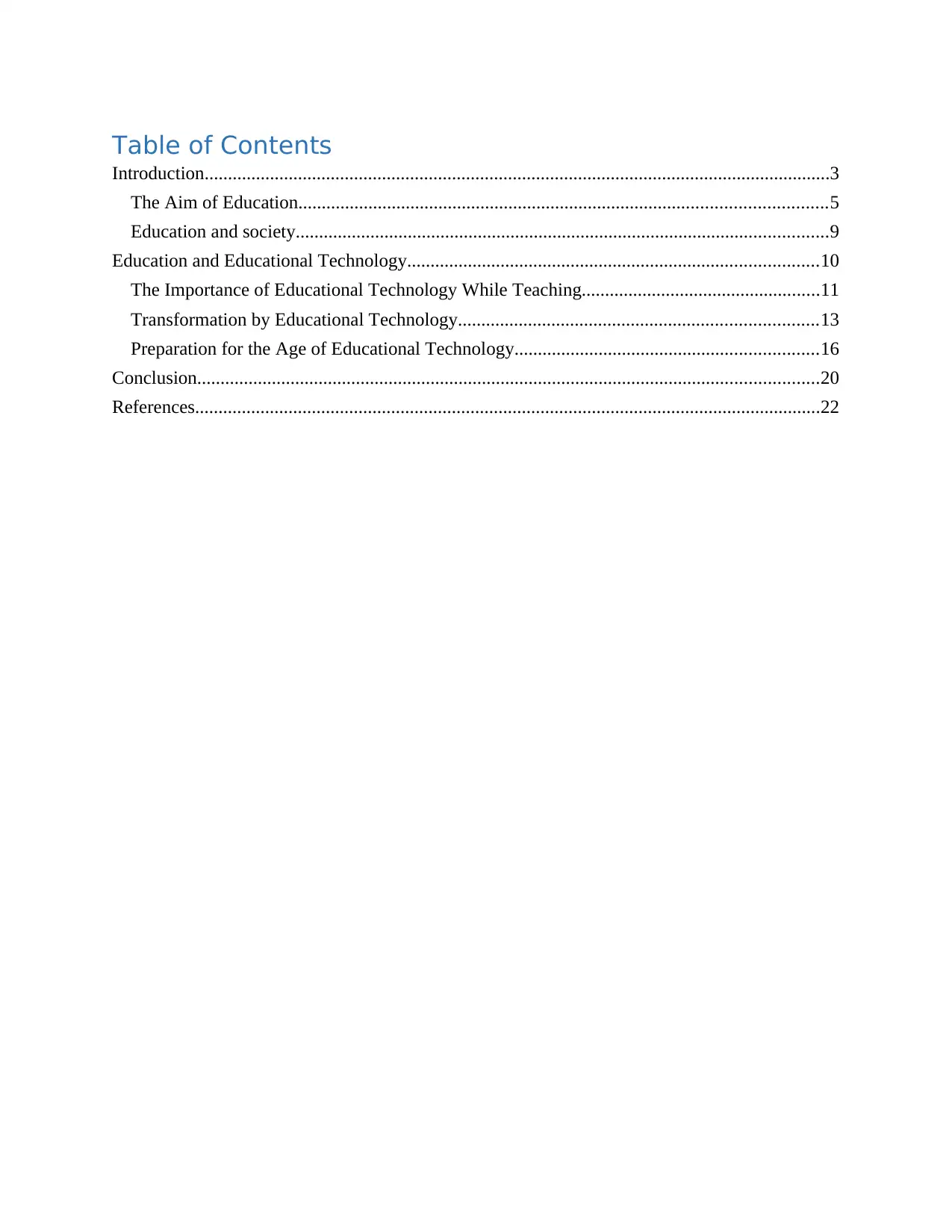
Table of Contents
Introduction......................................................................................................................................3
The Aim of Education.................................................................................................................5
Education and society..................................................................................................................9
Education and Educational Technology........................................................................................10
The Importance of Educational Technology While Teaching...................................................11
Transformation by Educational Technology.............................................................................13
Preparation for the Age of Educational Technology.................................................................16
Conclusion.....................................................................................................................................20
References......................................................................................................................................22
Introduction......................................................................................................................................3
The Aim of Education.................................................................................................................5
Education and society..................................................................................................................9
Education and Educational Technology........................................................................................10
The Importance of Educational Technology While Teaching...................................................11
Transformation by Educational Technology.............................................................................13
Preparation for the Age of Educational Technology.................................................................16
Conclusion.....................................................................................................................................20
References......................................................................................................................................22
⊘ This is a preview!⊘
Do you want full access?
Subscribe today to unlock all pages.

Trusted by 1+ million students worldwide
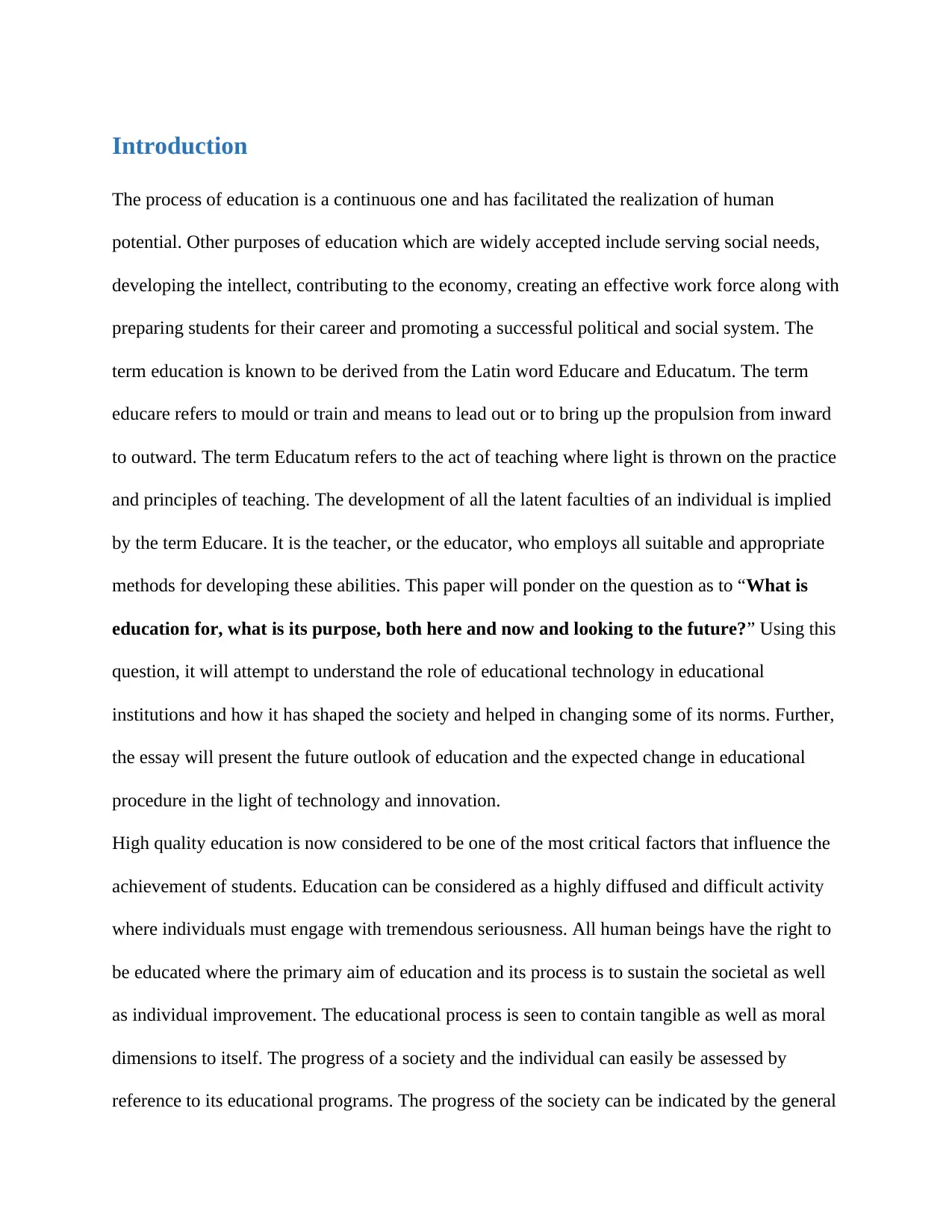
Introduction
The process of education is a continuous one and has facilitated the realization of human
potential. Other purposes of education which are widely accepted include serving social needs,
developing the intellect, contributing to the economy, creating an effective work force along with
preparing students for their career and promoting a successful political and social system. The
term education is known to be derived from the Latin word Educare and Educatum. The term
educare refers to mould or train and means to lead out or to bring up the propulsion from inward
to outward. The term Educatum refers to the act of teaching where light is thrown on the practice
and principles of teaching. The development of all the latent faculties of an individual is implied
by the term Educare. It is the teacher, or the educator, who employs all suitable and appropriate
methods for developing these abilities. This paper will ponder on the question as to “What is
education for, what is its purpose, both here and now and looking to the future?” Using this
question, it will attempt to understand the role of educational technology in educational
institutions and how it has shaped the society and helped in changing some of its norms. Further,
the essay will present the future outlook of education and the expected change in educational
procedure in the light of technology and innovation.
High quality education is now considered to be one of the most critical factors that influence the
achievement of students. Education can be considered as a highly diffused and difficult activity
where individuals must engage with tremendous seriousness. All human beings have the right to
be educated where the primary aim of education and its process is to sustain the societal as well
as individual improvement. The educational process is seen to contain tangible as well as moral
dimensions to itself. The progress of a society and the individual can easily be assessed by
reference to its educational programs. The progress of the society can be indicated by the general
The process of education is a continuous one and has facilitated the realization of human
potential. Other purposes of education which are widely accepted include serving social needs,
developing the intellect, contributing to the economy, creating an effective work force along with
preparing students for their career and promoting a successful political and social system. The
term education is known to be derived from the Latin word Educare and Educatum. The term
educare refers to mould or train and means to lead out or to bring up the propulsion from inward
to outward. The term Educatum refers to the act of teaching where light is thrown on the practice
and principles of teaching. The development of all the latent faculties of an individual is implied
by the term Educare. It is the teacher, or the educator, who employs all suitable and appropriate
methods for developing these abilities. This paper will ponder on the question as to “What is
education for, what is its purpose, both here and now and looking to the future?” Using this
question, it will attempt to understand the role of educational technology in educational
institutions and how it has shaped the society and helped in changing some of its norms. Further,
the essay will present the future outlook of education and the expected change in educational
procedure in the light of technology and innovation.
High quality education is now considered to be one of the most critical factors that influence the
achievement of students. Education can be considered as a highly diffused and difficult activity
where individuals must engage with tremendous seriousness. All human beings have the right to
be educated where the primary aim of education and its process is to sustain the societal as well
as individual improvement. The educational process is seen to contain tangible as well as moral
dimensions to itself. The progress of a society and the individual can easily be assessed by
reference to its educational programs. The progress of the society can be indicated by the general
Paraphrase This Document
Need a fresh take? Get an instant paraphrase of this document with our AI Paraphraser
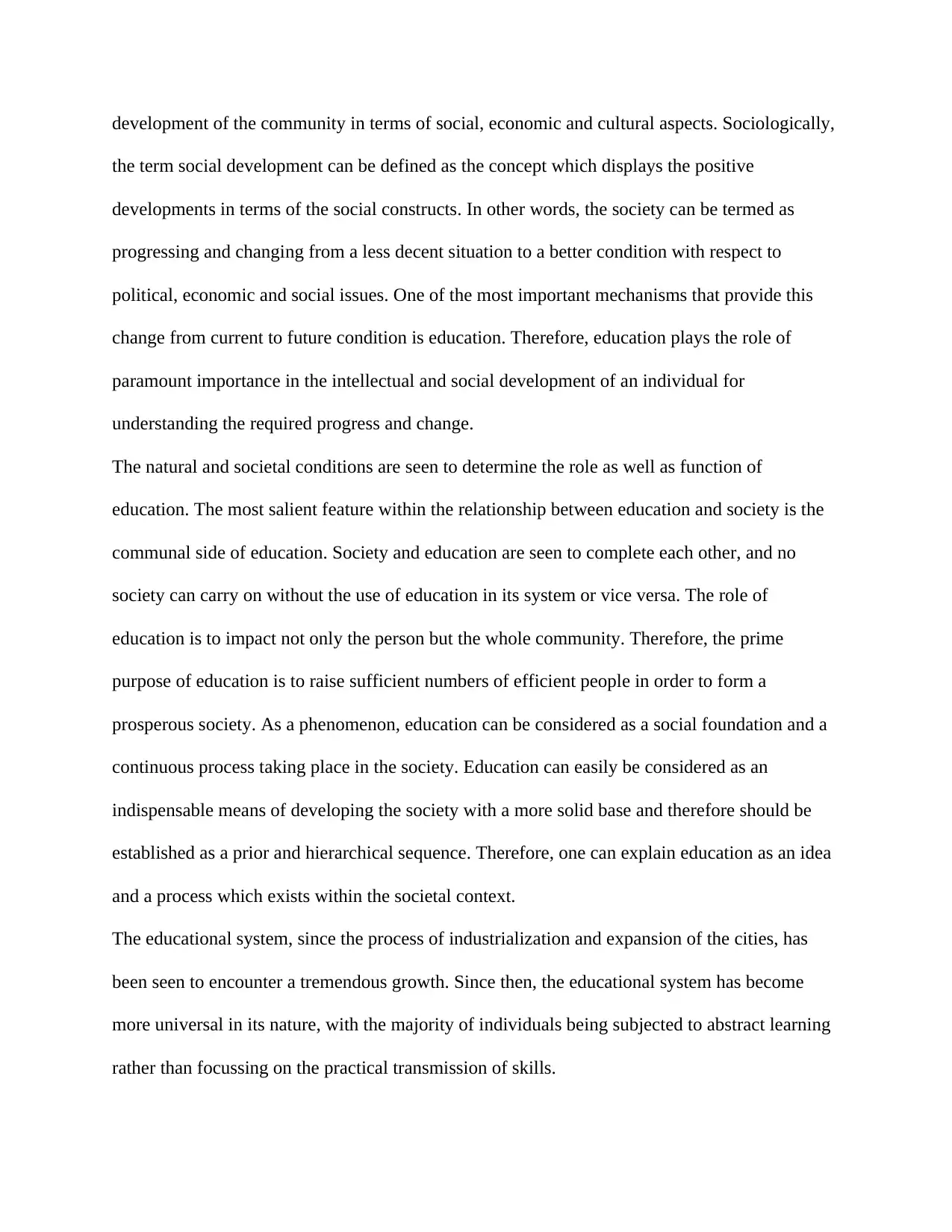
development of the community in terms of social, economic and cultural aspects. Sociologically,
the term social development can be defined as the concept which displays the positive
developments in terms of the social constructs. In other words, the society can be termed as
progressing and changing from a less decent situation to a better condition with respect to
political, economic and social issues. One of the most important mechanisms that provide this
change from current to future condition is education. Therefore, education plays the role of
paramount importance in the intellectual and social development of an individual for
understanding the required progress and change.
The natural and societal conditions are seen to determine the role as well as function of
education. The most salient feature within the relationship between education and society is the
communal side of education. Society and education are seen to complete each other, and no
society can carry on without the use of education in its system or vice versa. The role of
education is to impact not only the person but the whole community. Therefore, the prime
purpose of education is to raise sufficient numbers of efficient people in order to form a
prosperous society. As a phenomenon, education can be considered as a social foundation and a
continuous process taking place in the society. Education can easily be considered as an
indispensable means of developing the society with a more solid base and therefore should be
established as a prior and hierarchical sequence. Therefore, one can explain education as an idea
and a process which exists within the societal context.
The educational system, since the process of industrialization and expansion of the cities, has
been seen to encounter a tremendous growth. Since then, the educational system has become
more universal in its nature, with the majority of individuals being subjected to abstract learning
rather than focussing on the practical transmission of skills.
the term social development can be defined as the concept which displays the positive
developments in terms of the social constructs. In other words, the society can be termed as
progressing and changing from a less decent situation to a better condition with respect to
political, economic and social issues. One of the most important mechanisms that provide this
change from current to future condition is education. Therefore, education plays the role of
paramount importance in the intellectual and social development of an individual for
understanding the required progress and change.
The natural and societal conditions are seen to determine the role as well as function of
education. The most salient feature within the relationship between education and society is the
communal side of education. Society and education are seen to complete each other, and no
society can carry on without the use of education in its system or vice versa. The role of
education is to impact not only the person but the whole community. Therefore, the prime
purpose of education is to raise sufficient numbers of efficient people in order to form a
prosperous society. As a phenomenon, education can be considered as a social foundation and a
continuous process taking place in the society. Education can easily be considered as an
indispensable means of developing the society with a more solid base and therefore should be
established as a prior and hierarchical sequence. Therefore, one can explain education as an idea
and a process which exists within the societal context.
The educational system, since the process of industrialization and expansion of the cities, has
been seen to encounter a tremendous growth. Since then, the educational system has become
more universal in its nature, with the majority of individuals being subjected to abstract learning
rather than focussing on the practical transmission of skills.
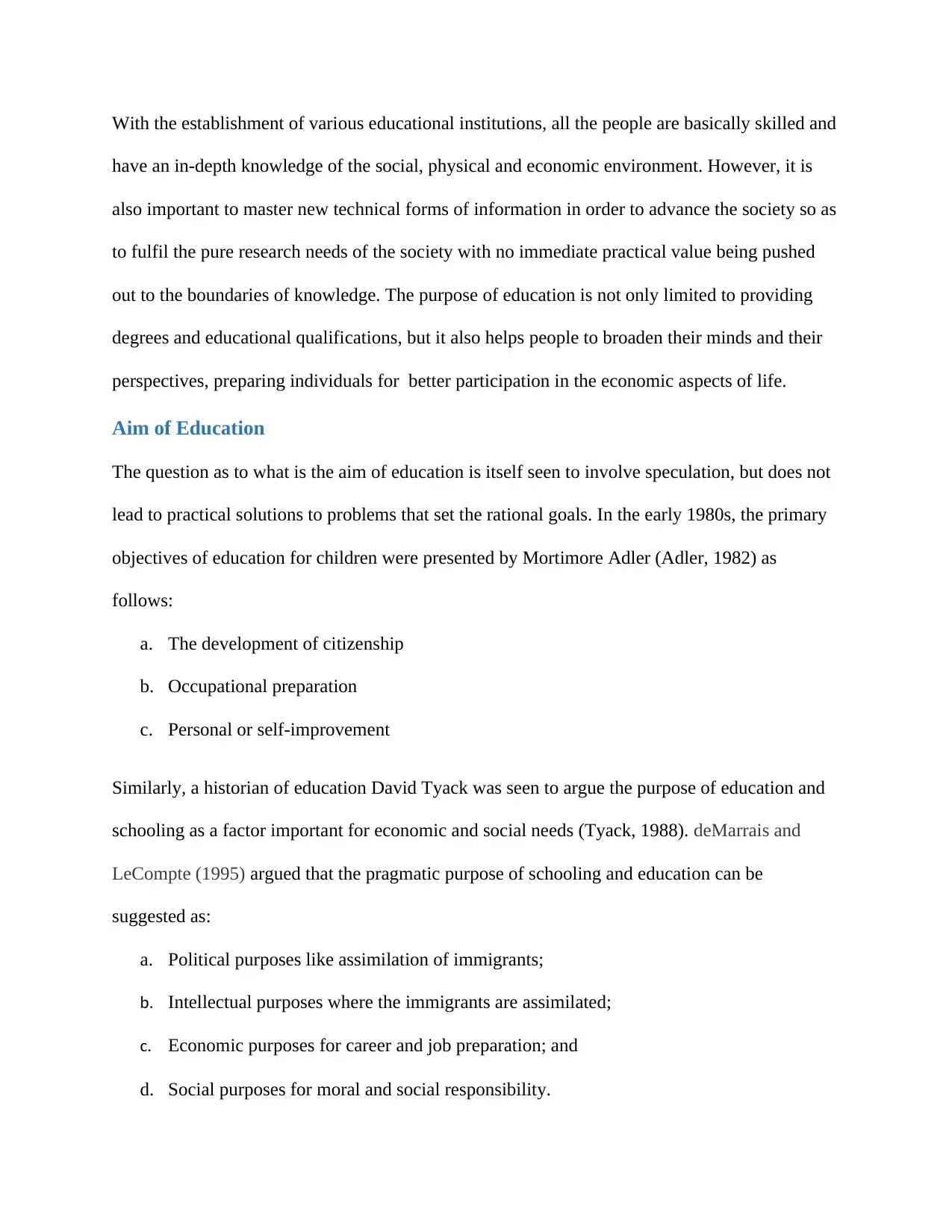
With the establishment of various educational institutions, all the people are basically skilled and
have an in-depth knowledge of the social, physical and economic environment. However, it is
also important to master new technical forms of information in order to advance the society so as
to fulfil the pure research needs of the society with no immediate practical value being pushed
out to the boundaries of knowledge. The purpose of education is not only limited to providing
degrees and educational qualifications, but it also helps people to broaden their minds and their
perspectives, preparing individuals for better participation in the economic aspects of life.
Aim of Education
The question as to what is the aim of education is itself seen to involve speculation, but does not
lead to practical solutions to problems that set the rational goals. In the early 1980s, the primary
objectives of education for children were presented by Mortimore Adler (Adler, 1982) as
follows:
a. The development of citizenship
b. Occupational preparation
c. Personal or self-improvement
Similarly, a historian of education David Tyack was seen to argue the purpose of education and
schooling as a factor important for economic and social needs (Tyack, 1988). deMarrais and
LeCompte (1995) argued that the pragmatic purpose of schooling and education can be
suggested as:
a. Political purposes like assimilation of immigrants;
b. Intellectual purposes where the immigrants are assimilated;
c. Economic purposes for career and job preparation; and
d. Social purposes for moral and social responsibility.
have an in-depth knowledge of the social, physical and economic environment. However, it is
also important to master new technical forms of information in order to advance the society so as
to fulfil the pure research needs of the society with no immediate practical value being pushed
out to the boundaries of knowledge. The purpose of education is not only limited to providing
degrees and educational qualifications, but it also helps people to broaden their minds and their
perspectives, preparing individuals for better participation in the economic aspects of life.
Aim of Education
The question as to what is the aim of education is itself seen to involve speculation, but does not
lead to practical solutions to problems that set the rational goals. In the early 1980s, the primary
objectives of education for children were presented by Mortimore Adler (Adler, 1982) as
follows:
a. The development of citizenship
b. Occupational preparation
c. Personal or self-improvement
Similarly, a historian of education David Tyack was seen to argue the purpose of education and
schooling as a factor important for economic and social needs (Tyack, 1988). deMarrais and
LeCompte (1995) argued that the pragmatic purpose of schooling and education can be
suggested as:
a. Political purposes like assimilation of immigrants;
b. Intellectual purposes where the immigrants are assimilated;
c. Economic purposes for career and job preparation; and
d. Social purposes for moral and social responsibility.
⊘ This is a preview!⊘
Do you want full access?
Subscribe today to unlock all pages.
Trusted by 1+ million students worldwide
It can be considered that any attempt of formulating educational aims, especially for a particular
society, without considering the needs and wants of the people of the society, is likely to fail.
The task oriented education is seen to inhibit the growth of the individuals and therefore presents
a lack of vision, lack of wisdom and lack of intelligence. Educational goals must be set within
the framework of the prevailing paradigm and worldwide view. Albert Einstein (1960)
mentioned that
"The school should always have as its aim that the young man leave it as a harmonious
personality, not as a specialist. The development of general ability for independent thinking and
judgment should always be placed foremost." This philosophy was further approved by Bruner
(1966, page 65) mentioning that, "The objective of education is not the production of self-
confident fools."
The primary aims and objectives of a good educational system can easily be classified as
1. Individual development
2. Social and national development
Individual Development
Education should aim at enabling the human being towards attaining the highest level possible of
harmony - spiritual and external, material and internal - so as to attain the highest possible level
of the development of their capacities and potentialities. Individual development is one of the
well-known aims of education, and it facilitates the development of self-dependence and self-
confidence in students. Education helps in making students strong mentally as well physically.
Its prime function is the development of human beings who are intelligent and integrated. This
education is not based on degrees and information, and it cannot be derived from books or
aggressive assertions alone. The capacity to perceive the essential can be defined as intelligence,
society, without considering the needs and wants of the people of the society, is likely to fail.
The task oriented education is seen to inhibit the growth of the individuals and therefore presents
a lack of vision, lack of wisdom and lack of intelligence. Educational goals must be set within
the framework of the prevailing paradigm and worldwide view. Albert Einstein (1960)
mentioned that
"The school should always have as its aim that the young man leave it as a harmonious
personality, not as a specialist. The development of general ability for independent thinking and
judgment should always be placed foremost." This philosophy was further approved by Bruner
(1966, page 65) mentioning that, "The objective of education is not the production of self-
confident fools."
The primary aims and objectives of a good educational system can easily be classified as
1. Individual development
2. Social and national development
Individual Development
Education should aim at enabling the human being towards attaining the highest level possible of
harmony - spiritual and external, material and internal - so as to attain the highest possible level
of the development of their capacities and potentialities. Individual development is one of the
well-known aims of education, and it facilitates the development of self-dependence and self-
confidence in students. Education helps in making students strong mentally as well physically.
Its prime function is the development of human beings who are intelligent and integrated. This
education is not based on degrees and information, and it cannot be derived from books or
aggressive assertions alone. The capacity to perceive the essential can be defined as intelligence,
Paraphrase This Document
Need a fresh take? Get an instant paraphrase of this document with our AI Paraphraser
whereas the method of awakening the capacity is called education. It aims towards helping
individuals to discover lasting values so as not to be dependent on formulas or slogans, but in
helping to break down the social and national barriers rather than emphasizing on them.
Education must be considered as a judicious amalgamation of present life, along with preparing
for subsequent events.
Social and National Development
The social aim of the educational process and education must be to produce efficient and
effective individuals so that they are able to understand their responsibilities towards their
community and society. Further, the social aim of education is highly critical as the individual
living in a society has obligations towards his nation and the world at large. Education helps
individuals to focus on an inquiring and innovation-oriented society. With the emergence of the
twenty-first century, creativity, novelty and integration of knowledge at a research, global and
analytical level, and education can help the nation to prepare their youth for intense competition.
Therefore, education will develop the required critical and analytical thinking, attitude and skills
among the youth. This will be helpful in making them flexible as well as innovative in
preparation to face crises and uncertainty at a global and national level.
Relation between social and individual aims
The educational aims of individuals and social aims are inter-related and highly complementary
to each other. The prime purpose of fulfilling these aims using education is to develop our best
possible potentialities and capacities - spiritual and physical. This way the individual is able to
contribute to national as well as social efforts.
individuals to discover lasting values so as not to be dependent on formulas or slogans, but in
helping to break down the social and national barriers rather than emphasizing on them.
Education must be considered as a judicious amalgamation of present life, along with preparing
for subsequent events.
Social and National Development
The social aim of the educational process and education must be to produce efficient and
effective individuals so that they are able to understand their responsibilities towards their
community and society. Further, the social aim of education is highly critical as the individual
living in a society has obligations towards his nation and the world at large. Education helps
individuals to focus on an inquiring and innovation-oriented society. With the emergence of the
twenty-first century, creativity, novelty and integration of knowledge at a research, global and
analytical level, and education can help the nation to prepare their youth for intense competition.
Therefore, education will develop the required critical and analytical thinking, attitude and skills
among the youth. This will be helpful in making them flexible as well as innovative in
preparation to face crises and uncertainty at a global and national level.
Relation between social and individual aims
The educational aims of individuals and social aims are inter-related and highly complementary
to each other. The prime purpose of fulfilling these aims using education is to develop our best
possible potentialities and capacities - spiritual and physical. This way the individual is able to
contribute to national as well as social efforts.
Therefore, education does not only aim towards equipping individuals for adjusting to the
community and society and its conventions and customs, but also enables them to bring about the
desirable change in the society (Mezirow, J., 1997).
community and society and its conventions and customs, but also enables them to bring about the
desirable change in the society (Mezirow, J., 1997).
⊘ This is a preview!⊘
Do you want full access?
Subscribe today to unlock all pages.
Trusted by 1+ million students worldwide
Education and society
Education has been considered as the major agency for socialization, and the educational
institutions and teachers as the socializing agents. While describing education as one of the
instruments for social change, the recognition of three critical factors is important: content of
change, agents of change and the social background of those who are seeking for the change, i.e.
the students. The teachers are seen to impart specific aspirations and values to the children in
order to support and control education. Education has helped in removing caste restrictions,
doing away with evil social customs, promoting equality for women, and even helped in raising a
voice in matters related to the governance of a country and establishing democratic institutions.
The main foundation of that education was to teach liberal philosophy, using education in order
to bring out the change. Therefore, the prime purpose of education is to ignite a flame or light of
knowledge which will be important in dispelling the darkness of ignorance. Earlier, education
has also been helpful in spreading the values of modernization which led to distributive justice,
highly productive economies, adoption of scientific technology and increased participation of
people in the decision-making bodies (Fielding, M. and Moss, P., 2010). All these goals were
realised through the liberal education which was utilized as the prime channel for spreading
modernity. Education is not seen to arise as a response towards the needs of an individual but as
a response to societal needs.
Currently the educational system of a society has been linked directly to the total social system,
and is performing almost all the functions of the on-going social system. It has been seen that the
goals and needs of the social system are reflected in the functioning of the educational system
which also fulfils those functions. Earlier, the educational system focussed on transmitting the
cultural heritage to the new generation, but with the change in society the educational systems
Education has been considered as the major agency for socialization, and the educational
institutions and teachers as the socializing agents. While describing education as one of the
instruments for social change, the recognition of three critical factors is important: content of
change, agents of change and the social background of those who are seeking for the change, i.e.
the students. The teachers are seen to impart specific aspirations and values to the children in
order to support and control education. Education has helped in removing caste restrictions,
doing away with evil social customs, promoting equality for women, and even helped in raising a
voice in matters related to the governance of a country and establishing democratic institutions.
The main foundation of that education was to teach liberal philosophy, using education in order
to bring out the change. Therefore, the prime purpose of education is to ignite a flame or light of
knowledge which will be important in dispelling the darkness of ignorance. Earlier, education
has also been helpful in spreading the values of modernization which led to distributive justice,
highly productive economies, adoption of scientific technology and increased participation of
people in the decision-making bodies (Fielding, M. and Moss, P., 2010). All these goals were
realised through the liberal education which was utilized as the prime channel for spreading
modernity. Education is not seen to arise as a response towards the needs of an individual but as
a response to societal needs.
Currently the educational system of a society has been linked directly to the total social system,
and is performing almost all the functions of the on-going social system. It has been seen that the
goals and needs of the social system are reflected in the functioning of the educational system
which also fulfils those functions. Earlier, the educational system focussed on transmitting the
cultural heritage to the new generation, but with the change in society the educational systems
Paraphrase This Document
Need a fresh take? Get an instant paraphrase of this document with our AI Paraphraser
are also focussing on preparing the youth for the adjustments to any change which is likely to
occurre in the future. In the modern complex social context, education can be considered as an
act which performs an additional function of becoming. Therefore, the relationship between
society and its educational system is highly mutual. The influences in society are seen to
introduce changes in its educational system, and the educational system is also seen to influence
societal changes.
Various research papers have documented the fact that education can directly be linked with
productivity, preparing individuals that are more productive citizens in order to build a more
productive society. Education brings about a transformation in the society thereby enhancing the
productivity and efficiency of all the relevant sectors (Jalongo, M.R., 1991).
Education and education technology
In order to improve the quality of education, the modern technology has been employed in order
to develop a process for the integration of educational technology. This process conceptualizes
the execution and evaluation of the educational process where modern teaching methods are
applied.
Due to the differences in the approach towards the technical characteristics and the innovative
technology, these have not been applied in the actual pedagogical application. In order to apply
the educational technology strategies in the educational arena, the areas like pedagogy, didactics,
informatics, computer sciences etc., education technology has to be improved. There are three
domains of use educational technology, namely:
1. Technology as a teaching tool;
2. Technology as a tutor and
3. Technology as a learning tool.
occurre in the future. In the modern complex social context, education can be considered as an
act which performs an additional function of becoming. Therefore, the relationship between
society and its educational system is highly mutual. The influences in society are seen to
introduce changes in its educational system, and the educational system is also seen to influence
societal changes.
Various research papers have documented the fact that education can directly be linked with
productivity, preparing individuals that are more productive citizens in order to build a more
productive society. Education brings about a transformation in the society thereby enhancing the
productivity and efficiency of all the relevant sectors (Jalongo, M.R., 1991).
Education and education technology
In order to improve the quality of education, the modern technology has been employed in order
to develop a process for the integration of educational technology. This process conceptualizes
the execution and evaluation of the educational process where modern teaching methods are
applied.
Due to the differences in the approach towards the technical characteristics and the innovative
technology, these have not been applied in the actual pedagogical application. In order to apply
the educational technology strategies in the educational arena, the areas like pedagogy, didactics,
informatics, computer sciences etc., education technology has to be improved. There are three
domains of use educational technology, namely:
1. Technology as a teaching tool;
2. Technology as a tutor and
3. Technology as a learning tool.
Lowther et al. (2012), on the basis of use and benefits suggested that education technology has
not emerged successfully in spite of being recommended every now and then. This has affected
the statute of the social company. Similarly, Leu et al, (2009) pointed out the lack of Internet as a
learning tool among the children from poorer areas is a disadvantage and the children using
modern technical equipment from an early age are seen to appreciate the educational
technologies at school ( Gutnik et al, 2011; Rideout, 2011). According to Kaufman (2004), the
educational technology imposes a strong influence on the cognitive processesof the students.
While making use of the educational technology, the prime focus must be on the educational
value of the applications and the tools in use, along with the information on how adequate these
are in terms of knowledge acquisition and lastly on their positive effects. Authors like
Glaubke(2007); Celements and Sarnama(2003); Dynarski et al. (2007)suggested that there is a
need to focus on five areas of software programs which possess the potential of influencing the
learning experience of the children in a strong manner which are:
Educational value of the program;
Ease of use;
Ability of engaging children towards learning;
Interaction between program and child;
The software program monitoring the child’s progress.
Importance of educational technology while teaching
Teaching is widely dominated by the use of traditional methods as computers are not used in all
the schools. Traditional methods are dominated by the front form of the work where all the
teachers personally interact with the students. This type of learning has various drawbacks like
failure to thrive at their pace, insufficient activities for kids etc. The children who do not have
not emerged successfully in spite of being recommended every now and then. This has affected
the statute of the social company. Similarly, Leu et al, (2009) pointed out the lack of Internet as a
learning tool among the children from poorer areas is a disadvantage and the children using
modern technical equipment from an early age are seen to appreciate the educational
technologies at school ( Gutnik et al, 2011; Rideout, 2011). According to Kaufman (2004), the
educational technology imposes a strong influence on the cognitive processesof the students.
While making use of the educational technology, the prime focus must be on the educational
value of the applications and the tools in use, along with the information on how adequate these
are in terms of knowledge acquisition and lastly on their positive effects. Authors like
Glaubke(2007); Celements and Sarnama(2003); Dynarski et al. (2007)suggested that there is a
need to focus on five areas of software programs which possess the potential of influencing the
learning experience of the children in a strong manner which are:
Educational value of the program;
Ease of use;
Ability of engaging children towards learning;
Interaction between program and child;
The software program monitoring the child’s progress.
Importance of educational technology while teaching
Teaching is widely dominated by the use of traditional methods as computers are not used in all
the schools. Traditional methods are dominated by the front form of the work where all the
teachers personally interact with the students. This type of learning has various drawbacks like
failure to thrive at their pace, insufficient activities for kids etc. The children who do not have
⊘ This is a preview!⊘
Do you want full access?
Subscribe today to unlock all pages.
Trusted by 1+ million students worldwide

1 out of 24


Related Documents


Your All-in-One AI-Powered Toolkit for Academic Success.
+13062052269
info@desklib.com
Available 24*7 on WhatsApp / Email
![[object Object]](/_next/static/media/star-bottom.7253800d.svg)
Unlock your academic potential
Copyright © 2020–2026 A2Z Services. All Rights Reserved. Developed and managed by ZUCOL.