Business Ethics: A Normative Analysis of Food Retail Ethical Issues

Verified

Added on  2023/04/23

|4
|960
|481
Report
AI Summary
This report critically analyzes the ethical issues confronting the food retail sector, specifically supermarkets, using normative ethical theories such as utilitarianism and Kantianism. It references Thomas Nagel's article, "What We Owe a Rabbit," which discusses Christine Korsgaard's perspective on the moral implications of animal slaughter and non-veganism. The analysis emphasizes the importance of considering the value of animal lives and challenges the notion that human needs justify unethical practices. The report further explores how supermarkets, driven by consumer demand, contribute to these ethical issues and suggests that promoting veganism through mass campaigns, potentially initiated by food retail giants, could help eliminate animal cruelty. It concludes by advocating for the adoption of non-consequentialist theories to raise awareness and abolish unethical practices within the food retail sector, ensuring that business decisions account for the interests and values of all entities.
Document Page
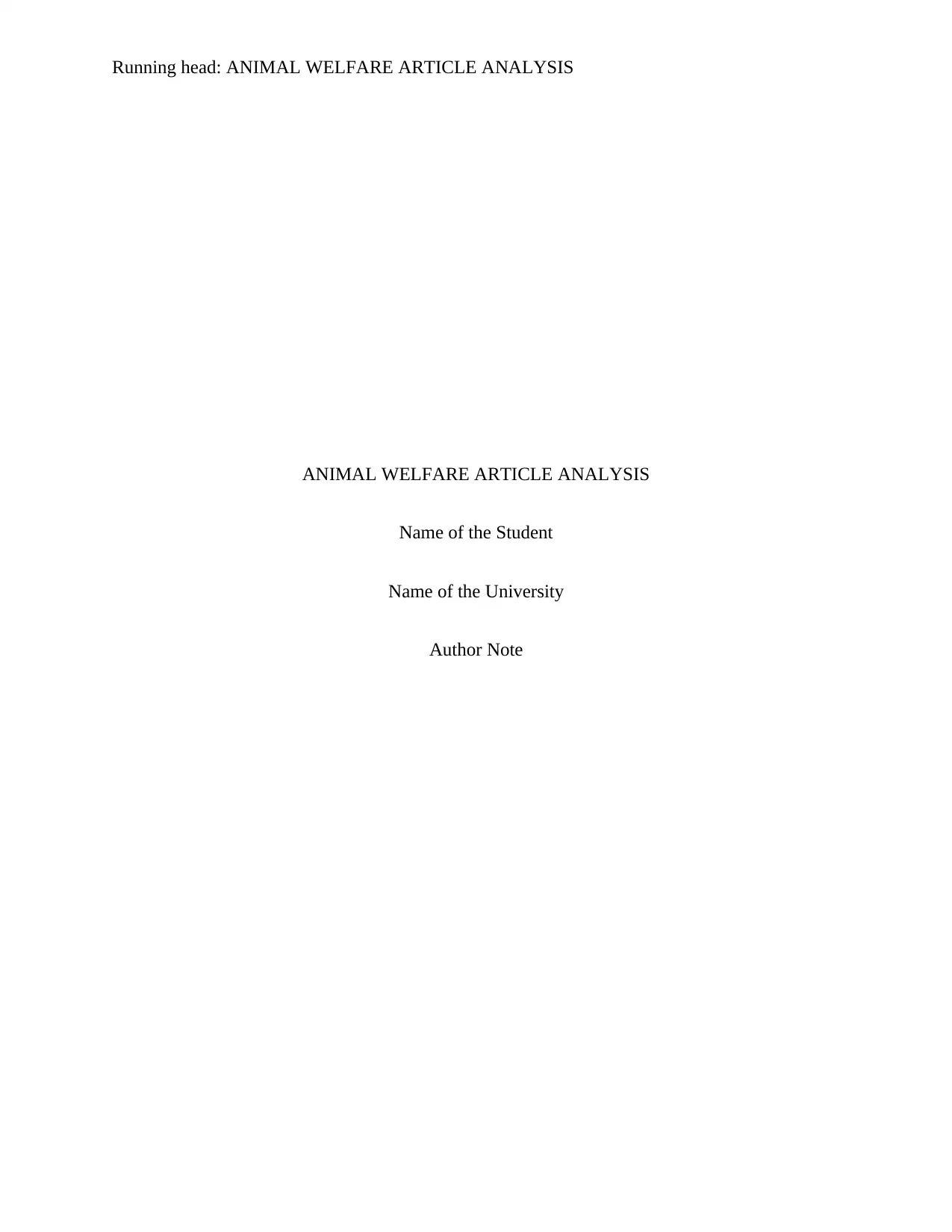
Running head: ANIMAL WELFARE ARTICLE ANALYSIS
ANIMAL WELFARE ARTICLE ANALYSIS
Name of the Student
Name of the University
Author Note
tabler-icon-diamond-filled.svg

Paraphrase This Document

Need a fresh take? Get an instant paraphrase of this document with our AI Paraphraser
Document Page
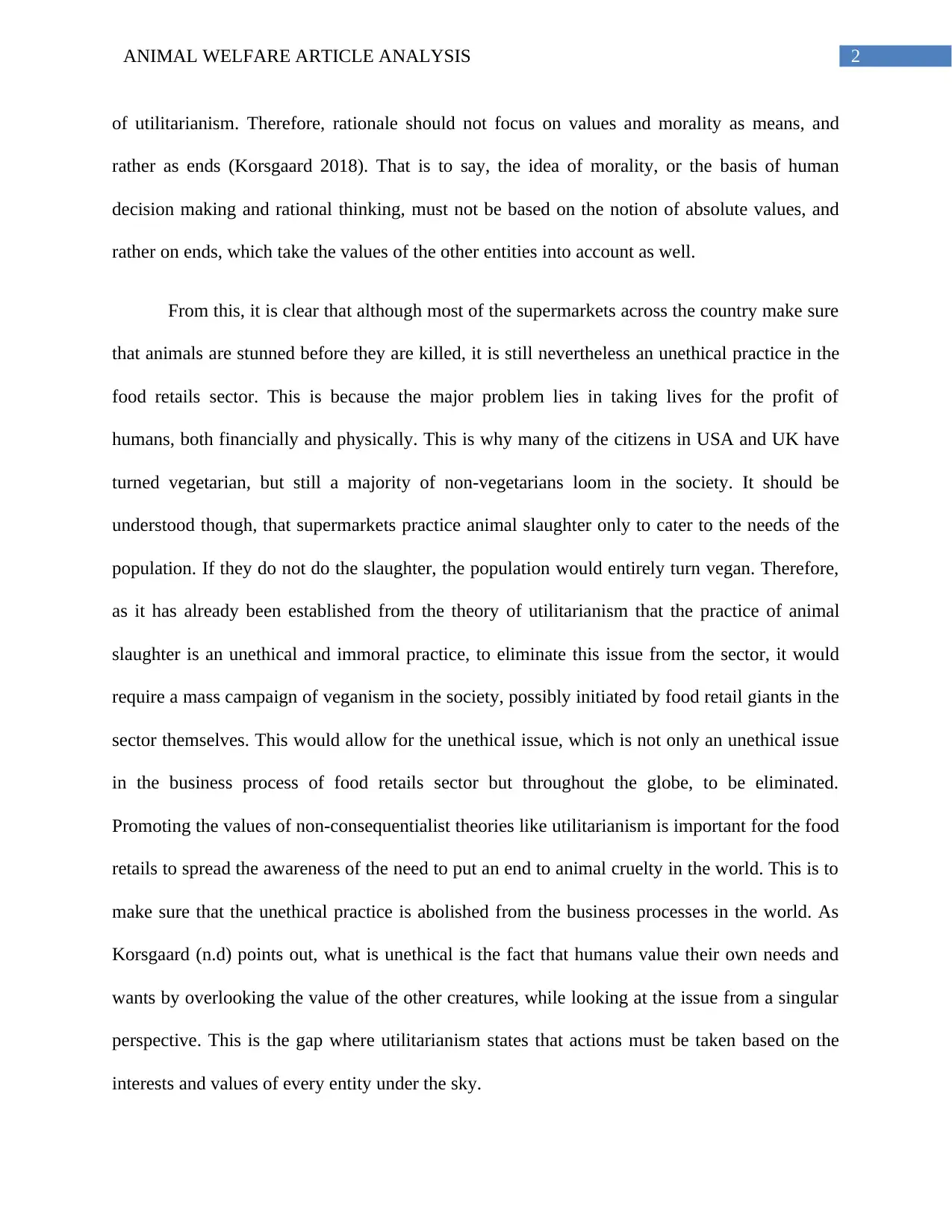
1ANIMAL WELFARE ARTICLE ANALYSIS
In his article titled “What We Owe a Rabbit”, Thomas Nagel refers to Christine
Korsgaard to justify why exactly the practice of animal slaughter and non-veganism is an issue.
Korsgaard is of the opinion that it does not make sense to assume that a human life is more
important than an animal’s. Thomas Nagel in his article brings forth a more complex theory than
utilitarianism, by incorporating utilitarianism and kaantism in his article referring to the
arguments made by Korsgaard and Kaant. According to the article, Korsgaard is of the opinion
that animal lives matter as much as human lives do. Just because they are stunned before they are
slaughtered, does not changed the fact that their lives are taken by humans to suit their needs.
She argues that humans tend to think of a personal perspective, and assume it as a universal law
(Korsgaard n.d.). That is to say, humans have a value of their lives. Animals too have a value of
their lives. For each of the entities, they value their own lives more than they do of the other.
What Korsgaard aims at delivering here is the fact that even though humans think killing animals
harmlessly is morally correct, it does not stand true for the animals as they value their lives more
than they do of the human lives. Morality is universal, and its rationality cannot be based on a
single perspective (Nagel 2019).
Nagel also takes reference from Kant in his article and states that utilitarianism is about
the total amount of happiness gained or pain incurred in an environment, pertaining to a specific
decision or action (Kennington 2018). In the event of humans killing animals, lives of the
animals are lost, but if humans do not kill animals, no entity will be losing out on their valuable
loss, thus creating mutual harmony (Kant 2017). The important thing to note here is that the
author takes animals into the account of the theory, after establishing that the lives of both the
entities are equally important, through the theory of utilitarianism. The author further reasserts
the statement, where Korsgaard argues that there is nothing such as absolute value, in the sense
Document Page
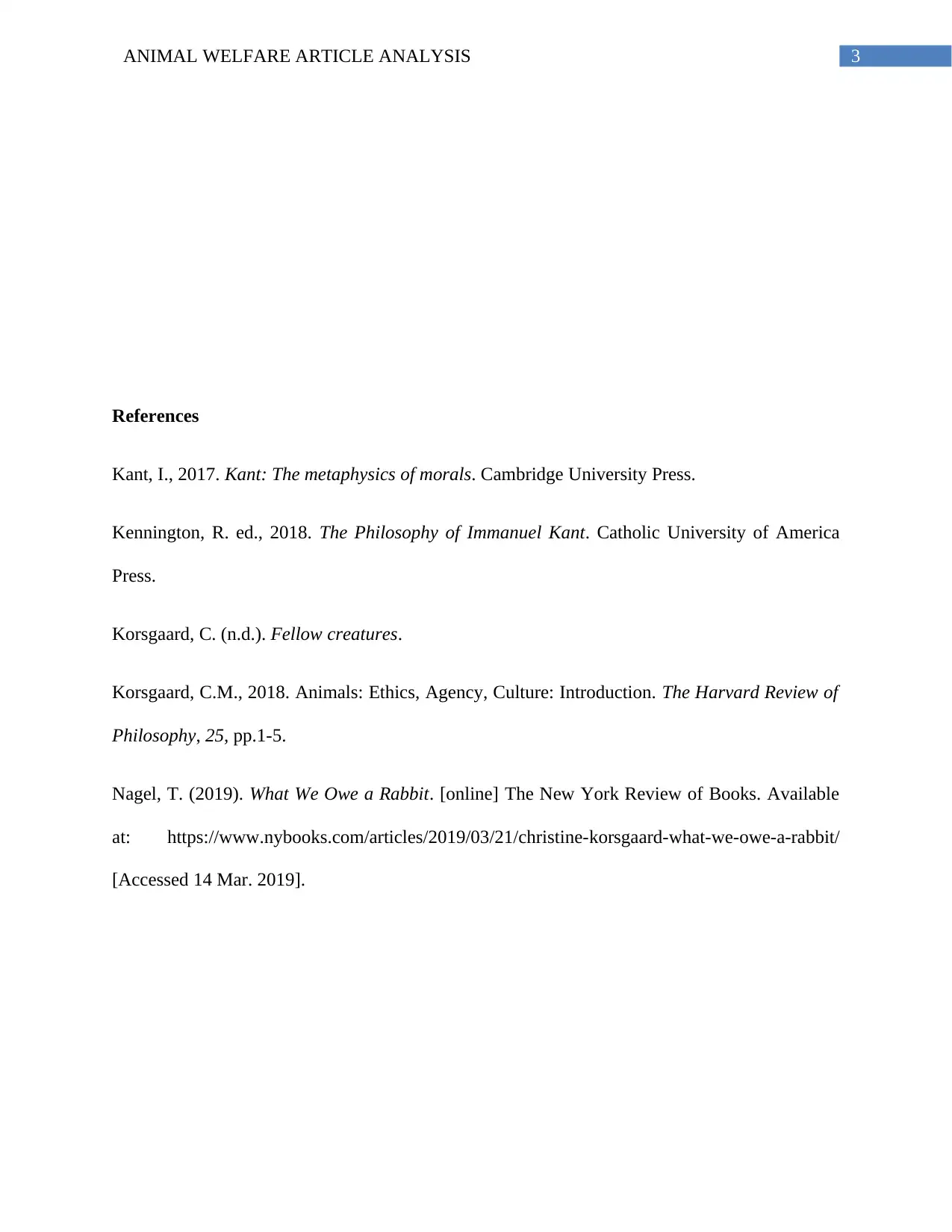
2ANIMAL WELFARE ARTICLE ANALYSIS
of utilitarianism. Therefore, rationale should not focus on values and morality as means, and
rather as ends (Korsgaard 2018). That is to say, the idea of morality, or the basis of human
decision making and rational thinking, must not be based on the notion of absolute values, and
rather on ends, which take the values of the other entities into account as well.
From this, it is clear that although most of the supermarkets across the country make sure
that animals are stunned before they are killed, it is still nevertheless an unethical practice in the
food retails sector. This is because the major problem lies in taking lives for the profit of
humans, both financially and physically. This is why many of the citizens in USA and UK have
turned vegetarian, but still a majority of non-vegetarians loom in the society. It should be
understood though, that supermarkets practice animal slaughter only to cater to the needs of the
population. If they do not do the slaughter, the population would entirely turn vegan. Therefore,
as it has already been established from the theory of utilitarianism that the practice of animal
slaughter is an unethical and immoral practice, to eliminate this issue from the sector, it would
require a mass campaign of veganism in the society, possibly initiated by food retail giants in the
sector themselves. This would allow for the unethical issue, which is not only an unethical issue
in the business process of food retails sector but throughout the globe, to be eliminated.
Promoting the values of non-consequentialist theories like utilitarianism is important for the food
retails to spread the awareness of the need to put an end to animal cruelty in the world. This is to
make sure that the unethical practice is abolished from the business processes in the world. As
Korsgaard (n.d) points out, what is unethical is the fact that humans value their own needs and
wants by overlooking the value of the other creatures, while looking at the issue from a singular
perspective. This is the gap where utilitarianism states that actions must be taken based on the
interests and values of every entity under the sky.
Document Page
3ANIMAL WELFARE ARTICLE ANALYSIS
References
Kant, I., 2017. Kant: The metaphysics of morals. Cambridge University Press.
Kennington, R. ed., 2018. The Philosophy of Immanuel Kant. Catholic University of America
Press.
Korsgaard, C. (n.d.). Fellow creatures.
Korsgaard, C.M., 2018. Animals: Ethics, Agency, Culture: Introduction. The Harvard Review of
Philosophy, 25, pp.1-5.
Nagel, T. (2019). What We Owe a Rabbit. [online] The New York Review of Books. Available
at: https://www.nybooks.com/articles/2019/03/21/christine-korsgaard-what-we-owe-a-rabbit/
[Accessed 14 Mar. 2019].
chevron_up_icon
1 out of 4
circle_padding
hide_on_mobile
zoom_out_icon
[object Object]