Crisis Leadership Evaluation: MMA and Lac-Megantic Case Study

Verified

Added on  2022/09/18

|2
|541
|19
Case Study
AI Summary
This case study analyzes the crisis leadership failures of Edward Burkhardt, the chairman of Montreal, Maine, and Atlantic Railway (MMA), following the Lac-Mégantic train disaster. The assignment evaluates the blame for the crisis, placing it on MMA due to negligence in securing the train. It outlines guidelines for employees representing the organization to the media, emphasizing factual accuracy and avoiding personal commentary. The leader's competence is deemed unacceptable, citing examples of his inappropriate statements and actions, such as highlighting personal losses and deflecting responsibility. The analysis further explores how contextual factors, including physical geography, timing, cultural diversity, and audience response, influenced public reactions to the leader's crisis management. The study highlights the importance of effective crisis communication and leadership in mitigating the impact of such disasters.
Document Page
Case Study:
Question 1: Who would be blamed for the crisis and why?
The blame for the crisis should be on MMA, that is, the organization that owned the train. The
representative of MMA should have further taken measures to ensure that the train was emptied out
since there was evidence of petroleum in it and it should not have been left unmanned (Pearson,
n.d.).
Question 2: In crisis what guidelines should all employees (officers) follow when representing
their organization (country) to the media or the public?
The primary things that all employees or officers should take into consideration when representing
the company in public is that personal gains or losses should not be highlighted and the
specifications of the subject should only be highlighted. There shouldn’t be any finger pointing done
but the actual issue in question must be discussed alone. The officer must refrain from using any
negative comments against anyone on a public platform and only stick to the words that are
important at that particular time.
Question 3: How would you evaluate the leader’s crisis or the official spokesman management
competence? Provide examples of his deeds and words led to your evaluation?
The competence of the leader is unacceptable. The leader should not have highlighted the personal
losses that he received or try to put the blame on someone else. His own officers should have taken
the responsibility of securing the train and ensuring that no other accidents happen as the train was
unmanned when the accident actually occurred. The reporter was asking basic questions that anyone
would ask at this moment. The deeds of the leader like ‘putting words in my mouth’ and ‘lot less
worth as compared to what I was on Saturday’ are some of the leading examples of mistakes done.
Even at fault, the leader was not ready to give a direct answer and said he took some part of the
responsibility alone.
tabler-icon-diamond-filled.svg

Paraphrase This Document

Need a fresh take? Get an instant paraphrase of this document with our AI Paraphraser
Document Page
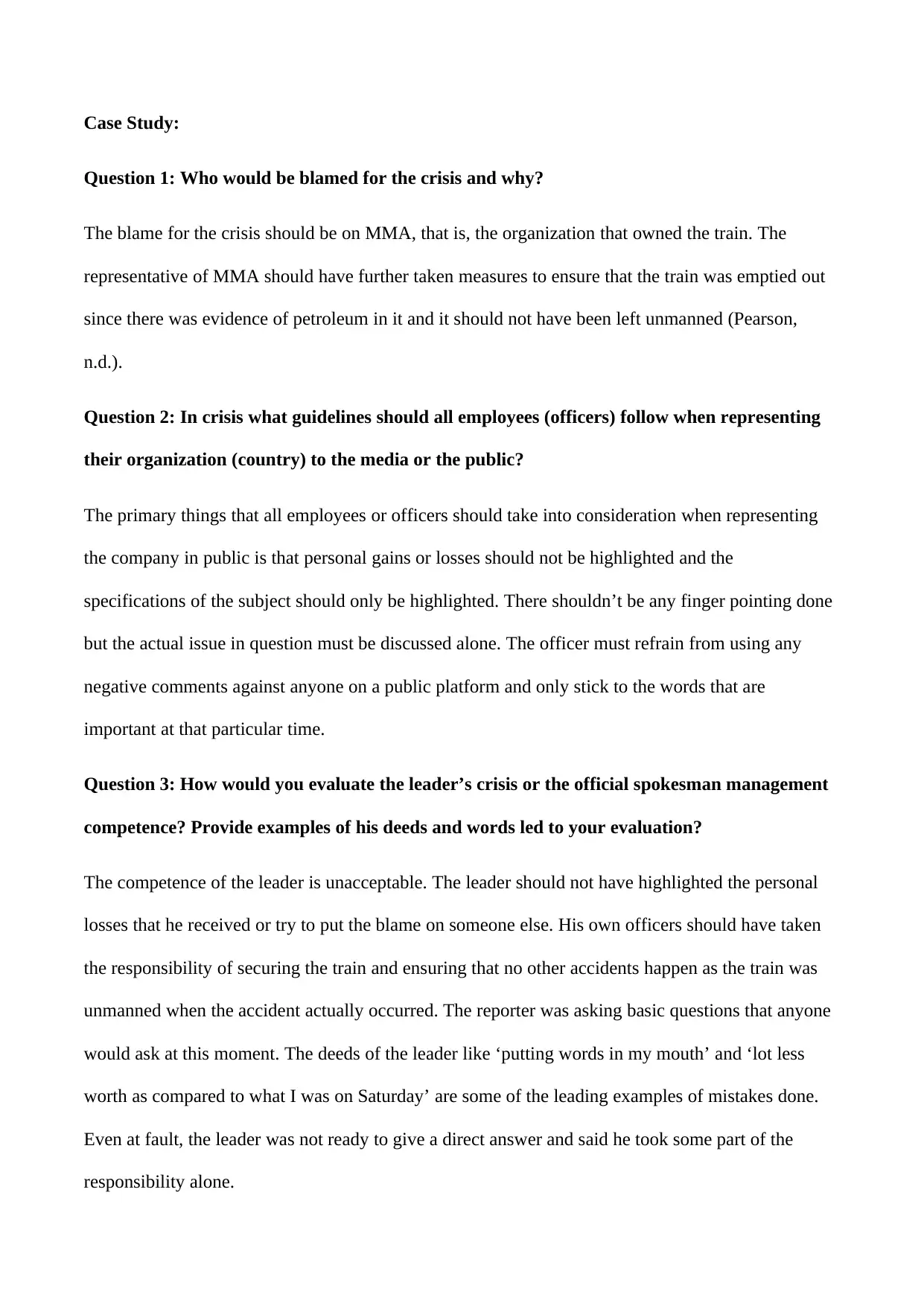
Question 4: How would context (physical geographic environment, setting, timing, cultural
diversity, audience response) have affected public responses to the leader and the crisis?
The physical geography was scary and made the leader nervous. The setting and timing of the
response to the crisis was given 5 days later. Before the leader, several other people had already
visited and responded, like the Canadian PM as well. His timing was not right, he should have been
there before. The leader was an English-French person living and operating in Canada. The response
of the audience was also not positive as they wanted to know about the delay in the response from
MMA. All these factors can be reflected in the response of the audience or the reporter who asked
the questions to the leader.
References:
Pearson, C. M. (n.d.). “Le Train d’Enfer” and the Derailing of Crisis Leadership at Lac-Megantic.
Thunderbird: School of Global Management.
chevron_up_icon
1 out of 2
circle_padding
hide_on_mobile
zoom_out_icon
[object Object]