BIZ202: Environmental Scan Report on Woolworths Business Performance

Verified

Added on  2023/06/10

|8
|1679
|351
Report
AI Summary
This report provides a comprehensive analysis of Woolworths' business environment, focusing on both internal and external factors that influence its performance. It examines the impact of macroeconomic indicators, government regulations, social changes, and technological advancements on Woolworths' business structure and profitability. The report also delves into micro-environmental factors such as suppliers, customers, and competitors, highlighting Woolworths' strategies for managing relationships and delivering value. Furthermore, it addresses the environmental risks and challenges faced by Woolworths, particularly within its global supply chain, and proposes solutions such as collaboration with the Alliance for Water Stewardship and the implementation of the Farming for Future program. The analysis concludes that Woolworths' proactive approach to adapting to environmental changes and mitigating risks is crucial for maintaining its competitive advantage and ensuring long-term sustainability.
Document Page
Running head: BUSINESS ENVIRONMENT
BUSINESS ENVIRONMENT
Name of the University
Name of the Student
Author’s Note
tabler-icon-diamond-filled.svg

Paraphrase This Document

Need a fresh take? Get an instant paraphrase of this document with our AI Paraphraser
Document Page
1BUSINESS ENVIRONMENT
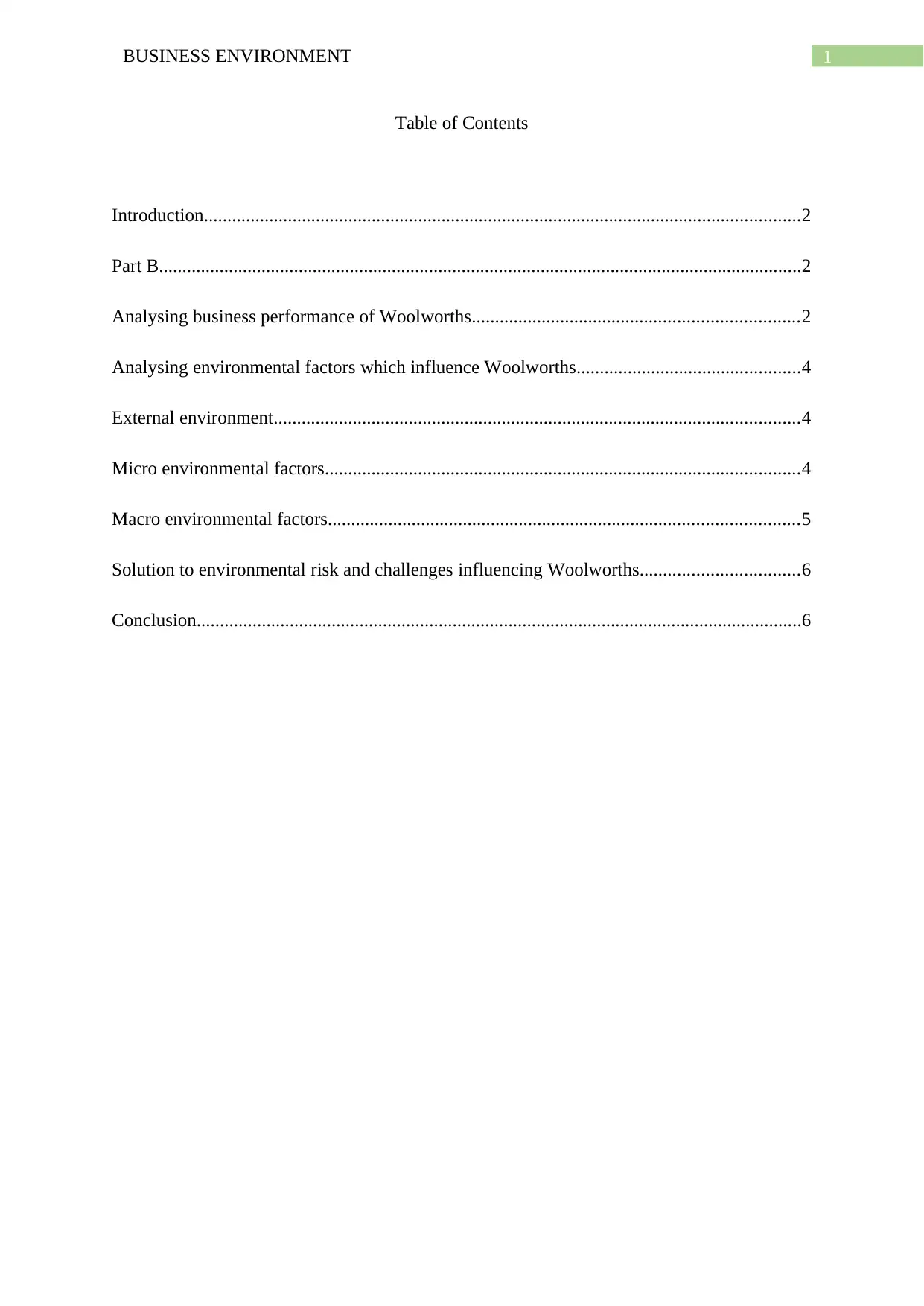
Table of Contents
Introduction................................................................................................................................2
Part B..........................................................................................................................................2
Analysing business performance of Woolworths......................................................................2
Analysing environmental factors which influence Woolworths................................................4
External environment.................................................................................................................4
Micro environmental factors......................................................................................................4
Macro environmental factors.....................................................................................................5
Solution to environmental risk and challenges influencing Woolworths..................................6
Conclusion..................................................................................................................................6
Document Page
2BUSINESS ENVIRONMENT
Introduction
This section of this assessment focuses on the proposed solutions to environmental
challenges that is faced by Woolworths. The business performance of Woolworths involving
few changes in its business structure and profitability occurring from effect of this factors are
analysed in this report. This segment not only focuses on the macroeconomic and political
factors but also on the microeconomic and social factors affecting the business. The solution
to the environmental risk and challenges laid out in the first section is also discussed in this
segment.
Part B
Analysing business performance of Woolworths
The changes in business structure, operational methods and strategies of the enterprise
are vital for sustainability in business. Over the years, Woolworths blends changing business
environment and has made considerable changes in order to accomplish extended demand of
customers and higher values of their choices. This company has been responding towards
new development by proving foundations for assuring growth as well as opportunities. Chen
et al., (2014) opines that changes in business structure is about assuring sustainability in
business operation. The enterprise has made changes in business structure not only by
adopting mobile technology for providing benefit to the customers regarding shopping across
the nation but also in their human resource management. In order to extend the business
operations, Woolworths also made changes in the workers engagement policies. For meeting
the requirements of customers, the enterprise’s human resource department has followed
policies towards employing large number of individuals and working hard for earning their
custom as well as reward their loyalties. The company’s policy towards offering of discount
on their products also enhanced the profitability level of the business.
Document Page
3BUSINESS ENVIRONMENT
Changes in government regulation also influences the business environment of
Woolworths. Even though the government create rules and regulation where the business
have the ability to compete with each other, these regulation can adversely impact
Woolworths. The government change in taxation policy also impacts the cost of business.
Increase in tax leads to rise in cost of business, which in turn lowers the profit margin of the
business (Wheelen et al., 2017). Woolworths then pass this tax on to the customers in terms
of increase in price of product.
Changes in macroeconomic indicators also impacts the businesses environment such
as- employment, interest rate, inflation and consumer confidence. High consumer confidence
present opportunities for Woolworths to enter marketplace while period of customer’s low
confidence also force the enterprise to cut business cost for maintaining profits. Besides this,
when unemployment rate is low, consumer expenditure apt to be high as most individuals
have income for spending, which in turn benefits the company and drives profitability. When
unemployment rate is high, consumer expenditure apt to be low as unemployed individuals
do not have excess income for spending. Higher rates of interest result in higher business
spending for Woolworths with debt. High interest rate also decrease consumer expenditure as
it makes it highly expensive for customers to take loans. Increase in cost also forces
Woolworths to increase prices on the products for keeping pace with inflation and
maintaining profits. Social changes also impact Woolworth’s future plans. Woolworths
understand individuals changing requirement and wants in order to remain abreast of trends
as well as remain competitive in the marketplace. Changing personal priorities of the
individuals enhance the cost of business, which in turn influences the profitability level. In
addition to this, corporate social responsibility provides employees of Woolworth’s
invaluable feeling of making difference and thus positive impact on this business.
tabler-icon-diamond-filled.svg

Paraphrase This Document

Need a fresh take? Get an instant paraphrase of this document with our AI Paraphraser
Document Page
4BUSINESS ENVIRONMENT
Analysing environmental factors which influence Woolworths
External environment
The external environment are of two types- macro environment and micro
environment. The environmental factors that influence the business of Woolworths are
described below-
Micro environmental factors
Internal environment is also taken into account a part of microenvironment. The
forces that are part of microenvironment are suppliers, customers, other markets where
products are sold, intermediaries, competitors that are generally direct or indirect
stakeholders of enterprise. Woolworth has committed partnerships with their suppliers for
developing long- term and building relationship with others (Sarooghi, Libaers & Burkemper,
2015). These partnerships are mutually beneficial to both Woolworths and its suppliers. They
have also introduced speaking up service in which trade partners might report fraud, breach
of law, corruption and so on. This leads to value delivery to its customers in form of products
(Kew & Stredwick, 2017).
The relation with marketing channels such as resellers, logistics chain in between
customers and suppliers is driven by Woolworth values. This enterprise also has huge
collaboration with the farmers for delivering quality products. The company’s close
relationships with its suppliers facilitate to attain higher profitability. Woolworth adopts
numerous strategies and methods for responding to changing requirements of customers.
Woolworth also attains feedback from their customers in order to make improvement in its
products and services.
Document Page
5BUSINESS ENVIRONMENT
Macro environmental factors
Factors that make up macro- economic environment mainly operates externally to
enterprise. The organization modifies their marketing as well as management strategies for
dealing with these factors. These factors are political, technological, economic , cultural and
demographic in nature.
Political-legal forces
Political or legal forces are highly strong in business environment as it creates opportunities
for them by way different market rules (Gupta, 2012). Woolworth has good constitution that
outlines their rules as well as policies. Moreover, it has proper code of conduct, shareholders
communication policy and securities policy. These policies assure that individuals linked
with this organization comply with law.
Technological forces
Woolworth integrates self- check machines that enables customers to improve on their
shopping. This company has applied software in order to monitor all their business activities.
In addition to this, Woolworths introduced Visa’s Paywave for shortening waiting time of
customers.
Economic factors
Economic factors plays vital role in Woolworths business as they determine
consumers purchasing power. As the economy of Australia is free from issues, it does not
impact the business of Woolworth (Wang, Chen & Chen, 2012).
Cultural factors
Socio- cultural factors brings about change in actions of the organization. By linking
to environmental initiatives and technological innovations, this enterprise has responded to
Document Page
6BUSINESS ENVIRONMENT
such changes in better way (Prajogo, 2016). They brings about fresh produce for the
customers by expanding new areas in business.
Solution to environmental risk and challenges influencing Woolworths
Woolworth face several challenges in global supply chain involving impact of
weather events, reducing water quality and rising input cost. Woolworths work together with
its suppliers for minimizing environmental challenges and risk. This in turn positively
impacts social as well as environmental outcomes of doing business. Woolworth mainly
works in connection with Alliance for Water Stewardship for addressing water relating risk in
supply chain. They also developed Farming for future programme in order to manage and
transform the environmental performance among the suppliers.
Conclusion
From the above discussion, it can be concluded that both internal as well as external
environment impacts all the enterprise. Woolworth adopts numerous strategies and methods
for mitigating with environmental risk and changes. They modify few strategies in order to
cope with government policies and regulations. Overall, these strategies facilitate
Woolworths to gain competitive advantage over its competitors.
tabler-icon-diamond-filled.svg

Paraphrase This Document

Need a fresh take? Get an instant paraphrase of this document with our AI Paraphraser
Document Page
7BUSINESS ENVIRONMENT
References
Chen, Y., Wang, Y., Nevo, S., Jin, J., Wang, L., & Chow, W. S. (2014). IT capability and
organizational performance: the roles of business process agility and environmental
factors. European Journal of Information Systems, 23(3), 326-342.
Gupta, A. (2013). Environment & PEST analysis: an approach to external business
environment. International Journal of Modern Social Sciences, 2(1), 34-43.
Kew, J., & Stredwick, J. (2017). Business environment: managing in a strategic context.
Kogan Page Publishers.
Prajogo, D. I. (2016). The strategic fit between innovation strategies and business
environment in delivering business performance. International Journal of Production
Economics, 171, 241-249.
Sarooghi, H., Libaers, D. & Burkemper, A.,(2015). Examining the relationship between
creativity and innovation: A meta-analysis of organizational, cultural, and environmental
factors. Journal of business venturing, 30(5), pp.714-731.
Wang, C. H., Chen, K. Y., & Chen, S. C. (2012). Total quality management, market
orientation and hotel performance: The moderating effects of external environmental
factors. International Journal of Hospitality Management, 31(1), 119-129.
Wheelen, T. L., Hunger, J. D., Hoffman, A. N., & Bamford, C. E. (2017). Strategic
management and business policy. pearson.
chevron_up_icon
1 out of 8
circle_padding
hide_on_mobile
zoom_out_icon
[object Object]