MGT605 Project Proposal: Knowledge Management & Decision-Making
VerifiedAdded on 2023/06/04
|15
|2581
|494
Project
AI Summary
This project proposal aims to assess the impact of knowledge management on the decision-making process at Woolworths. It identifies Woolworths' leadership style, assesses decision-making techniques, and examines the impact of knowledge management. The proposal includes research objectives, questions, and significance, followed by a literature review covering knowledge management, decision-making processes, Original Knowledge Creation Theory, Impression Management Theory, and Classical Decision-Making Theory. A conceptual framework illustrates the relationship between knowledge management, employee skills, and productivity. The methodology outlines the research philosophy (positivism), design (exploratory), approach (deductive), data collection (primary quantitative), and analysis methods. The proposal also details the sample size, sampling technique, ethical considerations, and a timeline for the project. This assignment is available on Desklib, where students can find a wealth of study resources including past papers and solved assignments.

Running head: BUSINESS PROPOSAL
Proposal on Impact of knowledge management on decision making process: A case study of
Woolworths
Name of the student:
Name of the university:
Author note:
Proposal on Impact of knowledge management on decision making process: A case study of
Woolworths
Name of the student:
Name of the university:
Author note:

Paraphrase This Document
Need a fresh take? Get an instant paraphrase of this document with our AI Paraphraser
1
BUSINESS PROPOSAL
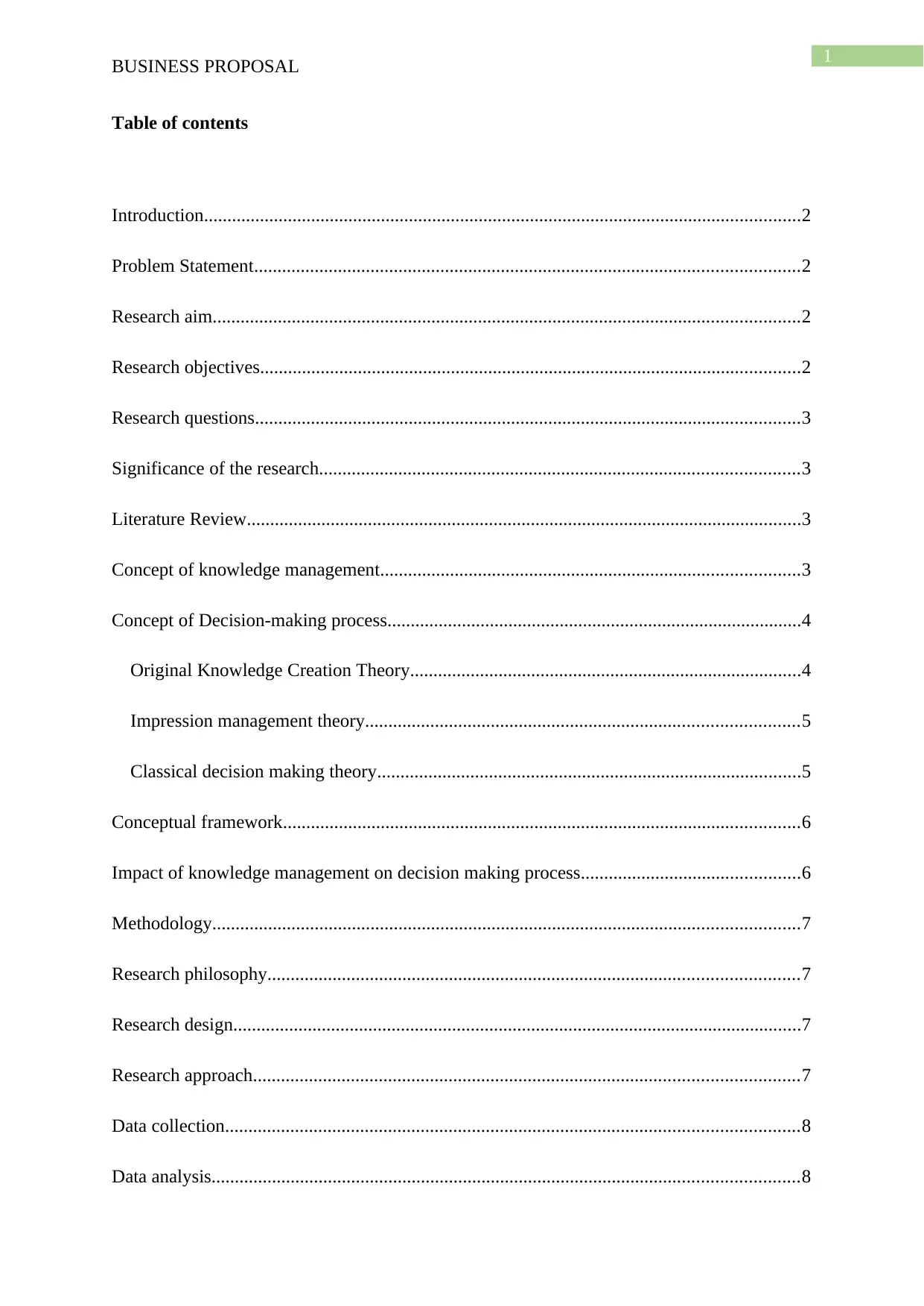
Table of contents
Introduction................................................................................................................................2
Problem Statement.....................................................................................................................2
Research aim..............................................................................................................................2
Research objectives....................................................................................................................2
Research questions.....................................................................................................................3
Significance of the research.......................................................................................................3
Literature Review.......................................................................................................................3
Concept of knowledge management..........................................................................................3
Concept of Decision-making process.........................................................................................4
Original Knowledge Creation Theory....................................................................................4
Impression management theory.............................................................................................5
Classical decision making theory...........................................................................................5
Conceptual framework...............................................................................................................6
Impact of knowledge management on decision making process...............................................6
Methodology..............................................................................................................................7
Research philosophy..................................................................................................................7
Research design..........................................................................................................................7
Research approach.....................................................................................................................7
Data collection...........................................................................................................................8
Data analysis..............................................................................................................................8
BUSINESS PROPOSAL
Table of contents
Introduction................................................................................................................................2
Problem Statement.....................................................................................................................2
Research aim..............................................................................................................................2
Research objectives....................................................................................................................2
Research questions.....................................................................................................................3
Significance of the research.......................................................................................................3
Literature Review.......................................................................................................................3
Concept of knowledge management..........................................................................................3
Concept of Decision-making process.........................................................................................4
Original Knowledge Creation Theory....................................................................................4
Impression management theory.............................................................................................5
Classical decision making theory...........................................................................................5
Conceptual framework...............................................................................................................6
Impact of knowledge management on decision making process...............................................6
Methodology..............................................................................................................................7
Research philosophy..................................................................................................................7
Research design..........................................................................................................................7
Research approach.....................................................................................................................7
Data collection...........................................................................................................................8
Data analysis..............................................................................................................................8

2
BUSINESS PROPOSAL
Sample size.................................................................................................................................8
Sampling technique....................................................................................................................9
Ethical considerations................................................................................................................9
Timeline.....................................................................................................................................9
References................................................................................................................................11
BUSINESS PROPOSAL
Sample size.................................................................................................................................8
Sampling technique....................................................................................................................9
Ethical considerations................................................................................................................9
Timeline.....................................................................................................................................9
References................................................................................................................................11
⊘ This is a preview!⊘
Do you want full access?
Subscribe today to unlock all pages.

Trusted by 1+ million students worldwide
3
BUSINESS PROPOSAL
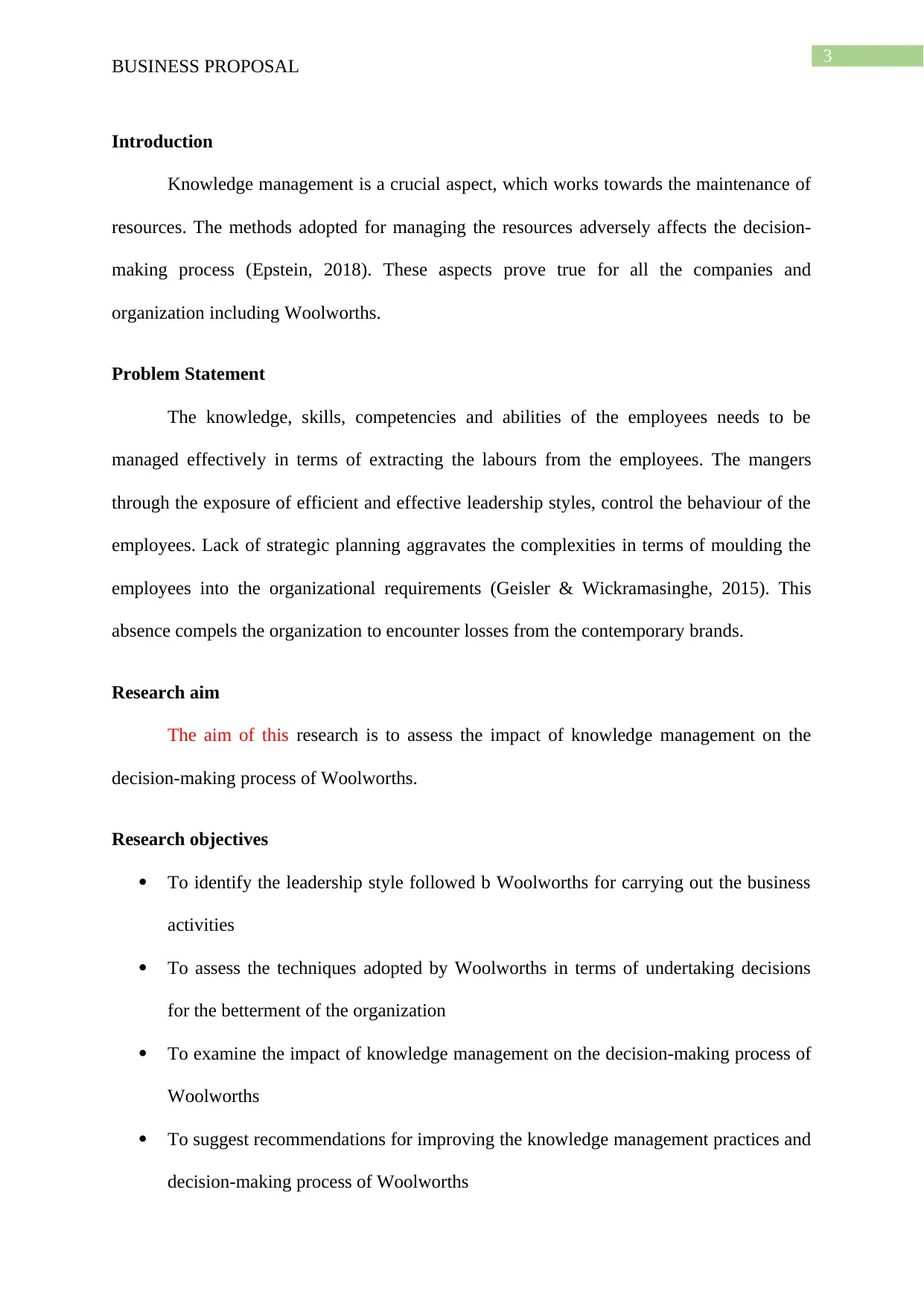
Introduction
Knowledge management is a crucial aspect, which works towards the maintenance of
resources. The methods adopted for managing the resources adversely affects the decision-
making process (Epstein, 2018). These aspects prove true for all the companies and
organization including Woolworths.
Problem Statement
The knowledge, skills, competencies and abilities of the employees needs to be
managed effectively in terms of extracting the labours from the employees. The mangers
through the exposure of efficient and effective leadership styles, control the behaviour of the
employees. Lack of strategic planning aggravates the complexities in terms of moulding the
employees into the organizational requirements (Geisler & Wickramasinghe, 2015). This
absence compels the organization to encounter losses from the contemporary brands.
Research aim
The aim of this research is to assess the impact of knowledge management on the
decision-making process of Woolworths.
Research objectives
To identify the leadership style followed b Woolworths for carrying out the business
activities
To assess the techniques adopted by Woolworths in terms of undertaking decisions
for the betterment of the organization
To examine the impact of knowledge management on the decision-making process of
Woolworths
To suggest recommendations for improving the knowledge management practices and
decision-making process of Woolworths
BUSINESS PROPOSAL
Introduction
Knowledge management is a crucial aspect, which works towards the maintenance of
resources. The methods adopted for managing the resources adversely affects the decision-
making process (Epstein, 2018). These aspects prove true for all the companies and
organization including Woolworths.
Problem Statement
The knowledge, skills, competencies and abilities of the employees needs to be
managed effectively in terms of extracting the labours from the employees. The mangers
through the exposure of efficient and effective leadership styles, control the behaviour of the
employees. Lack of strategic planning aggravates the complexities in terms of moulding the
employees into the organizational requirements (Geisler & Wickramasinghe, 2015). This
absence compels the organization to encounter losses from the contemporary brands.
Research aim
The aim of this research is to assess the impact of knowledge management on the
decision-making process of Woolworths.
Research objectives
To identify the leadership style followed b Woolworths for carrying out the business
activities
To assess the techniques adopted by Woolworths in terms of undertaking decisions
for the betterment of the organization
To examine the impact of knowledge management on the decision-making process of
Woolworths
To suggest recommendations for improving the knowledge management practices and
decision-making process of Woolworths
Paraphrase This Document
Need a fresh take? Get an instant paraphrase of this document with our AI Paraphraser
4
BUSINESS PROPOSAL
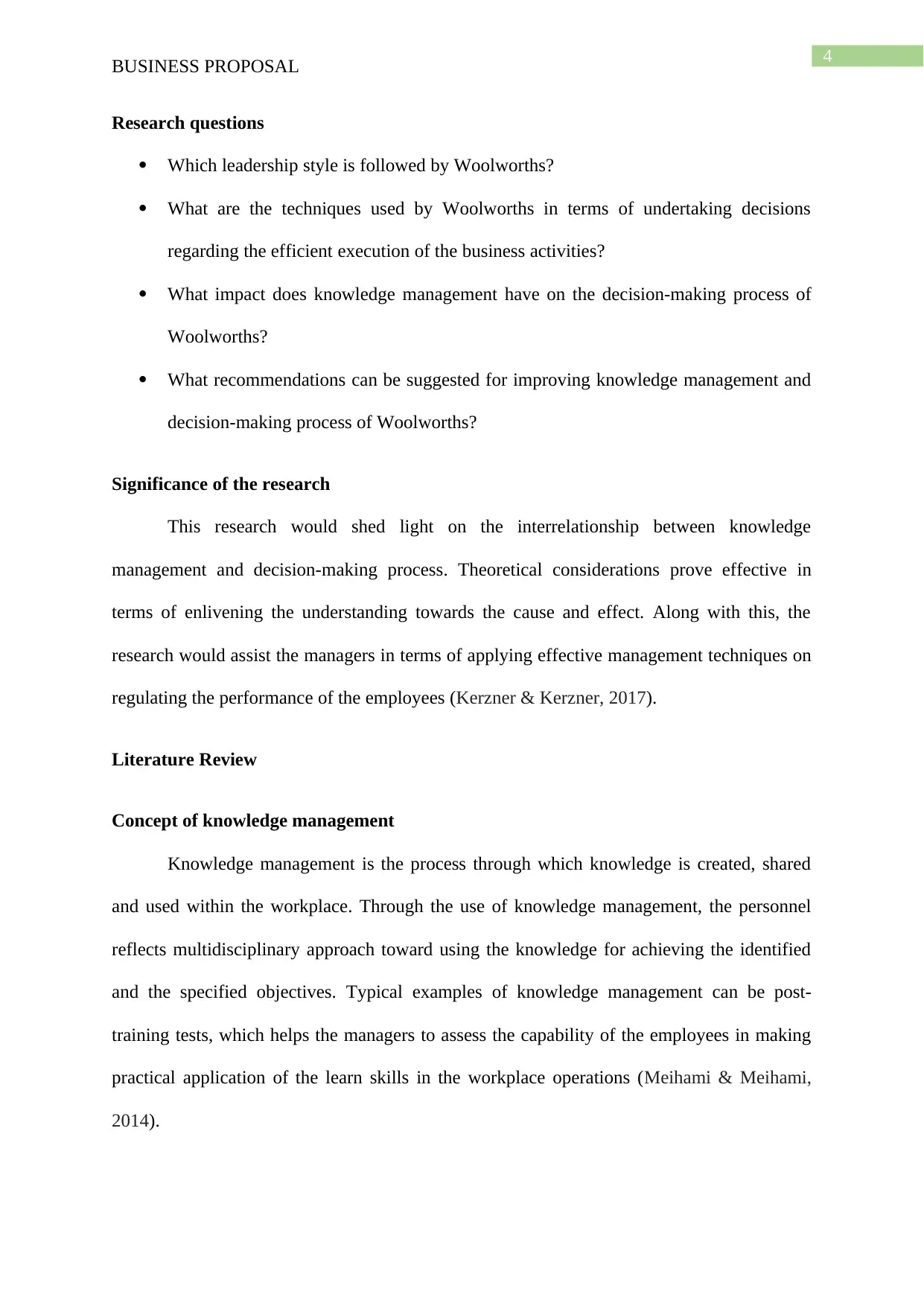
Research questions
Which leadership style is followed by Woolworths?
What are the techniques used by Woolworths in terms of undertaking decisions
regarding the efficient execution of the business activities?
What impact does knowledge management have on the decision-making process of
Woolworths?
What recommendations can be suggested for improving knowledge management and
decision-making process of Woolworths?
Significance of the research
This research would shed light on the interrelationship between knowledge
management and decision-making process. Theoretical considerations prove effective in
terms of enlivening the understanding towards the cause and effect. Along with this, the
research would assist the managers in terms of applying effective management techniques on
regulating the performance of the employees (Kerzner & Kerzner, 2017).
Literature Review
Concept of knowledge management
Knowledge management is the process through which knowledge is created, shared
and used within the workplace. Through the use of knowledge management, the personnel
reflects multidisciplinary approach toward using the knowledge for achieving the identified
and the specified objectives. Typical examples of knowledge management can be post-
training tests, which helps the managers to assess the capability of the employees in making
practical application of the learn skills in the workplace operations (Meihami & Meihami,
2014).
BUSINESS PROPOSAL
Research questions
Which leadership style is followed by Woolworths?
What are the techniques used by Woolworths in terms of undertaking decisions
regarding the efficient execution of the business activities?
What impact does knowledge management have on the decision-making process of
Woolworths?
What recommendations can be suggested for improving knowledge management and
decision-making process of Woolworths?
Significance of the research
This research would shed light on the interrelationship between knowledge
management and decision-making process. Theoretical considerations prove effective in
terms of enlivening the understanding towards the cause and effect. Along with this, the
research would assist the managers in terms of applying effective management techniques on
regulating the performance of the employees (Kerzner & Kerzner, 2017).
Literature Review
Concept of knowledge management
Knowledge management is the process through which knowledge is created, shared
and used within the workplace. Through the use of knowledge management, the personnel
reflects multidisciplinary approach toward using the knowledge for achieving the identified
and the specified objectives. Typical examples of knowledge management can be post-
training tests, which helps the managers to assess the capability of the employees in making
practical application of the learn skills in the workplace operations (Meihami & Meihami,
2014).
5
BUSINESS PROPOSAL
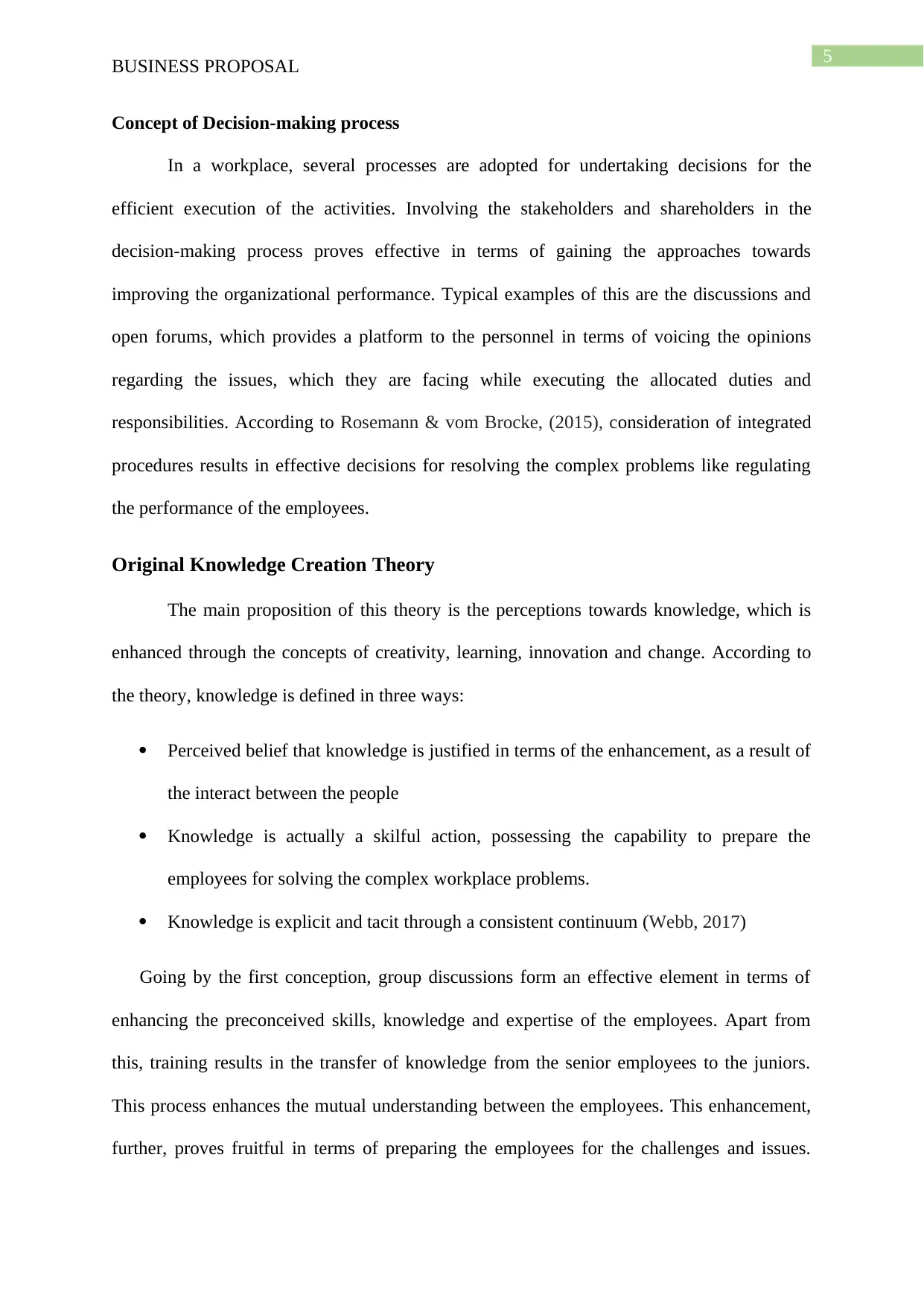
Concept of Decision-making process
In a workplace, several processes are adopted for undertaking decisions for the
efficient execution of the activities. Involving the stakeholders and shareholders in the
decision-making process proves effective in terms of gaining the approaches towards
improving the organizational performance. Typical examples of this are the discussions and
open forums, which provides a platform to the personnel in terms of voicing the opinions
regarding the issues, which they are facing while executing the allocated duties and
responsibilities. According to Rosemann & vom Brocke, (2015), consideration of integrated
procedures results in effective decisions for resolving the complex problems like regulating
the performance of the employees.
Original Knowledge Creation Theory
The main proposition of this theory is the perceptions towards knowledge, which is
enhanced through the concepts of creativity, learning, innovation and change. According to
the theory, knowledge is defined in three ways:
Perceived belief that knowledge is justified in terms of the enhancement, as a result of
the interact between the people
Knowledge is actually a skilful action, possessing the capability to prepare the
employees for solving the complex workplace problems.
Knowledge is explicit and tacit through a consistent continuum (Webb, 2017)
Going by the first conception, group discussions form an effective element in terms of
enhancing the preconceived skills, knowledge and expertise of the employees. Apart from
this, training results in the transfer of knowledge from the senior employees to the juniors.
This process enhances the mutual understanding between the employees. This enhancement,
further, proves fruitful in terms of preparing the employees for the challenges and issues.
BUSINESS PROPOSAL
Concept of Decision-making process
In a workplace, several processes are adopted for undertaking decisions for the
efficient execution of the activities. Involving the stakeholders and shareholders in the
decision-making process proves effective in terms of gaining the approaches towards
improving the organizational performance. Typical examples of this are the discussions and
open forums, which provides a platform to the personnel in terms of voicing the opinions
regarding the issues, which they are facing while executing the allocated duties and
responsibilities. According to Rosemann & vom Brocke, (2015), consideration of integrated
procedures results in effective decisions for resolving the complex problems like regulating
the performance of the employees.
Original Knowledge Creation Theory
The main proposition of this theory is the perceptions towards knowledge, which is
enhanced through the concepts of creativity, learning, innovation and change. According to
the theory, knowledge is defined in three ways:
Perceived belief that knowledge is justified in terms of the enhancement, as a result of
the interact between the people
Knowledge is actually a skilful action, possessing the capability to prepare the
employees for solving the complex workplace problems.
Knowledge is explicit and tacit through a consistent continuum (Webb, 2017)
Going by the first conception, group discussions form an effective element in terms of
enhancing the preconceived skills, knowledge and expertise of the employees. Apart from
this, training results in the transfer of knowledge from the senior employees to the juniors.
This process enhances the mutual understanding between the employees. This enhancement,
further, proves fruitful in terms of preparing the employees for the challenges and issues.
⊘ This is a preview!⊘
Do you want full access?
Subscribe today to unlock all pages.
Trusted by 1+ million students worldwide
6
BUSINESS PROPOSAL
Here, managerial assistance is crucial in terms of averting any illegal instances. Explicit
representation of tacit knowledge through consistent evaluation helps in upgrading the
standards and evaluation of the knowledge management practices (Meihami& Meihami,
2014).
Impression management theory
According to this theory, social interaction bears resemblance to the theatrical
performance. Countering this, not all interactions are like theatrical performance. This is
because some of the interactions are informal and lack ornamentation. One of the other
considerations of the theory is the engagement of the employees into the scripted behaviours.
This is in terms of exposing persuasive tone towards the other person. The main aim of this
theory is creating impression of the other person. The goal here is to attain an advantageous
position, where positive image is created on the other person (Kerzner & Kerzner, 2017).
Theorists are of the opinion that the members of the individual groups play their respective
parts. This is true in terms of the allocated duties and responsibilities to the members.
Classical decision making theory
According to the classical view, decision-making is conducted through the
consideration of rationality. The theory is based on the following steps:
Obtaining the information
Evaluation of the information
Aligning the choice with the objectives
Obtaining the information about the problems and the issues, supports the personnel in
gaining information about the approaches towards the issues. Evaluation of the approaches
helps in reaching to the appropriate solutions for the complex problems. This evaluation
BUSINESS PROPOSAL
Here, managerial assistance is crucial in terms of averting any illegal instances. Explicit
representation of tacit knowledge through consistent evaluation helps in upgrading the
standards and evaluation of the knowledge management practices (Meihami& Meihami,
2014).
Impression management theory
According to this theory, social interaction bears resemblance to the theatrical
performance. Countering this, not all interactions are like theatrical performance. This is
because some of the interactions are informal and lack ornamentation. One of the other
considerations of the theory is the engagement of the employees into the scripted behaviours.
This is in terms of exposing persuasive tone towards the other person. The main aim of this
theory is creating impression of the other person. The goal here is to attain an advantageous
position, where positive image is created on the other person (Kerzner & Kerzner, 2017).
Theorists are of the opinion that the members of the individual groups play their respective
parts. This is true in terms of the allocated duties and responsibilities to the members.
Classical decision making theory
According to the classical view, decision-making is conducted through the
consideration of rationality. The theory is based on the following steps:
Obtaining the information
Evaluation of the information
Aligning the choice with the objectives
Obtaining the information about the problems and the issues, supports the personnel in
gaining information about the approaches towards the issues. Evaluation of the approaches
helps in reaching to the appropriate solutions for the complex problems. This evaluation
Paraphrase This Document
Need a fresh take? Get an instant paraphrase of this document with our AI Paraphraser
7
BUSINESS PROPOSAL
aligns the choices provided to the employees with the identified and the specified objectives
(Geisler & Wickramasinghe, 2015).
Conceptual framework
Fig: Conceptual framework
Impact of knowledge management on decision making process
Engaging the employees, in the decision making process, upgrades their knowledge,
skills and competencies. Training results in knowledge transfer from the senior to the junior
employees. Motivation and encouragement to the employees generates within them an urge
to expose better performance. Training is one of the practices in terms of managing the skills
and knowledge of the employees. Post training tests is assistance in terms of assessing the
capability of the employees in terms of making practical application of the learnt skills in
executing the workplace operations (Meihami & Meihami, 2014).
Productivity
Knowledge
management
Decision making
process
Improved skills,
abilities and
competencies of
the employees
BUSINESS PROPOSAL
aligns the choices provided to the employees with the identified and the specified objectives
(Geisler & Wickramasinghe, 2015).
Conceptual framework
Fig: Conceptual framework
Impact of knowledge management on decision making process
Engaging the employees, in the decision making process, upgrades their knowledge,
skills and competencies. Training results in knowledge transfer from the senior to the junior
employees. Motivation and encouragement to the employees generates within them an urge
to expose better performance. Training is one of the practices in terms of managing the skills
and knowledge of the employees. Post training tests is assistance in terms of assessing the
capability of the employees in terms of making practical application of the learnt skills in
executing the workplace operations (Meihami & Meihami, 2014).
Productivity
Knowledge
management
Decision making
process
Improved skills,
abilities and
competencies of
the employees
8
BUSINESS PROPOSAL
Methodology
Research philosophy
In a research, there are three types of philosophy- positivism, post positivism and
interpretivism. Positivism helps the researcher in projecting the scientific, real and objective
knowledge related to the subject matter of the research. Post positivism assists the researcher
to bring out the results of the scientific and objective knowledge related to the subject of the
research. Interpretivism supports the researcher in terms of interpreting possible facts from
the real, scientific and the objective facts (Mackey & Gass, 2015). In this research, the
researcher would choose positivism philosophy for establishing the real and scientific facts
related to the impact of knowledge management on the decision-making process of
Woolworths.
Research design
A research is conducted mainly through three designs- exploratory, explanatory and
descriptive. Exploratory design assists the researcher to explore the minute details related to
the subject matter of the research. Explanatory and descriptive design consumes much time
(Taylor, Bogdan & DeVault, 2015). Therefore, the researcher would select explorative design
for exploring the factors, which influence the decision-making process of Woolworths.
Research approach
A research is done mainly through two types of approaches- inductive and deductive.
Deductive approach helps the researcher to deduce relevant facts, ideas and concepts from the
facts, which have been established. Inductive approach needs the researcher to create new
theories, facts and ideas about the subject matter of the research (Flick, 2015). In this
research, the researcher would select deductive approach for deducing relevant ideas, theories
BUSINESS PROPOSAL
Methodology
Research philosophy
In a research, there are three types of philosophy- positivism, post positivism and
interpretivism. Positivism helps the researcher in projecting the scientific, real and objective
knowledge related to the subject matter of the research. Post positivism assists the researcher
to bring out the results of the scientific and objective knowledge related to the subject of the
research. Interpretivism supports the researcher in terms of interpreting possible facts from
the real, scientific and the objective facts (Mackey & Gass, 2015). In this research, the
researcher would choose positivism philosophy for establishing the real and scientific facts
related to the impact of knowledge management on the decision-making process of
Woolworths.
Research design
A research is conducted mainly through three designs- exploratory, explanatory and
descriptive. Exploratory design assists the researcher to explore the minute details related to
the subject matter of the research. Explanatory and descriptive design consumes much time
(Taylor, Bogdan & DeVault, 2015). Therefore, the researcher would select explorative design
for exploring the factors, which influence the decision-making process of Woolworths.
Research approach
A research is done mainly through two types of approaches- inductive and deductive.
Deductive approach helps the researcher to deduce relevant facts, ideas and concepts from the
facts, which have been established. Inductive approach needs the researcher to create new
theories, facts and ideas about the subject matter of the research (Flick, 2015). In this
research, the researcher would select deductive approach for deducing relevant ideas, theories
⊘ This is a preview!⊘
Do you want full access?
Subscribe today to unlock all pages.
Trusted by 1+ million students worldwide
9
BUSINESS PROPOSAL
and facts from the collected data regarding the impact of knowledge management on the
decision-making process of Woolworths.
Data collection
The data needed for completing a research is collected mainly through primary and
secondary methods. These methods are subdivided into quantitative and qualitative. In
primary quantitative, data is collected through the means of surveys. In primary qualitative,
interviews are the sources, which help the researcher in completing the data collection
process. In secondary method, data is collected through journals, articles and books on the
subject matter of the research (Panneerselvam, 2014). In this research, the researcher would
choose primary quantitative method for collecting data on the role of knowledge management
on the decision-making process of Woolworths.
Data analysis
The collected data, in a research, is analysed through primary and secondary methods,
which are further subdivided into quantitative and qualitative. In primary quantitative,
qualitative, responses of survey and interview questions form the basis for analysing the
collected data. In secondary methods, relevant themes are developed, based on which the
analysis is done (Smith, 2015). In this research, the researcher would use primary quantitative
methods for analysing the collected data on the impact of knowledge management on the
decision-making process of Woolworths. Interview questions would be prepared for
analysing the responses of the managers on the role of knowledge management on the
decisions making process. The responses would be depicted through tables, charts and
graphs.
BUSINESS PROPOSAL
and facts from the collected data regarding the impact of knowledge management on the
decision-making process of Woolworths.
Data collection
The data needed for completing a research is collected mainly through primary and
secondary methods. These methods are subdivided into quantitative and qualitative. In
primary quantitative, data is collected through the means of surveys. In primary qualitative,
interviews are the sources, which help the researcher in completing the data collection
process. In secondary method, data is collected through journals, articles and books on the
subject matter of the research (Panneerselvam, 2014). In this research, the researcher would
choose primary quantitative method for collecting data on the role of knowledge management
on the decision-making process of Woolworths.
Data analysis
The collected data, in a research, is analysed through primary and secondary methods,
which are further subdivided into quantitative and qualitative. In primary quantitative,
qualitative, responses of survey and interview questions form the basis for analysing the
collected data. In secondary methods, relevant themes are developed, based on which the
analysis is done (Smith, 2015). In this research, the researcher would use primary quantitative
methods for analysing the collected data on the impact of knowledge management on the
decision-making process of Woolworths. Interview questions would be prepared for
analysing the responses of the managers on the role of knowledge management on the
decisions making process. The responses would be depicted through tables, charts and
graphs.
Paraphrase This Document
Need a fresh take? Get an instant paraphrase of this document with our AI Paraphraser
10
BUSINESS PROPOSAL
Sample size
The whole population is directly or indirectly related with the research, however, in
terms of coping up with the time and the financial constraints, the researcher selects a certain
sample size for collecting data on the topic of the research (Panneerselvam, 2014). In this
research, the researcher would choose 3 managers of Woolworths as samples for collecting
data on the impact of knowledge management on the decision-making process.
Sampling technique
The samples for a research are collected through simple, random and probability
techniques. Simple and random techniques are devoid of any calculation, while probability
technique is with the calculation regarding the proficiency of the samples about the topic of
the research (Flick, 2015). In this research, the researcher would desire to select the managers
on the probability basis for testing their proficiency towards the knowledge management
practices and their impact on the decision-making process.
Ethical considerations
Maintaining the ethics makes the researcher capable for achieving loyalty, trust and
dependence from the samples. For conducting a research, ethical consideration is crucial in
terms of averting the illegal instances. In this research, the researcher would adhere to the
terms and conditions of Data Protection Act (1998). This would help the researcher in
protecting the privacy of the responses provided by the samples. Along with this, the
researcher would assure the samples that their responses would be used solely for the purpose
of research and not for commercialization (Taylor, Bogdan & DeVault, 2015). Apart from
this, the researcher would refrain from the use of such websites, which needs subscriptions.
This is in terms of avoiding the instances of plagiarism and collusion.
BUSINESS PROPOSAL
Sample size
The whole population is directly or indirectly related with the research, however, in
terms of coping up with the time and the financial constraints, the researcher selects a certain
sample size for collecting data on the topic of the research (Panneerselvam, 2014). In this
research, the researcher would choose 3 managers of Woolworths as samples for collecting
data on the impact of knowledge management on the decision-making process.
Sampling technique
The samples for a research are collected through simple, random and probability
techniques. Simple and random techniques are devoid of any calculation, while probability
technique is with the calculation regarding the proficiency of the samples about the topic of
the research (Flick, 2015). In this research, the researcher would desire to select the managers
on the probability basis for testing their proficiency towards the knowledge management
practices and their impact on the decision-making process.
Ethical considerations
Maintaining the ethics makes the researcher capable for achieving loyalty, trust and
dependence from the samples. For conducting a research, ethical consideration is crucial in
terms of averting the illegal instances. In this research, the researcher would adhere to the
terms and conditions of Data Protection Act (1998). This would help the researcher in
protecting the privacy of the responses provided by the samples. Along with this, the
researcher would assure the samples that their responses would be used solely for the purpose
of research and not for commercialization (Taylor, Bogdan & DeVault, 2015). Apart from
this, the researcher would refrain from the use of such websites, which needs subscriptions.
This is in terms of avoiding the instances of plagiarism and collusion.
11
BUSINESS PROPOSAL
Activities Week
1
Week
2
Week
3
Week
4
Week
5
Week
6
Week
7
Week
8
Selecting the topic
Collecting
information through
library search
Developing aims
and objectives
Literature review
Data Collection
Data analysis
Conclusion and
recommendations
Evaluation
Making the
necessary changes
Final evaluation
Submission and
closure
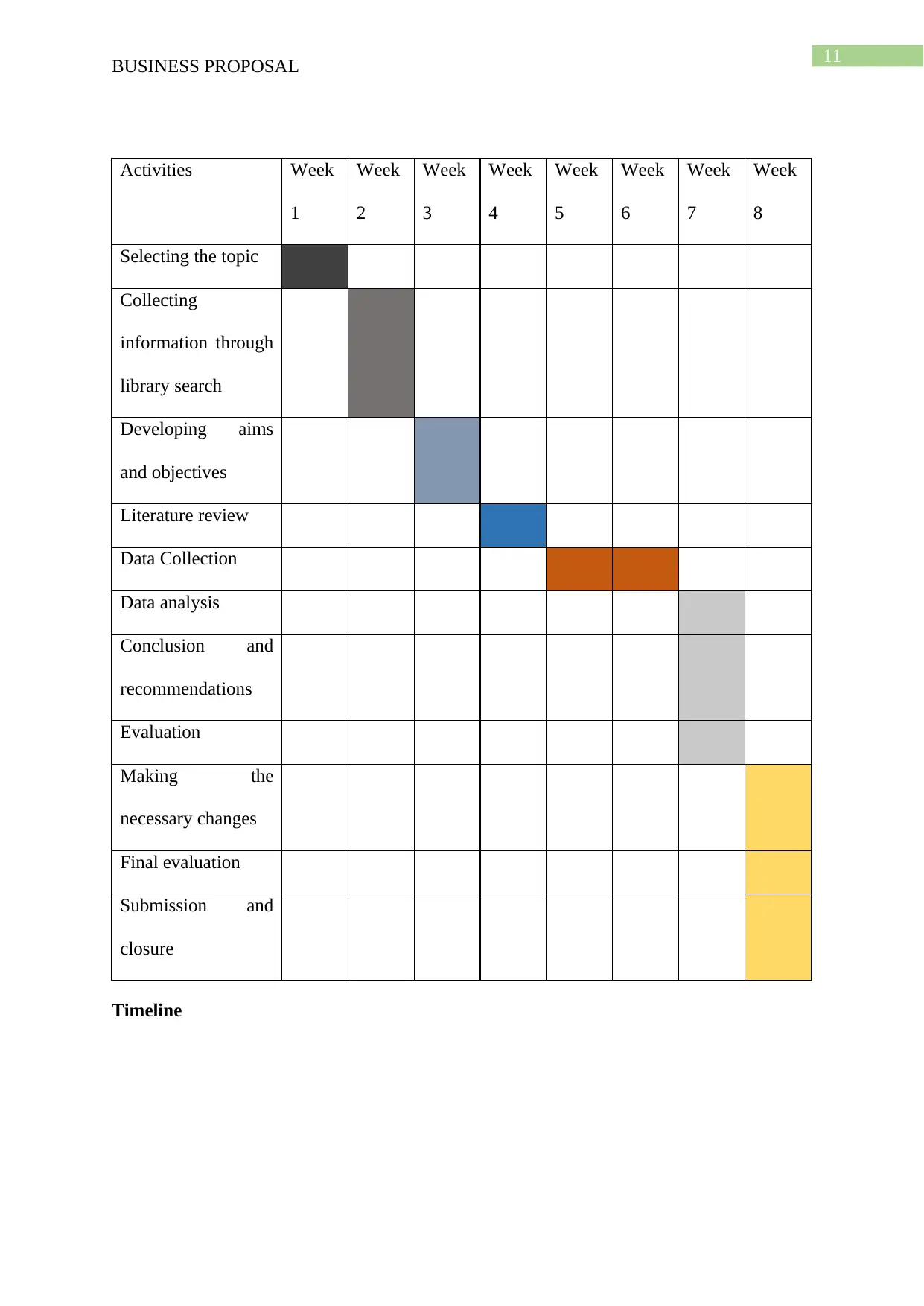
Timeline
BUSINESS PROPOSAL
Activities Week
1
Week
2
Week
3
Week
4
Week
5
Week
6
Week
7
Week
8
Selecting the topic
Collecting
information through
library search
Developing aims
and objectives
Literature review
Data Collection
Data analysis
Conclusion and
recommendations
Evaluation
Making the
necessary changes
Final evaluation
Submission and
closure
Timeline
⊘ This is a preview!⊘
Do you want full access?
Subscribe today to unlock all pages.
Trusted by 1+ million students worldwide

1 out of 15


Related Documents


Your All-in-One AI-Powered Toolkit for Academic Success.
+13062052269
info@desklib.com
Available 24*7 on WhatsApp / Email
![[object Object]](/_next/static/media/star-bottom.7253800d.svg)
Unlock your academic potential
Copyright © 2020–2026 A2Z Services. All Rights Reserved. Developed and managed by ZUCOL.