The Role of Labour Education and Employee Development Schemes in Work
VerifiedAdded on 2023/04/21
|9
|2469
|221
Essay
AI Summary
This essay explores the significance of labour education and employee development schemes (EDS) in empowering workers and democratizing the workplace. It highlights the role of trade unions, particularly CUPE, in advocating for worker education and ensuring their voices are heard in organizational decision-making. The essay discusses various types of labour education, including tool courses, issue courses, and labour studies, and examines the factors to consider when developing EDS. It further analyzes the benefits of union actions on EDS, such as increased employee motivation and access to learning opportunities. The discussion emphasizes the importance of empowered workers as integral assets to organizations and concludes by advocating for continuous education and the recognition of employee learning in the workplace. Desklib provides a platform for students to access similar essays and study resources.

Work and learning 1
Work and learning
Work and learning

Paraphrase This Document
Need a fresh take? Get an instant paraphrase of this document with our AI Paraphraser
Work and learning 2
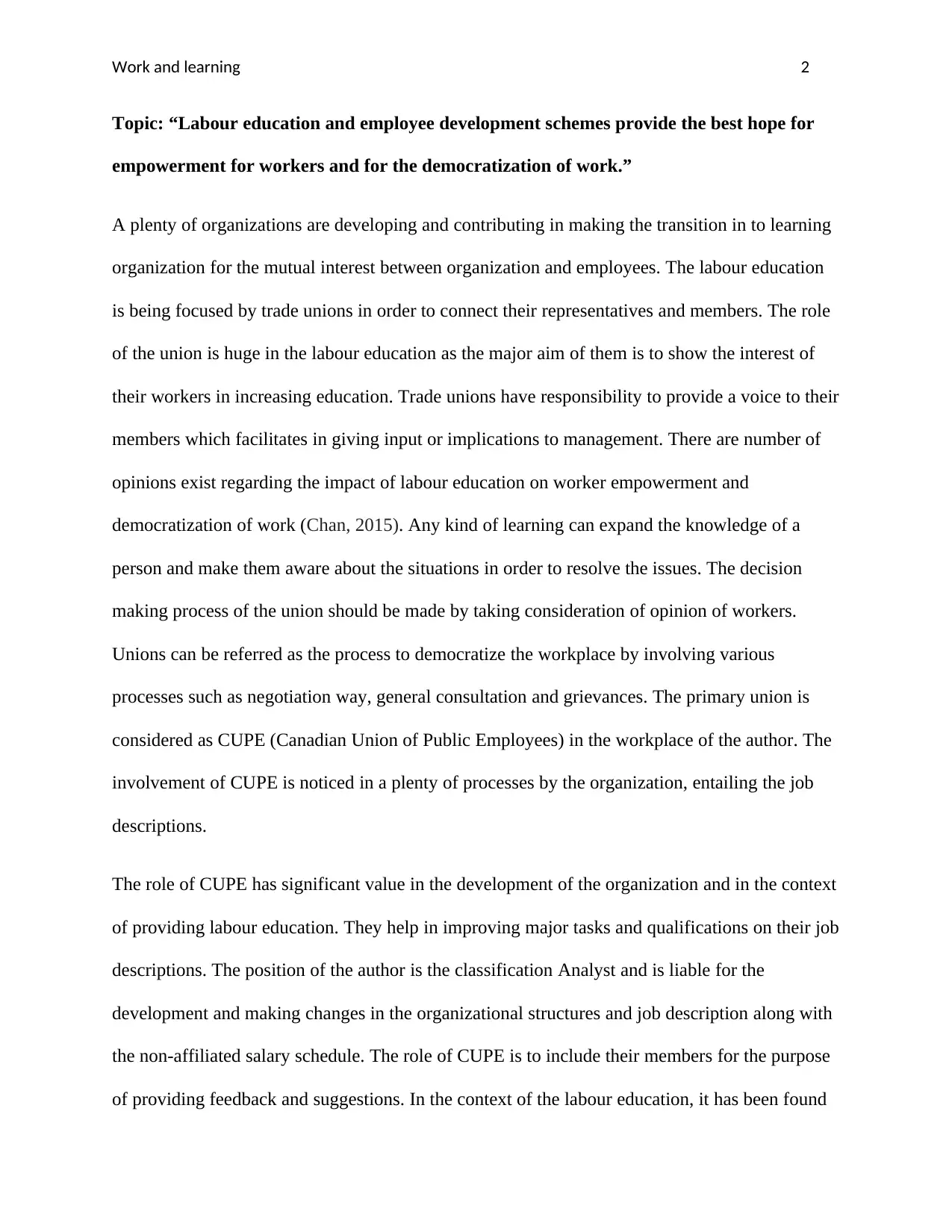
Topic: “Labour education and employee development schemes provide the best hope for
empowerment for workers and for the democratization of work.”
A plenty of organizations are developing and contributing in making the transition in to learning
organization for the mutual interest between organization and employees. The labour education
is being focused by trade unions in order to connect their representatives and members. The role
of the union is huge in the labour education as the major aim of them is to show the interest of
their workers in increasing education. Trade unions have responsibility to provide a voice to their
members which facilitates in giving input or implications to management. There are number of
opinions exist regarding the impact of labour education on worker empowerment and
democratization of work (Chan, 2015). Any kind of learning can expand the knowledge of a
person and make them aware about the situations in order to resolve the issues. The decision
making process of the union should be made by taking consideration of opinion of workers.
Unions can be referred as the process to democratize the workplace by involving various
processes such as negotiation way, general consultation and grievances. The primary union is
considered as CUPE (Canadian Union of Public Employees) in the workplace of the author. The
involvement of CUPE is noticed in a plenty of processes by the organization, entailing the job
descriptions.
The role of CUPE has significant value in the development of the organization and in the context
of providing labour education. They help in improving major tasks and qualifications on their job
descriptions. The position of the author is the classification Analyst and is liable for the
development and making changes in the organizational structures and job description along with
the non-affiliated salary schedule. The role of CUPE is to include their members for the purpose
of providing feedback and suggestions. In the context of the labour education, it has been found
Topic: “Labour education and employee development schemes provide the best hope for
empowerment for workers and for the democratization of work.”
A plenty of organizations are developing and contributing in making the transition in to learning
organization for the mutual interest between organization and employees. The labour education
is being focused by trade unions in order to connect their representatives and members. The role
of the union is huge in the labour education as the major aim of them is to show the interest of
their workers in increasing education. Trade unions have responsibility to provide a voice to their
members which facilitates in giving input or implications to management. There are number of
opinions exist regarding the impact of labour education on worker empowerment and
democratization of work (Chan, 2015). Any kind of learning can expand the knowledge of a
person and make them aware about the situations in order to resolve the issues. The decision
making process of the union should be made by taking consideration of opinion of workers.
Unions can be referred as the process to democratize the workplace by involving various
processes such as negotiation way, general consultation and grievances. The primary union is
considered as CUPE (Canadian Union of Public Employees) in the workplace of the author. The
involvement of CUPE is noticed in a plenty of processes by the organization, entailing the job
descriptions.
The role of CUPE has significant value in the development of the organization and in the context
of providing labour education. They help in improving major tasks and qualifications on their job
descriptions. The position of the author is the classification Analyst and is liable for the
development and making changes in the organizational structures and job description along with
the non-affiliated salary schedule. The role of CUPE is to include their members for the purpose
of providing feedback and suggestions. In the context of the labour education, it has been found

Work and learning 3
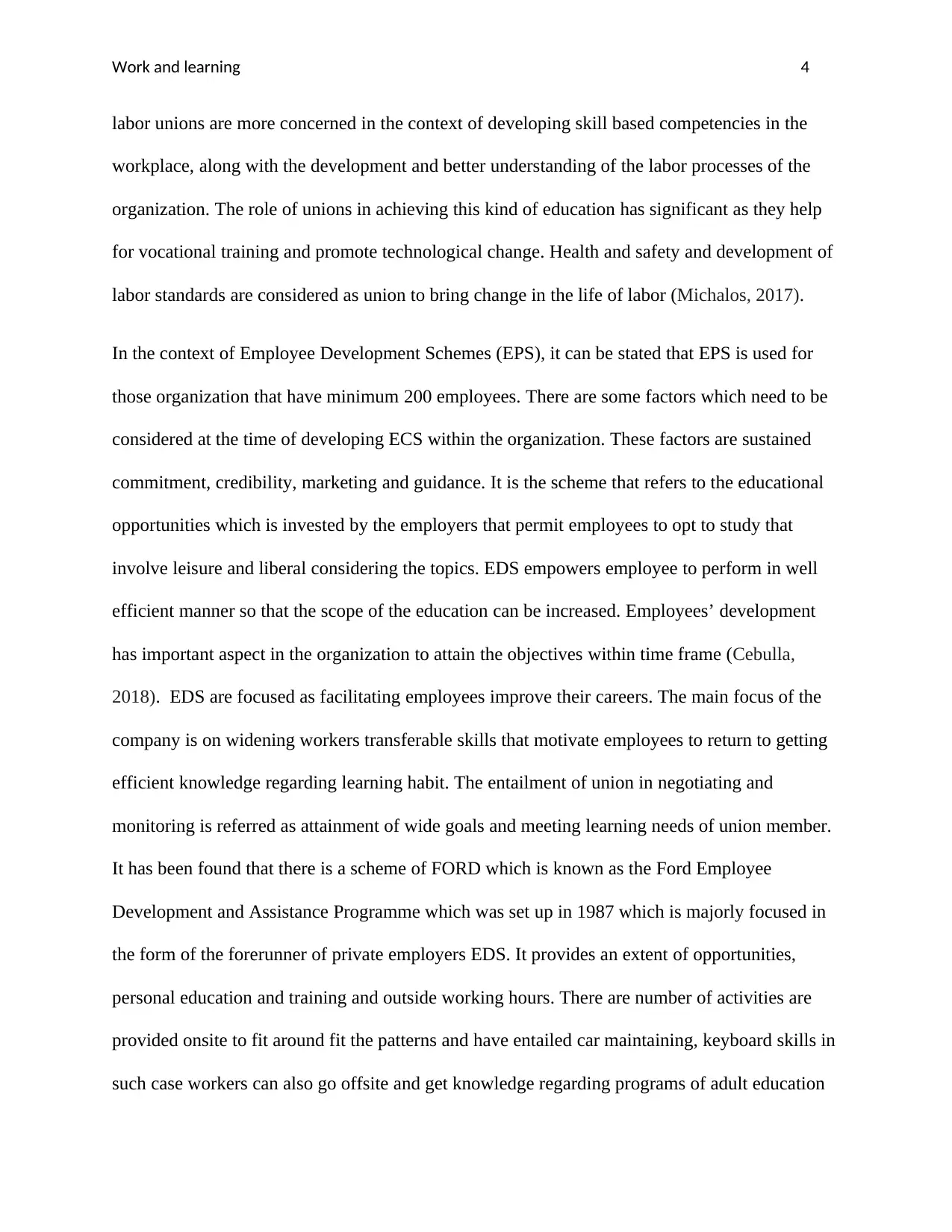
that it is considered as the training and education that is taken into consideration by unions to
their representatives (Butcher & MacKinnon, 2015). It provides the training to help to make non-
active union members for the purpose of becoming active union members in the future. The
major role of it is to educate members regarding policies, amendments in the environment or
labour law. The role of them is to educate the members in order to make them aware about the
activities regarding the policies and changes in the environment (Goel & Vijay, 2017).
For a form of education, the role of the unions advocate is to facilitate employees for the purpose
of learning in the form of completing their mandates in the workplace. There are three kinds of
education offered y trade unions that is issues courses, tools courses and labour studies courses.
The tool courses are made to equip unions with an effective knowledge and skills for the purpose
of showing their members efficiently. It is helpful in giving better understanding regarding their
policies so t hat they can perform in well efficient manner within the business. It has been
analyzed that this kind of education has major focus on the collective leadership, bargaining and
grievance procedures. It also facilitates in reforming the daily activities in the workplace for the
purpose of making sure that work related issues will be addresses in quick manner. On the other
hand, issue course is another subject for labour education that depicts the number of concerns
like racism, work reorganization and sexism in the workplace. The main motive of this training
is to facilitate employees to understand the ongoing concerns that can influence in the
environment of workplace. This kind of education has significant value in the organizations as it
impacts the interaction of the employees in the workplace (Li, 2017). A labour study is third kind
of education which is commonly considered at universities or other kind of formal places. This
kind of study influences the management and the relation with the union, majorly at the time of
improving the collective bargaining agreement (Shields, et. al., 2015). It has been found that the
that it is considered as the training and education that is taken into consideration by unions to
their representatives (Butcher & MacKinnon, 2015). It provides the training to help to make non-
active union members for the purpose of becoming active union members in the future. The
major role of it is to educate members regarding policies, amendments in the environment or
labour law. The role of them is to educate the members in order to make them aware about the
activities regarding the policies and changes in the environment (Goel & Vijay, 2017).
For a form of education, the role of the unions advocate is to facilitate employees for the purpose
of learning in the form of completing their mandates in the workplace. There are three kinds of
education offered y trade unions that is issues courses, tools courses and labour studies courses.
The tool courses are made to equip unions with an effective knowledge and skills for the purpose
of showing their members efficiently. It is helpful in giving better understanding regarding their
policies so t hat they can perform in well efficient manner within the business. It has been
analyzed that this kind of education has major focus on the collective leadership, bargaining and
grievance procedures. It also facilitates in reforming the daily activities in the workplace for the
purpose of making sure that work related issues will be addresses in quick manner. On the other
hand, issue course is another subject for labour education that depicts the number of concerns
like racism, work reorganization and sexism in the workplace. The main motive of this training
is to facilitate employees to understand the ongoing concerns that can influence in the
environment of workplace. This kind of education has significant value in the organizations as it
impacts the interaction of the employees in the workplace (Li, 2017). A labour study is third kind
of education which is commonly considered at universities or other kind of formal places. This
kind of study influences the management and the relation with the union, majorly at the time of
improving the collective bargaining agreement (Shields, et. al., 2015). It has been found that the
⊘ This is a preview!⊘
Do you want full access?
Subscribe today to unlock all pages.

Trusted by 1+ million students worldwide
Work and learning 4
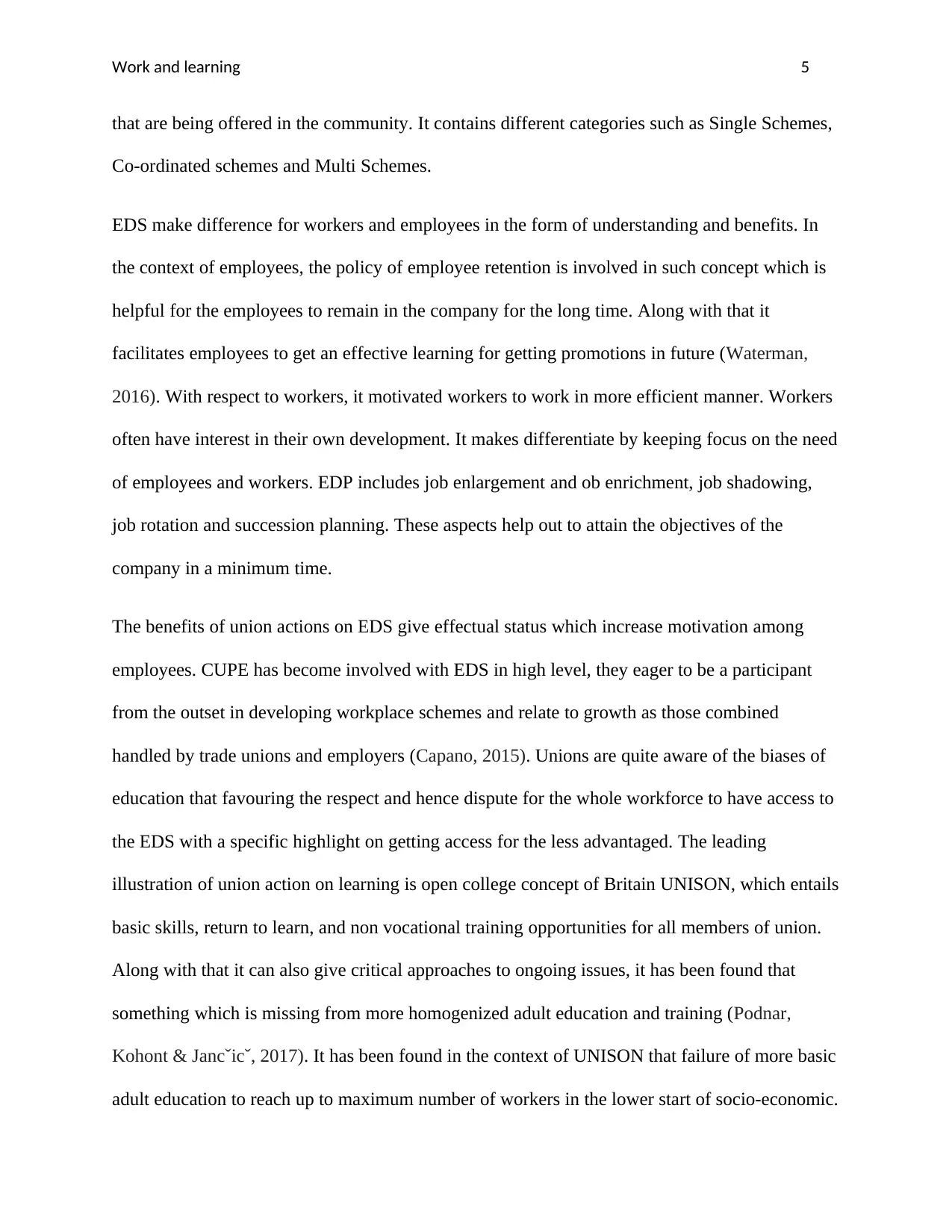
labor unions are more concerned in the context of developing skill based competencies in the
workplace, along with the development and better understanding of the labor processes of the
organization. The role of unions in achieving this kind of education has significant as they help
for vocational training and promote technological change. Health and safety and development of
labor standards are considered as union to bring change in the life of labor (Michalos, 2017).
In the context of Employee Development Schemes (EPS), it can be stated that EPS is used for
those organization that have minimum 200 employees. There are some factors which need to be
considered at the time of developing ECS within the organization. These factors are sustained
commitment, credibility, marketing and guidance. It is the scheme that refers to the educational
opportunities which is invested by the employers that permit employees to opt to study that
involve leisure and liberal considering the topics. EDS empowers employee to perform in well
efficient manner so that the scope of the education can be increased. Employees’ development
has important aspect in the organization to attain the objectives within time frame (Cebulla,
2018). EDS are focused as facilitating employees improve their careers. The main focus of the
company is on widening workers transferable skills that motivate employees to return to getting
efficient knowledge regarding learning habit. The entailment of union in negotiating and
monitoring is referred as attainment of wide goals and meeting learning needs of union member.
It has been found that there is a scheme of FORD which is known as the Ford Employee
Development and Assistance Programme which was set up in 1987 which is majorly focused in
the form of the forerunner of private employers EDS. It provides an extent of opportunities,
personal education and training and outside working hours. There are number of activities are
provided onsite to fit around fit the patterns and have entailed car maintaining, keyboard skills in
such case workers can also go offsite and get knowledge regarding programs of adult education
labor unions are more concerned in the context of developing skill based competencies in the
workplace, along with the development and better understanding of the labor processes of the
organization. The role of unions in achieving this kind of education has significant as they help
for vocational training and promote technological change. Health and safety and development of
labor standards are considered as union to bring change in the life of labor (Michalos, 2017).
In the context of Employee Development Schemes (EPS), it can be stated that EPS is used for
those organization that have minimum 200 employees. There are some factors which need to be
considered at the time of developing ECS within the organization. These factors are sustained
commitment, credibility, marketing and guidance. It is the scheme that refers to the educational
opportunities which is invested by the employers that permit employees to opt to study that
involve leisure and liberal considering the topics. EDS empowers employee to perform in well
efficient manner so that the scope of the education can be increased. Employees’ development
has important aspect in the organization to attain the objectives within time frame (Cebulla,
2018). EDS are focused as facilitating employees improve their careers. The main focus of the
company is on widening workers transferable skills that motivate employees to return to getting
efficient knowledge regarding learning habit. The entailment of union in negotiating and
monitoring is referred as attainment of wide goals and meeting learning needs of union member.
It has been found that there is a scheme of FORD which is known as the Ford Employee
Development and Assistance Programme which was set up in 1987 which is majorly focused in
the form of the forerunner of private employers EDS. It provides an extent of opportunities,
personal education and training and outside working hours. There are number of activities are
provided onsite to fit around fit the patterns and have entailed car maintaining, keyboard skills in
such case workers can also go offsite and get knowledge regarding programs of adult education
Paraphrase This Document
Need a fresh take? Get an instant paraphrase of this document with our AI Paraphraser
Work and learning 5
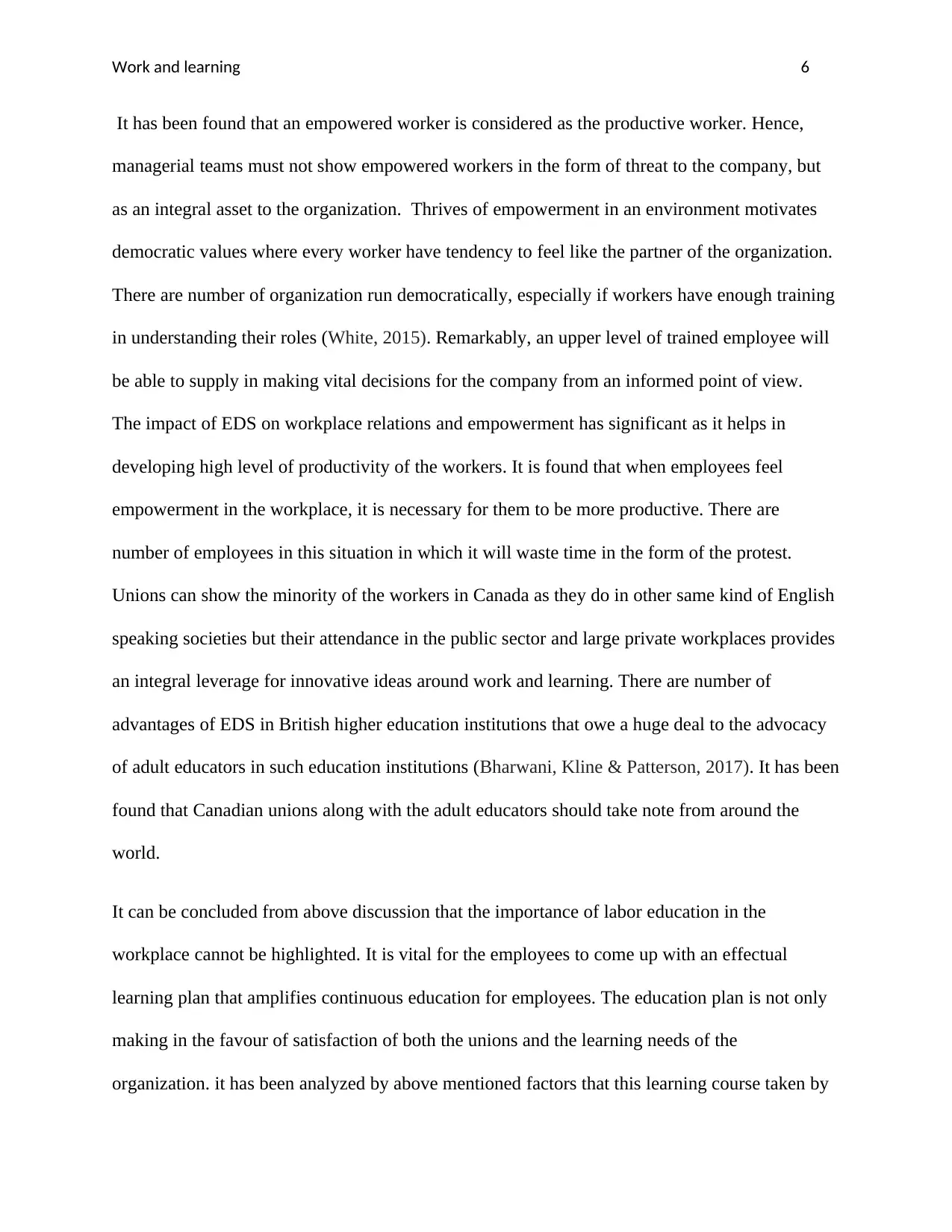
that are being offered in the community. It contains different categories such as Single Schemes,
Co-ordinated schemes and Multi Schemes.
EDS make difference for workers and employees in the form of understanding and benefits. In
the context of employees, the policy of employee retention is involved in such concept which is
helpful for the employees to remain in the company for the long time. Along with that it
facilitates employees to get an effective learning for getting promotions in future (Waterman,
2016). With respect to workers, it motivated workers to work in more efficient manner. Workers
often have interest in their own development. It makes differentiate by keeping focus on the need
of employees and workers. EDP includes job enlargement and ob enrichment, job shadowing,
job rotation and succession planning. These aspects help out to attain the objectives of the
company in a minimum time.
The benefits of union actions on EDS give effectual status which increase motivation among
employees. CUPE has become involved with EDS in high level, they eager to be a participant
from the outset in developing workplace schemes and relate to growth as those combined
handled by trade unions and employers (Capano, 2015). Unions are quite aware of the biases of
education that favouring the respect and hence dispute for the whole workforce to have access to
the EDS with a specific highlight on getting access for the less advantaged. The leading
illustration of union action on learning is open college concept of Britain UNISON, which entails
basic skills, return to learn, and non vocational training opportunities for all members of union.
Along with that it can also give critical approaches to ongoing issues, it has been found that
something which is missing from more homogenized adult education and training (Podnar,
Kohont & Jancˇicˇ, 2017). It has been found in the context of UNISON that failure of more basic
adult education to reach up to maximum number of workers in the lower start of socio-economic.
that are being offered in the community. It contains different categories such as Single Schemes,
Co-ordinated schemes and Multi Schemes.
EDS make difference for workers and employees in the form of understanding and benefits. In
the context of employees, the policy of employee retention is involved in such concept which is
helpful for the employees to remain in the company for the long time. Along with that it
facilitates employees to get an effective learning for getting promotions in future (Waterman,
2016). With respect to workers, it motivated workers to work in more efficient manner. Workers
often have interest in their own development. It makes differentiate by keeping focus on the need
of employees and workers. EDP includes job enlargement and ob enrichment, job shadowing,
job rotation and succession planning. These aspects help out to attain the objectives of the
company in a minimum time.
The benefits of union actions on EDS give effectual status which increase motivation among
employees. CUPE has become involved with EDS in high level, they eager to be a participant
from the outset in developing workplace schemes and relate to growth as those combined
handled by trade unions and employers (Capano, 2015). Unions are quite aware of the biases of
education that favouring the respect and hence dispute for the whole workforce to have access to
the EDS with a specific highlight on getting access for the less advantaged. The leading
illustration of union action on learning is open college concept of Britain UNISON, which entails
basic skills, return to learn, and non vocational training opportunities for all members of union.
Along with that it can also give critical approaches to ongoing issues, it has been found that
something which is missing from more homogenized adult education and training (Podnar,
Kohont & Jancˇicˇ, 2017). It has been found in the context of UNISON that failure of more basic
adult education to reach up to maximum number of workers in the lower start of socio-economic.
Work and learning 6
It has been found that an empowered worker is considered as the productive worker. Hence,
managerial teams must not show empowered workers in the form of threat to the company, but
as an integral asset to the organization. Thrives of empowerment in an environment motivates
democratic values where every worker have tendency to feel like the partner of the organization.
There are number of organization run democratically, especially if workers have enough training
in understanding their roles (White, 2015). Remarkably, an upper level of trained employee will
be able to supply in making vital decisions for the company from an informed point of view.
The impact of EDS on workplace relations and empowerment has significant as it helps in
developing high level of productivity of the workers. It is found that when employees feel
empowerment in the workplace, it is necessary for them to be more productive. There are
number of employees in this situation in which it will waste time in the form of the protest.
Unions can show the minority of the workers in Canada as they do in other same kind of English
speaking societies but their attendance in the public sector and large private workplaces provides
an integral leverage for innovative ideas around work and learning. There are number of
advantages of EDS in British higher education institutions that owe a huge deal to the advocacy
of adult educators in such education institutions (Bharwani, Kline & Patterson, 2017). It has been
found that Canadian unions along with the adult educators should take note from around the
world.
It can be concluded from above discussion that the importance of labor education in the
workplace cannot be highlighted. It is vital for the employees to come up with an effectual
learning plan that amplifies continuous education for employees. The education plan is not only
making in the favour of satisfaction of both the unions and the learning needs of the
organization. it has been analyzed by above mentioned factors that this learning course taken by
It has been found that an empowered worker is considered as the productive worker. Hence,
managerial teams must not show empowered workers in the form of threat to the company, but
as an integral asset to the organization. Thrives of empowerment in an environment motivates
democratic values where every worker have tendency to feel like the partner of the organization.
There are number of organization run democratically, especially if workers have enough training
in understanding their roles (White, 2015). Remarkably, an upper level of trained employee will
be able to supply in making vital decisions for the company from an informed point of view.
The impact of EDS on workplace relations and empowerment has significant as it helps in
developing high level of productivity of the workers. It is found that when employees feel
empowerment in the workplace, it is necessary for them to be more productive. There are
number of employees in this situation in which it will waste time in the form of the protest.
Unions can show the minority of the workers in Canada as they do in other same kind of English
speaking societies but their attendance in the public sector and large private workplaces provides
an integral leverage for innovative ideas around work and learning. There are number of
advantages of EDS in British higher education institutions that owe a huge deal to the advocacy
of adult educators in such education institutions (Bharwani, Kline & Patterson, 2017). It has been
found that Canadian unions along with the adult educators should take note from around the
world.
It can be concluded from above discussion that the importance of labor education in the
workplace cannot be highlighted. It is vital for the employees to come up with an effectual
learning plan that amplifies continuous education for employees. The education plan is not only
making in the favour of satisfaction of both the unions and the learning needs of the
organization. it has been analyzed by above mentioned factors that this learning course taken by
⊘ This is a preview!⊘
Do you want full access?
Subscribe today to unlock all pages.
Trusted by 1+ million students worldwide
Work and learning 7
the worker in the form of trigger that please the learning and individual empowerment which
help employee to make feel that they are working on effectual educational course from which
they can learn how to perform in well efficient manner. The role of trade unions in the context of
employee learning entails suggesting employees on effectual courses, giving proper training on
issues regarding labor, and forcing for recognition of learning of employees in the workplace. On
the other hand, the role of the organization in the context of providing educational course is to
play in reimbursement for employee learning. Moreover, the training needs should be identified
by the organization in their workplace and emphasis the education and study leaves in order to
help employees’ training.
the worker in the form of trigger that please the learning and individual empowerment which
help employee to make feel that they are working on effectual educational course from which
they can learn how to perform in well efficient manner. The role of trade unions in the context of
employee learning entails suggesting employees on effectual courses, giving proper training on
issues regarding labor, and forcing for recognition of learning of employees in the workplace. On
the other hand, the role of the organization in the context of providing educational course is to
play in reimbursement for employee learning. Moreover, the training needs should be identified
by the organization in their workplace and emphasis the education and study leaves in order to
help employees’ training.
Paraphrase This Document
Need a fresh take? Get an instant paraphrase of this document with our AI Paraphraser

Work and learning 8
References
Bharwani, A., Kline, T., & Patterson, M. (2017). A stakeholder‐based approach to leadership
development training: the case of medical education in Canada. International Journal of
Training and Development, 21(3), 211-223.
Butcher, D. L., & MacKinnon, K. A. (2015). Educational silos in nursing education: a critical
review of practical nurse education in Canada. Nursing inquiry, 22(3), 231-239.
Capano, G. (2015). Federal strategies for changing the governance of higher education:
Australia, Canada and Germany compared. In Varieties of Governance (pp. 103-130).
Palgrave Macmillan, London.
Cebulla, A. (2018). Welfare-to-work: New Labour and the US Experience. Routledge.
Chan, W. K. (2015). Higher education and graduate employment in China: Challenges for
sustainable development. Higher Education Policy, 28(1), 35-53.
Goel, D., & Vijay, P. (2017). Echnical and vocational education and training (tvet) system\in
india for sustainable development.
Li, Q. (2017). Education Quality and Immigrants’ Success in the Canadian Labour Market. CD
Howe Institute E-brief, 262.
Michalos, A. C. (2017). Education, happiness and wellbeing. In Connecting the Quality of Life
Theory to Health, Well-being and Education (pp. 277-299). Springer, Cham.
References
Bharwani, A., Kline, T., & Patterson, M. (2017). A stakeholder‐based approach to leadership
development training: the case of medical education in Canada. International Journal of
Training and Development, 21(3), 211-223.
Butcher, D. L., & MacKinnon, K. A. (2015). Educational silos in nursing education: a critical
review of practical nurse education in Canada. Nursing inquiry, 22(3), 231-239.
Capano, G. (2015). Federal strategies for changing the governance of higher education:
Australia, Canada and Germany compared. In Varieties of Governance (pp. 103-130).
Palgrave Macmillan, London.
Cebulla, A. (2018). Welfare-to-work: New Labour and the US Experience. Routledge.
Chan, W. K. (2015). Higher education and graduate employment in China: Challenges for
sustainable development. Higher Education Policy, 28(1), 35-53.
Goel, D., & Vijay, P. (2017). Echnical and vocational education and training (tvet) system\in
india for sustainable development.
Li, Q. (2017). Education Quality and Immigrants’ Success in the Canadian Labour Market. CD
Howe Institute E-brief, 262.
Michalos, A. C. (2017). Education, happiness and wellbeing. In Connecting the Quality of Life
Theory to Health, Well-being and Education (pp. 277-299). Springer, Cham.
Work and learning 9
Podnar, K., Kohont, A., & Jancˇicˇ, Z. (2017). Employee development in the international arena:
internal marketing and human resource management perspectives. Strategic International
Marketing: An Advanced Perspective, 153.
Shields, J., Brown, M., Kaine, S., Dolle-Samuel, C., North-Samardzic, A., McLean, P., ... &
Plimmer, G. (2015). Managing employee performance & reward: Concepts, practices,
strategies. Cambridge University Press.
Waterman, P. (Ed.). (2016). Labour worldwide in the era of globalization: Alternative union
models in the new world order. Springer.
White, M. (2015). The Political Economy of Training in Canada and England: Politics,
pragmatism and public opinion in a post-industrial age/L'économie politique de la
formation au Canada et en Angleterre: La politique, le pragmatisme et l'opinion publique
dans une ère post-industrielle. Comparative and International Education, 43(3), 1.
Podnar, K., Kohont, A., & Jancˇicˇ, Z. (2017). Employee development in the international arena:
internal marketing and human resource management perspectives. Strategic International
Marketing: An Advanced Perspective, 153.
Shields, J., Brown, M., Kaine, S., Dolle-Samuel, C., North-Samardzic, A., McLean, P., ... &
Plimmer, G. (2015). Managing employee performance & reward: Concepts, practices,
strategies. Cambridge University Press.
Waterman, P. (Ed.). (2016). Labour worldwide in the era of globalization: Alternative union
models in the new world order. Springer.
White, M. (2015). The Political Economy of Training in Canada and England: Politics,
pragmatism and public opinion in a post-industrial age/L'économie politique de la
formation au Canada et en Angleterre: La politique, le pragmatisme et l'opinion publique
dans une ère post-industrielle. Comparative and International Education, 43(3), 1.
⊘ This is a preview!⊘
Do you want full access?
Subscribe today to unlock all pages.
Trusted by 1+ million students worldwide

1 out of 9


Related Documents


Your All-in-One AI-Powered Toolkit for Academic Success.
+13062052269
info@desklib.com
Available 24*7 on WhatsApp / Email
![[object Object]](/_next/static/media/star-bottom.7253800d.svg)
Unlock your academic potential
Copyright © 2020–2026 A2Z Services. All Rights Reserved. Developed and managed by ZUCOL.