Sustainability Portfolio: Applying Principles in Work Placement
VerifiedAdded on 2023/06/03
|8
|2025
|473
Portfolio
AI Summary
This portfolio assignment explores the application of sustainability principles in both personal and professional contexts. It includes reflections on personal choices related to sustainability, such as purchasing environmentally friendly products, and examines how sustainability can be integrated into the workplace. The portfolio discusses the importance of environmental, social, and economic sustainability, and it suggests practical strategies for promoting sustainability in organizations, such as redesigning job roles, sourcing eco-friendly materials, and supporting local communities. The assignment also references sustainability theories like Natural Capitalism and the Four Capital Model, highlighting the need for a balanced approach to sustainability that considers environmental, social, and economic factors. Desklib offers a wealth of resources, including solved assignments and past papers, to aid students in their academic pursuits.
Running head: PREPARATION FOR WORK PLACEMENT
Preparation for work placement
Name of Student:
Name of College:
Authors Note:
1
Preparation for work placement
Name of Student:
Name of College:
Authors Note:
1

Paraphrase This Document
Need a fresh take? Get an instant paraphrase of this document with our AI Paraphraser
PREPARATION FOR WORK PLACEMENT
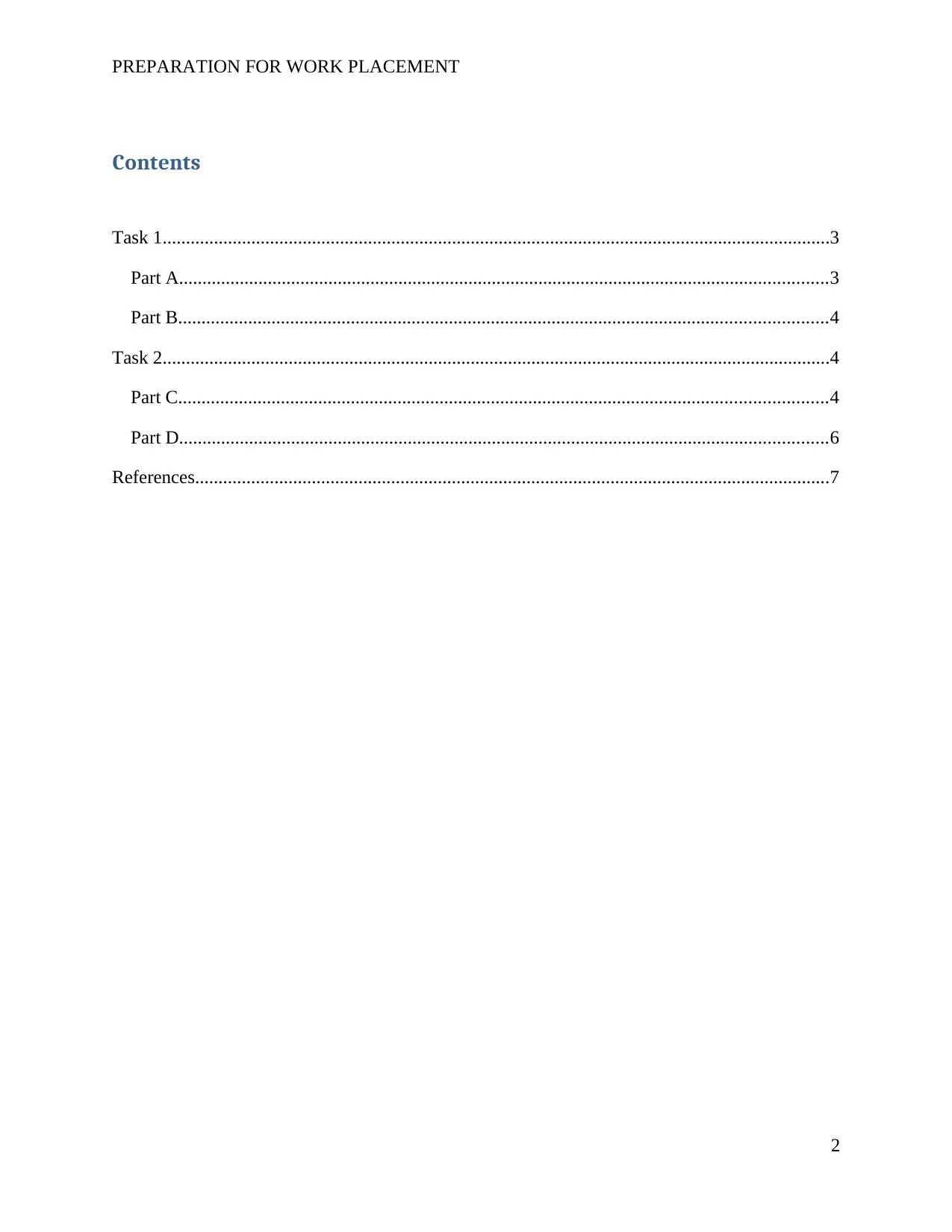
Contents
Task 1...............................................................................................................................................3
Part A...........................................................................................................................................3
Part B...........................................................................................................................................4
Task 2...............................................................................................................................................4
Part C...........................................................................................................................................4
Part D...........................................................................................................................................6
References........................................................................................................................................7
2
Contents
Task 1...............................................................................................................................................3
Part A...........................................................................................................................................3
Part B...........................................................................................................................................4
Task 2...............................................................................................................................................4
Part C...........................................................................................................................................4
Part D...........................................................................................................................................6
References........................................................................................................................................7
2
PREPARATION FOR WORK PLACEMENT
Task 1
Part A
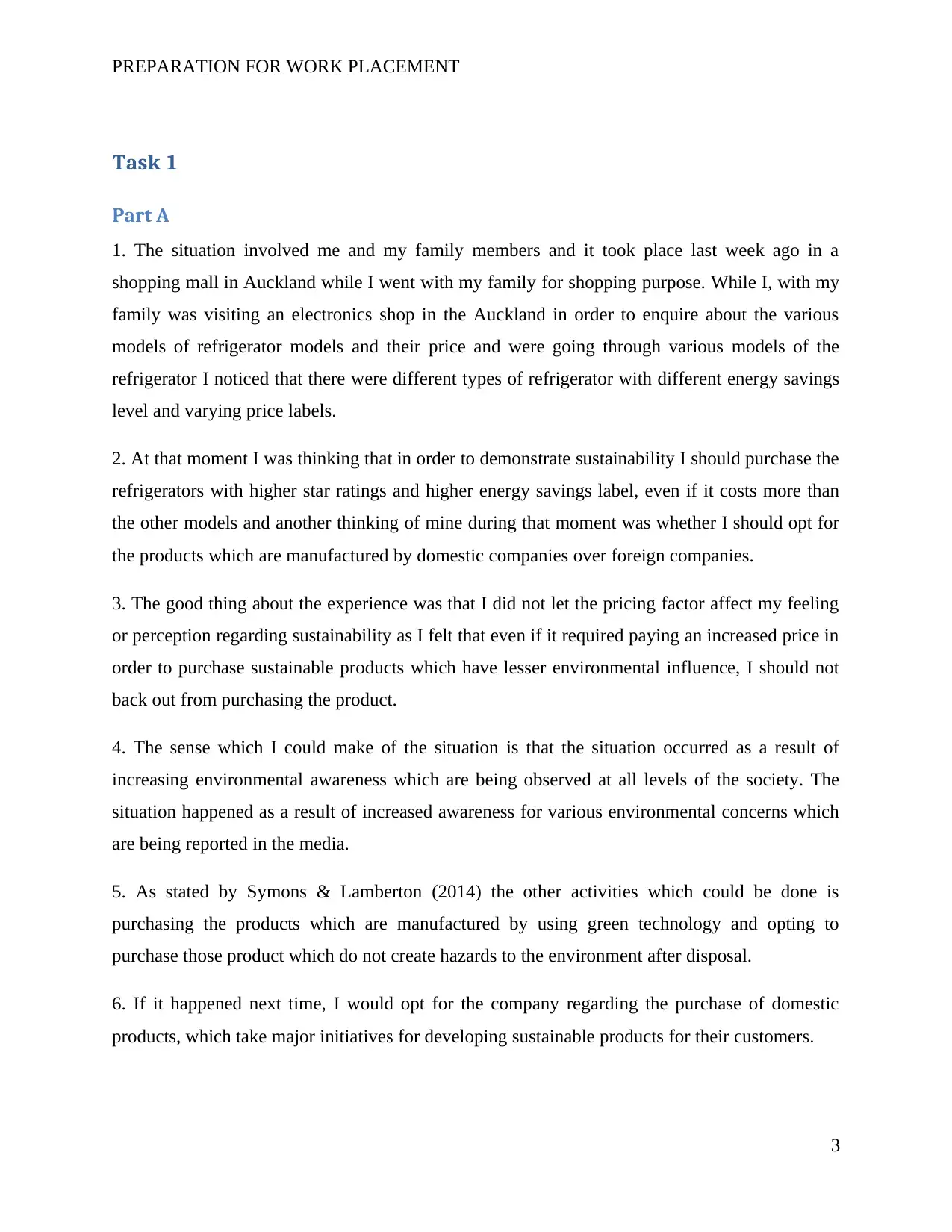
1. The situation involved me and my family members and it took place last week ago in a
shopping mall in Auckland while I went with my family for shopping purpose. While I, with my
family was visiting an electronics shop in the Auckland in order to enquire about the various
models of refrigerator models and their price and were going through various models of the
refrigerator I noticed that there were different types of refrigerator with different energy savings
level and varying price labels.
2. At that moment I was thinking that in order to demonstrate sustainability I should purchase the
refrigerators with higher star ratings and higher energy savings label, even if it costs more than
the other models and another thinking of mine during that moment was whether I should opt for
the products which are manufactured by domestic companies over foreign companies.
3. The good thing about the experience was that I did not let the pricing factor affect my feeling
or perception regarding sustainability as I felt that even if it required paying an increased price in
order to purchase sustainable products which have lesser environmental influence, I should not
back out from purchasing the product.
4. The sense which I could make of the situation is that the situation occurred as a result of
increasing environmental awareness which are being observed at all levels of the society. The
situation happened as a result of increased awareness for various environmental concerns which
are being reported in the media.
5. As stated by Symons & Lamberton (2014) the other activities which could be done is
purchasing the products which are manufactured by using green technology and opting to
purchase those product which do not create hazards to the environment after disposal.
6. If it happened next time, I would opt for the company regarding the purchase of domestic
products, which take major initiatives for developing sustainable products for their customers.
3
Task 1
Part A
1. The situation involved me and my family members and it took place last week ago in a
shopping mall in Auckland while I went with my family for shopping purpose. While I, with my
family was visiting an electronics shop in the Auckland in order to enquire about the various
models of refrigerator models and their price and were going through various models of the
refrigerator I noticed that there were different types of refrigerator with different energy savings
level and varying price labels.
2. At that moment I was thinking that in order to demonstrate sustainability I should purchase the
refrigerators with higher star ratings and higher energy savings label, even if it costs more than
the other models and another thinking of mine during that moment was whether I should opt for
the products which are manufactured by domestic companies over foreign companies.
3. The good thing about the experience was that I did not let the pricing factor affect my feeling
or perception regarding sustainability as I felt that even if it required paying an increased price in
order to purchase sustainable products which have lesser environmental influence, I should not
back out from purchasing the product.
4. The sense which I could make of the situation is that the situation occurred as a result of
increasing environmental awareness which are being observed at all levels of the society. The
situation happened as a result of increased awareness for various environmental concerns which
are being reported in the media.
5. As stated by Symons & Lamberton (2014) the other activities which could be done is
purchasing the products which are manufactured by using green technology and opting to
purchase those product which do not create hazards to the environment after disposal.
6. If it happened next time, I would opt for the company regarding the purchase of domestic
products, which take major initiatives for developing sustainable products for their customers.
3
⊘ This is a preview!⊘
Do you want full access?
Subscribe today to unlock all pages.

Trusted by 1+ million students worldwide
PREPARATION FOR WORK PLACEMENT
Part B
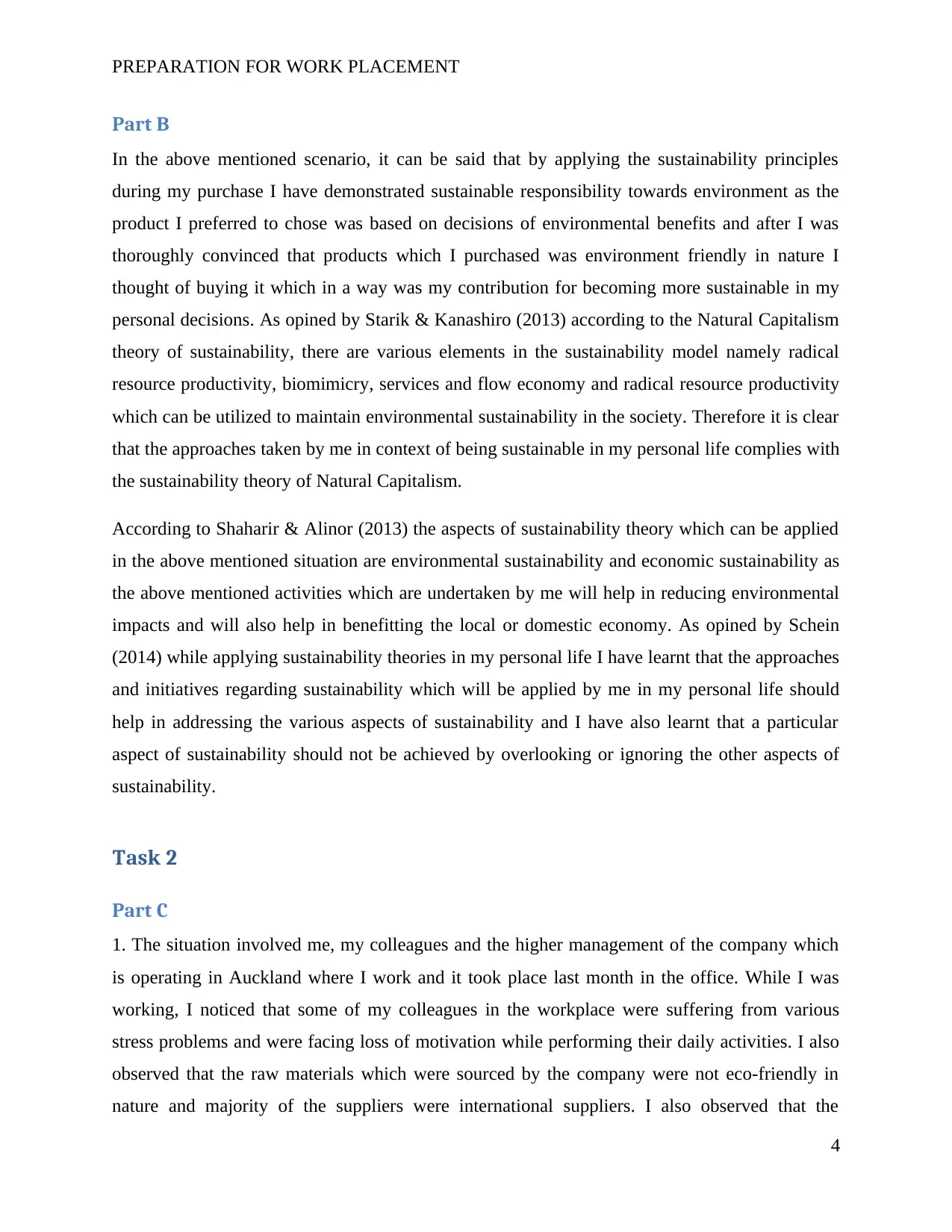
In the above mentioned scenario, it can be said that by applying the sustainability principles
during my purchase I have demonstrated sustainable responsibility towards environment as the
product I preferred to chose was based on decisions of environmental benefits and after I was
thoroughly convinced that products which I purchased was environment friendly in nature I
thought of buying it which in a way was my contribution for becoming more sustainable in my
personal decisions. As opined by Starik & Kanashiro (2013) according to the Natural Capitalism
theory of sustainability, there are various elements in the sustainability model namely radical
resource productivity, biomimicry, services and flow economy and radical resource productivity
which can be utilized to maintain environmental sustainability in the society. Therefore it is clear
that the approaches taken by me in context of being sustainable in my personal life complies with
the sustainability theory of Natural Capitalism.
According to Shaharir & Alinor (2013) the aspects of sustainability theory which can be applied
in the above mentioned situation are environmental sustainability and economic sustainability as
the above mentioned activities which are undertaken by me will help in reducing environmental
impacts and will also help in benefitting the local or domestic economy. As opined by Schein
(2014) while applying sustainability theories in my personal life I have learnt that the approaches
and initiatives regarding sustainability which will be applied by me in my personal life should
help in addressing the various aspects of sustainability and I have also learnt that a particular
aspect of sustainability should not be achieved by overlooking or ignoring the other aspects of
sustainability.
Task 2
Part C
1. The situation involved me, my colleagues and the higher management of the company which
is operating in Auckland where I work and it took place last month in the office. While I was
working, I noticed that some of my colleagues in the workplace were suffering from various
stress problems and were facing loss of motivation while performing their daily activities. I also
observed that the raw materials which were sourced by the company were not eco-friendly in
nature and majority of the suppliers were international suppliers. I also observed that the
4
Part B
In the above mentioned scenario, it can be said that by applying the sustainability principles
during my purchase I have demonstrated sustainable responsibility towards environment as the
product I preferred to chose was based on decisions of environmental benefits and after I was
thoroughly convinced that products which I purchased was environment friendly in nature I
thought of buying it which in a way was my contribution for becoming more sustainable in my
personal decisions. As opined by Starik & Kanashiro (2013) according to the Natural Capitalism
theory of sustainability, there are various elements in the sustainability model namely radical
resource productivity, biomimicry, services and flow economy and radical resource productivity
which can be utilized to maintain environmental sustainability in the society. Therefore it is clear
that the approaches taken by me in context of being sustainable in my personal life complies with
the sustainability theory of Natural Capitalism.
According to Shaharir & Alinor (2013) the aspects of sustainability theory which can be applied
in the above mentioned situation are environmental sustainability and economic sustainability as
the above mentioned activities which are undertaken by me will help in reducing environmental
impacts and will also help in benefitting the local or domestic economy. As opined by Schein
(2014) while applying sustainability theories in my personal life I have learnt that the approaches
and initiatives regarding sustainability which will be applied by me in my personal life should
help in addressing the various aspects of sustainability and I have also learnt that a particular
aspect of sustainability should not be achieved by overlooking or ignoring the other aspects of
sustainability.
Task 2
Part C
1. The situation involved me, my colleagues and the higher management of the company which
is operating in Auckland where I work and it took place last month in the office. While I was
working, I noticed that some of my colleagues in the workplace were suffering from various
stress problems and were facing loss of motivation while performing their daily activities. I also
observed that the raw materials which were sourced by the company were not eco-friendly in
nature and majority of the suppliers were international suppliers. I also observed that the
4
Paraphrase This Document
Need a fresh take? Get an instant paraphrase of this document with our AI Paraphraser
PREPARATION FOR WORK PLACEMENT
company in which I work had not taken any sort of initiatives for the benefit of the local
community in which it operates.
2. My feeling about the situation was the company where I work was lacking in implementing
sustainability approaches and therefore they must take necessary steps to achieve environmental,
social and economic sustainability in order to promote sustainability in the society.
According to me the sustainability practices which could be applied are re-designing the job
roles of the company, offering flexible working hour to the employee, offering incentives and
benefits to the employees of the company based on their performance, and implementing an
effective leave structure which suits the requirements of the employees. The other sustainability
practices which could be applied in the workplace are sourcing green raw materials from
suppliers, sourcing domestic raw materials or sourcing from domestic suppliers and thus
investing in the development of the local communities.
3. The bad thing about the experience was that the company did not take appropriate steps to
fulfil the sustainability needs of their stakeholders and therefore the company could be termed as
un-responsive towards community which is also a stakeholder. The good thing about the
experience was I felt the necessity to recommend various sustainability practices to the
organization in order to promote sustainability.
4. The sense which I could make of the situation is that the situation could have occurred due to
excessive focus of the company to generate profit and growth at any costs and not caring about
the outcomes which are associated with it. The thing which could have made a difference to the
situation is the availability of a sustainability strategy in the strategic plan of the organization.
5.As stated by Vinnari, Vinnari & Kupsala (2017) the other thing which could have been done in
the same situation was communicating to the top management the benefits of sustainability for
the organization so that it becomes easier for the top management to adopt sustainability
principles. Another thing which could have been done in the same situation was demonstrating to
the top management, the business results of various companies who have implemented
sustainability strategy in their day to day operations.
5
company in which I work had not taken any sort of initiatives for the benefit of the local
community in which it operates.
2. My feeling about the situation was the company where I work was lacking in implementing
sustainability approaches and therefore they must take necessary steps to achieve environmental,
social and economic sustainability in order to promote sustainability in the society.
According to me the sustainability practices which could be applied are re-designing the job
roles of the company, offering flexible working hour to the employee, offering incentives and
benefits to the employees of the company based on their performance, and implementing an
effective leave structure which suits the requirements of the employees. The other sustainability
practices which could be applied in the workplace are sourcing green raw materials from
suppliers, sourcing domestic raw materials or sourcing from domestic suppliers and thus
investing in the development of the local communities.
3. The bad thing about the experience was that the company did not take appropriate steps to
fulfil the sustainability needs of their stakeholders and therefore the company could be termed as
un-responsive towards community which is also a stakeholder. The good thing about the
experience was I felt the necessity to recommend various sustainability practices to the
organization in order to promote sustainability.
4. The sense which I could make of the situation is that the situation could have occurred due to
excessive focus of the company to generate profit and growth at any costs and not caring about
the outcomes which are associated with it. The thing which could have made a difference to the
situation is the availability of a sustainability strategy in the strategic plan of the organization.
5.As stated by Vinnari, Vinnari & Kupsala (2017) the other thing which could have been done in
the same situation was communicating to the top management the benefits of sustainability for
the organization so that it becomes easier for the top management to adopt sustainability
principles. Another thing which could have been done in the same situation was demonstrating to
the top management, the business results of various companies who have implemented
sustainability strategy in their day to day operations.
5
PREPARATION FOR WORK PLACEMENT
6. If the situation happened again, I would communicate the activities of the company to various
Governmental agencies and regulatory bodies that are responsible for overseeing the
implementation of sustainability strategies implemented by the companies in the country so that
they could take necessary legal steps which could compel the company to adopt effective
sustainability strategies.
Part D
In the above mentioned scenario, the sustainability practices which could be applied are re-
designing the job roles of the company, offering flexible working hour to the employee, offering
incentives and benefits to the employees based on their performance, and designing an effective
leave structure which suits the requirements of the employees. The other sustainability practices
which could be applied in the workplace are sourcing eco-friendly materials from suppliers,
supporting domestic suppliers through sourcing local materials and investing in the development
of the local communities. As opined by Swaim, Maloni, Napshin & Henley (2014) according to
the sustainability theory of four capital model, there are four different types of capital in each
society in the form of human capital, finance capital, environmental capital and manufactured
capital and in order to create and maintain sustainability in the society, the above mentioned four
capitals must be balanced in the society as it is not possible to build a sustainable society without
maintaining the balance among the above mentioned four capitals and maintenance of their
sustainability. Therefore the sustainability practices which can be applied in the above mentioned
scenario complies with the four capital model theory as the above mentioned practices helps in
maintaining a balance between the various types of capital in the society in which the company
operates.
According to Shafiq, Klassen & Awaysheh (2017) the aspects of sustainability theory which can
be applied in the above mentioned scenario are environmental sustainability, social sustainability
and economic sustainability as the practices will help in reducing the carbon footprint of the
company in the environment, will help in the development of the local communities and will also
improve social interactions between the members of the organization. As opined by Salzmann
(2013) while applying sustainability theories in the workplace, it is very important to ensure that
the different capitals of the society must be balanced and maintained accordingly in order to
improve the sustainability practices of the organization.
6
6. If the situation happened again, I would communicate the activities of the company to various
Governmental agencies and regulatory bodies that are responsible for overseeing the
implementation of sustainability strategies implemented by the companies in the country so that
they could take necessary legal steps which could compel the company to adopt effective
sustainability strategies.
Part D
In the above mentioned scenario, the sustainability practices which could be applied are re-
designing the job roles of the company, offering flexible working hour to the employee, offering
incentives and benefits to the employees based on their performance, and designing an effective
leave structure which suits the requirements of the employees. The other sustainability practices
which could be applied in the workplace are sourcing eco-friendly materials from suppliers,
supporting domestic suppliers through sourcing local materials and investing in the development
of the local communities. As opined by Swaim, Maloni, Napshin & Henley (2014) according to
the sustainability theory of four capital model, there are four different types of capital in each
society in the form of human capital, finance capital, environmental capital and manufactured
capital and in order to create and maintain sustainability in the society, the above mentioned four
capitals must be balanced in the society as it is not possible to build a sustainable society without
maintaining the balance among the above mentioned four capitals and maintenance of their
sustainability. Therefore the sustainability practices which can be applied in the above mentioned
scenario complies with the four capital model theory as the above mentioned practices helps in
maintaining a balance between the various types of capital in the society in which the company
operates.
According to Shafiq, Klassen & Awaysheh (2017) the aspects of sustainability theory which can
be applied in the above mentioned scenario are environmental sustainability, social sustainability
and economic sustainability as the practices will help in reducing the carbon footprint of the
company in the environment, will help in the development of the local communities and will also
improve social interactions between the members of the organization. As opined by Salzmann
(2013) while applying sustainability theories in the workplace, it is very important to ensure that
the different capitals of the society must be balanced and maintained accordingly in order to
improve the sustainability practices of the organization.
6
⊘ This is a preview!⊘
Do you want full access?
Subscribe today to unlock all pages.
Trusted by 1+ million students worldwide
PREPARATION FOR WORK PLACEMENT
References
Salzmann, A. J. (2013). The integration of sustainability into the theory and practice of finance:
An overview of the state of the art and outline of future
developments. ZeitschriftFürBetriebswirtschaft, 83(6), 555-576. Retrieved from doi:
http://dx.doi.org/10.1007/s11573-013-0667-3 Accessed as on 30/10/2018
Schein, S. (2014). The ecological world views and post-conventional action logics of global
sustainability leaders. Business Premium Collection. Retrieved from
https://search.proquest.com/docview/1559194383?accountid=30552Accessed as on
30/10/2018
Shafiq, A., P, F. J., Klassen, R. D., & Awaysheh, A. (2017).Exploring the implications of supply
risk on sustainability performance. International Journal of Operations & Production
Management, 37(10), 1386-1407. Retrieved from doi: http://dx.doi.org/10.1108/IJOPM-
01-2016-0029 Accessed as on 30/10/2018
Shaharir, b. M. Z., & Alinor, M. b. A. K. (2013).THE NEED FOR A NEW DEFINITION OF
SUSTAINABILITY. Journal of Indonesian Economy and Business: JIEB. 28(2), 257-274.
Retrieved from https://search.proquest.com/docview/1475552003?accountid=30552
Accessed as on 30/10/2018
Starik, M., & Kanashiro, P. (2013). Toward a theory of sustainability management: Uncovering
and integrating the nearly obvious. Organization & Environment, 26(1), 7.Retrieved from
doi: http://dx.doi.org/10.1177/1086026612474958 Accessed as on 30/10/2018
Swaim, J. A., Maloni, M. J., Napshin, S. A., & Henley, A. B. (2014).Influences on student
intention and behavior toward environmental sustainability. Journal of Business
Ethics, 124(3), 465-484. Retrieved from doi: http://dx.doi.org/10.1007/s10551-013-1883-z
Accessed as on 30/10/2018
Symons, C., & Lamberton, G. (2014). Building a social case for business sustainability. Journal
of Economic and Social Policy, 16(2), 0_1,0_2,1-22. Retrieved from
https://search.proquest.com/docview/1628378906?accountid=30552 Accessed as on
30/10/2018
7
References
Salzmann, A. J. (2013). The integration of sustainability into the theory and practice of finance:
An overview of the state of the art and outline of future
developments. ZeitschriftFürBetriebswirtschaft, 83(6), 555-576. Retrieved from doi:
http://dx.doi.org/10.1007/s11573-013-0667-3 Accessed as on 30/10/2018
Schein, S. (2014). The ecological world views and post-conventional action logics of global
sustainability leaders. Business Premium Collection. Retrieved from
https://search.proquest.com/docview/1559194383?accountid=30552Accessed as on
30/10/2018
Shafiq, A., P, F. J., Klassen, R. D., & Awaysheh, A. (2017).Exploring the implications of supply
risk on sustainability performance. International Journal of Operations & Production
Management, 37(10), 1386-1407. Retrieved from doi: http://dx.doi.org/10.1108/IJOPM-
01-2016-0029 Accessed as on 30/10/2018
Shaharir, b. M. Z., & Alinor, M. b. A. K. (2013).THE NEED FOR A NEW DEFINITION OF
SUSTAINABILITY. Journal of Indonesian Economy and Business: JIEB. 28(2), 257-274.
Retrieved from https://search.proquest.com/docview/1475552003?accountid=30552
Accessed as on 30/10/2018
Starik, M., & Kanashiro, P. (2013). Toward a theory of sustainability management: Uncovering
and integrating the nearly obvious. Organization & Environment, 26(1), 7.Retrieved from
doi: http://dx.doi.org/10.1177/1086026612474958 Accessed as on 30/10/2018
Swaim, J. A., Maloni, M. J., Napshin, S. A., & Henley, A. B. (2014).Influences on student
intention and behavior toward environmental sustainability. Journal of Business
Ethics, 124(3), 465-484. Retrieved from doi: http://dx.doi.org/10.1007/s10551-013-1883-z
Accessed as on 30/10/2018
Symons, C., & Lamberton, G. (2014). Building a social case for business sustainability. Journal
of Economic and Social Policy, 16(2), 0_1,0_2,1-22. Retrieved from
https://search.proquest.com/docview/1628378906?accountid=30552 Accessed as on
30/10/2018
7
Paraphrase This Document
Need a fresh take? Get an instant paraphrase of this document with our AI Paraphraser
PREPARATION FOR WORK PLACEMENT
Vinnari, M., Vinnari, E., &Kupsala, S. (2017). Sustainability matrix: Interest groups and ethical
theories as the basis of decision-making. Journal of Agricultural and Environmental
Ethics, 30(3), 349-366. Retrieved from doi: http://dx.doi.org/10.1007/s10806-017-9670-
Accessed as on 30/10/2018
8
Vinnari, M., Vinnari, E., &Kupsala, S. (2017). Sustainability matrix: Interest groups and ethical
theories as the basis of decision-making. Journal of Agricultural and Environmental
Ethics, 30(3), 349-366. Retrieved from doi: http://dx.doi.org/10.1007/s10806-017-9670-
Accessed as on 30/10/2018
8

1 out of 8


Your All-in-One AI-Powered Toolkit for Academic Success.
+13062052269
info@desklib.com
Available 24*7 on WhatsApp / Email
![[object Object]](/_next/static/media/star-bottom.7253800d.svg)
Unlock your academic potential
Copyright © 2020–2026 A2Z Services. All Rights Reserved. Developed and managed by ZUCOL.