Determining Work, Power, and Energy Transfer in Engineering Systems

Verified

Added on  2022/11/03

|15
|1586
|82
Homework Assignment
AI Summary
This assignment solution focuses on determining work, power, and energy transfer in dynamic engineering systems. It includes detailed calculations involving velocity, kinetic energy, momentum, and the application of kinetic and dynamic principles. Task 1 calculates velocity and kinetic energy changes in a system, as well as the common velocity after impact of two bodies. Task 2 addresses kinetic energy and force calculations, with a focus on retardation and deceleration. Task 3 involves calculations of the time taken to raise a load, force in a cable, and power during acceleration and constant speed phases. The assignment also includes calculations of the average ground resistance when driving a pile into the ground and the work done in this process. The solution utilizes formulas and principles from dynamics, freely falling bodies, and conservation of energy to solve the problems.
Document Page
Work, Power and Energy Transfer1
DETERMINING WORK, POWER AND ENERGY TRANSFER IN DYNAMIC
ENGINEERING SYSTEM
Name
Course
Professor
University
City/state
Date
tabler-icon-diamond-filled.svg

Paraphrase This Document

Need a fresh take? Get an instant paraphrase of this document with our AI Paraphraser
Document Page
Work, Power and Energy Transfer2
Determining Work, Power and Energy Transfer in Dynamic Engineering System
Introduction
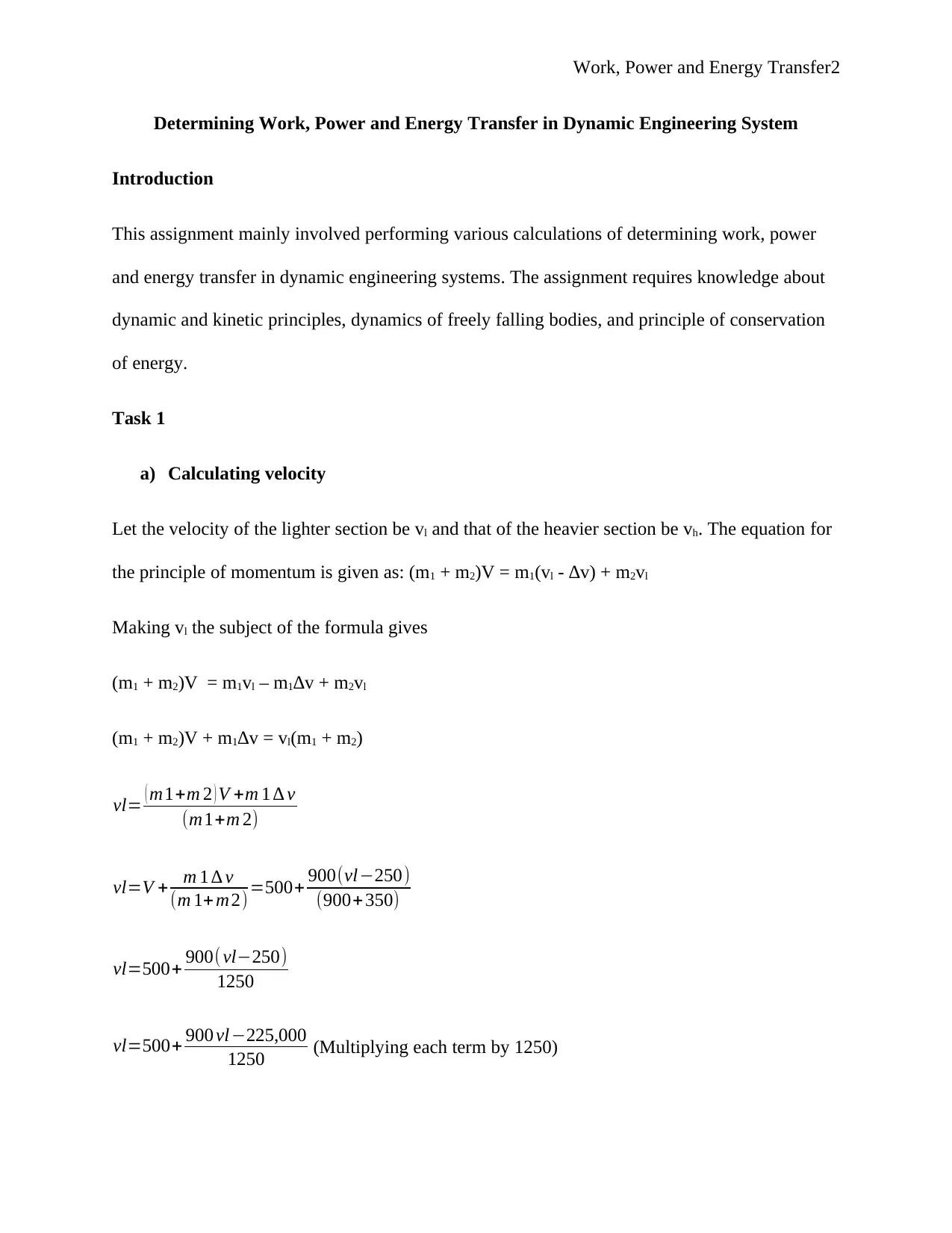
This assignment mainly involved performing various calculations of determining work, power
and energy transfer in dynamic engineering systems. The assignment requires knowledge about
dynamic and kinetic principles, dynamics of freely falling bodies, and principle of conservation
of energy.
Task 1
a) Calculating velocity
Let the velocity of the lighter section be vl and that of the heavier section be vh. The equation for
the principle of momentum is given as: (m1 + m2)V = m1(vl - ∆v) + m2vl
Making vl the subject of the formula gives
(m1 + m2)V = m1vl – m1∆v + m2vl
(m1 + m2)V + m1∆v = vl(m1 + m2)
vl= ( m1+m 2 ) V +m 1 v
(m1+m 2)
vl=V + m 1 v
(m 1+ m2) =500+ 900(vl250)
(900+ 350)
vl=500+ 900( vl250)
1250
vl=500+ 900 vl225,000
1250 (Multiplying each term by 1250)
Document Page
Work, Power and Energy Transfer3
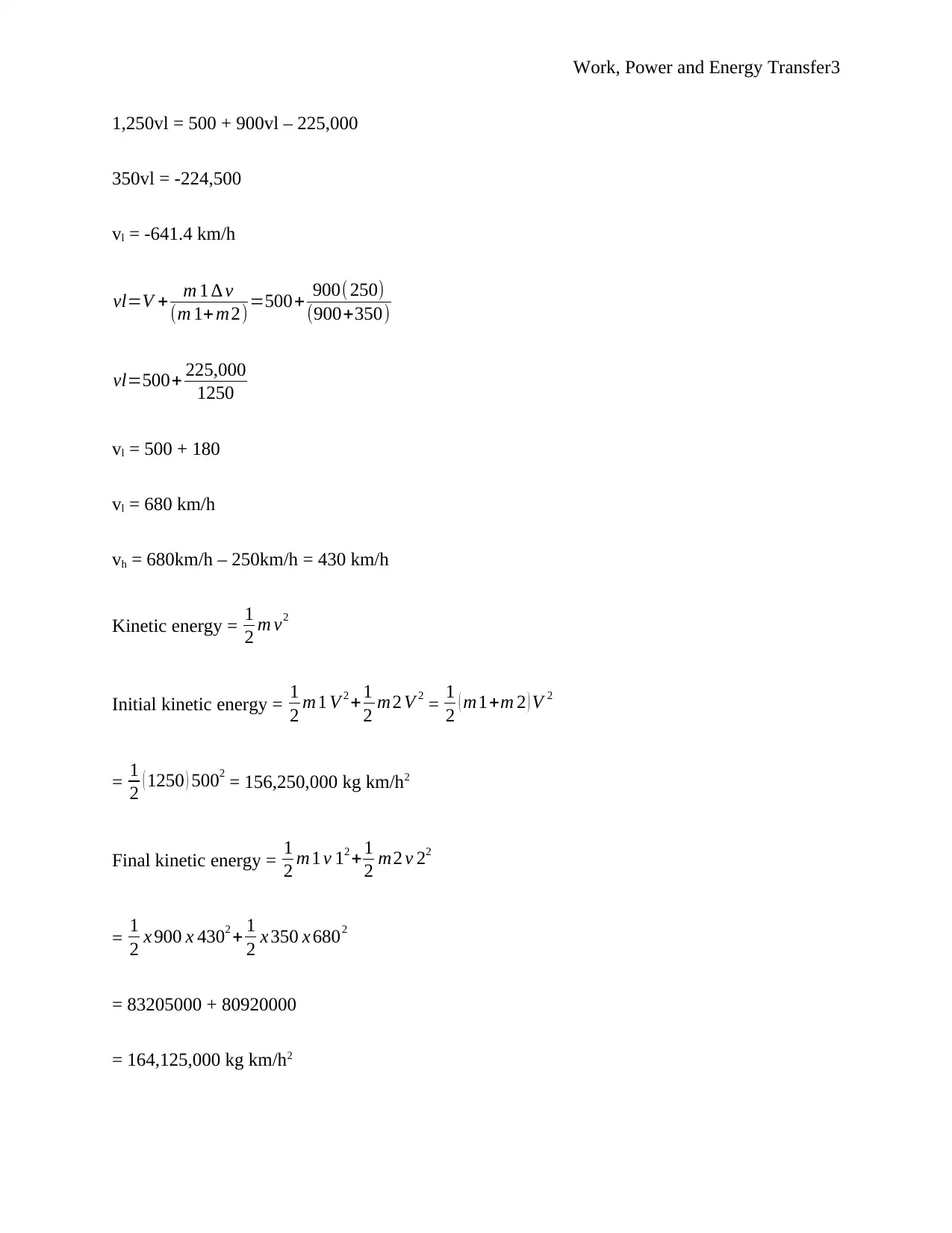
1,250vl = 500 + 900vl – 225,000
350vl = -224,500
vl = -641.4 km/h
vl=V + m 1 v
(m 1+ m2)=500+ 900( 250)
(900+350)
vl=500+ 225,000
1250
vl = 500 + 180
vl = 680 km/h
vh = 680km/h – 250km/h = 430 km/h
Kinetic energy = 1
2 m v2
Initial kinetic energy = 1
2 m1 V 2 +1
2 m2 V 2 = 1
2 ( m1+m 2 ) V 2
= 1
2 ( 1250 ) 5002
= 156,250,000 kg km/h2
Final kinetic energy = 1
2 m1 v 12 + 1
2 m2 v 22
= 1
2 x 900 x 4302 + 1
2 x 350 x 6802
= 83205000 + 80920000
= 164,125,000 kg km/h2
Document Page
Work, Power and Energy Transfer4
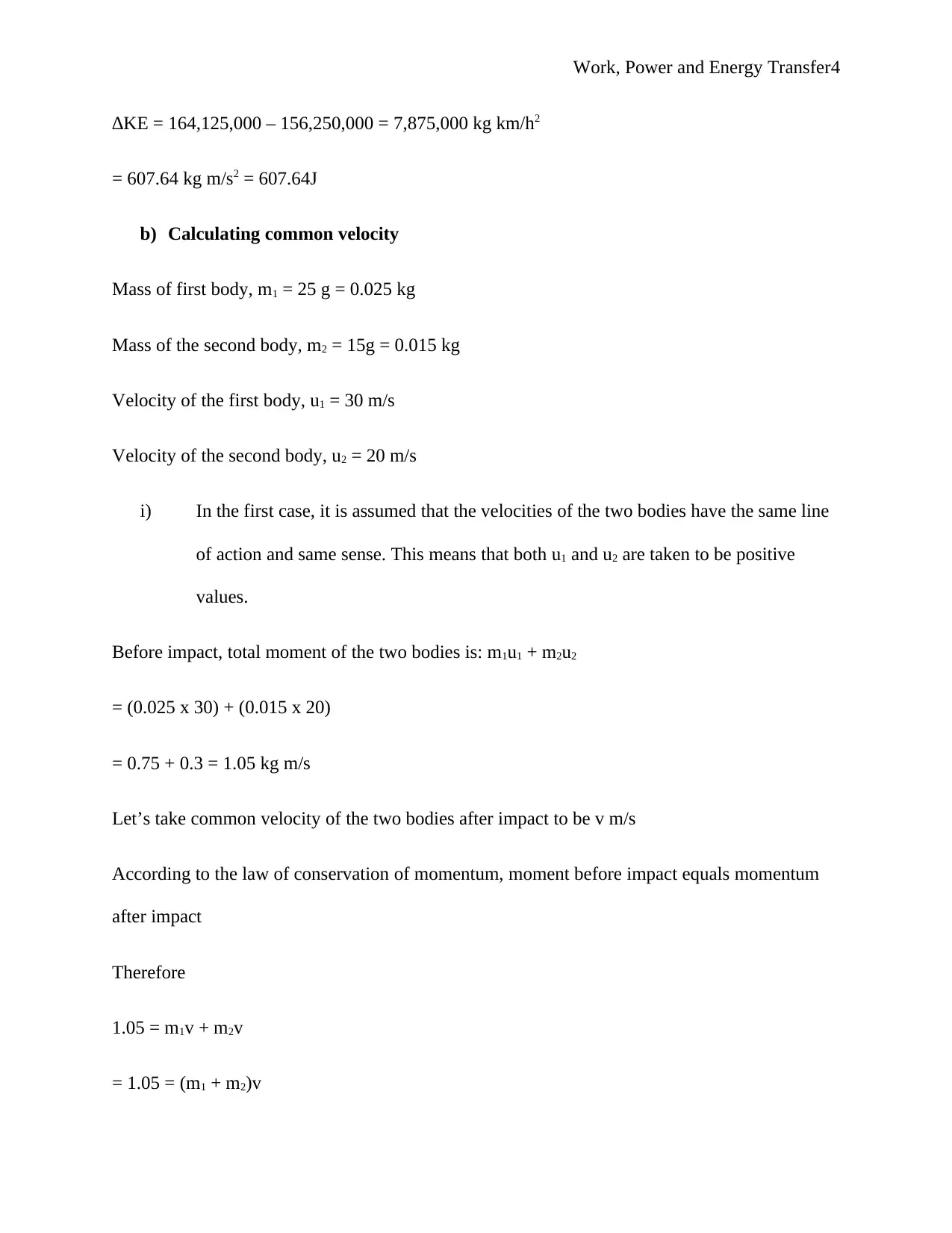
∆KE = 164,125,000 – 156,250,000 = 7,875,000 kg km/h2
= 607.64 kg m/s2 = 607.64J
b) Calculating common velocity
Mass of first body, m1 = 25 g = 0.025 kg
Mass of the second body, m2 = 15g = 0.015 kg
Velocity of the first body, u1 = 30 m/s
Velocity of the second body, u2 = 20 m/s
i) In the first case, it is assumed that the velocities of the two bodies have the same line
of action and same sense. This means that both u1 and u2 are taken to be positive
values.
Before impact, total moment of the two bodies is: m1u1 + m2u2
= (0.025 x 30) + (0.015 x 20)
= 0.75 + 0.3 = 1.05 kg m/s
Let’s take common velocity of the two bodies after impact to be v m/s
According to the law of conservation of momentum, moment before impact equals momentum
after impact
Therefore
1.05 = m1v + m2v
= 1.05 = (m1 + m2)v
tabler-icon-diamond-filled.svg

Paraphrase This Document

Need a fresh take? Get an instant paraphrase of this document with our AI Paraphraser
Document Page
Work, Power and Energy Transfer5
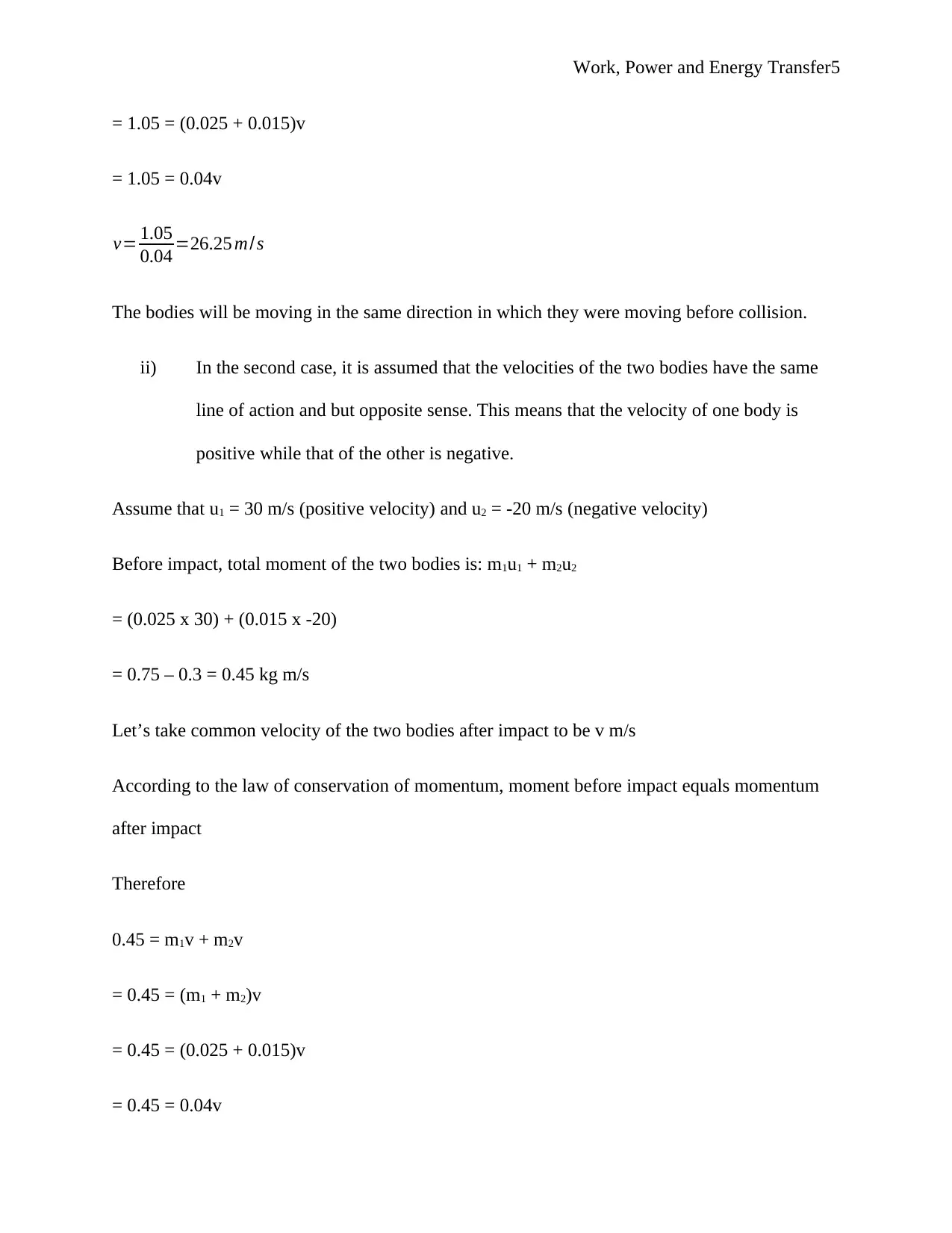
= 1.05 = (0.025 + 0.015)v
= 1.05 = 0.04v
v= 1.05
0.04 =26.25 m/s
The bodies will be moving in the same direction in which they were moving before collision.
ii) In the second case, it is assumed that the velocities of the two bodies have the same
line of action and but opposite sense. This means that the velocity of one body is
positive while that of the other is negative.
Assume that u1 = 30 m/s (positive velocity) and u2 = -20 m/s (negative velocity)
Before impact, total moment of the two bodies is: m1u1 + m2u2
= (0.025 x 30) + (0.015 x -20)
= 0.75 – 0.3 = 0.45 kg m/s
Let’s take common velocity of the two bodies after impact to be v m/s
According to the law of conservation of momentum, moment before impact equals momentum
after impact
Therefore
0.45 = m1v + m2v
= 0.45 = (m1 + m2)v
= 0.45 = (0.025 + 0.015)v
= 0.45 = 0.04v
Document Page
Work, Power and Energy Transfer6
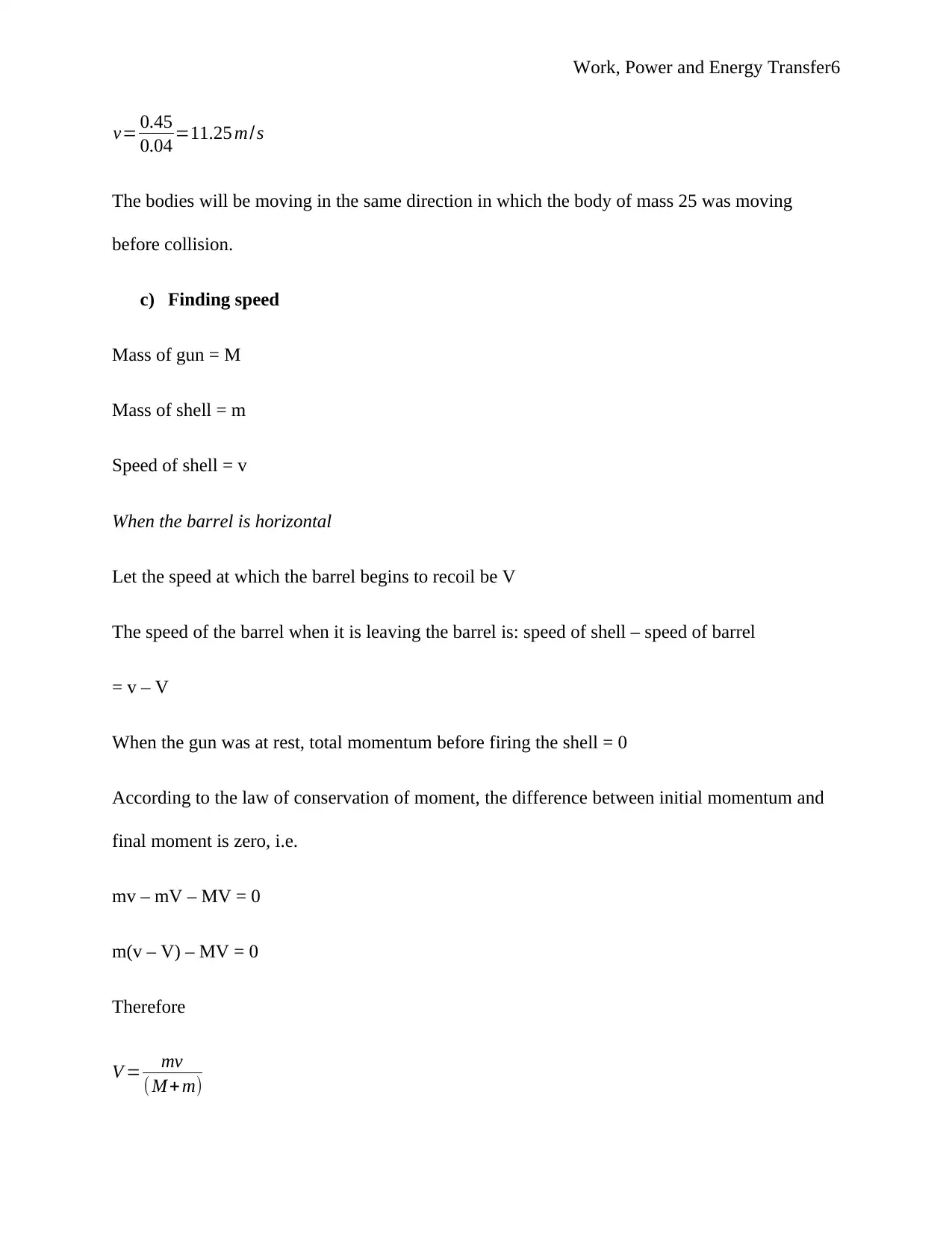
v= 0.45
0.04 =11.25 m/s
The bodies will be moving in the same direction in which the body of mass 25 was moving
before collision.
c) Finding speed
Mass of gun = M
Mass of shell = m
Speed of shell = v
When the barrel is horizontal
Let the speed at which the barrel begins to recoil be V
The speed of the barrel when it is leaving the barrel is: speed of shell – speed of barrel
= v – V
When the gun was at rest, total momentum before firing the shell = 0
According to the law of conservation of moment, the difference between initial momentum and
final moment is zero, i.e.
mv – mV – MV = 0
m(v – V) – MV = 0
Therefore
V = mv
(M+ m)
Document Page
Work, Power and Energy Transfer7
When the barrel makes an angle α with reference to the horizontal
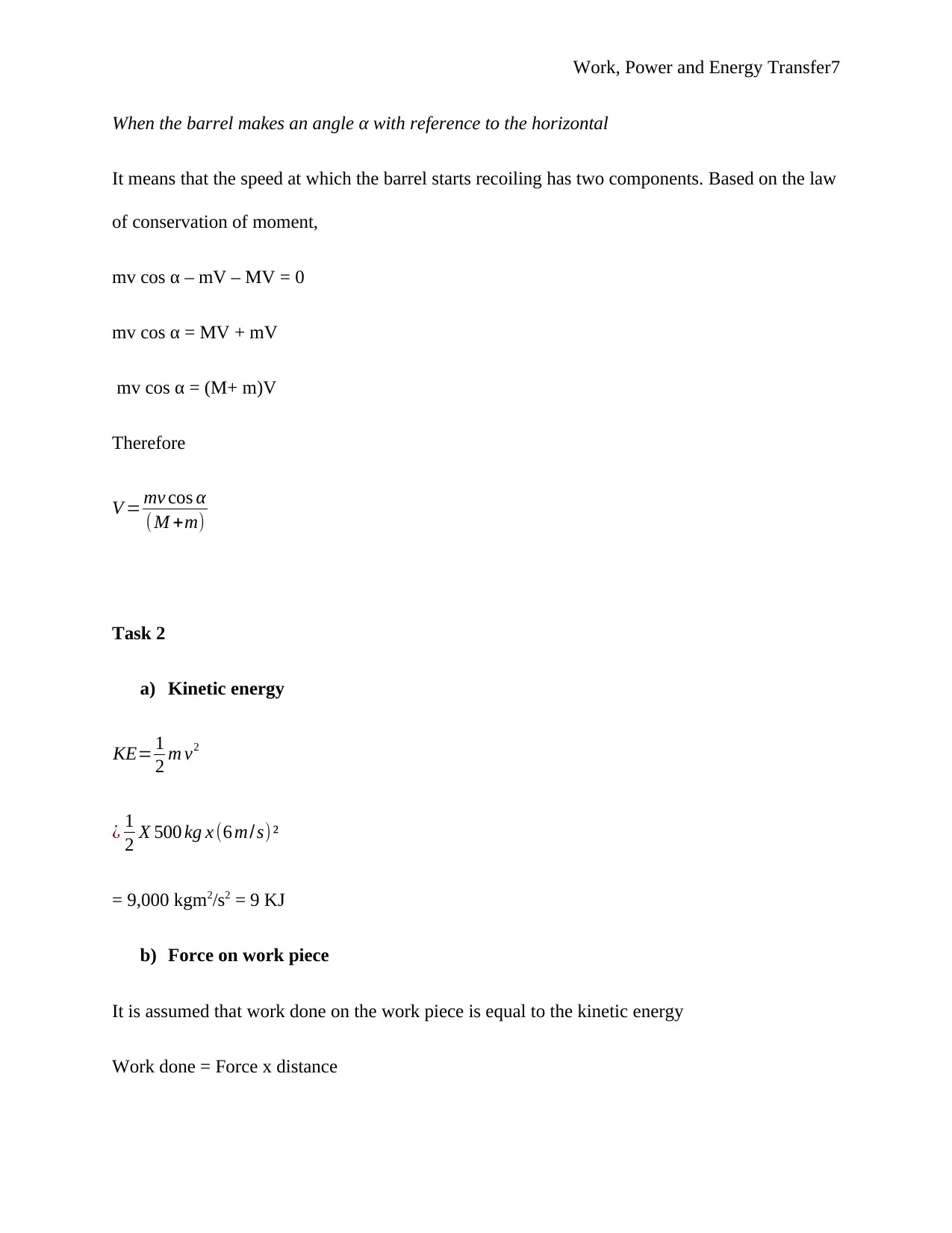
It means that the speed at which the barrel starts recoiling has two components. Based on the law
of conservation of moment,
mv cos α – mV – MV = 0
mv cos α = MV + mV
mv cos α = (M+ m)V
Therefore
V = mv cos α
(M +m)
Task 2
a) Kinetic energy
KE= 1
2 m v2
¿ 1
2 X 500 kg x (6 m/s) ²
= 9,000 kgm2/s2 = 9 KJ
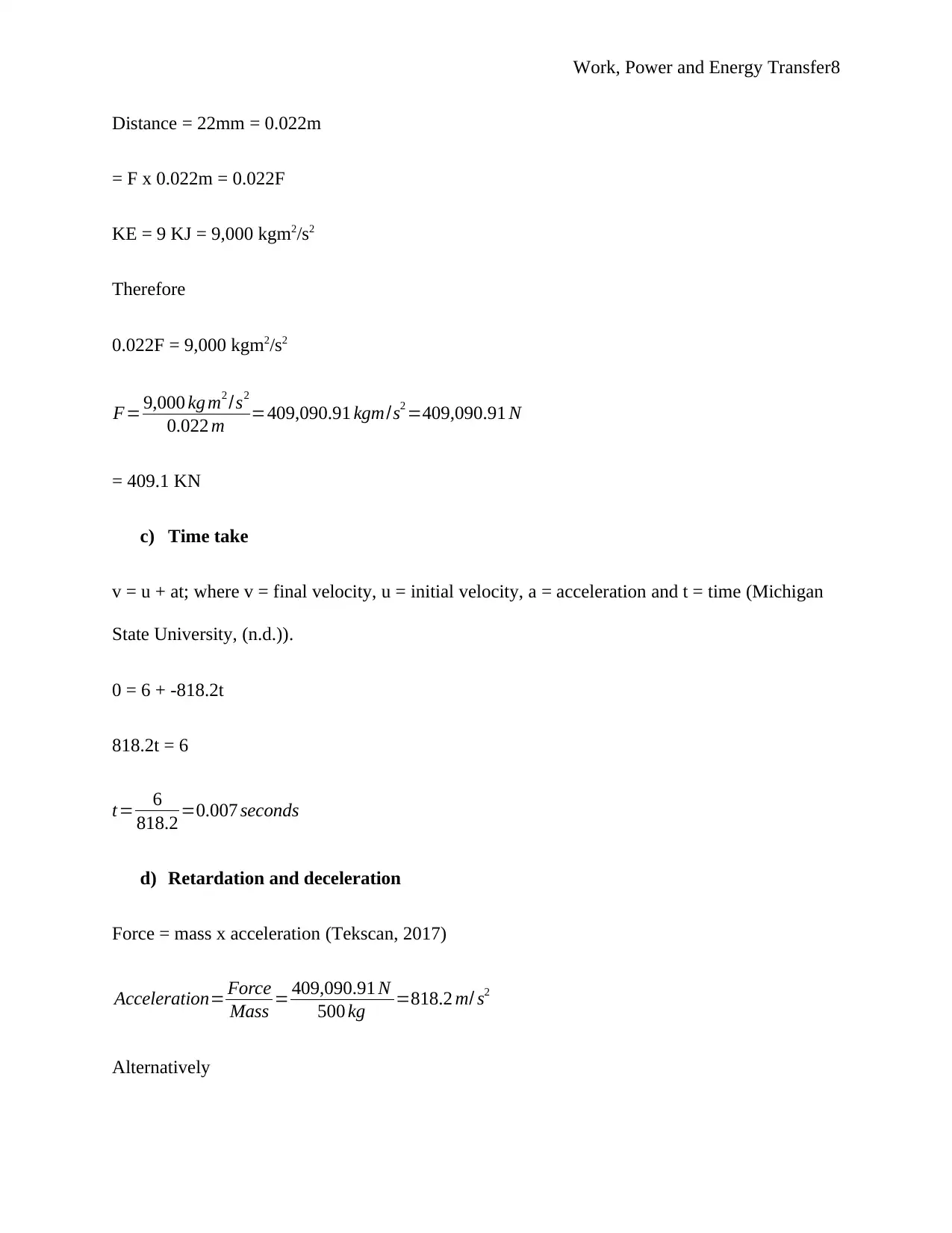
b) Force on work piece
It is assumed that work done on the work piece is equal to the kinetic energy
Work done = Force x distance
tabler-icon-diamond-filled.svg

Paraphrase This Document

Need a fresh take? Get an instant paraphrase of this document with our AI Paraphraser
Document Page
Work, Power and Energy Transfer8
Distance = 22mm = 0.022m
= F x 0.022m = 0.022F
KE = 9 KJ = 9,000 kgm2/s2
Therefore
0.022F = 9,000 kgm2/s2
F= 9,000 kg m2 /s2
0.022 m =409,090.91 kgm/s2 =409,090.91 N
= 409.1 KN
c) Time take
v = u + at; where v = final velocity, u = initial velocity, a = acceleration and t = time (Michigan
State University, (n.d.)).
0 = 6 + -818.2t
818.2t = 6
t= 6
818.2 =0.007 seconds
d) Retardation and deceleration
Force = mass x acceleration (Tekscan, 2017)
Acceleration= Force
Mass = 409,090.91 N
500 kg =818.2 m/ s2
Alternatively
Document Page
Work, Power and Energy Transfer9
Retardation of moving parts (deceleration)
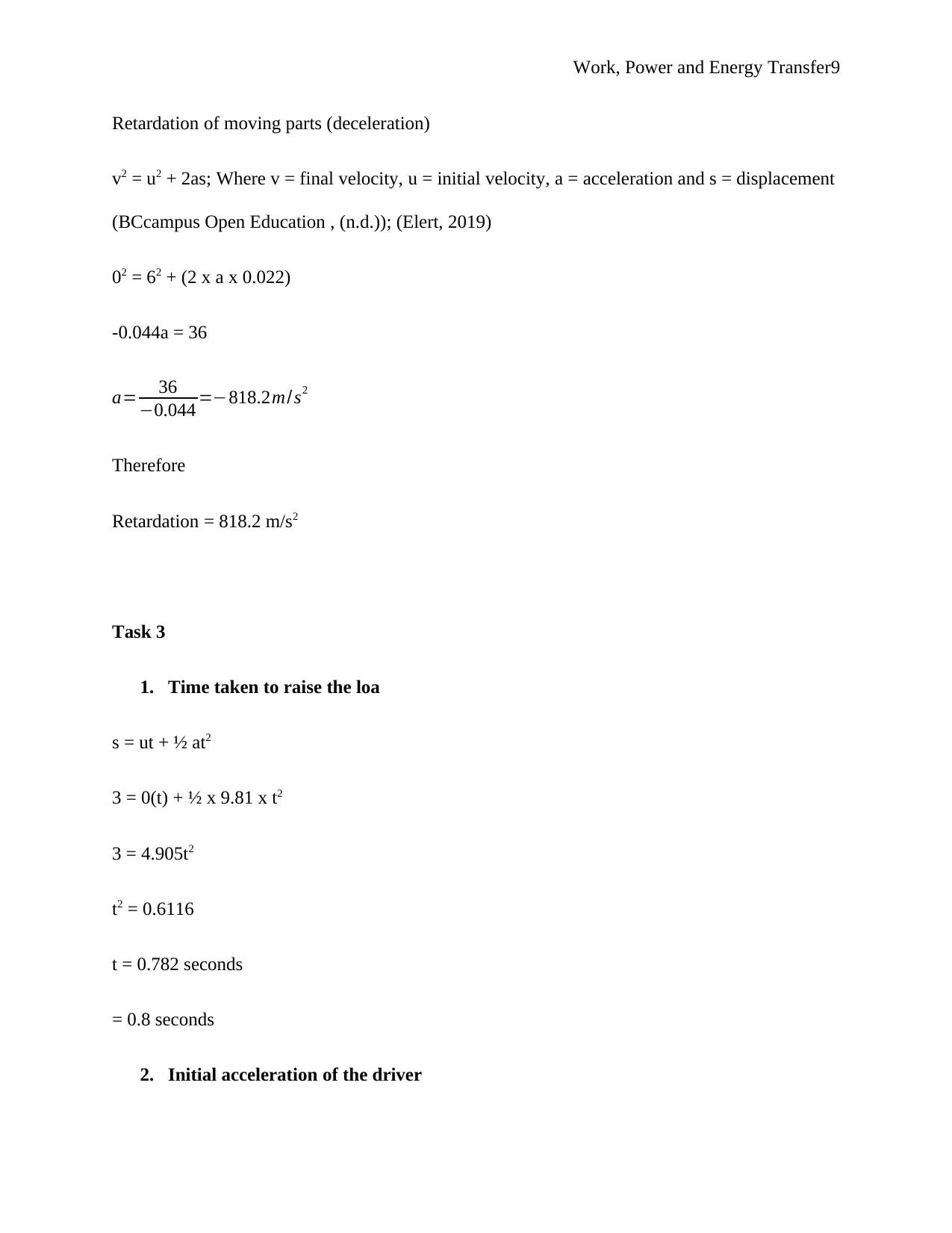
v2 = u2 + 2as; Where v = final velocity, u = initial velocity, a = acceleration and s = displacement
(BCcampus Open Education , (n.d.)); (Elert, 2019)
02 = 62 + (2 x a x 0.022)
-0.044a = 36
a= 36
0.044 =818.2m/s2
Therefore
Retardation = 818.2 m/s2
Task 3
1. Time taken to raise the loa
s = ut + ½ at2
3 = 0(t) + ½ x 9.81 x t2
3 = 4.905t2
t2 = 0.6116
t = 0.782 seconds
= 0.8 seconds
2. Initial acceleration of the driver
Document Page
Work, Power and Energy Transfer10
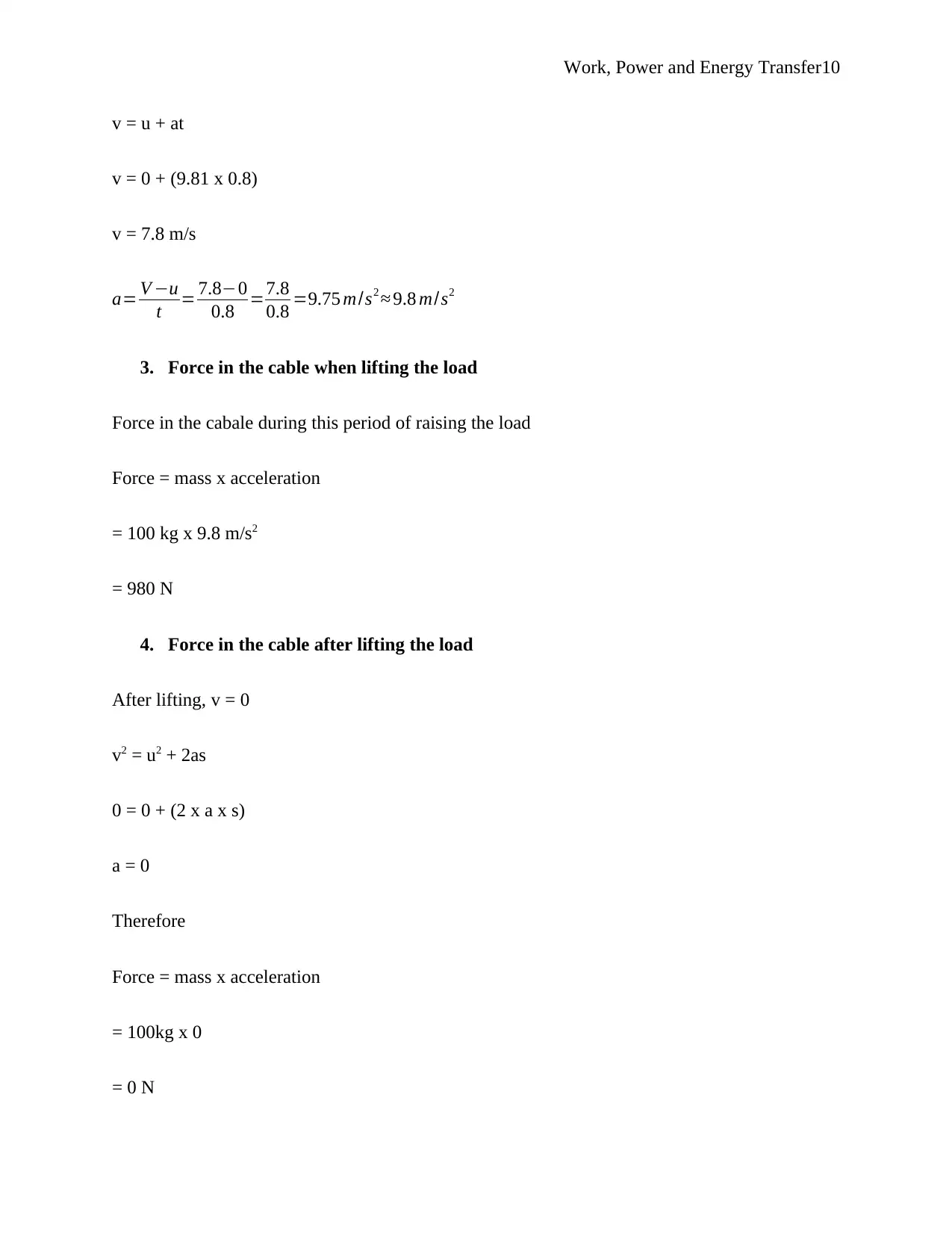
v = u + at
v = 0 + (9.81 x 0.8)
v = 7.8 m/s
a= V u
t = 7.80
0.8 =7.8
0.8 =9.75 m/s2 9.8 m/s2
3. Force in the cable when lifting the load
Force in the cabale during this period of raising the load
Force = mass x acceleration
= 100 kg x 9.8 m/s2
= 980 N
4. Force in the cable after lifting the load
After lifting, v = 0
v2 = u2 + 2as
0 = 0 + (2 x a x s)
a = 0
Therefore
Force = mass x acceleration
= 100kg x 0
= 0 N
tabler-icon-diamond-filled.svg

Paraphrase This Document

Need a fresh take? Get an instant paraphrase of this document with our AI Paraphraser
Document Page
Work, Power and Energy Transfer11
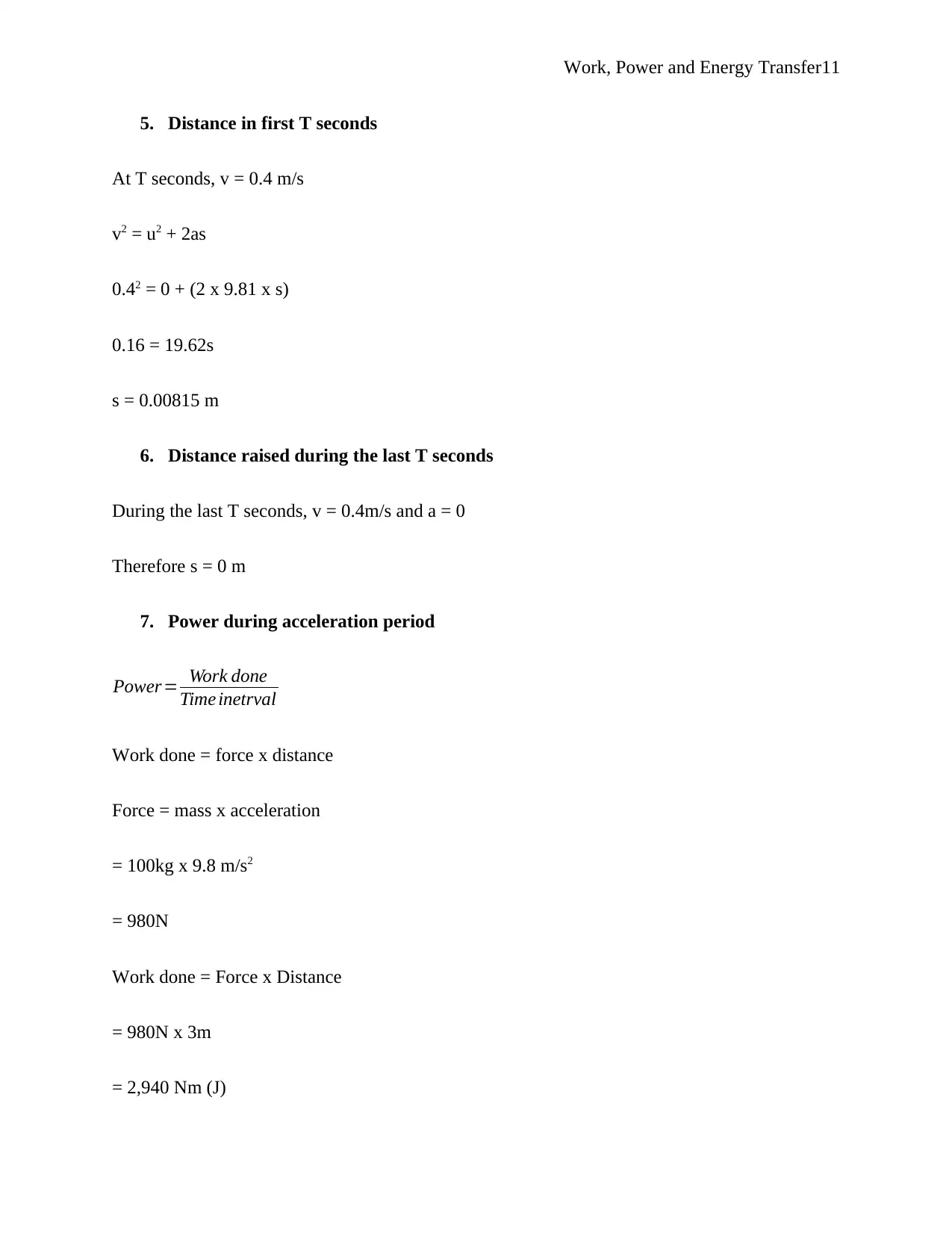
5. Distance in first T seconds
At T seconds, v = 0.4 m/s
v2 = u2 + 2as
0.42 = 0 + (2 x 9.81 x s)
0.16 = 19.62s
s = 0.00815 m
6. Distance raised during the last T seconds
During the last T seconds, v = 0.4m/s and a = 0
Therefore s = 0 m
7. Power during acceleration period
Power= Work done
Time inetrval
Work done = force x distance
Force = mass x acceleration
= 100kg x 9.8 m/s2
= 980N
Work done = Force x Distance
= 980N x 3m
= 2,940 Nm (J)
Document Page
Work, Power and Energy Transfer12
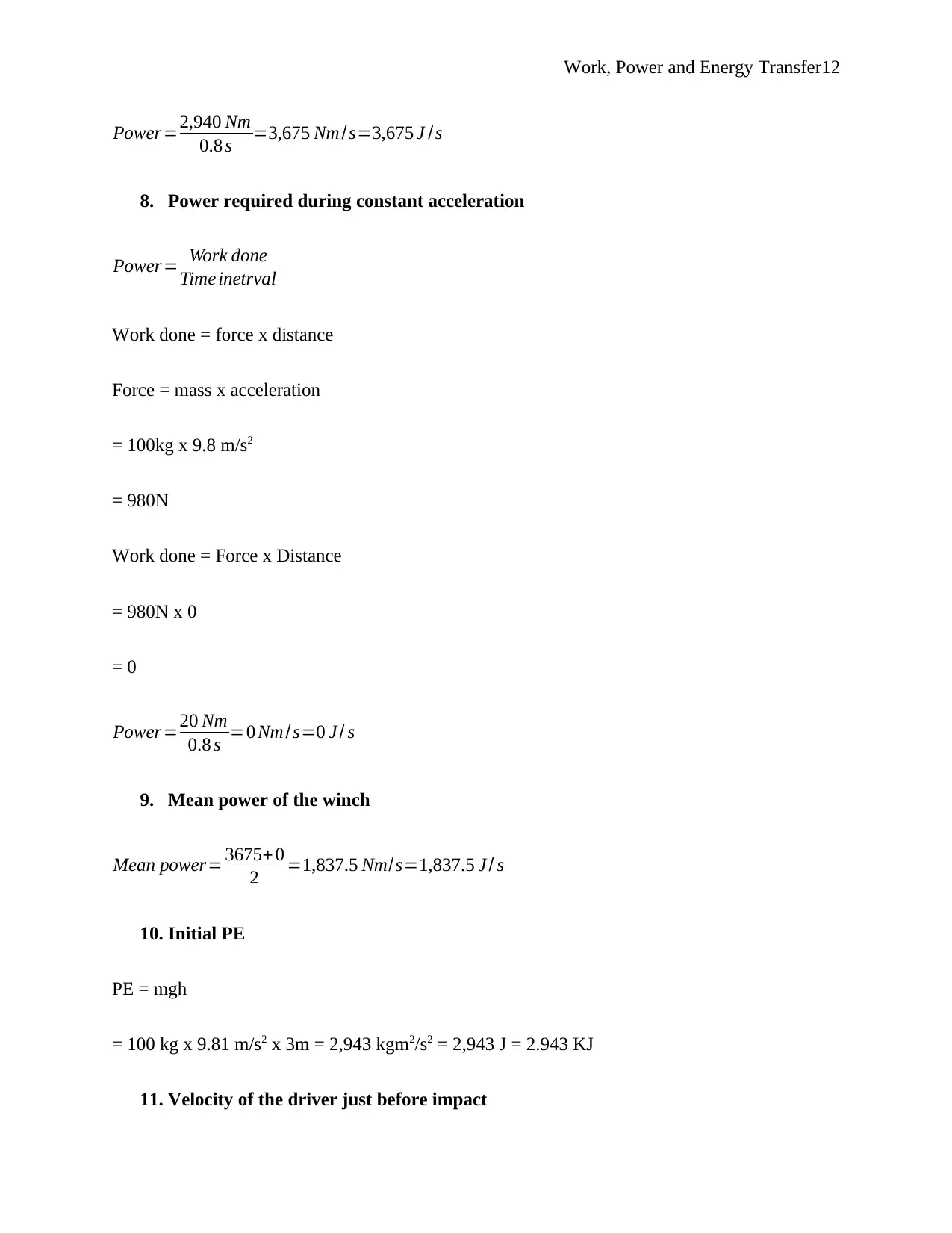
Power=2,940 Nm
0.8 s =3,675 Nm /s=3,675 J / s
8. Power required during constant acceleration
Power= Work done
Time inetrval
Work done = force x distance
Force = mass x acceleration
= 100kg x 9.8 m/s2
= 980N
Work done = Force x Distance
= 980N x 0
= 0
Power=20 Nm
0.8 s =0 Nm /s=0 J / s
9. Mean power of the winch
Mean power= 3675+ 0
2 =1,837.5 Nm/s=1,837.5 J / s
10. Initial PE
PE = mgh
= 100 kg x 9.81 m/s2 x 3m = 2,943 kgm2/s2 = 2,943 J = 2.943 KJ
11. Velocity of the driver just before impact
chevron_up_icon
1 out of 15
circle_padding
hide_on_mobile
zoom_out_icon
[object Object]