Worksheet 3: Implementing a Search Strategy for Evidence
VerifiedAdded on 2022/10/01
|9
|2677
|53
Homework Assignment
AI Summary
This worksheet assignment focuses on implementing a search strategy for evidence-based research, specifically addressing a PICO question related to healthcare interventions. The student is tasked with demonstrating their skills in selecting appropriate databases, constructing search terms using Boolean operators and synonyms, and recording their search history. The assignment requires the student to iteratively refine their search strategy based on the results obtained, evaluating the number of references identified and adjusting search terms to broaden or narrow the scope of the search. The student is expected to consider the effectiveness hierarchy of evidence and to justify the rationale behind each adjustment made to the search terms, ensuring the search is comprehensive and efficient. The example provided illustrates the process of searching in Psycinfo and MEDLINE. This exercise aims to develop the student's ability to locate and evaluate relevant research literature to inform their practice and answer their chosen foreground question. The student is expected to choose four empirical studies that best inform the question and assess their quality.
Worksheet 3
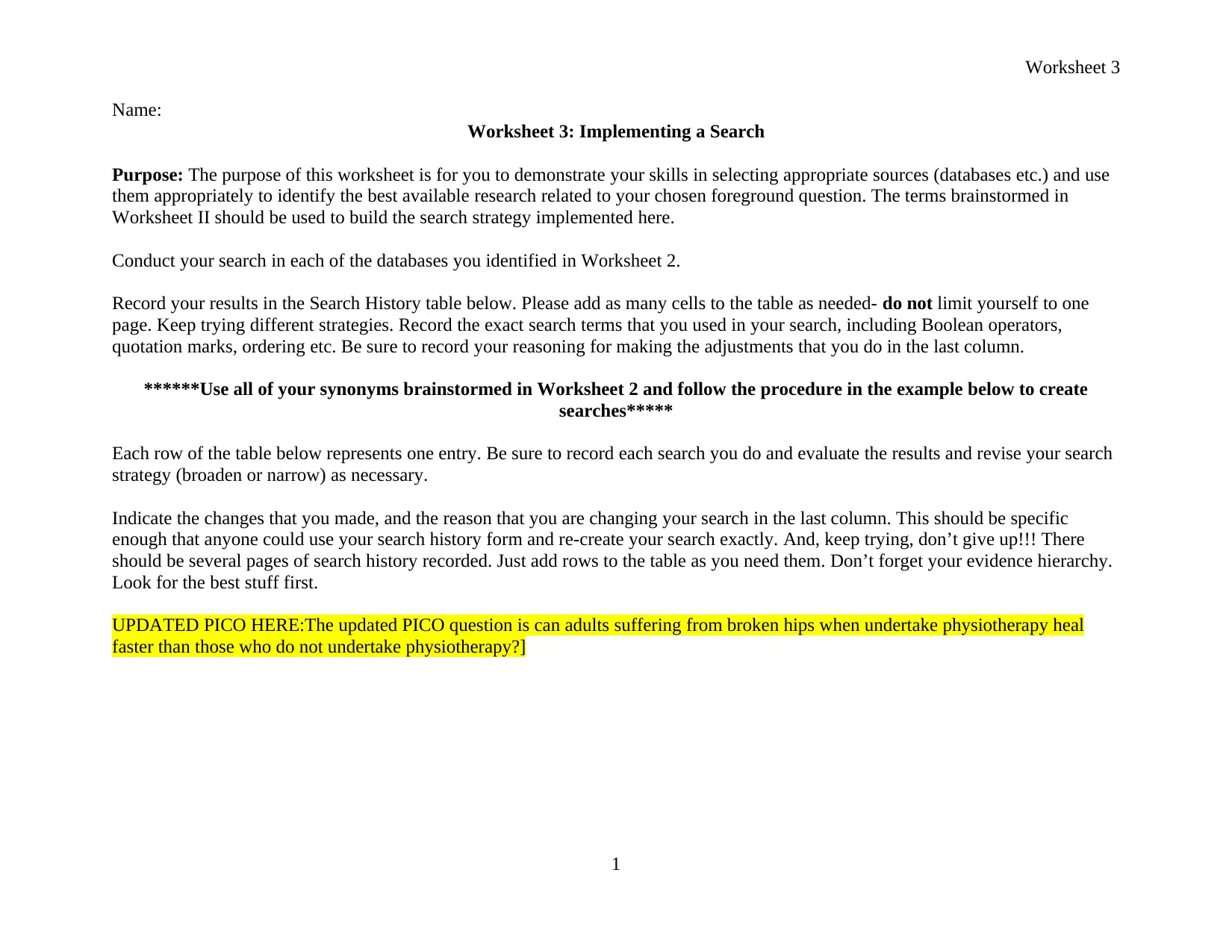
Name:
Worksheet 3: Implementing a Search
Purpose: The purpose of this worksheet is for you to demonstrate your skills in selecting appropriate sources (databases etc.) and use
them appropriately to identify the best available research related to your chosen foreground question. The terms brainstormed in
Worksheet II should be used to build the search strategy implemented here.
Conduct your search in each of the databases you identified in Worksheet 2.
Record your results in the Search History table below. Please add as many cells to the table as needed- do not limit yourself to one
page. Keep trying different strategies. Record the exact search terms that you used in your search, including Boolean operators,
quotation marks, ordering etc. Be sure to record your reasoning for making the adjustments that you do in the last column.
******Use all of your synonyms brainstormed in Worksheet 2 and follow the procedure in the example below to create
searches*****
Each row of the table below represents one entry. Be sure to record each search you do and evaluate the results and revise your search
strategy (broaden or narrow) as necessary.
Indicate the changes that you made, and the reason that you are changing your search in the last column. This should be specific
enough that anyone could use your search history form and re-create your search exactly. And, keep trying, don’t give up!!! There
should be several pages of search history recorded. Just add rows to the table as you need them. Don’t forget your evidence hierarchy.
Look for the best stuff first.
UPDATED PICO HERE:The updated PICO question is can adults suffering from broken hips when undertake physiotherapy heal
faster than those who do not undertake physiotherapy?]
1
Name:
Worksheet 3: Implementing a Search
Purpose: The purpose of this worksheet is for you to demonstrate your skills in selecting appropriate sources (databases etc.) and use
them appropriately to identify the best available research related to your chosen foreground question. The terms brainstormed in
Worksheet II should be used to build the search strategy implemented here.
Conduct your search in each of the databases you identified in Worksheet 2.
Record your results in the Search History table below. Please add as many cells to the table as needed- do not limit yourself to one
page. Keep trying different strategies. Record the exact search terms that you used in your search, including Boolean operators,
quotation marks, ordering etc. Be sure to record your reasoning for making the adjustments that you do in the last column.
******Use all of your synonyms brainstormed in Worksheet 2 and follow the procedure in the example below to create
searches*****
Each row of the table below represents one entry. Be sure to record each search you do and evaluate the results and revise your search
strategy (broaden or narrow) as necessary.
Indicate the changes that you made, and the reason that you are changing your search in the last column. This should be specific
enough that anyone could use your search history form and re-create your search exactly. And, keep trying, don’t give up!!! There
should be several pages of search history recorded. Just add rows to the table as you need them. Don’t forget your evidence hierarchy.
Look for the best stuff first.
UPDATED PICO HERE:The updated PICO question is can adults suffering from broken hips when undertake physiotherapy heal
faster than those who do not undertake physiotherapy?]
1
Paraphrase This Document
Need a fresh take? Get an instant paraphrase of this document with our AI Paraphraser

Worksheet 3
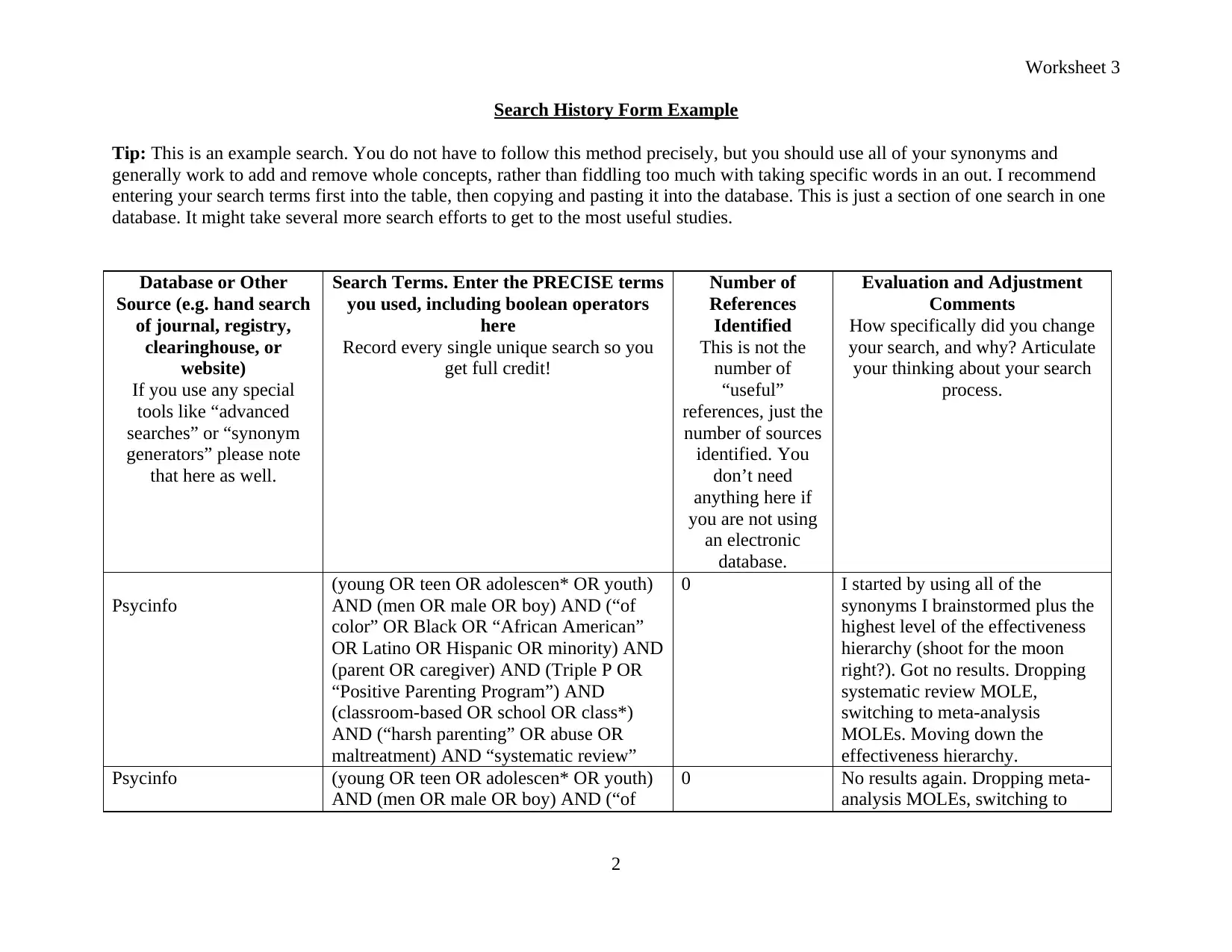
Search History Form Example
Tip: This is an example search. You do not have to follow this method precisely, but you should use all of your synonyms and
generally work to add and remove whole concepts, rather than fiddling too much with taking specific words in an out. I recommend
entering your search terms first into the table, then copying and pasting it into the database. This is just a section of one search in one
database. It might take several more search efforts to get to the most useful studies.
Database or Other
Source (e.g. hand search
of journal, registry,
clearinghouse, or
website)
If you use any special
tools like “advanced
searches” or “synonym
generators” please note
that here as well.
Search Terms. Enter the PRECISE terms
you used, including boolean operators
here
Record every single unique search so you
get full credit!
Number of
References
Identified
This is not the
number of
“useful”
references, just the
number of sources
identified. You
don’t need
anything here if
you are not using
an electronic
database.
Evaluation and Adjustment
Comments
How specifically did you change
your search, and why? Articulate
your thinking about your search
process.
Psycinfo
(young OR teen OR adolescen* OR youth)
AND (men OR male OR boy) AND (“of
color” OR Black OR “African American”
OR Latino OR Hispanic OR minority) AND
(parent OR caregiver) AND (Triple P OR
“Positive Parenting Program”) AND
(classroom-based OR school OR class*)
AND (“harsh parenting” OR abuse OR
maltreatment) AND “systematic review”
0 I started by using all of the
synonyms I brainstormed plus the
highest level of the effectiveness
hierarchy (shoot for the moon
right?). Got no results. Dropping
systematic review MOLE,
switching to meta-analysis
MOLEs. Moving down the
effectiveness hierarchy.
Psycinfo (young OR teen OR adolescen* OR youth)
AND (men OR male OR boy) AND (“of
0 No results again. Dropping meta-
analysis MOLEs, switching to
2
Search History Form Example
Tip: This is an example search. You do not have to follow this method precisely, but you should use all of your synonyms and
generally work to add and remove whole concepts, rather than fiddling too much with taking specific words in an out. I recommend
entering your search terms first into the table, then copying and pasting it into the database. This is just a section of one search in one
database. It might take several more search efforts to get to the most useful studies.
Database or Other
Source (e.g. hand search
of journal, registry,
clearinghouse, or
website)
If you use any special
tools like “advanced
searches” or “synonym
generators” please note
that here as well.
Search Terms. Enter the PRECISE terms
you used, including boolean operators
here
Record every single unique search so you
get full credit!
Number of
References
Identified
This is not the
number of
“useful”
references, just the
number of sources
identified. You
don’t need
anything here if
you are not using
an electronic
database.
Evaluation and Adjustment
Comments
How specifically did you change
your search, and why? Articulate
your thinking about your search
process.
Psycinfo
(young OR teen OR adolescen* OR youth)
AND (men OR male OR boy) AND (“of
color” OR Black OR “African American”
OR Latino OR Hispanic OR minority) AND
(parent OR caregiver) AND (Triple P OR
“Positive Parenting Program”) AND
(classroom-based OR school OR class*)
AND (“harsh parenting” OR abuse OR
maltreatment) AND “systematic review”
0 I started by using all of the
synonyms I brainstormed plus the
highest level of the effectiveness
hierarchy (shoot for the moon
right?). Got no results. Dropping
systematic review MOLE,
switching to meta-analysis
MOLEs. Moving down the
effectiveness hierarchy.
Psycinfo (young OR teen OR adolescen* OR youth)
AND (men OR male OR boy) AND (“of
0 No results again. Dropping meta-
analysis MOLEs, switching to
2

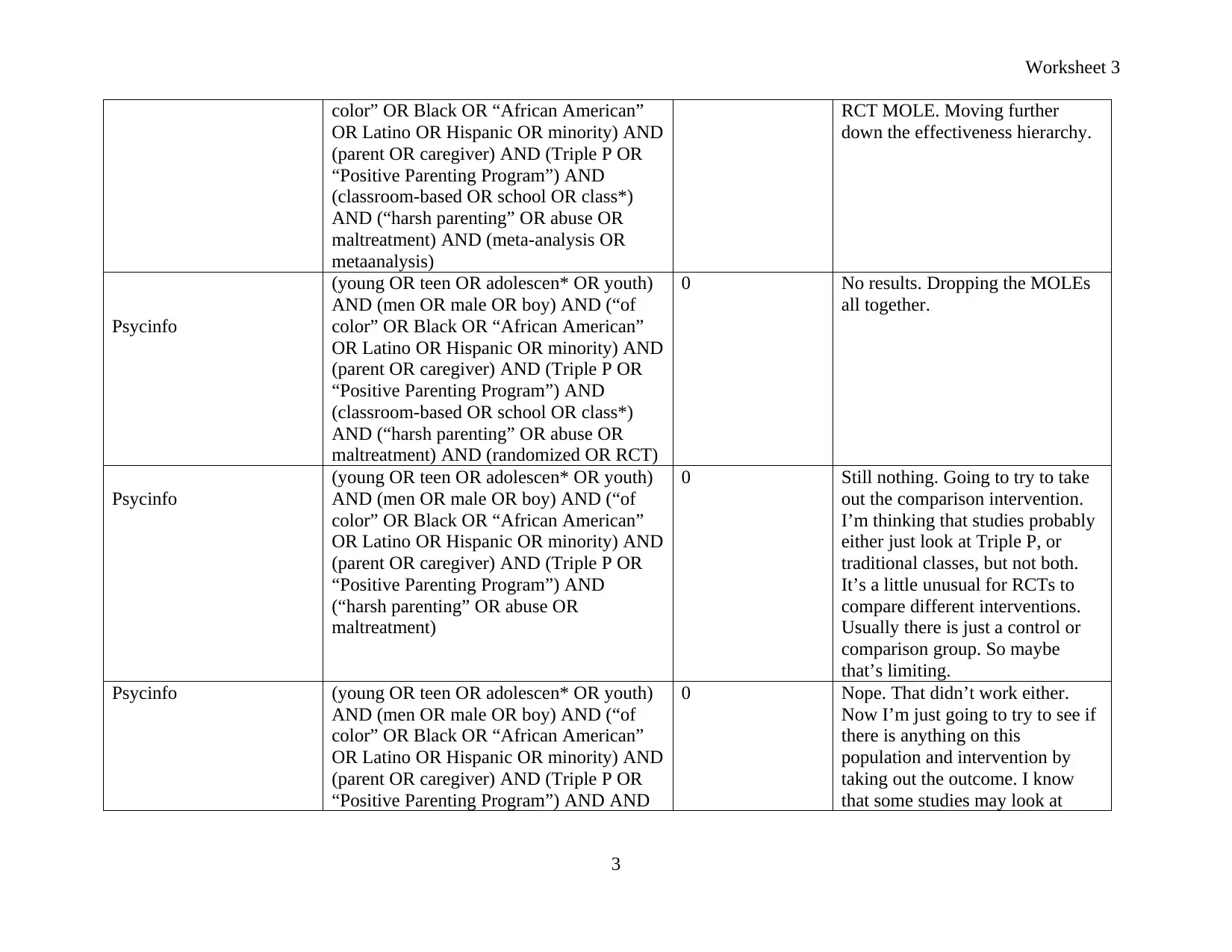
Worksheet 3
color” OR Black OR “African American”
OR Latino OR Hispanic OR minority) AND
(parent OR caregiver) AND (Triple P OR
“Positive Parenting Program”) AND
(classroom-based OR school OR class*)
AND (“harsh parenting” OR abuse OR
maltreatment) AND (meta-analysis OR
metaanalysis)
RCT MOLE. Moving further
down the effectiveness hierarchy.
Psycinfo
(young OR teen OR adolescen* OR youth)
AND (men OR male OR boy) AND (“of
color” OR Black OR “African American”
OR Latino OR Hispanic OR minority) AND
(parent OR caregiver) AND (Triple P OR
“Positive Parenting Program”) AND
(classroom-based OR school OR class*)
AND (“harsh parenting” OR abuse OR
maltreatment) AND (randomized OR RCT)
0 No results. Dropping the MOLEs
all together.
Psycinfo
(young OR teen OR adolescen* OR youth)
AND (men OR male OR boy) AND (“of
color” OR Black OR “African American”
OR Latino OR Hispanic OR minority) AND
(parent OR caregiver) AND (Triple P OR
“Positive Parenting Program”) AND
(“harsh parenting” OR abuse OR
maltreatment)
0 Still nothing. Going to try to take
out the comparison intervention.
I’m thinking that studies probably
either just look at Triple P, or
traditional classes, but not both.
It’s a little unusual for RCTs to
compare different interventions.
Usually there is just a control or
comparison group. So maybe
that’s limiting.
Psycinfo (young OR teen OR adolescen* OR youth)
AND (men OR male OR boy) AND (“of
color” OR Black OR “African American”
OR Latino OR Hispanic OR minority) AND
(parent OR caregiver) AND (Triple P OR
“Positive Parenting Program”) AND AND
0 Nope. That didn’t work either.
Now I’m just going to try to see if
there is anything on this
population and intervention by
taking out the outcome. I know
that some studies may look at
3
color” OR Black OR “African American”
OR Latino OR Hispanic OR minority) AND
(parent OR caregiver) AND (Triple P OR
“Positive Parenting Program”) AND
(classroom-based OR school OR class*)
AND (“harsh parenting” OR abuse OR
maltreatment) AND (meta-analysis OR
metaanalysis)
RCT MOLE. Moving further
down the effectiveness hierarchy.
Psycinfo
(young OR teen OR adolescen* OR youth)
AND (men OR male OR boy) AND (“of
color” OR Black OR “African American”
OR Latino OR Hispanic OR minority) AND
(parent OR caregiver) AND (Triple P OR
“Positive Parenting Program”) AND
(classroom-based OR school OR class*)
AND (“harsh parenting” OR abuse OR
maltreatment) AND (randomized OR RCT)
0 No results. Dropping the MOLEs
all together.
Psycinfo
(young OR teen OR adolescen* OR youth)
AND (men OR male OR boy) AND (“of
color” OR Black OR “African American”
OR Latino OR Hispanic OR minority) AND
(parent OR caregiver) AND (Triple P OR
“Positive Parenting Program”) AND
(“harsh parenting” OR abuse OR
maltreatment)
0 Still nothing. Going to try to take
out the comparison intervention.
I’m thinking that studies probably
either just look at Triple P, or
traditional classes, but not both.
It’s a little unusual for RCTs to
compare different interventions.
Usually there is just a control or
comparison group. So maybe
that’s limiting.
Psycinfo (young OR teen OR adolescen* OR youth)
AND (men OR male OR boy) AND (“of
color” OR Black OR “African American”
OR Latino OR Hispanic OR minority) AND
(parent OR caregiver) AND (Triple P OR
“Positive Parenting Program”) AND AND
0 Nope. That didn’t work either.
Now I’m just going to try to see if
there is anything on this
population and intervention by
taking out the outcome. I know
that some studies may look at
3
⊘ This is a preview!⊘
Do you want full access?
Subscribe today to unlock all pages.

Trusted by 1+ million students worldwide

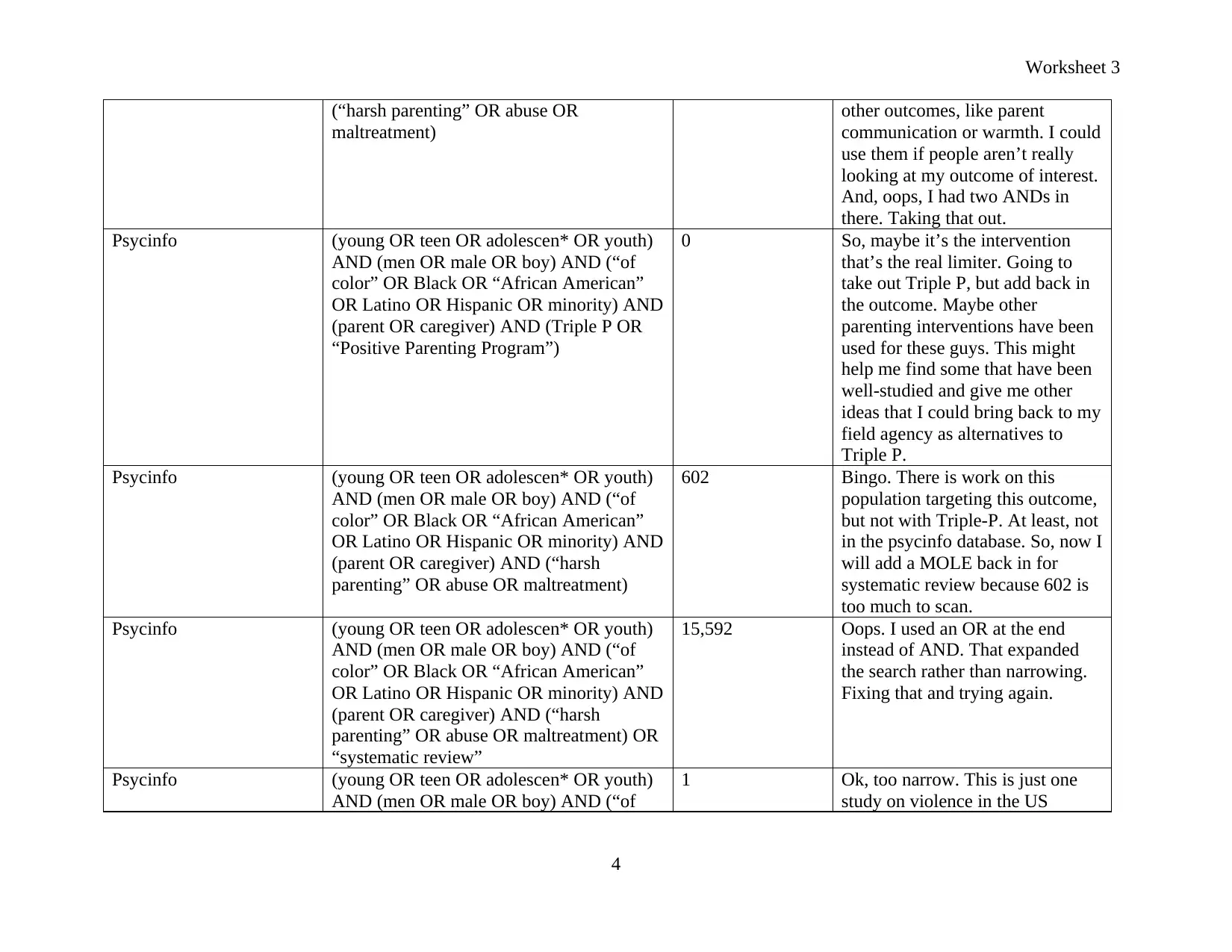
Worksheet 3
(“harsh parenting” OR abuse OR
maltreatment)
other outcomes, like parent
communication or warmth. I could
use them if people aren’t really
looking at my outcome of interest.
And, oops, I had two ANDs in
there. Taking that out.
Psycinfo (young OR teen OR adolescen* OR youth)
AND (men OR male OR boy) AND (“of
color” OR Black OR “African American”
OR Latino OR Hispanic OR minority) AND
(parent OR caregiver) AND (Triple P OR
“Positive Parenting Program”)
0 So, maybe it’s the intervention
that’s the real limiter. Going to
take out Triple P, but add back in
the outcome. Maybe other
parenting interventions have been
used for these guys. This might
help me find some that have been
well-studied and give me other
ideas that I could bring back to my
field agency as alternatives to
Triple P.
Psycinfo (young OR teen OR adolescen* OR youth)
AND (men OR male OR boy) AND (“of
color” OR Black OR “African American”
OR Latino OR Hispanic OR minority) AND
(parent OR caregiver) AND (“harsh
parenting” OR abuse OR maltreatment)
602 Bingo. There is work on this
population targeting this outcome,
but not with Triple-P. At least, not
in the psycinfo database. So, now I
will add a MOLE back in for
systematic review because 602 is
too much to scan.
Psycinfo (young OR teen OR adolescen* OR youth)
AND (men OR male OR boy) AND (“of
color” OR Black OR “African American”
OR Latino OR Hispanic OR minority) AND
(parent OR caregiver) AND (“harsh
parenting” OR abuse OR maltreatment) OR
“systematic review”
15,592 Oops. I used an OR at the end
instead of AND. That expanded
the search rather than narrowing.
Fixing that and trying again.
Psycinfo (young OR teen OR adolescen* OR youth)
AND (men OR male OR boy) AND (“of
1 Ok, too narrow. This is just one
study on violence in the US
4
(“harsh parenting” OR abuse OR
maltreatment)
other outcomes, like parent
communication or warmth. I could
use them if people aren’t really
looking at my outcome of interest.
And, oops, I had two ANDs in
there. Taking that out.
Psycinfo (young OR teen OR adolescen* OR youth)
AND (men OR male OR boy) AND (“of
color” OR Black OR “African American”
OR Latino OR Hispanic OR minority) AND
(parent OR caregiver) AND (Triple P OR
“Positive Parenting Program”)
0 So, maybe it’s the intervention
that’s the real limiter. Going to
take out Triple P, but add back in
the outcome. Maybe other
parenting interventions have been
used for these guys. This might
help me find some that have been
well-studied and give me other
ideas that I could bring back to my
field agency as alternatives to
Triple P.
Psycinfo (young OR teen OR adolescen* OR youth)
AND (men OR male OR boy) AND (“of
color” OR Black OR “African American”
OR Latino OR Hispanic OR minority) AND
(parent OR caregiver) AND (“harsh
parenting” OR abuse OR maltreatment)
602 Bingo. There is work on this
population targeting this outcome,
but not with Triple-P. At least, not
in the psycinfo database. So, now I
will add a MOLE back in for
systematic review because 602 is
too much to scan.
Psycinfo (young OR teen OR adolescen* OR youth)
AND (men OR male OR boy) AND (“of
color” OR Black OR “African American”
OR Latino OR Hispanic OR minority) AND
(parent OR caregiver) AND (“harsh
parenting” OR abuse OR maltreatment) OR
“systematic review”
15,592 Oops. I used an OR at the end
instead of AND. That expanded
the search rather than narrowing.
Fixing that and trying again.
Psycinfo (young OR teen OR adolescen* OR youth)
AND (men OR male OR boy) AND (“of
1 Ok, too narrow. This is just one
study on violence in the US
4
Paraphrase This Document
Need a fresh take? Get an instant paraphrase of this document with our AI Paraphraser

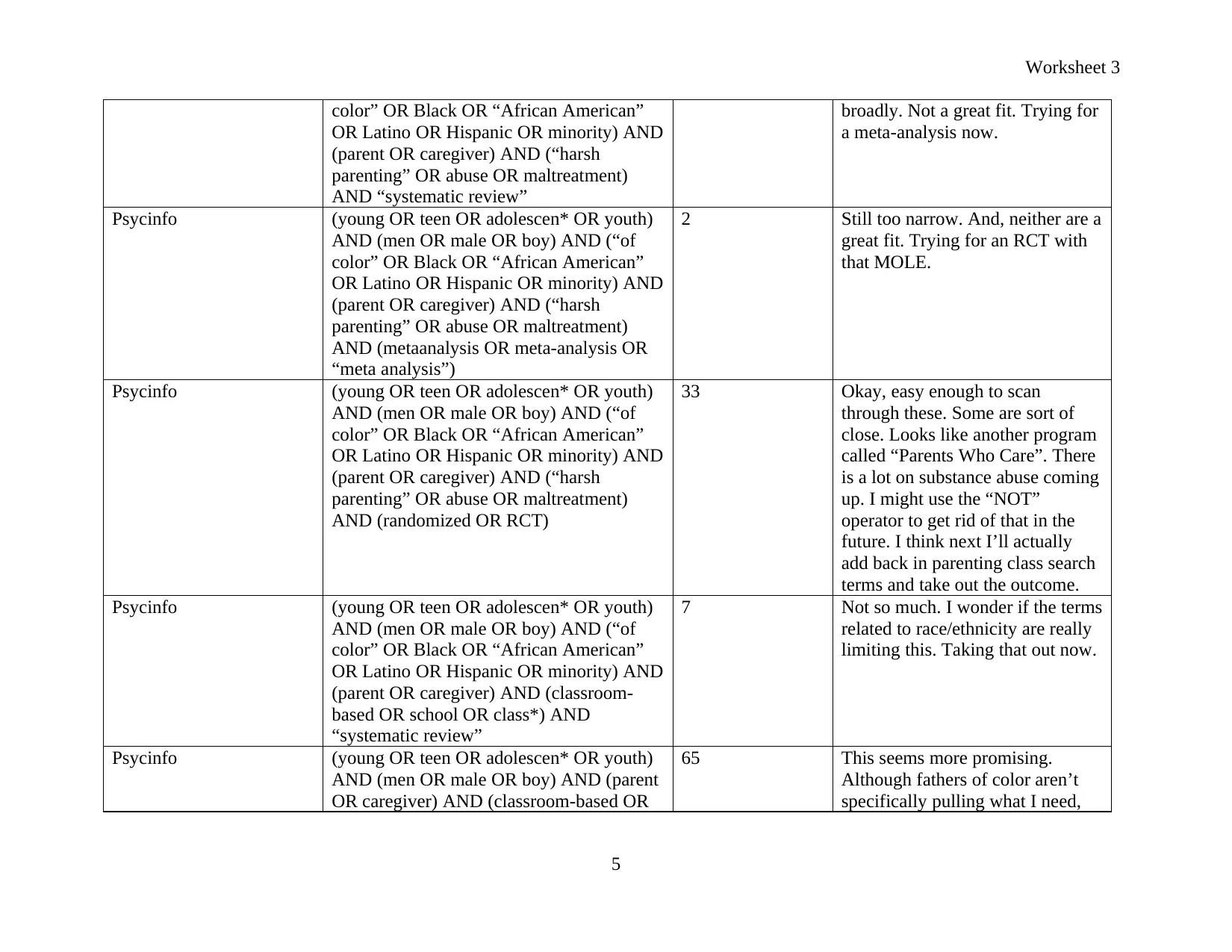
Worksheet 3
color” OR Black OR “African American”
OR Latino OR Hispanic OR minority) AND
(parent OR caregiver) AND (“harsh
parenting” OR abuse OR maltreatment)
AND “systematic review”
broadly. Not a great fit. Trying for
a meta-analysis now.
Psycinfo (young OR teen OR adolescen* OR youth)
AND (men OR male OR boy) AND (“of
color” OR Black OR “African American”
OR Latino OR Hispanic OR minority) AND
(parent OR caregiver) AND (“harsh
parenting” OR abuse OR maltreatment)
AND (metaanalysis OR meta-analysis OR
“meta analysis”)
2 Still too narrow. And, neither are a
great fit. Trying for an RCT with
that MOLE.
Psycinfo (young OR teen OR adolescen* OR youth)
AND (men OR male OR boy) AND (“of
color” OR Black OR “African American”
OR Latino OR Hispanic OR minority) AND
(parent OR caregiver) AND (“harsh
parenting” OR abuse OR maltreatment)
AND (randomized OR RCT)
33 Okay, easy enough to scan
through these. Some are sort of
close. Looks like another program
called “Parents Who Care”. There
is a lot on substance abuse coming
up. I might use the “NOT”
operator to get rid of that in the
future. I think next I’ll actually
add back in parenting class search
terms and take out the outcome.
Psycinfo (young OR teen OR adolescen* OR youth)
AND (men OR male OR boy) AND (“of
color” OR Black OR “African American”
OR Latino OR Hispanic OR minority) AND
(parent OR caregiver) AND (classroom-
based OR school OR class*) AND
“systematic review”
7 Not so much. I wonder if the terms
related to race/ethnicity are really
limiting this. Taking that out now.
Psycinfo (young OR teen OR adolescen* OR youth)
AND (men OR male OR boy) AND (parent
OR caregiver) AND (classroom-based OR
65 This seems more promising.
Although fathers of color aren’t
specifically pulling what I need,
5
color” OR Black OR “African American”
OR Latino OR Hispanic OR minority) AND
(parent OR caregiver) AND (“harsh
parenting” OR abuse OR maltreatment)
AND “systematic review”
broadly. Not a great fit. Trying for
a meta-analysis now.
Psycinfo (young OR teen OR adolescen* OR youth)
AND (men OR male OR boy) AND (“of
color” OR Black OR “African American”
OR Latino OR Hispanic OR minority) AND
(parent OR caregiver) AND (“harsh
parenting” OR abuse OR maltreatment)
AND (metaanalysis OR meta-analysis OR
“meta analysis”)
2 Still too narrow. And, neither are a
great fit. Trying for an RCT with
that MOLE.
Psycinfo (young OR teen OR adolescen* OR youth)
AND (men OR male OR boy) AND (“of
color” OR Black OR “African American”
OR Latino OR Hispanic OR minority) AND
(parent OR caregiver) AND (“harsh
parenting” OR abuse OR maltreatment)
AND (randomized OR RCT)
33 Okay, easy enough to scan
through these. Some are sort of
close. Looks like another program
called “Parents Who Care”. There
is a lot on substance abuse coming
up. I might use the “NOT”
operator to get rid of that in the
future. I think next I’ll actually
add back in parenting class search
terms and take out the outcome.
Psycinfo (young OR teen OR adolescen* OR youth)
AND (men OR male OR boy) AND (“of
color” OR Black OR “African American”
OR Latino OR Hispanic OR minority) AND
(parent OR caregiver) AND (classroom-
based OR school OR class*) AND
“systematic review”
7 Not so much. I wonder if the terms
related to race/ethnicity are really
limiting this. Taking that out now.
Psycinfo (young OR teen OR adolescen* OR youth)
AND (men OR male OR boy) AND (parent
OR caregiver) AND (classroom-based OR
65 This seems more promising.
Although fathers of color aren’t
specifically pulling what I need,
5

Worksheet 3
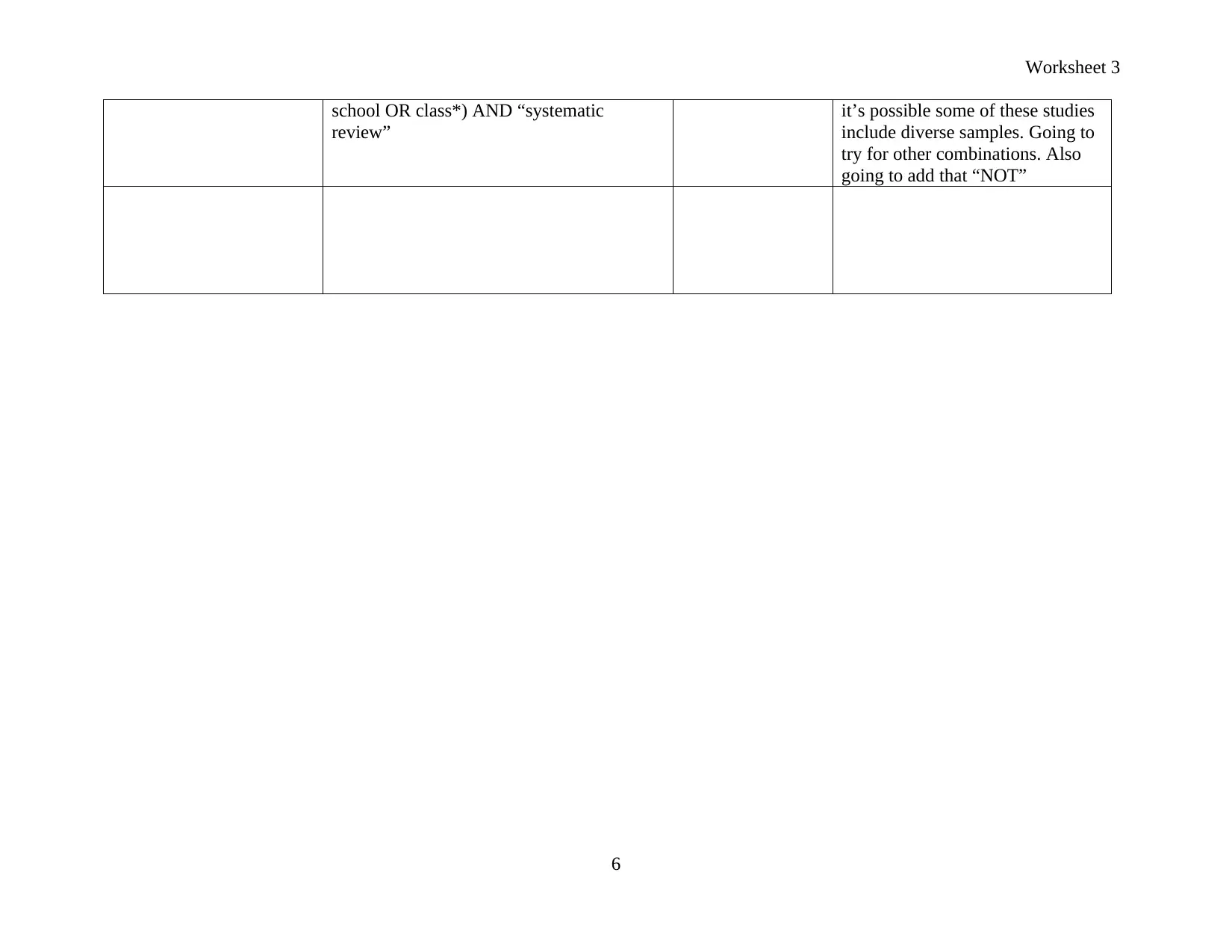
school OR class*) AND “systematic
review”
it’s possible some of these studies
include diverse samples. Going to
try for other combinations. Also
going to add that “NOT”
6
school OR class*) AND “systematic
review”
it’s possible some of these studies
include diverse samples. Going to
try for other combinations. Also
going to add that “NOT”
6
⊘ This is a preview!⊘
Do you want full access?
Subscribe today to unlock all pages.

Trusted by 1+ million students worldwide

Worksheet 3
Search History Form
Use this blank worksheet to track your search for the best available research evidence on your chosen question. Add additional rows as
needed. Hitting the tab button in the last row and column will create a new row. A good search will require several pages. In order to
complete worksheet 4, you will need to choose 4 empirical studies (qualitative or quantitative), that you feel best inform your
question.
Database or Other
Source (e.g. hand search
of journal, registry,
clearinghouse, or
website)
If you use any special
tools like “advanced
searches” or “synonym
generators” please not that
here as well.
Search Terms. Enter the PRECISE terms
you used, including boolean operators
here
Record every single unique search so you
get full credit!
Number of
References
Identified
This is not the
number of
“useful”
references, just the
number of sources
identified. You
don’t need
anything here if
you are not using
an electronic
database.
Evaluation and Adjustment
Comments
How specifically did you change
your search, and why? Articulate
your thinking about your search
process.
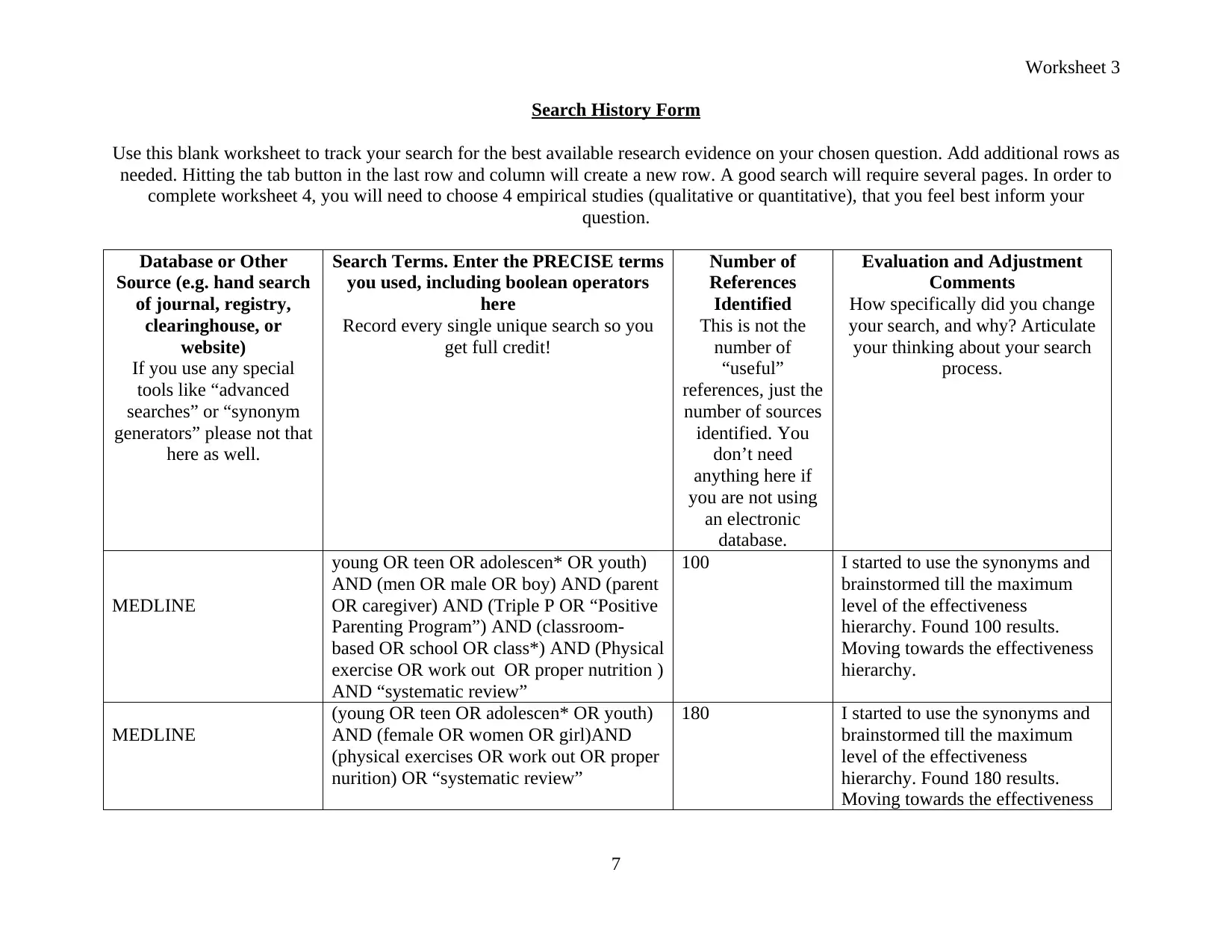
MEDLINE
young OR teen OR adolescen* OR youth)
AND (men OR male OR boy) AND (parent
OR caregiver) AND (Triple P OR “Positive
Parenting Program”) AND (classroom-
based OR school OR class*) AND (Physical
exercise OR work out OR proper nutrition )
AND “systematic review”
100 I started to use the synonyms and
brainstormed till the maximum
level of the effectiveness
hierarchy. Found 100 results.
Moving towards the effectiveness
hierarchy.
MEDLINE
(young OR teen OR adolescen* OR youth)
AND (female OR women OR girl)AND
(physical exercises OR work out OR proper
nurition) OR “systematic review”
180 I started to use the synonyms and
brainstormed till the maximum
level of the effectiveness
hierarchy. Found 180 results.
Moving towards the effectiveness
7
Search History Form
Use this blank worksheet to track your search for the best available research evidence on your chosen question. Add additional rows as
needed. Hitting the tab button in the last row and column will create a new row. A good search will require several pages. In order to
complete worksheet 4, you will need to choose 4 empirical studies (qualitative or quantitative), that you feel best inform your
question.
Database or Other
Source (e.g. hand search
of journal, registry,
clearinghouse, or
website)
If you use any special
tools like “advanced
searches” or “synonym
generators” please not that
here as well.
Search Terms. Enter the PRECISE terms
you used, including boolean operators
here
Record every single unique search so you
get full credit!
Number of
References
Identified
This is not the
number of
“useful”
references, just the
number of sources
identified. You
don’t need
anything here if
you are not using
an electronic
database.
Evaluation and Adjustment
Comments
How specifically did you change
your search, and why? Articulate
your thinking about your search
process.
MEDLINE
young OR teen OR adolescen* OR youth)
AND (men OR male OR boy) AND (parent
OR caregiver) AND (Triple P OR “Positive
Parenting Program”) AND (classroom-
based OR school OR class*) AND (Physical
exercise OR work out OR proper nutrition )
AND “systematic review”
100 I started to use the synonyms and
brainstormed till the maximum
level of the effectiveness
hierarchy. Found 100 results.
Moving towards the effectiveness
hierarchy.
MEDLINE
(young OR teen OR adolescen* OR youth)
AND (female OR women OR girl)AND
(physical exercises OR work out OR proper
nurition) OR “systematic review”
180 I started to use the synonyms and
brainstormed till the maximum
level of the effectiveness
hierarchy. Found 180 results.
Moving towards the effectiveness
7
Paraphrase This Document
Need a fresh take? Get an instant paraphrase of this document with our AI Paraphraser

Worksheet 3
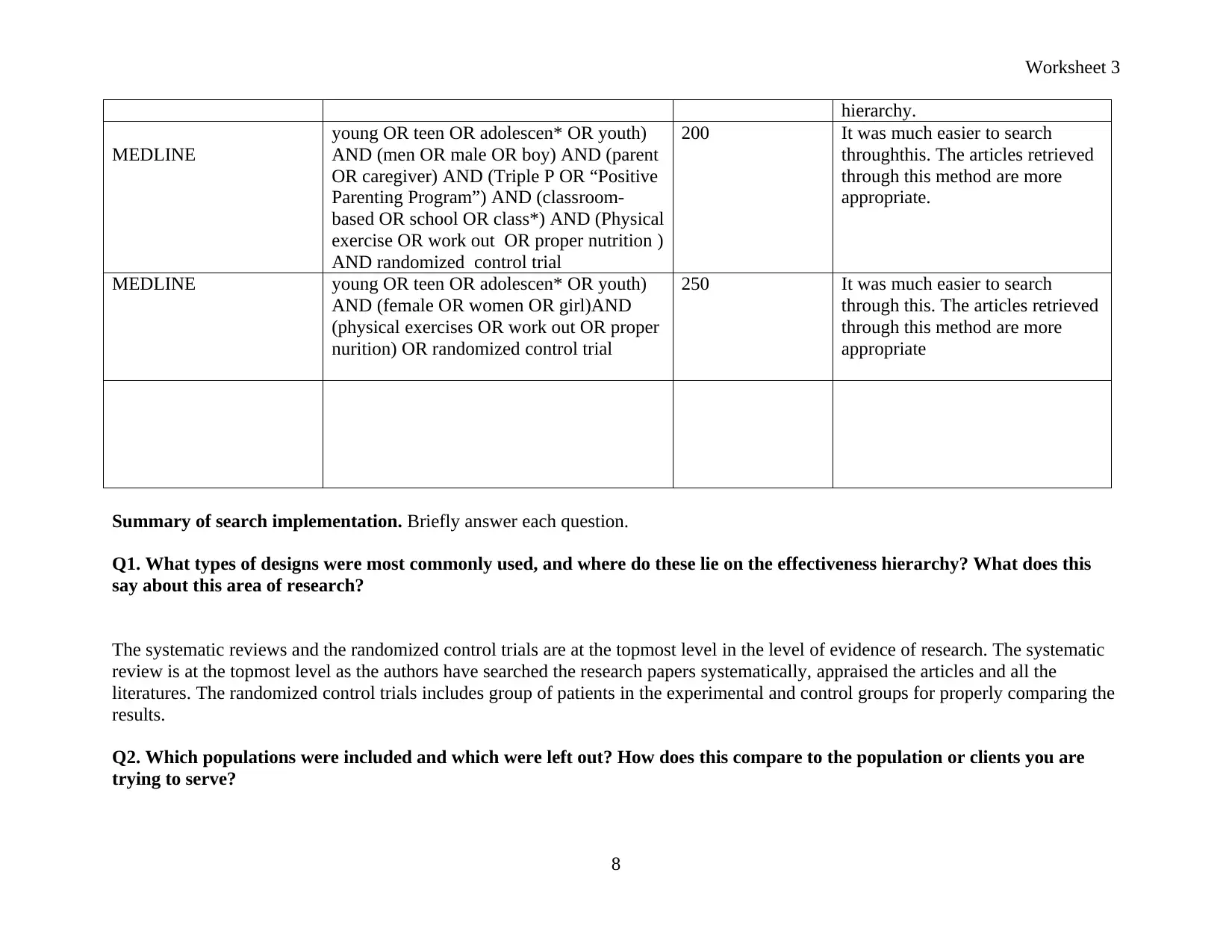
hierarchy.
MEDLINE
young OR teen OR adolescen* OR youth)
AND (men OR male OR boy) AND (parent
OR caregiver) AND (Triple P OR “Positive
Parenting Program”) AND (classroom-
based OR school OR class*) AND (Physical
exercise OR work out OR proper nutrition )
AND randomized control trial
200 It was much easier to search
throughthis. The articles retrieved
through this method are more
appropriate.
MEDLINE young OR teen OR adolescen* OR youth)
AND (female OR women OR girl)AND
(physical exercises OR work out OR proper
nurition) OR randomized control trial
250 It was much easier to search
through this. The articles retrieved
through this method are more
appropriate
Summary of search implementation. Briefly answer each question.
Q1. What types of designs were most commonly used, and where do these lie on the effectiveness hierarchy? What does this
say about this area of research?
The systematic reviews and the randomized control trials are at the topmost level in the level of evidence of research. The systematic
review is at the topmost level as the authors have searched the research papers systematically, appraised the articles and all the
literatures. The randomized control trials includes group of patients in the experimental and control groups for properly comparing the
results.
Q2. Which populations were included and which were left out? How does this compare to the population or clients you are
trying to serve?
8
hierarchy.
MEDLINE
young OR teen OR adolescen* OR youth)
AND (men OR male OR boy) AND (parent
OR caregiver) AND (Triple P OR “Positive
Parenting Program”) AND (classroom-
based OR school OR class*) AND (Physical
exercise OR work out OR proper nutrition )
AND randomized control trial
200 It was much easier to search
throughthis. The articles retrieved
through this method are more
appropriate.
MEDLINE young OR teen OR adolescen* OR youth)
AND (female OR women OR girl)AND
(physical exercises OR work out OR proper
nurition) OR randomized control trial
250 It was much easier to search
through this. The articles retrieved
through this method are more
appropriate
Summary of search implementation. Briefly answer each question.
Q1. What types of designs were most commonly used, and where do these lie on the effectiveness hierarchy? What does this
say about this area of research?
The systematic reviews and the randomized control trials are at the topmost level in the level of evidence of research. The systematic
review is at the topmost level as the authors have searched the research papers systematically, appraised the articles and all the
literatures. The randomized control trials includes group of patients in the experimental and control groups for properly comparing the
results.
Q2. Which populations were included and which were left out? How does this compare to the population or clients you are
trying to serve?
8

Worksheet 3
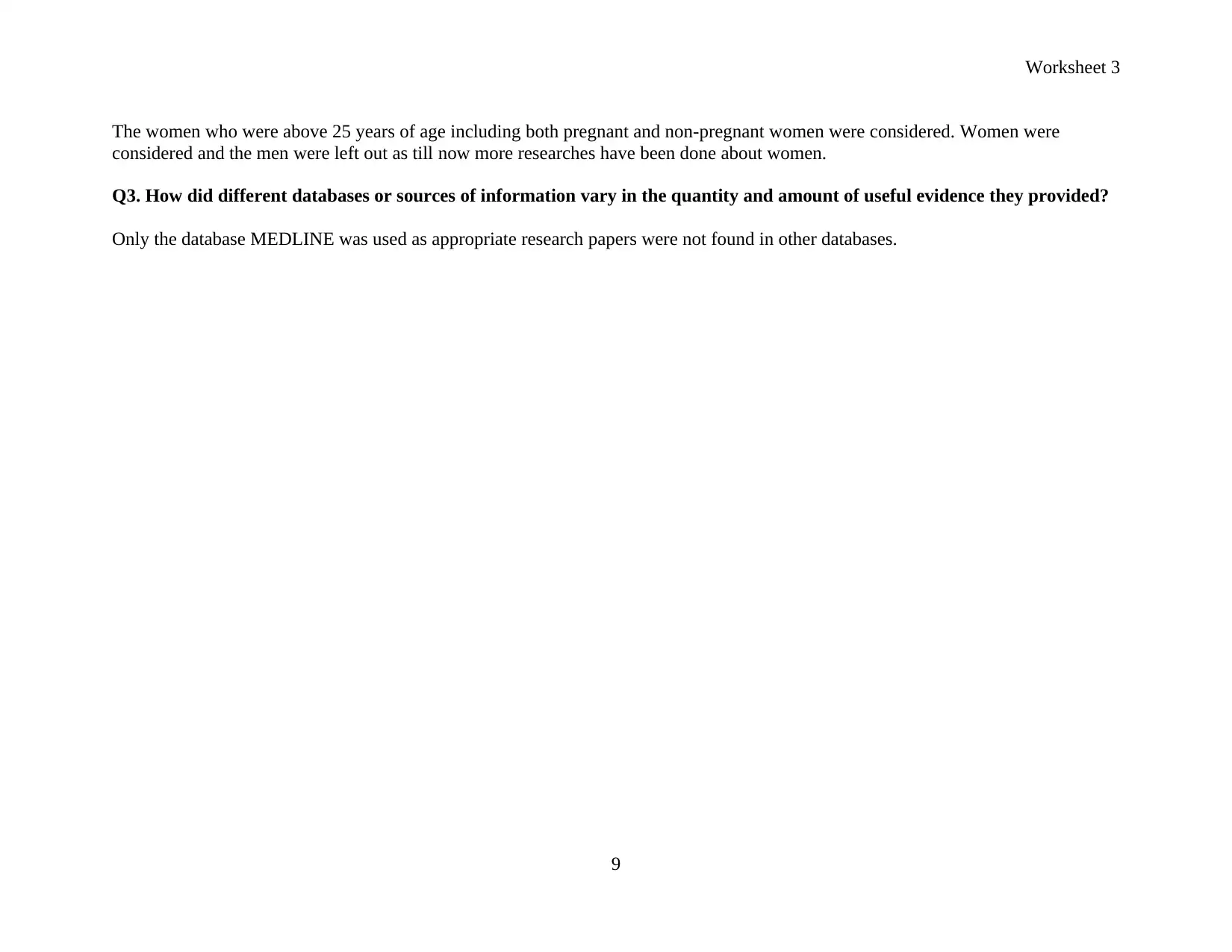
The women who were above 25 years of age including both pregnant and non-pregnant women were considered. Women were
considered and the men were left out as till now more researches have been done about women.
Q3. How did different databases or sources of information vary in the quantity and amount of useful evidence they provided?
Only the database MEDLINE was used as appropriate research papers were not found in other databases.
9
The women who were above 25 years of age including both pregnant and non-pregnant women were considered. Women were
considered and the men were left out as till now more researches have been done about women.
Q3. How did different databases or sources of information vary in the quantity and amount of useful evidence they provided?
Only the database MEDLINE was used as appropriate research papers were not found in other databases.
9
⊘ This is a preview!⊘
Do you want full access?
Subscribe today to unlock all pages.

Trusted by 1+ million students worldwide
1 out of 9
Related Documents
Your All-in-One AI-Powered Toolkit for Academic Success.
+13062052269
info@desklib.com
Available 24*7 on WhatsApp / Email
Unlock your academic potential
Copyright © 2020–2025 A2Z Services. All Rights Reserved. Developed and managed by ZUCOL.