Designing a Comprehensive Wound Assessment Chart: A Healthcare Report
VerifiedAdded on 2023/01/19
|15
|3581
|30
Report
AI Summary
This report proposes a new wound assessment chart designed for healthcare professionals. It begins with an introduction highlighting the prevalence and cost of chronic wounds, emphasizing the need for effective assessment tools. The report focuses on a specific patient group (young engineers) and professional group (young doctors) in a healthcare setting. It justifies the need for a new chart, outlining the shortcomings of existing methods. The proposed chart includes sections for patient details (age, gender, marital status, medical history), wound characteristics (type, location, dimensions, exudate, pain levels), and evaluation metrics. The report provides detailed explanations for each section and its components, including factors affecting wound healing, and a glossary of terms. The chart is designed to be simple, comprehensive, and user-friendly, aimed at improving wound assessment and treatment outcomes. The report provides a detailed overview of the chart's components and their significance in effective wound care management.

Running Head: WOUND ASSESSMENT CHART
1
A Proposed Wound Assessment Chart
Name of Student:
Name of Institution:
Date:
1
A Proposed Wound Assessment Chart
Name of Student:
Name of Institution:
Date:

Paraphrase This Document
Need a fresh take? Get an instant paraphrase of this document with our AI Paraphraser
WOUND ASSESSMENT CHART
2
Introduction
Approximately 6.5 million patients suffer from chronic wounds in the United States
every year (Chandan K. Sen; Gayle M. Gordillo, MD; Sashwati Roy, PhD; Robert Kirsner, MD;
Lynn Lambert Thomas; K. Hunt; Finn Gottrup, MD; Geoffrey C Gurtner, MD; and Michael T.
Longaker, MD, 2010). The US government spends more than 25 billion US dollars every year
towards the treatment of chronic wounds. If these are statistics from only one country, how much
then is being spent globally towards the treatment of wounds? Evidently, it is necessary that
long-lasting preventive measures are designed to bring down this cost.
However, it is a fact that it is not practically impossible to totally eradicate wounds from
the society members. Some professions such as engineering expose their members to higher
chances of sustaining wounds compared to others. How fast someone recovers from wounds is a
function of a number of factors (DiPietro & Guo, 2010). Some of these factors include habits,
diet, age, gender, lifestyle among others (DiPietro & Guo, 2010). When any of these factors are
not favorable, an impaired healing process is experienced.
How effective treatment is administered is also a major contributor to the healing process of
wounds. Because of this, it is very important to have a simple but comprehensive wound
assessment chart to be used by nurses and health practitioners when administering treatment to
wound-inflicted patients. This is the main objective of this paper. The paper aims to design a new
wound assessment chart that captures the most important aspects of the treatment process. The
proposed chart should also be very simple to understand and apply. To start this process, it would
be a critical top look at the patient group under consideration, the professional group and the
defects of the existing chart should there be any.
2
Introduction
Approximately 6.5 million patients suffer from chronic wounds in the United States
every year (Chandan K. Sen; Gayle M. Gordillo, MD; Sashwati Roy, PhD; Robert Kirsner, MD;
Lynn Lambert Thomas; K. Hunt; Finn Gottrup, MD; Geoffrey C Gurtner, MD; and Michael T.
Longaker, MD, 2010). The US government spends more than 25 billion US dollars every year
towards the treatment of chronic wounds. If these are statistics from only one country, how much
then is being spent globally towards the treatment of wounds? Evidently, it is necessary that
long-lasting preventive measures are designed to bring down this cost.
However, it is a fact that it is not practically impossible to totally eradicate wounds from
the society members. Some professions such as engineering expose their members to higher
chances of sustaining wounds compared to others. How fast someone recovers from wounds is a
function of a number of factors (DiPietro & Guo, 2010). Some of these factors include habits,
diet, age, gender, lifestyle among others (DiPietro & Guo, 2010). When any of these factors are
not favorable, an impaired healing process is experienced.
How effective treatment is administered is also a major contributor to the healing process of
wounds. Because of this, it is very important to have a simple but comprehensive wound
assessment chart to be used by nurses and health practitioners when administering treatment to
wound-inflicted patients. This is the main objective of this paper. The paper aims to design a new
wound assessment chart that captures the most important aspects of the treatment process. The
proposed chart should also be very simple to understand and apply. To start this process, it would
be a critical top look at the patient group under consideration, the professional group and the
defects of the existing chart should there be any.
WOUND ASSESSMENT CHART
3
The patient group
This paper shall majorly focus on young engineers involved in a road construction project
in the neighboring village. In their day to day activities, they are exposed to the risk of getting
involved in accidents that results in the sustaining wounds. Some of these wounds are severe, but
others are very shallow and not serious at all. These engineers usually come for treatment in a
nearby medical facility which apparently is the closest from the site. To ensure they receive the
best treatment for their wounds, the hospital management has decided to design a new chart to
specificity suite this category of parents.
Professional group
Majority of the doctors in the hospital are young professionals with little experience in
the field. Most of them have less than five years since they began practicing their profession.
Owing to this fact, there is a need to have a clear guideline on how best to treat the patients.
Considering the major patient group under consideration are engineers with wounds
sustained at work, a comprehensive but simple wound assessment chart is necessary for the
hospital. This will help the doctors to not only administer the right treatment but also track the
rate of recovery of the wounds being treated over time.
The proposed wound assessment chart
In order to keep track of the wound treatment process, a proper record with clear
characteristics of the wound is necessary. Some of the details to be included in the chart include
the name of the patient, age, their medical history, the type of wound, the part of the body where
3
The patient group
This paper shall majorly focus on young engineers involved in a road construction project
in the neighboring village. In their day to day activities, they are exposed to the risk of getting
involved in accidents that results in the sustaining wounds. Some of these wounds are severe, but
others are very shallow and not serious at all. These engineers usually come for treatment in a
nearby medical facility which apparently is the closest from the site. To ensure they receive the
best treatment for their wounds, the hospital management has decided to design a new chart to
specificity suite this category of parents.
Professional group
Majority of the doctors in the hospital are young professionals with little experience in
the field. Most of them have less than five years since they began practicing their profession.
Owing to this fact, there is a need to have a clear guideline on how best to treat the patients.
Considering the major patient group under consideration are engineers with wounds
sustained at work, a comprehensive but simple wound assessment chart is necessary for the
hospital. This will help the doctors to not only administer the right treatment but also track the
rate of recovery of the wounds being treated over time.
The proposed wound assessment chart
In order to keep track of the wound treatment process, a proper record with clear
characteristics of the wound is necessary. Some of the details to be included in the chart include
the name of the patient, age, their medical history, the type of wound, the part of the body where
⊘ This is a preview!⊘
Do you want full access?
Subscribe today to unlock all pages.

Trusted by 1+ million students worldwide
WOUND ASSESSMENT CHART
4
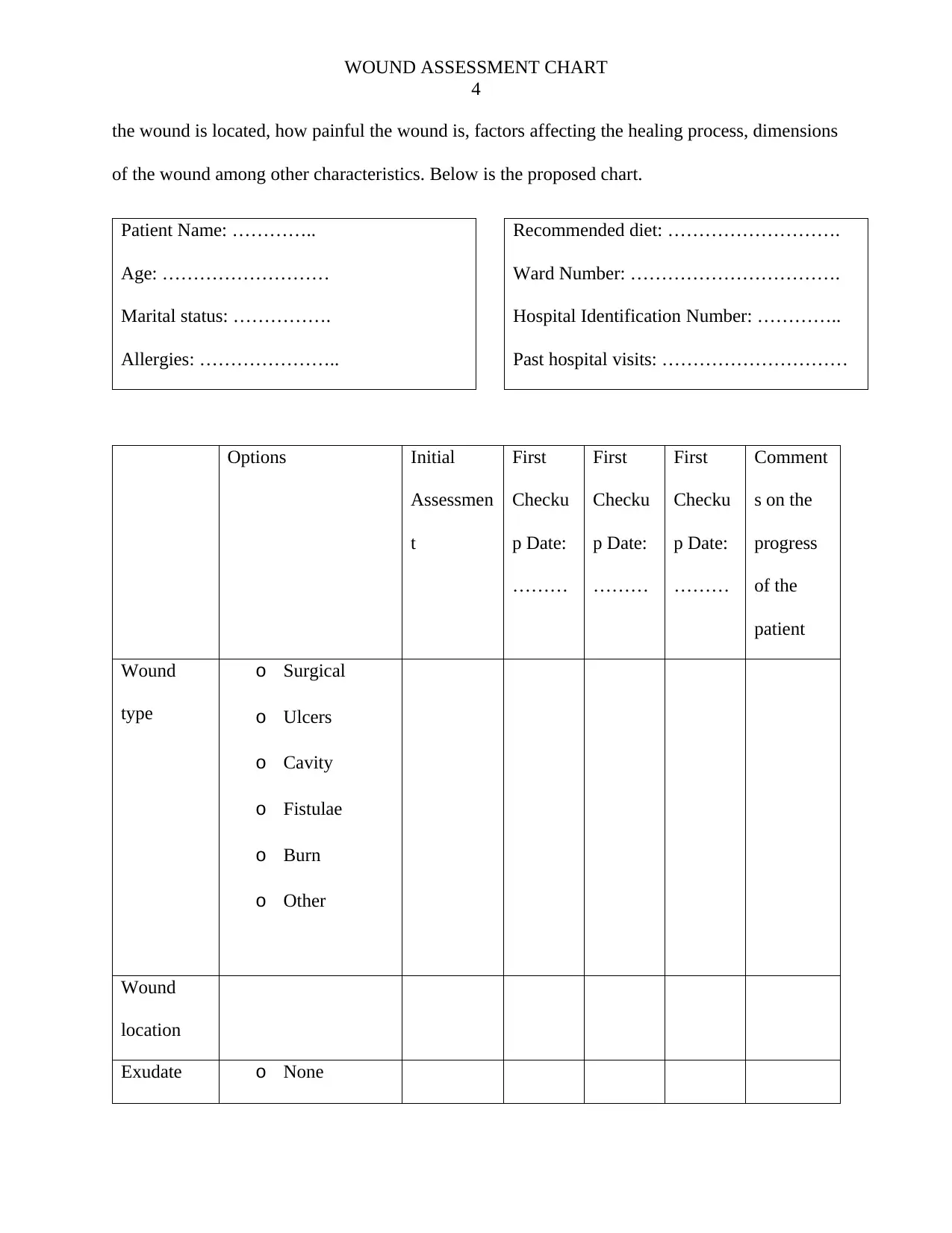
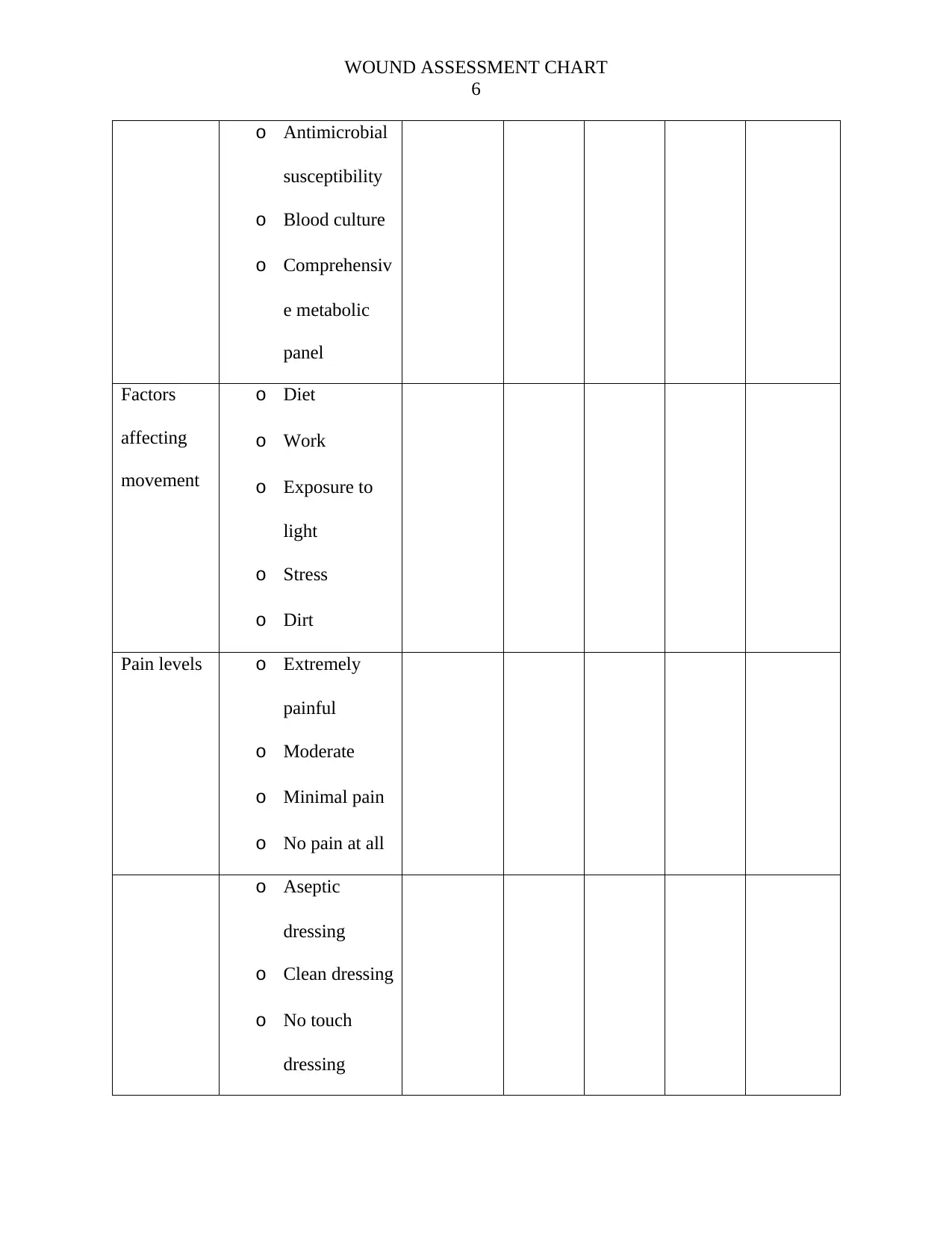
the wound is located, how painful the wound is, factors affecting the healing process, dimensions
of the wound among other characteristics. Below is the proposed chart.
Patient Name: …………..
Age: ………………………
Marital status: …………….
Allergies: …………………..
Recommended diet: ……………………….
Ward Number: …………………………….
Hospital Identification Number: …………..
Past hospital visits: …………………………
Options Initial
Assessmen
t
First
Checku
p Date:
………
First
Checku
p Date:
………
First
Checku
p Date:
………
Comment
s on the
progress
of the
patient
Wound
type
o Surgical
o Ulcers
o Cavity
o Fistulae
o Burn
o Other
Wound
location
Exudate o None
4
the wound is located, how painful the wound is, factors affecting the healing process, dimensions
of the wound among other characteristics. Below is the proposed chart.
Patient Name: …………..
Age: ………………………
Marital status: …………….
Allergies: …………………..
Recommended diet: ……………………….
Ward Number: …………………………….
Hospital Identification Number: …………..
Past hospital visits: …………………………
Options Initial
Assessmen
t
First
Checku
p Date:
………
First
Checku
p Date:
………
First
Checku
p Date:
………
Comment
s on the
progress
of the
patient
Wound
type
o Surgical
o Ulcers
o Cavity
o Fistulae
o Burn
o Other
Wound
location
Exudate o None
Paraphrase This Document
Need a fresh take? Get an instant paraphrase of this document with our AI Paraphraser
WOUND ASSESSMENT CHART
5
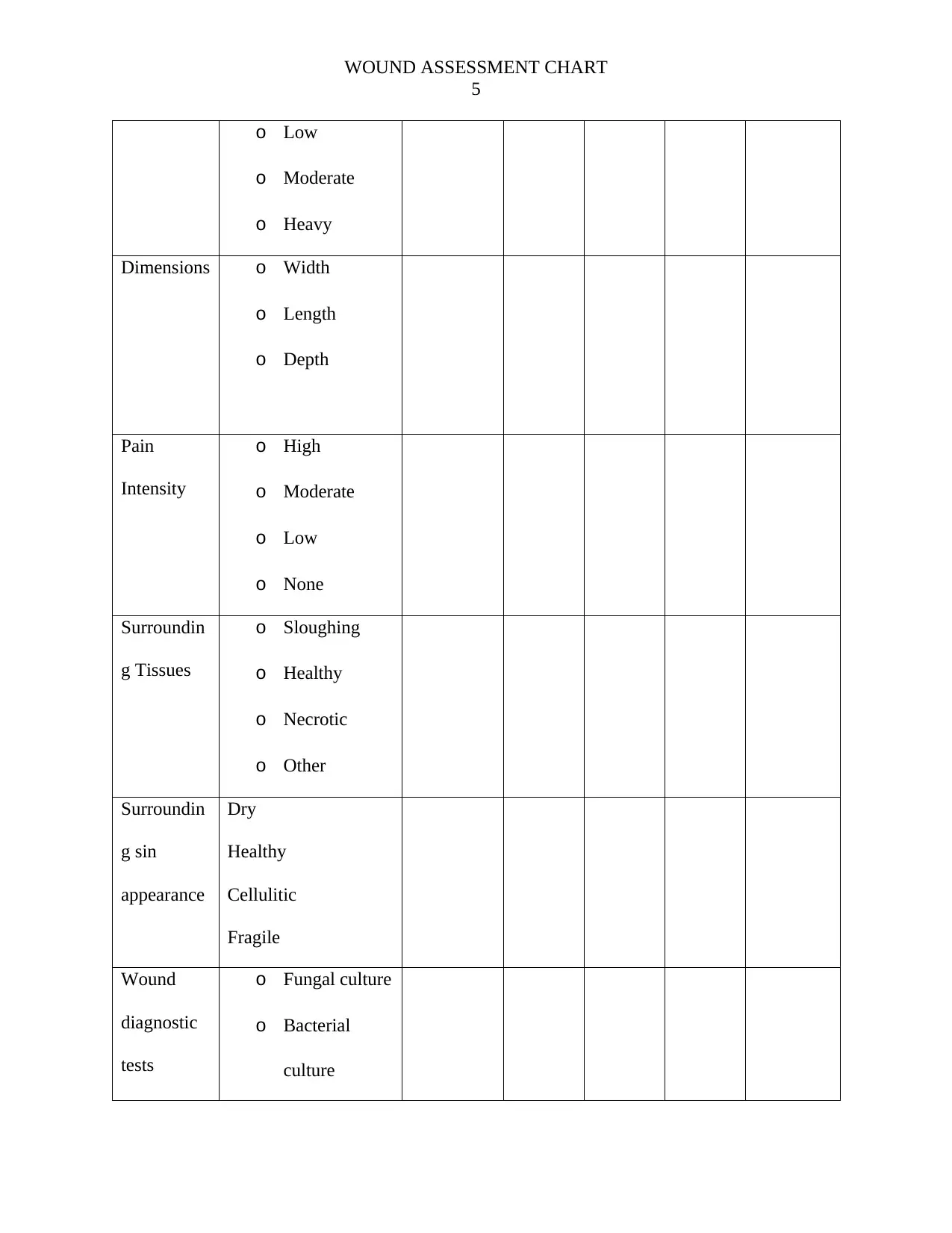
o Low
o Moderate
o Heavy
Dimensions o Width
o Length
o Depth
Pain
Intensity
o High
o Moderate
o Low
o None
Surroundin
g Tissues
o Sloughing
o Healthy
o Necrotic
o Other
Surroundin
g sin
appearance
Dry
Healthy
Cellulitic
Fragile
Wound
diagnostic
tests
o Fungal culture
o Bacterial
culture
5
o Low
o Moderate
o Heavy
Dimensions o Width
o Length
o Depth
Pain
Intensity
o High
o Moderate
o Low
o None
Surroundin
g Tissues
o Sloughing
o Healthy
o Necrotic
o Other
Surroundin
g sin
appearance
Dry
Healthy
Cellulitic
Fragile
Wound
diagnostic
tests
o Fungal culture
o Bacterial
culture
WOUND ASSESSMENT CHART
6
o Antimicrobial
susceptibility
o Blood culture
o Comprehensiv
e metabolic
panel
Factors
affecting
movement
o Diet
o Work
o Exposure to
light
o Stress
o Dirt
Pain levels o Extremely
painful
o Moderate
o Minimal pain
o No pain at all
o Aseptic
dressing
o Clean dressing
o No touch
dressing
6
o Antimicrobial
susceptibility
o Blood culture
o Comprehensiv
e metabolic
panel
Factors
affecting
movement
o Diet
o Work
o Exposure to
light
o Stress
o Dirt
Pain levels o Extremely
painful
o Moderate
o Minimal pain
o No pain at all
o Aseptic
dressing
o Clean dressing
o No touch
dressing
⊘ This is a preview!⊘
Do you want full access?
Subscribe today to unlock all pages.
Trusted by 1+ million students worldwide
WOUND ASSESSMENT CHART
7
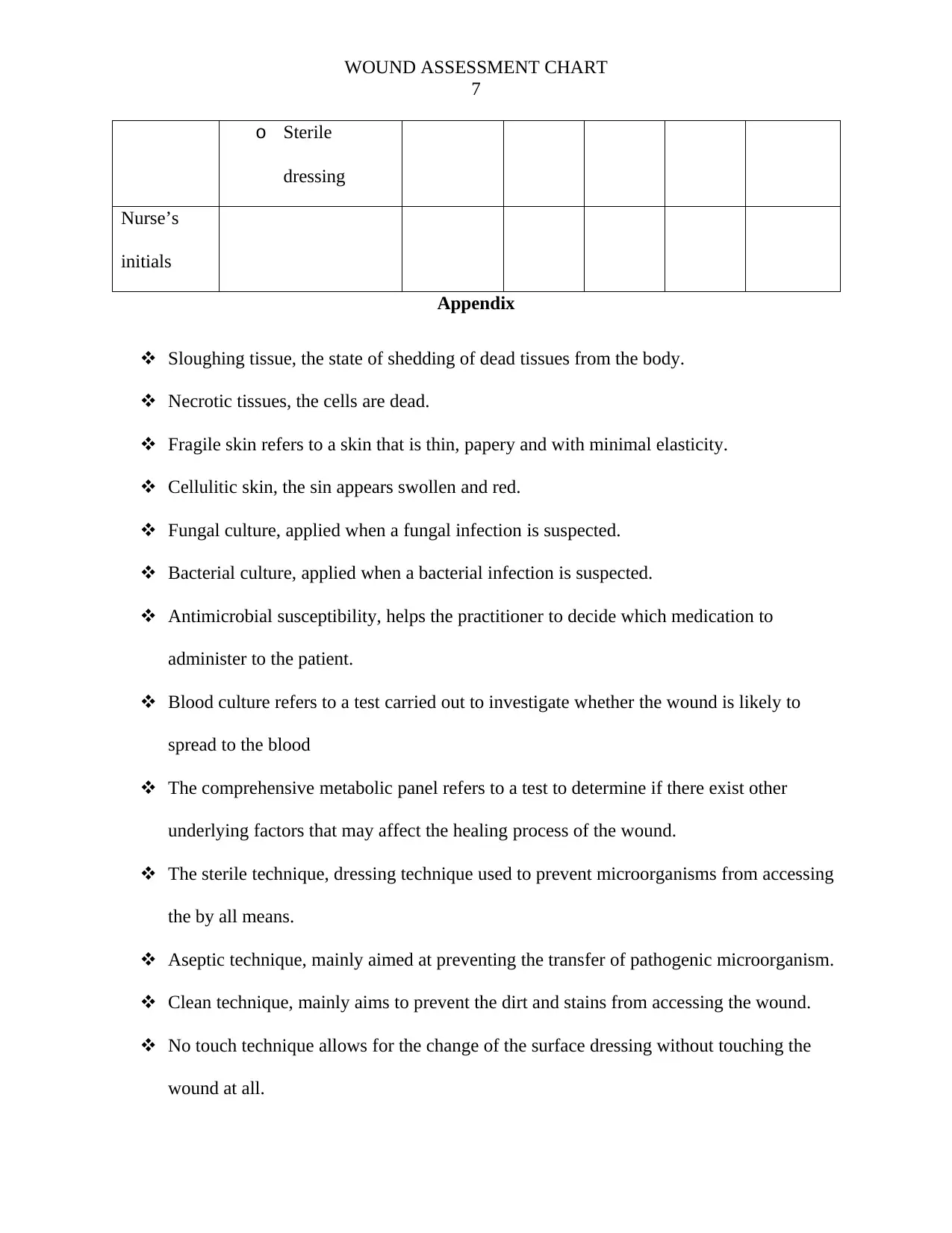
o Sterile
dressing
Nurse’s
initials
Appendix
Sloughing tissue, the state of shedding of dead tissues from the body.
Necrotic tissues, the cells are dead.
Fragile skin refers to a skin that is thin, papery and with minimal elasticity.
Cellulitic skin, the sin appears swollen and red.
Fungal culture, applied when a fungal infection is suspected.
Bacterial culture, applied when a bacterial infection is suspected.
Antimicrobial susceptibility, helps the practitioner to decide which medication to
administer to the patient.
Blood culture refers to a test carried out to investigate whether the wound is likely to
spread to the blood
The comprehensive metabolic panel refers to a test to determine if there exist other
underlying factors that may affect the healing process of the wound.
The sterile technique, dressing technique used to prevent microorganisms from accessing
the by all means.
Aseptic technique, mainly aimed at preventing the transfer of pathogenic microorganism.
Clean technique, mainly aims to prevent the dirt and stains from accessing the wound.
No touch technique allows for the change of the surface dressing without touching the
wound at all.
7
o Sterile
dressing
Nurse’s
initials
Appendix
Sloughing tissue, the state of shedding of dead tissues from the body.
Necrotic tissues, the cells are dead.
Fragile skin refers to a skin that is thin, papery and with minimal elasticity.
Cellulitic skin, the sin appears swollen and red.
Fungal culture, applied when a fungal infection is suspected.
Bacterial culture, applied when a bacterial infection is suspected.
Antimicrobial susceptibility, helps the practitioner to decide which medication to
administer to the patient.
Blood culture refers to a test carried out to investigate whether the wound is likely to
spread to the blood
The comprehensive metabolic panel refers to a test to determine if there exist other
underlying factors that may affect the healing process of the wound.
The sterile technique, dressing technique used to prevent microorganisms from accessing
the by all means.
Aseptic technique, mainly aimed at preventing the transfer of pathogenic microorganism.
Clean technique, mainly aims to prevent the dirt and stains from accessing the wound.
No touch technique allows for the change of the surface dressing without touching the
wound at all.
Paraphrase This Document
Need a fresh take? Get an instant paraphrase of this document with our AI Paraphraser
WOUND ASSESSMENT CHART
8
Components of the Proposed Wound Assessment Chart
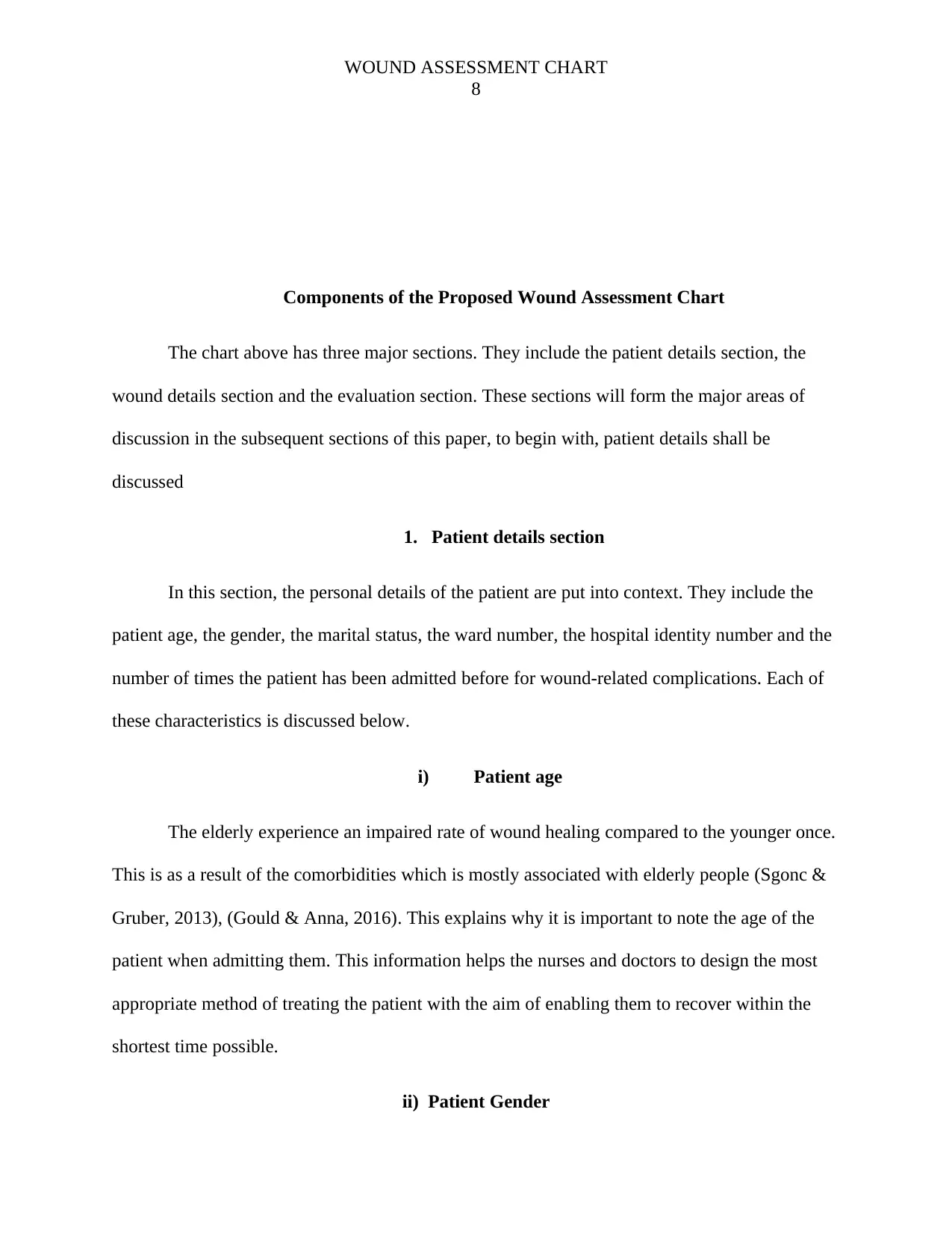
The chart above has three major sections. They include the patient details section, the
wound details section and the evaluation section. These sections will form the major areas of
discussion in the subsequent sections of this paper, to begin with, patient details shall be
discussed
1. Patient details section
In this section, the personal details of the patient are put into context. They include the
patient age, the gender, the marital status, the ward number, the hospital identity number and the
number of times the patient has been admitted before for wound-related complications. Each of
these characteristics is discussed below.
i) Patient age
The elderly experience an impaired rate of wound healing compared to the younger once.
This is as a result of the comorbidities which is mostly associated with elderly people (Sgonc &
Gruber, 2013), (Gould & Anna, 2016). This explains why it is important to note the age of the
patient when admitting them. This information helps the nurses and doctors to design the most
appropriate method of treating the patient with the aim of enabling them to recover within the
shortest time possible.
ii) Patient Gender
8
Components of the Proposed Wound Assessment Chart
The chart above has three major sections. They include the patient details section, the
wound details section and the evaluation section. These sections will form the major areas of
discussion in the subsequent sections of this paper, to begin with, patient details shall be
discussed
1. Patient details section
In this section, the personal details of the patient are put into context. They include the
patient age, the gender, the marital status, the ward number, the hospital identity number and the
number of times the patient has been admitted before for wound-related complications. Each of
these characteristics is discussed below.
i) Patient age
The elderly experience an impaired rate of wound healing compared to the younger once.
This is as a result of the comorbidities which is mostly associated with elderly people (Sgonc &
Gruber, 2013), (Gould & Anna, 2016). This explains why it is important to note the age of the
patient when admitting them. This information helps the nurses and doctors to design the most
appropriate method of treating the patient with the aim of enabling them to recover within the
shortest time possible.
ii) Patient Gender
WOUND ASSESSMENT CHART
9
The hormone estrogen is more in women than in men. As a result, it causes the rate of
wound healing to be slower in women compared to men (Federation of American Societies for
Experimental Biology, 2012). Based on this research finding, it is important to note the gender of
the patient as this will inform a number of subsequent decisions including the medication to be
prescribed.
iii) Marital status
Married women have higher levels of oxytocin and vasopressin in their body. These two
hormones speed up the rate of wound healing in married women (Gouin, et al., 2010). The
research findings, therefore, showed that married women and men recorded a higher rate of
response to medication (Archie, Altmann, & Alberts, 2012). Based on this, it would be wise for
any nurse and doctor involved in treating the new patients to note their marital status for the
purposes of deciding on the medication.
iv) Ward number and hospital identity number
These two numbers are important as they make it easier for the doctors and visiting friends and
relatives to locate the patients when they go to either treat or check on the patient. Considering
the fact that most hospitals are usually very crowded, lack of accurate and updated identification
details for a patient may make it very difficult to locate a patient within the hospital rooms.
Moreover, the history of the patient and how many times they have been admitted in the
past for wound-related complications is useful in approximating how frequent the patient
sustains wounds. This helps to know whether the wound is as a result of an accident or it is
through biological inheritance.
Having discussed this, the next section shall discuss type wound to be treated.
9
The hormone estrogen is more in women than in men. As a result, it causes the rate of
wound healing to be slower in women compared to men (Federation of American Societies for
Experimental Biology, 2012). Based on this research finding, it is important to note the gender of
the patient as this will inform a number of subsequent decisions including the medication to be
prescribed.
iii) Marital status
Married women have higher levels of oxytocin and vasopressin in their body. These two
hormones speed up the rate of wound healing in married women (Gouin, et al., 2010). The
research findings, therefore, showed that married women and men recorded a higher rate of
response to medication (Archie, Altmann, & Alberts, 2012). Based on this, it would be wise for
any nurse and doctor involved in treating the new patients to note their marital status for the
purposes of deciding on the medication.
iv) Ward number and hospital identity number
These two numbers are important as they make it easier for the doctors and visiting friends and
relatives to locate the patients when they go to either treat or check on the patient. Considering
the fact that most hospitals are usually very crowded, lack of accurate and updated identification
details for a patient may make it very difficult to locate a patient within the hospital rooms.
Moreover, the history of the patient and how many times they have been admitted in the
past for wound-related complications is useful in approximating how frequent the patient
sustains wounds. This helps to know whether the wound is as a result of an accident or it is
through biological inheritance.
Having discussed this, the next section shall discuss type wound to be treated.
⊘ This is a preview!⊘
Do you want full access?
Subscribe today to unlock all pages.
Trusted by 1+ million students worldwide
WOUND ASSESSMENT CHART
10
2. Characteristics of the wound
To begin with, it is worth mentioning that every wound is unique in its own way. The difference
might be in regards to the depth, the part of the body where it is located, the dimensions, the
appearance of the skin around the wound, whether or not it is painful and whether or not the
wound has an oduor. Each of the specific factors tends to affect how the wound should be
treated. As such, it is important to classify the wound correctly in order to give the best
prescription for the wound. Research conducted some time back by a group of scholars showed
that one out of every five three surgical wounds is usually misclassified. This leads to
misdiagnosis resulting in an extended healing period more than what is expected.
To begin the discussion on the characteristics of the wound, we look at the body weight
of the patient. Statistics have shown that anyone whose weight is above the recommended weight
by at least 20% faces a higher risk of delayed healing when they sustain wounds (Solutions
Wound Care, 2017). This is attributed to their higher risk of exposure to infections. Compared to
people within the recommended weight category, they take longer to heal.
The location of the wound is also a determinant on the rate at which the wound would
heal. The location of the wound determined not only the dressing section to be used but also
other interventions such as the device to be used in relieving pressure (Swezey, 2014). The
wound size, on the other hand, can be used to track whether the wound is recovering or if it is
getting worse over time (Swezey, 2014).
10
2. Characteristics of the wound
To begin with, it is worth mentioning that every wound is unique in its own way. The difference
might be in regards to the depth, the part of the body where it is located, the dimensions, the
appearance of the skin around the wound, whether or not it is painful and whether or not the
wound has an oduor. Each of the specific factors tends to affect how the wound should be
treated. As such, it is important to classify the wound correctly in order to give the best
prescription for the wound. Research conducted some time back by a group of scholars showed
that one out of every five three surgical wounds is usually misclassified. This leads to
misdiagnosis resulting in an extended healing period more than what is expected.
To begin the discussion on the characteristics of the wound, we look at the body weight
of the patient. Statistics have shown that anyone whose weight is above the recommended weight
by at least 20% faces a higher risk of delayed healing when they sustain wounds (Solutions
Wound Care, 2017). This is attributed to their higher risk of exposure to infections. Compared to
people within the recommended weight category, they take longer to heal.
The location of the wound is also a determinant on the rate at which the wound would
heal. The location of the wound determined not only the dressing section to be used but also
other interventions such as the device to be used in relieving pressure (Swezey, 2014). The
wound size, on the other hand, can be used to track whether the wound is recovering or if it is
getting worse over time (Swezey, 2014).
Paraphrase This Document
Need a fresh take? Get an instant paraphrase of this document with our AI Paraphraser
WOUND ASSESSMENT CHART
11
Moreover, the dimensions of the wound are critical to note as well. The width, depth, and
length of the wound can be used to gauge whether or not the wound is healing (Pavlovčič &
Jezeršek, 2018). The condition of the tissue around the area affected by the wound can also be
used to evaluate the healing process or the possibility of healing for the wound. If the
surrounding tissues are healthy, then there are higher chances that the wound would actually heal
within a shorter period of time.
Furthermore, the production of exudate is necessary for the wound healing process. It is a
mechanism used by the wound to get rid of waste products that might hinder the healing process.
This mainly occurs in the early stages of the inflammatory healing stage (Dowsett, 2012). The
inflammatory stage is the first stage out of the four stages of healing for a wound. The other three
stages include proliferative stage, maturation stage and the remodeling stage in that order
(Wallace & Zito, 2019). Overall these phases of healing, it is important to keep seeking the
services of a qualified doctor for frequent checkups.
In some cases, the wound is very painful while this is not the case in several other cases.
When diagnosing wounds, it is important for the medical practitioner to find out whether or not
the wound has some elements of pain. That way, it is possible to decide if it is necessary to
administer pain relievers to the patient or not. The patient needs to be as comfortable as possible
while undergoing treatment. This way, the healing process is likely to be faster than when the
patient is stressed and in pain (Gouina & Kiecolt-Glaser, 2011). Stress, for example, can cause
the patient to develop heath-damaging behaviors. This n return makes the healing process longer
and much slower.
11
Moreover, the dimensions of the wound are critical to note as well. The width, depth, and
length of the wound can be used to gauge whether or not the wound is healing (Pavlovčič &
Jezeršek, 2018). The condition of the tissue around the area affected by the wound can also be
used to evaluate the healing process or the possibility of healing for the wound. If the
surrounding tissues are healthy, then there are higher chances that the wound would actually heal
within a shorter period of time.
Furthermore, the production of exudate is necessary for the wound healing process. It is a
mechanism used by the wound to get rid of waste products that might hinder the healing process.
This mainly occurs in the early stages of the inflammatory healing stage (Dowsett, 2012). The
inflammatory stage is the first stage out of the four stages of healing for a wound. The other three
stages include proliferative stage, maturation stage and the remodeling stage in that order
(Wallace & Zito, 2019). Overall these phases of healing, it is important to keep seeking the
services of a qualified doctor for frequent checkups.
In some cases, the wound is very painful while this is not the case in several other cases.
When diagnosing wounds, it is important for the medical practitioner to find out whether or not
the wound has some elements of pain. That way, it is possible to decide if it is necessary to
administer pain relievers to the patient or not. The patient needs to be as comfortable as possible
while undergoing treatment. This way, the healing process is likely to be faster than when the
patient is stressed and in pain (Gouina & Kiecolt-Glaser, 2011). Stress, for example, can cause
the patient to develop heath-damaging behaviors. This n return makes the healing process longer
and much slower.
WOUND ASSESSMENT CHART
12
Finally, the wound type is also important to note even before beginning the treatment
process. The most common types of wound include surgical, ulcers, cavity, burns, and fistulae
(Wound Care, 2016). Depending on which type of wound the patient has, an appropriate dressing
type, medicine, and even diet can be recommended. These aspects vary from patient to patient
depending on the factors discussed above. Wrong medication to a patient has adverse effects on
the patient. In some cases, a patient may even die due to wrong medication (Rodziewicz &
Hipskind., 2019). This situation can be contained by taking precaution and making the right
diagnosis for the patients. It saves far much more than what is lost if not we observed.
The last section of this paper is an evaluation section. Keeping track of the progress of
the wound over the period of treatment is equally important (Gupta & Kumar, 2015). This form
the need to include a mechanism for evaluation as part of the wound assessment chart.
3. Evaluation Section
After administering treatment to the patient, it is always important to follow up on them
and understand how they are responding to medication. This enables the doctor in charge to
evaluate the effectiveness of the prescriptions given earlier. In the event that the evaluation
indicates the response is not as was expected, the doctor or nurse is able to relook at the
prescriptions given and even change them should there be need. How far the wound has
contracted and increased tensile length are signs that the wound is healing (Dwivedi, Dwivedi,
Malviya, & Singh, 2016). Based on the evaluation report released by the nurse, noting the major
improvements and the key challenges faced, a better decision can be arrived at and a decision
made.
12
Finally, the wound type is also important to note even before beginning the treatment
process. The most common types of wound include surgical, ulcers, cavity, burns, and fistulae
(Wound Care, 2016). Depending on which type of wound the patient has, an appropriate dressing
type, medicine, and even diet can be recommended. These aspects vary from patient to patient
depending on the factors discussed above. Wrong medication to a patient has adverse effects on
the patient. In some cases, a patient may even die due to wrong medication (Rodziewicz &
Hipskind., 2019). This situation can be contained by taking precaution and making the right
diagnosis for the patients. It saves far much more than what is lost if not we observed.
The last section of this paper is an evaluation section. Keeping track of the progress of
the wound over the period of treatment is equally important (Gupta & Kumar, 2015). This form
the need to include a mechanism for evaluation as part of the wound assessment chart.
3. Evaluation Section
After administering treatment to the patient, it is always important to follow up on them
and understand how they are responding to medication. This enables the doctor in charge to
evaluate the effectiveness of the prescriptions given earlier. In the event that the evaluation
indicates the response is not as was expected, the doctor or nurse is able to relook at the
prescriptions given and even change them should there be need. How far the wound has
contracted and increased tensile length are signs that the wound is healing (Dwivedi, Dwivedi,
Malviya, & Singh, 2016). Based on the evaluation report released by the nurse, noting the major
improvements and the key challenges faced, a better decision can be arrived at and a decision
made.
⊘ This is a preview!⊘
Do you want full access?
Subscribe today to unlock all pages.
Trusted by 1+ million students worldwide

1 out of 15


Your All-in-One AI-Powered Toolkit for Academic Success.
+13062052269
info@desklib.com
Available 24*7 on WhatsApp / Email
![[object Object]](/_next/static/media/star-bottom.7253800d.svg)
Unlock your academic potential
Copyright © 2020–2026 A2Z Services. All Rights Reserved. Developed and managed by ZUCOL.