Writing Assignment 1: Metatheory: Social Science vs Humanism

Verified

Added on  2019/09/25

|3
|1050
|262
Homework Assignment
AI Summary
This assignment analyzes the metatheoretical differences between social scientific and humanistic approaches to communication. The student completed a table comparing ontological, epistemological, and axiological assumptions of each perspective. The assignment then addresses how the goals of theory, types of explanation, and methods used to test theories differ between the two viewpoints. Social scientists focus on explaining and predicting communication phenomena, using causal necessity and quantitative methods, while humanists aim for understanding and creating social change, embracing multiple meanings and qualitative methods. The student highlights the contrasting perspectives on the role of context, the nature of knowledge, and the influence of values in communication research.
Document Page
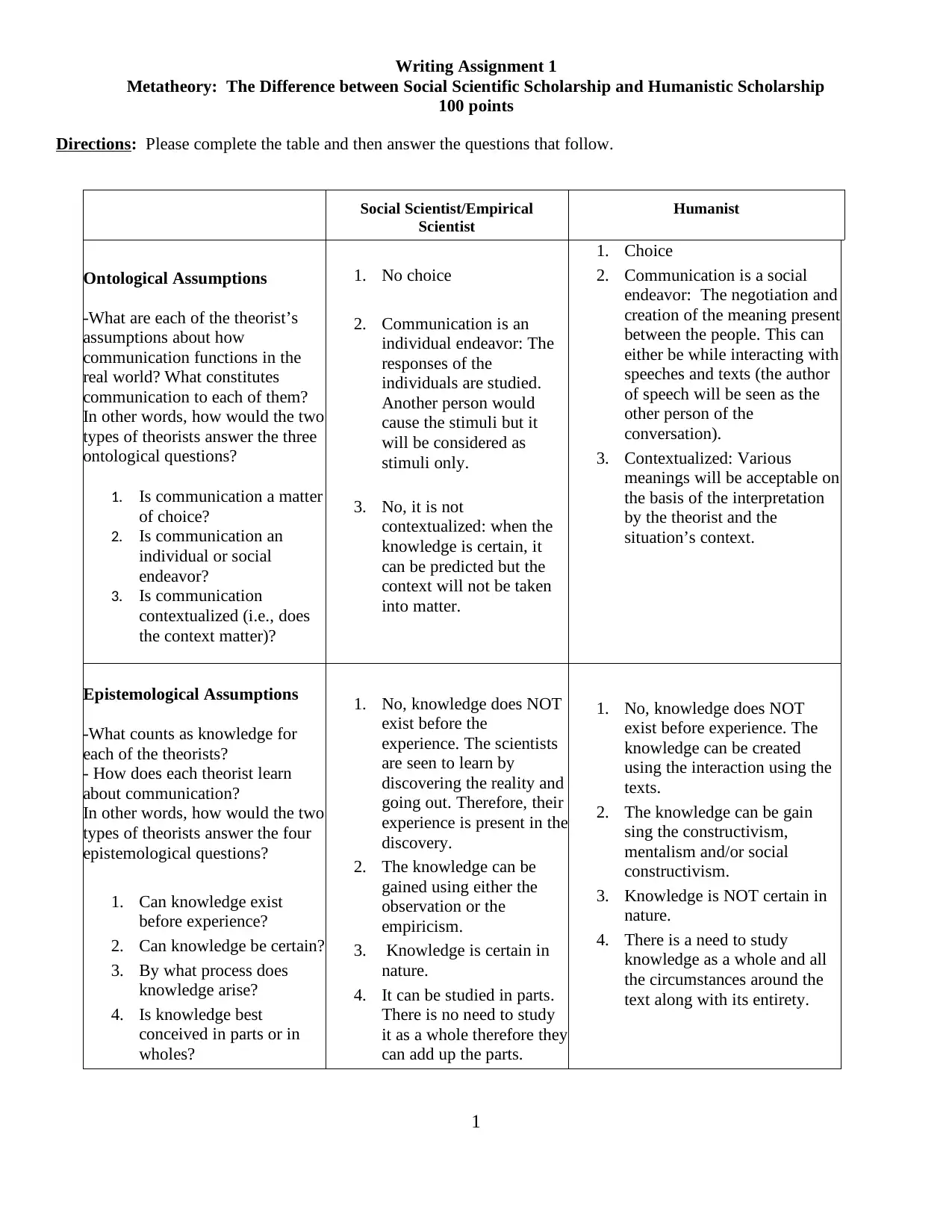
Writing Assignment 1
Metatheory: The Difference between Social Scientific Scholarship and Humanistic Scholarship
100 points
Directions: Please complete the table and then answer the questions that follow.
Social Scientist/Empirical
Scientist
Humanist
Ontological Assumptions
-What are each of the theorist’s
assumptions about how
communication functions in the
real world? What constitutes
communication to each of them?
In other words, how would the two
types of theorists answer the three
ontological questions?
1. Is communication a matter
of choice?
2. Is communication an
individual or social
endeavor?
3. Is communication
contextualized (i.e., does
the context matter)?
1. No choice
2. Communication is an
individual endeavor: The
responses of the
individuals are studied.
Another person would
cause the stimuli but it
will be considered as
stimuli only.
3. No, it is not
contextualized: when the
knowledge is certain, it
can be predicted but the
context will not be taken
into matter.
1. Choice
2. Communication is a social
endeavor: The negotiation and
creation of the meaning present
between the people. This can
either be while interacting with
speeches and texts (the author
of speech will be seen as the
other person of the
conversation).
3. Contextualized: Various
meanings will be acceptable on
the basis of the interpretation
by the theorist and the
situation’s context.
Epistemological Assumptions
-What counts as knowledge for
each of the theorists?
- How does each theorist learn
about communication?
In other words, how would the two
types of theorists answer the four
epistemological questions?
1. Can knowledge exist
before experience?
2. Can knowledge be certain?
3. By what process does
knowledge arise?
4. Is knowledge best
conceived in parts or in
wholes?
1. No, knowledge does NOT
exist before the
experience. The scientists
are seen to learn by
discovering the reality and
going out. Therefore, their
experience is present in the
discovery.
2. The knowledge can be
gained using either the
observation or the
empiricism.
3. Knowledge is certain in
nature.
4. It can be studied in parts.
There is no need to study
it as a whole therefore they
can add up the parts.
1. No, knowledge does NOT
exist before experience. The
knowledge can be created
using the interaction using the
texts.
2. The knowledge can be gain
sing the constructivism,
mentalism and/or social
constructivism.
3. Knowledge is NOT certain in
nature.
4. There is a need to study
knowledge as a whole and all
the circumstances around the
text along with its entirety.
1
tabler-icon-diamond-filled.svg

Paraphrase This Document

Need a fresh take? Get an instant paraphrase of this document with our AI Paraphraser
Document Page
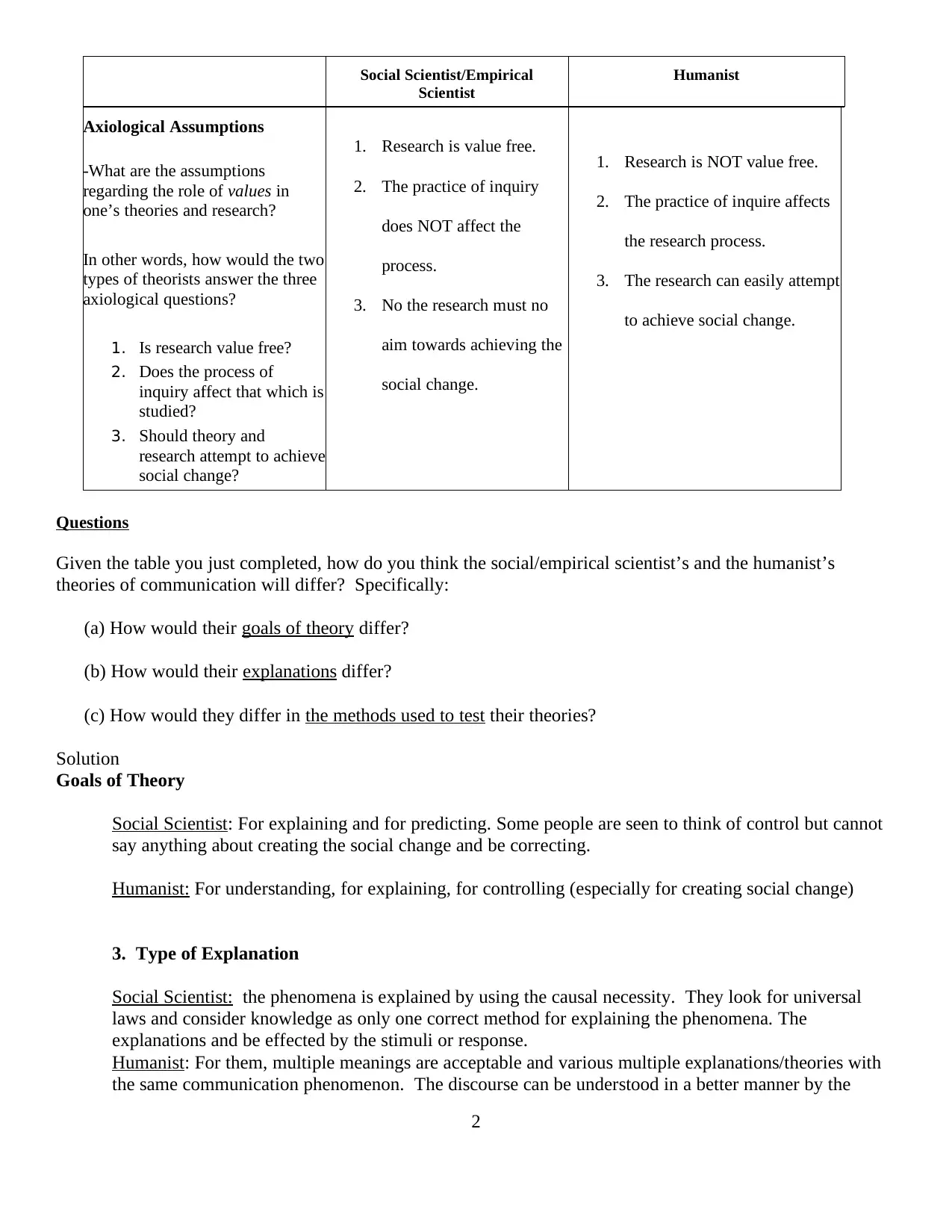
Social Scientist/Empirical
Scientist
Humanist
Axiological Assumptions
-What are the assumptions
regarding the role of values in
one’s theories and research?
In other words, how would the two
types of theorists answer the three
axiological questions?
1. Is research value free?
2. Does the process of
inquiry affect that which is
studied?
3. Should theory and
research attempt to achieve
social change?
1. Research is value free.
2. The practice of inquiry
does NOT affect the
process.
3. No the research must no
aim towards achieving the
social change.
1. Research is NOT value free.
2. The practice of inquire affects
the research process.
3. The research can easily attempt
to achieve social change.
Questions
Given the table you just completed, how do you think the social/empirical scientist’s and the humanist’s
theories of communication will differ? Specifically:
(a) How would their goals of theory differ?
(b) How would their explanations differ?
(c) How would they differ in the methods used to test their theories?
Solution
Goals of Theory
Social Scientist: For explaining and for predicting. Some people are seen to think of control but cannot
say anything about creating the social change and be correcting.
Humanist: For understanding, for explaining, for controlling (especially for creating social change)
3. Type of Explanation
Social Scientist: the phenomena is explained by using the causal necessity. They look for universal
laws and consider knowledge as only one correct method for explaining the phenomena. The
explanations and be effected by the stimuli or response.
Humanist: For them, multiple meanings are acceptable and various multiple explanations/theories with
the same communication phenomenon. The discourse can be understood in a better manner by the
2
Document Page
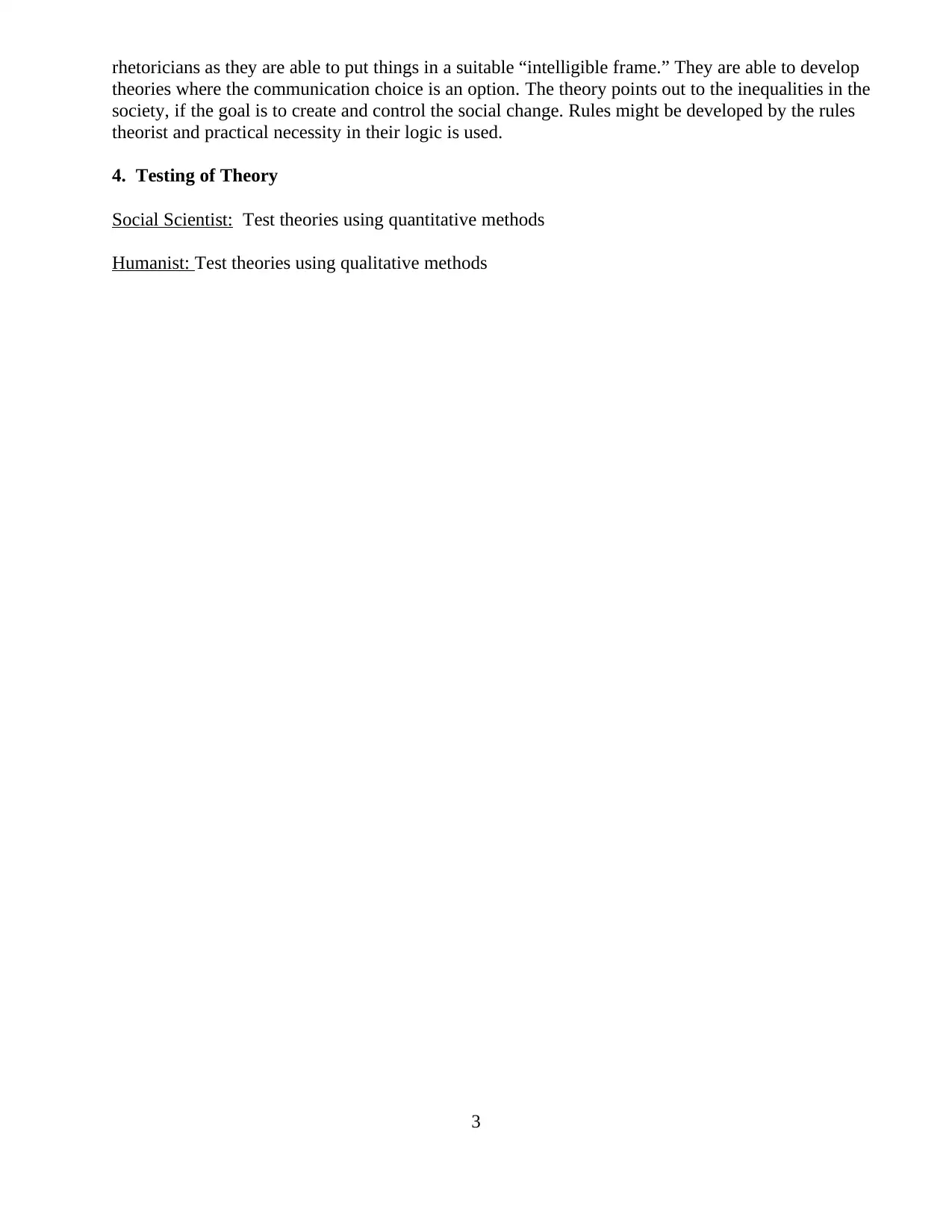
rhetoricians as they are able to put things in a suitable “intelligible frame.” They are able to develop
theories where the communication choice is an option. The theory points out to the inequalities in the
society, if the goal is to create and control the social change. Rules might be developed by the rules
theorist and practical necessity in their logic is used.
4. Testing of Theory
Social Scientist: Test theories using quantitative methods
Humanist: Test theories using qualitative methods
3
chevron_up_icon
1 out of 3
circle_padding
hide_on_mobile
zoom_out_icon
[object Object]