Year 5 Classroom Table Positioning
VerifiedAdded on 2020/02/03
|19
|4724
|174
Report
AI Summary
This research report investigates the impact of table positioning in a Year 5 classroom on children's learning behaviors. Using a mixed-methods approach (primary data from teacher questionnaires and secondary data from literature review), the study explores teacher perceptions of table arrangement, its effect on student attentiveness and engagement, and the reasons behind changes in seating arrangements. The findings suggest a positive correlation between strategic table positioning and improved learning behaviors, highlighting the importance of flexible seating arrangements and regular changes to promote interaction and engagement among students. The report concludes that while some students may initially resist changes, regular shifts in seating can lead to positive outcomes in terms of learning and behavior.
How does the positioning of tables in a
year 5 class affect children's learning
behaviours?
year 5 class affect children's learning
behaviours?

Paraphrase This Document
Need a fresh take? Get an instant paraphrase of this document with our AI Paraphraser
ABSTRACT
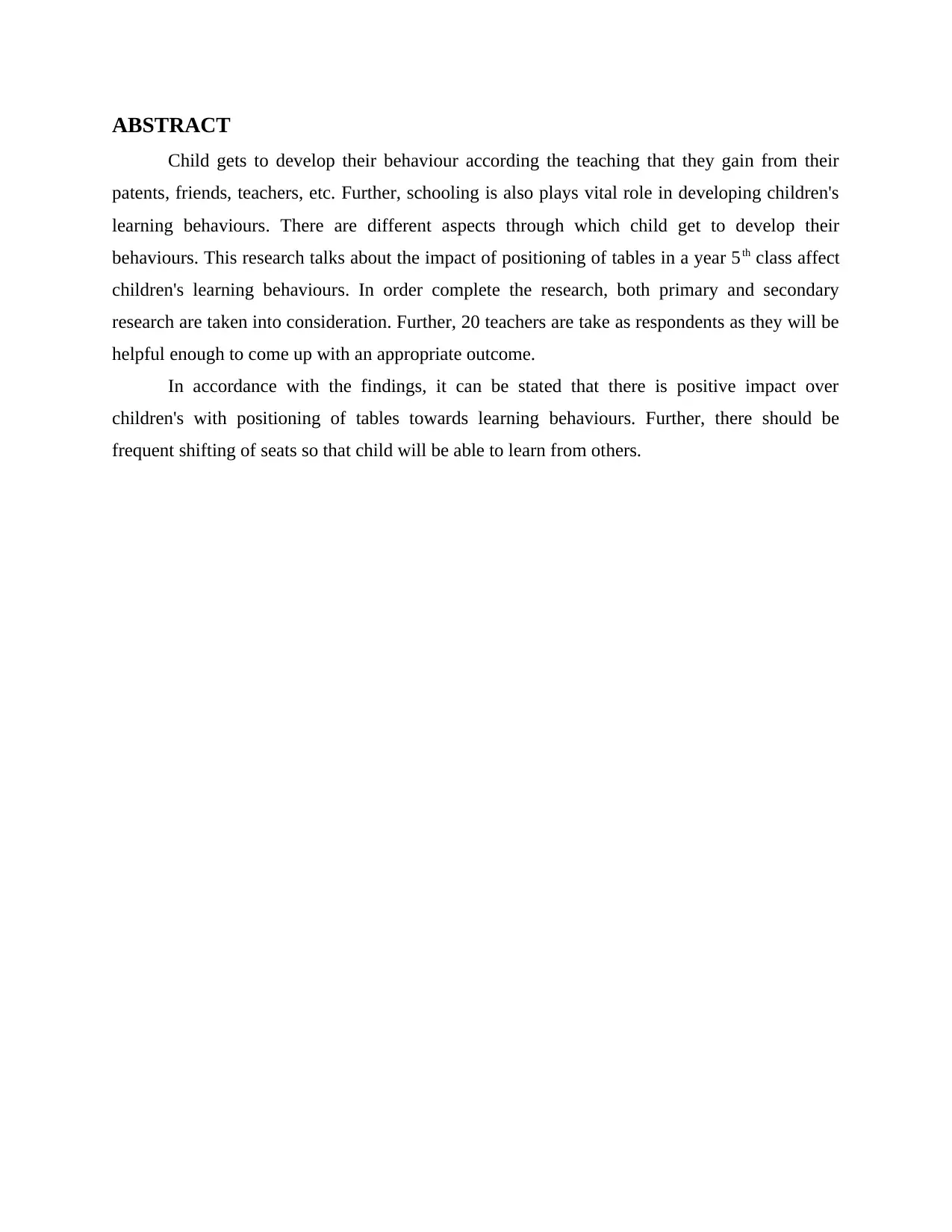
Child gets to develop their behaviour according the teaching that they gain from their
patents, friends, teachers, etc. Further, schooling is also plays vital role in developing children's
learning behaviours. There are different aspects through which child get to develop their
behaviours. This research talks about the impact of positioning of tables in a year 5th class affect
children's learning behaviours. In order complete the research, both primary and secondary
research are taken into consideration. Further, 20 teachers are take as respondents as they will be
helpful enough to come up with an appropriate outcome.
In accordance with the findings, it can be stated that there is positive impact over
children's with positioning of tables towards learning behaviours. Further, there should be
frequent shifting of seats so that child will be able to learn from others.
Child gets to develop their behaviour according the teaching that they gain from their
patents, friends, teachers, etc. Further, schooling is also plays vital role in developing children's
learning behaviours. There are different aspects through which child get to develop their
behaviours. This research talks about the impact of positioning of tables in a year 5th class affect
children's learning behaviours. In order complete the research, both primary and secondary
research are taken into consideration. Further, 20 teachers are take as respondents as they will be
helpful enough to come up with an appropriate outcome.
In accordance with the findings, it can be stated that there is positive impact over
children's with positioning of tables towards learning behaviours. Further, there should be
frequent shifting of seats so that child will be able to learn from others.
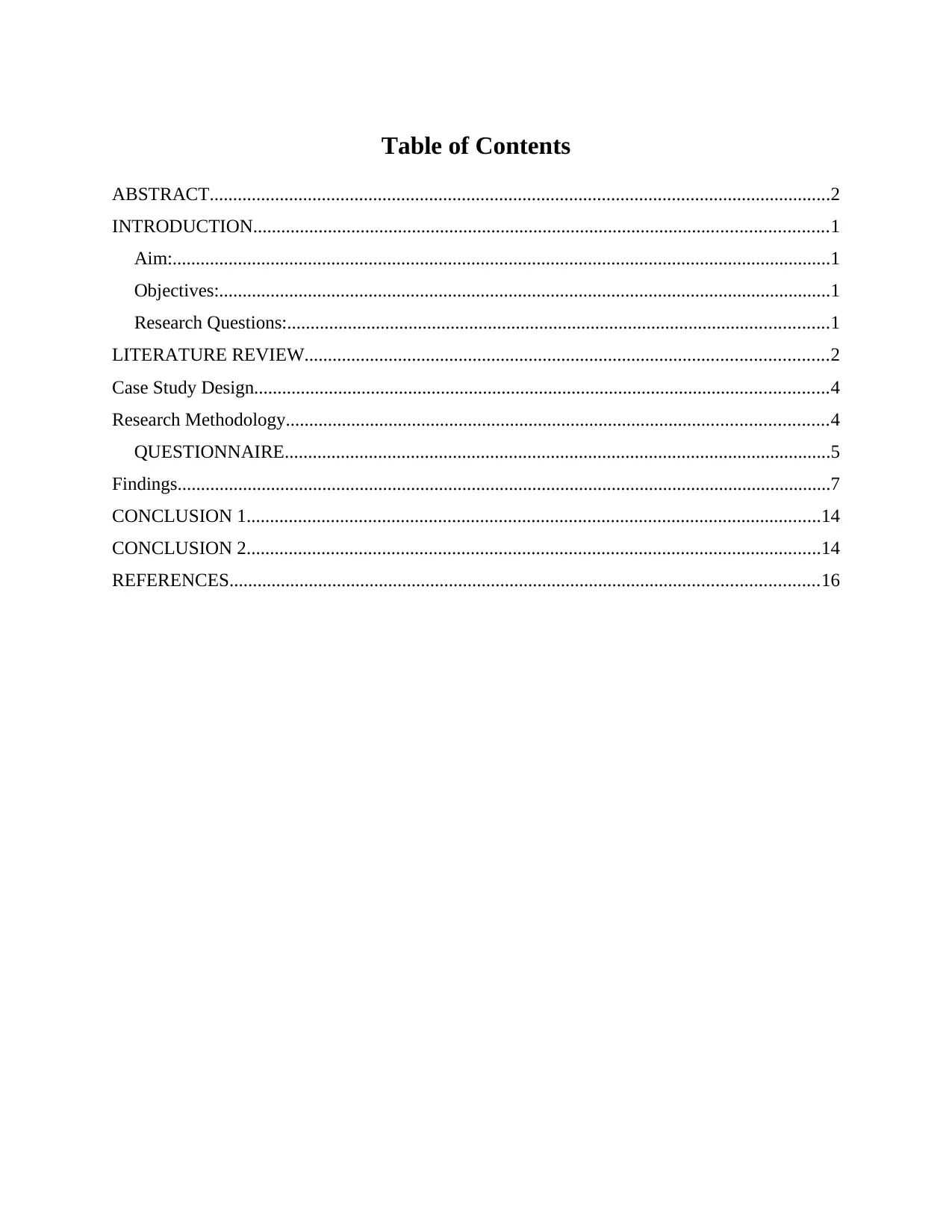
Table of Contents
ABSTRACT.....................................................................................................................................2
INTRODUCTION...........................................................................................................................1
Aim:.............................................................................................................................................1
Objectives:...................................................................................................................................1
Research Questions:....................................................................................................................1
LITERATURE REVIEW................................................................................................................2
Case Study Design...........................................................................................................................4
Research Methodology....................................................................................................................4
QUESTIONNAIRE.....................................................................................................................5
Findings............................................................................................................................................7
CONCLUSION 1...........................................................................................................................14
CONCLUSION 2...........................................................................................................................14
REFERENCES..............................................................................................................................16
ABSTRACT.....................................................................................................................................2
INTRODUCTION...........................................................................................................................1
Aim:.............................................................................................................................................1
Objectives:...................................................................................................................................1
Research Questions:....................................................................................................................1
LITERATURE REVIEW................................................................................................................2
Case Study Design...........................................................................................................................4
Research Methodology....................................................................................................................4
QUESTIONNAIRE.....................................................................................................................5
Findings............................................................................................................................................7
CONCLUSION 1...........................................................................................................................14
CONCLUSION 2...........................................................................................................................14
REFERENCES..............................................................................................................................16
⊘ This is a preview!⊘
Do you want full access?
Subscribe today to unlock all pages.

Trusted by 1+ million students worldwide
INTRODUCTION
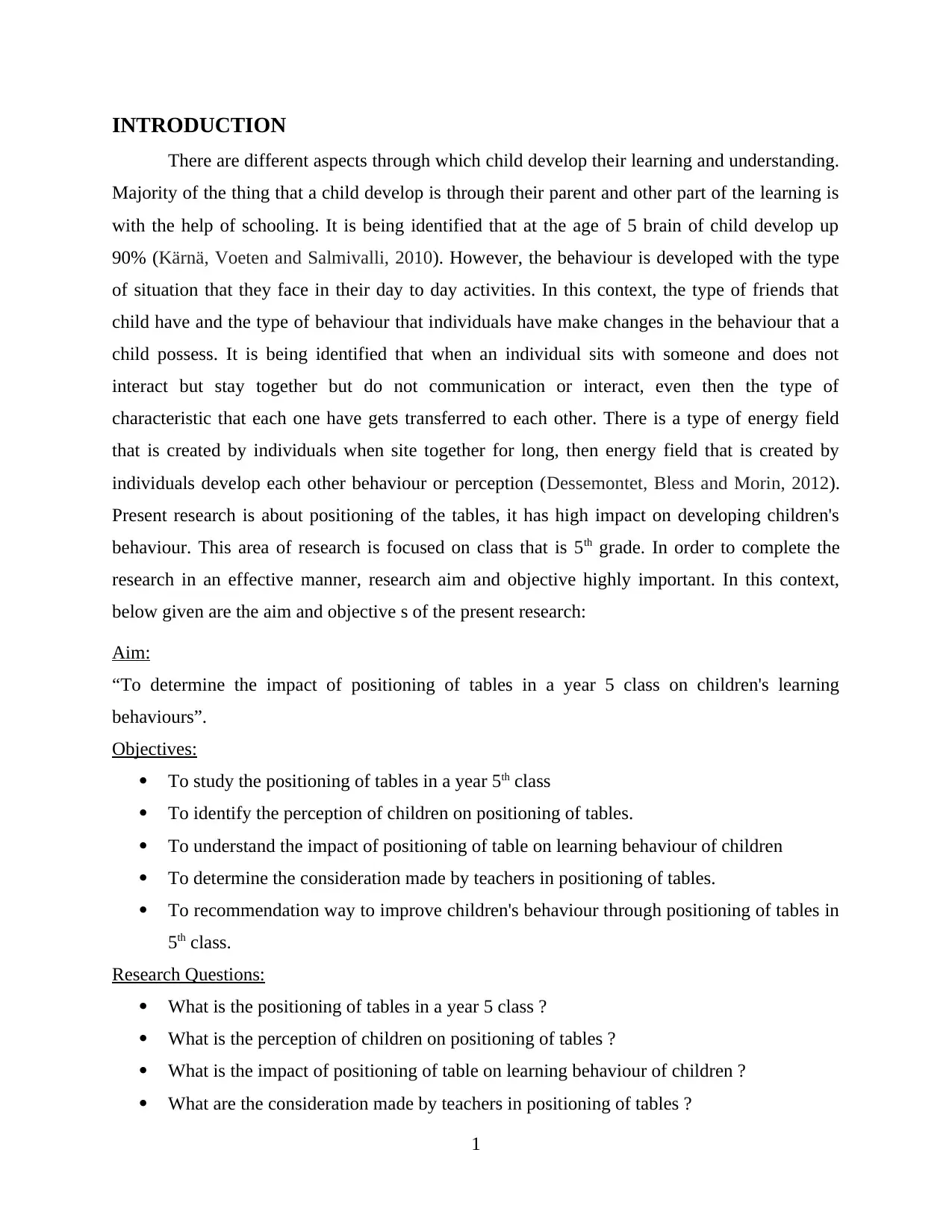
There are different aspects through which child develop their learning and understanding.
Majority of the thing that a child develop is through their parent and other part of the learning is
with the help of schooling. It is being identified that at the age of 5 brain of child develop up
90% (Kärnä, Voeten and Salmivalli, 2010). However, the behaviour is developed with the type
of situation that they face in their day to day activities. In this context, the type of friends that
child have and the type of behaviour that individuals have make changes in the behaviour that a
child possess. It is being identified that when an individual sits with someone and does not
interact but stay together but do not communication or interact, even then the type of
characteristic that each one have gets transferred to each other. There is a type of energy field
that is created by individuals when site together for long, then energy field that is created by
individuals develop each other behaviour or perception (Dessemontet, Bless and Morin, 2012).
Present research is about positioning of the tables, it has high impact on developing children's
behaviour. This area of research is focused on class that is 5th grade. In order to complete the
research in an effective manner, research aim and objective highly important. In this context,
below given are the aim and objective s of the present research:
Aim:
“To determine the impact of positioning of tables in a year 5 class on children's learning
behaviours”.
Objectives:
To study the positioning of tables in a year 5th class
To identify the perception of children on positioning of tables.
To understand the impact of positioning of table on learning behaviour of children
To determine the consideration made by teachers in positioning of tables.
To recommendation way to improve children's behaviour through positioning of tables in
5th class.
Research Questions:
What is the positioning of tables in a year 5 class ?
What is the perception of children on positioning of tables ?
What is the impact of positioning of table on learning behaviour of children ?
What are the consideration made by teachers in positioning of tables ?
1
There are different aspects through which child develop their learning and understanding.
Majority of the thing that a child develop is through their parent and other part of the learning is
with the help of schooling. It is being identified that at the age of 5 brain of child develop up
90% (Kärnä, Voeten and Salmivalli, 2010). However, the behaviour is developed with the type
of situation that they face in their day to day activities. In this context, the type of friends that
child have and the type of behaviour that individuals have make changes in the behaviour that a
child possess. It is being identified that when an individual sits with someone and does not
interact but stay together but do not communication or interact, even then the type of
characteristic that each one have gets transferred to each other. There is a type of energy field
that is created by individuals when site together for long, then energy field that is created by
individuals develop each other behaviour or perception (Dessemontet, Bless and Morin, 2012).
Present research is about positioning of the tables, it has high impact on developing children's
behaviour. This area of research is focused on class that is 5th grade. In order to complete the
research in an effective manner, research aim and objective highly important. In this context,
below given are the aim and objective s of the present research:
Aim:
“To determine the impact of positioning of tables in a year 5 class on children's learning
behaviours”.
Objectives:
To study the positioning of tables in a year 5th class
To identify the perception of children on positioning of tables.
To understand the impact of positioning of table on learning behaviour of children
To determine the consideration made by teachers in positioning of tables.
To recommendation way to improve children's behaviour through positioning of tables in
5th class.
Research Questions:
What is the positioning of tables in a year 5 class ?
What is the perception of children on positioning of tables ?
What is the impact of positioning of table on learning behaviour of children ?
What are the consideration made by teachers in positioning of tables ?
1
Paraphrase This Document
Need a fresh take? Get an instant paraphrase of this document with our AI Paraphraser
LITERATURE REVIEW
This is an important part that enables to determine different research that are conducted
by various investigators. These helpful enough to come up with an appropriate outcome for the
present research. Different views that are given by researchers are considered that will be helpful
to provide wider consideration for the research objectives.
According to Blatchford, Bassett and Brown, (2011) positioning of table play vital role
for children's to show up their creativity and skills that they possess. There are different type of
preference that individuals have in order to sit in a class room. In this context, some may prefer
to sit at the back, some at the front and some will prefer to sit near window. As per Suhrcke and
de Paz Nieves, (2011) preference is developed according to environment in which child grows.
There is common perception that people have developed and that that child who sit at the front
are more attentive and focused and they do not miss out any of the vital information that is being
given by their teachers. Further, children's at the back seats prefer them in order to get avoided
by educators. In addition to this, some of them prefer to sit near window and this is because they
get sufficient distractions in order to escape from the monotony of lessons that is taught to them
(Fessakis, Gouli and Mavroudi, 2013). From this, it can be stated that position of tables play vital
role in development of children's behaviour and learning.
In accordance with the perception children's, they prefer to select their seats as per the
type of attitude they have for studies. Morgan, Frisco and Hibel, (2010)stated that child who
prefer to get high marks generally sit at front seats. Children's how lack interest in studies prefer
to sit at back or near window. The type of behaviour is developed according to child with they
sit. It is important to make sure that teachers understand the requirement of child and type of
preference that they have within class for positioning of tables. Further, perception of child also
differs from type of mood they prefer. There are conditions in which child may feel not like
studying and in such they prefer to sit near window or at the back (Klatte, Hellbrück and
Leistner, 2010 ). Further, seriousness and pressure from parent can also be determined as one of
the factors due to which children's prefer to sit at the front. As per Guo, Piasta and Kaderavek,
(2010) changes in preference for positioning of table among children's differs according to the
teaching that they get from their parents and friends.
There is positive impact over children's when the arrangement of tables are made in
which all are able to sit at each side and with different child. When each child is able to sit at
2
This is an important part that enables to determine different research that are conducted
by various investigators. These helpful enough to come up with an appropriate outcome for the
present research. Different views that are given by researchers are considered that will be helpful
to provide wider consideration for the research objectives.
According to Blatchford, Bassett and Brown, (2011) positioning of table play vital role
for children's to show up their creativity and skills that they possess. There are different type of
preference that individuals have in order to sit in a class room. In this context, some may prefer
to sit at the back, some at the front and some will prefer to sit near window. As per Suhrcke and
de Paz Nieves, (2011) preference is developed according to environment in which child grows.
There is common perception that people have developed and that that child who sit at the front
are more attentive and focused and they do not miss out any of the vital information that is being
given by their teachers. Further, children's at the back seats prefer them in order to get avoided
by educators. In addition to this, some of them prefer to sit near window and this is because they
get sufficient distractions in order to escape from the monotony of lessons that is taught to them
(Fessakis, Gouli and Mavroudi, 2013). From this, it can be stated that position of tables play vital
role in development of children's behaviour and learning.
In accordance with the perception children's, they prefer to select their seats as per the
type of attitude they have for studies. Morgan, Frisco and Hibel, (2010)stated that child who
prefer to get high marks generally sit at front seats. Children's how lack interest in studies prefer
to sit at back or near window. The type of behaviour is developed according to child with they
sit. It is important to make sure that teachers understand the requirement of child and type of
preference that they have within class for positioning of tables. Further, perception of child also
differs from type of mood they prefer. There are conditions in which child may feel not like
studying and in such they prefer to sit near window or at the back (Klatte, Hellbrück and
Leistner, 2010 ). Further, seriousness and pressure from parent can also be determined as one of
the factors due to which children's prefer to sit at the front. As per Guo, Piasta and Kaderavek,
(2010) changes in preference for positioning of table among children's differs according to the
teaching that they get from their parents and friends.
There is positive impact over children's when the arrangement of tables are made in
which all are able to sit at each side and with different child. When each child is able to sit at
2
different places, then they get to develop their understanding and knowledge (Brühwiler and
Blatchford, 2011). However, it is not possible to make each child to sit at the front but it is
important for all to have equal chance to get their turns. Kärnä, Voeten and Salmivalli, (2010)
accounted that seating arrangement is the primary aspect which affects the learning behaviour of
students especially children. The interaction skills and capabilities for adjusting in different
environments is inculcated in the students. Teachers and the school curriculum designers
consider cyclic change in positions as a great step for creating a collective learning environment.
Dessemontet, Bless and Morin, (2012) stated that children at the initial stage might not like to get
their places changed but eventually there can be positive changes visible. These changes are
witnessed in the form of results and outcomes assessed after regular intervals. Often students
tend to develop friendships in their comfort zones but this hinders the professional learning
aspects. The concentration level is distributed. In order to achieve collective growth a change in
sitting arrangement is realised by the teachers.
According to Blatchford, Bassett and Brown, (2011 ), fixed table positions reduce the
flexibility of movement. Often monotonous flow of information and no necessary changes result
in no improvements case. This signifies that students become habitual to the environment and
they create their own comfort zone which restricts learning. Hence, teachers consider this
conditional rotation of sitting arrangement or position of table as a basic necessity for imparting
knowledge in a much better fashion. Suhrcke and de Paz Nieves, (2011) stated that active
learning attributes can only lead to development and growth. The layout of the classroom has to
be developed in such a manner that there is scope for learning in every situation. Teachers aim to
initiate a learning environment which invites discussions and teamwork in a productive way.
This becomes the main motive for variable position of tables and frequent shifts in sitting
arrangements. Fessakis, Gouli and Mavroudi, (2013) accounted for this credibility of table
positioning as an important aspect in managing the classroom learning scenarios.
Case Study Design
In accordance with the case, research is conducted for positioning of the tables. It is not
easy to consider all the class. In order to be specific, in this present research 5th class is taken in
to consideration (Kärnä, Voeten and Salmivalli, 2010 ). As per the research made, it is identified
3
Blatchford, 2011). However, it is not possible to make each child to sit at the front but it is
important for all to have equal chance to get their turns. Kärnä, Voeten and Salmivalli, (2010)
accounted that seating arrangement is the primary aspect which affects the learning behaviour of
students especially children. The interaction skills and capabilities for adjusting in different
environments is inculcated in the students. Teachers and the school curriculum designers
consider cyclic change in positions as a great step for creating a collective learning environment.
Dessemontet, Bless and Morin, (2012) stated that children at the initial stage might not like to get
their places changed but eventually there can be positive changes visible. These changes are
witnessed in the form of results and outcomes assessed after regular intervals. Often students
tend to develop friendships in their comfort zones but this hinders the professional learning
aspects. The concentration level is distributed. In order to achieve collective growth a change in
sitting arrangement is realised by the teachers.
According to Blatchford, Bassett and Brown, (2011 ), fixed table positions reduce the
flexibility of movement. Often monotonous flow of information and no necessary changes result
in no improvements case. This signifies that students become habitual to the environment and
they create their own comfort zone which restricts learning. Hence, teachers consider this
conditional rotation of sitting arrangement or position of table as a basic necessity for imparting
knowledge in a much better fashion. Suhrcke and de Paz Nieves, (2011) stated that active
learning attributes can only lead to development and growth. The layout of the classroom has to
be developed in such a manner that there is scope for learning in every situation. Teachers aim to
initiate a learning environment which invites discussions and teamwork in a productive way.
This becomes the main motive for variable position of tables and frequent shifts in sitting
arrangements. Fessakis, Gouli and Mavroudi, (2013) accounted for this credibility of table
positioning as an important aspect in managing the classroom learning scenarios.
Case Study Design
In accordance with the case, research is conducted for positioning of the tables. It is not
easy to consider all the class. In order to be specific, in this present research 5th class is taken in
to consideration (Kärnä, Voeten and Salmivalli, 2010 ). As per the research made, it is identified
3
⊘ This is a preview!⊘
Do you want full access?
Subscribe today to unlock all pages.
Trusted by 1+ million students worldwide
that in schools there are particular type of formation made in class room. Seats are changes
according to the type of behaviour that is made by child. More specifically, child who is not
good at studies will be aspected to sit in the front. Further, the child who is slow grabbing up
with the things, they are asked to sit in front. Further, there are also conditions in which child
who is getting consistently low marks or one who disturbs the class is also asked to sit in front.
There are also conditions identified in which after certain period of time, child who were aspect
to sit in front will get back to their old places (Dessemontet, Bless and Morin, 2012 ). The
changes that are made in positioning of the seats are temporary. Learning behaviour of child is
affected in negative manner when the type of child does not allow him/her to study. It is
important for teachers to make proper observation so that they will be able to understand the
behaviour that each child have when they are positioned at different places. In order to conduct
the research in an effective manner, there are two different type of methods that will be used. In
this context, it includes observation method and questionnaire that will be filled up by teachers
(Blatchford, Bassett and Brown, 2011). They are selected to be the respondents as they have
direct interaction with children's and they know better about the impact on child behaviour due to
positioning of tables.
Research Methodology
This is an essential part in order to make sure that research can be conducted effectively
and efficiently. There are different type of approaches, techniques, etc. that are involved and
these focus on presenting the conducted research in and effective manner. In this context,
research methodology for the current research are as follows:
Research philosophy: There are different type of research philosophy that is included. In
accordance with the present research, investigator will make use of positivism (Mackey and
Gass, 2015 ). This is a type of method that enables to focus on the objectives more when
compared with subjective of the topic.
Research approach: Research will make use of inductive research. This is type of method
that aims at understanding different type of theories and models that are included as per present
topic. This is effective enough to develop understanding about to aim and objectives and to come
up with an appropriate outcome.
Research strategy: There are mainly two different type of research strategies which are
qualitative and quantitative (Taylor, Bogdan and DeVault, 2015). In this present research,
4
according to the type of behaviour that is made by child. More specifically, child who is not
good at studies will be aspected to sit in the front. Further, the child who is slow grabbing up
with the things, they are asked to sit in front. Further, there are also conditions in which child
who is getting consistently low marks or one who disturbs the class is also asked to sit in front.
There are also conditions identified in which after certain period of time, child who were aspect
to sit in front will get back to their old places (Dessemontet, Bless and Morin, 2012 ). The
changes that are made in positioning of the seats are temporary. Learning behaviour of child is
affected in negative manner when the type of child does not allow him/her to study. It is
important for teachers to make proper observation so that they will be able to understand the
behaviour that each child have when they are positioned at different places. In order to conduct
the research in an effective manner, there are two different type of methods that will be used. In
this context, it includes observation method and questionnaire that will be filled up by teachers
(Blatchford, Bassett and Brown, 2011). They are selected to be the respondents as they have
direct interaction with children's and they know better about the impact on child behaviour due to
positioning of tables.
Research Methodology
This is an essential part in order to make sure that research can be conducted effectively
and efficiently. There are different type of approaches, techniques, etc. that are involved and
these focus on presenting the conducted research in and effective manner. In this context,
research methodology for the current research are as follows:
Research philosophy: There are different type of research philosophy that is included. In
accordance with the present research, investigator will make use of positivism (Mackey and
Gass, 2015 ). This is a type of method that enables to focus on the objectives more when
compared with subjective of the topic.
Research approach: Research will make use of inductive research. This is type of method
that aims at understanding different type of theories and models that are included as per present
topic. This is effective enough to develop understanding about to aim and objectives and to come
up with an appropriate outcome.
Research strategy: There are mainly two different type of research strategies which are
qualitative and quantitative (Taylor, Bogdan and DeVault, 2015). In this present research,
4
Paraphrase This Document
Need a fresh take? Get an instant paraphrase of this document with our AI Paraphraser
investigator will make use of qualitative method as it will help to understand the concept for
positioning of tables for class 5th and its impact on children's behaviour.
Research design: There are two type of research design, among which researcher will
make use of descriptive research design (Flick, 2015 ). This type of design enables to develop
survey which helpful enough identify appropriate data for the research.
Data collection: Research can use of two type of data collection method, which are
primary and secondary data. In this present research, investigator will make use of both
secondary and primary (Smith, 2015). Primary will be collected with the help of observation
method and questionnaire. On the other hand, secondary will be collected with the help of books,
journals, articles, etc.
Sampling: Before conducting the research, it is important to cater knowledge regarding
the individuals or groups through which specific information has to be collected. There are two
primary categories of sampling, i.e. probabilistic and non-probabilistic (Cammarota and Fine,
2010). This research on undermining the impact of positioning tables is a qualitative research
hence, probabilistic sampling is performed. It helps in determining the characteristics of
sampling units and the number of samples selected. For the present research Simple Random
Sampling method is adopted and 20 teachers have been selected to be questioned. It helps in
gathering random samples and attaining authentic qualitative results.
Data analysis: The data so collected by performing primary and secondary research has
to be interpreted and analysed so that necessary outcomes can be acquired. This research based
on the analysis of Impact of Positioning Tables shall be qualitatively conducted and
questionnaire is to be used for collecting the information (Geerts, 2011 ). The thematic analysis
technique will be used for this research. It involves the use of themes, graphical representations
and analysis of figures and quantitative inputs. This particular technique has been used for
examining and recording the data in a patterned manner.
QUESTIONNAIRE
Name: _________
Age: _________
Gender: _________
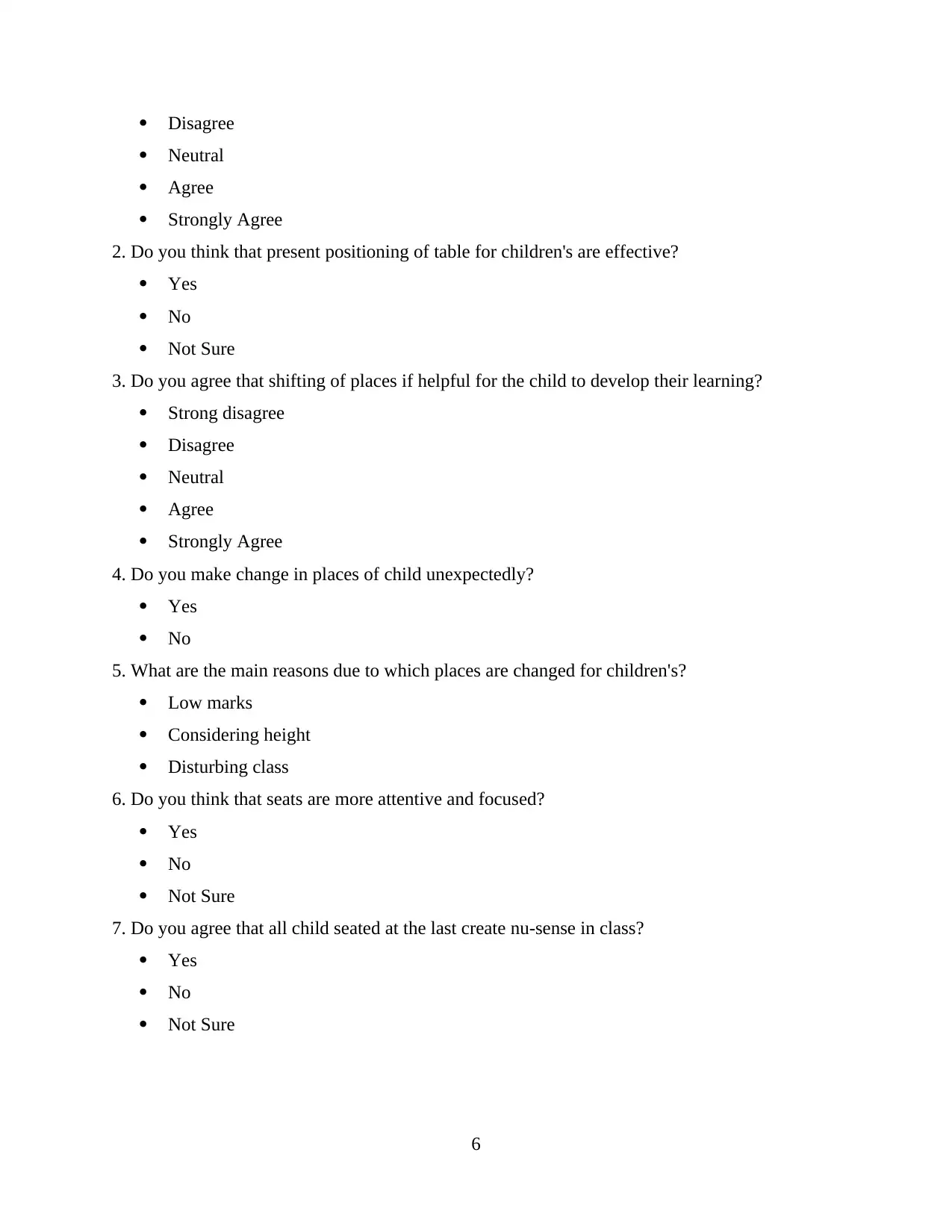
1. Do you agree that positioning of table affects children's learning behaviours ?
Strong disagree
5
positioning of tables for class 5th and its impact on children's behaviour.
Research design: There are two type of research design, among which researcher will
make use of descriptive research design (Flick, 2015 ). This type of design enables to develop
survey which helpful enough identify appropriate data for the research.
Data collection: Research can use of two type of data collection method, which are
primary and secondary data. In this present research, investigator will make use of both
secondary and primary (Smith, 2015). Primary will be collected with the help of observation
method and questionnaire. On the other hand, secondary will be collected with the help of books,
journals, articles, etc.
Sampling: Before conducting the research, it is important to cater knowledge regarding
the individuals or groups through which specific information has to be collected. There are two
primary categories of sampling, i.e. probabilistic and non-probabilistic (Cammarota and Fine,
2010). This research on undermining the impact of positioning tables is a qualitative research
hence, probabilistic sampling is performed. It helps in determining the characteristics of
sampling units and the number of samples selected. For the present research Simple Random
Sampling method is adopted and 20 teachers have been selected to be questioned. It helps in
gathering random samples and attaining authentic qualitative results.
Data analysis: The data so collected by performing primary and secondary research has
to be interpreted and analysed so that necessary outcomes can be acquired. This research based
on the analysis of Impact of Positioning Tables shall be qualitatively conducted and
questionnaire is to be used for collecting the information (Geerts, 2011 ). The thematic analysis
technique will be used for this research. It involves the use of themes, graphical representations
and analysis of figures and quantitative inputs. This particular technique has been used for
examining and recording the data in a patterned manner.
QUESTIONNAIRE
Name: _________
Age: _________
Gender: _________
1. Do you agree that positioning of table affects children's learning behaviours ?
Strong disagree
5
Disagree
Neutral
Agree
Strongly Agree
2. Do you think that present positioning of table for children's are effective?
Yes
No
Not Sure
3. Do you agree that shifting of places if helpful for the child to develop their learning?
Strong disagree
Disagree
Neutral
Agree
Strongly Agree
4. Do you make change in places of child unexpectedly?
Yes
No
5. What are the main reasons due to which places are changed for children's?
Low marks
Considering height
Disturbing class
6. Do you think that seats are more attentive and focused?
Yes
No
Not Sure
7. Do you agree that all child seated at the last create nu-sense in class?
Yes
No
Not Sure
6
Neutral
Agree
Strongly Agree
2. Do you think that present positioning of table for children's are effective?
Yes
No
Not Sure
3. Do you agree that shifting of places if helpful for the child to develop their learning?
Strong disagree
Disagree
Neutral
Agree
Strongly Agree
4. Do you make change in places of child unexpectedly?
Yes
No
5. What are the main reasons due to which places are changed for children's?
Low marks
Considering height
Disturbing class
6. Do you think that seats are more attentive and focused?
Yes
No
Not Sure
7. Do you agree that all child seated at the last create nu-sense in class?
Yes
No
Not Sure
6
⊘ This is a preview!⊘
Do you want full access?
Subscribe today to unlock all pages.
Trusted by 1+ million students worldwide
Findings
As stated that above, there are two different method that are being used by investigator
with the help of which data for the current research will be collected. In this context, it includes
questionnaire. Below given are the thematics for each of the questions gathered from data
collected from 20 teachers:
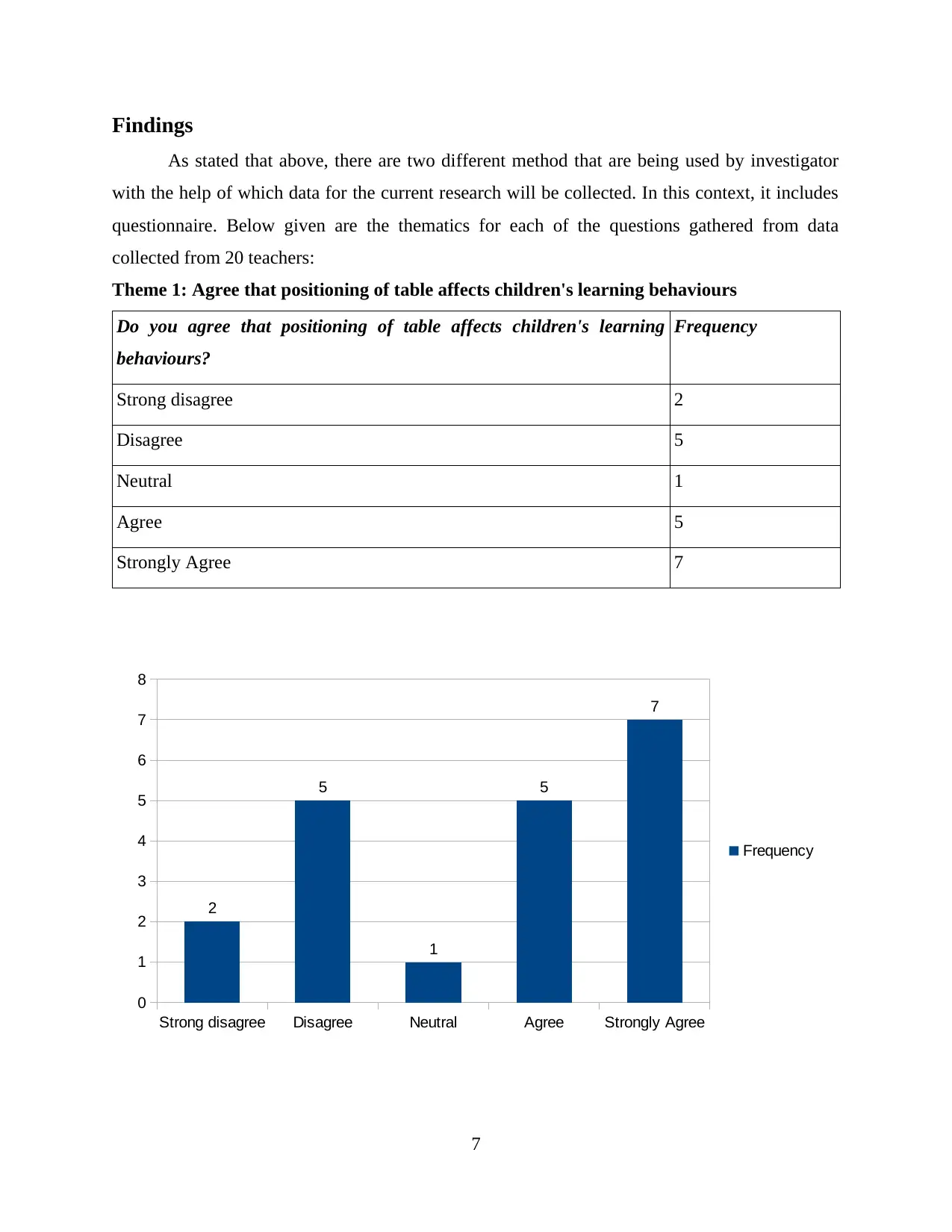
Theme 1: Agree that positioning of table affects children's learning behaviours
Do you agree that positioning of table affects children's learning
behaviours?
Frequency
Strong disagree 2
Disagree 5
Neutral 1
Agree 5
Strongly Agree 7
7
Strong disagree Disagree Neutral Agree Strongly Agree
0
1
2
3
4
5
6
7
8
2
5
1
5
7
Frequency
As stated that above, there are two different method that are being used by investigator
with the help of which data for the current research will be collected. In this context, it includes
questionnaire. Below given are the thematics for each of the questions gathered from data
collected from 20 teachers:
Theme 1: Agree that positioning of table affects children's learning behaviours
Do you agree that positioning of table affects children's learning
behaviours?
Frequency
Strong disagree 2
Disagree 5
Neutral 1
Agree 5
Strongly Agree 7
7
Strong disagree Disagree Neutral Agree Strongly Agree
0
1
2
3
4
5
6
7
8
2
5
1
5
7
Frequency
Paraphrase This Document
Need a fresh take? Get an instant paraphrase of this document with our AI Paraphraser
Description: As per the above conducted analysis, it can be stated that there are about 2
of the teachers who strongly disagree that positioning of tables affects the children's learning
behaviour. Further, there are 5 of the respondents who disagree to it. On the other hand, there are
7 of the staff members who strongly agree that positioning of table does affects children's
learning behaviour. From this, overall analysis can be made that majority of the staff members
think that positioning the table is an effective aspect that help in improving or making changes in
the learning behaviour of children's within class room . This way, it is important for teacher to
have frequent positioning of the table but it should be done as per the learning skills that each
child possess.
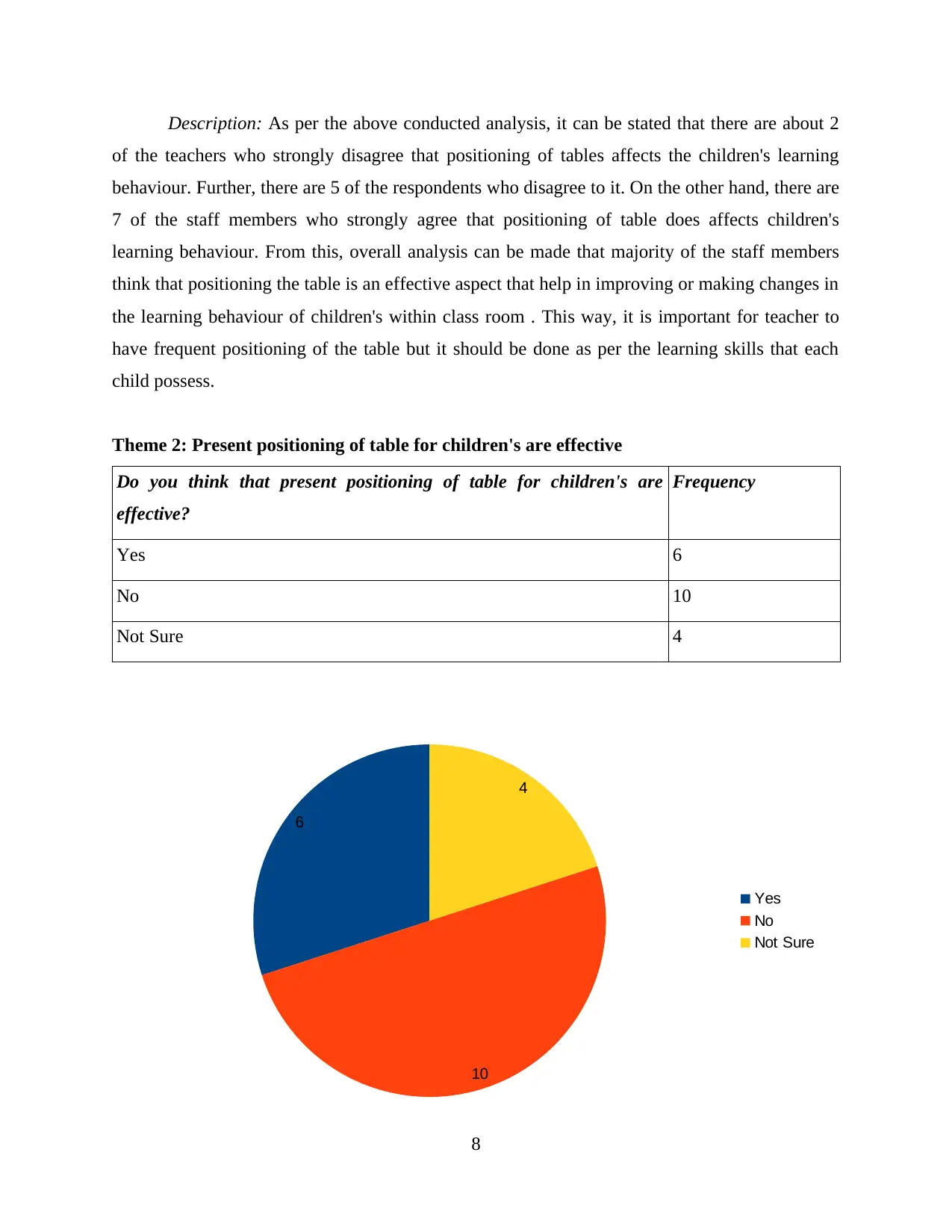
Theme 2: Present positioning of table for children's are effective
Do you think that present positioning of table for children's are
effective?
Frequency
Yes 6
No 10
Not Sure 4
8
6
10
4
Yes
No
Not Sure
of the teachers who strongly disagree that positioning of tables affects the children's learning
behaviour. Further, there are 5 of the respondents who disagree to it. On the other hand, there are
7 of the staff members who strongly agree that positioning of table does affects children's
learning behaviour. From this, overall analysis can be made that majority of the staff members
think that positioning the table is an effective aspect that help in improving or making changes in
the learning behaviour of children's within class room . This way, it is important for teacher to
have frequent positioning of the table but it should be done as per the learning skills that each
child possess.
Theme 2: Present positioning of table for children's are effective
Do you think that present positioning of table for children's are
effective?
Frequency
Yes 6
No 10
Not Sure 4
8
6
10
4
Yes
No
Not Sure
Description: From the questionnaire collected from 20 of the educators, it can be stated
that there are about 6 of the respondents who agree that the present positioning of the table is
effective enough to develop children's learning behaviour. On the other hand, there are 10 of the
teachers who do not think this. As per their point of view the current type of positioning table for
children's is not effective in order to develop their learning behaviour. However, there are about
4 of the teachers who are not sure for this aspect . Further, it can be stated that the teachers
should have proper understanding of the sequence with the help of which positioning is being
made. This will enable to develop perception among teachers towards child's learning behaviour.
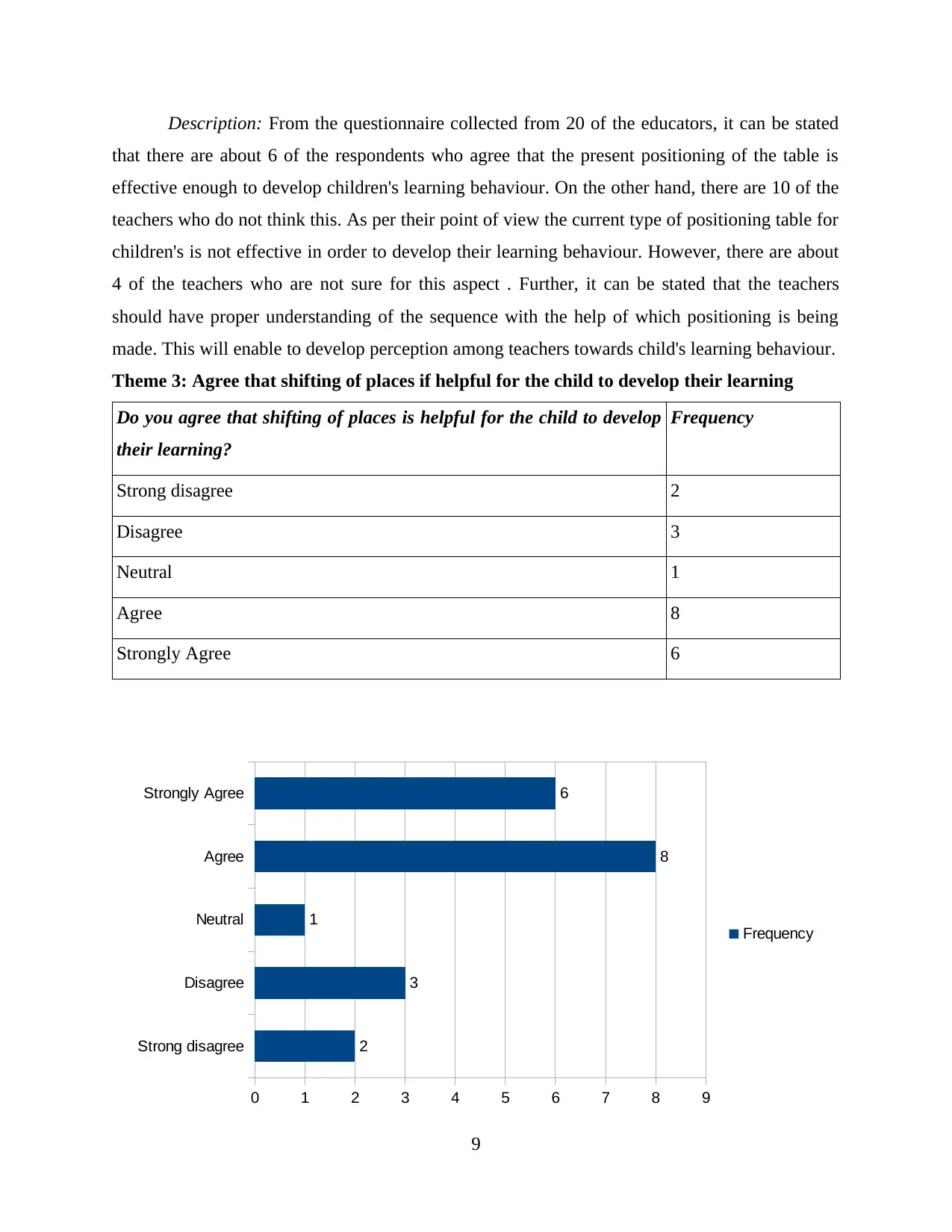
Theme 3: Agree that shifting of places if helpful for the child to develop their learning
Do you agree that shifting of places is helpful for the child to develop
their learning?
Frequency
Strong disagree 2
Disagree 3
Neutral 1
Agree 8
Strongly Agree 6
9
Strong disagree
Disagree
Neutral
Agree
Strongly Agree
0 1 2 3 4 5 6 7 8 9
2
3
1
8
6
Frequency
that there are about 6 of the respondents who agree that the present positioning of the table is
effective enough to develop children's learning behaviour. On the other hand, there are 10 of the
teachers who do not think this. As per their point of view the current type of positioning table for
children's is not effective in order to develop their learning behaviour. However, there are about
4 of the teachers who are not sure for this aspect . Further, it can be stated that the teachers
should have proper understanding of the sequence with the help of which positioning is being
made. This will enable to develop perception among teachers towards child's learning behaviour.
Theme 3: Agree that shifting of places if helpful for the child to develop their learning
Do you agree that shifting of places is helpful for the child to develop
their learning?
Frequency
Strong disagree 2
Disagree 3
Neutral 1
Agree 8
Strongly Agree 6
9
Strong disagree
Disagree
Neutral
Agree
Strongly Agree
0 1 2 3 4 5 6 7 8 9
2
3
1
8
6
Frequency
⊘ This is a preview!⊘
Do you want full access?
Subscribe today to unlock all pages.
Trusted by 1+ million students worldwide

1 out of 19


Related Documents


Your All-in-One AI-Powered Toolkit for Academic Success.
+13062052269
info@desklib.com
Available 24*7 on WhatsApp / Email
![[object Object]](/_next/static/media/star-bottom.7253800d.svg)
Unlock your academic potential
Copyright © 2020–2026 A2Z Services. All Rights Reserved. Developed and managed by ZUCOL.