Report on 3D Graphene Structure Design - {Student University}
VerifiedAdded on 2023/06/13
|6
|1886
|93
Report
AI Summary
This report details the design and development of a three-dimensional graphene structure, highlighting its advantages over the traditional two-dimensional design and steel. The 3D graphene structure, designed using SolidWorks, exhibits a sponge-like, porous configuration with lighter weight and thinner walls, resulting in significantly enhanced strength. The report includes a literature review of previous work on 2D graphene and steel, identifying weaknesses addressed by the 3D design. The methodology section outlines the experimental design, including data collection, implementation, and comparison with existing structures. Findings indicate that the 3D structure is stronger, more versatile in material composition, and deforms incrementally, making it a more efficient and effective alternative. The report concludes with recommendations for the adoption of the 3D graphene structure due to its superior design and strength.
THREE DIMENSIONAL GRAPHENE STRUCTURE DESIGN
{Student University}
{Student Name}
{Affiliation}
Contents
BACKGROUND............................................................................................................................2
Introduction................................................................................................................................2
Problem.......................................................................................................................................2
LITERATURE REVIEW.............................................................................................................2
Introduction................................................................................................................................2
Related Work..............................................................................................................................2
1. 2D graphene structure....................................................................................................2
2. The steel...........................................................................................................................2
Future Development..................................................................................................................2
Research Gap..............................................................................................................................3
Conclusion...................................................................................................................................3
METHODOLOGY........................................................................................................................3
Introduction................................................................................................................................3
Design Requirement...................................................................................................................3
Data collection............................................................................................................................4
Implementation..........................................................................................................................4
Conclusion...................................................................................................................................4
References.......................................................................................................................................5
{Student University}
{Student Name}
{Affiliation}
Contents
BACKGROUND............................................................................................................................2
Introduction................................................................................................................................2
Problem.......................................................................................................................................2
LITERATURE REVIEW.............................................................................................................2
Introduction................................................................................................................................2
Related Work..............................................................................................................................2
1. 2D graphene structure....................................................................................................2
2. The steel...........................................................................................................................2
Future Development..................................................................................................................2
Research Gap..............................................................................................................................3
Conclusion...................................................................................................................................3
METHODOLOGY........................................................................................................................3
Introduction................................................................................................................................3
Design Requirement...................................................................................................................3
Data collection............................................................................................................................4
Implementation..........................................................................................................................4
Conclusion...................................................................................................................................4
References.......................................................................................................................................5

Paraphrase This Document
Need a fresh take? Get an instant paraphrase of this document with our AI Paraphraser
BACKGROUND
Introduction
This is a qualitative report on the design and development of the graphene structure. The
graphene structure was initially designed and developed in 2D, it was thicker and heavy but the
redesign by the Massachusetts Institute of Technology (MIT) researchers which was the 3D
structure on the graphene which is lighter in weight but now, this is stronger that the one which
was earlier developed in the 2D design. The researcher say that the new design is 10 times
stronger than the older 2D graphene structure, Wei et al (2013).
LITERATURE REVIEW
Introduction
This involves picking from the assortment of the previous work done by researchers
related work, making analysis over them so that to be able to clearly understand about the design
that was developed. From the related work, advantage and there disadvantages are drawn
alongside there similarities and differences then conclusion is then drawn.
Problem
Though initially, the 2D structure of graphene was assumed and concluded to be the most
strongest structure when subjected to undue pressure, this was because the 2D graphene structure
was thicker and heavier, but still, since the 2D graphene structure was thicker and holding higher
energy of deformation, which then it is released just at once making the model to break just at
once.
This made the researchers to get back to the drawing table to check on how this can be
solved once and for all, In this process, the 3D graphene structure was introduced, which is
sponge like, porous and lighter weight with thinner walls. Due to its shape and design the 3D
model deformation process is incremental and not instant therefore stronger to withstand the
pressure of compression.
Case study on previous work and its relevance
1. 2D graphene structure
According to Zhang et al (2013).The graphene structure was the first structure of
graphene which is an allotrope of carbon in two dimensional properties. The structure is
thick and heavy hence perceived to be the strongest of its own kind. It was due to its 2D
design that made it developed with thicker walls so that it can withstand pressure.
2. The steel
Steel is a hard material that withstands pressure exerted over it. This s more
stronger than the 2D graphene structure. At the type, same structure which is made from
steel was the strongest of all since it could overcome more pressure exerted to it, Chen et
al(2011).
Introduction
This is a qualitative report on the design and development of the graphene structure. The
graphene structure was initially designed and developed in 2D, it was thicker and heavy but the
redesign by the Massachusetts Institute of Technology (MIT) researchers which was the 3D
structure on the graphene which is lighter in weight but now, this is stronger that the one which
was earlier developed in the 2D design. The researcher say that the new design is 10 times
stronger than the older 2D graphene structure, Wei et al (2013).
LITERATURE REVIEW
Introduction
This involves picking from the assortment of the previous work done by researchers
related work, making analysis over them so that to be able to clearly understand about the design
that was developed. From the related work, advantage and there disadvantages are drawn
alongside there similarities and differences then conclusion is then drawn.
Problem
Though initially, the 2D structure of graphene was assumed and concluded to be the most
strongest structure when subjected to undue pressure, this was because the 2D graphene structure
was thicker and heavier, but still, since the 2D graphene structure was thicker and holding higher
energy of deformation, which then it is released just at once making the model to break just at
once.
This made the researchers to get back to the drawing table to check on how this can be
solved once and for all, In this process, the 3D graphene structure was introduced, which is
sponge like, porous and lighter weight with thinner walls. Due to its shape and design the 3D
model deformation process is incremental and not instant therefore stronger to withstand the
pressure of compression.
Case study on previous work and its relevance
1. 2D graphene structure
According to Zhang et al (2013).The graphene structure was the first structure of
graphene which is an allotrope of carbon in two dimensional properties. The structure is
thick and heavy hence perceived to be the strongest of its own kind. It was due to its 2D
design that made it developed with thicker walls so that it can withstand pressure.
2. The steel
Steel is a hard material that withstands pressure exerted over it. This s more
stronger than the 2D graphene structure. At the type, same structure which is made from
steel was the strongest of all since it could overcome more pressure exerted to it, Chen et
al(2011).
Emerged Weaknesses from case study
Everything must have their negative side of it, and this as compared with the newly
designed there dimensional graphene structure, the below are the disadvantages and the
weaknesses of the case studies above which have been solved by the tree dimensional structure
of graphene.
The previous structures deforms easily as compared to the newly redesigned graphene
structure. From the experiment taken during the design, development and testing of the three
dimensional graphene structure, the steel which was taken as the most strong, the three
dimensional structure is ten times stronger than steel which is in turn stronger than the two
dimensional structure of graphene.
The 3D geometrical design is universal and also any material can be used to replace or
work in place of the graphene. This is very nice since this is not restricted to material. The
previous designs were restricted to steel and graphene.
When comparing the weight of each structure it is discovered that the three dimensional
graphene structure is very light than any other structure which is created before. Though this has
not meet the actual discovery since they wanted an structure which can be light than air.
Conclusion
From the above literature and the research gap which encompasses the weaknesses of the
researched structure that the recent design has solved, it is therefore concluded that the three
dimensional graphene structure is more efficient and effective enough to be fully used in place of
the two dimensional structures and the steel due to its recent improvement to the weaknesses of
the previous structures.
It is therefore recommended that the three dimensional structure be used due to its
cleverly design and strength.
METHODOLOGY
Introduction
Since this is a qualitative report, the design of the 3 dimensional graphene structure
followed the approach of the experimental design for its entire organization. The graphene
structure design employed the use of the solid works software. This was designed in accordance
with the two dimensional structure. For the testing of the strength of the design, the 3D structure
was exposed to pressure and after comparison, it was noticed that it can withstand pressure 10
times more than the steel.
Organization of samples
Everything must have their negative side of it, and this as compared with the newly
designed there dimensional graphene structure, the below are the disadvantages and the
weaknesses of the case studies above which have been solved by the tree dimensional structure
of graphene.
The previous structures deforms easily as compared to the newly redesigned graphene
structure. From the experiment taken during the design, development and testing of the three
dimensional graphene structure, the steel which was taken as the most strong, the three
dimensional structure is ten times stronger than steel which is in turn stronger than the two
dimensional structure of graphene.
The 3D geometrical design is universal and also any material can be used to replace or
work in place of the graphene. This is very nice since this is not restricted to material. The
previous designs were restricted to steel and graphene.
When comparing the weight of each structure it is discovered that the three dimensional
graphene structure is very light than any other structure which is created before. Though this has
not meet the actual discovery since they wanted an structure which can be light than air.
Conclusion
From the above literature and the research gap which encompasses the weaknesses of the
researched structure that the recent design has solved, it is therefore concluded that the three
dimensional graphene structure is more efficient and effective enough to be fully used in place of
the two dimensional structures and the steel due to its recent improvement to the weaknesses of
the previous structures.
It is therefore recommended that the three dimensional structure be used due to its
cleverly design and strength.
METHODOLOGY
Introduction
Since this is a qualitative report, the design of the 3 dimensional graphene structure
followed the approach of the experimental design for its entire organization. The graphene
structure design employed the use of the solid works software. This was designed in accordance
with the two dimensional structure. For the testing of the strength of the design, the 3D structure
was exposed to pressure and after comparison, it was noticed that it can withstand pressure 10
times more than the steel.
Organization of samples
⊘ This is a preview!⊘
Do you want full access?
Subscribe today to unlock all pages.

Trusted by 1+ million students worldwide
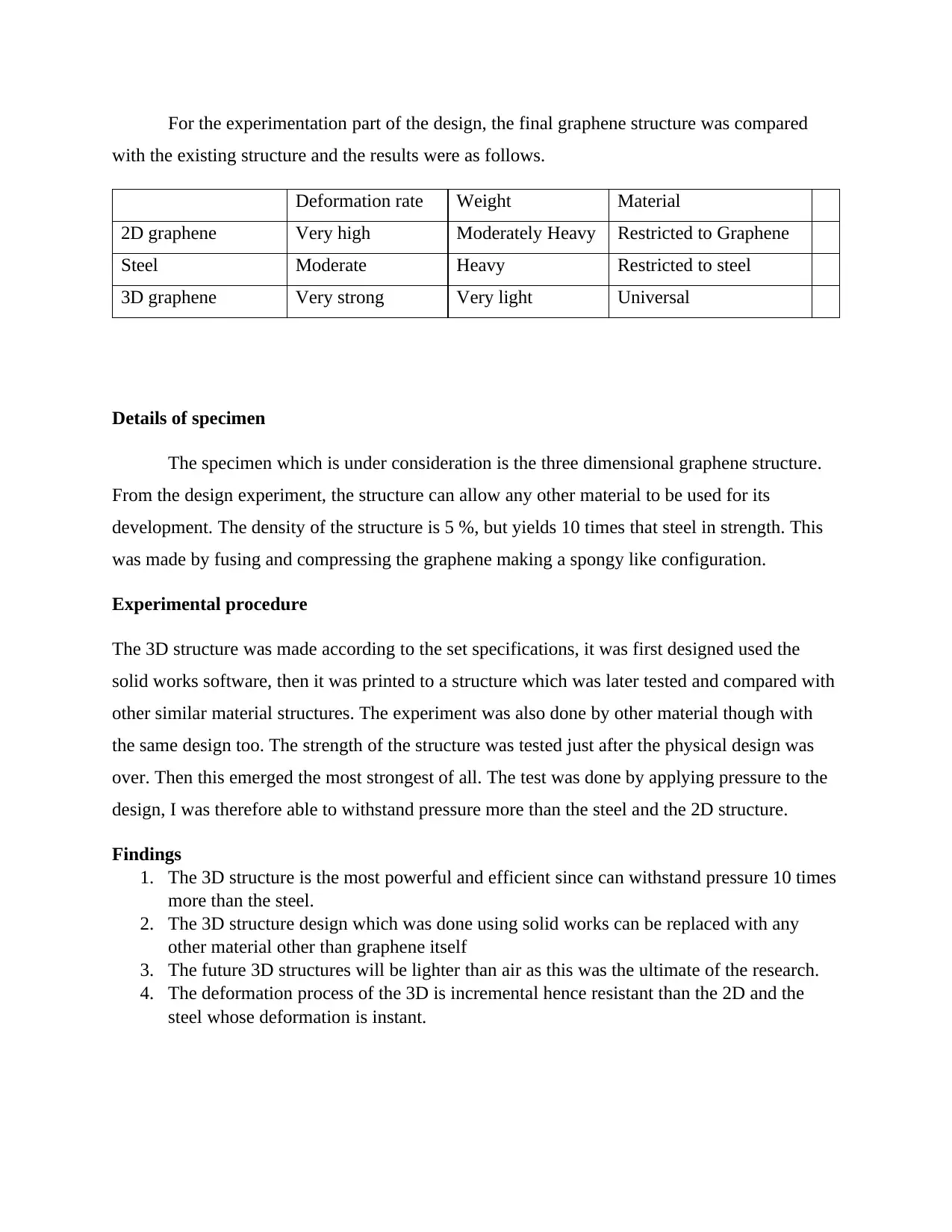
For the experimentation part of the design, the final graphene structure was compared
with the existing structure and the results were as follows.
Deformation rate Weight Material
2D graphene Very high Moderately Heavy Restricted to Graphene
Steel Moderate Heavy Restricted to steel
3D graphene Very strong Very light Universal
Details of specimen
The specimen which is under consideration is the three dimensional graphene structure.
From the design experiment, the structure can allow any other material to be used for its
development. The density of the structure is 5 %, but yields 10 times that steel in strength. This
was made by fusing and compressing the graphene making a spongy like configuration.
Experimental procedure
The 3D structure was made according to the set specifications, it was first designed used the
solid works software, then it was printed to a structure which was later tested and compared with
other similar material structures. The experiment was also done by other material though with
the same design too. The strength of the structure was tested just after the physical design was
over. Then this emerged the most strongest of all. The test was done by applying pressure to the
design, I was therefore able to withstand pressure more than the steel and the 2D structure.
Findings
1. The 3D structure is the most powerful and efficient since can withstand pressure 10 times
more than the steel.
2. The 3D structure design which was done using solid works can be replaced with any
other material other than graphene itself
3. The future 3D structures will be lighter than air as this was the ultimate of the research.
4. The deformation process of the 3D is incremental hence resistant than the 2D and the
steel whose deformation is instant.
with the existing structure and the results were as follows.
Deformation rate Weight Material
2D graphene Very high Moderately Heavy Restricted to Graphene
Steel Moderate Heavy Restricted to steel
3D graphene Very strong Very light Universal
Details of specimen
The specimen which is under consideration is the three dimensional graphene structure.
From the design experiment, the structure can allow any other material to be used for its
development. The density of the structure is 5 %, but yields 10 times that steel in strength. This
was made by fusing and compressing the graphene making a spongy like configuration.
Experimental procedure
The 3D structure was made according to the set specifications, it was first designed used the
solid works software, then it was printed to a structure which was later tested and compared with
other similar material structures. The experiment was also done by other material though with
the same design too. The strength of the structure was tested just after the physical design was
over. Then this emerged the most strongest of all. The test was done by applying pressure to the
design, I was therefore able to withstand pressure more than the steel and the 2D structure.
Findings
1. The 3D structure is the most powerful and efficient since can withstand pressure 10 times
more than the steel.
2. The 3D structure design which was done using solid works can be replaced with any
other material other than graphene itself
3. The future 3D structures will be lighter than air as this was the ultimate of the research.
4. The deformation process of the 3D is incremental hence resistant than the 2D and the
steel whose deformation is instant.
Paraphrase This Document
Need a fresh take? Get an instant paraphrase of this document with our AI Paraphraser
Interpretation
The implementation of this noble idea first started with the design using the solid works.
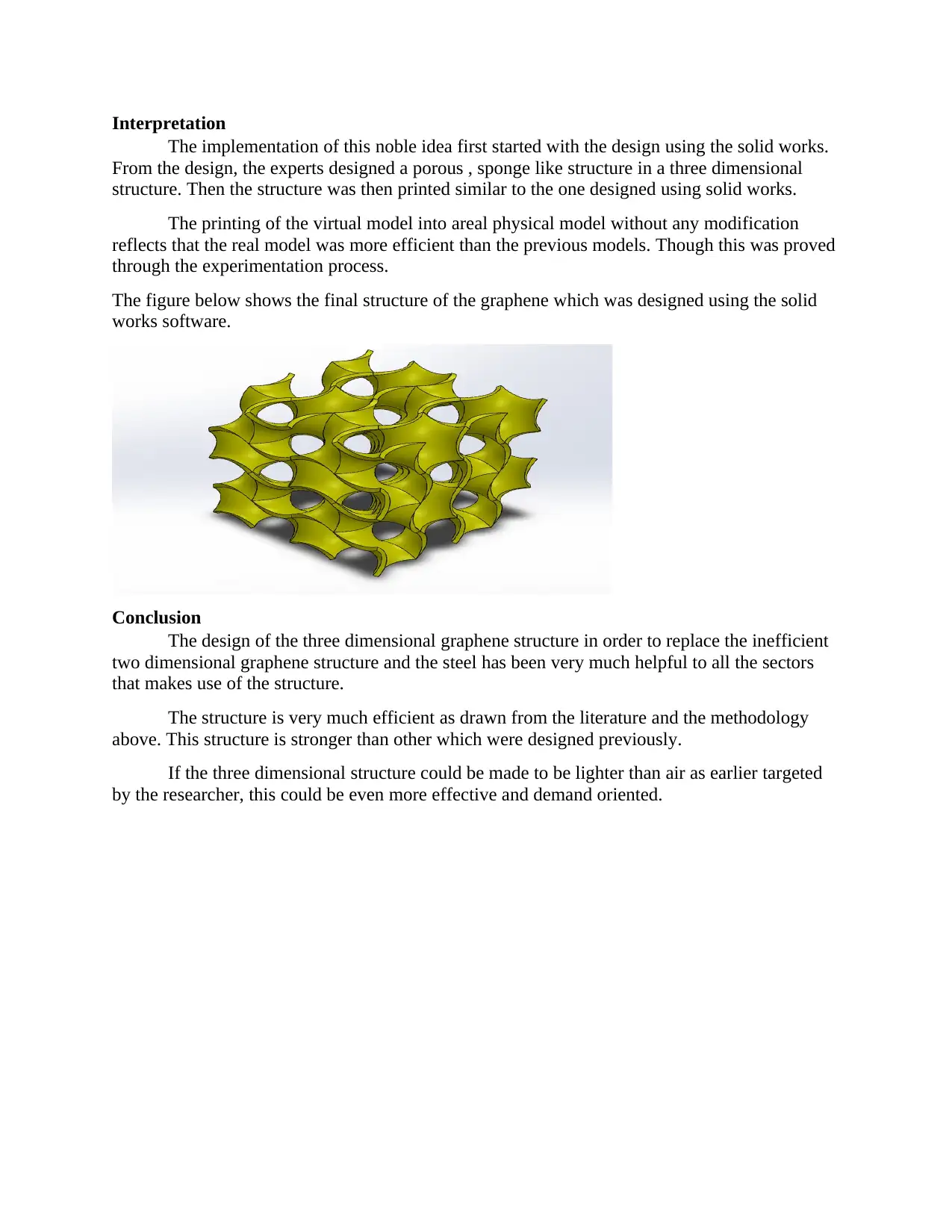
From the design, the experts designed a porous , sponge like structure in a three dimensional
structure. Then the structure was then printed similar to the one designed using solid works.
The printing of the virtual model into areal physical model without any modification
reflects that the real model was more efficient than the previous models. Though this was proved
through the experimentation process.
The figure below shows the final structure of the graphene which was designed using the solid
works software.
Conclusion
The design of the three dimensional graphene structure in order to replace the inefficient
two dimensional graphene structure and the steel has been very much helpful to all the sectors
that makes use of the structure.
The structure is very much efficient as drawn from the literature and the methodology
above. This structure is stronger than other which were designed previously.
If the three dimensional structure could be made to be lighter than air as earlier targeted
by the researcher, this could be even more effective and demand oriented.
The implementation of this noble idea first started with the design using the solid works.
From the design, the experts designed a porous , sponge like structure in a three dimensional
structure. Then the structure was then printed similar to the one designed using solid works.
The printing of the virtual model into areal physical model without any modification
reflects that the real model was more efficient than the previous models. Though this was proved
through the experimentation process.
The figure below shows the final structure of the graphene which was designed using the solid
works software.
Conclusion
The design of the three dimensional graphene structure in order to replace the inefficient
two dimensional graphene structure and the steel has been very much helpful to all the sectors
that makes use of the structure.
The structure is very much efficient as drawn from the literature and the methodology
above. This structure is stronger than other which were designed previously.
If the three dimensional structure could be made to be lighter than air as earlier targeted
by the researcher, this could be even more effective and demand oriented.
References
Chen, W., Li, S., Chen, C., & Yan, L. (2011). Self‐assembly and embedding of nanoparticles by
in situ reduced graphene for preparation of a 3d graphene/nanoparticle aerogel. Advanced
materials, 23(47), 5679-5683.
Britton and Doake (2013).Metal-catalyzed oxidations of organic compounds: mechanistic
principles and synthetic methodology including biochemical processes. Elsevier.
Zhang, L., Zhang, F., Yang, X., Long, G., Wu, Y., Zhang, T., ... & Chen, Y. (2013). Porous 3D
graphene-based bulk materials with exceptional high surface area and excellent conductivity for
supercapacitors. Scientific reports, 3, 1408.
Wei, W., Yang, S., Zhou, H., Lieberwirth, I., Feng, X., & Müllen, K. (2013). 3D Graphene
Foams Cross‐linked with Pre‐encapsulated Fe3O4 Nanospheres for Enhanced Lithium
Storage. Advanced materials, 25(21), 2909-2914.
Bibliography
Cao, X., Shi, Y., Shi, W., Lu, G., Huang, X., Yan, Q., ... & Zhang, H. (2011). Preparation of
novel 3D graphene networks for supercapacitor applications. small, 7(22), 3163-3168.
Dong, X. C., Xu, H., Wang, X. W., Huang, Y. X., Chan-Park, M. B., Zhang, H., ... & Chen, P.
(2012). 3D graphene–cobalt oxide electrode for high-performance supercapacitor and
enzymeless glucose detection. ACS nano, 6(4), 3206-3213.
Dong, X., Chen, J., Ma, Y., Wang, J., Chan-Park, M. B., Liu, X., ... & Chen, P. (2012).
Superhydrophobic and superoleophilic hybrid foam of graphene and carbon nanotube for
selective removal of oils or organic solvents from the surface of water. Chemical
communications, 48(86), 10660-10662.
Sam, R., Arrifin, K., & Buniyamin, N. (2012, September). Simulation of pick and place robotics
system using Solidworks Softmotion. In System Engineering and Technology (ICSET), 2012
International Conference on (pp. 1-6). IEEE.
Eraslan, O., & İnan, Ö. (2010). The effect of thread design on stress distribution in a solid screw
implant: a 3D finite element analysis. Clinical oral investigations, 14(4), 411-416.
Chen, W., Li, S., Chen, C., & Yan, L. (2011). Self‐assembly and embedding of nanoparticles by
in situ reduced graphene for preparation of a 3d graphene/nanoparticle aerogel. Advanced
materials, 23(47), 5679-5683.
Britton and Doake (2013).Metal-catalyzed oxidations of organic compounds: mechanistic
principles and synthetic methodology including biochemical processes. Elsevier.
Zhang, L., Zhang, F., Yang, X., Long, G., Wu, Y., Zhang, T., ... & Chen, Y. (2013). Porous 3D
graphene-based bulk materials with exceptional high surface area and excellent conductivity for
supercapacitors. Scientific reports, 3, 1408.
Wei, W., Yang, S., Zhou, H., Lieberwirth, I., Feng, X., & Müllen, K. (2013). 3D Graphene
Foams Cross‐linked with Pre‐encapsulated Fe3O4 Nanospheres for Enhanced Lithium
Storage. Advanced materials, 25(21), 2909-2914.
Bibliography
Cao, X., Shi, Y., Shi, W., Lu, G., Huang, X., Yan, Q., ... & Zhang, H. (2011). Preparation of
novel 3D graphene networks for supercapacitor applications. small, 7(22), 3163-3168.
Dong, X. C., Xu, H., Wang, X. W., Huang, Y. X., Chan-Park, M. B., Zhang, H., ... & Chen, P.
(2012). 3D graphene–cobalt oxide electrode for high-performance supercapacitor and
enzymeless glucose detection. ACS nano, 6(4), 3206-3213.
Dong, X., Chen, J., Ma, Y., Wang, J., Chan-Park, M. B., Liu, X., ... & Chen, P. (2012).
Superhydrophobic and superoleophilic hybrid foam of graphene and carbon nanotube for
selective removal of oils or organic solvents from the surface of water. Chemical
communications, 48(86), 10660-10662.
Sam, R., Arrifin, K., & Buniyamin, N. (2012, September). Simulation of pick and place robotics
system using Solidworks Softmotion. In System Engineering and Technology (ICSET), 2012
International Conference on (pp. 1-6). IEEE.
Eraslan, O., & İnan, Ö. (2010). The effect of thread design on stress distribution in a solid screw
implant: a 3D finite element analysis. Clinical oral investigations, 14(4), 411-416.
⊘ This is a preview!⊘
Do you want full access?
Subscribe today to unlock all pages.
Trusted by 1+ million students worldwide

1 out of 6


Your All-in-One AI-Powered Toolkit for Academic Success.
+13062052269
info@desklib.com
Available 24*7 on WhatsApp / Email
![[object Object]](/_next/static/media/star-bottom.7253800d.svg)
Unlock your academic potential
Copyright © 2020–2026 A2Z Services. All Rights Reserved. Developed and managed by ZUCOL.