University Essay: Comprehensive Analysis of 5G Network Characteristics
VerifiedAdded on 2022/10/18
|13
|3089
|13
Essay
AI Summary
This research essay delves into the characteristics of 5G wireless networks, exploring its advantages, challenges, and future implications. The essay begins with an introduction to 5G, highlighting its capabilities for high-speed data transmission, low latency, and ubiquitous connectivity. A comparison with previous generations of mobile networks (2G, 3G, and 4G) is provided to illustrate the advancements of 5G. The essay then examines the architecture of 5G networks, including cloud-based, energy-efficient, and device-to-device communication models. Furthermore, the essay identifies potential 5G attacks and security challenges, offering possible solutions to mitigate these threats. The limitations of 5G, such as network coverage issues, are also discussed, along with proposed solutions to overcome these constraints. The essay concludes by summarizing the key findings and emphasizing the significance of 5G in the evolution of wireless communication.
Running Head: NETWORKING
0
Networking
Wireless and Interactive Networks
(Student Details: )
9/23/2019
0
Networking
Wireless and Interactive Networks
(Student Details: )
9/23/2019

Paraphrase This Document
Need a fresh take? Get an instant paraphrase of this document with our AI Paraphraser
Networking
1
Contents
Wireless and Interactive Networks............................................................................................2
Introduction................................................................................................................................2
Comparison of wireless mobile networks..................................................................................2
5G Mobile Network...............................................................................................................3
5G Network Characteristics.......................................................................................................3
Very high-speed data transmission........................................................................................3
Extremely low latency............................................................................................................4
Ubiquitous connectivity.........................................................................................................4
5G Architecture......................................................................................................................5
Identification of 5G Attacks: Challenges and Issues of 5G...................................................6
5G Challenges and Issues.......................................................................................................7
5G limitation: Network Coverage..........................................................................................8
Possible Solutions: 5G Networks...........................................................................................8
Conclusion..................................................................................................................................9
References................................................................................................................................10
1
Contents
Wireless and Interactive Networks............................................................................................2
Introduction................................................................................................................................2
Comparison of wireless mobile networks..................................................................................2
5G Mobile Network...............................................................................................................3
5G Network Characteristics.......................................................................................................3
Very high-speed data transmission........................................................................................3
Extremely low latency............................................................................................................4
Ubiquitous connectivity.........................................................................................................4
5G Architecture......................................................................................................................5
Identification of 5G Attacks: Challenges and Issues of 5G...................................................6
5G Challenges and Issues.......................................................................................................7
5G limitation: Network Coverage..........................................................................................8
Possible Solutions: 5G Networks...........................................................................................8
Conclusion..................................................................................................................................9
References................................................................................................................................10
Networking
2
Wireless and Interactive Networks
Introduction
This research essay is mainly focused on the recent topic in relation to wireless and
interactive networks. The discussion is going to research upon future scope of wireless and
interactive networks in near future. To do so, a contemporary technology-based topic 5G
wireless networks has been chosen to write this essay. In general, 5G is that wireless network
that has the capability to offer broadband access all over the world while entertaining greater
user mobility 1. In other words, 5G network will enable higher connectivity of huge number
of devices into an affordable and ultra-reliable manner. Specifically, this essay will narrate on
5G network characteristics in detail so that all possible barriers, challenges, and threats
related to 5G network can be identified for effective future implementation. With the help of
this research essay, a detailed comparison of prevailing mobile networks like 2G, 3G, and 4G
will be demonstrated in relation to 5G 2. Moreover, 5G architecture will also be discussed in
this research paper. In this context, identification and analysis of 5G attacks are going to be
discussed so that prevention and addressing of those attacks can be done. Lastly, a summary
will be provided at the end of this research essay.
Comparison of wireless mobile networks
Before researching, explaining and describing 5G characteristics, a comparison of previously
available mobile networks is necessary so that a clear picture can be formed. It has been
found that for demonstrating an illustrative comparison of all wireless cellular network
generations, some specific factors must be chosen 3.
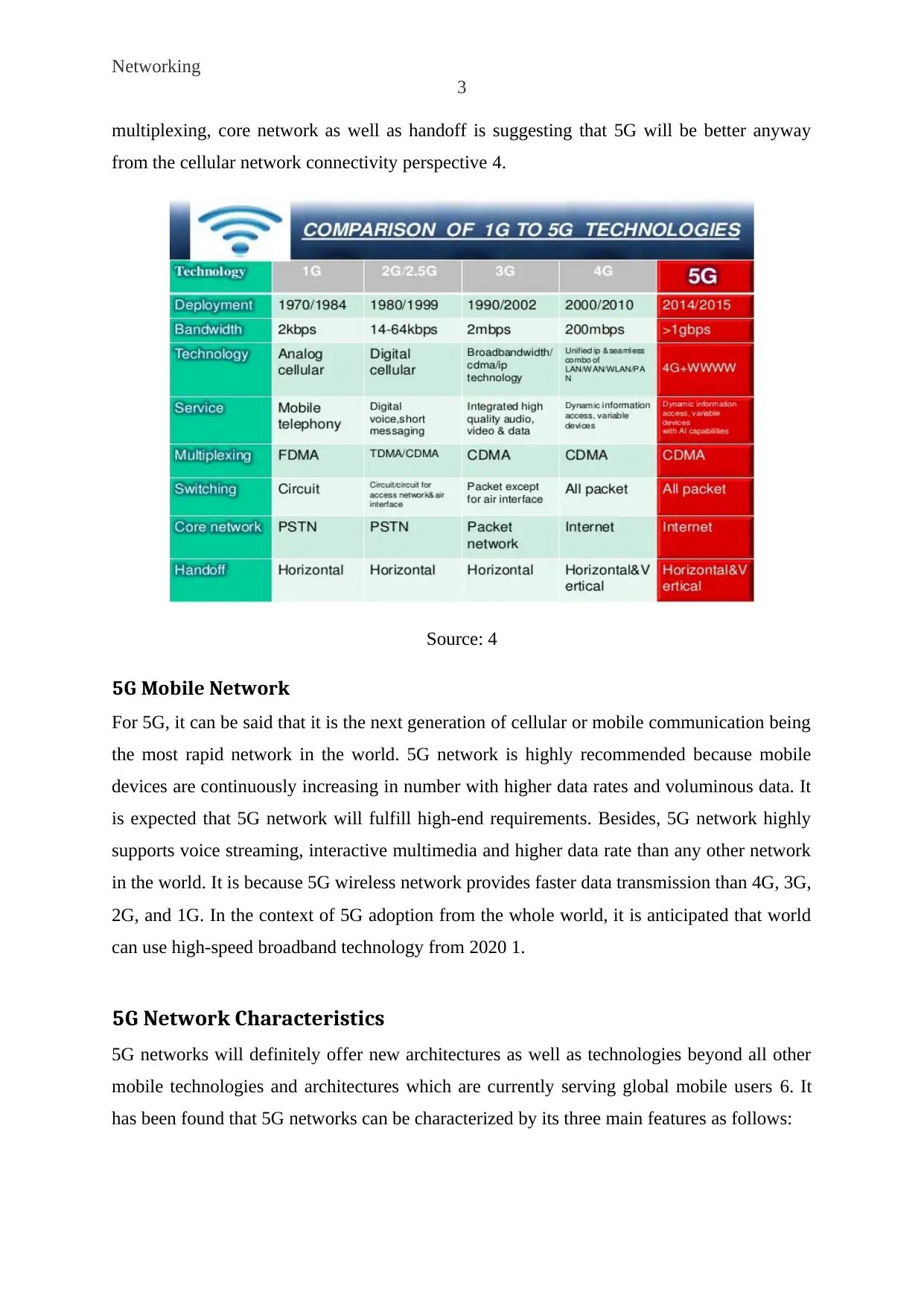
The below-mentioned figure is demonstrating a detailed comparison of the currently
available wireless mobile networks. In this way, the figure is aimed to motivate the readers to
perceive an overview of wireless mobile networks so as to motivate them for 5G adoption in
the near future. It is worth knowing that ‘G’ in the name of 5G stands for ‘generation’. Here,
the objective of wireless communication is to provide reliable, high-quality communication
which is actually similar to wired communication but high-speed in nature. In this way, all
key attributes of these cellular technologies such as deployment, bandwidth, service,
2
Wireless and Interactive Networks
Introduction
This research essay is mainly focused on the recent topic in relation to wireless and
interactive networks. The discussion is going to research upon future scope of wireless and
interactive networks in near future. To do so, a contemporary technology-based topic 5G
wireless networks has been chosen to write this essay. In general, 5G is that wireless network
that has the capability to offer broadband access all over the world while entertaining greater
user mobility 1. In other words, 5G network will enable higher connectivity of huge number
of devices into an affordable and ultra-reliable manner. Specifically, this essay will narrate on
5G network characteristics in detail so that all possible barriers, challenges, and threats
related to 5G network can be identified for effective future implementation. With the help of
this research essay, a detailed comparison of prevailing mobile networks like 2G, 3G, and 4G
will be demonstrated in relation to 5G 2. Moreover, 5G architecture will also be discussed in
this research paper. In this context, identification and analysis of 5G attacks are going to be
discussed so that prevention and addressing of those attacks can be done. Lastly, a summary
will be provided at the end of this research essay.
Comparison of wireless mobile networks
Before researching, explaining and describing 5G characteristics, a comparison of previously
available mobile networks is necessary so that a clear picture can be formed. It has been
found that for demonstrating an illustrative comparison of all wireless cellular network
generations, some specific factors must be chosen 3.
The below-mentioned figure is demonstrating a detailed comparison of the currently
available wireless mobile networks. In this way, the figure is aimed to motivate the readers to
perceive an overview of wireless mobile networks so as to motivate them for 5G adoption in
the near future. It is worth knowing that ‘G’ in the name of 5G stands for ‘generation’. Here,
the objective of wireless communication is to provide reliable, high-quality communication
which is actually similar to wired communication but high-speed in nature. In this way, all
key attributes of these cellular technologies such as deployment, bandwidth, service,
⊘ This is a preview!⊘
Do you want full access?
Subscribe today to unlock all pages.

Trusted by 1+ million students worldwide
Networking
3
multiplexing, core network as well as handoff is suggesting that 5G will be better anyway
from the cellular network connectivity perspective 4.
Source: 4
5G Mobile Network
For 5G, it can be said that it is the next generation of cellular or mobile communication being
the most rapid network in the world. 5G network is highly recommended because mobile
devices are continuously increasing in number with higher data rates and voluminous data. It
is expected that 5G network will fulfill high-end requirements. Besides, 5G network highly
supports voice streaming, interactive multimedia and higher data rate than any other network
in the world. It is because 5G wireless network provides faster data transmission than 4G, 3G,
2G, and 1G. In the context of 5G adoption from the whole world, it is anticipated that world
can use high-speed broadband technology from 2020 1.
5G Network Characteristics
5G networks will definitely offer new architectures as well as technologies beyond all other
mobile technologies and architectures which are currently serving global mobile users 6. It
has been found that 5G networks can be characterized by its three main features as follows:
3
multiplexing, core network as well as handoff is suggesting that 5G will be better anyway
from the cellular network connectivity perspective 4.
Source: 4
5G Mobile Network
For 5G, it can be said that it is the next generation of cellular or mobile communication being
the most rapid network in the world. 5G network is highly recommended because mobile
devices are continuously increasing in number with higher data rates and voluminous data. It
is expected that 5G network will fulfill high-end requirements. Besides, 5G network highly
supports voice streaming, interactive multimedia and higher data rate than any other network
in the world. It is because 5G wireless network provides faster data transmission than 4G, 3G,
2G, and 1G. In the context of 5G adoption from the whole world, it is anticipated that world
can use high-speed broadband technology from 2020 1.
5G Network Characteristics
5G networks will definitely offer new architectures as well as technologies beyond all other
mobile technologies and architectures which are currently serving global mobile users 6. It
has been found that 5G networks can be characterized by its three main features as follows:
Paraphrase This Document
Need a fresh take? Get an instant paraphrase of this document with our AI Paraphraser
Networking
4
Very high-speed data transmission
As we know that LTE is the faster cellular technology as of now which supports peak data
rates of 300 Mbps 7. Thus, 5G is superior in terms of data transfer rate because its data speed
is 1 Gbps or higher which is actually higher than any other cellular networks used in the past.
The 5G uses WWWW technology which stands for World Wide Wireless Web; it helps the
wireless network to offer very high-speed data transmission 5.
Extremely low latency
5G shows almost zero latency. Here, the meaning of the latency is that period of time amid
instructing a machine for performing command and its actual execution. In this way, such
characteristics of 5G make the wireless network most efficient cellular network among all. In
addition to that, lower latency of 5G will provide better as well as significant improvements
within user experience perceptions 6. Apart from this, there are some use cases linked with
5G’s low latency, which are as follows:
Simultaneous translating.
Immersive Virtual-Reality (VR) gaming.
V2X communication: V2V: V2I autonomous connected cars.
Remote surgical processes.
Ubiquitous connectivity
In this context, ubiquitous connectivity is the capability of 5G to provide connectivity to all
people in this world. 5G has the capability to offer everything, everywhere, every time
worldwide, it is known as ubiquitous connectivity 8. Initially, wireless connectivity used to
link people on the move, now it is increasingly underpinning surrounding services as well as
IT infrastructure. With this characteristic of 5G, different objects can be tagged as well as can
be situated, monitored, and organized while using compact, embedded electronics. In this
context, important examples of ubiquitous connectivity are available in fitness and health
trackers. Furthermore, more examples of ubiquitous connectivity are smart thermostats, as
well as monitors for babies or old people 9.
Apart from this, this research has found some useful and important characteristics of 5G,
which are as follows:
4
Very high-speed data transmission
As we know that LTE is the faster cellular technology as of now which supports peak data
rates of 300 Mbps 7. Thus, 5G is superior in terms of data transfer rate because its data speed
is 1 Gbps or higher which is actually higher than any other cellular networks used in the past.
The 5G uses WWWW technology which stands for World Wide Wireless Web; it helps the
wireless network to offer very high-speed data transmission 5.
Extremely low latency
5G shows almost zero latency. Here, the meaning of the latency is that period of time amid
instructing a machine for performing command and its actual execution. In this way, such
characteristics of 5G make the wireless network most efficient cellular network among all. In
addition to that, lower latency of 5G will provide better as well as significant improvements
within user experience perceptions 6. Apart from this, there are some use cases linked with
5G’s low latency, which are as follows:
Simultaneous translating.
Immersive Virtual-Reality (VR) gaming.
V2X communication: V2V: V2I autonomous connected cars.
Remote surgical processes.
Ubiquitous connectivity
In this context, ubiquitous connectivity is the capability of 5G to provide connectivity to all
people in this world. 5G has the capability to offer everything, everywhere, every time
worldwide, it is known as ubiquitous connectivity 8. Initially, wireless connectivity used to
link people on the move, now it is increasingly underpinning surrounding services as well as
IT infrastructure. With this characteristic of 5G, different objects can be tagged as well as can
be situated, monitored, and organized while using compact, embedded electronics. In this
context, important examples of ubiquitous connectivity are available in fitness and health
trackers. Furthermore, more examples of ubiquitous connectivity are smart thermostats, as
well as monitors for babies or old people 9.
Apart from this, this research has found some useful and important characteristics of 5G,
which are as follows:
Networking
5
5G is having higher peak data rates, effective connection density, and wide available
spectrum as compared to 4G networks. The possible values are 20 Gb/Sec, 30 GHz
and 1 Million connections/ Km2
5G wireless is capable of providing extensive roaming experience even when they
will travel abroad. In other words, 5G users will be capable to flawlessly leverage 5G
roaming experience over visited networks.
5G carries the perception of high-speed, which means that 5G owns instantaneous
response time along with quality performance for IoT. 5G will make so many dreams
in technology a reality 5G 10.
5G characteristics like ubiquitous connectivity will assure the well-expected success
of self-driving vehicles.
It has been found that 5G wireless network technology accelerates the
commercialization of IoT devices while relying on cellular despite Wi-Fi technology.
5G is able to offer high-quality IoT services with enhanced ubiquity, improved
mobility, as well as enhanced performance 11.
5G is superior to any other cellular network, speed-wise and response time-wise.
5G can be seen as a cellular broadband technology which is a network of complex
networks.
In the context of 5G characteristics, MNOs' knowledge and expertise for building and
functioning networks will play an important role in near future.
5G is able to unleash a novel IoT eco-system 12.
5G will be able to develop as well as offer new IoT services beyond offering network
services.
5G networks infer high connectivity for the base-station by using optical fibres for
reaching the 1ms latency goal.
From the cost-savings perspective, 5G wireless networks are greatly planned to be
able to assist virtual networks like inferior power low throughput networks for less-
cost IoT 13.
5G Architecture
5G architecture can be explained with different important architectures such as multi-tier,
cognitive radio-based, energy-efficient, cloud-based and device-proximity based architectures
14. In this context, major architectures of the future 5G networks can be listed as below:
5
5G is having higher peak data rates, effective connection density, and wide available
spectrum as compared to 4G networks. The possible values are 20 Gb/Sec, 30 GHz
and 1 Million connections/ Km2
5G wireless is capable of providing extensive roaming experience even when they
will travel abroad. In other words, 5G users will be capable to flawlessly leverage 5G
roaming experience over visited networks.
5G carries the perception of high-speed, which means that 5G owns instantaneous
response time along with quality performance for IoT. 5G will make so many dreams
in technology a reality 5G 10.
5G characteristics like ubiquitous connectivity will assure the well-expected success
of self-driving vehicles.
It has been found that 5G wireless network technology accelerates the
commercialization of IoT devices while relying on cellular despite Wi-Fi technology.
5G is able to offer high-quality IoT services with enhanced ubiquity, improved
mobility, as well as enhanced performance 11.
5G is superior to any other cellular network, speed-wise and response time-wise.
5G can be seen as a cellular broadband technology which is a network of complex
networks.
In the context of 5G characteristics, MNOs' knowledge and expertise for building and
functioning networks will play an important role in near future.
5G is able to unleash a novel IoT eco-system 12.
5G will be able to develop as well as offer new IoT services beyond offering network
services.
5G networks infer high connectivity for the base-station by using optical fibres for
reaching the 1ms latency goal.
From the cost-savings perspective, 5G wireless networks are greatly planned to be
able to assist virtual networks like inferior power low throughput networks for less-
cost IoT 13.
5G Architecture
5G architecture can be explained with different important architectures such as multi-tier,
cognitive radio-based, energy-efficient, cloud-based and device-proximity based architectures
14. In this context, major architectures of the future 5G networks can be listed as below:
⊘ This is a preview!⊘
Do you want full access?
Subscribe today to unlock all pages.
Trusted by 1+ million students worldwide
Networking
6
Cloud-based: it is based on how cloud assists better communication in future 5G
networks 15.
Energy-efficient: This 5G architecture contains the energy-saving mechanism in
upcoming 5G mobile networks
D2D communication: this is an architecture that is based on communication taking
place amid different devices that are close to each other while ignoring an MBS.
2-Tier: this 5G architecture is based on the mechanism of small cell deployment under
macro-cells.
CRN-based: the 5G architecture is majorly based on the deployment mechanism of
CRN into a macro-cell of 5G network systems 5.
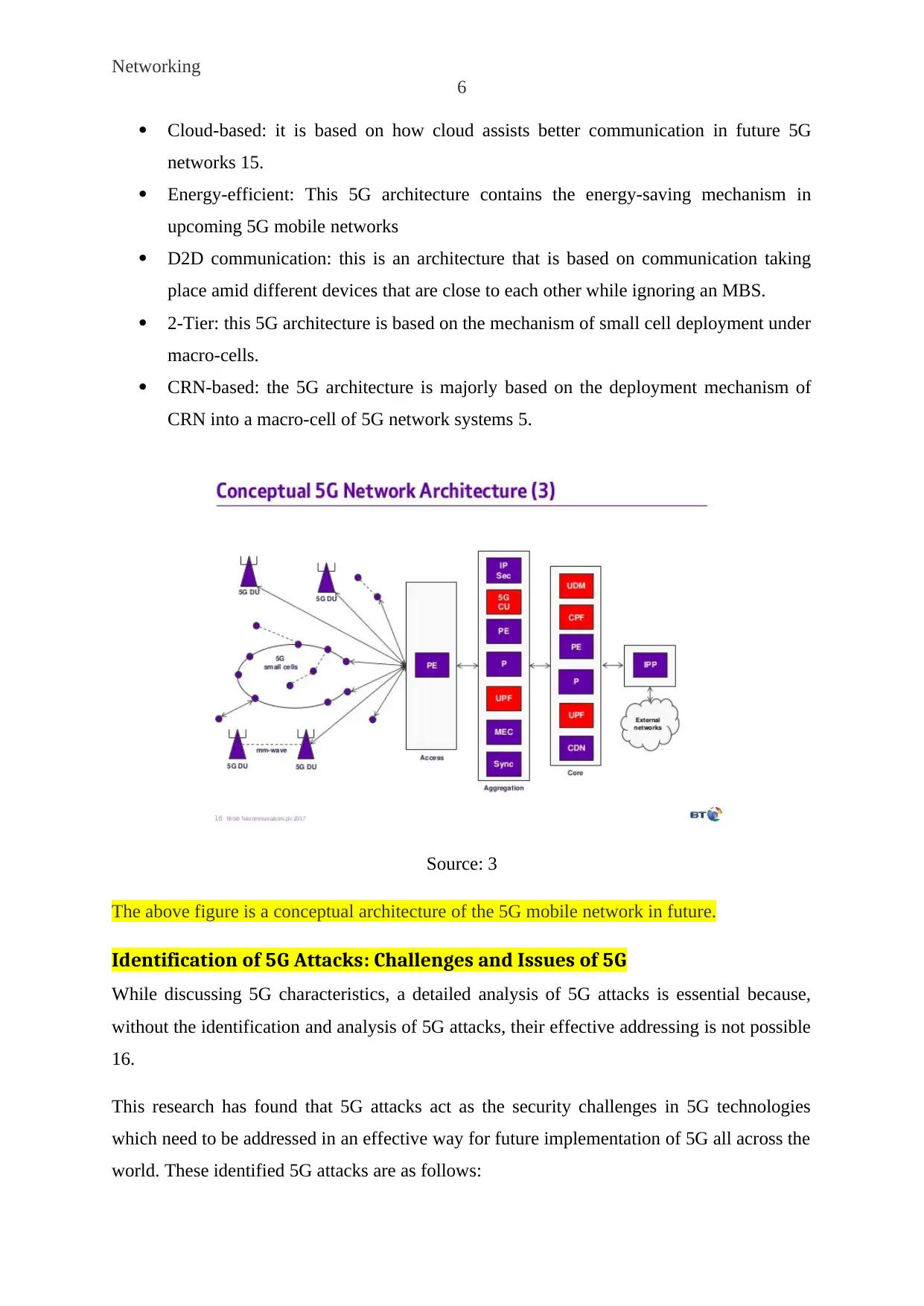
Source: 3
The above figure is a conceptual architecture of the 5G mobile network in future.
Identification of 5G Attacks: Challenges and Issues of 5G
While discussing 5G characteristics, a detailed analysis of 5G attacks is essential because,
without the identification and analysis of 5G attacks, their effective addressing is not possible
16.
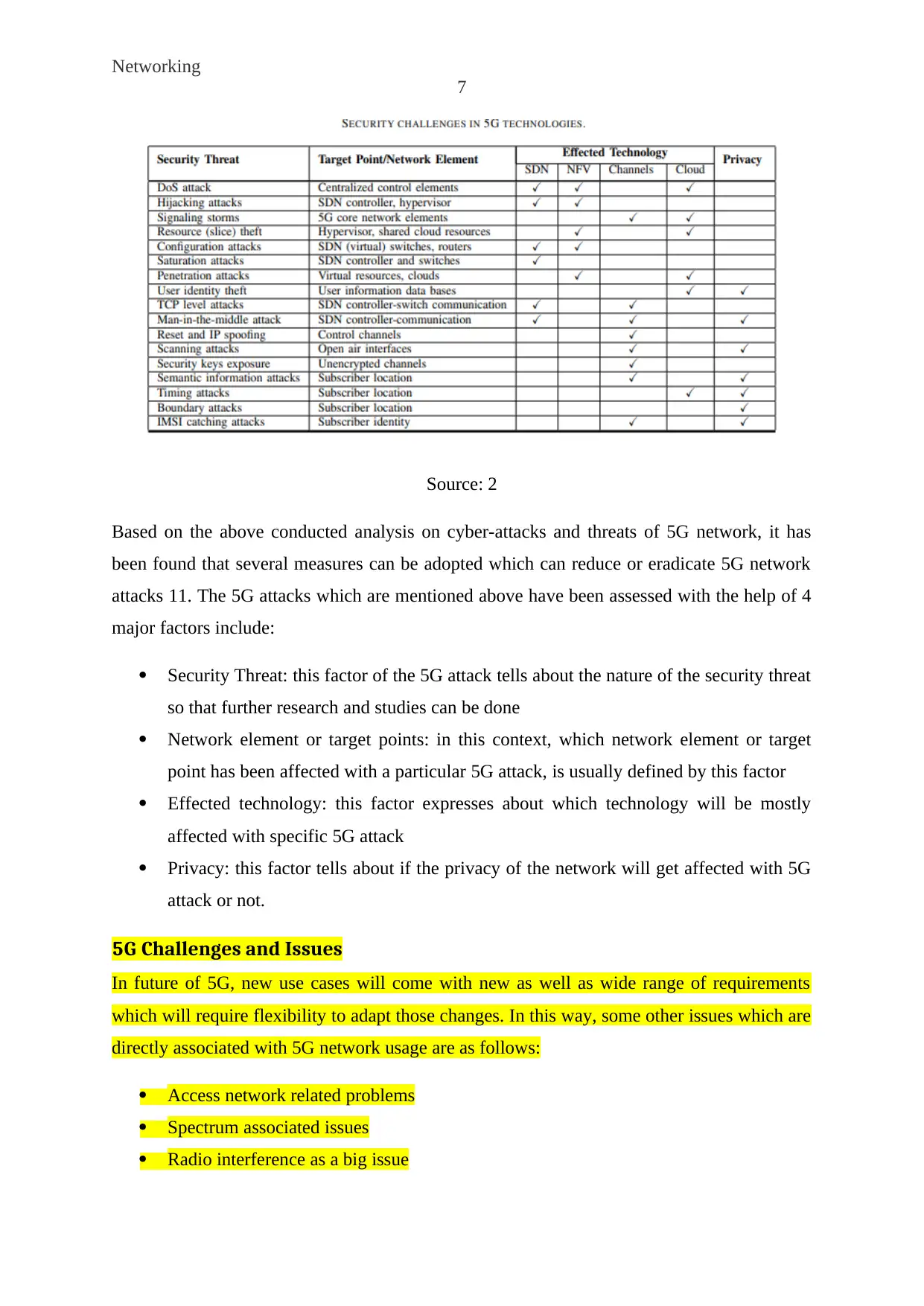
This research has found that 5G attacks act as the security challenges in 5G technologies
which need to be addressed in an effective way for future implementation of 5G all across the
world. These identified 5G attacks are as follows:
6
Cloud-based: it is based on how cloud assists better communication in future 5G
networks 15.
Energy-efficient: This 5G architecture contains the energy-saving mechanism in
upcoming 5G mobile networks
D2D communication: this is an architecture that is based on communication taking
place amid different devices that are close to each other while ignoring an MBS.
2-Tier: this 5G architecture is based on the mechanism of small cell deployment under
macro-cells.
CRN-based: the 5G architecture is majorly based on the deployment mechanism of
CRN into a macro-cell of 5G network systems 5.
Source: 3
The above figure is a conceptual architecture of the 5G mobile network in future.
Identification of 5G Attacks: Challenges and Issues of 5G
While discussing 5G characteristics, a detailed analysis of 5G attacks is essential because,
without the identification and analysis of 5G attacks, their effective addressing is not possible
16.
This research has found that 5G attacks act as the security challenges in 5G technologies
which need to be addressed in an effective way for future implementation of 5G all across the
world. These identified 5G attacks are as follows:
Paraphrase This Document
Need a fresh take? Get an instant paraphrase of this document with our AI Paraphraser
Networking
7
Source: 2
Based on the above conducted analysis on cyber-attacks and threats of 5G network, it has
been found that several measures can be adopted which can reduce or eradicate 5G network
attacks 11. The 5G attacks which are mentioned above have been assessed with the help of 4
major factors include:
Security Threat: this factor of the 5G attack tells about the nature of the security threat
so that further research and studies can be done
Network element or target points: in this context, which network element or target
point has been affected with a particular 5G attack, is usually defined by this factor
Effected technology: this factor expresses about which technology will be mostly
affected with specific 5G attack
Privacy: this factor tells about if the privacy of the network will get affected with 5G
attack or not.
5G Challenges and Issues
In future of 5G, new use cases will come with new as well as wide range of requirements
which will require flexibility to adapt those changes. In this way, some other issues which are
directly associated with 5G network usage are as follows:
Access network related problems
Spectrum associated issues
Radio interference as a big issue
7
Source: 2
Based on the above conducted analysis on cyber-attacks and threats of 5G network, it has
been found that several measures can be adopted which can reduce or eradicate 5G network
attacks 11. The 5G attacks which are mentioned above have been assessed with the help of 4
major factors include:
Security Threat: this factor of the 5G attack tells about the nature of the security threat
so that further research and studies can be done
Network element or target points: in this context, which network element or target
point has been affected with a particular 5G attack, is usually defined by this factor
Effected technology: this factor expresses about which technology will be mostly
affected with specific 5G attack
Privacy: this factor tells about if the privacy of the network will get affected with 5G
attack or not.
5G Challenges and Issues
In future of 5G, new use cases will come with new as well as wide range of requirements
which will require flexibility to adapt those changes. In this way, some other issues which are
directly associated with 5G network usage are as follows:
Access network related problems
Spectrum associated issues
Radio interference as a big issue
Networking
8
Interoperability from radio interference as a challenge to be solved
Complex traffic characteristics
5G limitation: Network Coverage
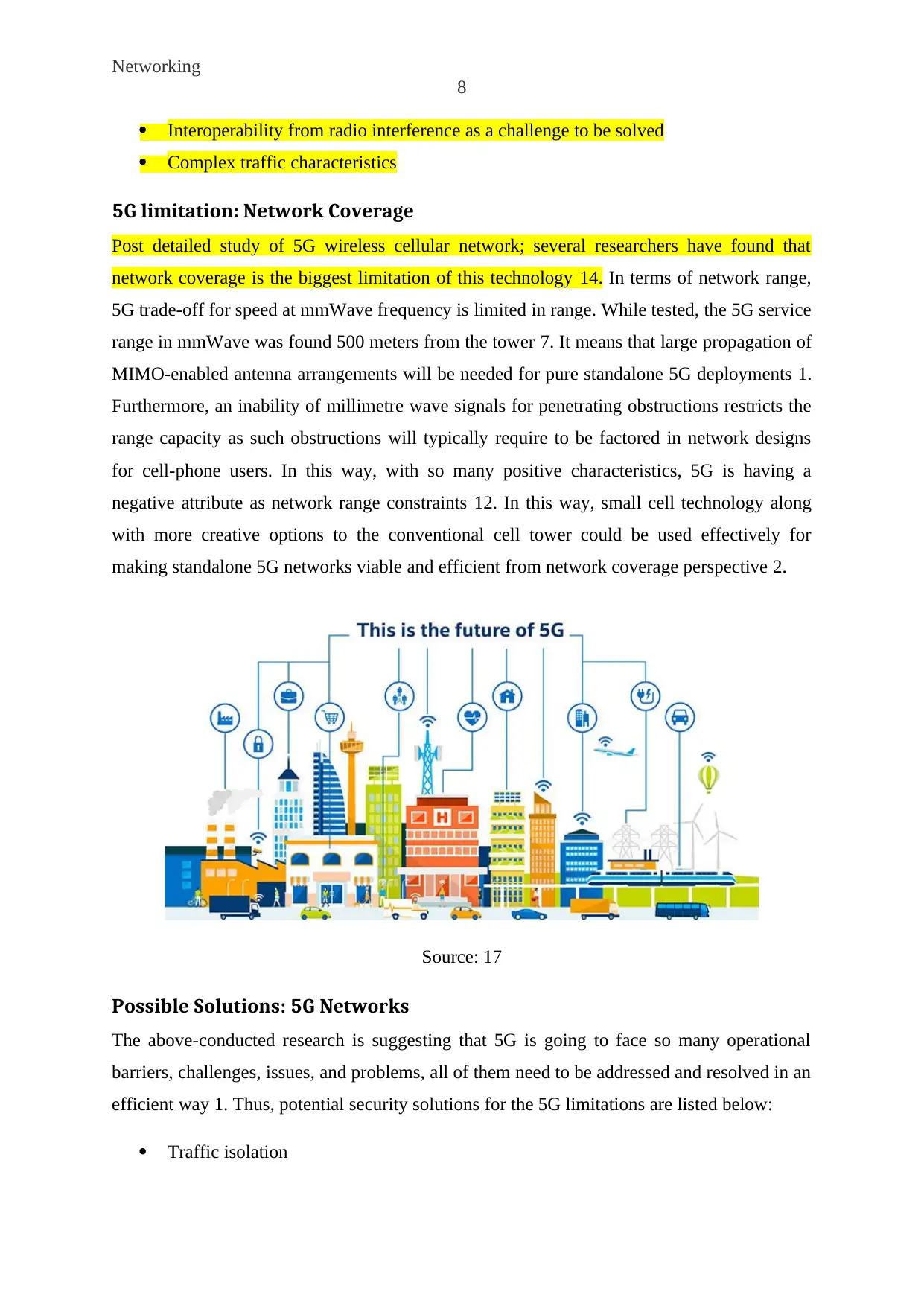
Post detailed study of 5G wireless cellular network; several researchers have found that
network coverage is the biggest limitation of this technology 14. In terms of network range,
5G trade-off for speed at mmWave frequency is limited in range. While tested, the 5G service
range in mmWave was found 500 meters from the tower 7. It means that large propagation of
MIMO-enabled antenna arrangements will be needed for pure standalone 5G deployments 1.
Furthermore, an inability of millimetre wave signals for penetrating obstructions restricts the
range capacity as such obstructions will typically require to be factored in network designs
for cell-phone users. In this way, with so many positive characteristics, 5G is having a
negative attribute as network range constraints 12. In this way, small cell technology along
with more creative options to the conventional cell tower could be used effectively for
making standalone 5G networks viable and efficient from network coverage perspective 2.
Source: 17
Possible Solutions: 5G Networks
The above-conducted research is suggesting that 5G is going to face so many operational
barriers, challenges, issues, and problems, all of them need to be addressed and resolved in an
efficient way 1. Thus, potential security solutions for the 5G limitations are listed below:
Traffic isolation
8
Interoperability from radio interference as a challenge to be solved
Complex traffic characteristics
5G limitation: Network Coverage
Post detailed study of 5G wireless cellular network; several researchers have found that
network coverage is the biggest limitation of this technology 14. In terms of network range,
5G trade-off for speed at mmWave frequency is limited in range. While tested, the 5G service
range in mmWave was found 500 meters from the tower 7. It means that large propagation of
MIMO-enabled antenna arrangements will be needed for pure standalone 5G deployments 1.
Furthermore, an inability of millimetre wave signals for penetrating obstructions restricts the
range capacity as such obstructions will typically require to be factored in network designs
for cell-phone users. In this way, with so many positive characteristics, 5G is having a
negative attribute as network range constraints 12. In this way, small cell technology along
with more creative options to the conventional cell tower could be used effectively for
making standalone 5G networks viable and efficient from network coverage perspective 2.
Source: 17
Possible Solutions: 5G Networks
The above-conducted research is suggesting that 5G is going to face so many operational
barriers, challenges, issues, and problems, all of them need to be addressed and resolved in an
efficient way 1. Thus, potential security solutions for the 5G limitations are listed below:
Traffic isolation
⊘ This is a preview!⊘
Do you want full access?
Subscribe today to unlock all pages.
Trusted by 1+ million students worldwide
Networking
9
HX-Dos mitigation.
Access control.
Link security 16.
Dos and DDoS detection
Configuration verification
Location and IMSI security
Identity security as well as validation
Integrity verification
Service access control
Apart from this, solution to the network coverage issue of 5G can be explained as below:
Conclusion
In whole, with the help of concrete research, this discussion has successfully identified,
explained, analysed and examines the various characteristics of 5G wireless mobile networks.
It has been found that 5G is going to offer novel apps together with enhanced user
experiences. Prior discussing the key useful characteristics, this essay has presented a detailed
comparison of different mobile technologies like 2G, 3G, 4G, and 5G. An illustrated
definition has been provided and explained in this discussion. Based on this research, it can
be said that 5G acts as a common network platform for allowing ICT transformation while
serving multiple industry sectors’ needs in relation to communications. In addition to that,
international harmonization of 5G spectrum has been identified as a key factor for the success
of 5G cellular communications. Here, harmonization is can be seen as a procedure of
enhancing the level of agreement into accounting standards as well as practices amid
different nations. Apart from this, it is found that 5G requires higher as well as lower
frequencies bandwidths for effectively meeting multiple use case scenarios in this world in
near future. Here, use case scenarios means different user requirements for different type of
applications in multiple sector in relation to 5G network.
Moreover, this research has concluded that global IT and network partners should achieve the
goal of sustainable as well as successful development of 5G networks post implementing all
possible solutions to 5G attacks, threats, and limitations effectively. In a nutshell, this
9
HX-Dos mitigation.
Access control.
Link security 16.
Dos and DDoS detection
Configuration verification
Location and IMSI security
Identity security as well as validation
Integrity verification
Service access control
Apart from this, solution to the network coverage issue of 5G can be explained as below:
Conclusion
In whole, with the help of concrete research, this discussion has successfully identified,
explained, analysed and examines the various characteristics of 5G wireless mobile networks.
It has been found that 5G is going to offer novel apps together with enhanced user
experiences. Prior discussing the key useful characteristics, this essay has presented a detailed
comparison of different mobile technologies like 2G, 3G, 4G, and 5G. An illustrated
definition has been provided and explained in this discussion. Based on this research, it can
be said that 5G acts as a common network platform for allowing ICT transformation while
serving multiple industry sectors’ needs in relation to communications. In addition to that,
international harmonization of 5G spectrum has been identified as a key factor for the success
of 5G cellular communications. Here, harmonization is can be seen as a procedure of
enhancing the level of agreement into accounting standards as well as practices amid
different nations. Apart from this, it is found that 5G requires higher as well as lower
frequencies bandwidths for effectively meeting multiple use case scenarios in this world in
near future. Here, use case scenarios means different user requirements for different type of
applications in multiple sector in relation to 5G network.
Moreover, this research has concluded that global IT and network partners should achieve the
goal of sustainable as well as successful development of 5G networks post implementing all
possible solutions to 5G attacks, threats, and limitations effectively. In a nutshell, this
Paraphrase This Document
Need a fresh take? Get an instant paraphrase of this document with our AI Paraphraser
Networking
10
research essay has successfully discussed various in-favours and challenging characteristics
of 5G wireless networks.
References
x
[1] W. Stallings, Wireless communications & networks.: Pearson Education India, 2009.
[2] R.N. Mitra and D.P. Agarwal, "5G mobile technology: A survey," ICT Express, vol. 1,
no. 3, pp. 132-137, 2015.
[3] C.X. Mavromoustakis, G. Mastorakis, and J.M. Batalla, Internet of Things (IoT) in 5G
mobile technologies. UK: Springer, 2016.
[4] V.W. Wong, Key technologies for 5G wireless systems. UK: Cambridge university
press, 2017.
[5] D.P. Agarwal and Q.A. Zeng, Introduction to wireless and mobile systems. USA:
Cengage Learning, 2015.
[6] N. Panwar, S. Sharma, and A.K. Singh, "A survey on 5G: The next generation of mobile
communication," Physical Communication, vol. 18, pp. 64-84, 2016.
[7] N. Ameen and R. Willis, "Current and future challenges facing the mobile
telecommunications industry in the Arab world," in the 3rd world congress on computer
applications and information systems, Dubai, 2016.
[8] W. Xiang, K. Zheng, and X.S. Shen, 5G mobile communications. UK: Springer, 2016.
[9] A. Gohil, H. Modi, and S.K. Patel, "5G technology of mobile communication: A
survey.," in International conference on intelligent systems and signal processing ISSP,
US, 2013, pp. 288-292.
[10] Y. Huo, X. Dong, and W. Xu, "5G Cellular User Equipment: From Theory to Practical
Hardware Design," IEEE Access, vol. 5, pp. 13992-14010, 2017.
[11] A. Gupta and R.K. Jha, "A survey of 5G network: Architecture and emerging
10
research essay has successfully discussed various in-favours and challenging characteristics
of 5G wireless networks.
References
x
[1] W. Stallings, Wireless communications & networks.: Pearson Education India, 2009.
[2] R.N. Mitra and D.P. Agarwal, "5G mobile technology: A survey," ICT Express, vol. 1,
no. 3, pp. 132-137, 2015.
[3] C.X. Mavromoustakis, G. Mastorakis, and J.M. Batalla, Internet of Things (IoT) in 5G
mobile technologies. UK: Springer, 2016.
[4] V.W. Wong, Key technologies for 5G wireless systems. UK: Cambridge university
press, 2017.
[5] D.P. Agarwal and Q.A. Zeng, Introduction to wireless and mobile systems. USA:
Cengage Learning, 2015.
[6] N. Panwar, S. Sharma, and A.K. Singh, "A survey on 5G: The next generation of mobile
communication," Physical Communication, vol. 18, pp. 64-84, 2016.
[7] N. Ameen and R. Willis, "Current and future challenges facing the mobile
telecommunications industry in the Arab world," in the 3rd world congress on computer
applications and information systems, Dubai, 2016.
[8] W. Xiang, K. Zheng, and X.S. Shen, 5G mobile communications. UK: Springer, 2016.
[9] A. Gohil, H. Modi, and S.K. Patel, "5G technology of mobile communication: A
survey.," in International conference on intelligent systems and signal processing ISSP,
US, 2013, pp. 288-292.
[10] Y. Huo, X. Dong, and W. Xu, "5G Cellular User Equipment: From Theory to Practical
Hardware Design," IEEE Access, vol. 5, pp. 13992-14010, 2017.
[11] A. Gupta and R.K. Jha, "A survey of 5G network: Architecture and emerging
Networking
11
technologies," IEEE access, vol. 3, pp. 1206-1232, 2015.
[12] X. Foukas, G. Patounas, A. Elmokashfi, and M.K. Marina, "Network slicing in 5G:
Survey and challenges," IEEE Communications Magazine, vol. 55, no. 5, pp. 94-100,
2017.
[13] G. Cecere, N. Corrocher, and R.D. Battaglia, "Innovation and competition in the
smartphone industry: Is there a dominant design?," Telecommunications Policy, vol. 39,
no. 3-4, pp. 162-175, 2015.
[14] S. Bi, Y. Zeng, and R. Zhang, "Wireless powered communication networks: An
overview," IEEE Wireless Communications, vol. 23, no. 2, pp. 10-18, 2016.
[15] M. Agiwal, A. Roy, and N. Saxena, "Next generation 5G wireless networks: A
comprehensive survey," IEEE communications surveys and tutorials, vol. 18, no. 3, pp.
1617-1655, 2016.
[16] L.C. Wang and S. Rangapillai, "A survey on green 5G cellular networks," in
International conference on Signal Processing and Comunnicatiobs SPCOM, New
York, 2012, pp. 1-5.
[17] T. Bakici, E. Almirall, and J. Wareham, "A smart city initiative: the case of Barcelona,"
Journal of the Knowledge Economy, vol. 4, no. 2, pp. 135-148, 2013.
x
11
technologies," IEEE access, vol. 3, pp. 1206-1232, 2015.
[12] X. Foukas, G. Patounas, A. Elmokashfi, and M.K. Marina, "Network slicing in 5G:
Survey and challenges," IEEE Communications Magazine, vol. 55, no. 5, pp. 94-100,
2017.
[13] G. Cecere, N. Corrocher, and R.D. Battaglia, "Innovation and competition in the
smartphone industry: Is there a dominant design?," Telecommunications Policy, vol. 39,
no. 3-4, pp. 162-175, 2015.
[14] S. Bi, Y. Zeng, and R. Zhang, "Wireless powered communication networks: An
overview," IEEE Wireless Communications, vol. 23, no. 2, pp. 10-18, 2016.
[15] M. Agiwal, A. Roy, and N. Saxena, "Next generation 5G wireless networks: A
comprehensive survey," IEEE communications surveys and tutorials, vol. 18, no. 3, pp.
1617-1655, 2016.
[16] L.C. Wang and S. Rangapillai, "A survey on green 5G cellular networks," in
International conference on Signal Processing and Comunnicatiobs SPCOM, New
York, 2012, pp. 1-5.
[17] T. Bakici, E. Almirall, and J. Wareham, "A smart city initiative: the case of Barcelona,"
Journal of the Knowledge Economy, vol. 4, no. 2, pp. 135-148, 2013.
x
⊘ This is a preview!⊘
Do you want full access?
Subscribe today to unlock all pages.
Trusted by 1+ million students worldwide

1 out of 13


Related Documents


Your All-in-One AI-Powered Toolkit for Academic Success.
+13062052269
info@desklib.com
Available 24*7 on WhatsApp / Email
![[object Object]](/_next/static/media/star-bottom.7253800d.svg)
Unlock your academic potential
Copyright © 2020–2026 A2Z Services. All Rights Reserved. Developed and managed by ZUCOL.