SIT792 Project Proposal: Analyzing 5G Contribution to IoT Systems

Verified

Added on  2022/10/16

|10
|1739
|332
Project
AI Summary
This research proposal investigates the role of 5G networks in supporting and enhancing Internet of Things (IoT) systems, focusing on the benefits and challenges of implementing 5G in IoT infrastructure. The proposal outlines a mixed-methods approach, including interviews with managers and surveys of employees from three Australian telecom companies, to assess the impact of 5G on IoT security, reliability, and overall effectiveness. It addresses research questions related to the relationship between 5G and IoT, the extent of 5G's influence on IoT systems, and the global impacts of 5G implementation in IoT. The research methodology emphasizes a positivism research philosophy and a deductive approach, employing a descriptive research design to explore both the positive and negative aspects of 5G networks in IoT environments. The proposal also includes a detailed timeframe for completing the research, from topic selection and literature analysis to data collection, analysis, and final submission.
Document Page
Running Head: RESEARCH PROPOSAL
RESEARCH PROPOSAL
Name of the Student:
Name of University:
Author Note:
tabler-icon-diamond-filled.svg

Paraphrase This Document

Need a fresh take? Get an instant paraphrase of this document with our AI Paraphraser
Document Page
1RESEARCH PROPOSAL
Abstract
5G network service is considered to be one of the advanced technologies that the international
business companies can adapt in order to get strategic advantage. In addition to this, automation
and smart technologies are also required in order to bring more efficacy into the organisational
practice. This research is going to analyse the contribution of 5G network in developing Internet
of Things (IoT). For this, 3 telecom companies of Australia is being chosen with a mixed method
of research process on both the employees and the managers of the respective organisations. It is
likely to get proper result that highlights positive impact of 5G network on Iot directly.
Document Page
2RESEARCH PROPOSAL
Table of Contents
1. Introduction..................................................................................................................................2
2. Key related work..........................................................................................................................2
3. Research aim................................................................................................................................3
4. Research problem........................................................................................................................4
5. Research question........................................................................................................................4
6. Research methodology.................................................................................................................4
Research philosophy....................................................................................................................4
Research approach.......................................................................................................................5
Research design...........................................................................................................................5
Data collection technique............................................................................................................5
Sampling technique and size.......................................................................................................6
7. Timeframe....................................................................................................................................6
Reference.........................................................................................................................................7
Document Page
3RESEARCH PROPOSAL
Topic: Can 5G support IoT?
1. Introduction
The technological advancement leads to the implementation of more advanced techniques
that can ease out the efforts and complexities of life. As a result of that the 5G wireless
technology has become a pertinent practice for current business practices that is associated with
the innovation and strategic advantages of the business organisations (Bartelt et al. 2017).
Present day business practices are intricately familiar with the positive impact of 5G network.
Therefore, using the 5G network is an obvious choice for the business organisations.
Subsequently, the development in networking also enhances the use of internet and internet of
things (IOT) due to immense use of digital devices like cloud storage or social media for
marketing. The fast data speed and the using large chunks of data through live feed is identified
as one of the best practice that the present business enterprises are followed. Gupta and Jha
(2015) articulated that the high rise in demand and the complexity in business activities create
high need of fast transformation of data. As a result of that using the 5G network is definitely an
effective and futuristic plan for the companies to ensure the sustainability of business
exclusively.
2. Key related work
There are significant relationship between the mechanism of IOT and 5G network. 5G
technology is a new core network that aims to improve wireless connection worldwide. Internet
of Things has become an important aspect of today’s technological advancement. According to
Palattella et al. (2016) IoT has been implemented in more devices, sensors, assets and other
tabler-icon-diamond-filled.svg

Paraphrase This Document

Need a fresh take? Get an instant paraphrase of this document with our AI Paraphraser
Document Page
4RESEARCH PROPOSAL
things in order to make it more smart and easy to use. However, Li, Da Xu and Zhao (2018)
opined that there are some security concerns regarding IoT as attacks on the targets like
distributed denial of services. As a result of that it is pertinent for IoT to take adequate measures
to ensure its security. However, lack of security is identified as a crucial challenge for IoT. For
the business organisation that are aspired to implement IoT in their production or services are
also being restricted due to the lack of security measures in IoT. In this context, Wollschlaeger,
Sauter and Jasperneite (2017) articulated that the role of the 5G network is definitely has a
solution for IoT system security risks. Hu et al. (2018) pointed out that the lower latency of 5G
network increased the bandwidth so that it becomes complicated to hack the IoT system easily.
Apart from the security purpose there are also other benefits that 5G network can provide
to IoT. Agiwal, Saxena and Roy (2019) asserted that 5G intricately works with the augmented
reality and virtual reality which are the core concepts of IoT. The network driven communication
of IoT requires great deal of data and information in the form of coding. 5G network helps the
IoT practice as a reliable network by providing industrial security and integrates it with the core
network architecture (Sabella et al. 2016). Henceforth, the purpose of IoT to facilitate a smart
and automotive mechanism can effectively be implemented through the use of 5G network.
3. Research aim
This research aims to understand the contribution of 5G network on making the IoT
system more authentic and reliable.
Document Page
5RESEARCH PROPOSAL
4. Research problem
There are some problems related to the implementation of 5G network in IoT. For
instance, the notion and framework of IoT is not developed by the 5G network only.
Interconnectedness with other devices and higher bandwidths is also required in order to make
the IoT mechanism more innovative and effective. The durability of the 5G networks is also
questioned by some of the scholars because it requires a steady range of bandwidth. However,
creating a high bandwidth is highly complex and critical for continuous access. Therefore, it is
essential for this research to identify both the importance and the drawbacks of 5G network on
the Internet of Things.
5. Research question
The research questions are as follows,
i. What are the relation between IOT and 5G network?
ii. How far 5G network can affect IoT system?
iii. What are the relevant impacts that IoT got by installing 5G network globally.
6. Research methodology
Research philosophy
This research is going to put emphasis on the positivism research philosophy as it
corroborates the data and information generating from the research findings. Logical and applied
form of the positivism research philosophy make it easier for the research to conduct the research
Document Page
6RESEARCH PROPOSAL
effectively. As the theme of this research is to find out the contribution of 5G network on IoT
therefore the positivism research philosophy will be relevant in this context.
Research approach
A deductive approach is going to be followed in this research for supporting and
evaluating the information gathered from reliable sources. Moreover, the researcher also likes to
follow the existing models and theories to prove important contribution of 5G network on
Internet of Things. Therefore, the deductive approach will be highly relevant with this research
topic.
Research design
This research will put emphasis on the descriptive research technique for exploring and
defining the elements of the research. As this research aims to find out both the positive and
negative impact of 5G network on Internet of Things, therefore the descriptive research design
will enable a gateway for the researcher to find out the recommended steps that IoT systems
require in order to get accompanied with the 5G networks.
Data collection technique
The data collection technique for this research will be based on primary data collection.
For this a mixed method will be followed that contains both the qualitative and quantitative
research method. The qualitative method will be formed as interview to the managers from 3
popular telecom companies in Australia. Apart from that a quantitative method is also conducted
by setting survey questionnaire for the employees of the respective companies.
tabler-icon-diamond-filled.svg

Paraphrase This Document

Need a fresh take? Get an instant paraphrase of this document with our AI Paraphraser
Document Page
7RESEARCH PROPOSAL
Sampling technique and size
For the interview not more than 5 respondents will be taken whereas for the survey 100
employees from those telecom companies in Australia will be chosen. A probable random
sampling technique is followed in reference to make the research a success.
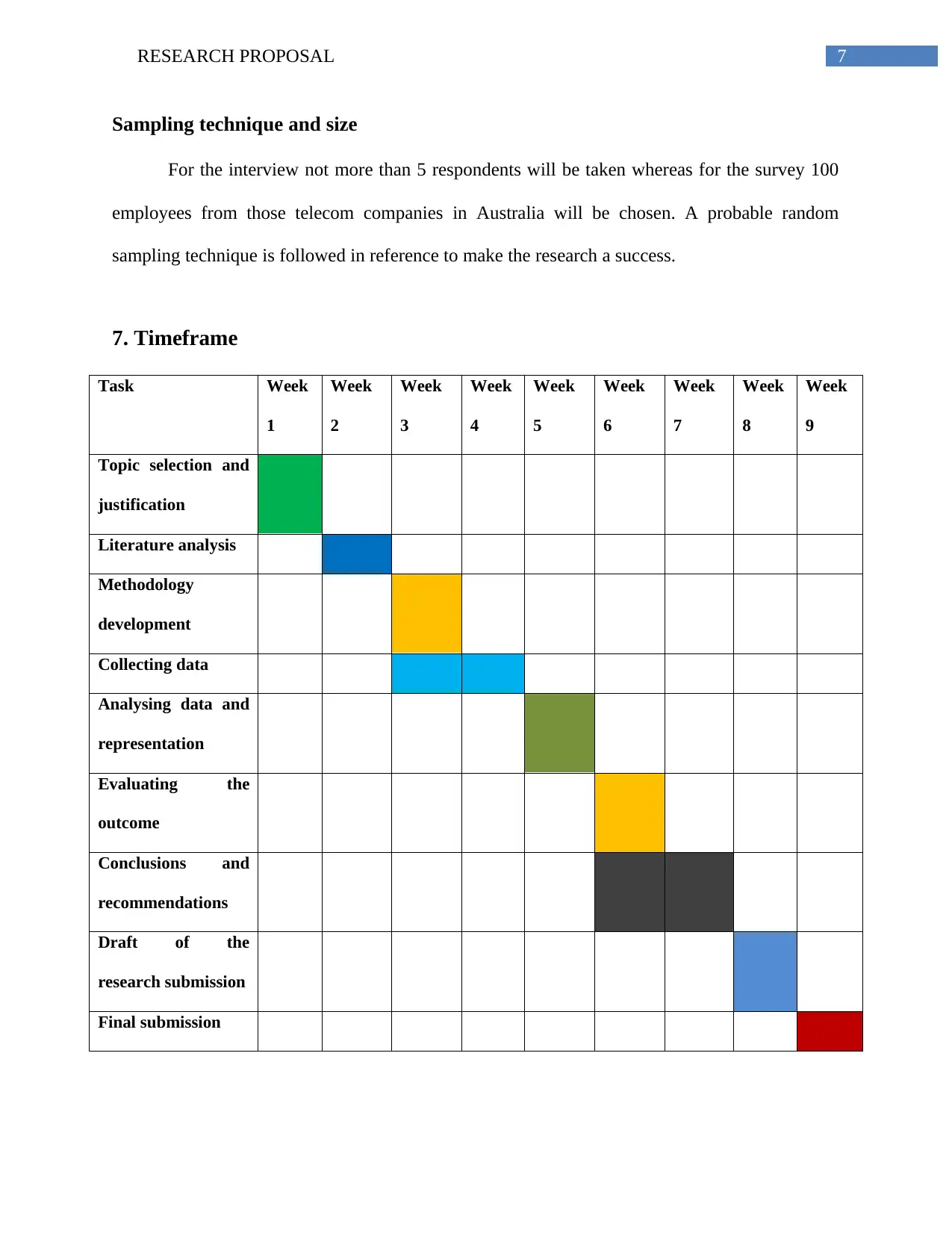
7. Timeframe
Task Week
1
Week
2
Week
3
Week
4
Week
5
Week
6
Week
7
Week
8
Week
9
Topic selection and
justification
Literature analysis
Methodology
development
Collecting data
Analysing data and
representation
Evaluating the
outcome
Conclusions and
recommendations
Draft of the
research submission
Final submission
Document Page
8RESEARCH PROPOSAL
Reference
Agiwal, M., Saxena, N. and Roy, A., 2019. Towards connected living: 5g enabled internet of
things (iot). IETE Technical Review, 36(2), pp.190-202.
Bartelt, J., Vucic, N., Camps-Mur, D., Garcia-Villegas, E., Demirkol, I., Fehske, A., Grieger, M.,
Tzanakaki, A., Gutierrez, J., Grass, E. and Lyberopoulos, G., 2017. 5G transport network
requirements for the next generation fronthaul interface. EURASIP Journal on Wireless
Communications and Networking, 2017(1), p.89.
Gupta, A. and Jha, R.K., 2015. A survey of 5G network: Architecture and emerging
technologies. IEEE access, 3, pp.1206-1232.
Hu, S., Yu, B., Qian, C., Xiao, Y., Xiong, Q., Sun, C. and Gao, Y., 2018. Nonorthogonal
interleave-grid multiple access scheme for industrial internet of things in 5G network. IEEE
Transactions on Industrial Informatics, 14(12), pp.5436-5446.
Li, S., Da Xu, L. and Zhao, S., 2018. 5G Internet of Things: A survey. Journal of Industrial
Information Integration, 10, pp.1-9.
Palattella, M.R., Dohler, M., Grieco, A., Rizzo, G., Torsner, J., Engel, T. and Ladid, L., 2016.
Internet of things in the 5G era: Enablers, architecture, and business models. IEEE Journal on
Selected Areas in Communications, 34(3), pp.510-527.
Sabella, D., Vaillant, A., Kuure, P., Rauschenbach, U. and Giust, F., 2016. Mobile-edge
computing architecture: The role of MEC in the Internet of Things. IEEE Consumer Electronics
Magazine, 5(4), pp.84-91.
Document Page
9RESEARCH PROPOSAL
Wollschlaeger, M., Sauter, T. and Jasperneite, J., 2017. The future of industrial communication:
Automation networks in the era of the internet of things and industry 4.0. IEEE industrial
electronics magazine, 11(1), pp.17-27.
chevron_up_icon
1 out of 10
circle_padding
hide_on_mobile
zoom_out_icon
[object Object]