Comprehensive Report on 99mTc Radiopharmaceuticals in Nuclear Medicine
VerifiedAdded on 2023/01/11
|8
|1736
|46
Report
AI Summary
This report provides a comprehensive overview of 99mTc radiopharmaceuticals in nuclear medicine. It begins by identifying the biological target of these pharmaceuticals, specifically focusing on prostate cancer and the use of PSMA. The report then delves into the physical characteristics of the 99mTc radionuclide, including its nuclear properties. A detailed explanation of the radiolabelling reaction used to prepare the radiopharmaceutical is provided, along with purification and formulation processes to ensure its suitability for human use. The quality control processes required for the release of the radiopharmaceutical are also outlined. The report concludes with a summary of the findings, assessing the usefulness of 99mTc, its clinical efficacy in managing diseases, and alternative diagnostic or therapeutic options. The report references various books, journals, and online resources to support its findings.

Nuclear Medicine

Paraphrase This Document
Need a fresh take? Get an instant paraphrase of this document with our AI Paraphraser
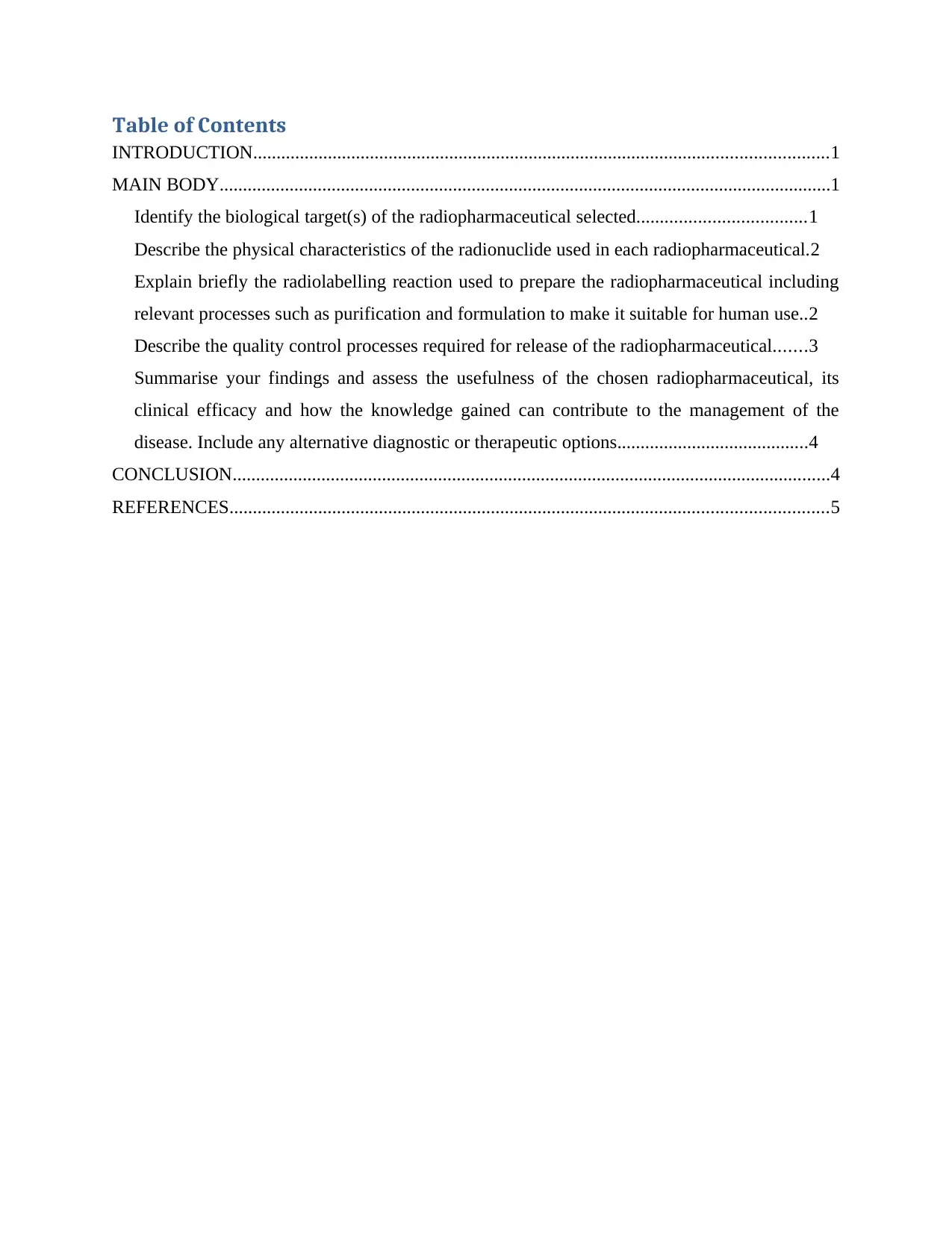
Table of Contents
INTRODUCTION...........................................................................................................................1
MAIN BODY...................................................................................................................................1
Identify the biological target(s) of the radiopharmaceutical selected....................................1
Describe the physical characteristics of the radionuclide used in each radiopharmaceutical.2
Explain briefly the radiolabelling reaction used to prepare the radiopharmaceutical including
relevant processes such as purification and formulation to make it suitable for human use..2
Describe the quality control processes required for release of the radiopharmaceutical.......3
Summarise your findings and assess the usefulness of the chosen radiopharmaceutical, its
clinical efficacy and how the knowledge gained can contribute to the management of the
disease. Include any alternative diagnostic or therapeutic options.........................................4
CONCLUSION................................................................................................................................4
REFERENCES................................................................................................................................5
INTRODUCTION...........................................................................................................................1
MAIN BODY...................................................................................................................................1
Identify the biological target(s) of the radiopharmaceutical selected....................................1
Describe the physical characteristics of the radionuclide used in each radiopharmaceutical.2
Explain briefly the radiolabelling reaction used to prepare the radiopharmaceutical including
relevant processes such as purification and formulation to make it suitable for human use..2
Describe the quality control processes required for release of the radiopharmaceutical.......3
Summarise your findings and assess the usefulness of the chosen radiopharmaceutical, its
clinical efficacy and how the knowledge gained can contribute to the management of the
disease. Include any alternative diagnostic or therapeutic options.........................................4
CONCLUSION................................................................................................................................4
REFERENCES................................................................................................................................5

⊘ This is a preview!⊘
Do you want full access?
Subscribe today to unlock all pages.

Trusted by 1+ million students worldwide
INTRODUCTION
Nuclear medicine refers to specialised area of radiology which utilises very small amount of
radioactive materials or radiopharmaceutical for examining organ function and structure. It
includes the use of radioactive elements to carry out diagnosis and treatment of specific health
problem for wellbeing of patient (Hine, 2016). In context of this assignment, it is based on the
concept of nuclear medicine and biological targets. It will also include physical characteristics of
radionuclide and radio labelling reaction used in radiopharmaceutical process. The quality
control processes and usefulness of metal based radiopharmaceutical is given here.
MAIN BODY
Identify the biological target(s) of the radiopharmaceutical selected.
99mTc-radiopharmaceutical has significant impact on various areas related to nuclear medicine.
It includes that Technetium-99m can be considered as an ideal radionuclide with optimum decay
features. It can be gained in sterile, pyrogen-free and carrier-free condition as sodium
pertechnerate (Na99mTcO4), from 99Mo/99mTc generator. However, it has been analysed that
the biological target of 99mTc-radiopharmaceutical is prostate cancer to deal with it effectively.
It includes the use of 99mTc based radiopharmaceuticals in order to develop PSMA (prostate-
specific membrane antigen) which is a glutamate carboxypeptidase enzyme overexpressed in
95% of cases related to advanced prostate cancer (PCa). Moreover, it includes the biological
molecular target of the imaging and radionuclide therapy of PCa utilising particular
pharmaceuticals.
In addition to this, the activity of the selected radiopharmaceutical therapy has inhibition that has
been attributed towards urea based Lys (b-naphthyl alanine)-NH-CO-NH-Glu(Lys(Nal)-Urea-
Glu fragment that are responsible for interacting with active peptide sites of the enzyme in
electrostatic manner (Aslam and et. al., 2017). It can be indicated to image advantageously
PSMA expressing in PCa is low. Meanwhile, it is observed that PSMA is much efficient and has
capability regarding high dose of radio therapeutic treatment along with minimising relevant side
effects of radioactivity for patient. Additionally, it includes use of 99mTc-radiopharmaceutical
therapy for dealing with prostate cancer and other problems related to tumours for making people
healthy.
1
Nuclear medicine refers to specialised area of radiology which utilises very small amount of
radioactive materials or radiopharmaceutical for examining organ function and structure. It
includes the use of radioactive elements to carry out diagnosis and treatment of specific health
problem for wellbeing of patient (Hine, 2016). In context of this assignment, it is based on the
concept of nuclear medicine and biological targets. It will also include physical characteristics of
radionuclide and radio labelling reaction used in radiopharmaceutical process. The quality
control processes and usefulness of metal based radiopharmaceutical is given here.
MAIN BODY
Identify the biological target(s) of the radiopharmaceutical selected.
99mTc-radiopharmaceutical has significant impact on various areas related to nuclear medicine.
It includes that Technetium-99m can be considered as an ideal radionuclide with optimum decay
features. It can be gained in sterile, pyrogen-free and carrier-free condition as sodium
pertechnerate (Na99mTcO4), from 99Mo/99mTc generator. However, it has been analysed that
the biological target of 99mTc-radiopharmaceutical is prostate cancer to deal with it effectively.
It includes the use of 99mTc based radiopharmaceuticals in order to develop PSMA (prostate-
specific membrane antigen) which is a glutamate carboxypeptidase enzyme overexpressed in
95% of cases related to advanced prostate cancer (PCa). Moreover, it includes the biological
molecular target of the imaging and radionuclide therapy of PCa utilising particular
pharmaceuticals.
In addition to this, the activity of the selected radiopharmaceutical therapy has inhibition that has
been attributed towards urea based Lys (b-naphthyl alanine)-NH-CO-NH-Glu(Lys(Nal)-Urea-
Glu fragment that are responsible for interacting with active peptide sites of the enzyme in
electrostatic manner (Aslam and et. al., 2017). It can be indicated to image advantageously
PSMA expressing in PCa is low. Meanwhile, it is observed that PSMA is much efficient and has
capability regarding high dose of radio therapeutic treatment along with minimising relevant side
effects of radioactivity for patient. Additionally, it includes use of 99mTc-radiopharmaceutical
therapy for dealing with prostate cancer and other problems related to tumours for making people
healthy.
1
Paraphrase This Document
Need a fresh take? Get an instant paraphrase of this document with our AI Paraphraser
Describe the physical characteristics of the radionuclide used in each radiopharmaceutical.
The 99mTc-radionuclide has several physical properties such as:
Silver grey radioactive metal
Melting point is 2200°C (4,000°F)
Density is 11.5 grams per cubic centimetre
Obtained as grey powder
The structure is in crystallised form of pure metal.
It has a hexagonal close packed shape and size.
The emission lines are at wavelength of 363.3 nm, 403.1 nm, 426.2 nm, 429.7 nm and
485.3 nm.
It is slightly paramagnetic as its magnetic dipoles align with external magnetic fields.
The pure, metallic single crystal technetium can acquire a property of type-II
superconductor at temperatures below the temperature of 7.46 K.
The technetium has extreme high magnetic penetration depth below 7.46 K.
Nuclear properties of Technetium-99m:
It is a metastable nuclear isomer
The nucleus relaxed to ground state via emission of gamma rays or internal conversion
electrons (Qaim, 2017).
It has ejection with high speed internal conversion electrons in some of sharp peaks at
140keV (99mTc → 99Tc+ + e−).
Ionization of electrons surrounded by beta radiation electrons would contribute with
140.5 keV and 142.6 keV gammas to the entire deposited dosage.
Explain briefly the radiolabelling reaction used to prepare the radiopharmaceutical including
relevant processes such as purification and formulation to make it suitable for human use.
Radiolabelling can be defined as procedure of formulating radiolabelled molecule or substance
that has been linked to radioactive substance that can be detected through radionuclide scan or
radioimmunoassay. It includes the radiolabelling reaction of 99mTc-radiopharmaceutical can be
done by deep knowledge about inorganic chemistry. However, it has been analysed that the
modern radiopharmaceutical research has main object is labelling of targeting vectors. The
technetium is known as transition metal having huge demerit in terms of combining with other
2
The 99mTc-radionuclide has several physical properties such as:
Silver grey radioactive metal
Melting point is 2200°C (4,000°F)
Density is 11.5 grams per cubic centimetre
Obtained as grey powder
The structure is in crystallised form of pure metal.
It has a hexagonal close packed shape and size.
The emission lines are at wavelength of 363.3 nm, 403.1 nm, 426.2 nm, 429.7 nm and
485.3 nm.
It is slightly paramagnetic as its magnetic dipoles align with external magnetic fields.
The pure, metallic single crystal technetium can acquire a property of type-II
superconductor at temperatures below the temperature of 7.46 K.
The technetium has extreme high magnetic penetration depth below 7.46 K.
Nuclear properties of Technetium-99m:
It is a metastable nuclear isomer
The nucleus relaxed to ground state via emission of gamma rays or internal conversion
electrons (Qaim, 2017).
It has ejection with high speed internal conversion electrons in some of sharp peaks at
140keV (99mTc → 99Tc+ + e−).
Ionization of electrons surrounded by beta radiation electrons would contribute with
140.5 keV and 142.6 keV gammas to the entire deposited dosage.
Explain briefly the radiolabelling reaction used to prepare the radiopharmaceutical including
relevant processes such as purification and formulation to make it suitable for human use.
Radiolabelling can be defined as procedure of formulating radiolabelled molecule or substance
that has been linked to radioactive substance that can be detected through radionuclide scan or
radioimmunoassay. It includes the radiolabelling reaction of 99mTc-radiopharmaceutical can be
done by deep knowledge about inorganic chemistry. However, it has been analysed that the
modern radiopharmaceutical research has main object is labelling of targeting vectors. The
technetium is known as transition metal having huge demerit in terms of combining with other
2
radionuclides. It is observed that technetium functional groups has feature of combination and
form variety of coordination complexes and molecular geometries.
Purification: This includes the process of using appropriate coordinating atoms with effective
strategy in terms of tethering a biologically active moiety with a technetium-99m complex. It
involves two main strategies for purification of 99mTc-radiopharmaceutical such as radioactive
metal fragment and an appropriate chelating group remain bound to specific bioactive molecule
with the help of spacer group. However, the purification of technetium is carried out by treating
extracted compound with hydrogen gas to obtain pure technetium metal.
Formulation: This includes the preparation of radioactive form of radionuclide of technetium
includes use of 99Mo/99mTc generator or via the cyclotron that is obtained as [99mTc]NaTcO4 in a
physiological solution. It consist to combine the radionuclide to a bioactive molecule required
the reduction of Tc(VII) metal to a favourable oxidation state through presence of appropriate
ligands (Lloyd and et. al., 2020). However, it consist the production of 99mTc-radionuclide by
nuclear reactor in which neutrons collide with atoms or plutonium or uranium in terms of
forming new elements. The technetium is required to be transform to specific compound named
ammonium pertechnate (NH4TcO4). Then the obtained compound with treated with hydrogen gas
for obtaining pure technetium metal.
Describe the quality control processes required for release of the radiopharmaceutical.
Quality control processes includes set of tests and measurements used to make sure about purity,
potency, product identity, biologic safety and efficacy of radiopharmaceutical products. It
includes using number of procedures and methods for ensuring potential and purity of
technetium-99m so that it can be used in clinical practices for human welfare. However, it has
been evaluated that quality control test are mandatory for radioactive drugs that are intended for
administration for human beings.
The quality control tests for technetium-99m include number of methods which can be
categorised intro tow categories like physicochemical tests and biological tests. However, the
physicochemical tests include several methods such as radionuclidic purity, radiochemical
purity, chemical purity and many more. On the other hand, the biological tests involve number of
procedures including sterility, pyrogenicity and toxicity for ensuring its suitability to use it for
welfare of human beings.
3
form variety of coordination complexes and molecular geometries.
Purification: This includes the process of using appropriate coordinating atoms with effective
strategy in terms of tethering a biologically active moiety with a technetium-99m complex. It
involves two main strategies for purification of 99mTc-radiopharmaceutical such as radioactive
metal fragment and an appropriate chelating group remain bound to specific bioactive molecule
with the help of spacer group. However, the purification of technetium is carried out by treating
extracted compound with hydrogen gas to obtain pure technetium metal.
Formulation: This includes the preparation of radioactive form of radionuclide of technetium
includes use of 99Mo/99mTc generator or via the cyclotron that is obtained as [99mTc]NaTcO4 in a
physiological solution. It consist to combine the radionuclide to a bioactive molecule required
the reduction of Tc(VII) metal to a favourable oxidation state through presence of appropriate
ligands (Lloyd and et. al., 2020). However, it consist the production of 99mTc-radionuclide by
nuclear reactor in which neutrons collide with atoms or plutonium or uranium in terms of
forming new elements. The technetium is required to be transform to specific compound named
ammonium pertechnate (NH4TcO4). Then the obtained compound with treated with hydrogen gas
for obtaining pure technetium metal.
Describe the quality control processes required for release of the radiopharmaceutical.
Quality control processes includes set of tests and measurements used to make sure about purity,
potency, product identity, biologic safety and efficacy of radiopharmaceutical products. It
includes using number of procedures and methods for ensuring potential and purity of
technetium-99m so that it can be used in clinical practices for human welfare. However, it has
been evaluated that quality control test are mandatory for radioactive drugs that are intended for
administration for human beings.
The quality control tests for technetium-99m include number of methods which can be
categorised intro tow categories like physicochemical tests and biological tests. However, the
physicochemical tests include several methods such as radionuclidic purity, radiochemical
purity, chemical purity and many more. On the other hand, the biological tests involve number of
procedures including sterility, pyrogenicity and toxicity for ensuring its suitability to use it for
welfare of human beings.
3
⊘ This is a preview!⊘
Do you want full access?
Subscribe today to unlock all pages.
Trusted by 1+ million students worldwide
Summarise your findings and assess the usefulness of the chosen radiopharmaceutical, its
clinical efficacy and how the knowledge gained can contribute to the management of the
disease. Include any alternative diagnostic or therapeutic options.
The 99mTc-radionuclide is known to be an effective as well as efficient method in order to
diagnose severe health problems. It can be considered as ideal diagnostic tools for evaluating
specific disease to identify relevant cause of it which facilitates to make appropriate decision of
providing correct treatment. Meanwhile, it has been analysed that 99mTc-radionuclide has a
half-life of about six hours because only half remains in actual form and remaining others
breakdown into another components (Bisogni, Del Guerra and Belcari, 2019). The use of
technetium-99m is to diagnose the radiation exposure of patients, technicians and passers-by to
treat the problem as soon as possible for wellness of them.
In addition to this, it has been evaluated that technetium-99m has medicinal use as 3-D scanning
technique that is SPECT (single photon emission computed tomography) which is known as
nuclear medicine imaging technique with the help of using gamma rays. It includes the bone
scan, myocardial perfusion imaging, cardiac ventriculography, functional brain imaging,
sentinel-node identification, immunoscintigraphy, blood pool labelling, pyrophosphate for heart
damage, sulphur colloid for spleen scan, Meckel’s diverticulum etc.
CONCLUSION
From the above assignment, it has been concluded that nuclear medicine includes the way of
using radioactive compounds in small amounts to evaluate the function or structure of an organs,
the technetium-99m is a radioactive element which is used for diagnosing health problems as it is
favourable to clearly observed internal problem. It can be considered as ideal diagnostic test for
human administration but it requires careful handling.
4
clinical efficacy and how the knowledge gained can contribute to the management of the
disease. Include any alternative diagnostic or therapeutic options.
The 99mTc-radionuclide is known to be an effective as well as efficient method in order to
diagnose severe health problems. It can be considered as ideal diagnostic tools for evaluating
specific disease to identify relevant cause of it which facilitates to make appropriate decision of
providing correct treatment. Meanwhile, it has been analysed that 99mTc-radionuclide has a
half-life of about six hours because only half remains in actual form and remaining others
breakdown into another components (Bisogni, Del Guerra and Belcari, 2019). The use of
technetium-99m is to diagnose the radiation exposure of patients, technicians and passers-by to
treat the problem as soon as possible for wellness of them.
In addition to this, it has been evaluated that technetium-99m has medicinal use as 3-D scanning
technique that is SPECT (single photon emission computed tomography) which is known as
nuclear medicine imaging technique with the help of using gamma rays. It includes the bone
scan, myocardial perfusion imaging, cardiac ventriculography, functional brain imaging,
sentinel-node identification, immunoscintigraphy, blood pool labelling, pyrophosphate for heart
damage, sulphur colloid for spleen scan, Meckel’s diverticulum etc.
CONCLUSION
From the above assignment, it has been concluded that nuclear medicine includes the way of
using radioactive compounds in small amounts to evaluate the function or structure of an organs,
the technetium-99m is a radioactive element which is used for diagnosing health problems as it is
favourable to clearly observed internal problem. It can be considered as ideal diagnostic test for
human administration but it requires careful handling.
4
Paraphrase This Document
Need a fresh take? Get an instant paraphrase of this document with our AI Paraphraser
REFERENCES
Books and journals
Aslam, N. and et. al., 2017. Nanoscale nuclear magnetic resonance with chemical
resolution. Science, 357(6346), pp.67-71.
Bisogni, M.G., Del Guerra, A. and Belcari, N., 2019. Medical applications of silicon
photomultipliers. Nuclear Instruments and Methods in Physics Research Section A:
Accelerators, Spectrometers, Detectors and Associated Equipment, 926, pp.118-128.
Hine, G.J. ed., 2016. Instrumentation in nuclear medicine. Academic Press.
Lloyd, R.C. and et. al., 2020. Criticality of Plutonium Nitrate Solutions in Slab
Geometry. Nuclear Science and Engineering.
Qaim, S.M., 2017. Nuclear data for production and medical application of radionuclides: present
status and future needs. Nuclear medicine and biology, 44, pp.31-49.
Online
A Picture of Modern Tc-99m Radiopharmaceuticals: Production, Chemistry, and Applications in
Molecular Imaging. 2020. [Online]. Available through:<https://www.mdpi.com/2076-
3417/9/12/2526/htm>
5
Books and journals
Aslam, N. and et. al., 2017. Nanoscale nuclear magnetic resonance with chemical
resolution. Science, 357(6346), pp.67-71.
Bisogni, M.G., Del Guerra, A. and Belcari, N., 2019. Medical applications of silicon
photomultipliers. Nuclear Instruments and Methods in Physics Research Section A:
Accelerators, Spectrometers, Detectors and Associated Equipment, 926, pp.118-128.
Hine, G.J. ed., 2016. Instrumentation in nuclear medicine. Academic Press.
Lloyd, R.C. and et. al., 2020. Criticality of Plutonium Nitrate Solutions in Slab
Geometry. Nuclear Science and Engineering.
Qaim, S.M., 2017. Nuclear data for production and medical application of radionuclides: present
status and future needs. Nuclear medicine and biology, 44, pp.31-49.
Online
A Picture of Modern Tc-99m Radiopharmaceuticals: Production, Chemistry, and Applications in
Molecular Imaging. 2020. [Online]. Available through:<https://www.mdpi.com/2076-
3417/9/12/2526/htm>
5

1 out of 8


Your All-in-One AI-Powered Toolkit for Academic Success.
+13062052269
info@desklib.com
Available 24*7 on WhatsApp / Email
![[object Object]](/_next/static/media/star-bottom.7253800d.svg)
Unlock your academic potential
Copyright © 2020–2026 A2Z Services. All Rights Reserved. Developed and managed by ZUCOL.