University Assignment: Analysis of McDonalds' Global Operations
VerifiedAdded on 2023/04/23
|9
|2266
|204
Case Study
AI Summary
This case study analyzes the global success of McDonald's, examining its expansion strategies in foreign markets, particularly in China and India, and its approach to customer loyalty in the highly competitive fast-food industry. It delves into the methods used by McDonald's to develop customer loyalty, emphasizing the importance of service differentiation and customer engagement. The study also identifies the mistakes made during its expansion, particularly in human resource management, and highlights best practices that other organizations can learn from. Furthermore, it explores the management practices, theories, and concepts behind McDonald's success, including market expansion, product adaptation, and franchising strategies. The report concludes by summarizing McDonald's strategies and their impact on the fast-food industry, including the importance of local adaptation and effective marketing.
Running head: ANALYSIS OF MCDONALDS CASE STUDY
ANALYSIS OF MCDONALDS CASE STUDY
Name of the Student
Name of the University
Author Note
ANALYSIS OF MCDONALDS CASE STUDY
Name of the Student
Name of the University
Author Note

Paraphrase This Document
Need a fresh take? Get an instant paraphrase of this document with our AI Paraphraser
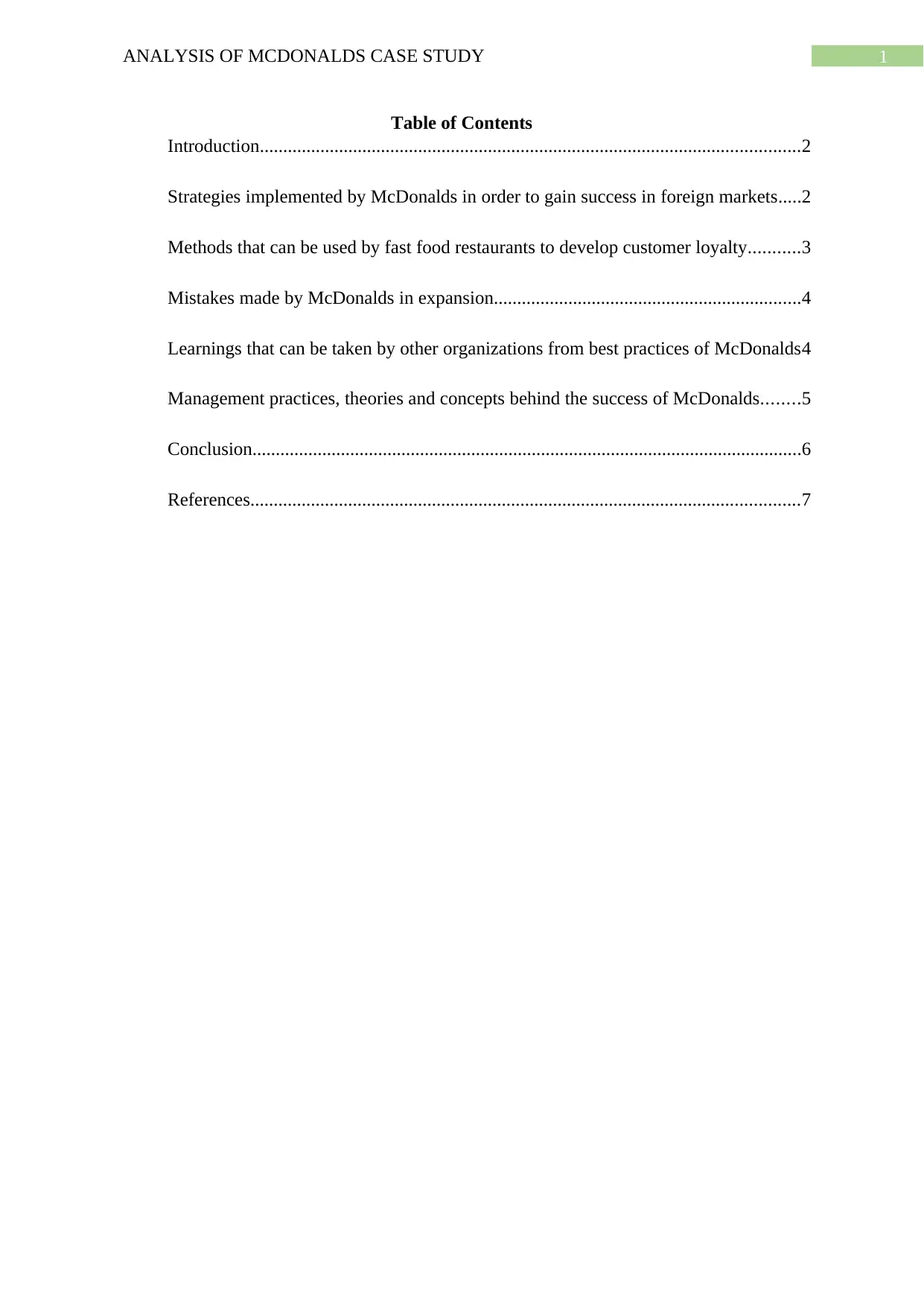
1ANALYSIS OF MCDONALDS CASE STUDY
Table of Contents
Introduction....................................................................................................................2
Strategies implemented by McDonalds in order to gain success in foreign markets.....2
Methods that can be used by fast food restaurants to develop customer loyalty...........3
Mistakes made by McDonalds in expansion..................................................................4
Learnings that can be taken by other organizations from best practices of McDonalds4
Management practices, theories and concepts behind the success of McDonalds........5
Conclusion......................................................................................................................6
References......................................................................................................................7
Table of Contents
Introduction....................................................................................................................2
Strategies implemented by McDonalds in order to gain success in foreign markets.....2
Methods that can be used by fast food restaurants to develop customer loyalty...........3
Mistakes made by McDonalds in expansion..................................................................4
Learnings that can be taken by other organizations from best practices of McDonalds4
Management practices, theories and concepts behind the success of McDonalds........5
Conclusion......................................................................................................................6
References......................................................................................................................7
2ANALYSIS OF MCDONALDS CASE STUDY
Introduction
McDonalds is considered to be one of the most successful international restaurant
based chains in the world. The global expansion and management based techniques that have
been implemented by the organization is considered to be an important part of the share that
is gained by McDonalds in the fast food based industry. The system that is formed by
McDonalds has provided major employment based opportunities to people in different parts
of the world. The organization has also shown major levels of commitments that can be
provided based on the growth based opportunities and the ways by which they can be used
(Anaf et al., 2017).
The report will be mainly based on the analysis of the ways by which McDonalds has
gained success in the fast food based industry. The issues that have been faced by the
organization based on its expansion process will also be analysed in the report.
Strategies implemented by McDonalds in order to gain success in foreign markets
As discussed by Badal (2017), McDonalds has started its growth and expansion based
operations in the fast food based industry in domestic areas and in different parts of the world
as well. The global expansion based strategy was first implemented by McDonalds in China.
The marketing strategies that have been applied by the organization are based on the target
markets in China. The organization has also expanded its operations in India which is
considered to be one of toughest markets for the entry of foreign organizations. The research
and development of different types of foods, preferences and tastes is a major strategy that is
implemented by McDonalds in India and in other countries as well.
According to Chan (2015), the success of the organization is mainly based on the
ways by which diverse levels of customers can be satisfied with the help of different types of
products which are related to the diverse tastes. The strategies that have been implemented
Introduction
McDonalds is considered to be one of the most successful international restaurant
based chains in the world. The global expansion and management based techniques that have
been implemented by the organization is considered to be an important part of the share that
is gained by McDonalds in the fast food based industry. The system that is formed by
McDonalds has provided major employment based opportunities to people in different parts
of the world. The organization has also shown major levels of commitments that can be
provided based on the growth based opportunities and the ways by which they can be used
(Anaf et al., 2017).
The report will be mainly based on the analysis of the ways by which McDonalds has
gained success in the fast food based industry. The issues that have been faced by the
organization based on its expansion process will also be analysed in the report.
Strategies implemented by McDonalds in order to gain success in foreign markets
As discussed by Badal (2017), McDonalds has started its growth and expansion based
operations in the fast food based industry in domestic areas and in different parts of the world
as well. The global expansion based strategy was first implemented by McDonalds in China.
The marketing strategies that have been applied by the organization are based on the target
markets in China. The organization has also expanded its operations in India which is
considered to be one of toughest markets for the entry of foreign organizations. The research
and development of different types of foods, preferences and tastes is a major strategy that is
implemented by McDonalds in India and in other countries as well.
According to Chan (2015), the success of the organization is mainly based on the
ways by which diverse levels of customers can be satisfied with the help of different types of
products which are related to the diverse tastes. The strategies that have been implemented
⊘ This is a preview!⊘
Do you want full access?
Subscribe today to unlock all pages.

Trusted by 1+ million students worldwide
3ANALYSIS OF MCDONALDS CASE STUDY
by the organization are politically sensitive in nature and McDonalds is also able to provide
major employment opportunities to the people in the countries. The environment friendly
operations of McDonalds are also considered to be a major part of the strategy which is
applied by the fast food based organization. Pricing strategies that are applied by McDonalds
are based on the currency levels in different parts of the world. For example, The Big Mac is
priced 60 Dollars more than that is the US (Rodrigues, Nikhil & Jacob, 2016).
Methods that can be used by fast food restaurants to develop customer loyalty
As opined by Coursaris, van Osch and Balogh (2016), the fast food restaurants have
to operate in a highly competitive environment. The organizations that are a part of this
industry need to develop a customer base that is loyal in nature. The experiences and services
that are offered to the customers by the fast food organizations are considered to be a major
factor which affect the revenues and profitability levels. The differentiation of an
organization based on the services that are offered to the customers is important for the ways
by which fast food organizations can maintain the loyal customer base and ensure the
revenues in the industry as well.
As discussed by Etgar (2015), the customer service based consultants are able to
provide major levels of opportunities to the fast food organizations in order to gain a loyal
base of customers. The trust levels have to be developed by the fast food organizations in
order to gain the customers and maintain them as well. The employees who are a part of
different stores of the organizations have to be highly attentive to the demands and needs of
the customers. Communication and engagement of customers in different organizational
processes are important factors that have an impact on the operations of various fast food
based organizations.
by the organization are politically sensitive in nature and McDonalds is also able to provide
major employment opportunities to the people in the countries. The environment friendly
operations of McDonalds are also considered to be a major part of the strategy which is
applied by the fast food based organization. Pricing strategies that are applied by McDonalds
are based on the currency levels in different parts of the world. For example, The Big Mac is
priced 60 Dollars more than that is the US (Rodrigues, Nikhil & Jacob, 2016).
Methods that can be used by fast food restaurants to develop customer loyalty
As opined by Coursaris, van Osch and Balogh (2016), the fast food restaurants have
to operate in a highly competitive environment. The organizations that are a part of this
industry need to develop a customer base that is loyal in nature. The experiences and services
that are offered to the customers by the fast food organizations are considered to be a major
factor which affect the revenues and profitability levels. The differentiation of an
organization based on the services that are offered to the customers is important for the ways
by which fast food organizations can maintain the loyal customer base and ensure the
revenues in the industry as well.
As discussed by Etgar (2015), the customer service based consultants are able to
provide major levels of opportunities to the fast food organizations in order to gain a loyal
base of customers. The trust levels have to be developed by the fast food organizations in
order to gain the customers and maintain them as well. The employees who are a part of
different stores of the organizations have to be highly attentive to the demands and needs of
the customers. Communication and engagement of customers in different organizational
processes are important factors that have an impact on the operations of various fast food
based organizations.
Paraphrase This Document
Need a fresh take? Get an instant paraphrase of this document with our AI Paraphraser
4ANALYSIS OF MCDONALDS CASE STUDY
Mistakes made by McDonalds in expansion
As discussed by Mathur (2017), major challenges have been faced by McDonalds
based on the human resource department and its operations. The human resource related
activities and the recruitment of employees have been related to the major cultural challenges
that have been faced by the organization. The development and training based programs of
the organization are related to the ways by which the organization is able to operate and
maintain the employees in different parts of the world. The training requirements in this case
are quite high for the ways by which McDonalds is able to provide its services to the
customers.
According to Mishra and Mishra (2017), the employees in various parts of the world
have faced major challenges that are based on the languages that are spoken and cultural
values as well. The process of knowledge transfer is considered to be a major factor that can
have an impact on the work process of the employees. The human resource based challenges
of the organization have affected the ways by which different positions in the organization
have been fulfilled by various employees. The organization has made major mistakes based
on the recruitment and selection of employees in different positions in various parts of the
world.
Learnings that can be taken by other organizations from best practices of McDonalds
According to Mujtaba and Patel (2011), the strategies and best practices that are
implemented by McDonalds in different stores and restaurants can inspire the operations of
different fast food organizations. The local management styles are provided with high levels
of importance by McDonalds and the processes of the organization have been formed with
respect to the “think global, act local” based strategy. The company aims at attracting local
talents and providing major opportunities to the local entrepreneurs with the help of its
Mistakes made by McDonalds in expansion
As discussed by Mathur (2017), major challenges have been faced by McDonalds
based on the human resource department and its operations. The human resource related
activities and the recruitment of employees have been related to the major cultural challenges
that have been faced by the organization. The development and training based programs of
the organization are related to the ways by which the organization is able to operate and
maintain the employees in different parts of the world. The training requirements in this case
are quite high for the ways by which McDonalds is able to provide its services to the
customers.
According to Mishra and Mishra (2017), the employees in various parts of the world
have faced major challenges that are based on the languages that are spoken and cultural
values as well. The process of knowledge transfer is considered to be a major factor that can
have an impact on the work process of the employees. The human resource based challenges
of the organization have affected the ways by which different positions in the organization
have been fulfilled by various employees. The organization has made major mistakes based
on the recruitment and selection of employees in different positions in various parts of the
world.
Learnings that can be taken by other organizations from best practices of McDonalds
According to Mujtaba and Patel (2011), the strategies and best practices that are
implemented by McDonalds in different stores and restaurants can inspire the operations of
different fast food organizations. The local management styles are provided with high levels
of importance by McDonalds and the processes of the organization have been formed with
respect to the “think global, act local” based strategy. The company aims at attracting local
talents and providing major opportunities to the local entrepreneurs with the help of its
5ANALYSIS OF MCDONALDS CASE STUDY
franchise based operations. The cultural values and local preferences are highly important for
the organizations that wish to operate on an international basis.
As discussed by Peloza, Merz and Chen (2015), the corporate citizenship related
activities and environment friendly operations are also important factors that are able to
provide major levels of learning based on the development of their operations. Other
organizations can also aim at providing major employment based opportunities to the local
people in various parts of the world. McDonalds has been able to overcome different
challenges that are related to adaptation to the local environments. Global organizations are
able to operate in a profitable manner with the help of proper adaptation to the local
environments.
Management practices, theories and concepts behind the success of McDonalds
As discussed by Pradhan (2018), the diversification based strategy has been
implemented by McDonalds in order to develop its operations in various parts of the world.
Market expansion is another major strategy that is implemented by the organization in order
to develop its operations in different parts of the world. McDonalds also applied product
expansion in order to fulfil the demands and needs of the local consumers. The market entry
based strategy which is implemented by McDonalds is termed as franchising.
According to Rodrigues, Nikhil and Jacob (2016), the franchise based business
operations of the organization has helped McDonalds to expand its operations in various parts
of the world. Market adaptation is a strategy that is applied in order to adapt its operations
based on different local preferences and choices. The services and products that are provided
by McDonalds to the consumers are also based on the ways by which the organization has
been able to adapt to the local conditions in an effective manner. The marketing mix of the
franchise based operations. The cultural values and local preferences are highly important for
the organizations that wish to operate on an international basis.
As discussed by Peloza, Merz and Chen (2015), the corporate citizenship related
activities and environment friendly operations are also important factors that are able to
provide major levels of learning based on the development of their operations. Other
organizations can also aim at providing major employment based opportunities to the local
people in various parts of the world. McDonalds has been able to overcome different
challenges that are related to adaptation to the local environments. Global organizations are
able to operate in a profitable manner with the help of proper adaptation to the local
environments.
Management practices, theories and concepts behind the success of McDonalds
As discussed by Pradhan (2018), the diversification based strategy has been
implemented by McDonalds in order to develop its operations in various parts of the world.
Market expansion is another major strategy that is implemented by the organization in order
to develop its operations in different parts of the world. McDonalds also applied product
expansion in order to fulfil the demands and needs of the local consumers. The market entry
based strategy which is implemented by McDonalds is termed as franchising.
According to Rodrigues, Nikhil and Jacob (2016), the franchise based business
operations of the organization has helped McDonalds to expand its operations in various parts
of the world. Market adaptation is a strategy that is applied in order to adapt its operations
based on different local preferences and choices. The services and products that are provided
by McDonalds to the consumers are also based on the ways by which the organization has
been able to adapt to the local conditions in an effective manner. The marketing mix of the
⊘ This is a preview!⊘
Do you want full access?
Subscribe today to unlock all pages.
Trusted by 1+ million students worldwide
6ANALYSIS OF MCDONALDS CASE STUDY
organization has been developed with respect to the strategy of “think global, act local”
related culture which is formed by McDonalds.
The products of the organization and their prices are based on the local environment
and choice of the consumers as well. On the other hand, the promotional activities of the
organization are also based on the local culture and sentiments of people in different
countries of the world. The organization has been able to gain a leadership position in fast
food based industry with the help of proper marketing and human resource based theories that
have been implemented by McDonalds in an effective way (Zhang & Chao, 2016).
Conclusion
The report can be concluded by stating that McDonalds has been successful in
developing a leadership position in the fast food industry with the help of different strategies
that are applied in various operations. The market expansion based strategies and activities of
the organization have proved to be the most important part of the success that has been
gained by McDonalds. The strategies that can be implemented by fast food organizations for
developing customer loyalty are based on the strategies of McDonalds. The different
mistakes that have been made by the organization in the operations are considered to be
major factors which affected the levels of profitability. The fast food organizations are able to
learn a lot from the strategies that are applied by McDonalds in different parts of the world.
McDonalds has implemented various management based practices, theories and concepts in
order to operate profitably in the industry.
organization has been developed with respect to the strategy of “think global, act local”
related culture which is formed by McDonalds.
The products of the organization and their prices are based on the local environment
and choice of the consumers as well. On the other hand, the promotional activities of the
organization are also based on the local culture and sentiments of people in different
countries of the world. The organization has been able to gain a leadership position in fast
food based industry with the help of proper marketing and human resource based theories that
have been implemented by McDonalds in an effective way (Zhang & Chao, 2016).
Conclusion
The report can be concluded by stating that McDonalds has been successful in
developing a leadership position in the fast food industry with the help of different strategies
that are applied in various operations. The market expansion based strategies and activities of
the organization have proved to be the most important part of the success that has been
gained by McDonalds. The strategies that can be implemented by fast food organizations for
developing customer loyalty are based on the strategies of McDonalds. The different
mistakes that have been made by the organization in the operations are considered to be
major factors which affected the levels of profitability. The fast food organizations are able to
learn a lot from the strategies that are applied by McDonalds in different parts of the world.
McDonalds has implemented various management based practices, theories and concepts in
order to operate profitably in the industry.
Paraphrase This Document
Need a fresh take? Get an instant paraphrase of this document with our AI Paraphraser
7ANALYSIS OF MCDONALDS CASE STUDY
References
Anaf, J., Baum, F. E., Fisher, M., Harris, E., & Friel, S. (2017). Assessing the health impact
of transnational corporations: a case study on McDonald’s Australia. Globalization
and health, 13(1), 7.
Badal, A. (2017). McDonalds Corporation–2015 (MCD). Academic Journal of Business.
Administration, Law & Social Sciences, 3(2), 27-40.
Chan, T. S. (2015). Franchising of Us Fast Food Chains in Hong Kong: Entry and Expansion
Strategies. In Proceedings of the 1989 Academy of Marketing Science (AMS) Annual
Conference (pp. 163-167). Springer, Cham.
Coursaris, C. K., van Osch, W., & Balogh, B. A. (2016). Informing brand messaging
strategies via social media analytics. Online Information Review, 40(1), 6-24.
Etgar, M. (2015). Global Retail Entrance Strategies. In Proceedings of the 1997 World
Marketing Congress (pp. 266-269). Springer, Cham.
Mathur, S. (2017). Glocalization in Fast Food Chains Glocalization in Fast Food Chains: A
Case Study of McDonald's. In Strategic Marketing Management and Tactics in the
Service Industry (pp. 330-347). IGI Global.
Mishra, K., & Mishra, A. (2017). Building brand engagement through Twitter marketing
strategies. Journal of Digital & Social Media Marketing, 4(4), 380-390.
Mujtaba, B. G., & Patel, B. (2011). McDonald’s success strategy and global expansion
through customer and brand loyalty. Journal of Business Case Studies, 3(3), 55-66.
Peloza, J., Merz, M. A., & Chen, Q. (2015). Standardization Vs. Localization of Firms’
Corporate Philanthropy Strategies when Entering Foreign Markets. In Proceedings of
References
Anaf, J., Baum, F. E., Fisher, M., Harris, E., & Friel, S. (2017). Assessing the health impact
of transnational corporations: a case study on McDonald’s Australia. Globalization
and health, 13(1), 7.
Badal, A. (2017). McDonalds Corporation–2015 (MCD). Academic Journal of Business.
Administration, Law & Social Sciences, 3(2), 27-40.
Chan, T. S. (2015). Franchising of Us Fast Food Chains in Hong Kong: Entry and Expansion
Strategies. In Proceedings of the 1989 Academy of Marketing Science (AMS) Annual
Conference (pp. 163-167). Springer, Cham.
Coursaris, C. K., van Osch, W., & Balogh, B. A. (2016). Informing brand messaging
strategies via social media analytics. Online Information Review, 40(1), 6-24.
Etgar, M. (2015). Global Retail Entrance Strategies. In Proceedings of the 1997 World
Marketing Congress (pp. 266-269). Springer, Cham.
Mathur, S. (2017). Glocalization in Fast Food Chains Glocalization in Fast Food Chains: A
Case Study of McDonald's. In Strategic Marketing Management and Tactics in the
Service Industry (pp. 330-347). IGI Global.
Mishra, K., & Mishra, A. (2017). Building brand engagement through Twitter marketing
strategies. Journal of Digital & Social Media Marketing, 4(4), 380-390.
Mujtaba, B. G., & Patel, B. (2011). McDonald’s success strategy and global expansion
through customer and brand loyalty. Journal of Business Case Studies, 3(3), 55-66.
Peloza, J., Merz, M. A., & Chen, Q. (2015). Standardization Vs. Localization of Firms’
Corporate Philanthropy Strategies when Entering Foreign Markets. In Proceedings of
8ANALYSIS OF MCDONALDS CASE STUDY
the 2008 Academy of Marketing Science (AMS) Annual Conference (pp. 295-295).
Springer, Cham.
Pradhan, S. (2018). McDonald’s India–plotting a winning strategy. Emerald Emerging
Markets Case Studies, 8(2), 1-25.
Rodrigues, J., Nikhil, S., & Jacob, S. (2016). Promotional Strategies of McDonalds and
Market Effects. Journal of Management Research and Analysis, 3(1), 53-55.
Zhang, L., & Chao, P. (2016, June). Social media as a platform for understanding consumer
concerns in product harm crises and designing crisis management strategies in China.
In 4 th International Conference on Contemporary Marketing Issues ICCMI June 22-
24, 2016 Heraklion, Greece (p. 522).
the 2008 Academy of Marketing Science (AMS) Annual Conference (pp. 295-295).
Springer, Cham.
Pradhan, S. (2018). McDonald’s India–plotting a winning strategy. Emerald Emerging
Markets Case Studies, 8(2), 1-25.
Rodrigues, J., Nikhil, S., & Jacob, S. (2016). Promotional Strategies of McDonalds and
Market Effects. Journal of Management Research and Analysis, 3(1), 53-55.
Zhang, L., & Chao, P. (2016, June). Social media as a platform for understanding consumer
concerns in product harm crises and designing crisis management strategies in China.
In 4 th International Conference on Contemporary Marketing Issues ICCMI June 22-
24, 2016 Heraklion, Greece (p. 522).
⊘ This is a preview!⊘
Do you want full access?
Subscribe today to unlock all pages.
Trusted by 1+ million students worldwide

1 out of 9


Related Documents


Your All-in-One AI-Powered Toolkit for Academic Success.
+13062052269
info@desklib.com
Available 24*7 on WhatsApp / Email
![[object Object]](/_next/static/media/star-bottom.7253800d.svg)
Unlock your academic potential
Copyright © 2020–2026 A2Z Services. All Rights Reserved. Developed and managed by ZUCOL.