AAF0436 - Management Accounting: Costing, Pricing & Profitability
VerifiedAdded on 2023/06/18
|12
|3394
|217
Report
AI Summary
This report delves into various management accounting techniques relevant to BETA, an IT company. It discusses the usage, types, and limitations of standard costing, followed by a critical analysis of target costing and its differentiation from standard costing. The role of contribution techniques in decision-making is explained with examples, highlighting its application in setting selling prices, calculating break-even points, and examining margin of safety. Furthermore, the report analyzes how transfer pricing can be strategically used to improve a company's profitability position. The report concludes by summarizing the key aspects of each costing method and their importance in enhancing business performance.
Management Accounting and
Financial Planning AAF0436
Financial Planning AAF0436

Paraphrase This Document
Need a fresh take? Get an instant paraphrase of this document with our AI Paraphraser
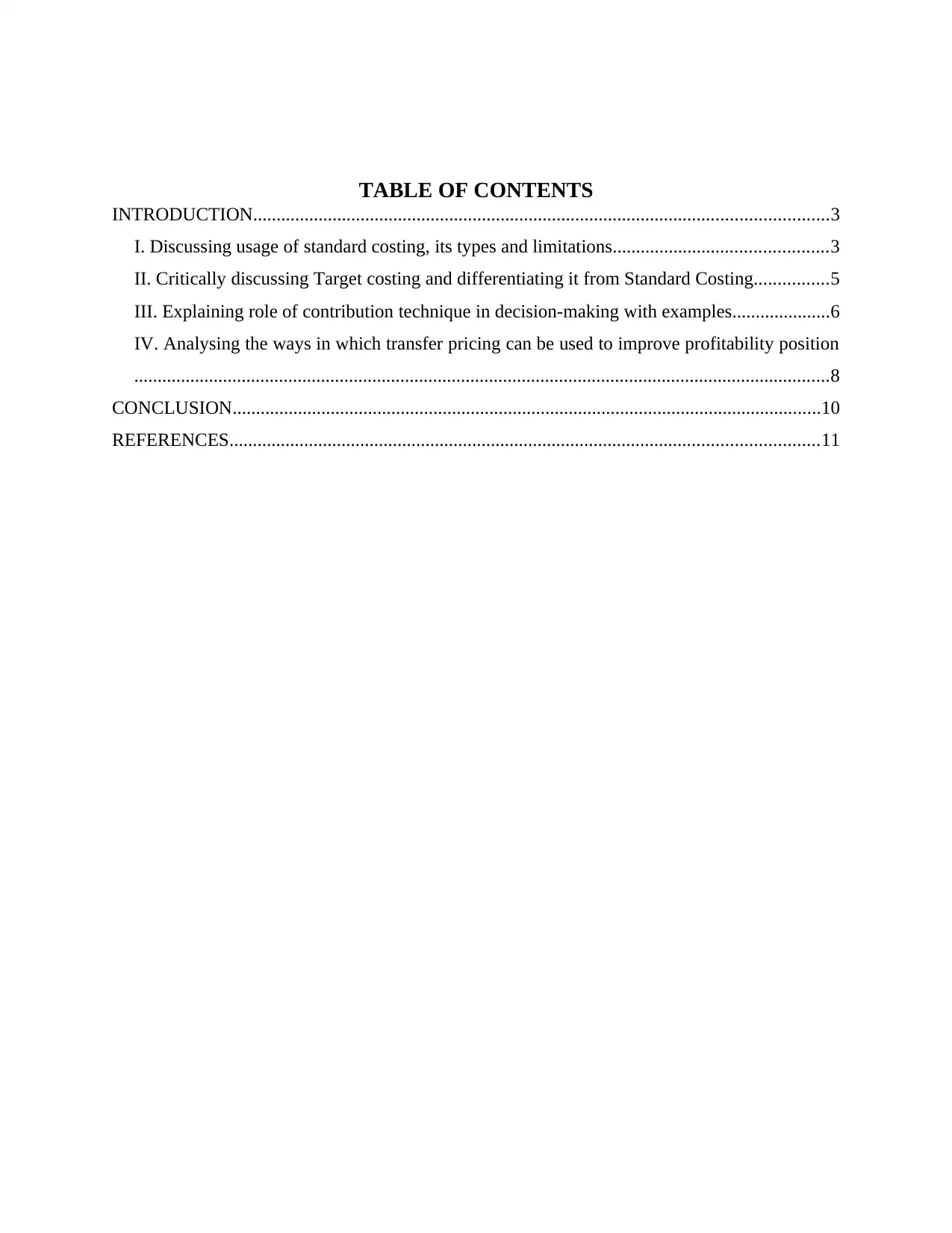
TABLE OF CONTENTS
INTRODUCTION...........................................................................................................................3
I. Discussing usage of standard costing, its types and limitations..............................................3
II. Critically discussing Target costing and differentiating it from Standard Costing................5
III. Explaining role of contribution technique in decision-making with examples.....................6
IV. Analysing the ways in which transfer pricing can be used to improve profitability position
.....................................................................................................................................................8
CONCLUSION..............................................................................................................................10
REFERENCES..............................................................................................................................11
INTRODUCTION...........................................................................................................................3
I. Discussing usage of standard costing, its types and limitations..............................................3
II. Critically discussing Target costing and differentiating it from Standard Costing................5
III. Explaining role of contribution technique in decision-making with examples.....................6
IV. Analysing the ways in which transfer pricing can be used to improve profitability position
.....................................................................................................................................................8
CONCLUSION..............................................................................................................................10
REFERENCES..............................................................................................................................11
INTRODUCTION
Management Accounting is the procedure where different reports are prepared and
maintained which provides an assistance to managers in taking various decisions that are
important to business. The present report is based on BETA, a MNC that deals in IT business
and specializes in producing business solutions and online retail systems. Report will discuss
usage of standard costing along with its types and limitations.
Further, study will shed light on Target costing and differentiate it from standard costing.
In addition to this, it will also describe role of contribution techniques in decision-making
process and its application in BETA to improve business. Lastly, study will analyse transfer
pricing approaches that can be used to improve business condition and profitability.
I. Discussing usage of standard costing, its types and limitations
A standard costing is a method where costs are predetermined after careful evaluation
under stated conditions. It is a cost accounting technique which is majorly used by
manufacturing industries to identify costs and expenses such as direct labour, material and
overheads (Paul, 2020). These costs are just not the estimations but also the objectives to be
achieved within stipulated time period. After setting proper standards, achieving it becomes
rationally efficient and effective. Standards are determined by evaluating the industry standards
to improve labour effectiveness and controlling wastage in order to curb product cost.
Usage:
The main usage is to assist management by providing relevant information for day-to-day
operations.
BETA can use this technique which will help in establishing a solid basis for effectively
managing and controlling costs by providing a criterion to evaluate actual costs.
Standard costing helps in identifying variances, whether favourable or adverse, between
actual and estimated costs so that necessary actions can be taken to improve the present
business condition (Kristensen, 2021).
Another usage of it is to help in setting and preparing budgets which aids BETA in giving
vital information at the time of decision-making process.
It is also used to examine the level of performance and effectiveness of employees and
management.
Management Accounting is the procedure where different reports are prepared and
maintained which provides an assistance to managers in taking various decisions that are
important to business. The present report is based on BETA, a MNC that deals in IT business
and specializes in producing business solutions and online retail systems. Report will discuss
usage of standard costing along with its types and limitations.
Further, study will shed light on Target costing and differentiate it from standard costing.
In addition to this, it will also describe role of contribution techniques in decision-making
process and its application in BETA to improve business. Lastly, study will analyse transfer
pricing approaches that can be used to improve business condition and profitability.
I. Discussing usage of standard costing, its types and limitations
A standard costing is a method where costs are predetermined after careful evaluation
under stated conditions. It is a cost accounting technique which is majorly used by
manufacturing industries to identify costs and expenses such as direct labour, material and
overheads (Paul, 2020). These costs are just not the estimations but also the objectives to be
achieved within stipulated time period. After setting proper standards, achieving it becomes
rationally efficient and effective. Standards are determined by evaluating the industry standards
to improve labour effectiveness and controlling wastage in order to curb product cost.
Usage:
The main usage is to assist management by providing relevant information for day-to-day
operations.
BETA can use this technique which will help in establishing a solid basis for effectively
managing and controlling costs by providing a criterion to evaluate actual costs.
Standard costing helps in identifying variances, whether favourable or adverse, between
actual and estimated costs so that necessary actions can be taken to improve the present
business condition (Kristensen, 2021).
Another usage of it is to help in setting and preparing budgets which aids BETA in giving
vital information at the time of decision-making process.
It is also used to examine the level of performance and effectiveness of employees and
management.
⊘ This is a preview!⊘
Do you want full access?
Subscribe today to unlock all pages.

Trusted by 1+ million students worldwide
This type of costing is a control technique which uses feedback control cycle, it further
helps in reducing unwanted costs in future and leads to reduction in costs.
Valuation of inventory becomes easier which assists in reducing costing and improving
pricing of goods. Such technique enables BETA to adopt Management by Exception which can be
implemented at operational level.
Types of standards
Ideal standards
These standards are also known as perfection standards which are accepted on maximum
efficiency level and when there is no plan to stop the work or production. Such tight standards
cannot be obtained in real world due to uncertainty of market with so many fluctuations in price
levels. Ideal standard showcases that level of production that can be achieved if all the market
condition are perfect at all times. These standards are established by BETA on the assumptions
that there will be no breakdown of machinery and no work interruptions.
Basic Standards
Standards which are long-term standards and remain unaffected after computing it for the
first time are known as Basic standards. These estimations are rarely revised or upgraded to show
any changes in price or products. These standards are used by BETA for comparison of actual
costs with predetermined standards and are basically used as fixed base to measure any trends in
operations and performance.
Normal Standards
These are average standards that are attainable during a time period, usually long enough
to cover on business cycle. Here, standards are set on a normal capacity which shows normal
average output of BETA. Such standards are not updated until the business cycle has completed.
It often results in erroneous valuation of stock and leads to incorrect profit estimation.
Currently Attainable Standards
It is established to be applied for a short duration and is concerned with current
conditions. These standards are set after considering cost of normal spoilage, idle time and other
events that may affect normal business operations. Such standards are upgraded regularly to
examine the changes in price and methods.
helps in reducing unwanted costs in future and leads to reduction in costs.
Valuation of inventory becomes easier which assists in reducing costing and improving
pricing of goods. Such technique enables BETA to adopt Management by Exception which can be
implemented at operational level.
Types of standards
Ideal standards
These standards are also known as perfection standards which are accepted on maximum
efficiency level and when there is no plan to stop the work or production. Such tight standards
cannot be obtained in real world due to uncertainty of market with so many fluctuations in price
levels. Ideal standard showcases that level of production that can be achieved if all the market
condition are perfect at all times. These standards are established by BETA on the assumptions
that there will be no breakdown of machinery and no work interruptions.
Basic Standards
Standards which are long-term standards and remain unaffected after computing it for the
first time are known as Basic standards. These estimations are rarely revised or upgraded to show
any changes in price or products. These standards are used by BETA for comparison of actual
costs with predetermined standards and are basically used as fixed base to measure any trends in
operations and performance.
Normal Standards
These are average standards that are attainable during a time period, usually long enough
to cover on business cycle. Here, standards are set on a normal capacity which shows normal
average output of BETA. Such standards are not updated until the business cycle has completed.
It often results in erroneous valuation of stock and leads to incorrect profit estimation.
Currently Attainable Standards
It is established to be applied for a short duration and is concerned with current
conditions. These standards are set after considering cost of normal spoilage, idle time and other
events that may affect normal business operations. Such standards are upgraded regularly to
examine the changes in price and methods.
Paraphrase This Document
Need a fresh take? Get an instant paraphrase of this document with our AI Paraphraser
Limitations
Establishment of standard is a very difficult task which involves a lot of scientific
evaluation such as time study, motion study, etc. Along with this, it is costly due to which
small firms cannot operate on this system.
Such rigid estimations once set cannot be altered for a certain time period. It is not
applicable in industries which faces regular price fluctuations. Updating the standards is
also a tough job because of its costly nature.
Setting standards is much tedious job because a loose standard will not be effective and
high standard may increase frustration levels in workers of BETA.
For industries like BETA producing tailor-made products cannot apply standard costing
(Iliemena and Amedu, 2019). Also, in industries where production normally takes more
than an accounting period, standard costing becomes a tough task to apply.
Identification of controllable and uncontrollable factors is not possible in this type of
costing because a particular person or process cannot be identified and evaluated. Generally, managers oppose this type of costing because of less freedom attached to it
which also has bad psychological effects.
II. Critically discussing Target costing and differentiating it from Standard Costing
Target Costing
In Target Costing, BETA can plan in advance the price points, product costs and margins
that it wants to attain for a particular product. If the product cannot be produced at this planned
level then the complete product design is cancelled. It is a good tool in the hands of management
where a continuous evaluation is done right from design stage to its actual production stage.
This is beneficial that shows commitment levels of management and staff to identify
areas of improvements and innovations that will help in getting a competitive advantage over
rival firms (Gonçalves, Gaio, and Silva, 2018). In this type of costing, BETA can create a
product after examining the market which leads to full customer satisfaction. Here, new market
opportunities can be tapped by company and converted into products to reduce the production
costs. The formula for calculating target cost is as follows:
Target Costing = Selling Price – Profit Margin
Establishment of standard is a very difficult task which involves a lot of scientific
evaluation such as time study, motion study, etc. Along with this, it is costly due to which
small firms cannot operate on this system.
Such rigid estimations once set cannot be altered for a certain time period. It is not
applicable in industries which faces regular price fluctuations. Updating the standards is
also a tough job because of its costly nature.
Setting standards is much tedious job because a loose standard will not be effective and
high standard may increase frustration levels in workers of BETA.
For industries like BETA producing tailor-made products cannot apply standard costing
(Iliemena and Amedu, 2019). Also, in industries where production normally takes more
than an accounting period, standard costing becomes a tough task to apply.
Identification of controllable and uncontrollable factors is not possible in this type of
costing because a particular person or process cannot be identified and evaluated. Generally, managers oppose this type of costing because of less freedom attached to it
which also has bad psychological effects.
II. Critically discussing Target costing and differentiating it from Standard Costing
Target Costing
In Target Costing, BETA can plan in advance the price points, product costs and margins
that it wants to attain for a particular product. If the product cannot be produced at this planned
level then the complete product design is cancelled. It is a good tool in the hands of management
where a continuous evaluation is done right from design stage to its actual production stage.
This is beneficial that shows commitment levels of management and staff to identify
areas of improvements and innovations that will help in getting a competitive advantage over
rival firms (Gonçalves, Gaio, and Silva, 2018). In this type of costing, BETA can create a
product after examining the market which leads to full customer satisfaction. Here, new market
opportunities can be tapped by company and converted into products to reduce the production
costs. The formula for calculating target cost is as follows:
Target Costing = Selling Price – Profit Margin
However, it is a very lengthy process due to many alterations that a product has to go
through at development process. In addition to this, it may reduce employee's morale and
motivation because of continuous cost reduction.
Difference between target & standard costing
Basis Target costing Standard costing
Definition It is the difference between
target price that will be paid by
potential customers and
associated profits.
It is a predetermined cost of
materials, labour, etc. for a certain
time period.
Purpose This helps a firm to remain in
the market for long time and
compete with rivals.
To calculate the major costs
associated with a product in the
future.
Usage Planning and designing stages of
product and reducing costs.
Main usage is to control the costs so
that BETA does not incur high cost
and thereby, decrease profit levels.
Concept It is an old concept which is used
by manufacturing industries
especially.
It is a new concept given by
Japanese.
Time frame Cost reduction techniques are
applied on a regular and
continuous basis.
Standards are updated annually or
after a particular business cycle.
Control Here, focus is on keeping the
costs at minimum levels
(Differences Between
Traditional Method of Costing
and Target Costing, 2021).
The emphasis is given to keep the
costs within predetermined costs.
Variances are calculated to measure
control.
through at development process. In addition to this, it may reduce employee's morale and
motivation because of continuous cost reduction.
Difference between target & standard costing
Basis Target costing Standard costing
Definition It is the difference between
target price that will be paid by
potential customers and
associated profits.
It is a predetermined cost of
materials, labour, etc. for a certain
time period.
Purpose This helps a firm to remain in
the market for long time and
compete with rivals.
To calculate the major costs
associated with a product in the
future.
Usage Planning and designing stages of
product and reducing costs.
Main usage is to control the costs so
that BETA does not incur high cost
and thereby, decrease profit levels.
Concept It is an old concept which is used
by manufacturing industries
especially.
It is a new concept given by
Japanese.
Time frame Cost reduction techniques are
applied on a regular and
continuous basis.
Standards are updated annually or
after a particular business cycle.
Control Here, focus is on keeping the
costs at minimum levels
(Differences Between
Traditional Method of Costing
and Target Costing, 2021).
The emphasis is given to keep the
costs within predetermined costs.
Variances are calculated to measure
control.
⊘ This is a preview!⊘
Do you want full access?
Subscribe today to unlock all pages.
Trusted by 1+ million students worldwide
III. Explaining role of contribution technique in decision-making with examples
Contribution can be defined as a payment that is made by a single product in order to
recover fixed costs of company. This payment is promptly converted into profits after the fixed
cost of BETA has been covered. It is determined by subtracting selling price from variable cost
of that product. Such analysis help in examining direct and variables costs that affects revenue of
company. Contribution technique also analyses strong and weak points of product or business in
general.
On contrary, there are various assumptions made in contribution technique which are far
from reality. Fixed selling price cannot be sustained for longer time due to heavy competition
prevailing in market. Also, decisions are taken by managers which can be affected by their
personal capacity to think.
Role of contribution analysis:
Helps in setting selling price
Fixing selling price helps in covering fixed and variable cost but at certain times, there
are uncontrollable factors that arises suddenly (Gollier, 2020). There is a situation where BETA
has a huge inventory levels in warehouses and godowns, and a potential customer wants to buy
all of it at price below the selling price. Now, contribution technique can be used to make a
decision as whether sell the inventory at below determined price or not. The extra money made
by company will be used to decrease the fixed cost of production.
Calculating Break-even point
When business starts its operations, it does not earn any profits because of covering the
costs associated. A point where business makes no profit no loss is the break-even point (Wang,
Deng and Xu, 2020). For example, BETA sells its product at £100 with a contribution of £40 to
slowly decrease the original cost (company sells 10000 units of product). So, BETA incurs a
fixed cost of £10 per unit and total fixed costs amounts to £100000 (£10 * 10000 units).
In this case, contribution serves to be a ladder, that is, by each step represents the
contribution that ultimately takes the company to a point of profit. Therefore, to break-even,
BETA needs to sell 2500 units of product (£100000 / £40). This contribution analysis helps in
determining a stage from where company will cover all cost (variable & fixed) and start earning
profits.
Aids in drawing Profit Volume Chart
Contribution can be defined as a payment that is made by a single product in order to
recover fixed costs of company. This payment is promptly converted into profits after the fixed
cost of BETA has been covered. It is determined by subtracting selling price from variable cost
of that product. Such analysis help in examining direct and variables costs that affects revenue of
company. Contribution technique also analyses strong and weak points of product or business in
general.
On contrary, there are various assumptions made in contribution technique which are far
from reality. Fixed selling price cannot be sustained for longer time due to heavy competition
prevailing in market. Also, decisions are taken by managers which can be affected by their
personal capacity to think.
Role of contribution analysis:
Helps in setting selling price
Fixing selling price helps in covering fixed and variable cost but at certain times, there
are uncontrollable factors that arises suddenly (Gollier, 2020). There is a situation where BETA
has a huge inventory levels in warehouses and godowns, and a potential customer wants to buy
all of it at price below the selling price. Now, contribution technique can be used to make a
decision as whether sell the inventory at below determined price or not. The extra money made
by company will be used to decrease the fixed cost of production.
Calculating Break-even point
When business starts its operations, it does not earn any profits because of covering the
costs associated. A point where business makes no profit no loss is the break-even point (Wang,
Deng and Xu, 2020). For example, BETA sells its product at £100 with a contribution of £40 to
slowly decrease the original cost (company sells 10000 units of product). So, BETA incurs a
fixed cost of £10 per unit and total fixed costs amounts to £100000 (£10 * 10000 units).
In this case, contribution serves to be a ladder, that is, by each step represents the
contribution that ultimately takes the company to a point of profit. Therefore, to break-even,
BETA needs to sell 2500 units of product (£100000 / £40). This contribution analysis helps in
determining a stage from where company will cover all cost (variable & fixed) and start earning
profits.
Aids in drawing Profit Volume Chart
Paraphrase This Document
Need a fresh take? Get an instant paraphrase of this document with our AI Paraphraser
It is a graphical representation that explains the relationship between profit and volume
by plotting contribution as a variable and tells management what will be the profit at a particular
level. It is important for managers who are non-technical and cannot deal with figures. BETA
can decide how many products need to be sold in order to maintain a profitability level. When
BETA wants to expand and add new products, it can calculate profitable levels or can evaluate
break even points.
Useful in examining margin of safety
This is also helpful in calculating a low sales position before company starts making
losses which is known as margin of safety (Kadhim, 2021). Suppose, break-even point of BETA
is 2500 units with estimated sales of 5000 units. Therefore, margin of safety will be 50% (5000 –
2500 / 5000 * 100). It is expressed in percentage to make it feasible for management to analyse
and understand the changing trends in costs and selling price.
Cost Benefit Analysis
CBA helps in identifying total benefits and costs involved in a project in money terms. It
identifies and evaluates positive and negative factors that affects the project. The positive factors
are called the Benefits and negative are called Cost of project and difference between both shows
the profitability (Thunström and et.al., 2020). It indicates whether planned action is profitable or
not. Management can easily take a decision based on this analysis which involves alternative
choices.
IV. Analysing the ways in which transfer pricing can be used to improve profitability position
Transfer Pricing is that price of goods and services that are transferred between
companies under same control (Suandari, Hardika and Wijana, 2019). For instance, subsidiary
company of BETA is selling its products to its another sister concern, so the price charged is
known as the transfer pricing. Generally, all MNCs uses this method of pricing to allocate profits
between subsidiaries of same company.
There are various transfer pricing approaches through which company can improve
profitability which are as follows:
Comparable uncontrolled price (CUP) method
This method compares the prices of products of a controlled transaction i.e. between
related companies with those of uncontrolled transaction which is between unrelated companies.
It uses relevant information from commercial databases (Khris and Whiteside, 2020). Now, if
by plotting contribution as a variable and tells management what will be the profit at a particular
level. It is important for managers who are non-technical and cannot deal with figures. BETA
can decide how many products need to be sold in order to maintain a profitability level. When
BETA wants to expand and add new products, it can calculate profitable levels or can evaluate
break even points.
Useful in examining margin of safety
This is also helpful in calculating a low sales position before company starts making
losses which is known as margin of safety (Kadhim, 2021). Suppose, break-even point of BETA
is 2500 units with estimated sales of 5000 units. Therefore, margin of safety will be 50% (5000 –
2500 / 5000 * 100). It is expressed in percentage to make it feasible for management to analyse
and understand the changing trends in costs and selling price.
Cost Benefit Analysis
CBA helps in identifying total benefits and costs involved in a project in money terms. It
identifies and evaluates positive and negative factors that affects the project. The positive factors
are called the Benefits and negative are called Cost of project and difference between both shows
the profitability (Thunström and et.al., 2020). It indicates whether planned action is profitable or
not. Management can easily take a decision based on this analysis which involves alternative
choices.
IV. Analysing the ways in which transfer pricing can be used to improve profitability position
Transfer Pricing is that price of goods and services that are transferred between
companies under same control (Suandari, Hardika and Wijana, 2019). For instance, subsidiary
company of BETA is selling its products to its another sister concern, so the price charged is
known as the transfer pricing. Generally, all MNCs uses this method of pricing to allocate profits
between subsidiaries of same company.
There are various transfer pricing approaches through which company can improve
profitability which are as follows:
Comparable uncontrolled price (CUP) method
This method compares the prices of products of a controlled transaction i.e. between
related companies with those of uncontrolled transaction which is between unrelated companies.
It uses relevant information from commercial databases (Khris and Whiteside, 2020). Now, if
different prices are quoted in two transaction, it suggests that Arms's length principle cannot be
implemented. In such situations, OECD says that price between unrelated parties should not be
substituted for price for related parties.
BETA uses this method when a product is sold to its subsidiaries and a similar product is
sold by another company. The two transactions are comparable if situations are same. But if
there are differences, then BETA will determine whether this affected the price or not. However,
external and internal market may not match these criteria and commodity prices are highly
volatile.
Resale Price method
In this method, that price is taken at which associated company sells their product to
another third party. Gross margin is calculated by making comparisons of gross margin in
comparable transaction which is then deduced from resale price (Juranek Schindler and
Schjelderup, 2018). This method needs to assure that third party transactions can be compared
with controlled one. On contrary, it is only suitable for resellers and distributors and not for
manufacturers like BETA. Also, it is tough to meet requirement because of uniqueness of
transaction.
Cost-Plus-Percent Method
Here, transactions are compared between gross profit and cost of sales. It means cost of
transaction is calculated by supplying party and then adding a markup profit on products
delivered. Markup percentage can be the desirable level of profit earned by third party in
comparable party (Gjorgieva-Trajkovska and et.al., 2019). Suppose, BETA manufactures
product A and sells it to associated company in another country. From this transaction, BETA
earns a profit markup and does not include operating expenses in its cost. Another company
manufactures product similar to product A and sells it by including operating expenses in cost.
Therefore, profit markup by that company needs to be adjusted so that it can be compared with
BETA.
Transactional net margin method (TNMM)
TNM method assesses net profit by taking an “appropriate base” for example, sales or
fixed assets which results from controlled transactions. After this, net profit is determined from
comparable uncontrolled transaction taken from same base. It then, adjusts differences that do
not affect net profit in open market and finally adjusts profit by establishing Arm's length price
implemented. In such situations, OECD says that price between unrelated parties should not be
substituted for price for related parties.
BETA uses this method when a product is sold to its subsidiaries and a similar product is
sold by another company. The two transactions are comparable if situations are same. But if
there are differences, then BETA will determine whether this affected the price or not. However,
external and internal market may not match these criteria and commodity prices are highly
volatile.
Resale Price method
In this method, that price is taken at which associated company sells their product to
another third party. Gross margin is calculated by making comparisons of gross margin in
comparable transaction which is then deduced from resale price (Juranek Schindler and
Schjelderup, 2018). This method needs to assure that third party transactions can be compared
with controlled one. On contrary, it is only suitable for resellers and distributors and not for
manufacturers like BETA. Also, it is tough to meet requirement because of uniqueness of
transaction.
Cost-Plus-Percent Method
Here, transactions are compared between gross profit and cost of sales. It means cost of
transaction is calculated by supplying party and then adding a markup profit on products
delivered. Markup percentage can be the desirable level of profit earned by third party in
comparable party (Gjorgieva-Trajkovska and et.al., 2019). Suppose, BETA manufactures
product A and sells it to associated company in another country. From this transaction, BETA
earns a profit markup and does not include operating expenses in its cost. Another company
manufactures product similar to product A and sells it by including operating expenses in cost.
Therefore, profit markup by that company needs to be adjusted so that it can be compared with
BETA.
Transactional net margin method (TNMM)
TNM method assesses net profit by taking an “appropriate base” for example, sales or
fixed assets which results from controlled transactions. After this, net profit is determined from
comparable uncontrolled transaction taken from same base. It then, adjusts differences that do
not affect net profit in open market and finally adjusts profit by establishing Arm's length price
⊘ This is a preview!⊘
Do you want full access?
Subscribe today to unlock all pages.
Trusted by 1+ million students worldwide
(Understanding TNMM In A Simple Way, 2021). It is commonly applied to industries like BETA
which provides business solutions, distributes finished goods or transfers semi-finished goods.
CONCLUSION
From the above report, it can be concluded that standard costing helps in setting
standards against which the actual performance can be evaluated and necessary actions can be
taken. However, it cannot be applied to companies where tailor-made goods are produced.
Further, it can also be said that target costing helps in examining the product continuously right
from design stage to its actual production. Report also examined that standard costing is an old
concept which is being used by companies from long time. In contrast to it, target costing is a
new method put to use by industries.
In addition to this, study also identified major role of contribution techniques in
evaluating break-even point, selling price, margin of safety, etc. Lastly, report mentioned the
importance of transfer pricing approaches through which business performance can be improved.
which provides business solutions, distributes finished goods or transfers semi-finished goods.
CONCLUSION
From the above report, it can be concluded that standard costing helps in setting
standards against which the actual performance can be evaluated and necessary actions can be
taken. However, it cannot be applied to companies where tailor-made goods are produced.
Further, it can also be said that target costing helps in examining the product continuously right
from design stage to its actual production. Report also examined that standard costing is an old
concept which is being used by companies from long time. In contrast to it, target costing is a
new method put to use by industries.
In addition to this, study also identified major role of contribution techniques in
evaluating break-even point, selling price, margin of safety, etc. Lastly, report mentioned the
importance of transfer pricing approaches through which business performance can be improved.
Paraphrase This Document
Need a fresh take? Get an instant paraphrase of this document with our AI Paraphraser
REFERENCES
Books and Journals
Gjorgieva-Trajkovska, O. and et.al., 2019. Transfer pricing–definition and methods. Knowledge
International Journal. 35(1). pp.167-173.
Gollier, C., 2020. Cost–benefit analysis of age‐specific deconfinement strategies. Journal of
Public Economic Theory. 22(6). pp.1746-1771.
Gonçalves, T., Gaio, C. and Silva, M., 2018. Target costing and innovation-exploratory
configurations: A comparison of fsQCA, multivariate regression, and variable cluster
analysis. Journal of Business Research. 89. pp.378-384.
Iliemena, R. O. and Amedu, J. M., 2019. Effect of standard costing on profitability of
manufacturing companies: study of Edo State Nigeria. Journal of Resources Development
and Management. 53(3). pp.28-34.
Juranek, S., Schindler, D. and Schjelderup, G., 2018. Transfer pricing regulation and taxation of
royalty payments. Journal of Public Economic Theory. 20(1). pp.67-84.
Kadhim, Z. R., 2021. Margin of Safety of Hiring Decision of Agricultural Machinery Services
by Rice Farmers in Alnajaf Al-Ashraf Province. IRAQI JOURNAL OF AGRICULTURAL
SCIENCES. 52(3). pp.756-762.
Khris, B. and Whiteside, M., 2020. Transfer Pricing: Purpose of Determination and Factors
Affecting Transfer Pricing Determination. Journal Dimensie Management and Public
Sector. 1(2). pp.27-34.
Kristensen, T. B., 2021. Enabling use of standard variable costing in lean production. Production
Planning & Control. 32(3). pp.169-184.
Paul, D. D., 2020. STANDARD COSTING AND ABC: A COEXISTENCE. Strategic Finance.
101(11). pp.32-39.
Suandari, N. K., Hardika, N. S. and Wijana, I. M., 2019. Analysis of Transfer Pricing Method
Determination in Transfer Pricing Documentation Practice at PT ABC Denpasar. Journal
of Applied Sciences in Accounting, Finance, and Tax. 2(1). pp.51-55.
Thunström, L. and et.al., 2020. The benefits and costs of using social distancing to flatten the
curve for COVID-19. Journal of Benefit-Cost Analysis. 11(2). pp.179-195.
Wang, Q., Deng, L. and Xu, G., 2020. Operational subsidy optimization in urban rail transit
under the break-even mode: considering two fare regimes. Computers & Industrial
Engineering. 149. p.106739.
Online
Differences Between Traditional Method of Costing and Target Costing. 2021. [Online].
Available through: <https://accountlearning.com/differences-traditional-method-costing-
target-costing/>
Understanding TNMM In A Simple Way. 2021. [Online]. Available through:
<https://taxguru.in/income-tax/understanding-tnmm-simple.html>
Books and Journals
Gjorgieva-Trajkovska, O. and et.al., 2019. Transfer pricing–definition and methods. Knowledge
International Journal. 35(1). pp.167-173.
Gollier, C., 2020. Cost–benefit analysis of age‐specific deconfinement strategies. Journal of
Public Economic Theory. 22(6). pp.1746-1771.
Gonçalves, T., Gaio, C. and Silva, M., 2018. Target costing and innovation-exploratory
configurations: A comparison of fsQCA, multivariate regression, and variable cluster
analysis. Journal of Business Research. 89. pp.378-384.
Iliemena, R. O. and Amedu, J. M., 2019. Effect of standard costing on profitability of
manufacturing companies: study of Edo State Nigeria. Journal of Resources Development
and Management. 53(3). pp.28-34.
Juranek, S., Schindler, D. and Schjelderup, G., 2018. Transfer pricing regulation and taxation of
royalty payments. Journal of Public Economic Theory. 20(1). pp.67-84.
Kadhim, Z. R., 2021. Margin of Safety of Hiring Decision of Agricultural Machinery Services
by Rice Farmers in Alnajaf Al-Ashraf Province. IRAQI JOURNAL OF AGRICULTURAL
SCIENCES. 52(3). pp.756-762.
Khris, B. and Whiteside, M., 2020. Transfer Pricing: Purpose of Determination and Factors
Affecting Transfer Pricing Determination. Journal Dimensie Management and Public
Sector. 1(2). pp.27-34.
Kristensen, T. B., 2021. Enabling use of standard variable costing in lean production. Production
Planning & Control. 32(3). pp.169-184.
Paul, D. D., 2020. STANDARD COSTING AND ABC: A COEXISTENCE. Strategic Finance.
101(11). pp.32-39.
Suandari, N. K., Hardika, N. S. and Wijana, I. M., 2019. Analysis of Transfer Pricing Method
Determination in Transfer Pricing Documentation Practice at PT ABC Denpasar. Journal
of Applied Sciences in Accounting, Finance, and Tax. 2(1). pp.51-55.
Thunström, L. and et.al., 2020. The benefits and costs of using social distancing to flatten the
curve for COVID-19. Journal of Benefit-Cost Analysis. 11(2). pp.179-195.
Wang, Q., Deng, L. and Xu, G., 2020. Operational subsidy optimization in urban rail transit
under the break-even mode: considering two fare regimes. Computers & Industrial
Engineering. 149. p.106739.
Online
Differences Between Traditional Method of Costing and Target Costing. 2021. [Online].
Available through: <https://accountlearning.com/differences-traditional-method-costing-
target-costing/>
Understanding TNMM In A Simple Way. 2021. [Online]. Available through:
<https://taxguru.in/income-tax/understanding-tnmm-simple.html>

⊘ This is a preview!⊘
Do you want full access?
Subscribe today to unlock all pages.
Trusted by 1+ million students worldwide

1 out of 12


Related Documents


Your All-in-One AI-Powered Toolkit for Academic Success.
+13062052269
info@desklib.com
Available 24*7 on WhatsApp / Email
![[object Object]](/_next/static/media/star-bottom.7253800d.svg)
Unlock your academic potential
Copyright © 2020–2026 A2Z Services. All Rights Reserved. Developed and managed by ZUCOL.