Management Briefing Paper: Recent AASB15 Changes and Implications
VerifiedAdded on 2020/01/28
|8
|2162
|354
Report
AI Summary
This management briefing paper examines the recent changes to the Australian Accounting Standards Board (AASB) standard, AASB15, focusing on revenue recognition. It details the background of the changes, highlighting the new five-step framework for revenue recognition and its implications. The report analyzes the impact on key stakeholders, particularly in the construction, telecommunication, and software development sectors, and discusses the application of accounting theory. It explores the implications of AASB15 on financial statements, business models, and internal processes. The paper concludes by summarizing the key takeaways and emphasizing the importance of understanding and adapting to these changes for businesses operating in Australia. Various implications like impact on business practices, IT systems, and financial statements have been discussed in detail.
Management Briefing Paper on most
recent changes to AASB15
1
recent changes to AASB15
1

Paraphrase This Document
Need a fresh take? Get an instant paraphrase of this document with our AI Paraphraser
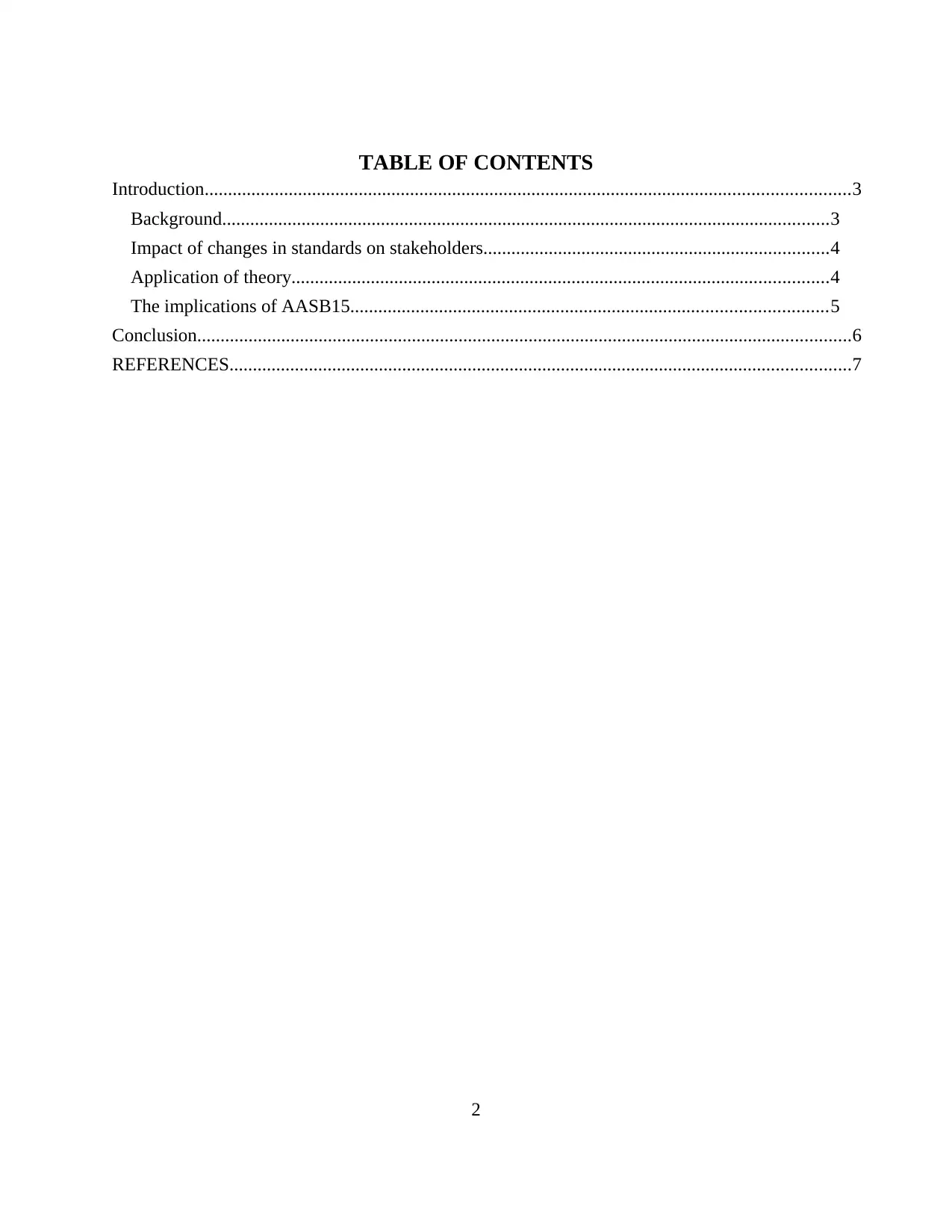
TABLE OF CONTENTS
Introduction..........................................................................................................................................3
Background..................................................................................................................................3
Impact of changes in standards on stakeholders..........................................................................4
Application of theory...................................................................................................................4
The implications of AASB15......................................................................................................5
Conclusion............................................................................................................................................6
REFERENCES.....................................................................................................................................7
2
Introduction..........................................................................................................................................3
Background..................................................................................................................................3
Impact of changes in standards on stakeholders..........................................................................4
Application of theory...................................................................................................................4
The implications of AASB15......................................................................................................5
Conclusion............................................................................................................................................6
REFERENCES.....................................................................................................................................7
2
INTRODUCTION
The Australian Accounting Standards Board (AASB) has carried out certain changes in
financial standard AASB15 and it provided great shock to people as no business in the country
was prepared for it. The change has introduced a complete new technique for carrying out
process such as recognition of revenue and measurement of the same (FINANCIAL REPORTING
STANDARDS UPDATE. 2015). The present research report explains the key problem which has
been addressed by making changes in AASB15. Along with this, the impact on changes on key
stakeholders is also highlighted in the present study.
Background
It can be expressed that the there was many modifications carried out by making changes
in AASB15. One of the main and most important change which was needed is related to the way
in which the recognition and management of revenue was carried out within many firms in
Australia. It can be expressed that the changes resulted in bringing up a complete new framework
for carrying out the process of revenue recognition (Kang and Gray, 2013). The new framework
introduced consists of five major steps which need to be carried out. In stage 1, the contact with
the customers is identified whereas in stage 2 the key obligations related to separate performance
are identified. In the third stage of new framework, the overall price of transaction is determined
and the fourth stage consider of a process in which the separate performance obligations are
being assigned with the transaction price (McMeeking and Bamber, 2015). In the last stage,
revenue is recognized when each and every obligation linked with performance is satisfied. It
can be expressed that in the first look the new framework seems to be simpler and clear.
However, it can be critically argued that the model consists of certain complicated riles, sets and
procedure which needs to be taken care by companies at the time of managing and recognition of
their revenues.
On the other side of this, AASB15 was also introduced with an objective to replace
different types of accounting pronouncement. Here, the purpose was to provide to satisfy various
types of requirement related to accounting by using a single source. Standards such as AASB
118: revenue, AASB 111: construction contract, AASB Interpretation 1042, AASB
Interpretation 131, AASB Interpretation 13 etc, has been replaced by the introduction of
AASB15. However, it can be asserted that industries such as software development, real estate,
3
The Australian Accounting Standards Board (AASB) has carried out certain changes in
financial standard AASB15 and it provided great shock to people as no business in the country
was prepared for it. The change has introduced a complete new technique for carrying out
process such as recognition of revenue and measurement of the same (FINANCIAL REPORTING
STANDARDS UPDATE. 2015). The present research report explains the key problem which has
been addressed by making changes in AASB15. Along with this, the impact on changes on key
stakeholders is also highlighted in the present study.
Background
It can be expressed that the there was many modifications carried out by making changes
in AASB15. One of the main and most important change which was needed is related to the way
in which the recognition and management of revenue was carried out within many firms in
Australia. It can be expressed that the changes resulted in bringing up a complete new framework
for carrying out the process of revenue recognition (Kang and Gray, 2013). The new framework
introduced consists of five major steps which need to be carried out. In stage 1, the contact with
the customers is identified whereas in stage 2 the key obligations related to separate performance
are identified. In the third stage of new framework, the overall price of transaction is determined
and the fourth stage consider of a process in which the separate performance obligations are
being assigned with the transaction price (McMeeking and Bamber, 2015). In the last stage,
revenue is recognized when each and every obligation linked with performance is satisfied. It
can be expressed that in the first look the new framework seems to be simpler and clear.
However, it can be critically argued that the model consists of certain complicated riles, sets and
procedure which needs to be taken care by companies at the time of managing and recognition of
their revenues.
On the other side of this, AASB15 was also introduced with an objective to replace
different types of accounting pronouncement. Here, the purpose was to provide to satisfy various
types of requirement related to accounting by using a single source. Standards such as AASB
118: revenue, AASB 111: construction contract, AASB Interpretation 1042, AASB
Interpretation 131, AASB Interpretation 13 etc, has been replaced by the introduction of
AASB15. However, it can be asserted that industries such as software development, real estate,
3
⊘ This is a preview!⊘
Do you want full access?
Subscribe today to unlock all pages.

Trusted by 1+ million students worldwide
manufacturing, telecommunication etc. will be getting affected by AASB15 (AASB Issues New
Revenue Recognition Standard. E.d).
Impact of changes in standards on stakeholders
One of the main and most important sectors which will be going to get affected by
AASB15 is the construction sector. The rationale behind this is that the sector carries out
transaction related to money in five major ways which are decreasing gross margin, increasing
gross revenue, delay in revenue recognition, bringing the revenue forward, decreasing the gross
revenue (Bond, Govendir and Wells, 2016). Now the major issue which companies will be
facing is that there are chances that the revenue gets forever lost and it also not gets recorded in
the financial statement of Construction Company. In addition to this, stakeholders such as
business operating in Australia affected by the AASB15. For example the companies are now
make changes in areas such as customer contract, the manuals related to budget and accounting,
system of IT and scheme related to bonus. It can be also expressed that carrying out the practical
implementation of AASB15 is not only the job of financial department of a company and it is
required by all member in staff to carry out practical implementation.
The impact of AASB15 also has potential and a materialistic impact on the financial
statement of a business enterprise. The key statements which are going to get affected include
income statement and balance sheet of companies. Stakeholders such as businessman and
investors also believes that the practical implementation of AASB15 will results in making
certain changes in the business model of organization. Thus, companies will be required to take
corrective measures regarding the same (He, Evans and He, 2016). However, at the same time
the stakeholder such as business owner, members in financial team, broad members believes that
the commercial sensitive information will not be disclosed because of the implementation of
AASB15 (Revenue matters Is Australia ready for AASB 15? 2016).
Application of theory
In simpler terms theory can be called as an authoritative principle which helps in getting
detailed information about something. The theory of accounting lays emphasis on the fact that a
conceptual framework is provided to businesses for their financial reporting. It can be stated that
the development of AASB15 was carried out with an useful purpose. The theory of accounting
lays emphasis on the fact that businesses should ensure that all forms of financial statement
4
Revenue Recognition Standard. E.d).
Impact of changes in standards on stakeholders
One of the main and most important sectors which will be going to get affected by
AASB15 is the construction sector. The rationale behind this is that the sector carries out
transaction related to money in five major ways which are decreasing gross margin, increasing
gross revenue, delay in revenue recognition, bringing the revenue forward, decreasing the gross
revenue (Bond, Govendir and Wells, 2016). Now the major issue which companies will be
facing is that there are chances that the revenue gets forever lost and it also not gets recorded in
the financial statement of Construction Company. In addition to this, stakeholders such as
business operating in Australia affected by the AASB15. For example the companies are now
make changes in areas such as customer contract, the manuals related to budget and accounting,
system of IT and scheme related to bonus. It can be also expressed that carrying out the practical
implementation of AASB15 is not only the job of financial department of a company and it is
required by all member in staff to carry out practical implementation.
The impact of AASB15 also has potential and a materialistic impact on the financial
statement of a business enterprise. The key statements which are going to get affected include
income statement and balance sheet of companies. Stakeholders such as businessman and
investors also believes that the practical implementation of AASB15 will results in making
certain changes in the business model of organization. Thus, companies will be required to take
corrective measures regarding the same (He, Evans and He, 2016). However, at the same time
the stakeholder such as business owner, members in financial team, broad members believes that
the commercial sensitive information will not be disclosed because of the implementation of
AASB15 (Revenue matters Is Australia ready for AASB 15? 2016).
Application of theory
In simpler terms theory can be called as an authoritative principle which helps in getting
detailed information about something. The theory of accounting lays emphasis on the fact that a
conceptual framework is provided to businesses for their financial reporting. It can be stated that
the development of AASB15 was carried out with an useful purpose. The theory of accounting
lays emphasis on the fact that businesses should ensure that all forms of financial statement
4
Paraphrase This Document
Need a fresh take? Get an instant paraphrase of this document with our AI Paraphraser
should offer useful information to people. The information gained from AASB15 should be also
very useful in terms of making strategic business decisions linked with growth and expansion.
The theory of financial accounting focuses the standards developed should be of qualitative
characteristics. This means that the data which has been provided by the AASB15 should be very
consistent and comparable.
The implications of AASB15
It can be asserted that many companies operating in Australia will be affected by the
implications of AASB15. However, it can be argued that the organizations which deal with
bundled services and products are more likely to be affected by the implementation of AASB15.
Furthermore, the degree to which this business will be affected will entirely rely on areas such as
nature of products/services, contact with customers etc. As it has been already discussed,
industries such as construction, telecommunication, real estate and software development will be
affected to a great extent. In terms of practical implications, it can be asserted that AASB15 is
going to encourage companies in Australia to carry out detailed examination of their past and
present operation of business (Carnegie and O’Connell, 2014). Here, companies will need to
define the kind of contract which they are using with customers. The business operating in
Australia will also need to place efforts regarding identification of the contracts which falls
outside the AASB15. On the other side of this, it can be also expressed that the clients or
business units which offer their customers with different types of rebates and warranties will be
getting affected by the AASB15. There are certain contract in which consideration is not fixed
and varies. Thus, the companies which have entered into such contract with their customers will
be also affected by the practical application of AASB15.
The practical implication of AASB15 will also force companies to incur some cost in
terms of contracting with customers. The different type of cost which needs to be beard by
company includes professional fees and different types of processing cost. Accounting for
performance obligation is another potential implication of AASB15 which will be required to be
taken care of in the best possible manner. Here, customers may start expecting something from
other company and this might results in increasing the chances of performance obligations. As
per the report of PWC Australia, there are wide ranges of areas which will be getting affected
from the introduction of AASB15. For example businesses which are operating in Australia are
5
very useful in terms of making strategic business decisions linked with growth and expansion.
The theory of financial accounting focuses the standards developed should be of qualitative
characteristics. This means that the data which has been provided by the AASB15 should be very
consistent and comparable.
The implications of AASB15
It can be asserted that many companies operating in Australia will be affected by the
implications of AASB15. However, it can be argued that the organizations which deal with
bundled services and products are more likely to be affected by the implementation of AASB15.
Furthermore, the degree to which this business will be affected will entirely rely on areas such as
nature of products/services, contact with customers etc. As it has been already discussed,
industries such as construction, telecommunication, real estate and software development will be
affected to a great extent. In terms of practical implications, it can be asserted that AASB15 is
going to encourage companies in Australia to carry out detailed examination of their past and
present operation of business (Carnegie and O’Connell, 2014). Here, companies will need to
define the kind of contract which they are using with customers. The business operating in
Australia will also need to place efforts regarding identification of the contracts which falls
outside the AASB15. On the other side of this, it can be also expressed that the clients or
business units which offer their customers with different types of rebates and warranties will be
getting affected by the AASB15. There are certain contract in which consideration is not fixed
and varies. Thus, the companies which have entered into such contract with their customers will
be also affected by the practical application of AASB15.
The practical implication of AASB15 will also force companies to incur some cost in
terms of contracting with customers. The different type of cost which needs to be beard by
company includes professional fees and different types of processing cost. Accounting for
performance obligation is another potential implication of AASB15 which will be required to be
taken care of in the best possible manner. Here, customers may start expecting something from
other company and this might results in increasing the chances of performance obligations. As
per the report of PWC Australia, there are wide ranges of areas which will be getting affected
from the introduction of AASB15. For example businesses which are operating in Australia are
5
more like to witness the impact of AASB15 on areas such as control, process, system, tax and
relations with regards to the key investors. For example system is one of the most important
areas which are going to get affected by the new standards (New revenue rules, 2014). Now
companies will need to carry out more disclosure regarding their accounting and financial
statements. The payment of tax in terms of cash can be termed as other major implications which
AASB15 will have on the overall performance and business practices. Here, accounting
authorities will really need to understand the fact that the companies will require to make
changes in their overall practices. On the other side of this, the implications will also have impact
on areas such as internal control assessment, internal resources of a company (Revenue matters,
2016). There are chances that AASB15 may encourage businesses or companies operating in
Australia to make changes in their overall revenue management team.
However, it can be argued that at present PWC is working with other financial companies
and experts in Australia in order to develop an approach which can be used for management of
AASB15.
CONCLUSION
From the above carried out research report, it can be concluded that there has been certain
modifications done in accounting standards of Australia and AASB15 has been introduced. It can
be also inferred that the introduction of AASB15 has resulted in encouraging businesses in
Australia to make certain changes in the way recognition and management of revenue was
carried out. Furthermore, it can be concluded that the framework consists of five different stages
which can be used for management of revenues in revised way. It can be inferred that the
business practices, IT systems and different types of financial statement of businesses are the key
areas which are going to be affected by the introduction or changes which has been carried out in
AASB15.
6
relations with regards to the key investors. For example system is one of the most important
areas which are going to get affected by the new standards (New revenue rules, 2014). Now
companies will need to carry out more disclosure regarding their accounting and financial
statements. The payment of tax in terms of cash can be termed as other major implications which
AASB15 will have on the overall performance and business practices. Here, accounting
authorities will really need to understand the fact that the companies will require to make
changes in their overall practices. On the other side of this, the implications will also have impact
on areas such as internal control assessment, internal resources of a company (Revenue matters,
2016). There are chances that AASB15 may encourage businesses or companies operating in
Australia to make changes in their overall revenue management team.
However, it can be argued that at present PWC is working with other financial companies
and experts in Australia in order to develop an approach which can be used for management of
AASB15.
CONCLUSION
From the above carried out research report, it can be concluded that there has been certain
modifications done in accounting standards of Australia and AASB15 has been introduced. It can
be also inferred that the introduction of AASB15 has resulted in encouraging businesses in
Australia to make certain changes in the way recognition and management of revenue was
carried out. Furthermore, it can be concluded that the framework consists of five different stages
which can be used for management of revenues in revised way. It can be inferred that the
business practices, IT systems and different types of financial statement of businesses are the key
areas which are going to be affected by the introduction or changes which has been carried out in
AASB15.
6
⊘ This is a preview!⊘
Do you want full access?
Subscribe today to unlock all pages.
Trusted by 1+ million students worldwide
REFERENCES
Books and Journals
Bond, D., Govendir, B. and Wells, P., 2016. An evaluation of asset impairments by Australian
firms and whether they were impacted by AASB 136. Accounting & Finance.
Bond, D., Govendir, B. and Wells, P., 2016. An evaluation of asset impairment decisions by
Australian firms and whether this was impacted by AASB 136.
Carnegie, G.D. and O’Connell, B.T., 2014. A longitudinal study of the interplay of corporate
collapse, accounting failure and governance change in Australia: Early 1890s to early
2000s. Critical Perspectives on Accounting, 25(6), pp.446-468.
Flack, T., Poole, G. and Marsden, S., 2014. Defining and Accounting for Fundraising Income
and Expenses.
He, L., Evans, E. and He, R., 2016. The Impact of AASB 8 Operating Segments on Analysts’
Earnings Forecasts: Australian Evidence. Australian Accounting Review, 26(4), pp.330-
340.
IASB, F., 2011. Revenue from Contracts with Customers. Exposure Draft.
Kang, H. and Gray, S.J., 2013. Segment reporting practices in Australia: Has IFRS 8 made a
difference?. Australian Accounting Review, 23(3), pp.232-243.
McGregor-Lowndes, M., Flack, T., Poole, G. and Marsden, S., 2014. Defining and Accounting
for Fundraising Income and Expenses.
McMeeking, K.P. and Bamber, M.A., 2015. An examination of international accounting
standard-setting due process and the implications for legitimacy.
Online
AASB Issues New Revenue Recognition Standard. E.d [Online]. Available through: <
http://australia.moorestephens.com/MediaLibsAndFiles/media/australia.moorestephens.co
m/Documents/Publications/Service%20Lines/Audit%20and%20Assurance/
AASB_issues_new_revenue_recognition_standard.pdf?ext=.pdf>. [Accessed on: 2nd March
2017].
FINANCIAL REPORTING STANDARDS UPDATE. 2015 [Pdf]. Available through: <
file:///C:/Users/user/Downloads/Financial-Reporting-Standards-Update-December-
2015.pdf>. [Accessed on: 2nd March 2017].
New revenue rules. 2014 [Pdf]. Available through: <
https://www.pwc.com.au/assurance/ifrs/assets/new-revenue-rules-may14.pdf>. [Accessed
on: 3rd March 2017].
Revenue matters Is Australia ready for AASB 15? 2016 [Pdf]. Available through: <
https://www2.deloitte.com/content/dam/Deloitte/au/Documents/audit/deloitte-au-audit-
revenue-matters-is-australia-ready-aasb-15-10-0816.pdf>. [Accessed on: 2nd March 2017].
Revenue matters. 2016 [Pdf]. Available through: < file:///C:/Users/user/Downloads/Feb_16-
Revenue%20Matters.pdf>. [Accessed on: 3rd March 2017].
7
Books and Journals
Bond, D., Govendir, B. and Wells, P., 2016. An evaluation of asset impairments by Australian
firms and whether they were impacted by AASB 136. Accounting & Finance.
Bond, D., Govendir, B. and Wells, P., 2016. An evaluation of asset impairment decisions by
Australian firms and whether this was impacted by AASB 136.
Carnegie, G.D. and O’Connell, B.T., 2014. A longitudinal study of the interplay of corporate
collapse, accounting failure and governance change in Australia: Early 1890s to early
2000s. Critical Perspectives on Accounting, 25(6), pp.446-468.
Flack, T., Poole, G. and Marsden, S., 2014. Defining and Accounting for Fundraising Income
and Expenses.
He, L., Evans, E. and He, R., 2016. The Impact of AASB 8 Operating Segments on Analysts’
Earnings Forecasts: Australian Evidence. Australian Accounting Review, 26(4), pp.330-
340.
IASB, F., 2011. Revenue from Contracts with Customers. Exposure Draft.
Kang, H. and Gray, S.J., 2013. Segment reporting practices in Australia: Has IFRS 8 made a
difference?. Australian Accounting Review, 23(3), pp.232-243.
McGregor-Lowndes, M., Flack, T., Poole, G. and Marsden, S., 2014. Defining and Accounting
for Fundraising Income and Expenses.
McMeeking, K.P. and Bamber, M.A., 2015. An examination of international accounting
standard-setting due process and the implications for legitimacy.
Online
AASB Issues New Revenue Recognition Standard. E.d [Online]. Available through: <
http://australia.moorestephens.com/MediaLibsAndFiles/media/australia.moorestephens.co
m/Documents/Publications/Service%20Lines/Audit%20and%20Assurance/
AASB_issues_new_revenue_recognition_standard.pdf?ext=.pdf>. [Accessed on: 2nd March
2017].
FINANCIAL REPORTING STANDARDS UPDATE. 2015 [Pdf]. Available through: <
file:///C:/Users/user/Downloads/Financial-Reporting-Standards-Update-December-
2015.pdf>. [Accessed on: 2nd March 2017].
New revenue rules. 2014 [Pdf]. Available through: <
https://www.pwc.com.au/assurance/ifrs/assets/new-revenue-rules-may14.pdf>. [Accessed
on: 3rd March 2017].
Revenue matters Is Australia ready for AASB 15? 2016 [Pdf]. Available through: <
https://www2.deloitte.com/content/dam/Deloitte/au/Documents/audit/deloitte-au-audit-
revenue-matters-is-australia-ready-aasb-15-10-0816.pdf>. [Accessed on: 2nd March 2017].
Revenue matters. 2016 [Pdf]. Available through: < file:///C:/Users/user/Downloads/Feb_16-
Revenue%20Matters.pdf>. [Accessed on: 3rd March 2017].
7
Paraphrase This Document
Need a fresh take? Get an instant paraphrase of this document with our AI Paraphraser

8

1 out of 8


Related Documents


Your All-in-One AI-Powered Toolkit for Academic Success.
+13062052269
info@desklib.com
Available 24*7 on WhatsApp / Email
![[object Object]](/_next/static/media/star-bottom.7253800d.svg)
Unlock your academic potential
Copyright © 2020–2025 A2Z Services. All Rights Reserved. Developed and managed by ZUCOL.