Specification: ABE Level 4 Foundation Diploma in Business Management
VerifiedAdded on 2023/05/15
|38
|9207
|170
Report
AI Summary
This document is a qualification specification for the ABE Level 4 Foundation Diploma in Business Management. It details the qualification's objectives, which include equipping learners with business skills, knowledge, and understanding for success in the global business environment. The specification covers entry criteria, assessment methods, and unit content. The diploma is designed for learners aged 16 and over and is regulated by Ofqual within the UK Regulated Qualifications Framework (RQF). The qualification structure includes mandatory core units, and the document provides information on credits, guided learning hours, and total qualification time. The document also highlights the recognition of prior learning, assessment methods, grading, and certification processes. The ABE Level 4 Foundation Diploma aims to provide a solid foundation in business management, enabling learners to progress in employment or higher education.
Qualification Specification
Version 3.1
ABE Level 4 Foundation
Diploma in Business
Management (603/1571/4)
Version 3.1
ABE Level 4 Foundation
Diploma in Business
Management (603/1571/4)

Paraphrase This Document
Need a fresh take? Get an instant paraphrase of this document with our AI Paraphraser
© ABE Qualification Specification – Version 3.1
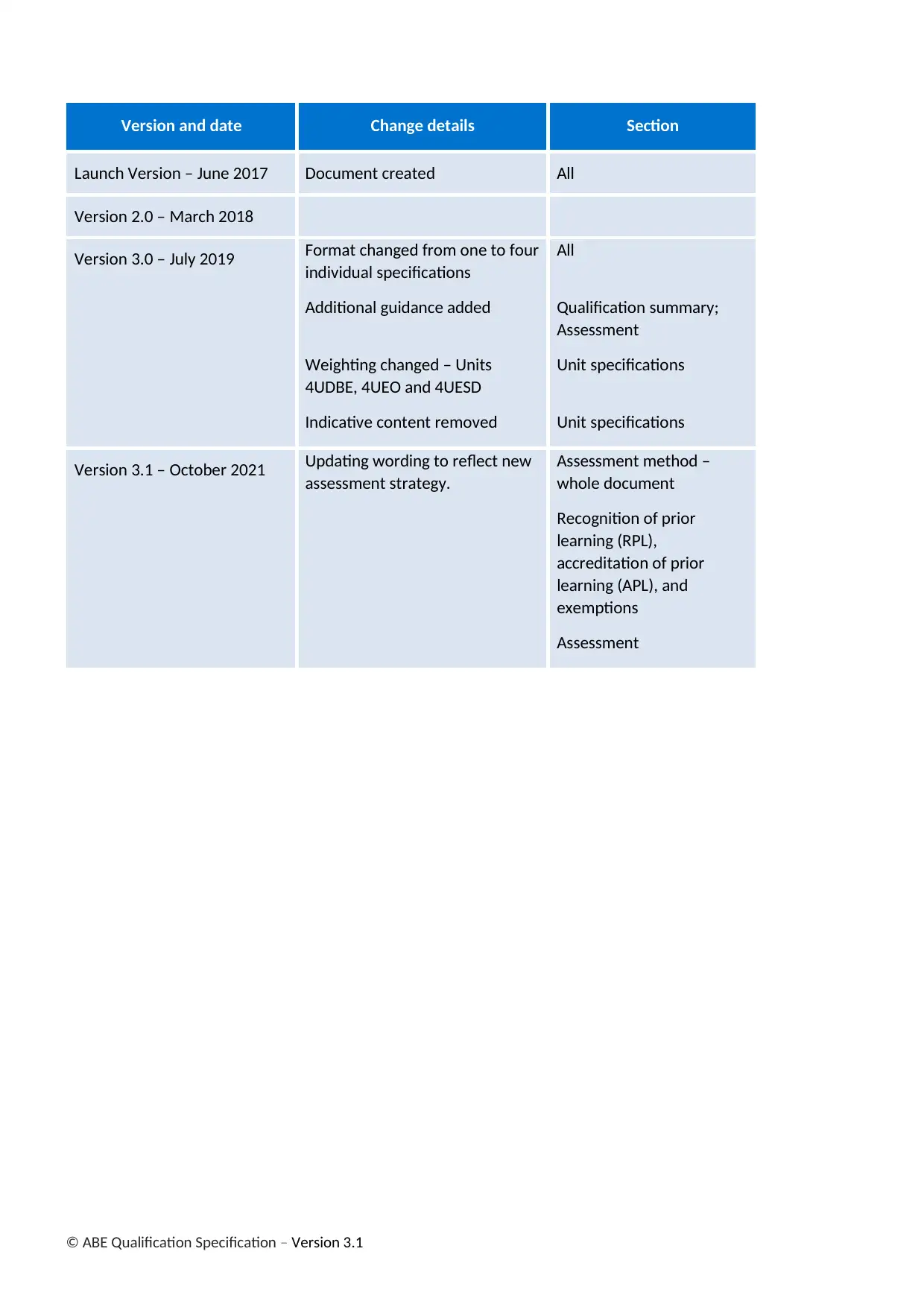
Version and date Change details Section
Launch Version – June 2017 Document created All
Version 2.0 – March 2018
Version 3.0 – July 2019 Format changed from one to four
individual specifications
Additional guidance added
Weighting changed – Units
4UDBE, 4UEO and 4UESD
Indicative content removed
All
Qualification summary;
Assessment
Unit specifications
Unit specifications
Version 3.1 – October 2021 Updating wording to reflect new
assessment strategy.
Assessment method –
whole document
Recognition of prior
learning (RPL),
accreditation of prior
learning (APL), and
exemptions
Assessment
Version and date Change details Section
Launch Version – June 2017 Document created All
Version 2.0 – March 2018
Version 3.0 – July 2019 Format changed from one to four
individual specifications
Additional guidance added
Weighting changed – Units
4UDBE, 4UEO and 4UESD
Indicative content removed
All
Qualification summary;
Assessment
Unit specifications
Unit specifications
Version 3.1 – October 2021 Updating wording to reflect new
assessment strategy.
Assessment method –
whole document
Recognition of prior
learning (RPL),
accreditation of prior
learning (APL), and
exemptions
Assessment
© ABE Qualification Specification – Version 3.1
Contents
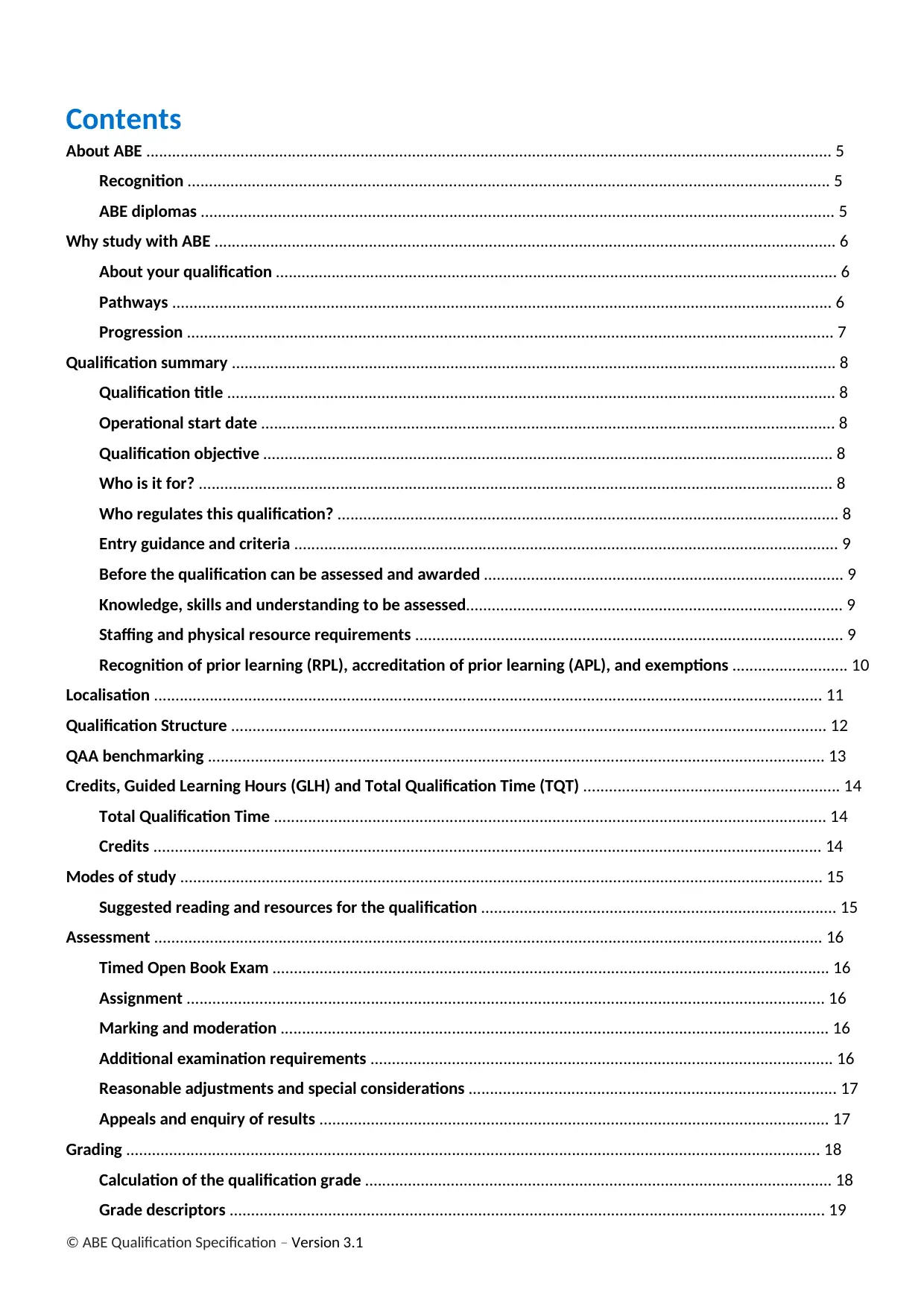
About ABE ................................................................................................................................................................ 5
Recognition ...................................................................................................................................................... 5
ABE diplomas .................................................................................................................................................... 5
Why study with ABE ................................................................................................................................................. 6
About your qualification ................................................................................................................................... 6
Pathways .......................................................................................................................................................... 6
Progression ....................................................................................................................................................... 7
Qualification summary ............................................................................................................................................. 8
Qualification title .............................................................................................................................................. 8
Operational start date ...................................................................................................................................... 8
Qualification objective ..................................................................................................................................... 8
Who is it for? .................................................................................................................................................... 8
Who regulates this qualification? ..................................................................................................................... 8
Entry guidance and criteria ............................................................................................................................... 9
Before the qualification can be assessed and awarded .................................................................................... 9
Knowledge, skills and understanding to be assessed........................................................................................ 9
Staffing and physical resource requirements .................................................................................................... 9
Recognition of prior learning (RPL), accreditation of prior learning (APL), and exemptions ........................... 10
Localisation ............................................................................................................................................................ 11
Qualification Structure ........................................................................................................................................... 12
QAA benchmarking ................................................................................................................................................ 13
Credits, Guided Learning Hours (GLH) and Total Qualification Time (TQT) ............................................................ 14
Total Qualification Time ................................................................................................................................. 14
Credits ............................................................................................................................................................ 14
Modes of study ...................................................................................................................................................... 15
Suggested reading and resources for the qualification ................................................................................... 15
Assessment ............................................................................................................................................................ 16
Timed Open Book Exam .................................................................................................................................. 16
Assignment ..................................................................................................................................................... 16
Marking and moderation ................................................................................................................................ 16
Additional examination requirements ............................................................................................................ 16
Reasonable adjustments and special considerations ...................................................................................... 17
Appeals and enquiry of results ....................................................................................................................... 17
Grading .................................................................................................................................................................. 18
Calculation of the qualification grade ............................................................................................................. 18
Grade descriptors ........................................................................................................................................... 19
Contents
About ABE ................................................................................................................................................................ 5
Recognition ...................................................................................................................................................... 5
ABE diplomas .................................................................................................................................................... 5
Why study with ABE ................................................................................................................................................. 6
About your qualification ................................................................................................................................... 6
Pathways .......................................................................................................................................................... 6
Progression ....................................................................................................................................................... 7
Qualification summary ............................................................................................................................................. 8
Qualification title .............................................................................................................................................. 8
Operational start date ...................................................................................................................................... 8
Qualification objective ..................................................................................................................................... 8
Who is it for? .................................................................................................................................................... 8
Who regulates this qualification? ..................................................................................................................... 8
Entry guidance and criteria ............................................................................................................................... 9
Before the qualification can be assessed and awarded .................................................................................... 9
Knowledge, skills and understanding to be assessed........................................................................................ 9
Staffing and physical resource requirements .................................................................................................... 9
Recognition of prior learning (RPL), accreditation of prior learning (APL), and exemptions ........................... 10
Localisation ............................................................................................................................................................ 11
Qualification Structure ........................................................................................................................................... 12
QAA benchmarking ................................................................................................................................................ 13
Credits, Guided Learning Hours (GLH) and Total Qualification Time (TQT) ............................................................ 14
Total Qualification Time ................................................................................................................................. 14
Credits ............................................................................................................................................................ 14
Modes of study ...................................................................................................................................................... 15
Suggested reading and resources for the qualification ................................................................................... 15
Assessment ............................................................................................................................................................ 16
Timed Open Book Exam .................................................................................................................................. 16
Assignment ..................................................................................................................................................... 16
Marking and moderation ................................................................................................................................ 16
Additional examination requirements ............................................................................................................ 16
Reasonable adjustments and special considerations ...................................................................................... 17
Appeals and enquiry of results ....................................................................................................................... 17
Grading .................................................................................................................................................................. 18
Calculation of the qualification grade ............................................................................................................. 18
Grade descriptors ........................................................................................................................................... 19
⊘ This is a preview!⊘
Do you want full access?
Subscribe today to unlock all pages.

Trusted by 1+ million students worldwide

© ABE Qualification Specification – Version 3.1
Results and certification ................................................................................................................................. 20
Unit specifications.................................................................................................................................................. 21
Appendix A ............................................................................................................................................................ 35
Mapping of modules to QAA Benchmark Statement ...................................................................................... 35
Results and certification ................................................................................................................................. 20
Unit specifications.................................................................................................................................................. 21
Appendix A ............................................................................................................................................................ 35
Mapping of modules to QAA Benchmark Statement ...................................................................................... 35
Paraphrase This Document
Need a fresh take? Get an instant paraphrase of this document with our AI Paraphraser
© ABE Qualification Specification – Version 3.1
About ABE
Recognition
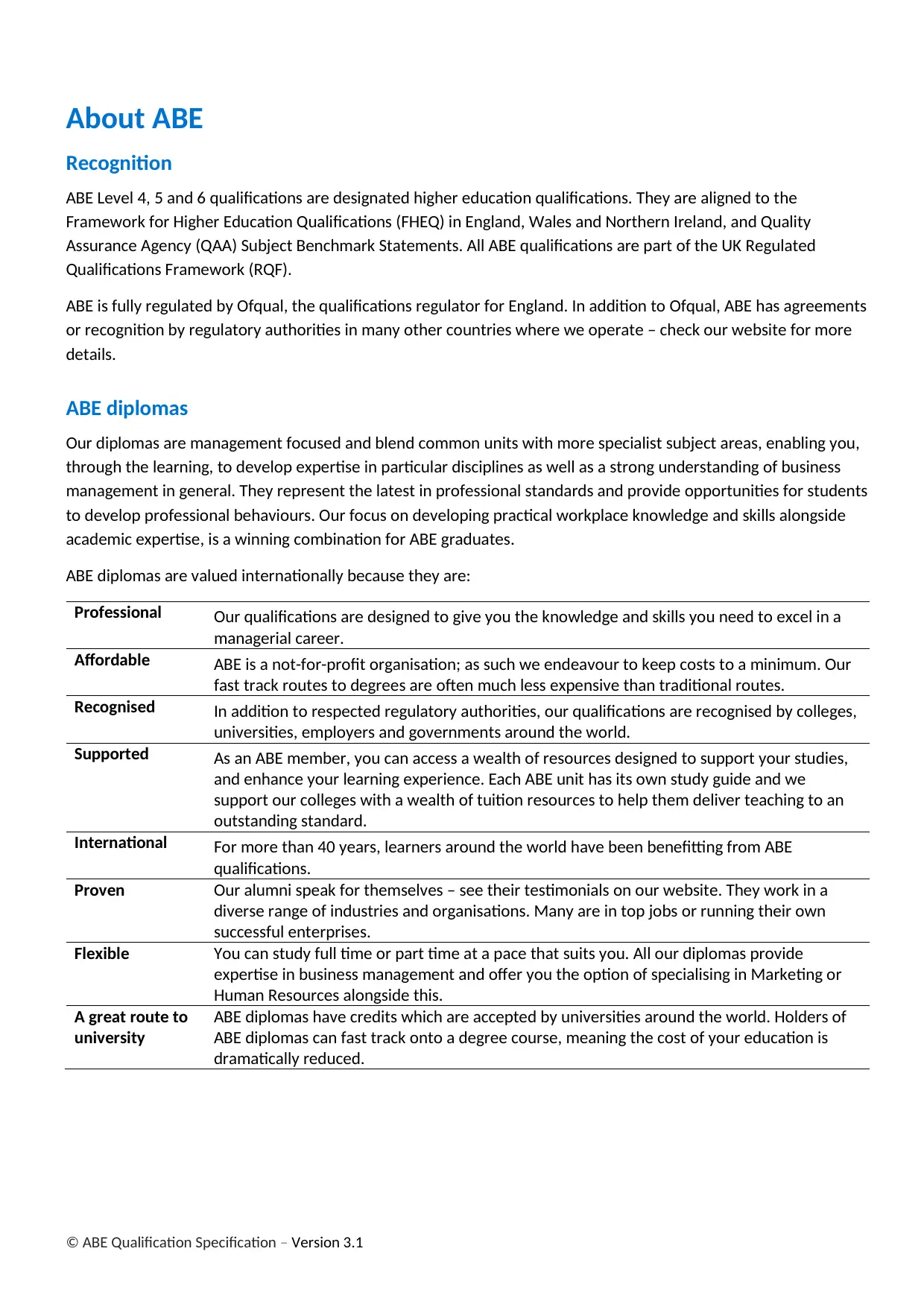
ABE Level 4, 5 and 6 qualifications are designated higher education qualifications. They are aligned to the
Framework for Higher Education Qualifications (FHEQ) in England, Wales and Northern Ireland, and Quality
Assurance Agency (QAA) Subject Benchmark Statements. All ABE qualifications are part of the UK Regulated
Qualifications Framework (RQF).
ABE is fully regulated by Ofqual, the qualifications regulator for England. In addition to Ofqual, ABE has agreements
or recognition by regulatory authorities in many other countries where we operate – check our website for more
details.
ABE diplomas
Our diplomas are management focused and blend common units with more specialist subject areas, enabling you,
through the learning, to develop expertise in particular disciplines as well as a strong understanding of business
management in general. They represent the latest in professional standards and provide opportunities for students
to develop professional behaviours. Our focus on developing practical workplace knowledge and skills alongside
academic expertise, is a winning combination for ABE graduates.
ABE diplomas are valued internationally because they are:
Professional Our qualifications are designed to give you the knowledge and skills you need to excel in a
managerial career.
Affordable ABE is a not-for-profit organisation; as such we endeavour to keep costs to a minimum. Our
fast track routes to degrees are often much less expensive than traditional routes.
Recognised In addition to respected regulatory authorities, our qualifications are recognised by colleges,
universities, employers and governments around the world.
Supported As an ABE member, you can access a wealth of resources designed to support your studies,
and enhance your learning experience. Each ABE unit has its own study guide and we
support our colleges with a wealth of tuition resources to help them deliver teaching to an
outstanding standard.
International For more than 40 years, learners around the world have been benefitting from ABE
qualifications.
Proven Our alumni speak for themselves – see their testimonials on our website. They work in a
diverse range of industries and organisations. Many are in top jobs or running their own
successful enterprises.
Flexible You can study full time or part time at a pace that suits you. All our diplomas provide
expertise in business management and offer you the option of specialising in Marketing or
Human Resources alongside this.
A great route to
university
ABE diplomas have credits which are accepted by universities around the world. Holders of
ABE diplomas can fast track onto a degree course, meaning the cost of your education is
dramatically reduced.
About ABE
Recognition
ABE Level 4, 5 and 6 qualifications are designated higher education qualifications. They are aligned to the
Framework for Higher Education Qualifications (FHEQ) in England, Wales and Northern Ireland, and Quality
Assurance Agency (QAA) Subject Benchmark Statements. All ABE qualifications are part of the UK Regulated
Qualifications Framework (RQF).
ABE is fully regulated by Ofqual, the qualifications regulator for England. In addition to Ofqual, ABE has agreements
or recognition by regulatory authorities in many other countries where we operate – check our website for more
details.
ABE diplomas
Our diplomas are management focused and blend common units with more specialist subject areas, enabling you,
through the learning, to develop expertise in particular disciplines as well as a strong understanding of business
management in general. They represent the latest in professional standards and provide opportunities for students
to develop professional behaviours. Our focus on developing practical workplace knowledge and skills alongside
academic expertise, is a winning combination for ABE graduates.
ABE diplomas are valued internationally because they are:
Professional Our qualifications are designed to give you the knowledge and skills you need to excel in a
managerial career.
Affordable ABE is a not-for-profit organisation; as such we endeavour to keep costs to a minimum. Our
fast track routes to degrees are often much less expensive than traditional routes.
Recognised In addition to respected regulatory authorities, our qualifications are recognised by colleges,
universities, employers and governments around the world.
Supported As an ABE member, you can access a wealth of resources designed to support your studies,
and enhance your learning experience. Each ABE unit has its own study guide and we
support our colleges with a wealth of tuition resources to help them deliver teaching to an
outstanding standard.
International For more than 40 years, learners around the world have been benefitting from ABE
qualifications.
Proven Our alumni speak for themselves – see their testimonials on our website. They work in a
diverse range of industries and organisations. Many are in top jobs or running their own
successful enterprises.
Flexible You can study full time or part time at a pace that suits you. All our diplomas provide
expertise in business management and offer you the option of specialising in Marketing or
Human Resources alongside this.
A great route to
university
ABE diplomas have credits which are accepted by universities around the world. Holders of
ABE diplomas can fast track onto a degree course, meaning the cost of your education is
dramatically reduced.
© ABE Qualification Specification – Version 3.1
Why study with ABE
ABE has an outstanding history and an excellent global reputation. Our qualifications are designed to give you the
best chance of achieving your full potential in your chosen career. There is a world of opportunity waiting for you,
and ABE can help you seize that opportunity and succeed.
The content and format of our qualifications are the outcome of extensive research which explored the knowledge
and skills employees need to possess in order for businesses to succeed. When redeveloping the new qualifications
in Business, we collaborated with a wide range of students, employers, higher education providers, colleges and
subject experts to ensure that the new qualifications meet their needs and expectations. Our findings highlighted
that organisations require staff with a set of strong core business skills that can be flexible and adapted to diverse
environments.
This research, along with consultation with employers and subject experts, has provided the backdrop for ABE’s
outstanding portfolio. Our qualifications are designed to adapt and develop in line with the needs and demands of
employers now and in the future.
Whether you dream of becoming an entrepreneur, getting a great job, being promoted to senior management, or if
you are already in a leadership role and want to enhance your professional skill set, an ABE qualification will help
you turn your plans into reality.
About your qualification
ABE is regulated by Ofqual who also manage the Regulated Qualifications Framework, which ABE Diplomas are
accredited against. Qualifications within the RQF must be levelled against the RQF level descriptors to ensure they
are broadly similar in the knowledge and depth of understanding required to pass them. The size and the content
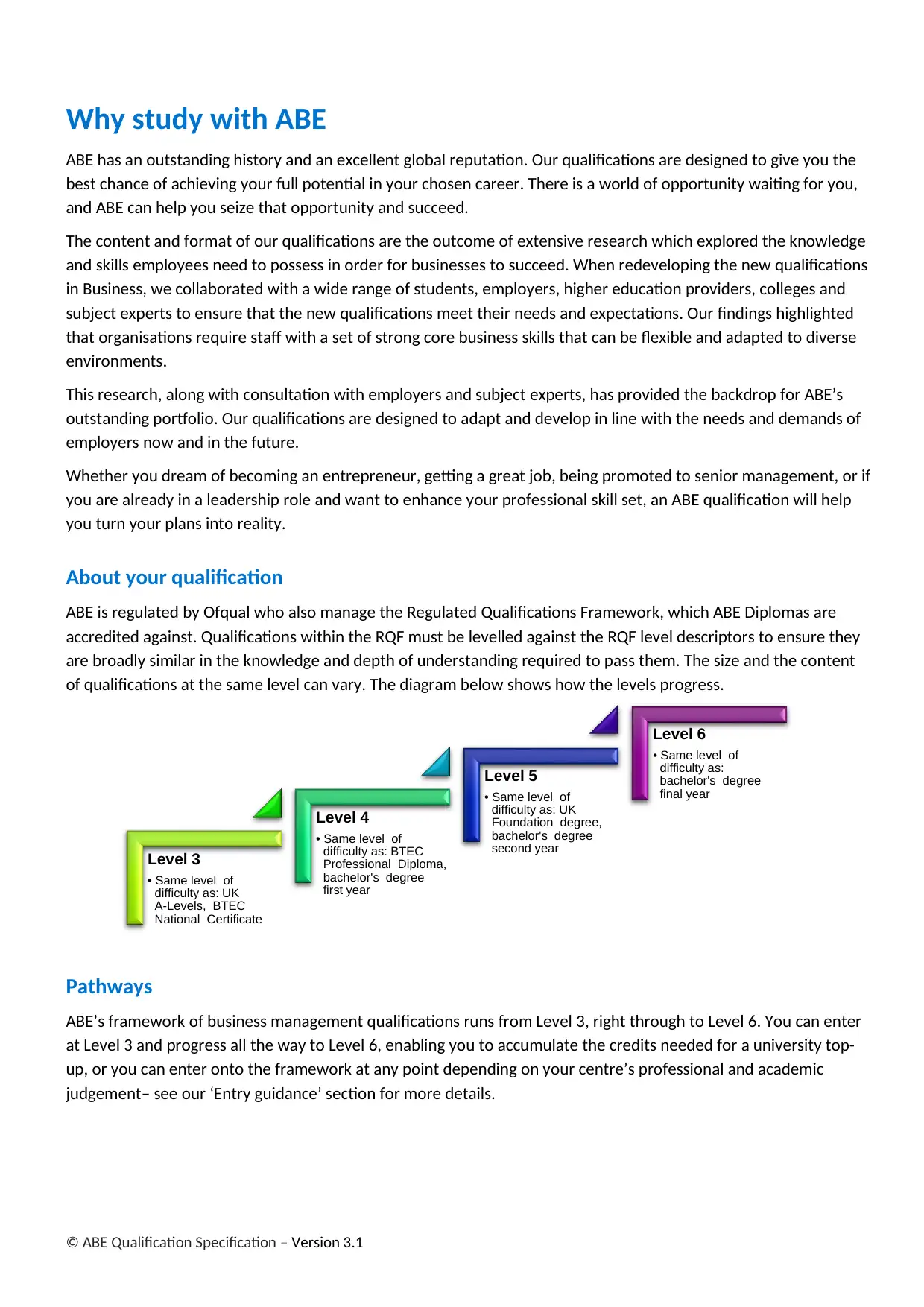
of qualifications at the same level can vary. The diagram below shows how the levels progress.
Pathways
ABE’s framework of business management qualifications runs from Level 3, right through to Level 6. You can enter
at Level 3 and progress all the way to Level 6, enabling you to accumulate the credits needed for a university top-
up, or you can enter onto the framework at any point depending on your centre’s professional and academic
judgement– see our ‘Entry guidance’ section for more details.
Level 3
• Same level of
difficulty as: UK
A-Levels, BTEC
National Certificate
Level 4
• Same level of
difficulty as: BTEC
Professional Diploma,
bachelor's degree
first year
Level 5
• Same level of
difficulty as: UK
Foundation degree,
bachelor's degree
second year
Level 6
• Same level of
difficulty as:
bachelor's degree
final year
Why study with ABE
ABE has an outstanding history and an excellent global reputation. Our qualifications are designed to give you the
best chance of achieving your full potential in your chosen career. There is a world of opportunity waiting for you,
and ABE can help you seize that opportunity and succeed.
The content and format of our qualifications are the outcome of extensive research which explored the knowledge
and skills employees need to possess in order for businesses to succeed. When redeveloping the new qualifications
in Business, we collaborated with a wide range of students, employers, higher education providers, colleges and
subject experts to ensure that the new qualifications meet their needs and expectations. Our findings highlighted
that organisations require staff with a set of strong core business skills that can be flexible and adapted to diverse
environments.
This research, along with consultation with employers and subject experts, has provided the backdrop for ABE’s
outstanding portfolio. Our qualifications are designed to adapt and develop in line with the needs and demands of
employers now and in the future.
Whether you dream of becoming an entrepreneur, getting a great job, being promoted to senior management, or if
you are already in a leadership role and want to enhance your professional skill set, an ABE qualification will help
you turn your plans into reality.
About your qualification
ABE is regulated by Ofqual who also manage the Regulated Qualifications Framework, which ABE Diplomas are
accredited against. Qualifications within the RQF must be levelled against the RQF level descriptors to ensure they
are broadly similar in the knowledge and depth of understanding required to pass them. The size and the content
of qualifications at the same level can vary. The diagram below shows how the levels progress.
Pathways
ABE’s framework of business management qualifications runs from Level 3, right through to Level 6. You can enter
at Level 3 and progress all the way to Level 6, enabling you to accumulate the credits needed for a university top-
up, or you can enter onto the framework at any point depending on your centre’s professional and academic
judgement– see our ‘Entry guidance’ section for more details.
Level 3
• Same level of
difficulty as: UK
A-Levels, BTEC
National Certificate
Level 4
• Same level of
difficulty as: BTEC
Professional Diploma,
bachelor's degree
first year
Level 5
• Same level of
difficulty as: UK
Foundation degree,
bachelor's degree
second year
Level 6
• Same level of
difficulty as:
bachelor's degree
final year
⊘ This is a preview!⊘
Do you want full access?
Subscribe today to unlock all pages.
Trusted by 1+ million students worldwide
© ABE Qualification Specification – Version 3.1
Progression
ABE qualifications have been designed with progression in mind and, after completing one of our qualifications, you
can progress to employment or to a higher level of study.
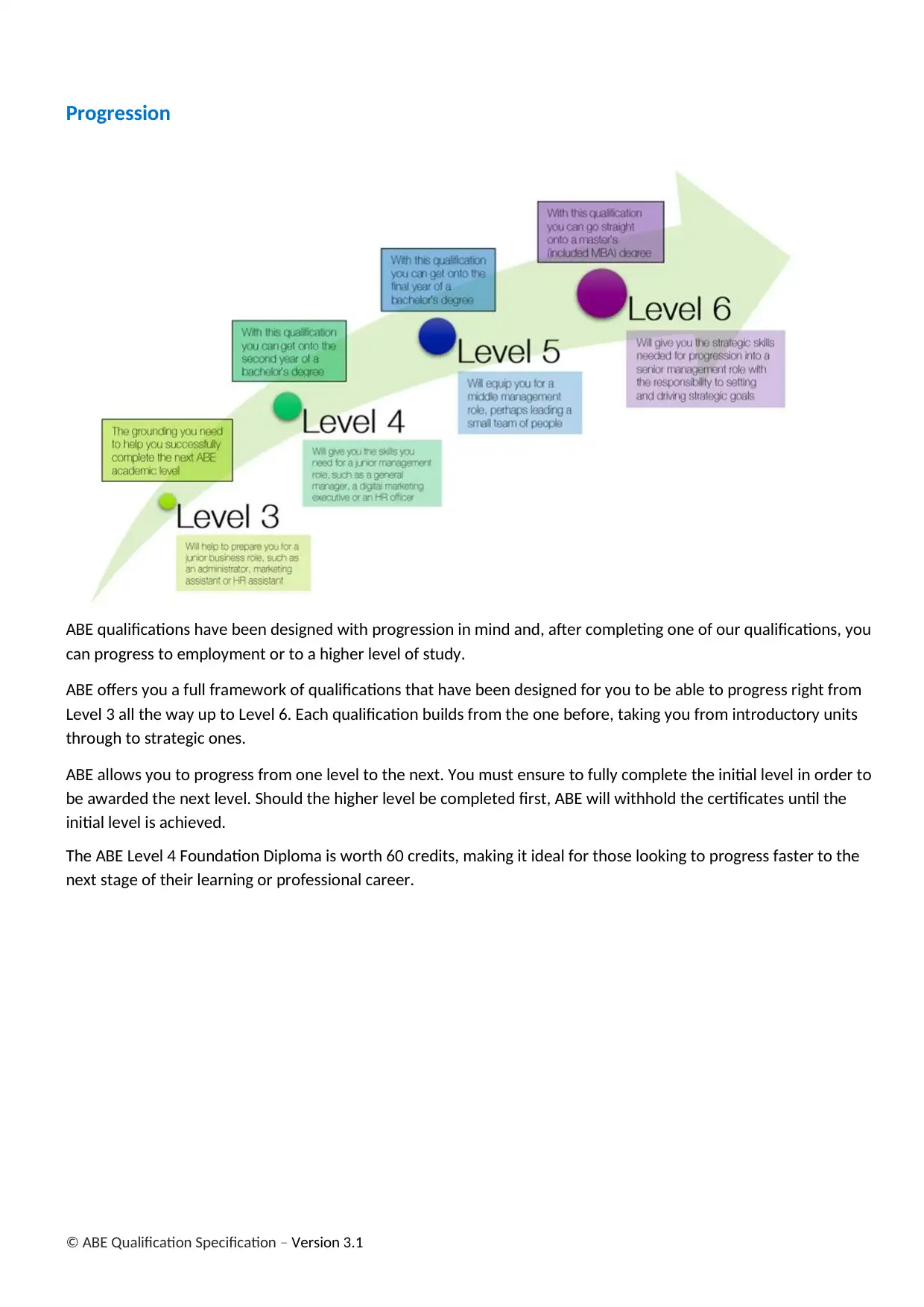
ABE offers you a full framework of qualifications that have been designed for you to be able to progress right from
Level 3 all the way up to Level 6. Each qualification builds from the one before, taking you from introductory units
through to strategic ones.
ABE allows you to progress from one level to the next. You must ensure to fully complete the initial level in order to
be awarded the next level. Should the higher level be completed first, ABE will withhold the certificates until the
initial level is achieved.
The ABE Level 4 Foundation Diploma is worth 60 credits, making it ideal for those looking to progress faster to the
next stage of their learning or professional career.
Progression
ABE qualifications have been designed with progression in mind and, after completing one of our qualifications, you
can progress to employment or to a higher level of study.
ABE offers you a full framework of qualifications that have been designed for you to be able to progress right from
Level 3 all the way up to Level 6. Each qualification builds from the one before, taking you from introductory units
through to strategic ones.
ABE allows you to progress from one level to the next. You must ensure to fully complete the initial level in order to
be awarded the next level. Should the higher level be completed first, ABE will withhold the certificates until the
initial level is achieved.
The ABE Level 4 Foundation Diploma is worth 60 credits, making it ideal for those looking to progress faster to the
next stage of their learning or professional career.
Paraphrase This Document
Need a fresh take? Get an instant paraphrase of this document with our AI Paraphraser
© ABE Qualification Specification – Version 3.1
Qualification summary
Qualification title
ABE Level 4 Foundation Diploma in Business Management (603/1571/4)
Operational start date
1st June 2017
Qualification objective
The objectives of the ABE Level 4 Foundation Diploma in Business Management are as follows:
• To equip learners with business skills, knowledge and the understanding necessary to achieve high
performance in the global business environment
• To provide education and training for a range of careers in business, including management, human
resources and marketing
• To provide insight and understanding into international business operations and the opportunities and
challenges presented by a globalised marketplace
• To equip learners with knowledge and understanding of culturally diverse organisations, cross-cultural
issues, diversity and values
• To provide opportunities for learners to enter or progress in employment in business, or progress to higher
education qualifications
• To provide opportunities for learners to develop the skills, techniques and personal attributes essential for
successful working lives
• To provide opportunities for those learners with a global outlook to aspire to international career pathways
• To provide opportunities for learners to achieve a nationally-recognised professional qualification
• To offer learners the chance of career progression in their chosen field
• To allow flexibility of study and to meet local or specialist needs
Who is it for?
This qualification is for learners that are 16 and over.
The ABE Level 4 Foundation Diploma in Business Management is for learners who wish to gain a solid
understanding of the business environment and employability skills in a shorter time to allow them to progress
faster to employment or a new job role.
Who regulates this qualification?
The qualification is regulated in the UK by:
• Ofqual
Qualification summary
Qualification title
ABE Level 4 Foundation Diploma in Business Management (603/1571/4)
Operational start date
1st June 2017
Qualification objective
The objectives of the ABE Level 4 Foundation Diploma in Business Management are as follows:
• To equip learners with business skills, knowledge and the understanding necessary to achieve high
performance in the global business environment
• To provide education and training for a range of careers in business, including management, human
resources and marketing
• To provide insight and understanding into international business operations and the opportunities and
challenges presented by a globalised marketplace
• To equip learners with knowledge and understanding of culturally diverse organisations, cross-cultural
issues, diversity and values
• To provide opportunities for learners to enter or progress in employment in business, or progress to higher
education qualifications
• To provide opportunities for learners to develop the skills, techniques and personal attributes essential for
successful working lives
• To provide opportunities for those learners with a global outlook to aspire to international career pathways
• To provide opportunities for learners to achieve a nationally-recognised professional qualification
• To offer learners the chance of career progression in their chosen field
• To allow flexibility of study and to meet local or specialist needs
Who is it for?
This qualification is for learners that are 16 and over.
The ABE Level 4 Foundation Diploma in Business Management is for learners who wish to gain a solid
understanding of the business environment and employability skills in a shorter time to allow them to progress
faster to employment or a new job role.
Who regulates this qualification?
The qualification is regulated in the UK by:
• Ofqual
© ABE Qualification Specification – Version 3.1
Entry guidance and criteria
There are no formal entry requirements to study ABE Level 4 Diplomas; however, the centre should ensure that
you have a reasonable expectation of success on the programme by assessing your previous qualifications and/or
related work experience.
Hence, it is their responsibility to use their professional and academic judgement when assisting you in making the
decision at which level you should enter the ABE programmes.
In order to successfully study for an ABE qualification, you should have an appropriate level of English language
skills (reading, writing, speaking and listening). For the ABE Level 4 Diplomas, ABE recommends the following
standards are met:
• IELTS 5.5
• Cambridge ESOL Cambridge English First
• Pearson Test of English Academic (PTE Academic) 51
• Common European Framework of Reference (CEFR) B2
Centres can use other English language tests as a measure of a learner’s English language Skills; but the centre must
be satisfied that the score is equivalent to those recommended above.
Before the qualification can be assessed and awarded
To be awarded the ABE Level 4 Foundation Diploma in Business Management learners are required to successfully
achieve four core mandatory units. There are no optional pathways as part of this qualification.
Knowledge, skills and understanding to be assessed
The knowledge, Skills and Understanding being assessed in this qualification is as follows:
• analysing the impact of increasingly dynamic business environments and increasingly volatile markets on an
organisations ability to compete successfully using a range of relevant tools and frameworks
• developing an understanding of the principles of business and the different legal formations by which an
organisation can operate.
• introduction to the key skills, behaviours, and attitudes you need to demonstrate in order to be
‘employable’, and how to develop them if they are missing, through self-development and/or other
learning
• gaining knowledge and understanding of accounting principles, processes, and concepts that can be
applied in a general management context
Staffing and physical resource requirements
As part of the centre accreditation process ABE ask for details around staffing and physical resource. For more
information on becoming an ABE accredited centre go to: https://www.abeuk.com/abe-accreditation
Entry guidance and criteria
There are no formal entry requirements to study ABE Level 4 Diplomas; however, the centre should ensure that
you have a reasonable expectation of success on the programme by assessing your previous qualifications and/or
related work experience.
Hence, it is their responsibility to use their professional and academic judgement when assisting you in making the
decision at which level you should enter the ABE programmes.
In order to successfully study for an ABE qualification, you should have an appropriate level of English language
skills (reading, writing, speaking and listening). For the ABE Level 4 Diplomas, ABE recommends the following
standards are met:
• IELTS 5.5
• Cambridge ESOL Cambridge English First
• Pearson Test of English Academic (PTE Academic) 51
• Common European Framework of Reference (CEFR) B2
Centres can use other English language tests as a measure of a learner’s English language Skills; but the centre must
be satisfied that the score is equivalent to those recommended above.
Before the qualification can be assessed and awarded
To be awarded the ABE Level 4 Foundation Diploma in Business Management learners are required to successfully
achieve four core mandatory units. There are no optional pathways as part of this qualification.
Knowledge, skills and understanding to be assessed
The knowledge, Skills and Understanding being assessed in this qualification is as follows:
• analysing the impact of increasingly dynamic business environments and increasingly volatile markets on an
organisations ability to compete successfully using a range of relevant tools and frameworks
• developing an understanding of the principles of business and the different legal formations by which an
organisation can operate.
• introduction to the key skills, behaviours, and attitudes you need to demonstrate in order to be
‘employable’, and how to develop them if they are missing, through self-development and/or other
learning
• gaining knowledge and understanding of accounting principles, processes, and concepts that can be
applied in a general management context
Staffing and physical resource requirements
As part of the centre accreditation process ABE ask for details around staffing and physical resource. For more
information on becoming an ABE accredited centre go to: https://www.abeuk.com/abe-accreditation
⊘ This is a preview!⊘
Do you want full access?
Subscribe today to unlock all pages.
Trusted by 1+ million students worldwide

© ABE Qualification Specification – Version 3.1
Recognition of prior learning (RPL), accreditation of prior learning (APL), and exemptions
If you hold a qualification from either another professional body or university which is similar in content and level
to the ABE Level 4, 5 or 6 qualifications, you might qualify for RPL, APL or an exemption from some ABE units.
If you wish to find out if you qualify for any exemptions before you register with us, please send us a letter or
an email to admissions@abeuk.com and we will forward you a copy of the ABE Exemptions Policy and application
form.
If you are already registered, you can find further information on the ABE Portal.
Recognition of prior learning (RPL), accreditation of prior learning (APL), and exemptions
If you hold a qualification from either another professional body or university which is similar in content and level
to the ABE Level 4, 5 or 6 qualifications, you might qualify for RPL, APL or an exemption from some ABE units.
If you wish to find out if you qualify for any exemptions before you register with us, please send us a letter or
an email to admissions@abeuk.com and we will forward you a copy of the ABE Exemptions Policy and application
form.
If you are already registered, you can find further information on the ABE Portal.
Paraphrase This Document
Need a fresh take? Get an instant paraphrase of this document with our AI Paraphraser
© ABE Qualification Specification – Version 3.1
Localisation
It is very important when studying for your ABE qualification that you consider your local business environment and
try to apply what you are learning to relevant scenarios in your local business context. Doing this will help you to
put your learning into practice and use it in your professional day-to-day activities.
The nature and form of organisations varies widely. Internal factors such as ownership, business strategy, and size
each play a part in defining the shape and focus of an organisation. In turn, this impacts upon the expectations and
responsibilities placed on individual managers. Whilst trends in the external environment impact on organisations
differently, increased globalisation and digitalisation have led to increasing competition resulting in a growing need
for managers to be aware of external practices and approaches and to adopt a best fit approach.
You should take into account the following when preparing for your summative assessment:
• The structure, culture, size, vision, and mission of the organisation you are working for or basing your
assessment on
• The local culture and how it impacts on employee and stakeholder expectations of a manager
• Availability of resources
• Feasibility and suitability of practices within your specific setting
Localisation
It is very important when studying for your ABE qualification that you consider your local business environment and
try to apply what you are learning to relevant scenarios in your local business context. Doing this will help you to
put your learning into practice and use it in your professional day-to-day activities.
The nature and form of organisations varies widely. Internal factors such as ownership, business strategy, and size
each play a part in defining the shape and focus of an organisation. In turn, this impacts upon the expectations and
responsibilities placed on individual managers. Whilst trends in the external environment impact on organisations
differently, increased globalisation and digitalisation have led to increasing competition resulting in a growing need
for managers to be aware of external practices and approaches and to adopt a best fit approach.
You should take into account the following when preparing for your summative assessment:
• The structure, culture, size, vision, and mission of the organisation you are working for or basing your
assessment on
• The local culture and how it impacts on employee and stakeholder expectations of a manager
• Availability of resources
• Feasibility and suitability of practices within your specific setting
© ABE Qualification Specification – Version 3.1
Qualification Structure
ABE Level 4 Foundation Diploma in Business Management (603/1571/4)
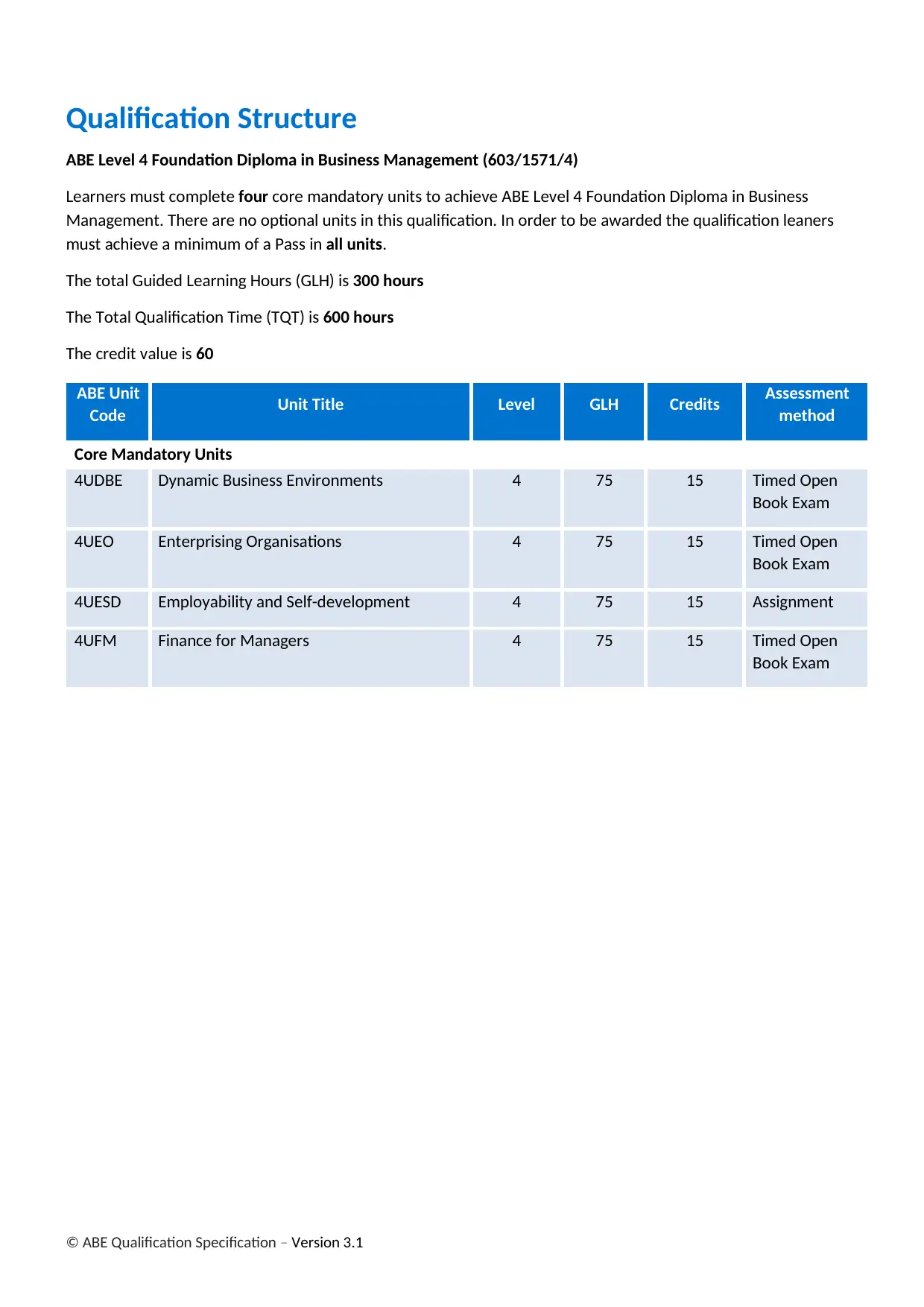
Learners must complete four core mandatory units to achieve ABE Level 4 Foundation Diploma in Business
Management. There are no optional units in this qualification. In order to be awarded the qualification leaners
must achieve a minimum of a Pass in all units.
The total Guided Learning Hours (GLH) is 300 hours
The Total Qualification Time (TQT) is 600 hours
The credit value is 60
ABE Unit
Code Unit Title Level GLH Credits Assessment
method
Core Mandatory Units
4UDBE Dynamic Business Environments 4 75 15 Timed Open
Book Exam
4UEO Enterprising Organisations 4 75 15 Timed Open
Book Exam
4UESD Employability and Self-development 4 75 15 Assignment
4UFM Finance for Managers 4 75 15 Timed Open
Book Exam
Qualification Structure
ABE Level 4 Foundation Diploma in Business Management (603/1571/4)
Learners must complete four core mandatory units to achieve ABE Level 4 Foundation Diploma in Business
Management. There are no optional units in this qualification. In order to be awarded the qualification leaners
must achieve a minimum of a Pass in all units.
The total Guided Learning Hours (GLH) is 300 hours
The Total Qualification Time (TQT) is 600 hours
The credit value is 60
ABE Unit
Code Unit Title Level GLH Credits Assessment
method
Core Mandatory Units
4UDBE Dynamic Business Environments 4 75 15 Timed Open
Book Exam
4UEO Enterprising Organisations 4 75 15 Timed Open
Book Exam
4UESD Employability and Self-development 4 75 15 Assignment
4UFM Finance for Managers 4 75 15 Timed Open
Book Exam
⊘ This is a preview!⊘
Do you want full access?
Subscribe today to unlock all pages.
Trusted by 1+ million students worldwide

1 out of 38


Related Documents


Your All-in-One AI-Powered Toolkit for Academic Success.
+13062052269
info@desklib.com
Available 24*7 on WhatsApp / Email
![[object Object]](/_next/static/media/star-bottom.7253800d.svg)
Unlock your academic potential
Copyright © 2020–2025 A2Z Services. All Rights Reserved. Developed and managed by ZUCOL.