AR1102: A Technical Comparison of Two Historic Buildings: Analysis
VerifiedAdded on 2022/11/19
|10
|3283
|435
Report
AI Summary
This report presents a detailed technical comparison between Abernodwydd Farmhouse, a timber-framed farmhouse from 1678, and Utzon House in Hellebæk, Denmark, designed by Jørn Utzon in 1953. The analysis encompasses site and climate considerations, including building orientation, solar path, prevailing winds, and topography. Comfort analysis delves into thermal, lighting, and acoustic conditions. Furthermore, the structural systems of both buildings are examined. The Abernodwydd Farmhouse analysis covers its timber-framed structure, materials, and adaptations over time, while the Utzon House analysis focuses on its modern design, single-storey layout, and integration with its environment. The report offers a comprehensive overview of these two distinct architectural examples, highlighting their technical features and design approaches. This report aims to provide a comprehensive overview of both buildings, focusing on their technical aspects and design approaches. This report is available on Desklib, offering students access to similar past papers and solved assignments.
ABERNODWYDD FARMHOUSE AND UTZON HOUSE IN HELLEBÆK: A TECHNICAL COMPARISON
HISTORY
OLD BUILDING (ABERNODWYDD FARMHOUSE)
Abernrdwydd Farmhouse is a timber-framed thatched farmhouse, which was constructed in 1678 as an
open –hall with a fire place at the center of the room and also open to the roof (Weber, 2015). The
building was first altered in 1708, when a timber framed chimney and stone –backed fire place was
constructed and an upper floor was incorporated into the structure thus effectively increasing the indoor
space area (Weber, 2015).
Abernrdwydd Farmhouse is a classic example of the timber-framed buildings of the mid-Wales and the
Marches in both plan and the construction, having the fire place adjacent to the only doorway (Edlin,
2017). All the walls of this house are set on a low stone plinth which was aimed at preventing the beams
from rotting , with the panels between the timbers filled with woven hazel rods which are daubed with
clay. The floor of Abernrdwydd Farmhouse is made up of beaten earth (Williams, 2017).
The quality of the furniture displayed in the house portrays the higher standards of living of the occupants
during the 18th century.
MODERN BUILDING (UTZON HOUSE IN HELLEBÆK
Utzon House in Hellebæk, Denmark is located 50 km north of the capital (Copenhagen). The house was
constructed in 1953 on the designs of the great architect, Jørn Utzon, was intended to be his own home in
one of his most loved areas of his country (Welsh Folk Museum, 2016). Though the house is small, it is
also very spacious. The house is hidden in the green Danish forest not far from the place where Jørn
Utzon grew up loved so much. The house is not just a paradigm of a general modern mid-century house
but one of the very first structure to feature the trend of single-storey , flat-roofed residence with
long glass walls (Stewart Williams, 2015).
SITE AND CLIMATE ANALYSIS
OLD BUILDING (ABERNODWYDD FARMHOUSE) MODERN BUILDING (UTZON HOUSE IN HELLEBÆK
building orientation in relation to its openings
Building orientation is the positioning of the building structure in regard of the seasonal variation
of the sun’s path and the prevailing wind patterns. When the building is well oriented on site, it
will greatly help in increasing energy efficiency of the home and making it more comfortable to
live in with low maintenance cost. The Abernodwydd farmhouse is located in an isolated natural
building orientation in relation to its openings
HISTORY
OLD BUILDING (ABERNODWYDD FARMHOUSE)
Abernrdwydd Farmhouse is a timber-framed thatched farmhouse, which was constructed in 1678 as an
open –hall with a fire place at the center of the room and also open to the roof (Weber, 2015). The
building was first altered in 1708, when a timber framed chimney and stone –backed fire place was
constructed and an upper floor was incorporated into the structure thus effectively increasing the indoor
space area (Weber, 2015).
Abernrdwydd Farmhouse is a classic example of the timber-framed buildings of the mid-Wales and the
Marches in both plan and the construction, having the fire place adjacent to the only doorway (Edlin,
2017). All the walls of this house are set on a low stone plinth which was aimed at preventing the beams
from rotting , with the panels between the timbers filled with woven hazel rods which are daubed with
clay. The floor of Abernrdwydd Farmhouse is made up of beaten earth (Williams, 2017).
The quality of the furniture displayed in the house portrays the higher standards of living of the occupants
during the 18th century.
MODERN BUILDING (UTZON HOUSE IN HELLEBÆK
Utzon House in Hellebæk, Denmark is located 50 km north of the capital (Copenhagen). The house was
constructed in 1953 on the designs of the great architect, Jørn Utzon, was intended to be his own home in
one of his most loved areas of his country (Welsh Folk Museum, 2016). Though the house is small, it is
also very spacious. The house is hidden in the green Danish forest not far from the place where Jørn
Utzon grew up loved so much. The house is not just a paradigm of a general modern mid-century house
but one of the very first structure to feature the trend of single-storey , flat-roofed residence with
long glass walls (Stewart Williams, 2015).
SITE AND CLIMATE ANALYSIS
OLD BUILDING (ABERNODWYDD FARMHOUSE) MODERN BUILDING (UTZON HOUSE IN HELLEBÆK
building orientation in relation to its openings
Building orientation is the positioning of the building structure in regard of the seasonal variation
of the sun’s path and the prevailing wind patterns. When the building is well oriented on site, it
will greatly help in increasing energy efficiency of the home and making it more comfortable to
live in with low maintenance cost. The Abernodwydd farmhouse is located in an isolated natural
building orientation in relation to its openings

Paraphrase This Document
Need a fresh take? Get an instant paraphrase of this document with our AI Paraphraser
just like the Utzon house it is surrounded by a forested area (Williams, 2017). The opening of the
house is facing towards the south where the prevailing winds are blowing towards.
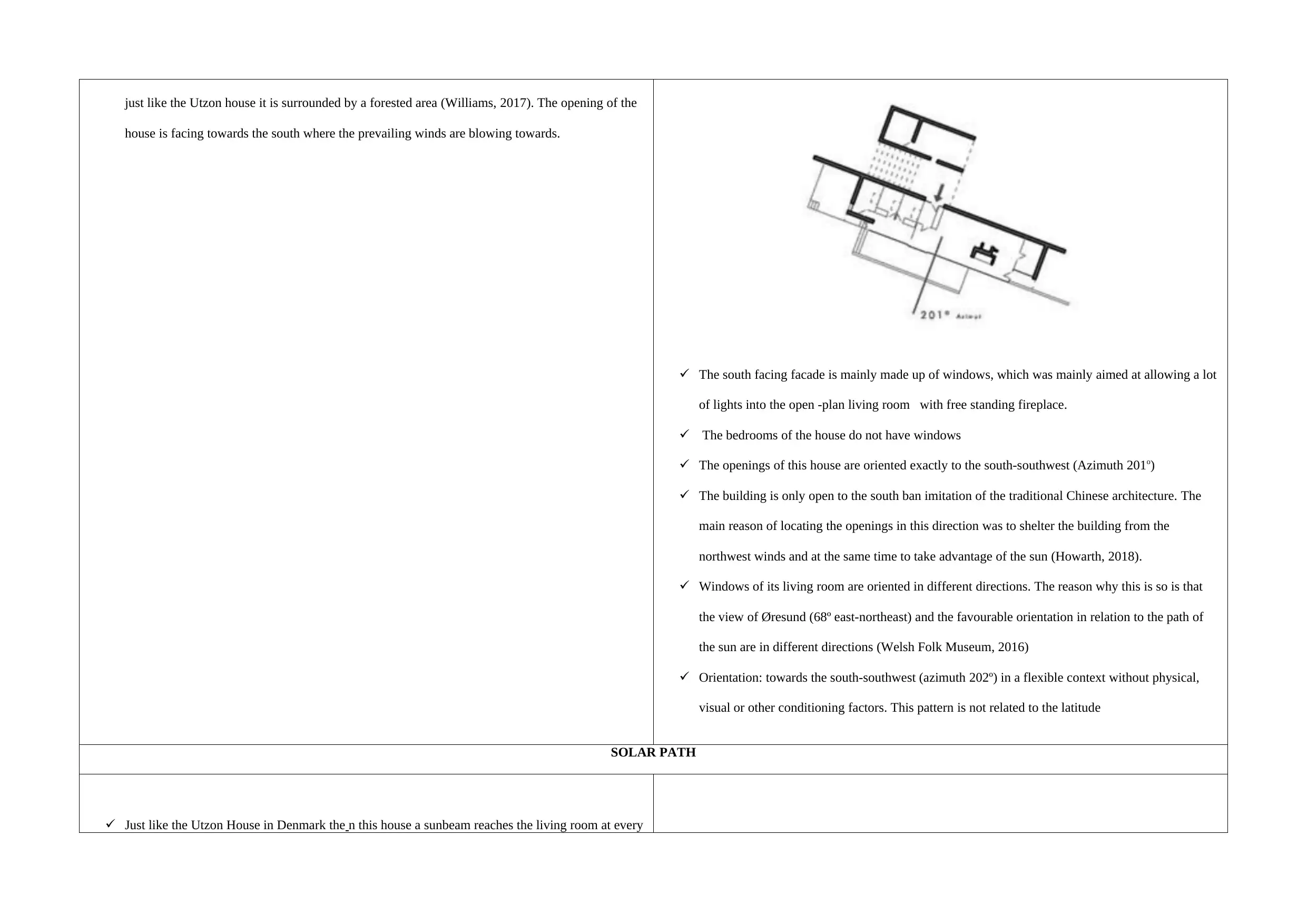
The south facing facade is mainly made up of windows, which was mainly aimed at allowing a lot
of lights into the open -plan living room with free standing fireplace.
The bedrooms of the house do not have windows
The openings of this house are oriented exactly to the south-southwest (Azimuth 201o)
The building is only open to the south ban imitation of the traditional Chinese architecture. The
main reason of locating the openings in this direction was to shelter the building from the
northwest winds and at the same time to take advantage of the sun (Howarth, 2018).
Windows of its living room are oriented in different directions. The reason why this is so is that
the view of Øresund (68º east-northeast) and the favourable orientation in relation to the path of
the sun are in different directions (Welsh Folk Museum, 2016)
Orientation: towards the south-southwest (azimuth 202º) in a flexible context without physical,
visual or other conditioning factors. This pattern is not related to the latitude
SOLAR PATH
Just like the Utzon House in Denmark the n this house a sunbeam reaches the living room at every
house is facing towards the south where the prevailing winds are blowing towards.
The south facing facade is mainly made up of windows, which was mainly aimed at allowing a lot
of lights into the open -plan living room with free standing fireplace.
The bedrooms of the house do not have windows
The openings of this house are oriented exactly to the south-southwest (Azimuth 201o)
The building is only open to the south ban imitation of the traditional Chinese architecture. The
main reason of locating the openings in this direction was to shelter the building from the
northwest winds and at the same time to take advantage of the sun (Howarth, 2018).
Windows of its living room are oriented in different directions. The reason why this is so is that
the view of Øresund (68º east-northeast) and the favourable orientation in relation to the path of
the sun are in different directions (Welsh Folk Museum, 2016)
Orientation: towards the south-southwest (azimuth 202º) in a flexible context without physical,
visual or other conditioning factors. This pattern is not related to the latitude
SOLAR PATH
Just like the Utzon House in Denmark the n this house a sunbeam reaches the living room at every
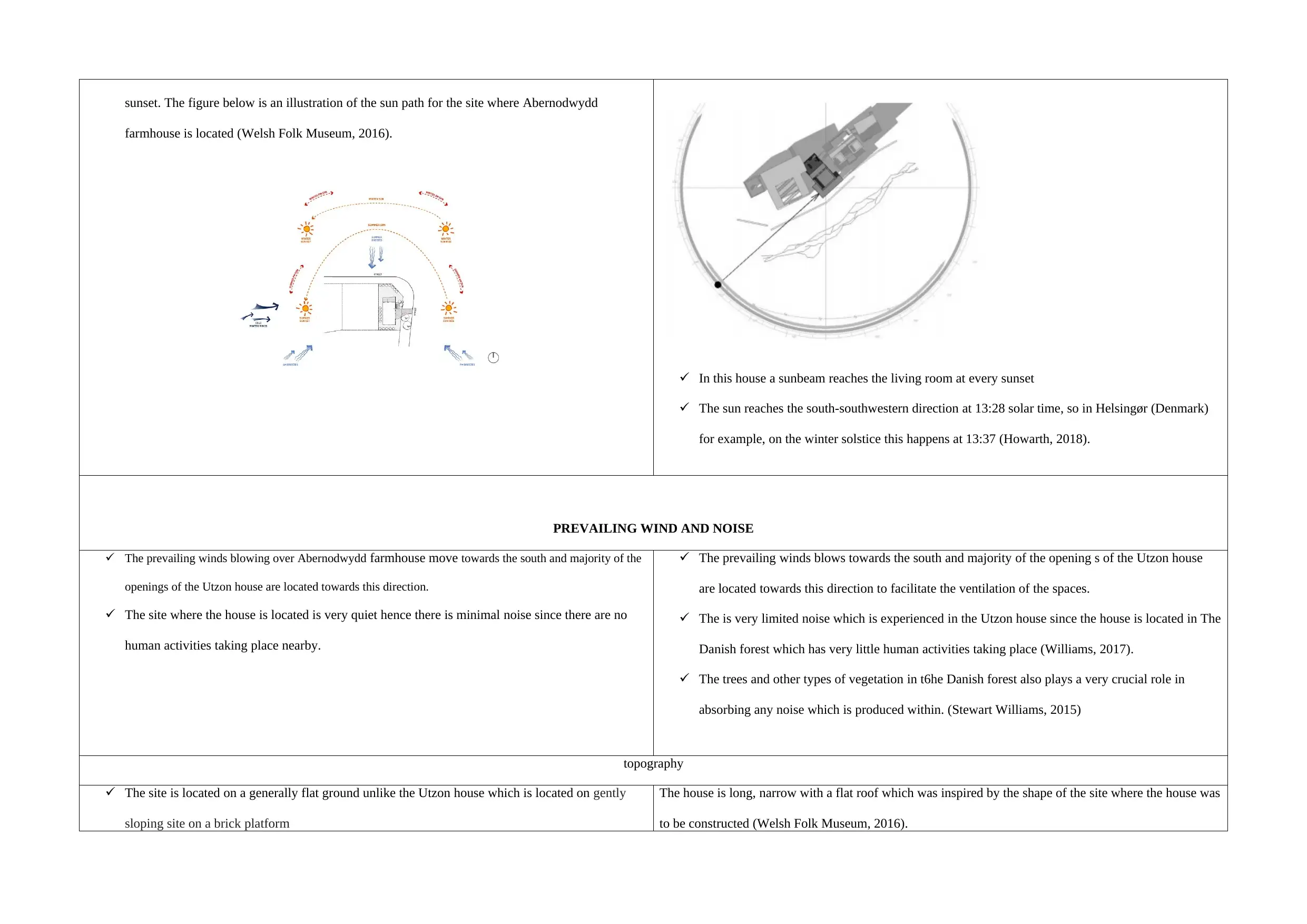
sunset. The figure below is an illustration of the sun path for the site where Abernodwydd
farmhouse is located (Welsh Folk Museum, 2016).
In this house a sunbeam reaches the living room at every sunset
The sun reaches the south-southwestern direction at 13:28 solar time, so in Helsingør (Denmark)
for example, on the winter solstice this happens at 13:37 (Howarth, 2018).
PREVAILING WIND AND NOISE
The prevailing winds blowing over Abernodwydd farmhouse move towards the south and majority of the
openings of the Utzon house are located towards this direction.
The site where the house is located is very quiet hence there is minimal noise since there are no
human activities taking place nearby.
The prevailing winds blows towards the south and majority of the opening s of the Utzon house
are located towards this direction to facilitate the ventilation of the spaces.
The is very limited noise which is experienced in the Utzon house since the house is located in The
Danish forest which has very little human activities taking place (Williams, 2017).
The trees and other types of vegetation in t6he Danish forest also plays a very crucial role in
absorbing any noise which is produced within. (Stewart Williams, 2015)
topography
The site is located on a generally flat ground unlike the Utzon house which is located on gently
sloping site on a brick platform
The house is long, narrow with a flat roof which was inspired by the shape of the site where the house was
to be constructed (Welsh Folk Museum, 2016).
farmhouse is located (Welsh Folk Museum, 2016).
In this house a sunbeam reaches the living room at every sunset
The sun reaches the south-southwestern direction at 13:28 solar time, so in Helsingør (Denmark)
for example, on the winter solstice this happens at 13:37 (Howarth, 2018).
PREVAILING WIND AND NOISE
The prevailing winds blowing over Abernodwydd farmhouse move towards the south and majority of the
openings of the Utzon house are located towards this direction.
The site where the house is located is very quiet hence there is minimal noise since there are no
human activities taking place nearby.
The prevailing winds blows towards the south and majority of the opening s of the Utzon house
are located towards this direction to facilitate the ventilation of the spaces.
The is very limited noise which is experienced in the Utzon house since the house is located in The
Danish forest which has very little human activities taking place (Williams, 2017).
The trees and other types of vegetation in t6he Danish forest also plays a very crucial role in
absorbing any noise which is produced within. (Stewart Williams, 2015)
topography
The site is located on a generally flat ground unlike the Utzon house which is located on gently
sloping site on a brick platform
The house is long, narrow with a flat roof which was inspired by the shape of the site where the house was
to be constructed (Welsh Folk Museum, 2016).
⊘ This is a preview!⊘
Do you want full access?
Subscribe today to unlock all pages.

Trusted by 1+ million students worldwide
it rises slightly above the gently sloping site on a brick platform
the house covers 130 square meters which is the maximum area which one family house can cover in
Denmark
BUILDING AND SITE CIRCULATION SCHEME AND ZONING
Unlike the utzon house which was constructed to cover the maximum space permitted for one
family house. The Abernodwydd farmhouse covers very little space hence allowing a lot of space
for Circulation (Edlin, 2017)
The house was designed and constructed to cover the maximum area which is allowed for one family
house to cover (Edlin, 2017).
The circulation with the building is facilitated by the use of an open plan during the design stage of the
house. Which sees the use of large spaces unlike the small spaces which were initially used in Denmark
houses.
DISTINCT FEATURES AND VIEWS.
Just like the utzon house, occupants here can also enjoy the spectacular views of the morning sun
and the shelter from the wind. (Welsh Folk Museum, 2016).
One can enjoy the views of natural environment. The figure below illustrates the view from the
house regarding the Danish forest.
The house was designed taking into account the surrounding landscape and its character
From the house one can enjoy the spectaculars view of sun and shelter from the wind.
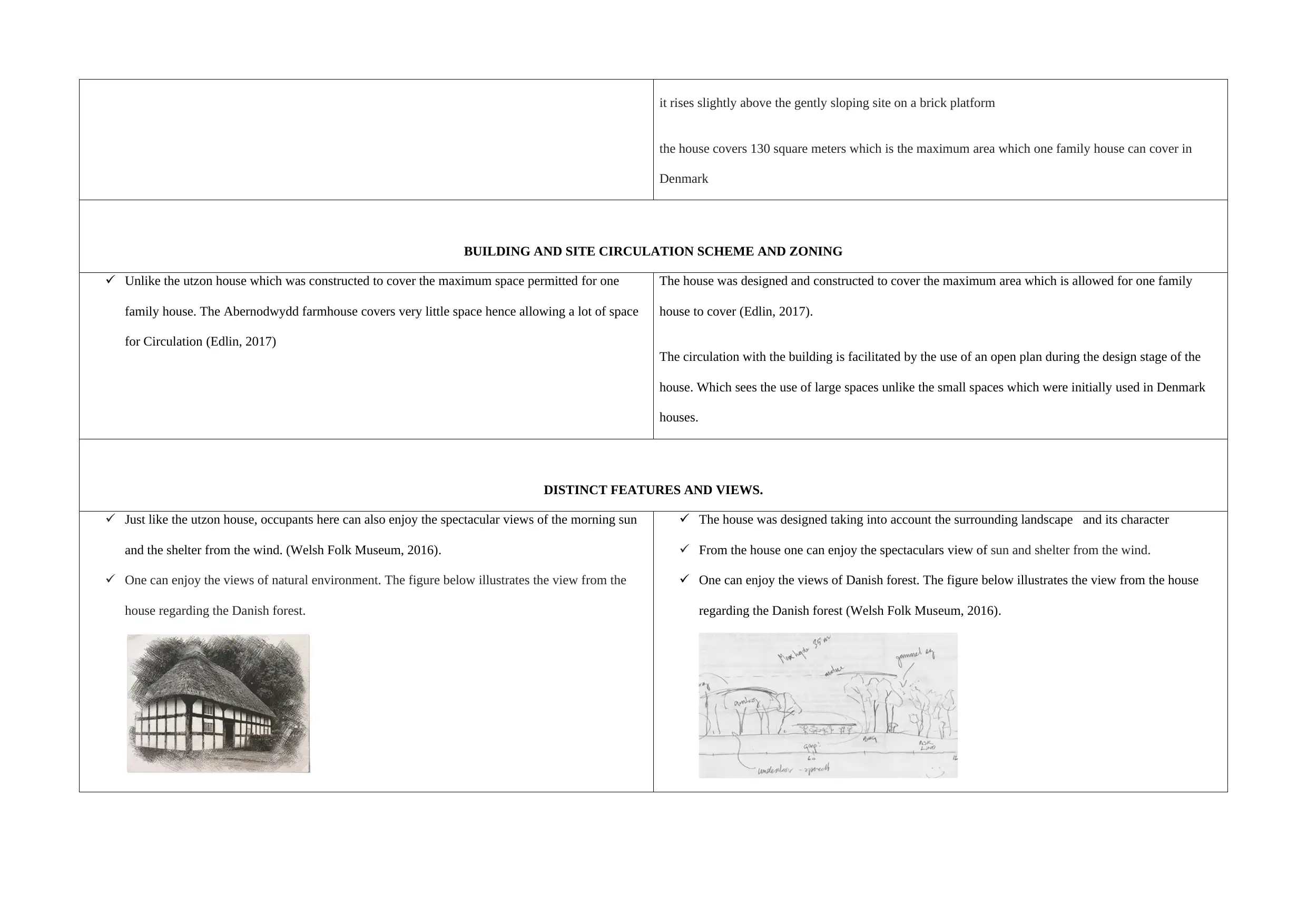
One can enjoy the views of Danish forest. The figure below illustrates the view from the house
regarding the Danish forest (Welsh Folk Museum, 2016).
the house covers 130 square meters which is the maximum area which one family house can cover in
Denmark
BUILDING AND SITE CIRCULATION SCHEME AND ZONING
Unlike the utzon house which was constructed to cover the maximum space permitted for one
family house. The Abernodwydd farmhouse covers very little space hence allowing a lot of space
for Circulation (Edlin, 2017)
The house was designed and constructed to cover the maximum area which is allowed for one family
house to cover (Edlin, 2017).
The circulation with the building is facilitated by the use of an open plan during the design stage of the
house. Which sees the use of large spaces unlike the small spaces which were initially used in Denmark
houses.
DISTINCT FEATURES AND VIEWS.
Just like the utzon house, occupants here can also enjoy the spectacular views of the morning sun
and the shelter from the wind. (Welsh Folk Museum, 2016).
One can enjoy the views of natural environment. The figure below illustrates the view from the
house regarding the Danish forest.
The house was designed taking into account the surrounding landscape and its character
From the house one can enjoy the spectaculars view of sun and shelter from the wind.
One can enjoy the views of Danish forest. The figure below illustrates the view from the house
regarding the Danish forest (Welsh Folk Museum, 2016).
Paraphrase This Document
Need a fresh take? Get an instant paraphrase of this document with our AI Paraphraser
COMFORT ANALYSIS
OLD BUILDING (ABERNODWYDD FARMHOUSE) MODERN BUILDING (UTZON HOUSE IN HELLEBÆK
thermal conditions
Thermal condition is the state of the mind that expresses any form of satisfaction with the environment
and is assessed by certain subjective evaluations (ASHRAE/ANSI Standard 55) (Welsh Folk Museum,
2016). Buildings are designed to protect the occupants from extreme weather conditions from outside.
Indoor temperature fluctuations and prolonged cold indoor temperature might have adverse effects on
human health (Welsh Folk Museum, 2016). Consequently, warmer temperatures reduce the risk of having
health problems. Therefore, it is important to always achieve thermal comfort by improving the indoor air
quality to desirable conditions.
Just like the Utzon House in Hellebaek the average temperature in Utzon House is between 19 and 21
degrees and the outside of the house is -1 degrees, but the temperatures are affected are affected by both
the physical and personal factors (Williams, 2017). Some of the physical factors which affects the thermal
conditions of this house include air velocity and relative humidity (Automobile Association, 2017)
thermal conditions
The average temperature in Utzon House is between 19 and 21 degrees and the outside of the
house is -1 degrees, but the temperatures are affected by both physical and personal factors. . Some
of the physical factors which affects the thermal conditions of this house include air velocity and
relative humidity in Danish forest (Automobile Association, 2017).
thermal characteristics
The house has required thermal comfort levels due to the materials used in t6hye construction of the
house. Both clay, timber and grass has very high thermal mass which preserves heat within the building
during the winter and at the same time plays a very crucial role in maintaining the internal temperature
of the house constant during the summer since grass, timber and clay are not go0ood conductors of heat
which can facilitate they transfer of heat. In and out of the building (Weber, 2015).
thermal characteristics
The internal characteristics of the house are cool due to the high relative humidity b which is
experienced in the Hellbaek, The high relative humidity is due to the High levels of transpiration
from the surrounding Danish forest (Welsh Folk Museum, 2016).
Free circulation of air also facilitates the cooling of the internal spaces of the house. The windows
which are located to the south facing aids in cooling the internal spaces of the house (Edlin, 2017).
lighting conditions
The house is naturally lighted during the day by the natural light from the openings i.e. the
lighting conditions
The house is naturally lighted in the living room since the light can penetrate to the house through
OLD BUILDING (ABERNODWYDD FARMHOUSE) MODERN BUILDING (UTZON HOUSE IN HELLEBÆK
thermal conditions
Thermal condition is the state of the mind that expresses any form of satisfaction with the environment
and is assessed by certain subjective evaluations (ASHRAE/ANSI Standard 55) (Welsh Folk Museum,
2016). Buildings are designed to protect the occupants from extreme weather conditions from outside.
Indoor temperature fluctuations and prolonged cold indoor temperature might have adverse effects on
human health (Welsh Folk Museum, 2016). Consequently, warmer temperatures reduce the risk of having
health problems. Therefore, it is important to always achieve thermal comfort by improving the indoor air
quality to desirable conditions.
Just like the Utzon House in Hellebaek the average temperature in Utzon House is between 19 and 21
degrees and the outside of the house is -1 degrees, but the temperatures are affected are affected by both
the physical and personal factors (Williams, 2017). Some of the physical factors which affects the thermal
conditions of this house include air velocity and relative humidity (Automobile Association, 2017)
thermal conditions
The average temperature in Utzon House is between 19 and 21 degrees and the outside of the
house is -1 degrees, but the temperatures are affected by both physical and personal factors. . Some
of the physical factors which affects the thermal conditions of this house include air velocity and
relative humidity in Danish forest (Automobile Association, 2017).
thermal characteristics
The house has required thermal comfort levels due to the materials used in t6hye construction of the
house. Both clay, timber and grass has very high thermal mass which preserves heat within the building
during the winter and at the same time plays a very crucial role in maintaining the internal temperature
of the house constant during the summer since grass, timber and clay are not go0ood conductors of heat
which can facilitate they transfer of heat. In and out of the building (Weber, 2015).
thermal characteristics
The internal characteristics of the house are cool due to the high relative humidity b which is
experienced in the Hellbaek, The high relative humidity is due to the High levels of transpiration
from the surrounding Danish forest (Welsh Folk Museum, 2016).
Free circulation of air also facilitates the cooling of the internal spaces of the house. The windows
which are located to the south facing aids in cooling the internal spaces of the house (Edlin, 2017).
lighting conditions
The house is naturally lighted during the day by the natural light from the openings i.e. the
lighting conditions
The house is naturally lighted in the living room since the light can penetrate to the house through
windows and the doors. Unlike the Utzon House which is artificially lighted at night by the use of
lamps the Abernodwydd farmhouse is lighted at night by the use of fire from the fireplace which
is located in the middle of the house (Williams, 2017).
The Abernodwydd farmhouse is also situated in an open location which makes it easier for the
natural light to reach the house with easy (Howarth, 2018).
the south facing glass wall. Other spaces in the house are artificially lighted such as the bedrooms
since they do not have openings to the outside.
The open plan nature of the Utzon House also facilitates the flow of natural light throughout the
house.
The use of bricks as a construction material also facilitated the achievement of desirable thermal
comfort levels. This is because the bricks are known to have a higher thermal mass as compared to
mother construction materials such as wood.
acoustic conditions acoustic conditions
Acoustics is a form of sound insulation where by a combination of techniques and materials that
are mechanized to attenuate or block noise levels in buildings in order to prevent extreme sounds
from getting in or getting out (Edlin, 2017). The main purpose of acoustic conditions is to allow
sound from a particular source to spread evenly in a space to create a diffuse sound field.
The Abernodwydd farmhouse is located in a silent surrounding which are far from human
activities which generates a lot of noise (Williams, 2017). The materials also that were used during
construction are acoustically friendly which have high levels or sound absorption.
The grass which is used as a roofing material have very high levels of sound absorption, the timber
and clay which are used in the construction of the walls also plays a very important role in
absorbing the noise.
The Utzon house is acoustic sound since the construction materials that were used in the
construction of the building have high mass which absorbs the noise.
The location of the utzon house in the Danish forest also plays a very important role in achieving
the required acoustic standards (Williams, 2017). The trees act as shades which absorbs the noise
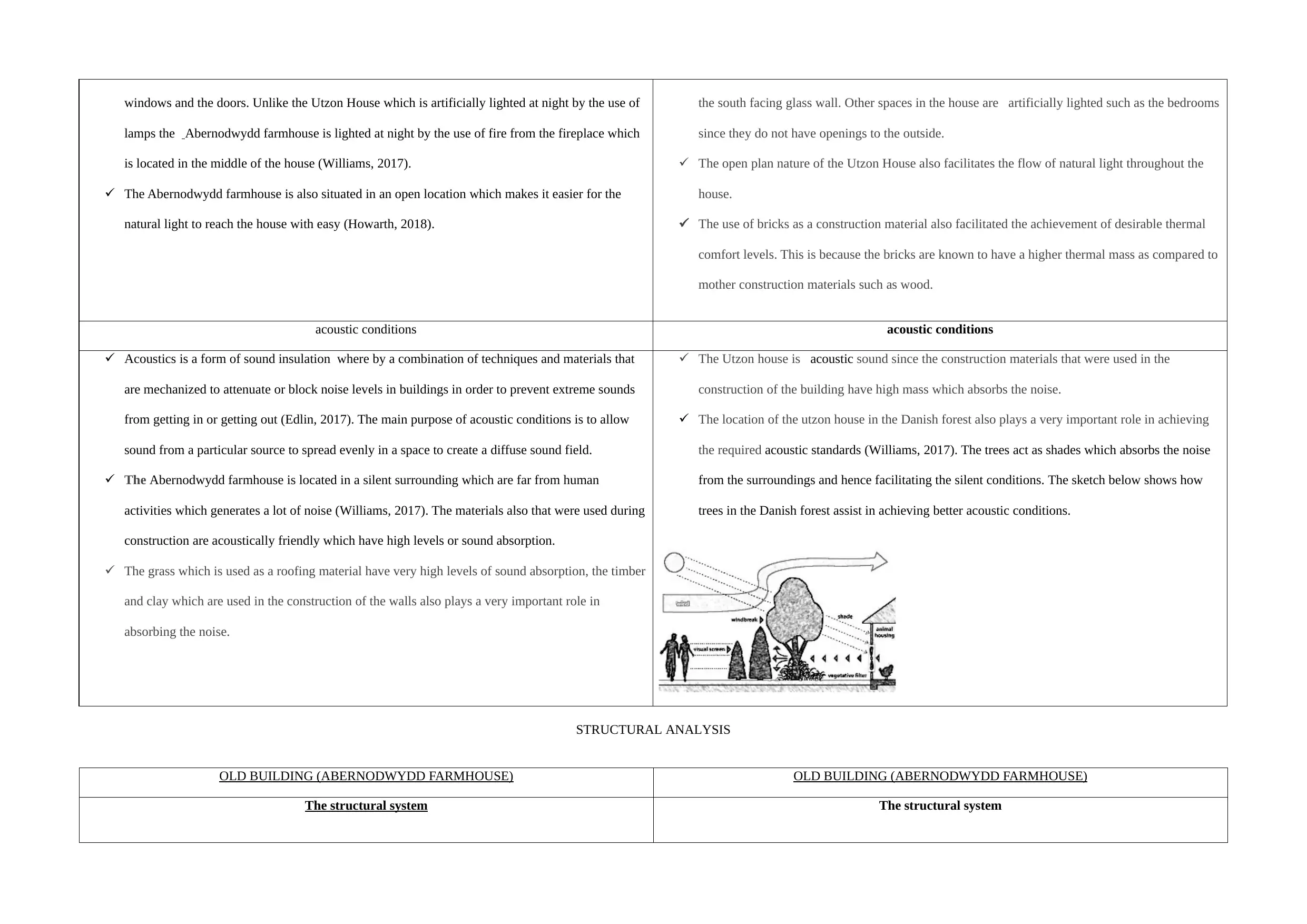
from the surroundings and hence facilitating the silent conditions. The sketch below shows how
trees in the Danish forest assist in achieving better acoustic conditions.
STRUCTURAL ANALYSIS
OLD BUILDING (ABERNODWYDD FARMHOUSE) OLD BUILDING (ABERNODWYDD FARMHOUSE)
The structural system The structural system
lamps the Abernodwydd farmhouse is lighted at night by the use of fire from the fireplace which
is located in the middle of the house (Williams, 2017).
The Abernodwydd farmhouse is also situated in an open location which makes it easier for the
natural light to reach the house with easy (Howarth, 2018).
the south facing glass wall. Other spaces in the house are artificially lighted such as the bedrooms
since they do not have openings to the outside.
The open plan nature of the Utzon House also facilitates the flow of natural light throughout the
house.
The use of bricks as a construction material also facilitated the achievement of desirable thermal
comfort levels. This is because the bricks are known to have a higher thermal mass as compared to
mother construction materials such as wood.
acoustic conditions acoustic conditions
Acoustics is a form of sound insulation where by a combination of techniques and materials that
are mechanized to attenuate or block noise levels in buildings in order to prevent extreme sounds
from getting in or getting out (Edlin, 2017). The main purpose of acoustic conditions is to allow
sound from a particular source to spread evenly in a space to create a diffuse sound field.
The Abernodwydd farmhouse is located in a silent surrounding which are far from human
activities which generates a lot of noise (Williams, 2017). The materials also that were used during
construction are acoustically friendly which have high levels or sound absorption.
The grass which is used as a roofing material have very high levels of sound absorption, the timber
and clay which are used in the construction of the walls also plays a very important role in
absorbing the noise.
The Utzon house is acoustic sound since the construction materials that were used in the
construction of the building have high mass which absorbs the noise.
The location of the utzon house in the Danish forest also plays a very important role in achieving
the required acoustic standards (Williams, 2017). The trees act as shades which absorbs the noise
from the surroundings and hence facilitating the silent conditions. The sketch below shows how
trees in the Danish forest assist in achieving better acoustic conditions.
STRUCTURAL ANALYSIS
OLD BUILDING (ABERNODWYDD FARMHOUSE) OLD BUILDING (ABERNODWYDD FARMHOUSE)
The structural system The structural system
⊘ This is a preview!⊘
Do you want full access?
Subscribe today to unlock all pages.
Trusted by 1+ million students worldwide
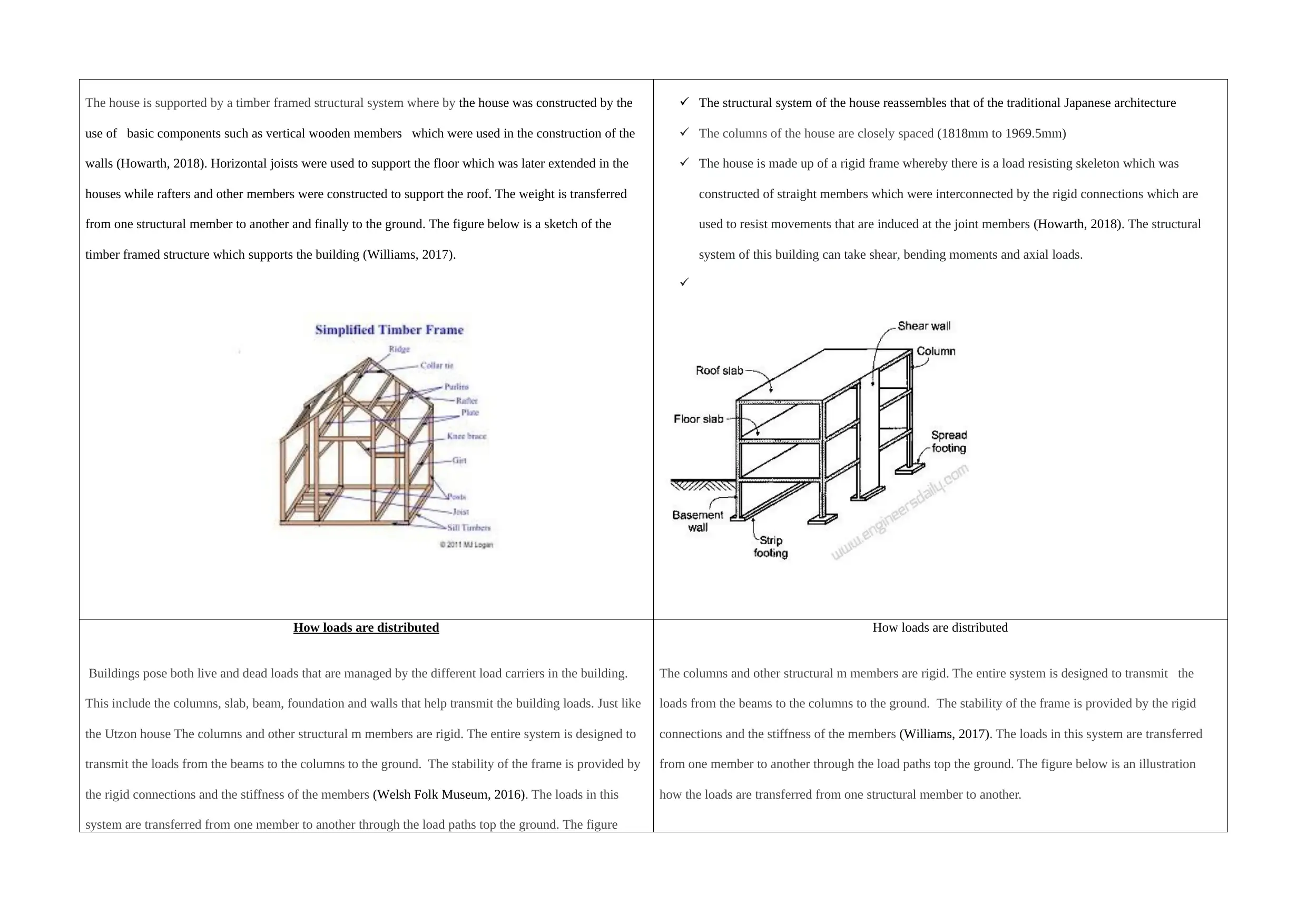
The house is supported by a timber framed structural system where by the house was constructed by the
use of basic components such as vertical wooden members which were used in the construction of the
walls (Howarth, 2018). Horizontal joists were used to support the floor which was later extended in the
houses while rafters and other members were constructed to support the roof. The weight is transferred
from one structural member to another and finally to the ground. The figure below is a sketch of the
timber framed structure which supports the building (Williams, 2017).
The structural system of the house reassembles that of the traditional Japanese architecture
The columns of the house are closely spaced (1818mm to 1969.5mm)
The house is made up of a rigid frame whereby there is a load resisting skeleton which was
constructed of straight members which were interconnected by the rigid connections which are
used to resist movements that are induced at the joint members (Howarth, 2018). The structural
system of this building can take shear, bending moments and axial loads.
How loads are distributed
Buildings pose both live and dead loads that are managed by the different load carriers in the building.
This include the columns, slab, beam, foundation and walls that help transmit the building loads. Just like
the Utzon house The columns and other structural m members are rigid. The entire system is designed to
transmit the loads from the beams to the columns to the ground. The stability of the frame is provided by
the rigid connections and the stiffness of the members (Welsh Folk Museum, 2016). The loads in this
system are transferred from one member to another through the load paths top the ground. The figure
How loads are distributed
The columns and other structural m members are rigid. The entire system is designed to transmit the
loads from the beams to the columns to the ground. The stability of the frame is provided by the rigid
connections and the stiffness of the members (Williams, 2017). The loads in this system are transferred
from one member to another through the load paths top the ground. The figure below is an illustration
how the loads are transferred from one structural member to another.
use of basic components such as vertical wooden members which were used in the construction of the
walls (Howarth, 2018). Horizontal joists were used to support the floor which was later extended in the
houses while rafters and other members were constructed to support the roof. The weight is transferred
from one structural member to another and finally to the ground. The figure below is a sketch of the
timber framed structure which supports the building (Williams, 2017).
The structural system of the house reassembles that of the traditional Japanese architecture
The columns of the house are closely spaced (1818mm to 1969.5mm)
The house is made up of a rigid frame whereby there is a load resisting skeleton which was
constructed of straight members which were interconnected by the rigid connections which are
used to resist movements that are induced at the joint members (Howarth, 2018). The structural
system of this building can take shear, bending moments and axial loads.
How loads are distributed
Buildings pose both live and dead loads that are managed by the different load carriers in the building.
This include the columns, slab, beam, foundation and walls that help transmit the building loads. Just like
the Utzon house The columns and other structural m members are rigid. The entire system is designed to
transmit the loads from the beams to the columns to the ground. The stability of the frame is provided by
the rigid connections and the stiffness of the members (Welsh Folk Museum, 2016). The loads in this
system are transferred from one member to another through the load paths top the ground. The figure
How loads are distributed
The columns and other structural m members are rigid. The entire system is designed to transmit the
loads from the beams to the columns to the ground. The stability of the frame is provided by the rigid
connections and the stiffness of the members (Williams, 2017). The loads in this system are transferred
from one member to another through the load paths top the ground. The figure below is an illustration
how the loads are transferred from one structural member to another.
Paraphrase This Document
Need a fresh take? Get an instant paraphrase of this document with our AI Paraphraser
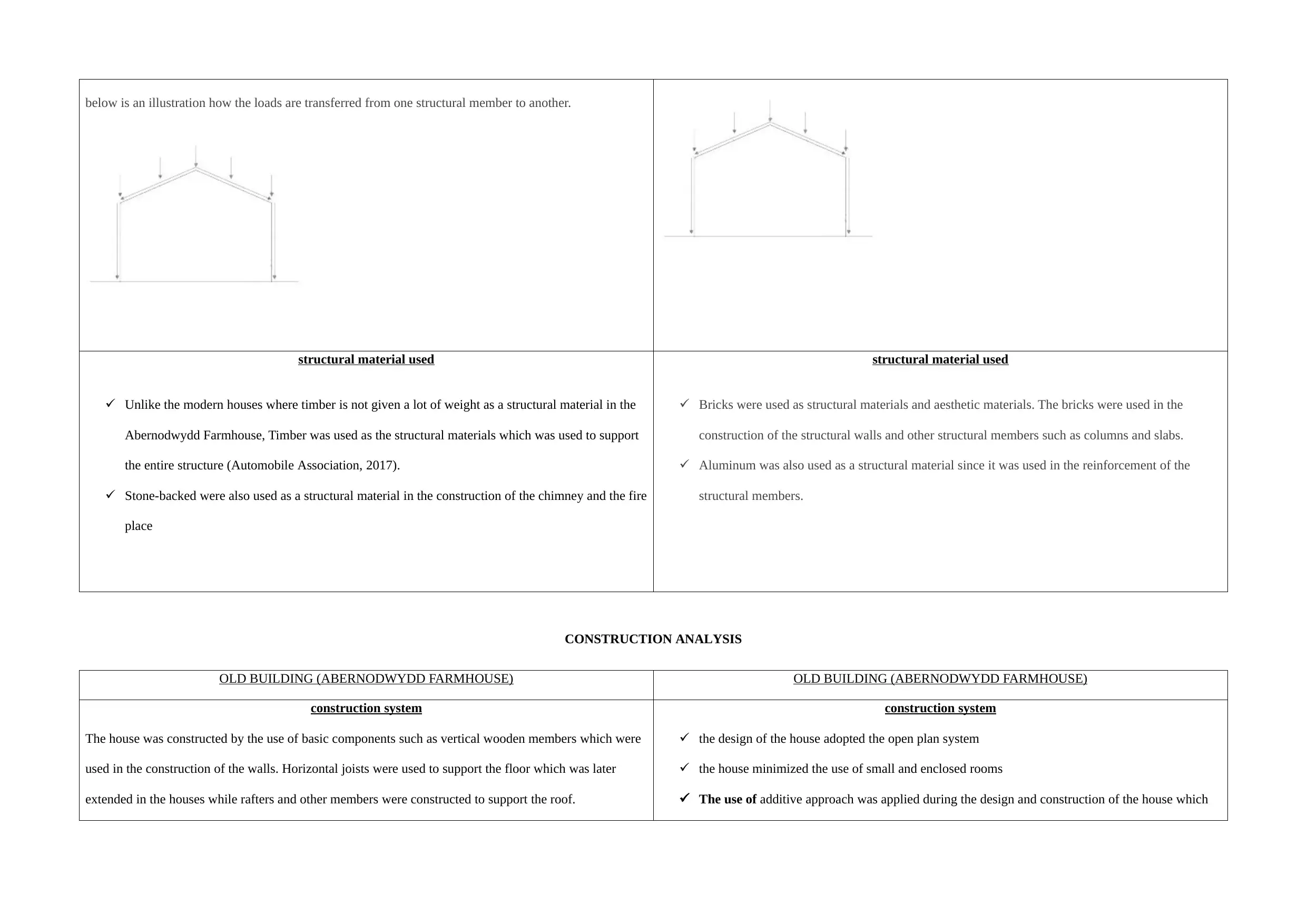
below is an illustration how the loads are transferred from one structural member to another.
structural material used
Unlike the modern houses where timber is not given a lot of weight as a structural material in the
Abernodwydd Farmhouse, Timber was used as the structural materials which was used to support
the entire structure (Automobile Association, 2017).
Stone-backed were also used as a structural material in the construction of the chimney and the fire
place
structural material used
Bricks were used as structural materials and aesthetic materials. The bricks were used in the
construction of the structural walls and other structural members such as columns and slabs.
Aluminum was also used as a structural material since it was used in the reinforcement of the
structural members.
CONSTRUCTION ANALYSIS
OLD BUILDING (ABERNODWYDD FARMHOUSE) OLD BUILDING (ABERNODWYDD FARMHOUSE)
construction system
The house was constructed by the use of basic components such as vertical wooden members which were
used in the construction of the walls. Horizontal joists were used to support the floor which was later
extended in the houses while rafters and other members were constructed to support the roof.
construction system
the design of the house adopted the open plan system
the house minimized the use of small and enclosed rooms
The use of additive approach was applied during the design and construction of the house which
structural material used
Unlike the modern houses where timber is not given a lot of weight as a structural material in the
Abernodwydd Farmhouse, Timber was used as the structural materials which was used to support
the entire structure (Automobile Association, 2017).
Stone-backed were also used as a structural material in the construction of the chimney and the fire
place
structural material used
Bricks were used as structural materials and aesthetic materials. The bricks were used in the
construction of the structural walls and other structural members such as columns and slabs.
Aluminum was also used as a structural material since it was used in the reinforcement of the
structural members.
CONSTRUCTION ANALYSIS
OLD BUILDING (ABERNODWYDD FARMHOUSE) OLD BUILDING (ABERNODWYDD FARMHOUSE)
construction system
The house was constructed by the use of basic components such as vertical wooden members which were
used in the construction of the walls. Horizontal joists were used to support the floor which was later
extended in the houses while rafters and other members were constructed to support the roof.
construction system
the design of the house adopted the open plan system
the house minimized the use of small and enclosed rooms
The use of additive approach was applied during the design and construction of the house which
allowed further extension of the house later.
Materials used
Building materials are the most important elements of ensuring that the buildings is structurally
sound and the choice of selection of materials will help achieve net zero energy home with less
emission of greenhouse gases. This will help in fighting or combating climate change by moving
towards sustainability which is the most recent debates across the world after the Tokyo protocol
of 1993 to ensure that development should be carried on a more sustainable manner. Different
materials were used in the construction of the Abernodwydd Farmhouse, some of the materials that
were used during construction include.
Wood: The wood was used as a structural material and as a cladding material, all the wall of the
Abernodwydd farmhouse are made up of wood.
Stone: the stones were used in the construction of the chimney band the fire place which is placed
in the middle of the housed.
Other materials which were used in construction include grass, which was the main roofing
material, clay and earth.
Materials used
Different materials were used in the construction of the Utzon house. Some of the materials were used as
structural materials while others were used for aesthetic purposes. Below are some of the materials that
were used during construction.
Pen glass wall for the southern facade.
The use of the glass wall was to ensure that the house was naturally lighted. This was to boost the
efforts of sustainable house.
pinewood partitions and doors
yellow-white bricks
The yellow and white bricks were used as both as structural materials and aesthetic materials
whereby they were used in the construction of the internal and external walls of the house.
Oregon pine
Aluminium
tiles
Materials used
Building materials are the most important elements of ensuring that the buildings is structurally
sound and the choice of selection of materials will help achieve net zero energy home with less
emission of greenhouse gases. This will help in fighting or combating climate change by moving
towards sustainability which is the most recent debates across the world after the Tokyo protocol
of 1993 to ensure that development should be carried on a more sustainable manner. Different
materials were used in the construction of the Abernodwydd Farmhouse, some of the materials that
were used during construction include.
Wood: The wood was used as a structural material and as a cladding material, all the wall of the
Abernodwydd farmhouse are made up of wood.
Stone: the stones were used in the construction of the chimney band the fire place which is placed
in the middle of the housed.
Other materials which were used in construction include grass, which was the main roofing
material, clay and earth.
Materials used
Different materials were used in the construction of the Utzon house. Some of the materials were used as
structural materials while others were used for aesthetic purposes. Below are some of the materials that
were used during construction.
Pen glass wall for the southern facade.
The use of the glass wall was to ensure that the house was naturally lighted. This was to boost the
efforts of sustainable house.
pinewood partitions and doors
yellow-white bricks
The yellow and white bricks were used as both as structural materials and aesthetic materials
whereby they were used in the construction of the internal and external walls of the house.
Oregon pine
Aluminium
tiles
⊘ This is a preview!⊘
Do you want full access?
Subscribe today to unlock all pages.
Trusted by 1+ million students worldwide

References
Automobile Association. (2017). AA Touring Guide to Wales (2nd ed.). Chicago: AA.
Edlin, H. L. (2017). Glamorgan Forests (3rd ed.). Sydney: H.M. Stationery Office,.
Howarth, E. (2018). The Museums Journal, (3rd ed.). London: Museums Association,.
Stewart Williams. (2015). Stewart Williams' Glamorgan historian (2nd ed.). Chicago: D. Brown.
Weber, W. (2015). Lessons from Vernacular Architecture. London: Routledge.
Welsh Folk Museum. (2016). Handbook (2nd ed.). Chicago: The Museum.
Williams, R. (2017). The Volunteers (2nd ed.). London: Eyre Methuen,.
Automobile Association. (2017). AA Touring Guide to Wales (2nd ed.). Chicago: AA.
Edlin, H. L. (2017). Glamorgan Forests (3rd ed.). Sydney: H.M. Stationery Office,.
Howarth, E. (2018). The Museums Journal, (3rd ed.). London: Museums Association,.
Stewart Williams. (2015). Stewart Williams' Glamorgan historian (2nd ed.). Chicago: D. Brown.
Weber, W. (2015). Lessons from Vernacular Architecture. London: Routledge.
Welsh Folk Museum. (2016). Handbook (2nd ed.). Chicago: The Museum.
Williams, R. (2017). The Volunteers (2nd ed.). London: Eyre Methuen,.

1 out of 10


Related Documents


Your All-in-One AI-Powered Toolkit for Academic Success.
+13062052269
info@desklib.com
Available 24*7 on WhatsApp / Email
![[object Object]](/_next/static/media/star-bottom.7253800d.svg)
Unlock your academic potential
Copyright © 2020–2026 A2Z Services. All Rights Reserved. Developed and managed by ZUCOL.