Associated British Foods PLC: Market Analysis and Recommendations
VerifiedAdded on 2021/08/10
|10
|3089
|59
Report
AI Summary
This report provides a comprehensive analysis of Associated British Foods PLC (ABF), a multinational food and retail company. It begins with a background and history of the company, tracing its evolution and key acquisitions. The report then delves into ABF's market positioning, highlighting its strategies and market sector selection. An external analysis is conducted, examining both the macro (PESTEL factors) and micro environments, including competitors and suppliers. Financial performance is evaluated using key metrics like revenue, net profit ratio, and ROA, with comparisons to competitors. Finally, the report offers recommendations, focusing on organizational culture, employee behavior, and the application of SWOT analysis to maintain a competitive edge and adapt to market changes. The analysis draws on various academic sources and industry reports to support its findings and conclusions, providing a well-rounded assessment of ABF's current standing and future prospects.
Contents
BACKGROUND..................................................................................................................................1
HISTORY...........................................................................................................................................1
Market Positioning...........................................................................................................................2
External Analysis..............................................................................................................................2
I. Macro External Environment Analysis..................................................................................2
II. Micro External Environment Analysis...................................................................................3
Financial Analysis Performance.......................................................................................................4
Recommendation............................................................................................................................6
References.......................................................................................................................................8
BACKGROUND..................................................................................................................................1
HISTORY...........................................................................................................................................1
Market Positioning...........................................................................................................................2
External Analysis..............................................................................................................................2
I. Macro External Environment Analysis..................................................................................2
II. Micro External Environment Analysis...................................................................................3
Financial Analysis Performance.......................................................................................................4
Recommendation............................................................................................................................6
References.......................................................................................................................................8

Paraphrase This Document
Need a fresh take? Get an instant paraphrase of this document with our AI Paraphraser
BACKGROUND
The Associated British Foods is a British corporation where their headquarter is located in
London. According to Goldberg in 2011, it is indeed a multinational company food retailing and
processing business that has been ranked highly in various classes of food manufacturing. The
associated British Foods plc seems to be the world's largest producer of sugar and baker's
yeast, as well as a leading producer of other ingredients like emulsifiers, lactose, and enzymes.
It was a main grocery division that includes Ovaltine, Twining, Jordans, and Ryvita, as well as
private label grocery foodstuffs. This company seems to have a large retail division of more
than 15,000,000 square feet of retail space in United Kingdom, Germany, Ireland, Spain, as well
as among other countries (Goldberg, 2011). British Foods plc, which is affiliated with the
company, is part of the leading manufacturers of consumables in the United Kingdom.
HISTORY
According to Goldberg in 2011, the Associated British Foods plc company was formed in 1935
by Canadian W. Garfield Weston as the Food Investments Limited, however after few months
were rebranded to Allied Bakeries Limited. Allied acquired ten state and local bakery firms
between 1935 and 1956. During this time, the company made a significant acquisition by
purchasing the Aerated Bread Company. Since then, Allied had achieved a considerable share of
the bakery products market in the United Kingdom throughout that period. At that time,
cookies and bread were being baked. ALLIED's gross margin increased dramatically as a result of
these acquisitions. Allied changed its name to Associated British Foods in 1960. Fine Fare, a
major British grocery store chain, was purchased by Allied in 1963. When the founder of
Association British Foods died in 1978, his children Garry and Galen took over. During the year
of 1986, the company began selling Fine Fare, and during 1991, they purchased the Sugar
Company. ABF pulled out from Ireland in 1997, sell off few of its main retails. Over the course of
the year 2000, the corporation showed interest in Burton's Biscuits as well as decided to
purchase a few shares of the company, and in 2002, ABF purchased the Argo and Kingsford's
cornstarch, Henri's dressing brands, mazona corn oil, and Karo and Golden Griddle syrups,
along with other products of Canadian. Finally in 2011, ABF Company was charged with tax
The Associated British Foods is a British corporation where their headquarter is located in
London. According to Goldberg in 2011, it is indeed a multinational company food retailing and
processing business that has been ranked highly in various classes of food manufacturing. The
associated British Foods plc seems to be the world's largest producer of sugar and baker's
yeast, as well as a leading producer of other ingredients like emulsifiers, lactose, and enzymes.
It was a main grocery division that includes Ovaltine, Twining, Jordans, and Ryvita, as well as
private label grocery foodstuffs. This company seems to have a large retail division of more
than 15,000,000 square feet of retail space in United Kingdom, Germany, Ireland, Spain, as well
as among other countries (Goldberg, 2011). British Foods plc, which is affiliated with the
company, is part of the leading manufacturers of consumables in the United Kingdom.
HISTORY
According to Goldberg in 2011, the Associated British Foods plc company was formed in 1935
by Canadian W. Garfield Weston as the Food Investments Limited, however after few months
were rebranded to Allied Bakeries Limited. Allied acquired ten state and local bakery firms
between 1935 and 1956. During this time, the company made a significant acquisition by
purchasing the Aerated Bread Company. Since then, Allied had achieved a considerable share of
the bakery products market in the United Kingdom throughout that period. At that time,
cookies and bread were being baked. ALLIED's gross margin increased dramatically as a result of
these acquisitions. Allied changed its name to Associated British Foods in 1960. Fine Fare, a
major British grocery store chain, was purchased by Allied in 1963. When the founder of
Association British Foods died in 1978, his children Garry and Galen took over. During the year
of 1986, the company began selling Fine Fare, and during 1991, they purchased the Sugar
Company. ABF pulled out from Ireland in 1997, sell off few of its main retails. Over the course of
the year 2000, the corporation showed interest in Burton's Biscuits as well as decided to
purchase a few shares of the company, and in 2002, ABF purchased the Argo and Kingsford's
cornstarch, Henri's dressing brands, mazona corn oil, and Karo and Golden Griddle syrups,
along with other products of Canadian. Finally in 2011, ABF Company was charged with tax
evasion. ABF was cleared of "illegal and unethical" duty evasion in February 2013 (Goldberg,
2011).
Market Positioning
Based on Chen in 2002, market positioning is a process of developing a product's brand and
reputation so that consumers view it in a specific way (Chen, 2002). The Associated British
Foods PLC is a multinational corporation that has been around for nearly eighty-five years, and
one of the main tactics the business has focused during that period has been proper market
positioning and market sector selection. Throughout the year, this company has purchased a
variety of other food manufacturing entities, including bakery business but not just limited to
bakery, also have the most recent being which is the corn-made oil businesses.
External Analysis
I. Macro External Environment Analysis
The macro external environment focuses on the external nature that surrounds the business
and affects critical decisions instead of or it is not influenced by the organization (Bourguignon,
1992). Associated British Foods plc seems to have a methods for measuring the macro world in
which it operates. The PESTEL theoretical instrument, according to Yuksel in 2012, aids in
critically evaluating the uncontrollable external. PESTEL acronyms for Political, Economic, Social,
Technical, Environmental, and Legal factors that have a substantial effect on The Associated
British foods PLC's macro ecosystem (Yuksel, 2012).
Variations in the macro-environment have negative consequences for the business as a whole
(Banham, 2010). They have the ability to affect a company's strategy and competitive
environment, as well as profit margins. A smooth business operation of Associated British
Foods plc is influenced by the political factors. Associated British Foods plc seems to have a
footprint in more than a dozen countries, positioning it in a wide range of political settings. This
can only deal with the issue by varying the structural problems that are present in different
political settings.
A lot of economic factors influence Associated British Foods plc, including the budget cycle,
inflation rates, foreign exchange rates, investment returns, and even interest rates (Dunner,
2011).
Market Positioning
Based on Chen in 2002, market positioning is a process of developing a product's brand and
reputation so that consumers view it in a specific way (Chen, 2002). The Associated British
Foods PLC is a multinational corporation that has been around for nearly eighty-five years, and
one of the main tactics the business has focused during that period has been proper market
positioning and market sector selection. Throughout the year, this company has purchased a
variety of other food manufacturing entities, including bakery business but not just limited to
bakery, also have the most recent being which is the corn-made oil businesses.
External Analysis
I. Macro External Environment Analysis
The macro external environment focuses on the external nature that surrounds the business
and affects critical decisions instead of or it is not influenced by the organization (Bourguignon,
1992). Associated British Foods plc seems to have a methods for measuring the macro world in
which it operates. The PESTEL theoretical instrument, according to Yuksel in 2012, aids in
critically evaluating the uncontrollable external. PESTEL acronyms for Political, Economic, Social,
Technical, Environmental, and Legal factors that have a substantial effect on The Associated
British foods PLC's macro ecosystem (Yuksel, 2012).
Variations in the macro-environment have negative consequences for the business as a whole
(Banham, 2010). They have the ability to affect a company's strategy and competitive
environment, as well as profit margins. A smooth business operation of Associated British
Foods plc is influenced by the political factors. Associated British Foods plc seems to have a
footprint in more than a dozen countries, positioning it in a wide range of political settings. This
can only deal with the issue by varying the structural problems that are present in different
political settings.
A lot of economic factors influence Associated British Foods plc, including the budget cycle,
inflation rates, foreign exchange rates, investment returns, and even interest rates (Dunner,
⊘ This is a preview!⊘
Do you want full access?
Subscribe today to unlock all pages.

Trusted by 1+ million students worldwide
1994). These factors play a significant role in deciding the company's growth trajectory. Yuksel
in 2012 defined social culture as "society's norm of doing things." Technological factors play a
significant role as well (Yuksel, 2012). With the rapid advancement in technology, several
industries have experienced negative changes, such as the transportation market, which has
been severely disrupted. Associated British Foods PLC has always discovered new methods and
techniques to fit into the present situation since its inception in the pre-technology era.
Furthermore, legal factor also consider as a critical threat in external influences. As we can see
from the issue when The Associated British Foods PLC was convicted of evading taxes in the
early of year 2011, we can say that this was a situation that had been debated for more than
three years. All in all, all these factors obstruct regular business operations.
II. Micro External Environment Analysis
Micro external factors, in contrast to macro external environment factors, are easily regulated
or less predetermined by the business. Although not explicitly, the corporation has a choice in
who their suppliers and even customers are. Competitors of the company fall into this category
as well, despite the fact that the company has little influence about who their competitors are.
The company's strategic planning should still be aware of the company's rivals, as well as their
most recent plans and implementations. This is for the sole purpose of being competitive at all
times. According to Bourguignon et al in 1992, the main factors we can find from external
microenvironment include consumers, the suppliers for the business, rivals, company's staff, as
well as the marketing intermediaries (Bourguignon, 1992).
Uhrenholt, Weis Markets, Sainsbury's, and Shamrock Foods are the primary rivals of the
Associated British Foods PLC. Except for the Uhrenholt, which is a private company while the
rest are all public corporations. In order to become the strongest amongst them, Associated
British Foods PLC must focuses on recognizing the customers' needs as well as well-managed
human resource organizations. Paying bills or debts on time and having a healthy market place
are two of the most important factors that contribute to The associated British foods PLC's
success. It's also worth on looking at marketing intermediaries. The Associated British Foods
PLC retains its market position by focusing on many factors, including knowing the needs of its
customers, investing wisely in advertising, and cultivating a positive culture (Goldberg, 2011).
in 2012 defined social culture as "society's norm of doing things." Technological factors play a
significant role as well (Yuksel, 2012). With the rapid advancement in technology, several
industries have experienced negative changes, such as the transportation market, which has
been severely disrupted. Associated British Foods PLC has always discovered new methods and
techniques to fit into the present situation since its inception in the pre-technology era.
Furthermore, legal factor also consider as a critical threat in external influences. As we can see
from the issue when The Associated British Foods PLC was convicted of evading taxes in the
early of year 2011, we can say that this was a situation that had been debated for more than
three years. All in all, all these factors obstruct regular business operations.
II. Micro External Environment Analysis
Micro external factors, in contrast to macro external environment factors, are easily regulated
or less predetermined by the business. Although not explicitly, the corporation has a choice in
who their suppliers and even customers are. Competitors of the company fall into this category
as well, despite the fact that the company has little influence about who their competitors are.
The company's strategic planning should still be aware of the company's rivals, as well as their
most recent plans and implementations. This is for the sole purpose of being competitive at all
times. According to Bourguignon et al in 1992, the main factors we can find from external
microenvironment include consumers, the suppliers for the business, rivals, company's staff, as
well as the marketing intermediaries (Bourguignon, 1992).
Uhrenholt, Weis Markets, Sainsbury's, and Shamrock Foods are the primary rivals of the
Associated British Foods PLC. Except for the Uhrenholt, which is a private company while the
rest are all public corporations. In order to become the strongest amongst them, Associated
British Foods PLC must focuses on recognizing the customers' needs as well as well-managed
human resource organizations. Paying bills or debts on time and having a healthy market place
are two of the most important factors that contribute to The associated British foods PLC's
success. It's also worth on looking at marketing intermediaries. The Associated British Foods
PLC retains its market position by focusing on many factors, including knowing the needs of its
customers, investing wisely in advertising, and cultivating a positive culture (Goldberg, 2011).
Paraphrase This Document
Need a fresh take? Get an instant paraphrase of this document with our AI Paraphraser
Financial Analysis Performance
The examination of financial statistics in a company ’s financial statements is important since it
helps identify both negative and positive market trends over time. It assists the business in
understanding its market position as well as its competitive potential.
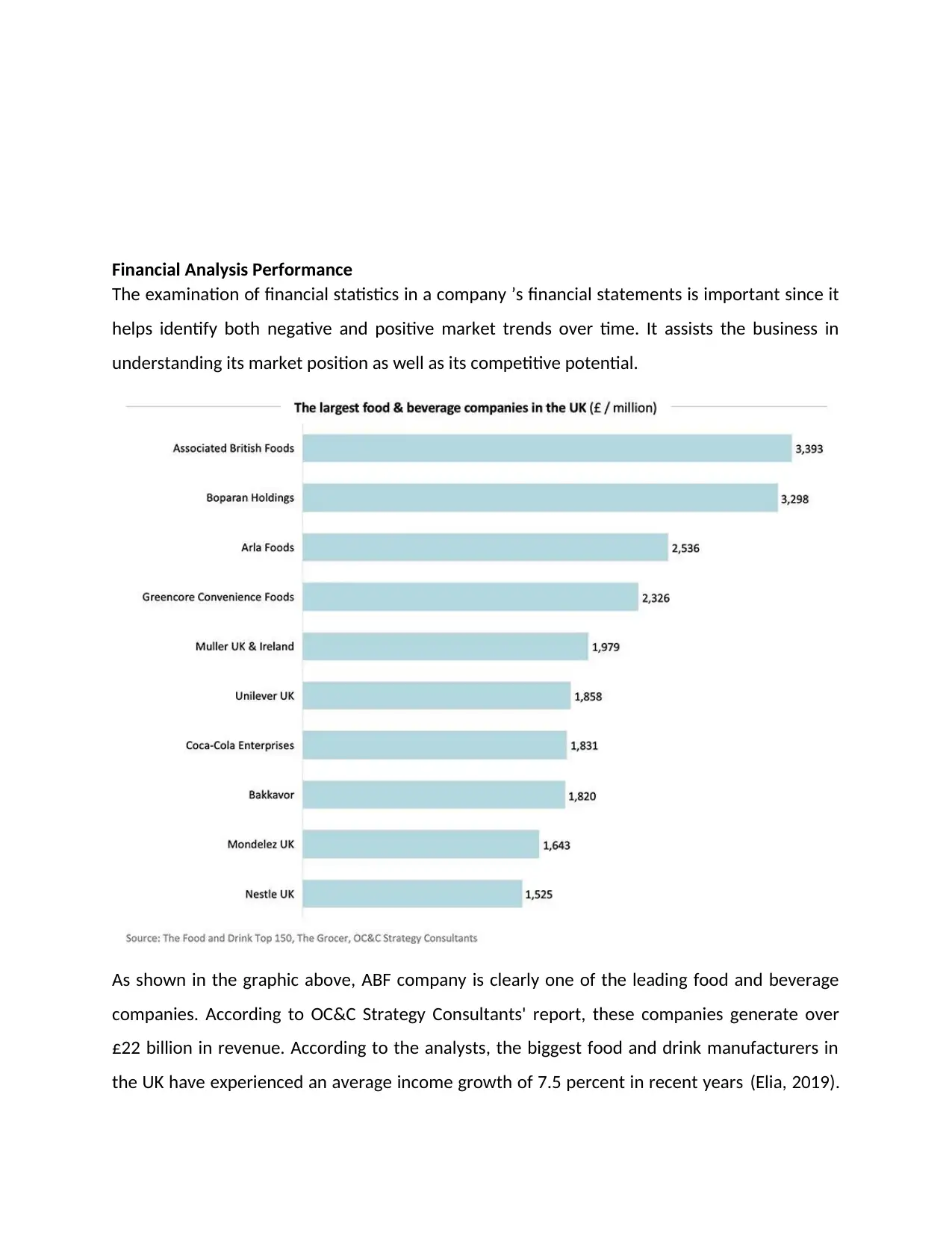
As shown in the graphic above, ABF company is clearly one of the leading food and beverage
companies. According to OC&C Strategy Consultants' report, these companies generate over
£22 billion in revenue. According to the analysts, the biggest food and drink manufacturers in
the UK have experienced an average income growth of 7.5 percent in recent years (Elia, 2019).
The examination of financial statistics in a company ’s financial statements is important since it
helps identify both negative and positive market trends over time. It assists the business in
understanding its market position as well as its competitive potential.
As shown in the graphic above, ABF company is clearly one of the leading food and beverage
companies. According to OC&C Strategy Consultants' report, these companies generate over
£22 billion in revenue. According to the analysts, the biggest food and drink manufacturers in
the UK have experienced an average income growth of 7.5 percent in recent years (Elia, 2019).
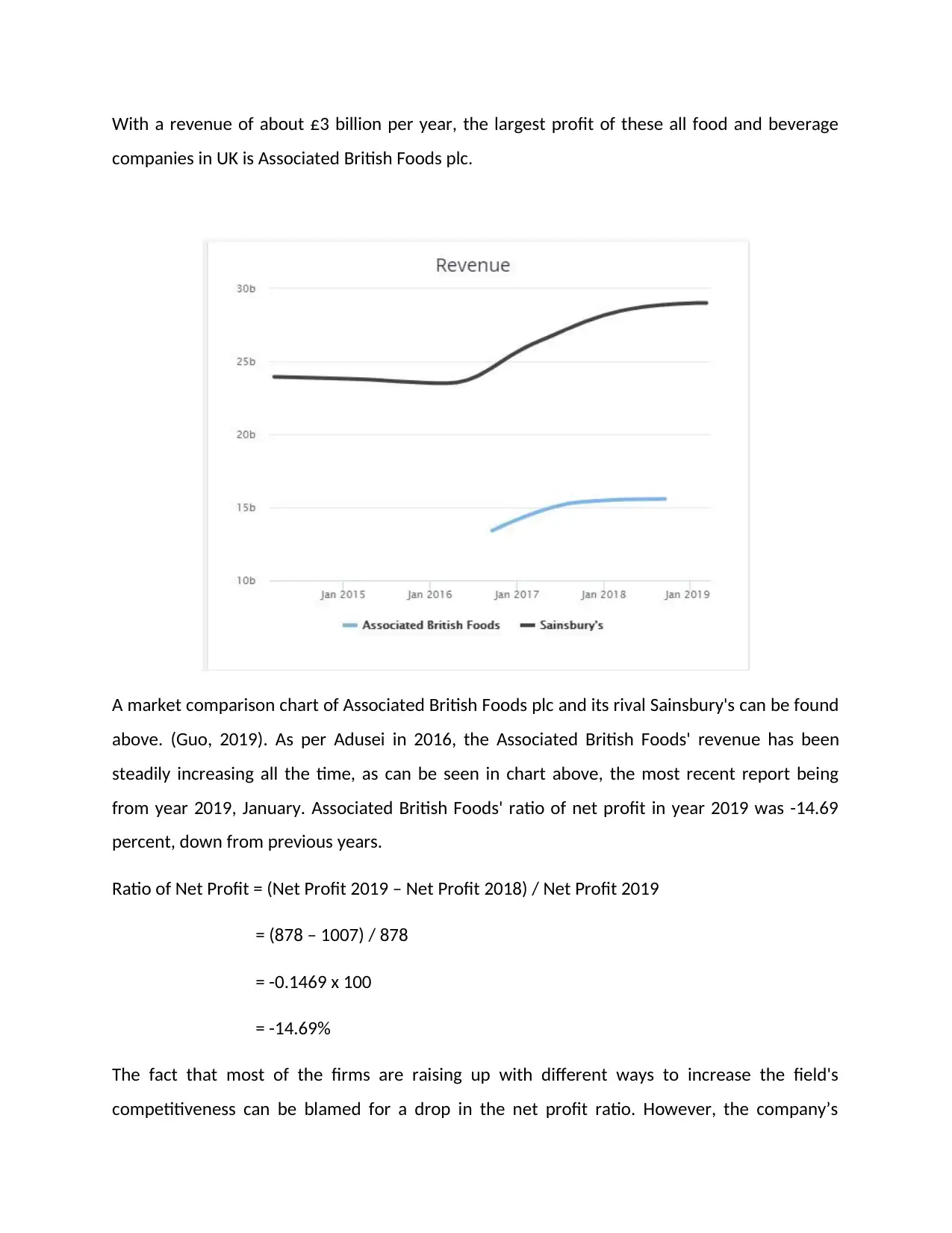
With a revenue of about £3 billion per year, the largest profit of these all food and beverage
companies in UK is Associated British Foods plc.
A market comparison chart of Associated British Foods plc and its rival Sainsbury's can be found
above. (Guo, 2019). As per Adusei in 2016, the Associated British Foods' revenue has been
steadily increasing all the time, as can be seen in chart above, the most recent report being
from year 2019, January. Associated British Foods' ratio of net profit in year 2019 was -14.69
percent, down from previous years.
Ratio of Net Profit = (Net Profit 2019 – Net Profit 2018) / Net Profit 2019
= (878 – 1007) / 878
= -0.1469 x 100
= -14.69%
The fact that most of the firms are raising up with different ways to increase the field's
competitiveness can be blamed for a drop in the net profit ratio. However, the company’s
companies in UK is Associated British Foods plc.
A market comparison chart of Associated British Foods plc and its rival Sainsbury's can be found
above. (Guo, 2019). As per Adusei in 2016, the Associated British Foods' revenue has been
steadily increasing all the time, as can be seen in chart above, the most recent report being
from year 2019, January. Associated British Foods' ratio of net profit in year 2019 was -14.69
percent, down from previous years.
Ratio of Net Profit = (Net Profit 2019 – Net Profit 2018) / Net Profit 2019
= (878 – 1007) / 878
= -0.1469 x 100
= -14.69%
The fact that most of the firms are raising up with different ways to increase the field's
competitiveness can be blamed for a drop in the net profit ratio. However, the company’s
⊘ This is a preview!⊘
Do you want full access?
Subscribe today to unlock all pages.
Trusted by 1+ million students worldwide
return on assets (ROA) ratio amounted to 4.87 percent (Adusei, 2016). The net income yielded
by total assets is calculated by the return on assets ratio (ROA) (Palepu, 2020). It is measured by
multiplying net profits after expenditures by the total assets. It allows management and
potential investors to calculate how much benefit they will make from asset investments (Cox,
2021). The return on assets (ROA) is a metric for determining the profitability of a company's
assets. The ROA of Associated British Food PLC and one of its direct rivals, Hovis Ltd, were
contrasted in 2019. The better the financial results, the higher the ROA (Wang, 2017).
ROA = Net Income/Average Total Assets
2019 ROA for Associated British Food Plc = 1,558,000,000/ 320,000,000
ROA = 4.87
2019 ROA Hovis Ltd = 8,300,000 / 5,040,700
ROA = 1646
Source: Annual Report 2019 Hovis Ltd & Annual Report 2019 Associated British Food Plc
According to the findings above, Associated British Food PLC seems to have a stronger ROA
than Hovis ltd, indicating that its assets are delivering more income than Hovis ltd's assets.
Recommendation
Associated British Foods plc is indeed a major retailer of consumables in the United Kingdom.
The fact that such an organization has survived for over 85 years demonstrates that the
company has had consistently excellent management and performance throughout the
decades. The figures above illustrate how competitive it is compared to other companies in the
industry. To be in the role the Associated British Foods is in, they must do such things the right
way and strive to do that without fail.
According to Davies et al in 2000, organizational culture refers to the company's attitudes and
practices, and its workers are crucial in the firm's internal operations. A healthy and positive
organizational culture in the business is defined by subordinates understanding the central
reason for the company's existence, upholding working ethical standards, and making good
by total assets is calculated by the return on assets ratio (ROA) (Palepu, 2020). It is measured by
multiplying net profits after expenditures by the total assets. It allows management and
potential investors to calculate how much benefit they will make from asset investments (Cox,
2021). The return on assets (ROA) is a metric for determining the profitability of a company's
assets. The ROA of Associated British Food PLC and one of its direct rivals, Hovis Ltd, were
contrasted in 2019. The better the financial results, the higher the ROA (Wang, 2017).
ROA = Net Income/Average Total Assets
2019 ROA for Associated British Food Plc = 1,558,000,000/ 320,000,000
ROA = 4.87
2019 ROA Hovis Ltd = 8,300,000 / 5,040,700
ROA = 1646
Source: Annual Report 2019 Hovis Ltd & Annual Report 2019 Associated British Food Plc
According to the findings above, Associated British Food PLC seems to have a stronger ROA
than Hovis ltd, indicating that its assets are delivering more income than Hovis ltd's assets.
Recommendation
Associated British Foods plc is indeed a major retailer of consumables in the United Kingdom.
The fact that such an organization has survived for over 85 years demonstrates that the
company has had consistently excellent management and performance throughout the
decades. The figures above illustrate how competitive it is compared to other companies in the
industry. To be in the role the Associated British Foods is in, they must do such things the right
way and strive to do that without fail.
According to Davies et al in 2000, organizational culture refers to the company's attitudes and
practices, and its workers are crucial in the firm's internal operations. A healthy and positive
organizational culture in the business is defined by subordinates understanding the central
reason for the company's existence, upholding working ethical standards, and making good
Paraphrase This Document
Need a fresh take? Get an instant paraphrase of this document with our AI Paraphraser
decisions (Davies, 2000). Having adopted such a culture within the Associated British Foods
would be an additional benefit in terms of staff retention. This is connected to the company's
employee behaviour. Employee behaviour, according to Shore in 1993, refers to how workers
respond to various job circumstances or situations. Although a variety of factors can influence
an employee's attitude at work, organizational culture is primarily responsible for influencing
employee behavior (Shore, 1993).
Each organization considers the SWOT review, which stands for Strengths, Weaknesses,
Opportunities, and Risks, when it comes to strategic management (Hill, 1997). Comprehending
the business strengths will placed the company's management in a strong negotiating or better
competitive position against the competition. A company's advantage or strength is what it can
easily do that other businesses in the same category can't. The organization could then
concentrate its resources and efforts in this field in order to gain a competitive advantage over
its competitors.
Weakness, which is the complete opposite of strength, reveal the areas where the organization
fails. Based on Hill's opinion in 1997, the organization must always devise tactics and methods
to significantly decrease its vulnerabilities (Hill, 1997). One method of keeping the business
updated is to look for changes and improvement in the day-to-day operations. It is essential for
the organization to identify various consumer patterns in order to keep track of what is popular
or hot selling and what is not. In the industry world, a static organization would not last long. In
every business environment, there are always threats (Hill, 1997). Leaders and managements
should always recognize and reinforce their weak ties in the business world. Failure to
recognize a business threat can easily lead to the demise of a company.
The use of the PESTEL strategic method is also a more effective way of assessing the company's
external framework (Yuksel, 2012). It's also necessary to consider factors that have no bearing
on the business. As previously stated, the macro external factors that affect the organization
are political, economic, social, technical, environmental, and legal. Different political systems
necessitate different management techniques. The various market dynamics of the region are
also predetermined by the political stability of the land (Yuksel, 2012). For instance, if the UK
would be an additional benefit in terms of staff retention. This is connected to the company's
employee behaviour. Employee behaviour, according to Shore in 1993, refers to how workers
respond to various job circumstances or situations. Although a variety of factors can influence
an employee's attitude at work, organizational culture is primarily responsible for influencing
employee behavior (Shore, 1993).
Each organization considers the SWOT review, which stands for Strengths, Weaknesses,
Opportunities, and Risks, when it comes to strategic management (Hill, 1997). Comprehending
the business strengths will placed the company's management in a strong negotiating or better
competitive position against the competition. A company's advantage or strength is what it can
easily do that other businesses in the same category can't. The organization could then
concentrate its resources and efforts in this field in order to gain a competitive advantage over
its competitors.
Weakness, which is the complete opposite of strength, reveal the areas where the organization
fails. Based on Hill's opinion in 1997, the organization must always devise tactics and methods
to significantly decrease its vulnerabilities (Hill, 1997). One method of keeping the business
updated is to look for changes and improvement in the day-to-day operations. It is essential for
the organization to identify various consumer patterns in order to keep track of what is popular
or hot selling and what is not. In the industry world, a static organization would not last long. In
every business environment, there are always threats (Hill, 1997). Leaders and managements
should always recognize and reinforce their weak ties in the business world. Failure to
recognize a business threat can easily lead to the demise of a company.
The use of the PESTEL strategic method is also a more effective way of assessing the company's
external framework (Yuksel, 2012). It's also necessary to consider factors that have no bearing
on the business. As previously stated, the macro external factors that affect the organization
are political, economic, social, technical, environmental, and legal. Different political systems
necessitate different management techniques. The various market dynamics of the region are
also predetermined by the political stability of the land (Yuksel, 2012). For instance, if the UK
government prohibits Associated British Foods plc from selling certain foods, the business
would suffer significant losses and could be forced to closeIn today's society, technology is
equally crucial. Bringing the firm up to date with current technological advancements is a
concern that can be accomplished by acquiring technology professionals and experts. Many
businesses get it wrong when it comes to addressing their customers' desires, while others
depend on it as the best way to reach out to them. Seeing as children prefer sugary snacks, a
company that makes sugar-free desserts will see a decrease in sales, while a company that
makes sugared desserts will see an increase. Companies must always be in compliance with the
rules. Violations of the country's rules and regulations affecting commercial operations could
lead in harsh penalties or possibly the dissolution of a company. In order to stay in business,
Associated British Foods plc always have to be smart to observe the latest laws and regulations
of each country .
References
Adusei, C. &. (2016). A five-year retrospective study of the financial situation of Northern Foods PLc.,
United Kingdom. Expert Journal of Finance 4(1).
Banham, H. (2010). External environmental analysis for small and medium enterprises (SMEs). Journal of
Business & Economics Research (JBER), 8(10).
Bourguignon, F. B. (1992). Adjustment and income distribution: A micro-macro model for counterfactual
analysis. Journal of Development Economics 38(1), 17-39.
Chen, J. &. (2002). Market positioning analysis: A hybrid approach. Annals of tousim research, 29(4),
987-1003.
Cox, J. (2021). The higher education environment driving academic library strategy: A political,
economic, social and technological (PEST) analysis. The Journal of Academic.
Davies, H. N. (2000). Organizational culture and quality of health care. BMJ Quality & Safety, 9(2), 111-
119.
Dunner, P. &. (1994). Age, size, growth, and survival: UK companies in the 1980s. The Journal of
Industrial Economics , 115 - 140.
Elia, A. (2019). Fashion's Destruction of Unsold Goods: Responsible Solutions for an Environmentally
Conscious Future. . Fordham Intell. Prop. Media & Ent. LJ, 539.
Goldberg, R. K. (2011). Associated British Foods, Plc.
would suffer significant losses and could be forced to closeIn today's society, technology is
equally crucial. Bringing the firm up to date with current technological advancements is a
concern that can be accomplished by acquiring technology professionals and experts. Many
businesses get it wrong when it comes to addressing their customers' desires, while others
depend on it as the best way to reach out to them. Seeing as children prefer sugary snacks, a
company that makes sugar-free desserts will see a decrease in sales, while a company that
makes sugared desserts will see an increase. Companies must always be in compliance with the
rules. Violations of the country's rules and regulations affecting commercial operations could
lead in harsh penalties or possibly the dissolution of a company. In order to stay in business,
Associated British Foods plc always have to be smart to observe the latest laws and regulations
of each country .
References
Adusei, C. &. (2016). A five-year retrospective study of the financial situation of Northern Foods PLc.,
United Kingdom. Expert Journal of Finance 4(1).
Banham, H. (2010). External environmental analysis for small and medium enterprises (SMEs). Journal of
Business & Economics Research (JBER), 8(10).
Bourguignon, F. B. (1992). Adjustment and income distribution: A micro-macro model for counterfactual
analysis. Journal of Development Economics 38(1), 17-39.
Chen, J. &. (2002). Market positioning analysis: A hybrid approach. Annals of tousim research, 29(4),
987-1003.
Cox, J. (2021). The higher education environment driving academic library strategy: A political,
economic, social and technological (PEST) analysis. The Journal of Academic.
Davies, H. N. (2000). Organizational culture and quality of health care. BMJ Quality & Safety, 9(2), 111-
119.
Dunner, P. &. (1994). Age, size, growth, and survival: UK companies in the 1980s. The Journal of
Industrial Economics , 115 - 140.
Elia, A. (2019). Fashion's Destruction of Unsold Goods: Responsible Solutions for an Environmentally
Conscious Future. . Fordham Intell. Prop. Media & Ent. LJ, 539.
Goldberg, R. K. (2011). Associated British Foods, Plc.
⊘ This is a preview!⊘
Do you want full access?
Subscribe today to unlock all pages.
Trusted by 1+ million students worldwide
Guo, L. &. (2019). Ratio analysis of J Sainsbury plc financial performance between 2015 and 2018 in
comparison with Tesco and Morrisons. American Journal of Industrial and Business
Management, 9(2), 325-341.
Hill, T. &. (1997). SWOT analysis: it's time for a product recall. Long range planning, 30(1), 46-52.
Palepu, K. H. (2020). Business analysis and valuation: Using financial statement. Cengage AU.
Shore, L. &. (1993). Commitment and employee behavior: Comparison of affective commitment and
continuance commitment with perceived organizational support. . Journal of applied
psychology, 78(5), 774.
Wang, Z. &. (2017). Corporate social responsibility governance, outcomes, and financial performance. .
Journal of Cleaner Production, 1607-1616.
Yuksel, I. (2012). Developing a multi-criteria decision making model for PESTEL analysis. International
Journal of Business and Management 7(24), 52.
comparison with Tesco and Morrisons. American Journal of Industrial and Business
Management, 9(2), 325-341.
Hill, T. &. (1997). SWOT analysis: it's time for a product recall. Long range planning, 30(1), 46-52.
Palepu, K. H. (2020). Business analysis and valuation: Using financial statement. Cengage AU.
Shore, L. &. (1993). Commitment and employee behavior: Comparison of affective commitment and
continuance commitment with perceived organizational support. . Journal of applied
psychology, 78(5), 774.
Wang, Z. &. (2017). Corporate social responsibility governance, outcomes, and financial performance. .
Journal of Cleaner Production, 1607-1616.
Yuksel, I. (2012). Developing a multi-criteria decision making model for PESTEL analysis. International
Journal of Business and Management 7(24), 52.

1 out of 10


Your All-in-One AI-Powered Toolkit for Academic Success.
+13062052269
info@desklib.com
Available 24*7 on WhatsApp / Email
![[object Object]](/_next/static/media/star-bottom.7253800d.svg)
Unlock your academic potential
Copyright © 2020–2026 A2Z Services. All Rights Reserved. Developed and managed by ZUCOL.