Assignment on Mood Disorders in Abnormal Psychology Course

Verified

Added on  2023/04/21

|3
|493
|281
Homework Assignment
AI Summary
This assignment delves into the realm of mood disorders within the field of abnormal psychology. It begins by differentiating between normal and abnormally depressed moods, defining mood disorders as psychological conditions impacting mood and daily functioning. The assignment then contrasts unipolar and bipolar mood disorders, providing definitions and outlining the characteristics of major depressive, dysthymic, bipolar, and cyclothymic disorders. Furthermore, it explores seasonal affective disorder and postpartum depression, examining their unique features and impact. The assignment draws upon the textbook and relevant research to provide a comprehensive understanding of mood disorders, their classification, symptoms, and associated factors.
Document Page
Running Head: ABNORMAL PSYCHOLOGY 1
ABNORMAL PSYCHOLOGY
Name
Institution Affiliation
tabler-icon-diamond-filled.svg

Paraphrase This Document

Need a fresh take? Get an instant paraphrase of this document with our AI Paraphraser
Document Page
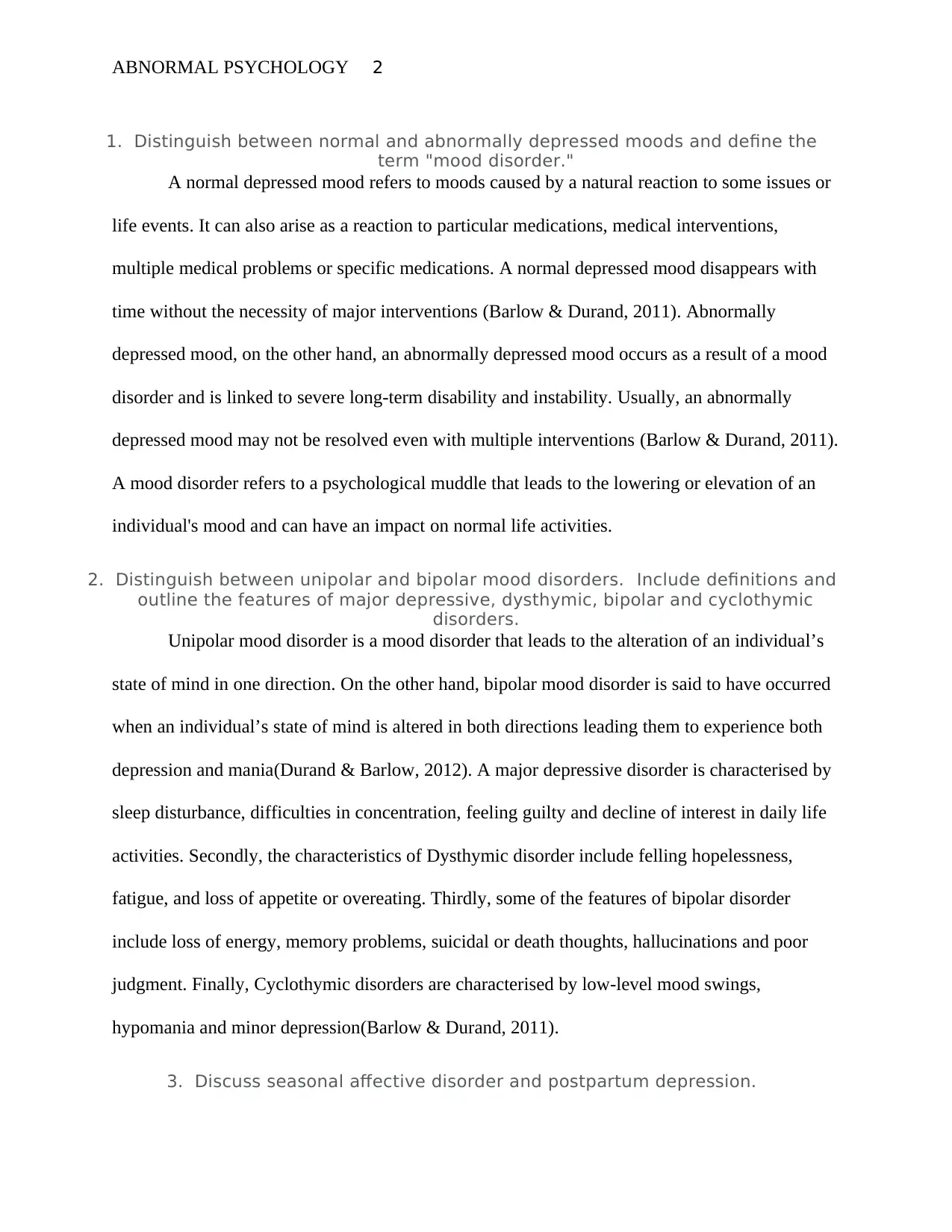
ABNORMAL PSYCHOLOGY 2
1. Distinguish between normal and abnormally depressed moods and define the
term "mood disorder."
A normal depressed mood refers to moods caused by a natural reaction to some issues or
life events. It can also arise as a reaction to particular medications, medical interventions,
multiple medical problems or specific medications. A normal depressed mood disappears with
time without the necessity of major interventions (Barlow & Durand, 2011). Abnormally
depressed mood, on the other hand, an abnormally depressed mood occurs as a result of a mood
disorder and is linked to severe long-term disability and instability. Usually, an abnormally
depressed mood may not be resolved even with multiple interventions (Barlow & Durand, 2011).
A mood disorder refers to a psychological muddle that leads to the lowering or elevation of an
individual's mood and can have an impact on normal life activities.
2. Distinguish between unipolar and bipolar mood disorders. Include definitions and
outline the features of major depressive, dysthymic, bipolar and cyclothymic
disorders.
Unipolar mood disorder is a mood disorder that leads to the alteration of an individual’s
state of mind in one direction. On the other hand, bipolar mood disorder is said to have occurred
when an individual’s state of mind is altered in both directions leading them to experience both
depression and mania(Durand & Barlow, 2012). A major depressive disorder is characterised by
sleep disturbance, difficulties in concentration, feeling guilty and decline of interest in daily life
activities. Secondly, the characteristics of Dysthymic disorder include felling hopelessness,
fatigue, and loss of appetite or overeating. Thirdly, some of the features of bipolar disorder
include loss of energy, memory problems, suicidal or death thoughts, hallucinations and poor
judgment. Finally, Cyclothymic disorders are characterised by low-level mood swings,
hypomania and minor depression(Barlow & Durand, 2011).
3. Discuss seasonal affective disorder and postpartum depression.
Document Page
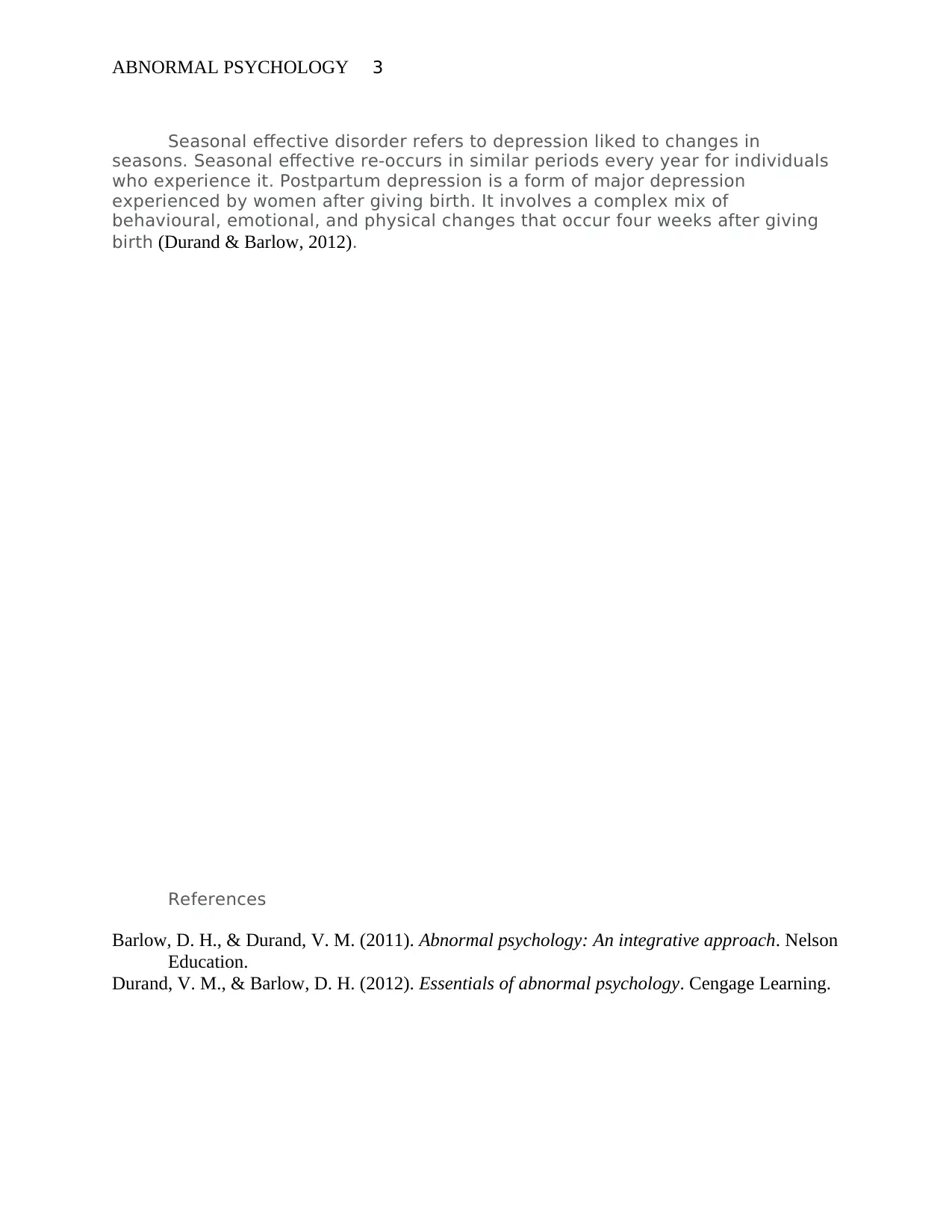
ABNORMAL PSYCHOLOGY 3
Seasonal effective disorder refers to depression liked to changes in
seasons. Seasonal effective re-occurs in similar periods every year for individuals
who experience it. Postpartum depression is a form of major depression
experienced by women after giving birth. It involves a complex mix of
behavioural, emotional, and physical changes that occur four weeks after giving
birth (Durand & Barlow, 2012).
References
Barlow, D. H., & Durand, V. M. (2011). Abnormal psychology: An integrative approach. Nelson
Education.
Durand, V. M., & Barlow, D. H. (2012). Essentials of abnormal psychology. Cengage Learning.
chevron_up_icon
1 out of 3
circle_padding
hide_on_mobile
zoom_out_icon
[object Object]