King Plates: History, Significance, and Impact on Aboriginal People
VerifiedAdded on 2023/06/05
|9
|2306
|453
Report
AI Summary
This report provides a comprehensive overview of the history of King Plates, also known as gorgets, in 19th-century Australia. It examines their significance as symbols of authority and their role in shaping relationships between Aboriginal and non-Aboriginal populations. The report delves into the creation of Aboriginal kings by the colonial government, the expansion of the pastoral frontier, and the protective function of these plates. It explores the reactions of Aboriginal people to the plates and their impact on Aboriginal leadership. The report highlights the benefits and challenges associated with the King Plates, concluding that they served as tools of both honor and exploitation, ultimately becoming important historical relics that document the history of Australia.
Running header: History of the King Plates 1
History of the King Plates
Students Name
Institutional Affiliation
History of the King Plates
Students Name
Institutional Affiliation

Paraphrase This Document
Need a fresh take? Get an instant paraphrase of this document with our AI Paraphraser
History of the King Plates 2
Abstract
King’s plates also referred to as gorgets are considered to be historical relics that were so crucial
in the nineteenth century to the aboriginal people. This report outlines the history of the king’s
plates, arguments, and facts about the aboriginal people and also their relationship with the non-
aboriginal people. The benefits and challenges of the king’s plates have been clearly outlined in
this report so as to determine the role of the king’s plates.
Abstract
King’s plates also referred to as gorgets are considered to be historical relics that were so crucial
in the nineteenth century to the aboriginal people. This report outlines the history of the king’s
plates, arguments, and facts about the aboriginal people and also their relationship with the non-
aboriginal people. The benefits and challenges of the king’s plates have been clearly outlined in
this report so as to determine the role of the king’s plates.
History of the King Plates 3
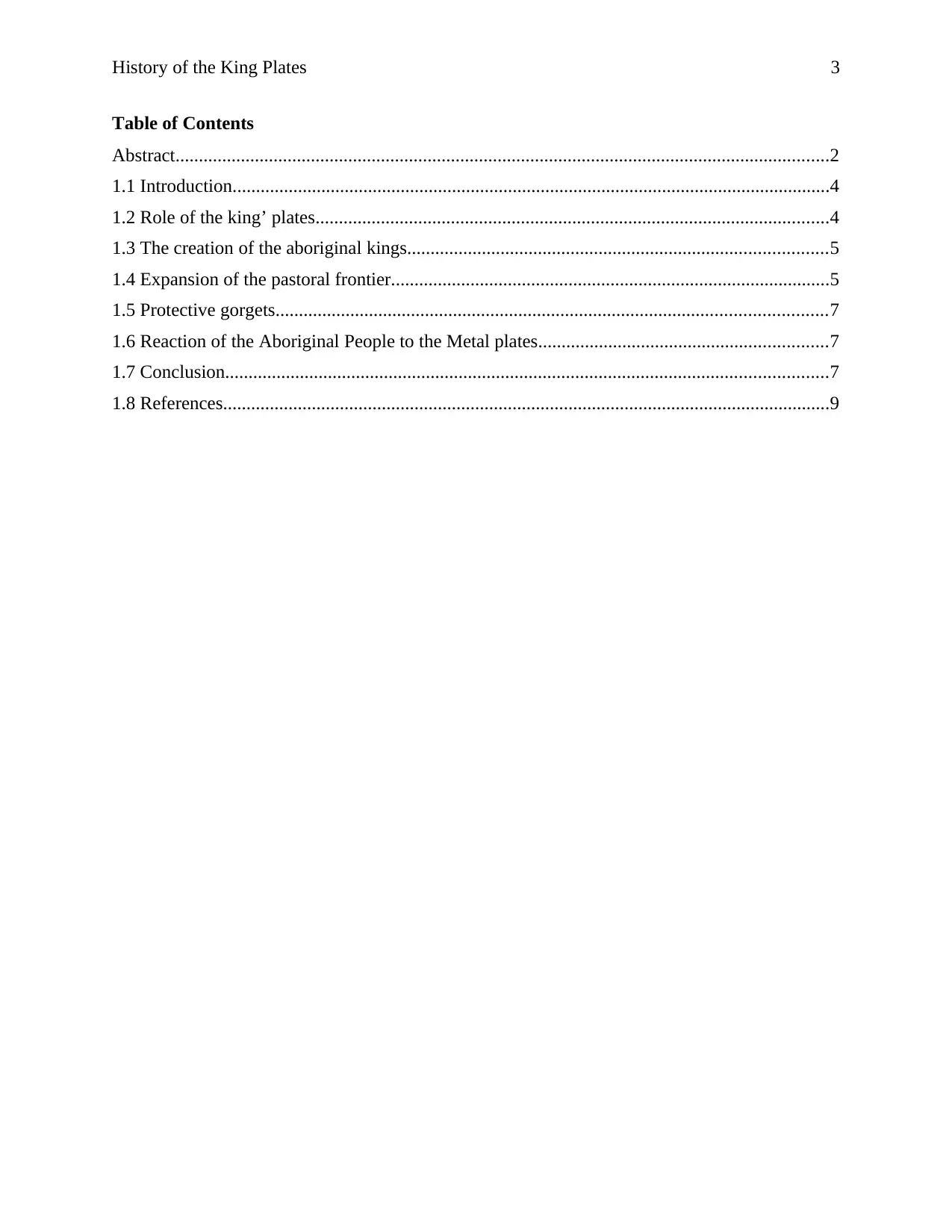
Table of Contents
Abstract............................................................................................................................................2
1.1 Introduction................................................................................................................................4
1.2 Role of the king’ plates..............................................................................................................4
1.3 The creation of the aboriginal kings..........................................................................................5
1.4 Expansion of the pastoral frontier..............................................................................................5
1.5 Protective gorgets......................................................................................................................7
1.6 Reaction of the Aboriginal People to the Metal plates..............................................................7
1.7 Conclusion.................................................................................................................................7
1.8 References..................................................................................................................................9
Table of Contents
Abstract............................................................................................................................................2
1.1 Introduction................................................................................................................................4
1.2 Role of the king’ plates..............................................................................................................4
1.3 The creation of the aboriginal kings..........................................................................................5
1.4 Expansion of the pastoral frontier..............................................................................................5
1.5 Protective gorgets......................................................................................................................7
1.6 Reaction of the Aboriginal People to the Metal plates..............................................................7
1.7 Conclusion.................................................................................................................................7
1.8 References..................................................................................................................................9
⊘ This is a preview!⊘
Do you want full access?
Subscribe today to unlock all pages.

Trusted by 1+ million students worldwide
History of the King Plates 4
1.1 Introduction.
In between the nineteenth and early twentieth century Australia, metal plates known as
the “gorgets or king plates” were used to honor the Aboriginal people who differentiated
themselves among the non-aboriginal population (History of king plates, 2018). The aboriginal
plates were crucial in colonial Australia since they promoted the development of social
relationships among the non-aboriginal and aboriginal populations. The aboriginal plates were
designed very similar to the military gorgets and were twice their size. According to Troy
(1993), the presentation of inscribed plates to the aboriginal people was considered an early
practice that was part of the European colonizers. For example, James Cook, a European
Explorer presented bronze medals to the aboriginal people along his voyages that were to be tied
on their necks using ribbons.
1.2 Role of the king’ plates
Wearing of the gorgets came with public recognition and acted as a symbol of authority.
Therefore, offering the gorgets was a great way of honoring the aboriginal people. The metal
plates known as “gorgets” or “king plates” would be inscribed with the name of the wearer and
were easily worn around the neck on chord or ribbon (Queensland Museum, 2018). Honorary
titles such as ‘king or queen” could be inscribed on the gorgets. In the 1830’s it was ordinary to
present a gorget to the aboriginal men who were perceived to be leaders or holding positions of
authority. The gorgets also acted as tokens of gratitude for the aboriginal people who assisted
with saving people’s lives, guiding the exploring parties or also being the last surviving
individual of a particular tribe.
One of the oldest gorgets belonged to King Bungaree and dates back to 1815. He was a
famous Sydney identity and therefore the Governor by that time known as Governor Lachlan
Macquarie made for him and his wife a gorget (Troy, 1993). Macquarie presented more plates to
the aboriginal people in an attempt to win the favor of the Aboriginal population since he
believed the aboriginal people had more power over the general community (McBryde, 1989).
Bungaree was a key individual in the civilization plans of Governor Lachlan over the Aboriginal
population. This is because it was his plan to expose him to the benefits of living in a civilized
lifestyle just to target the entire Aboriginal population.
1.1 Introduction.
In between the nineteenth and early twentieth century Australia, metal plates known as
the “gorgets or king plates” were used to honor the Aboriginal people who differentiated
themselves among the non-aboriginal population (History of king plates, 2018). The aboriginal
plates were crucial in colonial Australia since they promoted the development of social
relationships among the non-aboriginal and aboriginal populations. The aboriginal plates were
designed very similar to the military gorgets and were twice their size. According to Troy
(1993), the presentation of inscribed plates to the aboriginal people was considered an early
practice that was part of the European colonizers. For example, James Cook, a European
Explorer presented bronze medals to the aboriginal people along his voyages that were to be tied
on their necks using ribbons.
1.2 Role of the king’ plates
Wearing of the gorgets came with public recognition and acted as a symbol of authority.
Therefore, offering the gorgets was a great way of honoring the aboriginal people. The metal
plates known as “gorgets” or “king plates” would be inscribed with the name of the wearer and
were easily worn around the neck on chord or ribbon (Queensland Museum, 2018). Honorary
titles such as ‘king or queen” could be inscribed on the gorgets. In the 1830’s it was ordinary to
present a gorget to the aboriginal men who were perceived to be leaders or holding positions of
authority. The gorgets also acted as tokens of gratitude for the aboriginal people who assisted
with saving people’s lives, guiding the exploring parties or also being the last surviving
individual of a particular tribe.
One of the oldest gorgets belonged to King Bungaree and dates back to 1815. He was a
famous Sydney identity and therefore the Governor by that time known as Governor Lachlan
Macquarie made for him and his wife a gorget (Troy, 1993). Macquarie presented more plates to
the aboriginal people in an attempt to win the favor of the Aboriginal population since he
believed the aboriginal people had more power over the general community (McBryde, 1989).
Bungaree was a key individual in the civilization plans of Governor Lachlan over the Aboriginal
population. This is because it was his plan to expose him to the benefits of living in a civilized
lifestyle just to target the entire Aboriginal population.
Paraphrase This Document
Need a fresh take? Get an instant paraphrase of this document with our AI Paraphraser
History of the King Plates 5
1.3 The creation of the aboriginal kings
The colonial government manipulated the positions of dominance among the Aboriginal
people through bypassing leaderships choices given by the aboriginal communities (Babidge,
2016). They therefore, selected their leaders and conferred on them a gorget as an official title.
The colonialist’s selection criteria for the Aboriginal leaders was based on the person’s
usefulness and loyalty. According to Bellingshausen, an explorer, the Aboriginal leaders would
be used by the government to pursue escape convicts.
Traditionally, there were no kingship titles or chieftaincy among the Aboriginal people
since the senior men were regarded to be superior men able to command respect. Therefore,
when the colonialists found that the senior men were quite respected and were influential among
their people, they formed alliances with them by labeling them as kings and chiefs. The
Aboriginal people continued to dominate their colonies, and some participated in farming which
was a considered a cash economy of the colony (Organ, 2018). Various farming communities
were pioneered by the Aboriginal chiefs who were appointed by the non-aboriginal population.
For example, Mickey Johnson was in control of the most fertile regions in New South Wales
(Reece, 1967).
Also, Billy Kelly was given a gorget titled “King of Broadwater” for being a senior
leader in the farming community near the Richmond River (Haigh & Goldstein, 1981). Through
exploiting his communities’ resources, Billy promoted the independence of his community and
himself. He was recognized as a man of influence among his farming community. Paddy,
another leader among a farming community, was also given a title named the “King of
Boobarrego.” Paddy was made king while his community was still living a traditional lifestyle
(Haigh & Goldstein, 1981). He was given the gorget by a settler who desired to acquire the
influence among his people. Paddy is quite remembered for teaching his people to steal
vegetables from their settler friend while unseen. Paddy is considered to have died at the ages
between eighty and ninety. His gorget is held in the National Museum of Australia.
1.4 Expansion of the pastoral frontier.
The king’s plates known as “gorgets” are considered crucial in the expansion of the
pastoral frontier in the colonial era in Australia. The pastoralists came to understand that the
creation of “kings’ breastplates” was crucial in acquiring cooperation from the Aboriginal
1.3 The creation of the aboriginal kings
The colonial government manipulated the positions of dominance among the Aboriginal
people through bypassing leaderships choices given by the aboriginal communities (Babidge,
2016). They therefore, selected their leaders and conferred on them a gorget as an official title.
The colonialist’s selection criteria for the Aboriginal leaders was based on the person’s
usefulness and loyalty. According to Bellingshausen, an explorer, the Aboriginal leaders would
be used by the government to pursue escape convicts.
Traditionally, there were no kingship titles or chieftaincy among the Aboriginal people
since the senior men were regarded to be superior men able to command respect. Therefore,
when the colonialists found that the senior men were quite respected and were influential among
their people, they formed alliances with them by labeling them as kings and chiefs. The
Aboriginal people continued to dominate their colonies, and some participated in farming which
was a considered a cash economy of the colony (Organ, 2018). Various farming communities
were pioneered by the Aboriginal chiefs who were appointed by the non-aboriginal population.
For example, Mickey Johnson was in control of the most fertile regions in New South Wales
(Reece, 1967).
Also, Billy Kelly was given a gorget titled “King of Broadwater” for being a senior
leader in the farming community near the Richmond River (Haigh & Goldstein, 1981). Through
exploiting his communities’ resources, Billy promoted the independence of his community and
himself. He was recognized as a man of influence among his farming community. Paddy,
another leader among a farming community, was also given a title named the “King of
Boobarrego.” Paddy was made king while his community was still living a traditional lifestyle
(Haigh & Goldstein, 1981). He was given the gorget by a settler who desired to acquire the
influence among his people. Paddy is quite remembered for teaching his people to steal
vegetables from their settler friend while unseen. Paddy is considered to have died at the ages
between eighty and ninety. His gorget is held in the National Museum of Australia.
1.4 Expansion of the pastoral frontier.
The king’s plates known as “gorgets” are considered crucial in the expansion of the
pastoral frontier in the colonial era in Australia. The pastoralists came to understand that the
creation of “kings’ breastplates” was crucial in acquiring cooperation from the Aboriginal
History of the King Plates 6
population. The pastoralists treated the Aboriginal people as illegal occupiers of their land due to
their desire to expand (Prentis, 2011). However, in order to maintain peace and avoid conflicts,
the pastoralists ran for the most powerful aboriginal men so as to coerce them into cooperating
with them. This turned out to be a standard procedure for acquiring cooperation since the gorgets
were the main tools to acquire favor with the Aboriginal population.
The procedure of acquiring allies through creating “kings” continued into the nineteenth
century. In the year 1843, a station that runs into the Yeo Yeo Creek was bought by James
Graham. Since he understood honoring the Aboriginal people would guarantee him safety, after
he reached the station, he presented a gorget to the most important person and acknowledged him
as king. Jemmy Curraburma was the leader that was selected by Graham and received the
breastplate (Troy, 1993). According to Graham, that was the only way to gain and establish
authority among the blacks. Even in the late 1800’s, gorgets were used to protect and maintain
relations among the pastoralists and Aboriginal people.
Since the Aboriginal leaders had some level of influence, presenting them with the king
plates gave them some additional power in the confines of the limitations of the colonialist’s
society (Troy, 1993). The Aboriginal people treated the wearing of gorgets with authority.
However, this did not have any real power in the colonialist’s perspective. The Aboriginal people
therefore at times deferred with their people who had been given the gorgets. In the process,
Dawson and Graham, who were pastoralists suggested creating a workforce within the
Aboriginal communities. However, they had to exploit the “king” or “chief” so as their plan
could work. Surprisingly, the population bought the idea, and he was able to turn them into a
source of reliable labor.
According to Carl Lumholtz, pastoral expansion became destructive to the Aboriginal
population mainly in Queensland. Lumholtz came into contact with the Aboriginal people while
traveling in Queensland in the 1880’s. The hungry pastoralists, disenfranchised Queensland from
the Aboriginal population. Also, Lumholtz commented that the entire king-making process was a
scheme of the pastoralists to steal the Aboriginal land (Troy, 1993). After being given the
gorgets, the kings were expected to cheer up the negotiations on land among the Aboriginal
population. In turn, the Pastoralists awarded the kings handsomely by providing supplies of food,
clothing, tobacco, and special privileges. However, when the kings were no longer needed, they
population. The pastoralists treated the Aboriginal people as illegal occupiers of their land due to
their desire to expand (Prentis, 2011). However, in order to maintain peace and avoid conflicts,
the pastoralists ran for the most powerful aboriginal men so as to coerce them into cooperating
with them. This turned out to be a standard procedure for acquiring cooperation since the gorgets
were the main tools to acquire favor with the Aboriginal population.
The procedure of acquiring allies through creating “kings” continued into the nineteenth
century. In the year 1843, a station that runs into the Yeo Yeo Creek was bought by James
Graham. Since he understood honoring the Aboriginal people would guarantee him safety, after
he reached the station, he presented a gorget to the most important person and acknowledged him
as king. Jemmy Curraburma was the leader that was selected by Graham and received the
breastplate (Troy, 1993). According to Graham, that was the only way to gain and establish
authority among the blacks. Even in the late 1800’s, gorgets were used to protect and maintain
relations among the pastoralists and Aboriginal people.
Since the Aboriginal leaders had some level of influence, presenting them with the king
plates gave them some additional power in the confines of the limitations of the colonialist’s
society (Troy, 1993). The Aboriginal people treated the wearing of gorgets with authority.
However, this did not have any real power in the colonialist’s perspective. The Aboriginal people
therefore at times deferred with their people who had been given the gorgets. In the process,
Dawson and Graham, who were pastoralists suggested creating a workforce within the
Aboriginal communities. However, they had to exploit the “king” or “chief” so as their plan
could work. Surprisingly, the population bought the idea, and he was able to turn them into a
source of reliable labor.
According to Carl Lumholtz, pastoral expansion became destructive to the Aboriginal
population mainly in Queensland. Lumholtz came into contact with the Aboriginal people while
traveling in Queensland in the 1880’s. The hungry pastoralists, disenfranchised Queensland from
the Aboriginal population. Also, Lumholtz commented that the entire king-making process was a
scheme of the pastoralists to steal the Aboriginal land (Troy, 1993). After being given the
gorgets, the kings were expected to cheer up the negotiations on land among the Aboriginal
population. In turn, the Pastoralists awarded the kings handsomely by providing supplies of food,
clothing, tobacco, and special privileges. However, when the kings were no longer needed, they
⊘ This is a preview!⊘
Do you want full access?
Subscribe today to unlock all pages.
Trusted by 1+ million students worldwide
History of the King Plates 7
were treated as inconsequential nuisances. According to Lumholtz, the “king’s plate” acted as a
meal ticket to the Aboriginal people.
1.5 Protective gorgets
The gorgets were also a tool of protection against discrimination. The king plates proved
that the Aboriginal people were the friends of the colonists (Evans, 2018). For example, William
Robertson, an Aboriginal was given a gorget by a resident of a town known as Wellington. The
plate was primarily to protect him from being moved on by local settlers or killed.
1.6 Reaction of the Aboriginal People to the Metal plates
The Aboriginal population reacted differently to the “king plates” and the people who
received them. Some of the people believed the plates symbolized honor and the people who
wore them were heroes (Babidge, 2016). On the other hand, the other people deemed the plates
as insults from the non-Aboriginal people. Today, family history researchers are out to gather
more gorgets primarily for the information of the people and places. These gorgets are regarded
as historical relics. A member of the Cowra Aboriginal known as Bill Murray suggested that the
king’s plates were essential since the gorget documented the ancestor’s names and a place
connected to the ancestors. The gorgets are also key in maintaining links with the history of
individuals.
The Cowra Aboriginal population share an ancestor known as “Windradyne” identified
as a king. The population identify themselves as Wiradjuri people. Windradyne led a resistance
against the non-aboriginal settlers which led to a series of events (Evans, 2018). For example,
governor Thomas Brisbane declared the martial law. This was after agreeing to make peace with
Windradyne at the annual government feast designed for Aboriginal people. Windradyne is
considered a great leader among his people; a memorial was conducted in 1954 to commemorate
him as the last chief of the Aboriginals.
1.7 Conclusion
The “kings’ plate” was a tool of honor but also a tool of exploitation. The Aboriginals felt
a sense of security, but the fact is that the non-Aboriginal population took advantage of them.
Having a king’s plate that portrays honor, the Aboriginals felt a connection with the non-
Aboriginals which was not present. However, this policy of the king’s plate led to the discovery
were treated as inconsequential nuisances. According to Lumholtz, the “king’s plate” acted as a
meal ticket to the Aboriginal people.
1.5 Protective gorgets
The gorgets were also a tool of protection against discrimination. The king plates proved
that the Aboriginal people were the friends of the colonists (Evans, 2018). For example, William
Robertson, an Aboriginal was given a gorget by a resident of a town known as Wellington. The
plate was primarily to protect him from being moved on by local settlers or killed.
1.6 Reaction of the Aboriginal People to the Metal plates
The Aboriginal population reacted differently to the “king plates” and the people who
received them. Some of the people believed the plates symbolized honor and the people who
wore them were heroes (Babidge, 2016). On the other hand, the other people deemed the plates
as insults from the non-Aboriginal people. Today, family history researchers are out to gather
more gorgets primarily for the information of the people and places. These gorgets are regarded
as historical relics. A member of the Cowra Aboriginal known as Bill Murray suggested that the
king’s plates were essential since the gorget documented the ancestor’s names and a place
connected to the ancestors. The gorgets are also key in maintaining links with the history of
individuals.
The Cowra Aboriginal population share an ancestor known as “Windradyne” identified
as a king. The population identify themselves as Wiradjuri people. Windradyne led a resistance
against the non-aboriginal settlers which led to a series of events (Evans, 2018). For example,
governor Thomas Brisbane declared the martial law. This was after agreeing to make peace with
Windradyne at the annual government feast designed for Aboriginal people. Windradyne is
considered a great leader among his people; a memorial was conducted in 1954 to commemorate
him as the last chief of the Aboriginals.
1.7 Conclusion
The “kings’ plate” was a tool of honor but also a tool of exploitation. The Aboriginals felt
a sense of security, but the fact is that the non-Aboriginal population took advantage of them.
Having a king’s plate that portrays honor, the Aboriginals felt a connection with the non-
Aboriginals which was not present. However, this policy of the king’s plate led to the discovery
Paraphrase This Document
Need a fresh take? Get an instant paraphrase of this document with our AI Paraphraser

History of the King Plates 8
of different tribes hence acting as important historical relics. The plates which are now held by
the National Museum of Australia have assisted both students and people learn of their ancestry
and history of Australia in general.
of different tribes hence acting as important historical relics. The plates which are now held by
the National Museum of Australia have assisted both students and people learn of their ancestry
and history of Australia in general.
History of the King Plates 9
1.8 References
Babidge, S. (2016). Aboriginal family and the state: the conditions of history. Routledge.
Evans, R. (2018). ‘Kings’ in Brass Crescents. Defining Aboriginal Labour Patterns in Colonial
Queensland. In Indentured Labour in the British Empire, 1834-1920 (pp. 183-212).
Routledge.
Haigh, C., & Goldstein, W. (1981). The Aborigines of New South Wales (Vol. 2, No. 5). National
Parks & Wildlife Service.
History of king plates (2018). Retrieved from
http://www.nma.gov.au/online_features/aboriginal_breastplates/history_of_king_plates
McBryde, I. (1989). Guests of the Governor: Aboriginal residents of the first Government
House. Friends of the First Government House Site.
Organ, M. (2018). Mickey Johnson - Aboriginal King of Illawarra. Retrieved from
https://www.uow.edu.au/~morgan/mickey.htm
Prentis, M. D. (2011). Concise Companion to Aboriginal History. Rosenberg.
Queensland Museum. (2018). Retrieved from
http://www.qm.qld.gov.au/Find+out+about/
Aboriginal+and+Torres+Strait+Islander+Cultures/Politics/Breastplates#.W6Bw2-gza00/
Reece, R. H. W. (1967). Feasts and Blankets: The History of Some Early Attempts to Establish
Relations with the Aborigines of New South Wales, 1814–1846. Archaeology and
physical anthropology in Oceania, 2(3), 190-206.
Troy, J. (1993). King plates: a history of Aboriginal gorgets. Aboriginal Studies Press.
1.8 References
Babidge, S. (2016). Aboriginal family and the state: the conditions of history. Routledge.
Evans, R. (2018). ‘Kings’ in Brass Crescents. Defining Aboriginal Labour Patterns in Colonial
Queensland. In Indentured Labour in the British Empire, 1834-1920 (pp. 183-212).
Routledge.
Haigh, C., & Goldstein, W. (1981). The Aborigines of New South Wales (Vol. 2, No. 5). National
Parks & Wildlife Service.
History of king plates (2018). Retrieved from
http://www.nma.gov.au/online_features/aboriginal_breastplates/history_of_king_plates
McBryde, I. (1989). Guests of the Governor: Aboriginal residents of the first Government
House. Friends of the First Government House Site.
Organ, M. (2018). Mickey Johnson - Aboriginal King of Illawarra. Retrieved from
https://www.uow.edu.au/~morgan/mickey.htm
Prentis, M. D. (2011). Concise Companion to Aboriginal History. Rosenberg.
Queensland Museum. (2018). Retrieved from
http://www.qm.qld.gov.au/Find+out+about/
Aboriginal+and+Torres+Strait+Islander+Cultures/Politics/Breastplates#.W6Bw2-gza00/
Reece, R. H. W. (1967). Feasts and Blankets: The History of Some Early Attempts to Establish
Relations with the Aborigines of New South Wales, 1814–1846. Archaeology and
physical anthropology in Oceania, 2(3), 190-206.
Troy, J. (1993). King plates: a history of Aboriginal gorgets. Aboriginal Studies Press.
⊘ This is a preview!⊘
Do you want full access?
Subscribe today to unlock all pages.
Trusted by 1+ million students worldwide

1 out of 9


Your All-in-One AI-Powered Toolkit for Academic Success.
+13062052269
info@desklib.com
Available 24*7 on WhatsApp / Email
![[object Object]](/_next/static/media/star-bottom.7253800d.svg)
Unlock your academic potential
Copyright © 2020–2025 A2Z Services. All Rights Reserved. Developed and managed by ZUCOL.