Aboriginal Youth Alcohol Strategy in Tasmania: Comprehensive Report
VerifiedAdded on 2020/05/01
|22
|4102
|206
Report
AI Summary
This report, focusing on the Aboriginal Youth Alcohol Strategy in Tasmania, addresses the increasing alcohol consumption among Aboriginal youth and its detrimental effects on their health and social life. It begins with background information on alcohol consumption in Australia and Tasmania, highlighting the disproportionate impact on the Aboriginal population. The report analyzes the prevalence of alcohol consumption, citing statistical data and the associated health risks, including cardiovascular diseases, self-harm, and accidents. The report then delves into program development and planning, outlining the objectives, which include reducing alcohol consumption, decreasing health risks, and addressing disparities in healthcare. It details strategies such as promoting alcohol-free events, discouraging underage alcohol sales, and providing education and rehabilitation services. The report also includes an action plan with specific strategies, stakeholders, and timelines for implementation, emphasizing the importance of community engagement and government support. The document includes a teaching plan, evaluation strategy, and campaign posters. The report aims to provide a comprehensive strategy for mitigating the negative effects of alcohol consumption among Aboriginal youths in Tasmania.
Running head: ABORIGINAL YOUTH ALCOHOL STRATEGY IN TASMANIA
ABORIGINAL YOUTH ALCOHOL STRATEGY IN TASMANIA
Name of the Student
Name of the university
Author’s note
ABORIGINAL YOUTH ALCOHOL STRATEGY IN TASMANIA
Name of the Student
Name of the university
Author’s note

Paraphrase This Document
Need a fresh take? Get an instant paraphrase of this document with our AI Paraphraser
1
ABORIGINAL YOUTH ALCOHOL STRATEGY IN TASMANIA
ABORIGINAL YOUTH ALCOHOL STRATEGY IN TASMANIA
Background
Australia is a land of diverse cultures. Since the time of early colonization in Australia,
alcohol is being consumed as a beverage all over the country. Over the last few decades the
alcohol consumption in this continent has increased with time. The Aboriginal population and
the Torres Strait Islanders staying in Tasmania has always been centre of research for the past
few decades due to their linguistically and culturally different background. Statistical data says
that the consumption of alcohol among the aboriginal population residing in Tasmania has
increased with time. The rate of alcohol consumption had been greater in the young generation
aboriginals than that of the elderly ones (Howard et al., 2014). Although alcohol consumption
can be considered as a no0rm among the aboriginals but the customs often pose serious effect on
the health status of these aboriginal young generations. As per the reports, the New South Wales
Police force had mentioned alcohol to be one of the important causes of the mortality in patients.
Reports suggest that alcohol may bring about avoidable complications like self harm, lack of
consciousness, depression and may hamper the professional life (Lumley et al., 1985). It has
been reported that although alcohol is viewed as an essential part of socialization, a lot more is
consumed in ways that pose ill effects on health. The report places forward with a possible health
strategy to mitigate the disastrous effect of consumption of alcohol among the aboriginal youths.
Te report further sheds light in to different long term and the short term objective. The objectives
should be incorporated in the implementation plan.
ABORIGINAL YOUTH ALCOHOL STRATEGY IN TASMANIA
ABORIGINAL YOUTH ALCOHOL STRATEGY IN TASMANIA
Background
Australia is a land of diverse cultures. Since the time of early colonization in Australia,
alcohol is being consumed as a beverage all over the country. Over the last few decades the
alcohol consumption in this continent has increased with time. The Aboriginal population and
the Torres Strait Islanders staying in Tasmania has always been centre of research for the past
few decades due to their linguistically and culturally different background. Statistical data says
that the consumption of alcohol among the aboriginal population residing in Tasmania has
increased with time. The rate of alcohol consumption had been greater in the young generation
aboriginals than that of the elderly ones (Howard et al., 2014). Although alcohol consumption
can be considered as a no0rm among the aboriginals but the customs often pose serious effect on
the health status of these aboriginal young generations. As per the reports, the New South Wales
Police force had mentioned alcohol to be one of the important causes of the mortality in patients.
Reports suggest that alcohol may bring about avoidable complications like self harm, lack of
consciousness, depression and may hamper the professional life (Lumley et al., 1985). It has
been reported that although alcohol is viewed as an essential part of socialization, a lot more is
consumed in ways that pose ill effects on health. The report places forward with a possible health
strategy to mitigate the disastrous effect of consumption of alcohol among the aboriginal youths.
Te report further sheds light in to different long term and the short term objective. The objectives
should be incorporated in the implementation plan.
2
ABORIGINAL YOUTH ALCOHOL STRATEGY IN TASMANIA
The report further focuses on an evaluation plan that should be helpful for assessing the success
of the proposal. Finally, a teaching plan, an evaluation strategy, campaign posters to direct the
children will be found in the appendix section of the paper.
Prevalence of alcohol consumption among the aboriginal youths in Tasmania
As per the statistical data, in 2010-11, the national consumption of pure alcohol was
about 9.99 litres per day per person. As per the reports atleast 62% of the total volume of alcohol
consumed by the Australian population are at risks of acute harms and about 44% of the alcohol
per volume consumed bears risks of chronic diseases (Australian Drug Foundation, 2016).
As per the data produced by the department of Police and Emergency Management, Tasmania
has not been immune to harm related to alcohol. Nearly 1,194 families and 514 victims were
affected by alcohol, 1219 public assaults. There had been 2607 notices of liquor infringement
and 1232 cases of liquor confiscations (Australian Drug Foundation, 2016). As per the fact
sheets of the Tasmanian Alcohol Trends 2016, produced by the Department of Health and human
Services, Since 1995, the proportion of drinking at minimum risk levels among the Tasmanian
aboriginal youths has increased from 4.2% to 7.9% on the other hand the high risk levels have
risen from 2.7 to 4.7% (National Health Survey: First Results, 2014-15. 2017). Studies say that
Tasmania has got the highest rate of alcohol consumption among the youths.
ABORIGINAL YOUTH ALCOHOL STRATEGY IN TASMANIA
The report further focuses on an evaluation plan that should be helpful for assessing the success
of the proposal. Finally, a teaching plan, an evaluation strategy, campaign posters to direct the
children will be found in the appendix section of the paper.
Prevalence of alcohol consumption among the aboriginal youths in Tasmania
As per the statistical data, in 2010-11, the national consumption of pure alcohol was
about 9.99 litres per day per person. As per the reports atleast 62% of the total volume of alcohol
consumed by the Australian population are at risks of acute harms and about 44% of the alcohol
per volume consumed bears risks of chronic diseases (Australian Drug Foundation, 2016).
As per the data produced by the department of Police and Emergency Management, Tasmania
has not been immune to harm related to alcohol. Nearly 1,194 families and 514 victims were
affected by alcohol, 1219 public assaults. There had been 2607 notices of liquor infringement
and 1232 cases of liquor confiscations (Australian Drug Foundation, 2016). As per the fact
sheets of the Tasmanian Alcohol Trends 2016, produced by the Department of Health and human
Services, Since 1995, the proportion of drinking at minimum risk levels among the Tasmanian
aboriginal youths has increased from 4.2% to 7.9% on the other hand the high risk levels have
risen from 2.7 to 4.7% (National Health Survey: First Results, 2014-15. 2017). Studies say that
Tasmania has got the highest rate of alcohol consumption among the youths.
⊘ This is a preview!⊘
Do you want full access?
Subscribe today to unlock all pages.

Trusted by 1+ million students worldwide
3
ABORIGINAL YOUTH ALCOHOL STRATEGY IN TASMANIA
Figure1: Prevalence of alcohol consumption in Tasmania. Indigenous Vs Non-indigenous
(National Health Survey: First Results, 2014-15. (2017). Abs.gov.au)
Program development and planning
There are numerous reasons that prompted the development of the health proposal.
Problematic alcohol has become a serious public issue in Tasmania as it can put people at the
risk of injury, crime, poisoning, family breakdown, long term health issues and self destruction
(Calabria et al., 2013). It has been reported that Tasmania has received $5 million from the
Government of Australia for implementing plans for the controlling of alcohols among the
aboriginal resident of the state. Despite of all the measures taken, the alcohol use amongst the
aboriginal teenagers is still visible in the state of Tasmania. According to (National Health
Survey: First Results, 2014-15", 2017). The aboriginal youths of the Tasmania are becoming
susceptible to different health issues due to the excessive consumption of alcohol such as
cardiovascular diseases, self harm, alcohol related accidents and many more. Another factor that
acts as a driving factor for the health proposal is that, disparity in treatment is found amongst the
aboriginals due to many factors such as racism and their non reliance on the western modes of
ABORIGINAL YOUTH ALCOHOL STRATEGY IN TASMANIA
Figure1: Prevalence of alcohol consumption in Tasmania. Indigenous Vs Non-indigenous
(National Health Survey: First Results, 2014-15. (2017). Abs.gov.au)
Program development and planning
There are numerous reasons that prompted the development of the health proposal.
Problematic alcohol has become a serious public issue in Tasmania as it can put people at the
risk of injury, crime, poisoning, family breakdown, long term health issues and self destruction
(Calabria et al., 2013). It has been reported that Tasmania has received $5 million from the
Government of Australia for implementing plans for the controlling of alcohols among the
aboriginal resident of the state. Despite of all the measures taken, the alcohol use amongst the
aboriginal teenagers is still visible in the state of Tasmania. According to (National Health
Survey: First Results, 2014-15", 2017). The aboriginal youths of the Tasmania are becoming
susceptible to different health issues due to the excessive consumption of alcohol such as
cardiovascular diseases, self harm, alcohol related accidents and many more. Another factor that
acts as a driving factor for the health proposal is that, disparity in treatment is found amongst the
aboriginals due to many factors such as racism and their non reliance on the western modes of
Paraphrase This Document
Need a fresh take? Get an instant paraphrase of this document with our AI Paraphraser
4
ABORIGINAL YOUTH ALCOHOL STRATEGY IN TASMANIA
treatment (Chikritzhs & Pascal, 2004). This is not only hampering the professional life of the
aboriginals but also jeopardizing with their cognitive development. In order to mitigate this, it is
necessary to take some extensive health strategies.
The primary target audience for this initiative will be aboriginal younger adults between the age
15-28, residing in the aboriginal areas of Tasmania (Chikritzhs & Pascal, 2004). We have also
included the parents of these participants and the other elderly people of the population as the
secondary audience, which will help to evaluate the success of the assessment.
Engagement of the stake holders
As per the author (Adegbija, Hoy & Wang, 2015). In order to implement a successful
health strategy, a dedicated work force is required that would be able to invest ample time for
this project, set achievable goals and implementation of those goals. Initially the South East
Tasmanian Aboriginal health Corporation (SETAC) would provide with education, workforce,
early intervention, case management, counseling and prevention of the relapse (Chikritzhs &
Pascal, 2004). The whole regimen has to be done in collaboration with the families of the
participants. Organizations such as The Drug Education Network (DEN) will work in
collaboration with the Tasmanian Aboriginal Corporation for delivering safe and appropriate
education and training regarding alcohol treatment – (National Health Survey: First Results,
2014-15", 2017).
Time frame
A good action plan should have a proper time frame for achieving the goals and assessing
the outcomes of the success. The goals and the objectives of the ‘Aboriginal alcohol strategy in
Tasmania’ should be done in a time frame of one year (Chikritzhs & Pascal, 2004). The planning
ABORIGINAL YOUTH ALCOHOL STRATEGY IN TASMANIA
treatment (Chikritzhs & Pascal, 2004). This is not only hampering the professional life of the
aboriginals but also jeopardizing with their cognitive development. In order to mitigate this, it is
necessary to take some extensive health strategies.
The primary target audience for this initiative will be aboriginal younger adults between the age
15-28, residing in the aboriginal areas of Tasmania (Chikritzhs & Pascal, 2004). We have also
included the parents of these participants and the other elderly people of the population as the
secondary audience, which will help to evaluate the success of the assessment.
Engagement of the stake holders
As per the author (Adegbija, Hoy & Wang, 2015). In order to implement a successful
health strategy, a dedicated work force is required that would be able to invest ample time for
this project, set achievable goals and implementation of those goals. Initially the South East
Tasmanian Aboriginal health Corporation (SETAC) would provide with education, workforce,
early intervention, case management, counseling and prevention of the relapse (Chikritzhs &
Pascal, 2004). The whole regimen has to be done in collaboration with the families of the
participants. Organizations such as The Drug Education Network (DEN) will work in
collaboration with the Tasmanian Aboriginal Corporation for delivering safe and appropriate
education and training regarding alcohol treatment – (National Health Survey: First Results,
2014-15", 2017).
Time frame
A good action plan should have a proper time frame for achieving the goals and assessing
the outcomes of the success. The goals and the objectives of the ‘Aboriginal alcohol strategy in
Tasmania’ should be done in a time frame of one year (Chikritzhs & Pascal, 2004). The planning
5
ABORIGINAL YOUTH ALCOHOL STRATEGY IN TASMANIA
sessions should not take more than a month and the implementation sessions would commence
from the next month and should get completed within a year, depending upon the availability of
the resources.
Objectives of the program
Long term objectives
To decrease the rate of alcohol consumptions among the aboriginal youths in Tasmania.
To decrease the risks like health risks, alcohol related injuries and self harm.
To decrease the disparity among the aboriginals and the non aboriginals and the non
aboriginals in terms of health, education and profession, that would help to decrease the
stress and anxiety among the aboriginal youths.
Short term objectives
In order to achieve the long term objectives in the near future it is essential to work on a set of
short term goals. The objectives can be listed below as:-
Creating awareness among the youths of the Aboriginal population regarding the ill
effects of alcohol on their health and social life (Gilligan et al ., 2012).
Creating awareness regarding the risks of penalties for supplying alcohol to the aboriginal
youths in Tasmania.
Imparting education to the secondary audiences that is the parents regarding the ill effects
of alcohol consumption (Gilligan et al., 2012).
Imparting education to the other persons of the aboriginal community of different age
groups for creating a mass awareness.
Providing rehabilitation to the already addicted aboriginal youths.
ABORIGINAL YOUTH ALCOHOL STRATEGY IN TASMANIA
sessions should not take more than a month and the implementation sessions would commence
from the next month and should get completed within a year, depending upon the availability of
the resources.
Objectives of the program
Long term objectives
To decrease the rate of alcohol consumptions among the aboriginal youths in Tasmania.
To decrease the risks like health risks, alcohol related injuries and self harm.
To decrease the disparity among the aboriginals and the non aboriginals and the non
aboriginals in terms of health, education and profession, that would help to decrease the
stress and anxiety among the aboriginal youths.
Short term objectives
In order to achieve the long term objectives in the near future it is essential to work on a set of
short term goals. The objectives can be listed below as:-
Creating awareness among the youths of the Aboriginal population regarding the ill
effects of alcohol on their health and social life (Gilligan et al ., 2012).
Creating awareness regarding the risks of penalties for supplying alcohol to the aboriginal
youths in Tasmania.
Imparting education to the secondary audiences that is the parents regarding the ill effects
of alcohol consumption (Gilligan et al., 2012).
Imparting education to the other persons of the aboriginal community of different age
groups for creating a mass awareness.
Providing rehabilitation to the already addicted aboriginal youths.
⊘ This is a preview!⊘
Do you want full access?
Subscribe today to unlock all pages.
Trusted by 1+ million students worldwide
6
ABORIGINAL YOUTH ALCOHOL STRATEGY IN TASMANIA
Strategies
It should be noted that it is no possible to remove all the sources that triggers alcohol
consumption among the aboriginal youths in Tasmania, but simple interventions can be adopted
to improve their way of living (Treeby & Bruno, 2012). The different strategies that can be taken
up are as follows:-
Promotion of programs and events in Tasmania that are alcohol free.
Underage license for business in liquors should be discouraged and license should not be
permitted. In order to accomplish this it is necessary to reinforce the proof of age.
There should be sports and recreation for the youths (Peacock et al., 2013).
The young aboriginals should be impart with the knowledge regarding the detrimental
effects of alcohol on their health on their, social, personal and professional life.
It is necessary to impart education to the whole aboriginal community, as it is from them
that most of the children imitate.
Setting up rehabilitation clinic for providing shelter to the already victimized youths and
provide them with appropriate holistic care (Peacock et al., 2013).
To close the gaps between the health care facilities received by the indigenous and the
non indigenous population of Tasmania. Mobile dispensaries can be there to provide
health support to those who cannot get access to the healthcare due to the remote
locations.
Setting up alcohol awareness campaign throughout Tasmania.
Involving the government organization and the federal government to strengthen the
chalked out plan.
ABORIGINAL YOUTH ALCOHOL STRATEGY IN TASMANIA
Strategies
It should be noted that it is no possible to remove all the sources that triggers alcohol
consumption among the aboriginal youths in Tasmania, but simple interventions can be adopted
to improve their way of living (Treeby & Bruno, 2012). The different strategies that can be taken
up are as follows:-
Promotion of programs and events in Tasmania that are alcohol free.
Underage license for business in liquors should be discouraged and license should not be
permitted. In order to accomplish this it is necessary to reinforce the proof of age.
There should be sports and recreation for the youths (Peacock et al., 2013).
The young aboriginals should be impart with the knowledge regarding the detrimental
effects of alcohol on their health on their, social, personal and professional life.
It is necessary to impart education to the whole aboriginal community, as it is from them
that most of the children imitate.
Setting up rehabilitation clinic for providing shelter to the already victimized youths and
provide them with appropriate holistic care (Peacock et al., 2013).
To close the gaps between the health care facilities received by the indigenous and the
non indigenous population of Tasmania. Mobile dispensaries can be there to provide
health support to those who cannot get access to the healthcare due to the remote
locations.
Setting up alcohol awareness campaign throughout Tasmania.
Involving the government organization and the federal government to strengthen the
chalked out plan.
Paraphrase This Document
Need a fresh take? Get an instant paraphrase of this document with our AI Paraphraser
7
ABORIGINAL YOUTH ALCOHOL STRATEGY IN TASMANIA
Program implementation
The next step to this project is the preparation of a proper action plan or teaching plan for
exploring on the topics about the ill effects of alcohol, the key strategies to reduce the rate of
alcohol consumption, the strategies, the use of appropriate resources and time frame (Gilligan et
al ., 2012). Action plan is a plan which normally contains the list of tasks that are required to be
done to achieve the goals within a stipulated time period. This portion of the paper will be
discussing about the action plan that is required to fulfill the strategy and achieve the goals. The
action plan will enlist the goals and the strategies that have to be taken up supported by a valid
time frame. As per the guide lines provided by the World health organization (WHO), strategies
can be considered as approaches that can be used to attain objectives or goals of a health
proposal. The strategies taken up will be able to minimize the harm inflicted by the excessive use
of alcohol. There should be extensive and sound strategies in order to achieve the goals taken in
the action plan.
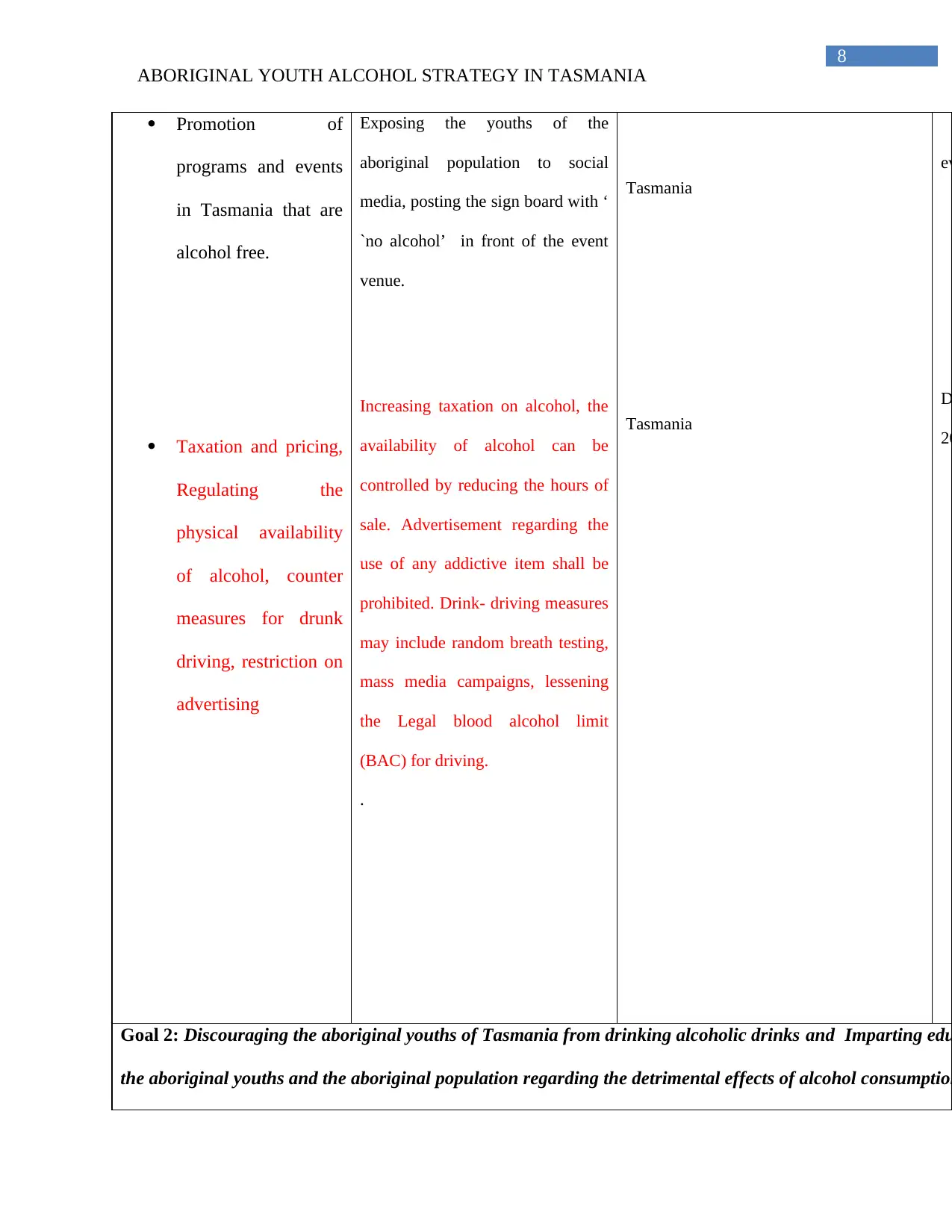
Action plan
STRATEGY ACTION/RESOURCES STAKE HOLDERS TIMEF
Goal 1 : Restricting the availability and the use of alcohol in the society
ABORIGINAL YOUTH ALCOHOL STRATEGY IN TASMANIA
Program implementation
The next step to this project is the preparation of a proper action plan or teaching plan for
exploring on the topics about the ill effects of alcohol, the key strategies to reduce the rate of
alcohol consumption, the strategies, the use of appropriate resources and time frame (Gilligan et
al ., 2012). Action plan is a plan which normally contains the list of tasks that are required to be
done to achieve the goals within a stipulated time period. This portion of the paper will be
discussing about the action plan that is required to fulfill the strategy and achieve the goals. The
action plan will enlist the goals and the strategies that have to be taken up supported by a valid
time frame. As per the guide lines provided by the World health organization (WHO), strategies
can be considered as approaches that can be used to attain objectives or goals of a health
proposal. The strategies taken up will be able to minimize the harm inflicted by the excessive use
of alcohol. There should be extensive and sound strategies in order to achieve the goals taken in
the action plan.
Action plan
STRATEGY ACTION/RESOURCES STAKE HOLDERS TIMEF
Goal 1 : Restricting the availability and the use of alcohol in the society
8
ABORIGINAL YOUTH ALCOHOL STRATEGY IN TASMANIA
Promotion of
programs and events
in Tasmania that are
alcohol free.
Taxation and pricing,
Regulating the
physical availability
of alcohol, counter
measures for drunk
driving, restriction on
advertising
Exposing the youths of the
aboriginal population to social
media, posting the sign board with ‘
`no alcohol’ in front of the event
venue.
Increasing taxation on alcohol, the
availability of alcohol can be
controlled by reducing the hours of
sale. Advertisement regarding the
use of any addictive item shall be
prohibited. Drink- driving measures
may include random breath testing,
mass media campaigns, lessening
the Legal blood alcohol limit
(BAC) for driving.
.
Tasmania
Tasmania
ev
D
20
Goal 2: Discouraging the aboriginal youths of Tasmania from drinking alcoholic drinks and Imparting edu
the aboriginal youths and the aboriginal population regarding the detrimental effects of alcohol consumption
ABORIGINAL YOUTH ALCOHOL STRATEGY IN TASMANIA
Promotion of
programs and events
in Tasmania that are
alcohol free.
Taxation and pricing,
Regulating the
physical availability
of alcohol, counter
measures for drunk
driving, restriction on
advertising
Exposing the youths of the
aboriginal population to social
media, posting the sign board with ‘
`no alcohol’ in front of the event
venue.
Increasing taxation on alcohol, the
availability of alcohol can be
controlled by reducing the hours of
sale. Advertisement regarding the
use of any addictive item shall be
prohibited. Drink- driving measures
may include random breath testing,
mass media campaigns, lessening
the Legal blood alcohol limit
(BAC) for driving.
.
Tasmania
Tasmania
ev
D
20
Goal 2: Discouraging the aboriginal youths of Tasmania from drinking alcoholic drinks and Imparting edu
the aboriginal youths and the aboriginal population regarding the detrimental effects of alcohol consumption
⊘ This is a preview!⊘
Do you want full access?
Subscribe today to unlock all pages.
Trusted by 1+ million students worldwide
9
ABORIGINAL YOUTH ALCOHOL STRATEGY IN TASMANIA
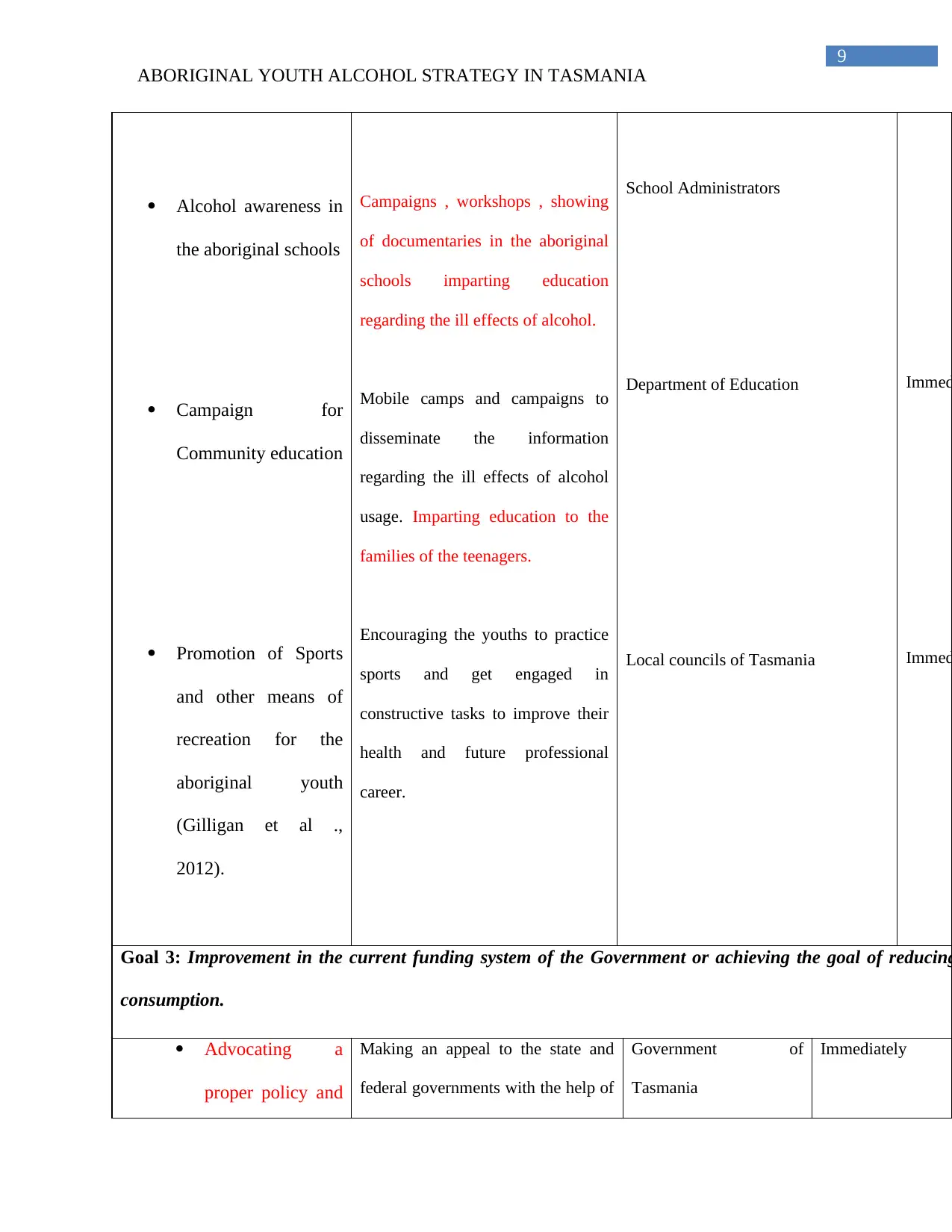
Alcohol awareness in
the aboriginal schools
Campaign for
Community education
Promotion of Sports
and other means of
recreation for the
aboriginal youth
(Gilligan et al .,
2012).
Campaigns , workshops , showing
of documentaries in the aboriginal
schools imparting education
regarding the ill effects of alcohol.
Mobile camps and campaigns to
disseminate the information
regarding the ill effects of alcohol
usage. Imparting education to the
families of the teenagers.
Encouraging the youths to practice
sports and get engaged in
constructive tasks to improve their
health and future professional
career.
School Administrators
Department of Education
Local councils of Tasmania
Immed
Immed
Goal 3: Improvement in the current funding system of the Government or achieving the goal of reducing
consumption.
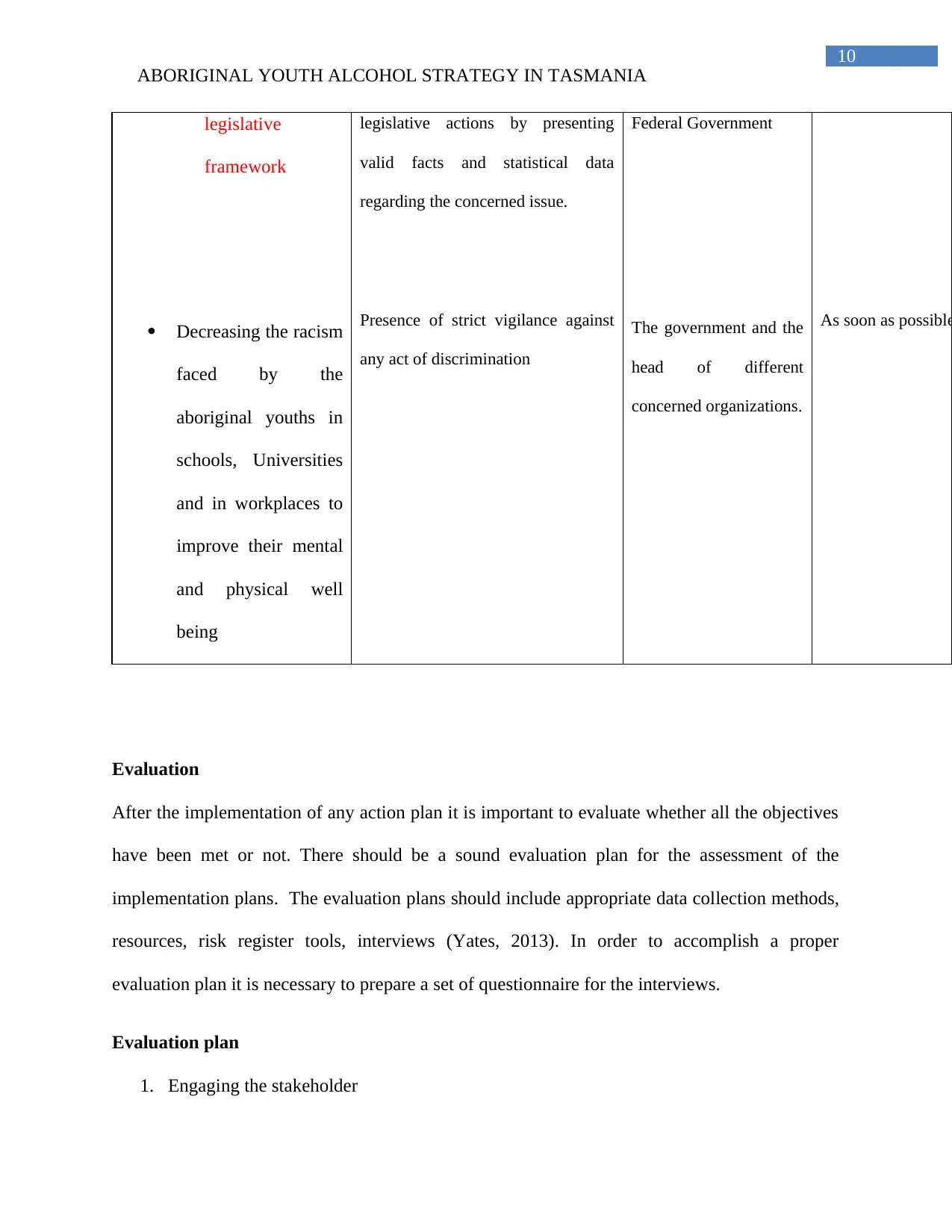
Advocating a
proper policy and
Making an appeal to the state and
federal governments with the help of
Government of
Tasmania
Immediately
ABORIGINAL YOUTH ALCOHOL STRATEGY IN TASMANIA
Alcohol awareness in
the aboriginal schools
Campaign for
Community education
Promotion of Sports
and other means of
recreation for the
aboriginal youth
(Gilligan et al .,
2012).
Campaigns , workshops , showing
of documentaries in the aboriginal
schools imparting education
regarding the ill effects of alcohol.
Mobile camps and campaigns to
disseminate the information
regarding the ill effects of alcohol
usage. Imparting education to the
families of the teenagers.
Encouraging the youths to practice
sports and get engaged in
constructive tasks to improve their
health and future professional
career.
School Administrators
Department of Education
Local councils of Tasmania
Immed
Immed
Goal 3: Improvement in the current funding system of the Government or achieving the goal of reducing
consumption.
Advocating a
proper policy and
Making an appeal to the state and
federal governments with the help of
Government of
Tasmania
Immediately
Paraphrase This Document
Need a fresh take? Get an instant paraphrase of this document with our AI Paraphraser
10
ABORIGINAL YOUTH ALCOHOL STRATEGY IN TASMANIA
legislative
framework
Decreasing the racism
faced by the
aboriginal youths in
schools, Universities
and in workplaces to
improve their mental
and physical well
being
legislative actions by presenting
valid facts and statistical data
regarding the concerned issue.
Presence of strict vigilance against
any act of discrimination
Federal Government
The government and the
head of different
concerned organizations.
As soon as possible
Evaluation
After the implementation of any action plan it is important to evaluate whether all the objectives
have been met or not. There should be a sound evaluation plan for the assessment of the
implementation plans. The evaluation plans should include appropriate data collection methods,
resources, risk register tools, interviews (Yates, 2013). In order to accomplish a proper
evaluation plan it is necessary to prepare a set of questionnaire for the interviews.
Evaluation plan
1. Engaging the stakeholder
ABORIGINAL YOUTH ALCOHOL STRATEGY IN TASMANIA
legislative
framework
Decreasing the racism
faced by the
aboriginal youths in
schools, Universities
and in workplaces to
improve their mental
and physical well
being
legislative actions by presenting
valid facts and statistical data
regarding the concerned issue.
Presence of strict vigilance against
any act of discrimination
Federal Government
The government and the
head of different
concerned organizations.
As soon as possible
Evaluation
After the implementation of any action plan it is important to evaluate whether all the objectives
have been met or not. There should be a sound evaluation plan for the assessment of the
implementation plans. The evaluation plans should include appropriate data collection methods,
resources, risk register tools, interviews (Yates, 2013). In order to accomplish a proper
evaluation plan it is necessary to prepare a set of questionnaire for the interviews.
Evaluation plan
1. Engaging the stakeholder
11
ABORIGINAL YOUTH ALCOHOL STRATEGY IN TASMANIA
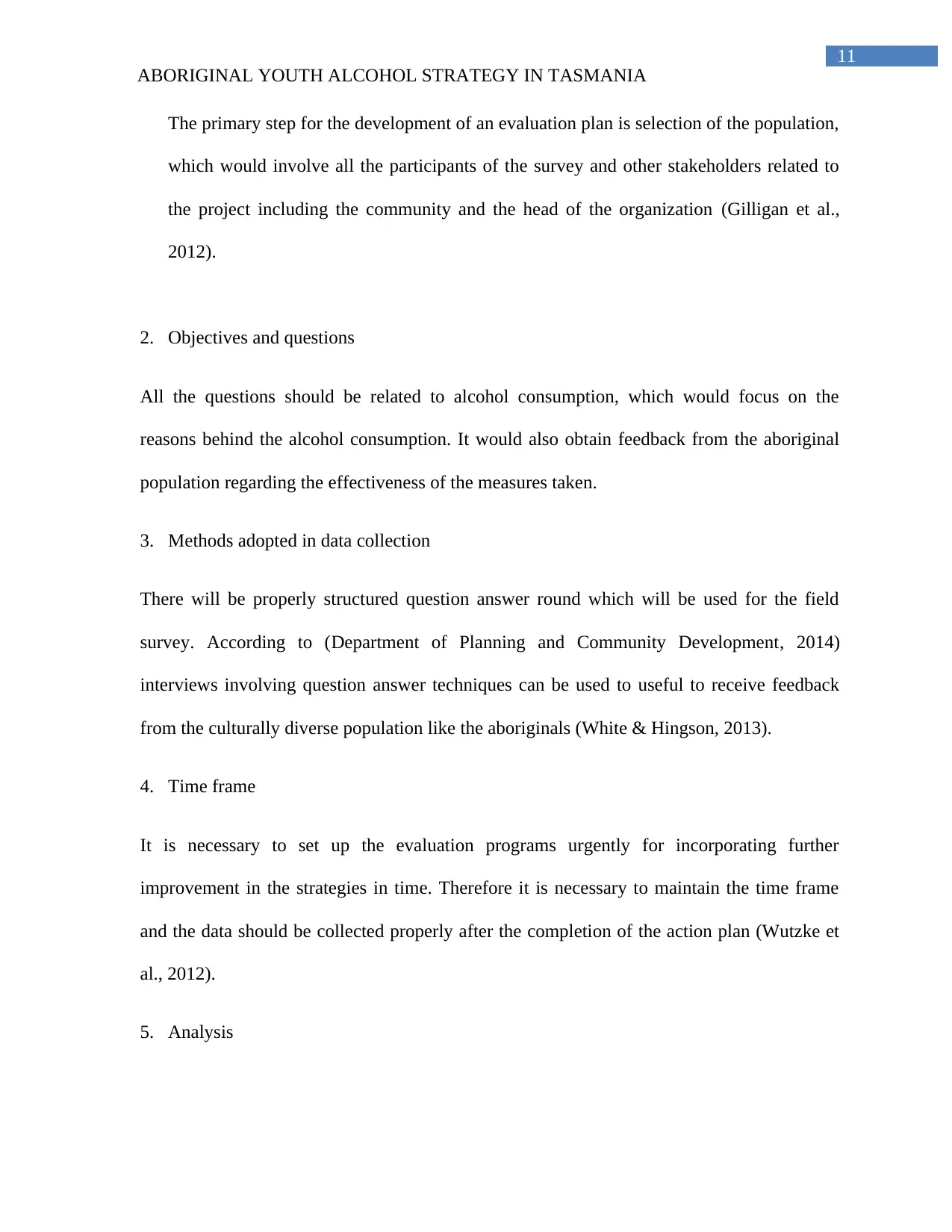
The primary step for the development of an evaluation plan is selection of the population,
which would involve all the participants of the survey and other stakeholders related to
the project including the community and the head of the organization (Gilligan et al.,
2012).
2. Objectives and questions
All the questions should be related to alcohol consumption, which would focus on the
reasons behind the alcohol consumption. It would also obtain feedback from the aboriginal
population regarding the effectiveness of the measures taken.
3. Methods adopted in data collection
There will be properly structured question answer round which will be used for the field
survey. According to (Department of Planning and Community Development, 2014)
interviews involving question answer techniques can be used to useful to receive feedback
from the culturally diverse population like the aboriginals (White & Hingson, 2013).
4. Time frame
It is necessary to set up the evaluation programs urgently for incorporating further
improvement in the strategies in time. Therefore it is necessary to maintain the time frame
and the data should be collected properly after the completion of the action plan (Wutzke et
al., 2012).
5. Analysis
ABORIGINAL YOUTH ALCOHOL STRATEGY IN TASMANIA
The primary step for the development of an evaluation plan is selection of the population,
which would involve all the participants of the survey and other stakeholders related to
the project including the community and the head of the organization (Gilligan et al.,
2012).
2. Objectives and questions
All the questions should be related to alcohol consumption, which would focus on the
reasons behind the alcohol consumption. It would also obtain feedback from the aboriginal
population regarding the effectiveness of the measures taken.
3. Methods adopted in data collection
There will be properly structured question answer round which will be used for the field
survey. According to (Department of Planning and Community Development, 2014)
interviews involving question answer techniques can be used to useful to receive feedback
from the culturally diverse population like the aboriginals (White & Hingson, 2013).
4. Time frame
It is necessary to set up the evaluation programs urgently for incorporating further
improvement in the strategies in time. Therefore it is necessary to maintain the time frame
and the data should be collected properly after the completion of the action plan (Wutzke et
al., 2012).
5. Analysis
⊘ This is a preview!⊘
Do you want full access?
Subscribe today to unlock all pages.
Trusted by 1+ million students worldwide

1 out of 22


Related Documents


Your All-in-One AI-Powered Toolkit for Academic Success.
+13062052269
info@desklib.com
Available 24*7 on WhatsApp / Email
![[object Object]](/_next/static/media/star-bottom.7253800d.svg)
Unlock your academic potential
Copyright © 2020–2026 A2Z Services. All Rights Reserved. Developed and managed by ZUCOL.