Case Study: Abortion Rights, Social and Political Perspectives

Verified

Added on  2023/06/09

|4
|802
|366
Case Study
AI Summary
This case study analyzes the complex issue of abortion rights through a socialist/humanist lens, focusing on the situation of a young woman named Kate. It challenges orthodox thinking and examines the ethical and social implications of denying abortion access, particularly for those lacking support. The study emphasizes the importance of respecting individual choices and providing comprehensive support, including childcare and counseling, regardless of religious beliefs. It highlights the potential negative consequences of inflexible healthcare policies and advocates for a collaborative approach involving legal systems and policymakers to ensure the well-being of individuals and their potential children. The conclusion stresses the need for experienced guidance and proper healthcare support before making individual decisions, allowing abortion in the absence of childcare policy for the baby would be an ethical stance.
Document Page
Running head: CASE STUDY: ABORTION RIGHTS
Case study: Abortion rights
Name of Student
Name of University
Author note
tabler-icon-diamond-filled.svg

Paraphrase This Document

Need a fresh take? Get an instant paraphrase of this document with our AI Paraphraser
Document Page
1CASE STUDY: ABORTION RIGHTS
Introduction
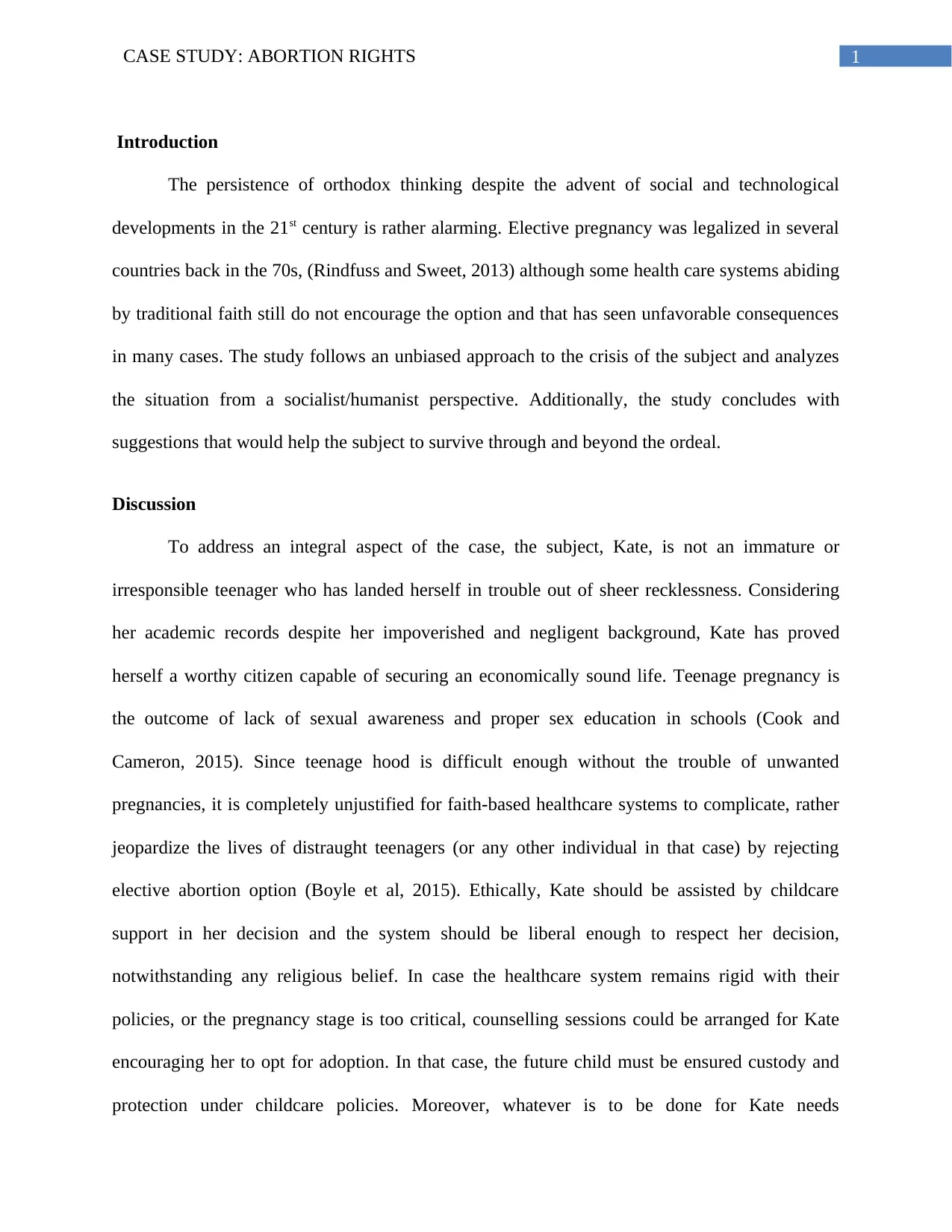
The persistence of orthodox thinking despite the advent of social and technological
developments in the 21st century is rather alarming. Elective pregnancy was legalized in several
countries back in the 70s, (Rindfuss and Sweet, 2013) although some health care systems abiding
by traditional faith still do not encourage the option and that has seen unfavorable consequences
in many cases. The study follows an unbiased approach to the crisis of the subject and analyzes
the situation from a socialist/humanist perspective. Additionally, the study concludes with
suggestions that would help the subject to survive through and beyond the ordeal.
Discussion
To address an integral aspect of the case, the subject, Kate, is not an immature or
irresponsible teenager who has landed herself in trouble out of sheer recklessness. Considering
her academic records despite her impoverished and negligent background, Kate has proved
herself a worthy citizen capable of securing an economically sound life. Teenage pregnancy is
the outcome of lack of sexual awareness and proper sex education in schools (Cook and
Cameron, 2015). Since teenage hood is difficult enough without the trouble of unwanted
pregnancies, it is completely unjustified for faith-based healthcare systems to complicate, rather
jeopardize the lives of distraught teenagers (or any other individual in that case) by rejecting
elective abortion option (Boyle et al, 2015). Ethically, Kate should be assisted by childcare
support in her decision and the system should be liberal enough to respect her decision,
notwithstanding any religious belief. In case the healthcare system remains rigid with their
policies, or the pregnancy stage is too critical, counselling sessions could be arranged for Kate
encouraging her to opt for adoption. In that case, the future child must be ensured custody and
protection under childcare policies. Moreover, whatever is to be done for Kate needs
Document Page
2CASE STUDY: ABORTION RIGHTS
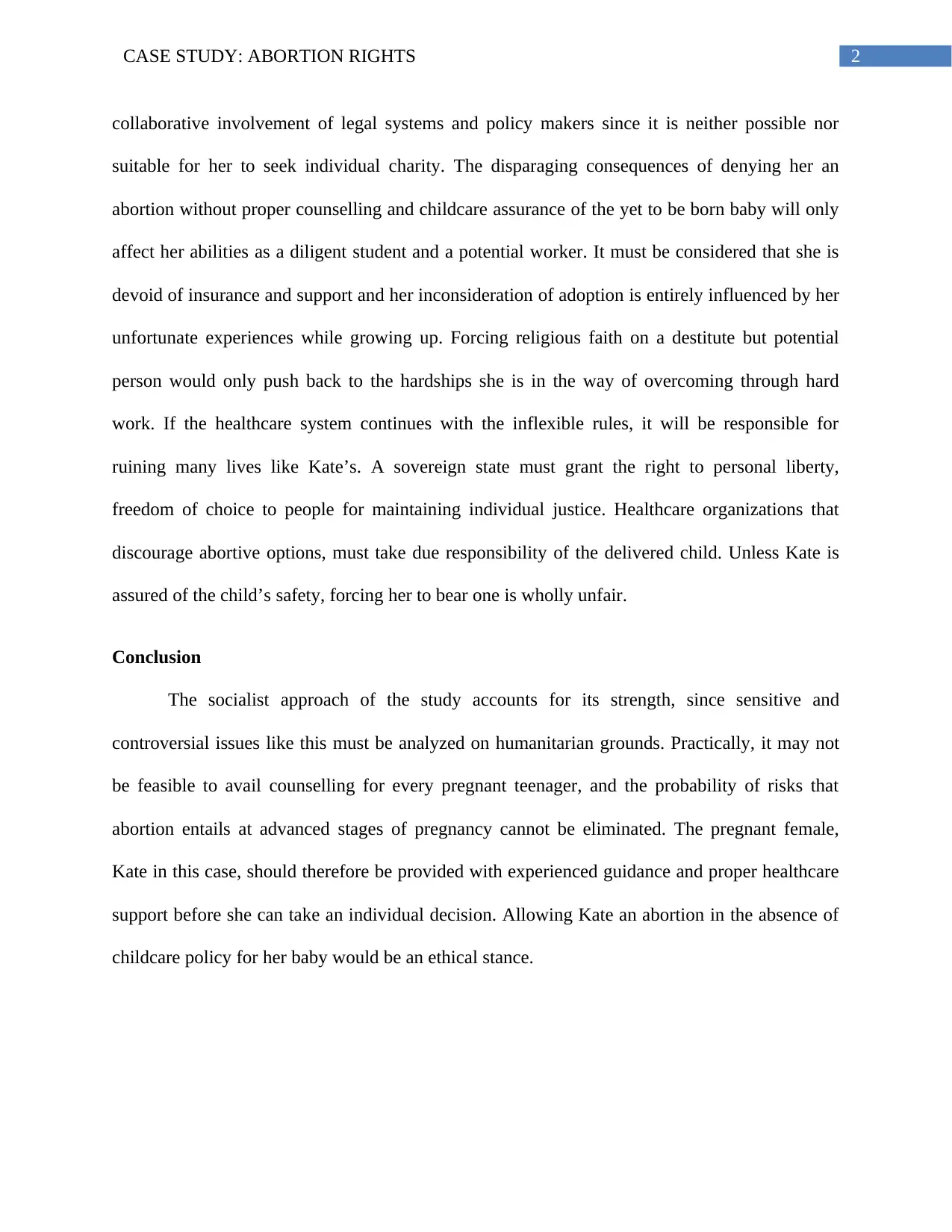
collaborative involvement of legal systems and policy makers since it is neither possible nor
suitable for her to seek individual charity. The disparaging consequences of denying her an
abortion without proper counselling and childcare assurance of the yet to be born baby will only
affect her abilities as a diligent student and a potential worker. It must be considered that she is
devoid of insurance and support and her inconsideration of adoption is entirely influenced by her
unfortunate experiences while growing up. Forcing religious faith on a destitute but potential
person would only push back to the hardships she is in the way of overcoming through hard
work. If the healthcare system continues with the inflexible rules, it will be responsible for
ruining many lives like Kate’s. A sovereign state must grant the right to personal liberty,
freedom of choice to people for maintaining individual justice. Healthcare organizations that
discourage abortive options, must take due responsibility of the delivered child. Unless Kate is
assured of the child’s safety, forcing her to bear one is wholly unfair.
Conclusion
The socialist approach of the study accounts for its strength, since sensitive and
controversial issues like this must be analyzed on humanitarian grounds. Practically, it may not
be feasible to avail counselling for every pregnant teenager, and the probability of risks that
abortion entails at advanced stages of pregnancy cannot be eliminated. The pregnant female,
Kate in this case, should therefore be provided with experienced guidance and proper healthcare
support before she can take an individual decision. Allowing Kate an abortion in the absence of
childcare policy for her baby would be an ethical stance.
Document Page
3CASE STUDY: ABORTION RIGHTS
References:
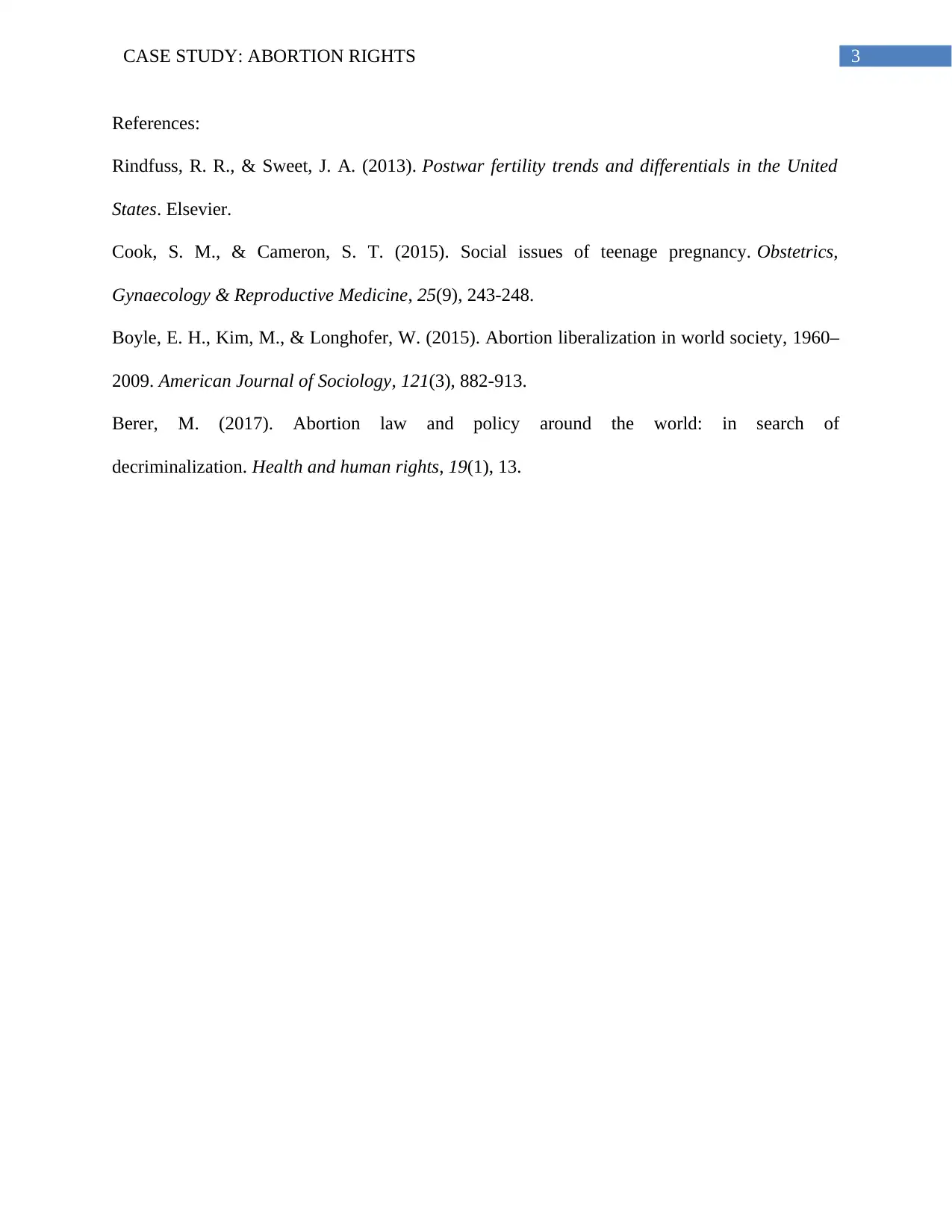
Rindfuss, R. R., & Sweet, J. A. (2013). Postwar fertility trends and differentials in the United
States. Elsevier.
Cook, S. M., & Cameron, S. T. (2015). Social issues of teenage pregnancy. Obstetrics,
Gynaecology & Reproductive Medicine, 25(9), 243-248.
Boyle, E. H., Kim, M., & Longhofer, W. (2015). Abortion liberalization in world society, 1960–
2009. American Journal of Sociology, 121(3), 882-913.
Berer, M. (2017). Abortion law and policy around the world: in search of
decriminalization. Health and human rights, 19(1), 13.
chevron_up_icon
1 out of 4
circle_padding
hide_on_mobile
zoom_out_icon
[object Object]