AC 4.1: Examining Situational Factors in Determining Human Behavior
VerifiedAdded on 2022/11/12
|7
|1116
|444
Essay
AI Summary
This essay delves into the significant role of situational factors in shaping human behavior, focusing on three key elements: deindividuation, helping behavior, and the bystander effect. Deindividuation, the loss of self-awareness in social groups, can lead to both negative and positive behavioral changes, highlighting the influence of social situations over individual norms. Helping behavior, the voluntary act of aiding others, showcases the varying motivations behind prosocial actions. The bystander effect illustrates how individuals are less likely to help a victim when others are present, due to factors like diffusion of responsibility and ambiguity. The essay concludes that bystander apathy is a primary situational factor, demonstrating how individuals' behaviors are heavily influenced by their immediate environment, suggesting that actions are often a response to the situation rather than a reflection of inherent traits. This document is available on Desklib, a platform offering a variety of study tools for students.
ROLE OF SITUATIONAL FACTORS THE DETERMINATION OF
HUMAN BEHAVIOUR
0
HUMAN BEHAVIOUR
0
Paraphrase This Document
Need a fresh take? Get an instant paraphrase of this document with our AI Paraphraser

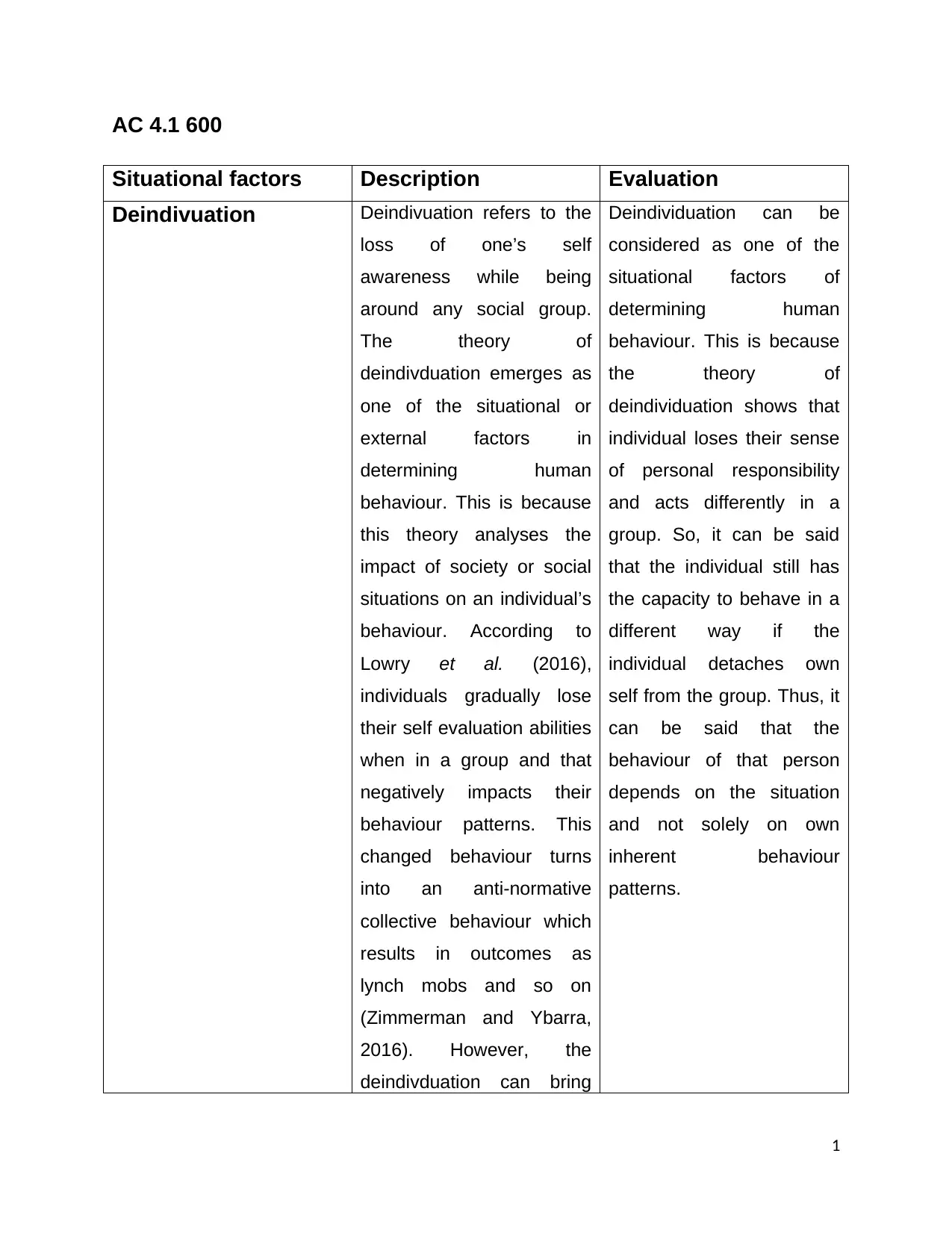
AC 4.1 600
Situational factors Description Evaluation
Deindivuation Deindivuation refers to the
loss of one’s self
awareness while being
around any social group.
The theory of
deindivduation emerges as
one of the situational or
external factors in
determining human
behaviour. This is because
this theory analyses the
impact of society or social
situations on an individual’s
behaviour. According to
Lowry et al. (2016),
individuals gradually lose
their self evaluation abilities
when in a group and that
negatively impacts their
behaviour patterns. This
changed behaviour turns
into an anti-normative
collective behaviour which
results in outcomes as
lynch mobs and so on
(Zimmerman and Ybarra,
2016). However, the
deindivduation can bring
Deindividuation can be
considered as one of the
situational factors of
determining human
behaviour. This is because
the theory of
deindividuation shows that
individual loses their sense
of personal responsibility
and acts differently in a
group. So, it can be said
that the individual still has
the capacity to behave in a
different way if the
individual detaches own
self from the group. Thus, it
can be said that the
behaviour of that person
depends on the situation
and not solely on own
inherent behaviour
patterns.
1
Situational factors Description Evaluation
Deindivuation Deindivuation refers to the
loss of one’s self
awareness while being
around any social group.
The theory of
deindivduation emerges as
one of the situational or
external factors in
determining human
behaviour. This is because
this theory analyses the
impact of society or social
situations on an individual’s
behaviour. According to
Lowry et al. (2016),
individuals gradually lose
their self evaluation abilities
when in a group and that
negatively impacts their
behaviour patterns. This
changed behaviour turns
into an anti-normative
collective behaviour which
results in outcomes as
lynch mobs and so on
(Zimmerman and Ybarra,
2016). However, the
deindivduation can bring
Deindividuation can be
considered as one of the
situational factors of
determining human
behaviour. This is because
the theory of
deindividuation shows that
individual loses their sense
of personal responsibility
and acts differently in a
group. So, it can be said
that the individual still has
the capacity to behave in a
different way if the
individual detaches own
self from the group. Thus, it
can be said that the
behaviour of that person
depends on the situation
and not solely on own
inherent behaviour
patterns.
1

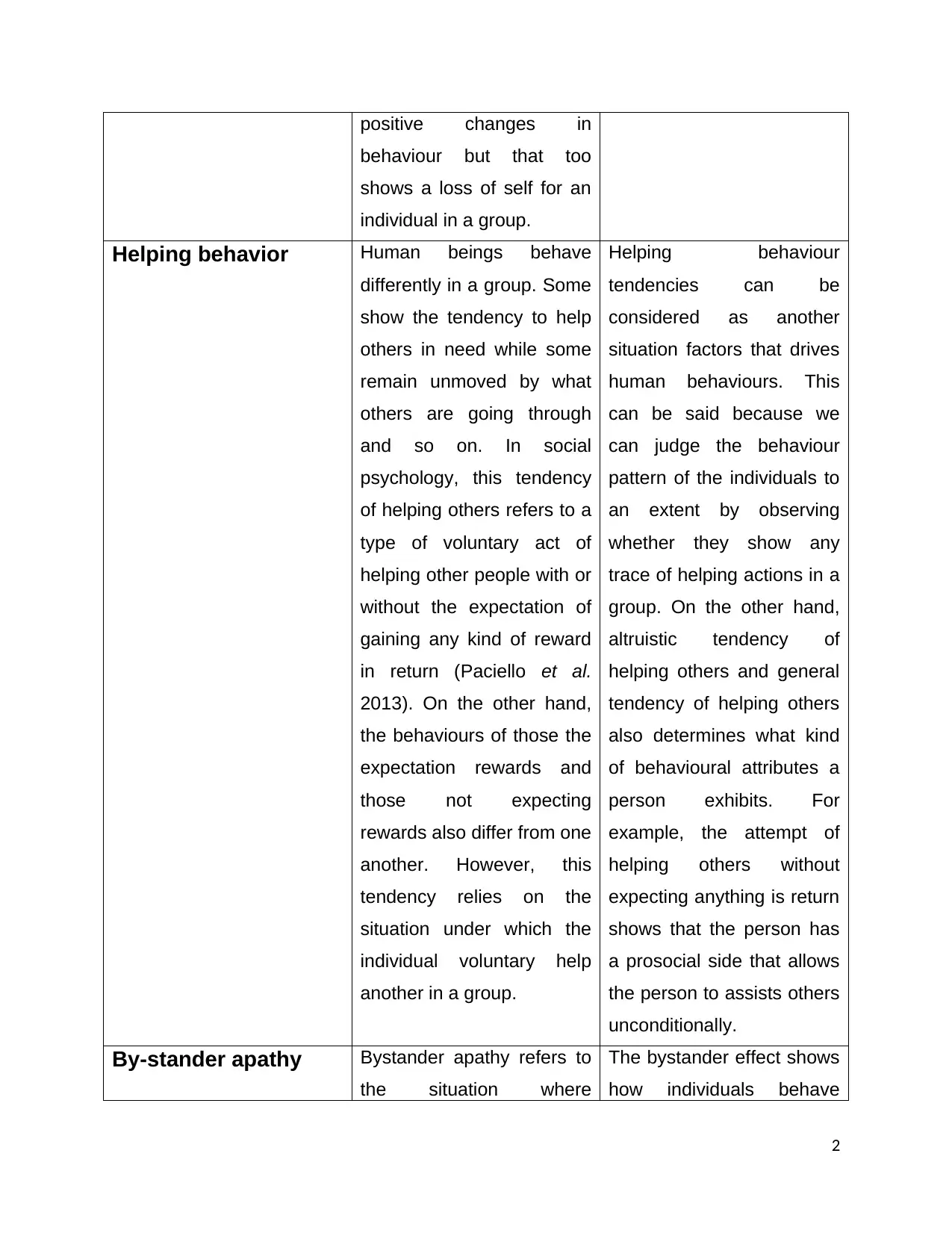
positive changes in
behaviour but that too
shows a loss of self for an
individual in a group.
Helping behavior Human beings behave
differently in a group. Some
show the tendency to help
others in need while some
remain unmoved by what
others are going through
and so on. In social
psychology, this tendency
of helping others refers to a
type of voluntary act of
helping other people with or
without the expectation of
gaining any kind of reward
in return (Paciello et al.
2013). On the other hand,
the behaviours of those the
expectation rewards and
those not expecting
rewards also differ from one
another. However, this
tendency relies on the
situation under which the
individual voluntary help
another in a group.
Helping behaviour
tendencies can be
considered as another
situation factors that drives
human behaviours. This
can be said because we
can judge the behaviour
pattern of the individuals to
an extent by observing
whether they show any
trace of helping actions in a
group. On the other hand,
altruistic tendency of
helping others and general
tendency of helping others
also determines what kind
of behavioural attributes a
person exhibits. For
example, the attempt of
helping others without
expecting anything is return
shows that the person has
a prosocial side that allows
the person to assists others
unconditionally.
By-stander apathy Bystander apathy refers to
the situation where
The bystander effect shows
how individuals behave
2
behaviour but that too
shows a loss of self for an
individual in a group.
Helping behavior Human beings behave
differently in a group. Some
show the tendency to help
others in need while some
remain unmoved by what
others are going through
and so on. In social
psychology, this tendency
of helping others refers to a
type of voluntary act of
helping other people with or
without the expectation of
gaining any kind of reward
in return (Paciello et al.
2013). On the other hand,
the behaviours of those the
expectation rewards and
those not expecting
rewards also differ from one
another. However, this
tendency relies on the
situation under which the
individual voluntary help
another in a group.
Helping behaviour
tendencies can be
considered as another
situation factors that drives
human behaviours. This
can be said because we
can judge the behaviour
pattern of the individuals to
an extent by observing
whether they show any
trace of helping actions in a
group. On the other hand,
altruistic tendency of
helping others and general
tendency of helping others
also determines what kind
of behavioural attributes a
person exhibits. For
example, the attempt of
helping others without
expecting anything is return
shows that the person has
a prosocial side that allows
the person to assists others
unconditionally.
By-stander apathy Bystander apathy refers to
the situation where
The bystander effect shows
how individuals behave
2
⊘ This is a preview!⊘
Do you want full access?
Subscribe today to unlock all pages.

Trusted by 1+ million students worldwide

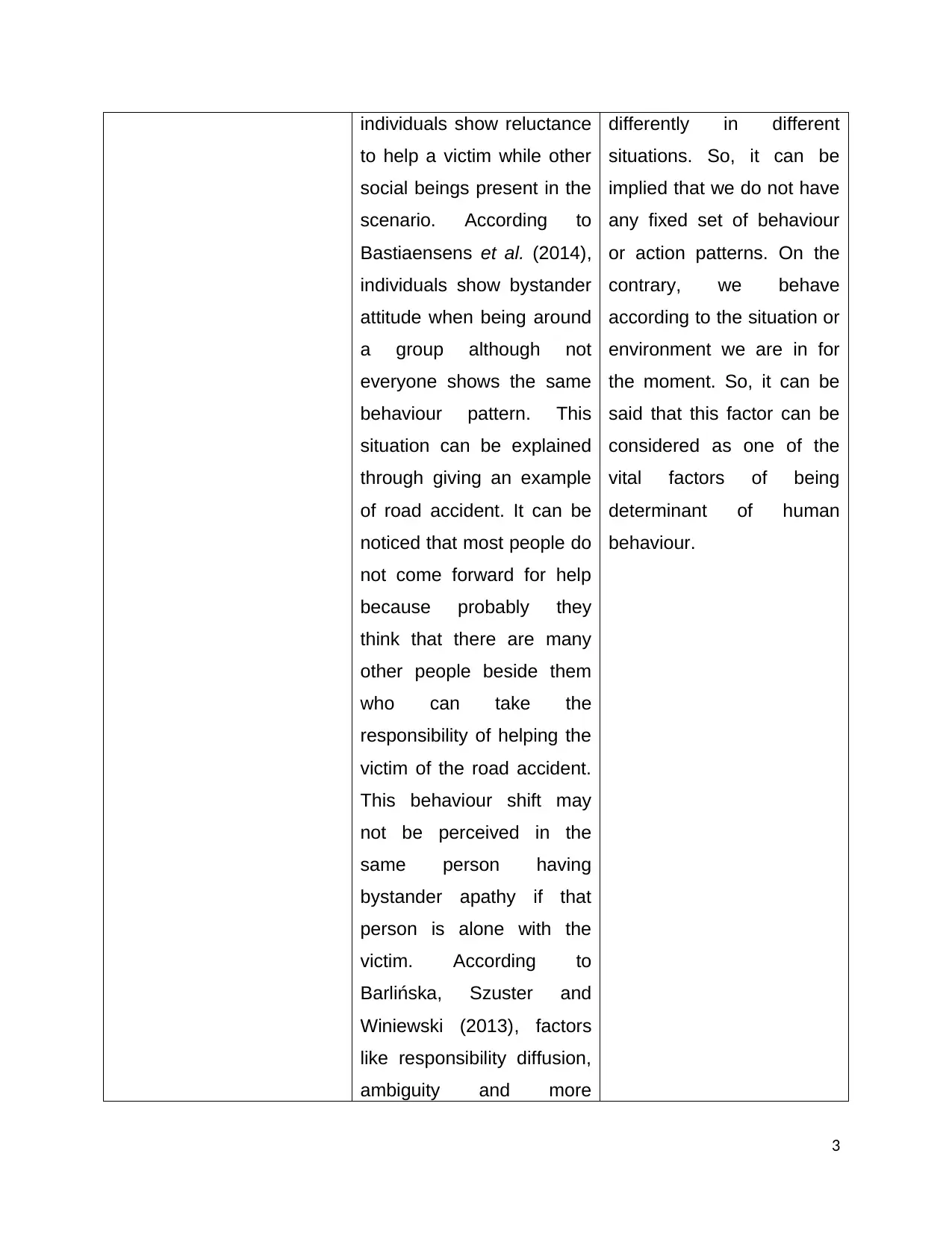
individuals show reluctance
to help a victim while other
social beings present in the
scenario. According to
Bastiaensens et al. (2014),
individuals show bystander
attitude when being around
a group although not
everyone shows the same
behaviour pattern. This
situation can be explained
through giving an example
of road accident. It can be
noticed that most people do
not come forward for help
because probably they
think that there are many
other people beside them
who can take the
responsibility of helping the
victim of the road accident.
This behaviour shift may
not be perceived in the
same person having
bystander apathy if that
person is alone with the
victim. According to
Barlińska, Szuster and
Winiewski (2013), factors
like responsibility diffusion,
ambiguity and more
differently in different
situations. So, it can be
implied that we do not have
any fixed set of behaviour
or action patterns. On the
contrary, we behave
according to the situation or
environment we are in for
the moment. So, it can be
said that this factor can be
considered as one of the
vital factors of being
determinant of human
behaviour.
3
to help a victim while other
social beings present in the
scenario. According to
Bastiaensens et al. (2014),
individuals show bystander
attitude when being around
a group although not
everyone shows the same
behaviour pattern. This
situation can be explained
through giving an example
of road accident. It can be
noticed that most people do
not come forward for help
because probably they
think that there are many
other people beside them
who can take the
responsibility of helping the
victim of the road accident.
This behaviour shift may
not be perceived in the
same person having
bystander apathy if that
person is alone with the
victim. According to
Barlińska, Szuster and
Winiewski (2013), factors
like responsibility diffusion,
ambiguity and more
differently in different
situations. So, it can be
implied that we do not have
any fixed set of behaviour
or action patterns. On the
contrary, we behave
according to the situation or
environment we are in for
the moment. So, it can be
said that this factor can be
considered as one of the
vital factors of being
determinant of human
behaviour.
3
Paraphrase This Document
Need a fresh take? Get an instant paraphrase of this document with our AI Paraphraser

impacts the shift in
behaviour in the individuals
for a particular situation.
4
behaviour in the individuals
for a particular situation.
4

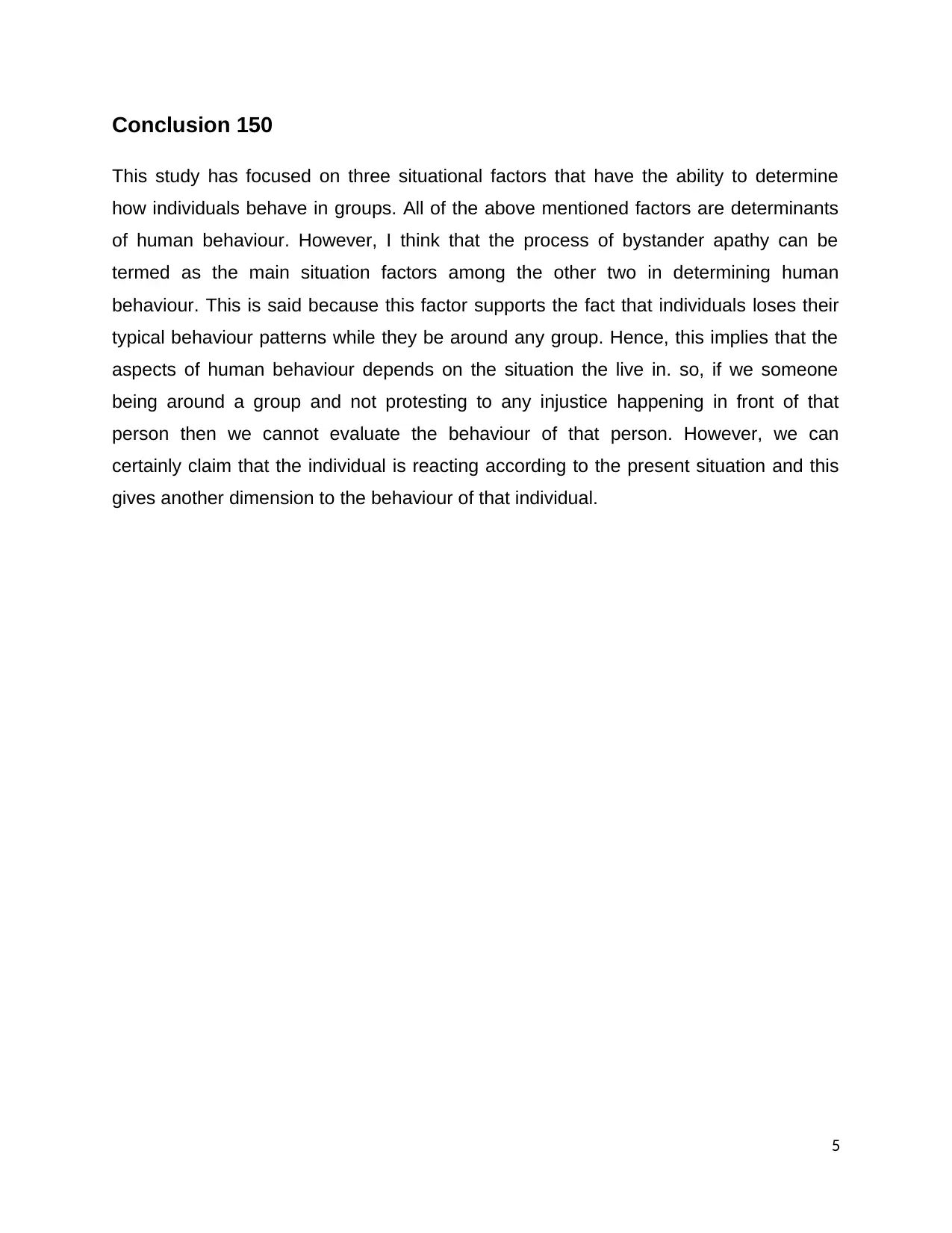
Conclusion 150
This study has focused on three situational factors that have the ability to determine
how individuals behave in groups. All of the above mentioned factors are determinants
of human behaviour. However, I think that the process of bystander apathy can be
termed as the main situation factors among the other two in determining human
behaviour. This is said because this factor supports the fact that individuals loses their
typical behaviour patterns while they be around any group. Hence, this implies that the
aspects of human behaviour depends on the situation the live in. so, if we someone
being around a group and not protesting to any injustice happening in front of that
person then we cannot evaluate the behaviour of that person. However, we can
certainly claim that the individual is reacting according to the present situation and this
gives another dimension to the behaviour of that individual.
5
This study has focused on three situational factors that have the ability to determine
how individuals behave in groups. All of the above mentioned factors are determinants
of human behaviour. However, I think that the process of bystander apathy can be
termed as the main situation factors among the other two in determining human
behaviour. This is said because this factor supports the fact that individuals loses their
typical behaviour patterns while they be around any group. Hence, this implies that the
aspects of human behaviour depends on the situation the live in. so, if we someone
being around a group and not protesting to any injustice happening in front of that
person then we cannot evaluate the behaviour of that person. However, we can
certainly claim that the individual is reacting according to the present situation and this
gives another dimension to the behaviour of that individual.
5
⊘ This is a preview!⊘
Do you want full access?
Subscribe today to unlock all pages.

Trusted by 1+ million students worldwide

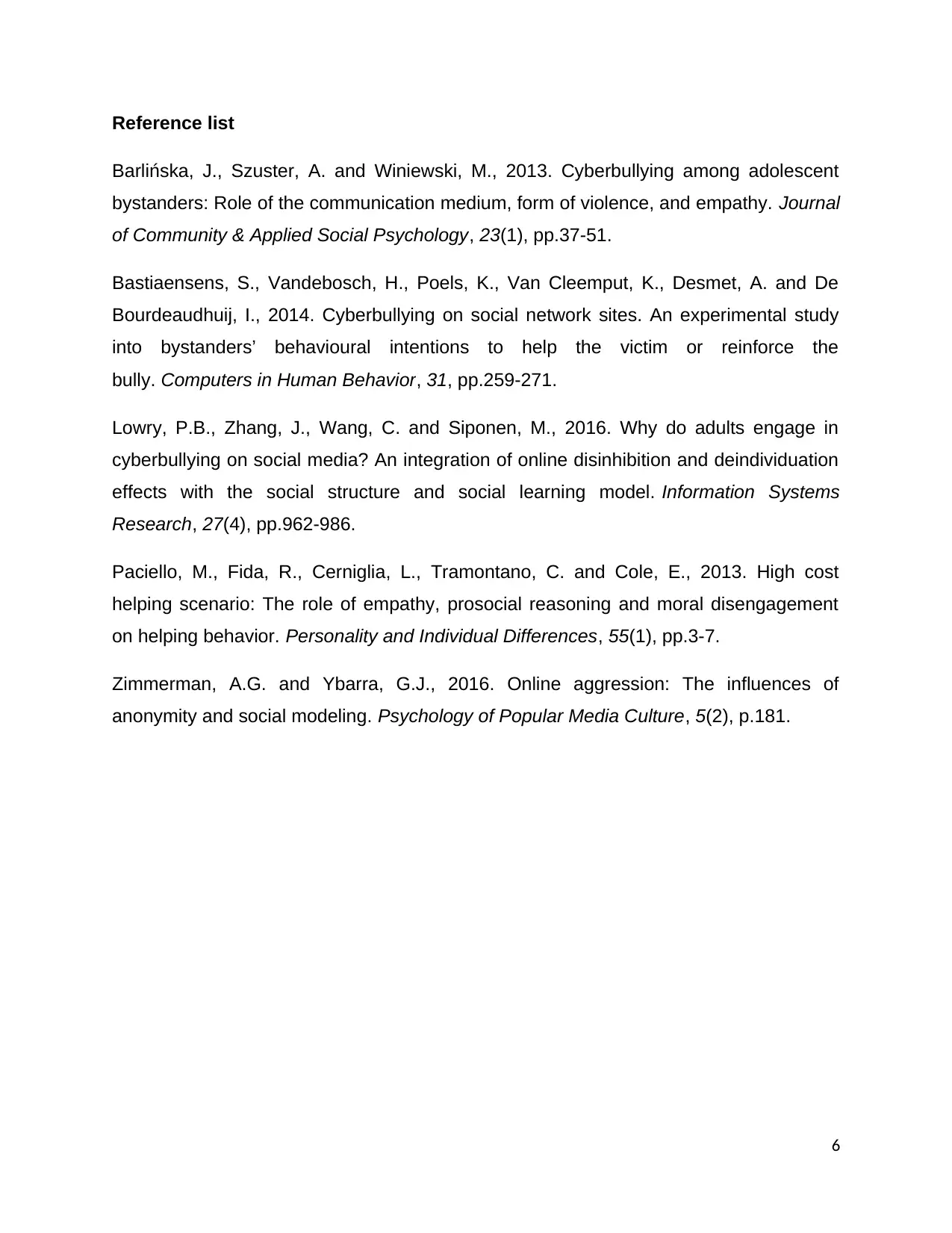
Reference list
Barlińska, J., Szuster, A. and Winiewski, M., 2013. Cyberbullying among adolescent
bystanders: Role of the communication medium, form of violence, and empathy. Journal
of Community & Applied Social Psychology, 23(1), pp.37-51.
Bastiaensens, S., Vandebosch, H., Poels, K., Van Cleemput, K., Desmet, A. and De
Bourdeaudhuij, I., 2014. Cyberbullying on social network sites. An experimental study
into bystanders’ behavioural intentions to help the victim or reinforce the
bully. Computers in Human Behavior, 31, pp.259-271.
Lowry, P.B., Zhang, J., Wang, C. and Siponen, M., 2016. Why do adults engage in
cyberbullying on social media? An integration of online disinhibition and deindividuation
effects with the social structure and social learning model. Information Systems
Research, 27(4), pp.962-986.
Paciello, M., Fida, R., Cerniglia, L., Tramontano, C. and Cole, E., 2013. High cost
helping scenario: The role of empathy, prosocial reasoning and moral disengagement
on helping behavior. Personality and Individual Differences, 55(1), pp.3-7.
Zimmerman, A.G. and Ybarra, G.J., 2016. Online aggression: The influences of
anonymity and social modeling. Psychology of Popular Media Culture, 5(2), p.181.
6
Barlińska, J., Szuster, A. and Winiewski, M., 2013. Cyberbullying among adolescent
bystanders: Role of the communication medium, form of violence, and empathy. Journal
of Community & Applied Social Psychology, 23(1), pp.37-51.
Bastiaensens, S., Vandebosch, H., Poels, K., Van Cleemput, K., Desmet, A. and De
Bourdeaudhuij, I., 2014. Cyberbullying on social network sites. An experimental study
into bystanders’ behavioural intentions to help the victim or reinforce the
bully. Computers in Human Behavior, 31, pp.259-271.
Lowry, P.B., Zhang, J., Wang, C. and Siponen, M., 2016. Why do adults engage in
cyberbullying on social media? An integration of online disinhibition and deindividuation
effects with the social structure and social learning model. Information Systems
Research, 27(4), pp.962-986.
Paciello, M., Fida, R., Cerniglia, L., Tramontano, C. and Cole, E., 2013. High cost
helping scenario: The role of empathy, prosocial reasoning and moral disengagement
on helping behavior. Personality and Individual Differences, 55(1), pp.3-7.
Zimmerman, A.G. and Ybarra, G.J., 2016. Online aggression: The influences of
anonymity and social modeling. Psychology of Popular Media Culture, 5(2), p.181.
6
1 out of 7
Related Documents
Your All-in-One AI-Powered Toolkit for Academic Success.
+13062052269
info@desklib.com
Available 24*7 on WhatsApp / Email
Unlock your academic potential
Copyright © 2020–2025 A2Z Services. All Rights Reserved. Developed and managed by ZUCOL.